When Solium Infernum was first announced, I confess to being excited without being particularly informed. I didn’t read any of the coverage, and consequently, I imagined a traditional 4X set in Hell. The prospect of interesting factions, units, and mechanics captured my imagination, and I jumped at the chance to review the game.
It turns out that reading announcement headlines may not be as informative as taking the time to read preview articles. Solium Infernum is not a 4X set in Hell. It’s not any kind of 4X. It is, instead, a complex and fascinating turn-based board game with some unique and compelling mechanics.
It’s also important to note that Solium Infernum is a remake of a cult classic game of the same name. This new iteration is developed by League of Geeks, best known for Armello, which has a similar board gamey feel. I can’t speak to how those who loved the original will feel about the remake.
Three Xs, Maybe?
In Solium Infernum, you play as one of eight Archfiends, lords of Hell who are competing with one another to become the new ruler of the underworld. This information is revealed in a torrent of hell-themed narratives inspired by Dante, medieval Catholicism, and a healthy dose of John Milton. The decision of who will emerge as Hell’s next leader, at least on paper, will be made by the Conclave, the powerful parliament of Hell, made up of demonic entities that I guess have no interest in leadership, or they would be competing against the other players. Still, that doesn’t strain credulity too much. I have no trouble imagining a Hell in which some demons are doers, and some are mere politicians.
On the surface, Solium Infernum looks very much like a traditional 4X. Each player starts out with an army, and you move around the board and capture territory. That’s not where the similarity ends, but it’s pretty close. You capture territory by moving your army onto it, and… that’s it. That territory is now yours until the end of the game – unless someone takes it away from you.
All that territory is visible from the start. There is no real eXploration in Solium Infernum and no fog of war. The entire map is laid bare, allowing you to begin scheming immediately. You also know where your rivals are and what territory they hold, though this is an area that could use some improvement. The borders of each hex a player controls are faintly outlined in their colors. It can be hard, as the board gets crowded, to tell what is inside and outside an enemy’s territory, particularly when that territory can be serpentine in shape. A map mode that marks each player’s territory is desperately needed.

The game looks great, however. The art style is simple and effective, working wonderfully with the game’s theme but also providing a very board-game feel.
Territory is mostly about a player’s ability to maneuver rather than resources or strategic advantage. You can move freely on your territory, but under normal conditions, you cannot cross onto a rival’s turf. So, from the beginning of the game, the players begin a mad scramble to capture territory and hem in their rivals. The main features worth capturing are the unique Place of Power locations, which provide various bonuses, and, more importantly, Prestige, the game’s victory currency. More on Prestige below, but for now just keep in mind that whoever controls the most and most significant Places of Power will have a huge advantage as the game moves forward. These locations are as close as the game gets to eXploitation.
Places of Power are captured with armies, and it is here that Solium Infernum makes some genuinely interesting decisions. Armies have three offensive stats: Ranged, Melee, and Infernal – essentially magic. The three stats are compared in the above order, and damage is determined by the difference. If I have a ranged score of 6 and my enemy has a ranged score of 5, then at the end of the round, the enemy takes 1 point of damage. When one of the combatants runs out of hit points, they are defeated, and the battle is over. If both survive the battle, then it can be continued on the next turn.
It all seems unsatisfyingly simple. You know, going into a fight, who will win, and how long the contest will take. Except you really don’t. If you are going to be destroyed during the Ranged and Melee portions, but Infernal is where your army shines, there may be hope for you. Certain actions or rituals can change the order of combat resolution, giving you a chance to put your best foot forward. Or maybe you can blast your enemy with a destructive ritual, wiping them off the board entirely. Or you can take over control of that enemy army, making it yours. The more powerful you grow, the more options are available to subvert your enemy’s expectations or, quite literally, change the rules of the game. Some of Solium Infernum’s best moments come from upending expectations (or finding your own plans dashed), so that a player who ought to have emerged victorious is, instead, in deep trouble.

The Ascending Pile
Military units in Solium Infernum feel unlike anything I’ve encountered in other games. You don’t recruit them, you buy them fully formed in the game’s Bazaar, one of the numerous features that feels both frustrating and tactically fascinating. They can earn promotions and become more powerful, but when you lose an unpromoted army, you can just buy a new one. On the other hand, that army may be irreplaceable. Available units in the Bazaar is the luck of the draw. If there is nothing you need or can work with, then you are simply out of luck unless you want to buy something cheap just to make room for a replacement. And when a powerful item does show up, and you can afford it, it can turn the tide of the entire game.

In the Bazaar you can buy armies, praetors (who can lead your armies and add various bonuses or maluses), artifacts, and manuscripts, the latter two being means of bolstering units, locations, or the entire faction. Armies are variations of what you start with, some more powerful or less powerful. However, sometimes the Bazaar will also offer titans for sale. These are single-unit creatures of incredible power. They are expensive and have upkeep that makes them hard to hold on to for too many turns, but they will smash their way through almost anything. Getting a titan at the right time and making proper use of it is one of those game highs you will keep chasing.
Items in the Bazaar, like most things in Solium Infernum, are paid for using four different currencies: Souls, Hellfire, Ichor, and Darkness. More powerful items, abilities or rituals cost more tokens, though it wasn’t clear to me if certain attributes are more closely associated with certain tokens or if the whole thing is just random.

How do you get these currency tokens? There are several ways. You can demand them from your subjects as one of your moves on a particular turn. You can also demand them from other players who will have to placate you if they are not willing to risk conflict. They can also be granted to you from time to time by the Conclave or by random game events which can pop up at any time. These events can also relieve you of some of your currency, and other players can steal it with rituals, so whatever is in your treasury at any given time is not guaranteed to be there after you end your turn.
It’s also worth noting that resources cannot generally be found on the map. Get out of that 4X mindset! If you desperately need more Darkness to buy that artifact in the Bazaar you’ve been coveting; you can’t build a Darkness mine or set up your extractor over a Darkness pit. You can ask for tribute or steal it and hope the haul has the specific currency you need. This randomness can be frustrating, but it feels very true to a game that wants you to be prepared to pivot based on what you’ve got, not what you take.
One aspect of the game I found needlessly frustrating was that, for expensive items, the currency must be consolidated into mega tokens. There are only so many slots when paying for an item, so if there’s not enough room for all the small tokens, you need to use up a move and a turn, creating a consolidated coin you can use to make your purchase. Yes, this adds another strategic layer, but it often felt to me like an artificial obstacle.

These currencies are also vital for moving along the tech tree, which is, in turn, vital for growing more powerful and outmaneuvering the opposition. In one of the game’s more interesting moves, you can spend Prestige (the currency that wins you the game) to improve your rank. That, in turn, means you get more and better currency when you request it. In other words, sometimes it makes sense to spend the thing that will help you win in order to grow powerful enough that you can actually win the game.
I love the idea of victory points also being a usable currency, but I wish there had been things other than rank to spend it on. It seems to me there is room to do more with the Prestige currency, particularly for players who may find themselves behind and looking for a way to beat the odds.

In Confused March Forlorn
All this moving, collecting, and spending happens during your turn, and, especially in the early game, players are very limited in what they can do. Not necessarily in terms of choices – though there were times when I felt that way – but in figuring out which of the many choices you should prioritize. At the start of the game, you can only make two choices per turn. Options include moving units, placing a bid on something in the Bazaar, requesting tribute, leveling up a power or rank, confronting another player, attacking an enemy, and so on. Some reactive decisions aside, almost everything you can do will take up a move. You can get more moves per turn through various means as you grow in power, but in the beginning, these limitations make it vital that you have a plan and execute it. The game has a good tutorial that introduces many of the key elements, but even so, when I started my first game, I had no idea what I should prioritize. When you can do very little, you want each move to count.
Turns unfold simultaneously, though different players go in a different order based on which player is the Regent, a title that shifts each turn. That means if you give your army an order to fight another army, you lock that order in and hit end turn. Your army will only move once all orders have been received. If the other army moves before you and gets out of the way, there is no battle.

I mostly love this system. Players feel a lot of pressure not only to move wisely but also to try to figure out what their opponents are up to. It can be very satisfying to time things correctly and cut off an enemy’s advance or swoop in and claim a Place of Power that a rival has weakened.
Unfortunately, watching each player’s move can feel excruciatingly slow. There is no way to speed up the animations, which can be skipped sometimes but not others (I never quite figured out why). I understand that this game is all about keeping a close eye on your rivals, but it desperately needs a sliding scale for animation speeds. There will be times when you will want to follow what happens very closely, but more often, I would hit the end turn and then check my email or get a beverage while my rivals’ turns played out with painful slowness.
Myself Am Hell
During setup, players have a chance to customize certain aspects of the game. These choices include the number of players, basic game maps, and the features of those maps. You can also choose your game length—anywhere between 25 and 70 turns. A 25-turn game unfolds quickly and doesn’t provide much time to acquire the game’s more powerful skills. I found the 50-turn game to hit the sweet spot of giving you enough time to develop but never feeling bogged down.

At the end of that turn limit, whoever has the most Prestige will win once the Conclave has finished deliberating. This deliberation goes on for several turns and gives other players a chance to upset things by choosing one of the alternative victory conditions.
At the heart of Hell lies the city of Pandemonium, just where Milton said it would be. You can circumvent the race for Prestige by capturing Pandemonium for a set number of turns. You can also win the game by destroying your rivals, but that is a bit complicated and should not be attempted except by players with wealth and an excess of military might.
Finally, there are manipulation victories in which you stand as a shadow behind another player’s throne, helping them to advance, and when they win, you can snatch their victory from them.
War by Other Means
Diplomacy is one of the game’s real strengths and is an effective throttle to steamrolling. If you want to capture a rival’s territory or remove one of their armies, you must first declare a Vendetta. To do that, you must first ask or demand something of a player, which they must then decline. For example, you can ask a rival for currency. If they say no, then you are free to declare a Vendetta.
The throttling comes in because all of this takes time. One turn is making your demand. The next is getting their response. The third is issuing your Vendetta. It takes three turns to set up an attack. All this time, the player knows exactly what you are doing and can prepare their response to open hostilities. When you gain access to your enemy’s territory, they gain access to yours. Picking a Vendetta with the wrong player can prove disastrous.

Once the Vendetta begins, you have a certain number of turns to achieve set goals – controlling a certain number of hexes or destroying a certain number of armies, for example. The winner gets not only the spoils they take but also a Prestige wager.
If you have enough Vendettas against a rival, you can declare a Blood Feud, after which you can try to eliminate them. It sounds like fun, but unless the enemy is weak and already constrained, it can be hard to pull off.
All of this will unfold against a shifting background of events that pop up occasionally. Sometimes, they are meaningless to you, but they can also force a shift in your entire strategy. In one game, I’d carefully positioned my armies before declaring a Vendetta that would allow me to claim two of a dangerous rival’s Places of Power. Unfortunately, an event unfolded that declared all Vendetta’s void, meaning my armies were now at far flung corners of my empire with nothing to do.
In many ways, Diplomacy is at the heart of Solium Infernum. Guessing what your rivals are up to (or using magic to find out) is vital to outmaneuvering your foes. Sadly, in single-player, the AI didn’t seem up to the job. Sometimes, the AI’s armies would move around the board without much of an apparent goal. They would ignore my deliberate provocations and allow me to back them into a corner. With most of my single-player games, I had a victory sewn up long before the counter ran out.
The AI just doesn’t seem to be able to make good use of Solium Infernum’s late game mechanics whereby a player who appears to be hopelessly behind can quickly change their ranking.
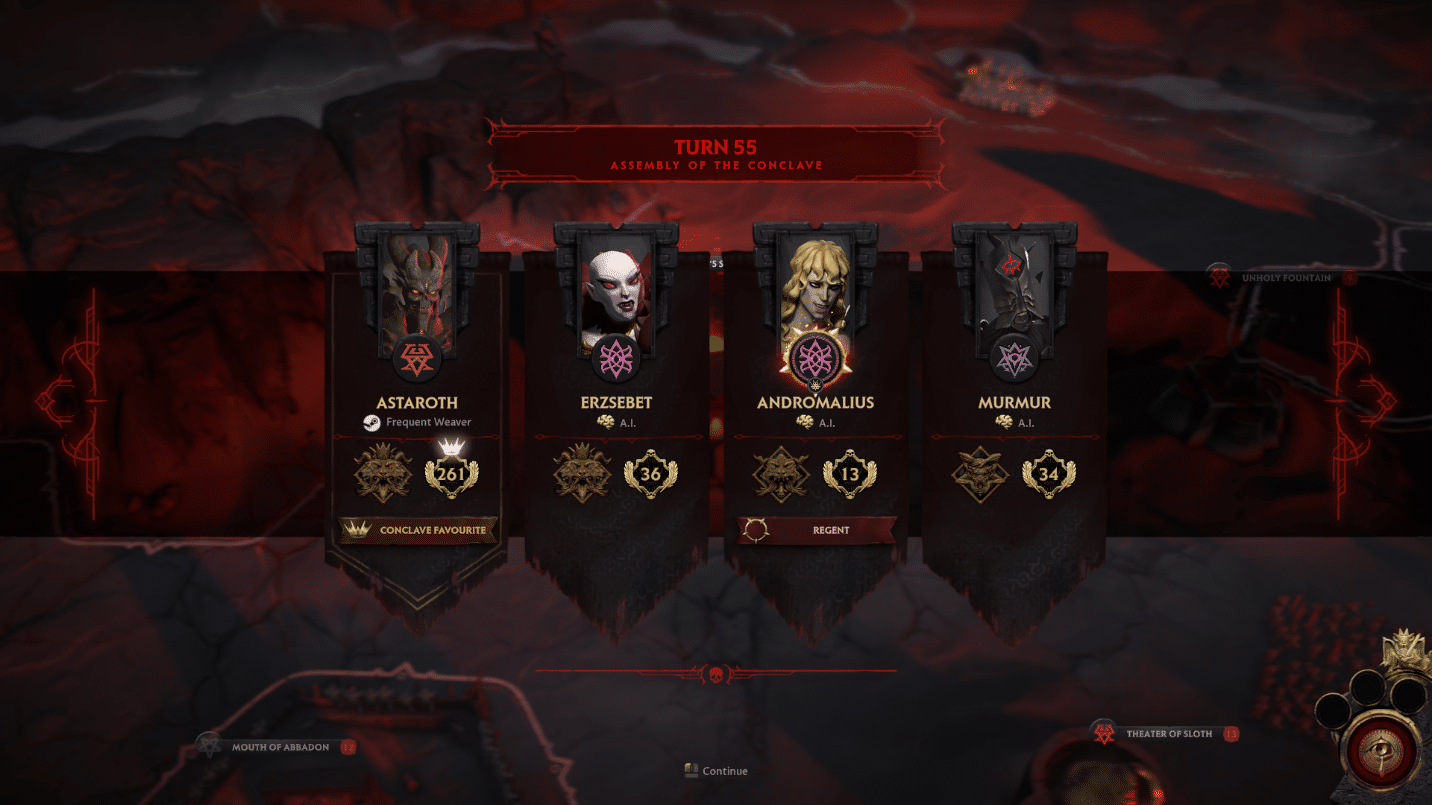
Fortunately, Solium Infernum has excellent asynchronous multiplayer. I had no trouble finding games and playing against real opponents. Usually, you will have 24 hours to respond to a turn notification, though most of the games I played involved multiple turns per day. This still felt a little slow, and it was easy to forget what had happened (especially if I were playing a single-player game at the same time), but this was still one of the best turn-based multiplayer experiences I’ve had.
However, something about the game cries out for a social experience. It’s designed like a board game, and it bristles with board game energy. Those moments when you undercut a rival or a rival outsmarts you are made for friendly backtalk and public lamentation. I haven’t played Solium Infernum with people I know, but I just think it would be resoundingly enjoyable, provided friendships survive the inevitable betrayals.

Fearful Asymmetry
I’ve read that the original Solium Infernum had a complicated character creation system, which the newer version has streamlined. In this version, players choose from one of eight available archfiends, each with their own “class” and playstyle, though these can be slightly customized.
The different archfiends can play very differently, and, at least on the surface, that is great, but the asymmetry doesn’t land quite right. The combat-oriented characters, such as Astaroth, whom the player will learn in the tutorial, are simply better than the others. If you begin with a strong army, you will capture more Places of Power early, which means you’ll have more Prestige to spend on your rank, which will get you more tribute, allowing you to accrue more abilities, and so forth. It is possible to overcome an early deficit, but doing so can feel like playing with one hand tied behind your back rather than achieving the same goals through different means. I wanted to feel like I was playing as a behind-the-scenes manipulator or a sneaky spy more than I did. A series of scenarios, some good for beginners and some quite challenging, serve as an excellent introduction to each Archfiend’s playstyle, though I suspect most players will spend their time in the skirmish mode.
Some of the game’s more minor issues are definitely fixable. There is some room for quality-of-life improvements. I would often get a couple of layers into a menu only to discover that I needed to back out and go a few layers into a different menu to make decisions. Moreover, some of the UI cues were a little vague, and I often wasn’t entirely sure if I had properly clicked on an item or not. In one game, I had the choice of accepting or rejecting the task of controlling a certain number of hexes in exchange for a Prestige reward, but I couldn’t figure out how to determine how many hexes I controlled before deciding. There was no way to tell if this would be a walk in the park or an uphill battle.
I would not call Solium Infernum a perfect game, but it has a lot of greatness within it. Some of its ideas are brilliant and refreshing, and the possibility of controlled chaos has the, no doubt, intended effect of turning every player into a subtle schemer. If you can coordinate with friends, this is an easy recommendation, as it is for people who like multiplayer with strangers. For solo play, I’m a little more reserved. So many of this game’s ideas are engaging and exciting, but once a player gets the hang of the mechanics, the AI doesn’t offer enough of a challenge. It’s strange because sometimes the AI would make just the right move at just the right time, but other times, it would overlook apparent solutions to my threats. And, of course, I have no way of knowing what schemes the AI was secretly cooking up. If the nastiness of the solo experience can be improved even slightly, then Solium Infernum will become a complete game. It’s already a very impressive one.

David Liss enjoys 4X, grand strategy, turn-based tactics, and deckbuilders. He works in the videogame industry as a writer and narrative designer. He is also the author of numerous comic books and thirteen novels, many of which have been bestsellers. You can learn more at www.davidliss.com.
I enjoyed greatly Solium Infernum original old pc version, this is what i can say for now. Price is high for this new one and i’m not sure if it really make anything in gameplay more deep. I see there is some online multiplayer. When time comes i will try it for sure 🙂 Thx for review.
Great review. I am very interested in how board game mechanics, such as limited actions per turn and a shifting turn order, would feel in a more computer based game, such as Age of Wonders.
In order for it to work, I suspect the game would have to be designed from the ground up to have these mechanics. In AoW, you need to make maximum use of your units, cities, resources, etc. in order to succeed. On the other hand, you have a game like Old World, which does incorporate the idea of a finite number of moves per turn. I definitely see an opportunity for more board game mechanics in 4X or 4Xish games, however. And, yes, I’d love to see shifting turn resolution order in more games. It’s a cool concept and would allow for some interesting strategies.
Oh for sure, I meant a brand new game built around these ideas/mechanics, not something bolted onto the existing game.