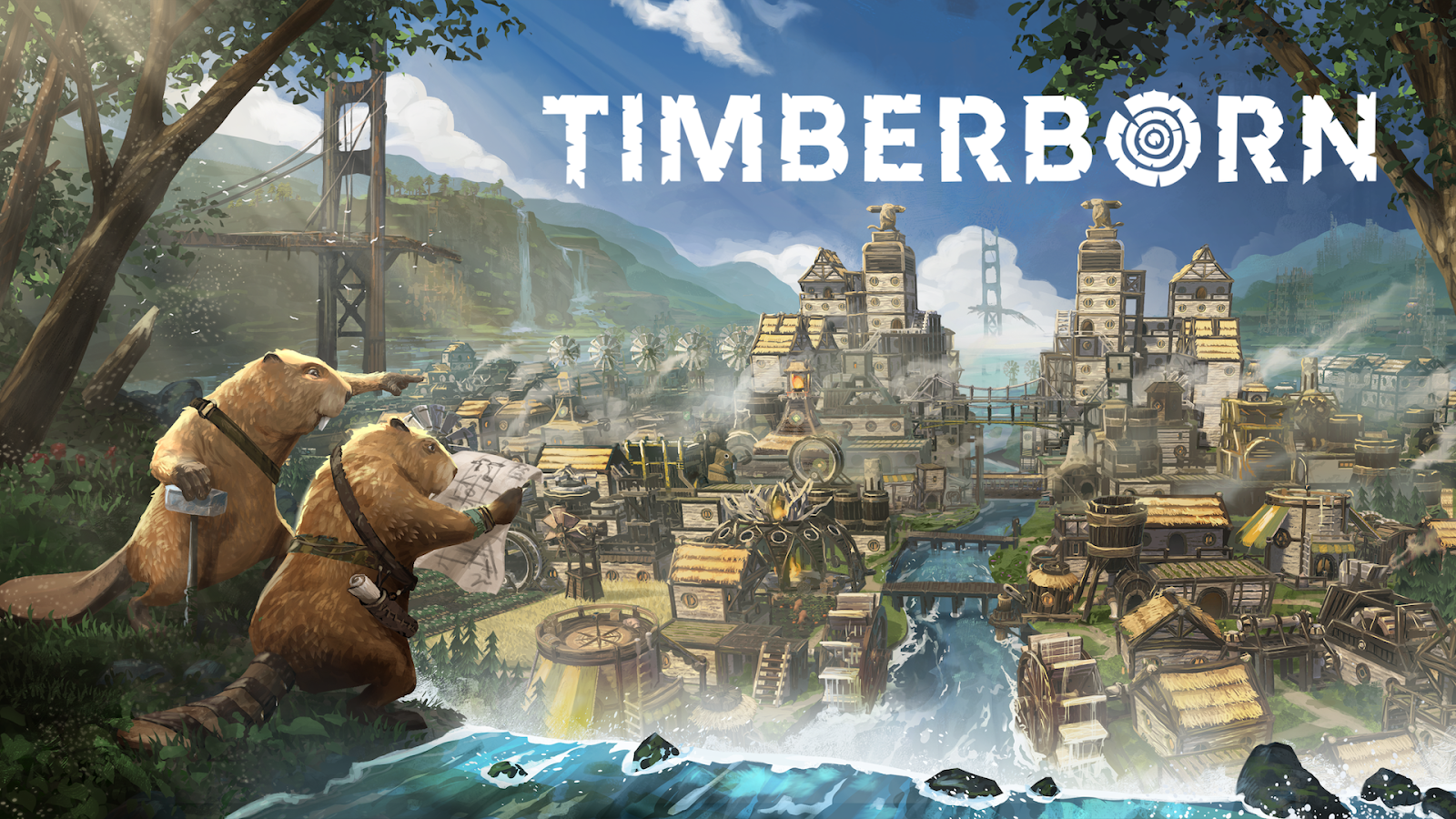
Timberborn is a city-builder with survival-oriented gameplay. While many similar games are banished to dusty corners of Steam libraries after just a few hours, it has some unique features that help it stand out like stackable buildings, realistic water physics, and…beavers.
But a question immediately presents itself – “Why beavers?” City-builders have a long history and typically feature humans or relatable fantasy creatures. In many ways, the beavers in Timberborn are far more human than their wild counterparts. They walk upright, can operate complex machinery, and even create robots. Yet what they share with the real water engineers of the natural world is also what sets the game itself apart, water!
Here are four things you should know before buying Timberborn!
#1: Water: A Faithful Simulation and a Core Game Element
The number of games out there that have water as a resource is astounding, so it comes as a surprise that in most of them, it isn’t much more than a number or a “blue” terrain feature. The idea to gamify water has always been out there, winding its way through games in many forms.
In Timberborn it is present in three ways, and it forms the basis for almost everything: as a basic resource consumed by the beavers on a daily basis, as an irrigation tool used to change the landscape to allow for wood and food production, and as a fluid governed by physics that influences the way the player changes the map and builds the city.

Every map starts as a relatively desolate area with more or less water flowing through it. Water is available in abundance during the wet season but, as time passes, droughts remove the water from the map. This forces the player to find a way to survive on the reserves they have stored, either in water tanks or by constructing dams.
Dams serve the same purpose as aqueducts in Caesar III, a central feature of the way water is managed throughout the game. Large reservoirs and irrigation channels provide the water needed to sustain both farmland and woodland during droughts and wet periods. As the game progresses, research will provide the technology to control water levels with pumps, as well as change the terrain in which it flows.
The physics system that governs the movement of water is well-made and mostly intuitive: a basic understanding of Archimedes’ laws of fluid dynamics is much more than what’s needed here. While well implemented, the system is fairly simplistic. All the dirt blocks that the terrain consists of (as well as some buildings) have a volume, and they will influence the water’s level and how it flows around them. The speed of the water flow will determine the power production of waterwheels but not much more, and that’s where the physics system fails to live up to its potential. A fast-flowing river will never damage anything based on its speed and mass (although it can flood an area). Buoyancy and water pressure are not implemented in any way, both elements that could have opened up many other mechanics and possibilities.
The only other game that has shown such a faithful simulation of water (better in many ways) and made it the central point of its gameplay was Éric Chahi’s From Dust, a game worth checking out, even today, for the way it manages to simulate fluids and incorporate them in both puzzles and terraforming.
Much like From Dust, Timberborn itself suffers from a lack of diversity when it comes to available maps. There is no random map generator and players will either have to design their own maps or download them. While From Dust shared this problem, which limited its replayability and ultimately pushed it into obscurity, Timberborn has the city-building elements that allow for multiple playthroughs on the same map and result in very different cities, as well as an active community that regularly offers new maps to try.

#2: Vertical by Design: Building Up is Essential and Creative
One of the definitions from the Oxford English Dictionary for “vertical” perfectly describes how cities are built in Timberborn: “having a structure in which there are top, middle, and bottom levels.” All constructions come in two varieties, the ones that can support another level on top and the ones that cannot. This allows for “stacks” as building blocks for larger buildings. The dynamic way in which complicated cities can be constructed is one of the most interesting features of the game and, most importantly, it is incorporated into the gameplay and is not just a gimmick. On the most basic level, land scarcity will motivate the player to build “tall” and conserve as much land as possible for food production to support a larger population of working beavers.
When looking at strategy games, especially in the 4X genre, the most interesting and still unsurpassed integration of vertical terrain elements into the economy is in Sid Meier’s Alpha Centauri from 1999. The way that tile yields were determined by the height of the terrain and the presence of water, and the ability to change the flow of rivers coupled with the importance of water for the size of the cities made ecology and terraforming a focal point as no other game has done since. Timberborn is not far behind yet it has one problem: there is no end goal.
What made terraforming important in Alpha Centauri was the urgency to develop the economy to fight off the other factions and ultimately win the game. Timberborn, on the other hand, often ends up in one of two ways, either with a perfectly built city with beavers that want for nothing and enjoy hedonistic rodent lives with bots doing the worst jobs or with over-population that slows the game down to an unplayable level because of the pathfinding (although the developers have already improved it and are actively working on allowing for larger populations).
#3: A City Worth Building, but Only if You Give a Dam
That being said, Timberborn is essentially a city-builder rather than a survival sim or strategy game. The best city-builders, starting with 1989’s SimCity, have always left the goals up to the player to allow for creativity to take hold and drive the player onward. Whether the player decides to build a green valley with idyllic vistas and short work days, or a great towering city reminiscent of Fritz Lang’s Metropolis with hundreds of beavers rushing to their jobs without even a moment to eat or sleep, is ultimately up to personal preference.
However, the game forces a few hours of the same, repetitive steps on every map, like researching “stairs” before a beaver can even climb down to the river for a swim. Surviving a few cycles of drought before finally having enough food and water reserves to let loose on a map is the same song and dance every time. This is really only fun the first time, maybe a second time if playing with the other faction. A free build mode would be welcome, allowing for all kinds of unexpected things to happen, both breaking and enriching the game.
Other than the limitations imposed by the research screen on available buildings and structures (which only serve to slow the game down at the moment), the game has a building limitation mechanic based on production chains similar to the old Settlers games. The more advanced and complicated constructions (and items) required building materials that could only be acquired by transforming the basic resources acquired directly from the map. If Timberborn is further developed with these limitations in mind, allowing the players to circumvent them through creativity, rather than by grinding for hours on end, the game will shine that much brighter.

#4: The Art is Wonderful and Charming
Stylized buildings dominate the blocky landscape. Cartoon beavers run around the city, down paths carrying visible and labeled items on their backs. They also stand up to do their given jobs in carefully animated sequences. The buildings are lively and have moving parts that spin and turn as the wind or water pushes them, allowing the player to guess the amount of power produced by a water wheel by the speed of the animation. The water itself moves and fills up space in a naturalistic way, clearly influenced by blocks that constitute the terrain. The beavers also take time for themselves, having separate animations for both idling and sleeping. Both factions on offer have many unique building models and different color schemes, drastically changing the feel of their cities. The UI is unobtrusive and easy to use, and the whole game is colorful and easy on the eyes.
The music is calming and appropriate to the setting, but even when turned off we can hear the sound of the river flowing or notice its absence when there is a drought. The beavers have a few lines of sim-talk, and every building and event has a sound that’s clearly discernible and serves the purpose of both informing the player of what is happening, and improving the game aesthetically. Once night falls, the crickets start chirping and the crackling of the fires around which the beavers chat, and eat, set the mood for a lazy night. For a moment, everyone goes home to sleep and then the bell rings with sunrise, and the beavers are off to work again. Good sound and visual design are increasingly rare, especially on typical indie developer budgets, but Timberborn is an example of how to accomplish a lot with very little, and the developers that take the effort to do so should be held up as an example. Timberborn can charm almost anyone with its visuals and sounds alone before the game has even begun.

Bonus: Beginner’s Tips
- 1. Water is life. Always have more than you think you will need. Water reserves only count the water stored in tanks, but a hole in the ground with a pump is as good as any reserve in a pinch. The beavers will only drink pumped water though, so don’t be surprised if they die from thirst while swimming.
- 2. Food doesn’t spoil and can be kept forever. Having many warehouses in advance is a good strategy, especially since food will not be harvested after the farmer’s storage is full. Berries and Carrots are the best crops to start with as they don’t require cooking.
- 3. Science takes time but it’s a good investment, so start researching as soon as you can. “Stairs” and “Platform” should be the first to get, as they allow the beavers to access new resources faster.
- 4. Timber is the basis for everything. Always build a Forester before you cut the last tree on the map. If you want trees to grow back without a Forester, leave some standing as clear-cuts will destroy a forest for good.
- 5. Materials from a destroyed building have to be stored in a depot before they can be reused.
- 6. The Folktails faction is better at growing food and can use wind energy for power later in the game. They will reproduce only if paired and provided with a house with a free spot for a kit (a baby beaver). They will typically need more space and time to develop.
- 7. The Iron Teeth faction is better at building tall and can burn wood as fuel later in the game, a stable but more expensive power source than wind. They reproduce in breeding pods using berries and water, so you can postpone the construction of houses for later.
Conclusion
While Timberborn is still in early access and has been for some time, it is in many ways the most innovative and fun city-builder available today. The people at Mechanistry have only improved the city-building genre with their hard work and dedication. It isn’t hard to claim that Timberborn is already excellent, but also that it will only get better as it nears release, whenever that might be.

Filip is interested in games and how they are created. He’s particularly interested in the art, story, and how they’re integrated with the game systems. He considers that a great game is one where all the elements fit together seamlessly. When he’s not discovering new games and writing about them, he works as a freelance illustrator and likes to read and write fiction.