Eldritch Realms is finally here, writhing its way onto the scene along with another big patch, this one called “Mystic.” At one time this was to be the end of Age of Wonders 4’s content cycle, but with a second season of DLC confirmed, it’s actually only the halfway point (for now)!
When I originally bought the Season Pass for AoW4 at release based solely on Triumph’s reputation and track record, all I had to go on were names – and Eldritch Realms was instantly at the top of my list. Dragon Dawn was self-evident and vanilla, Empires and Ashes sounded more like a Europa Universalis DLC, Primal Fury was obviously either going to be a fighting game for the Super Nintendo or something about Druids (yawn), but Eldritch Realms? At worst, it’s just hackneyed Lovecraft, but at best? It could be Shadow Magic.
Void Where Prohibited
So how did all this mess get started? Let’s do a quick story flyover:
There’s this capital-V Void, right? And it’s really big and really empty. So empty you’d go nuts if you had to wait in there while your oil got changed or something. Anyway, funny story, it turns out the Void actually has a Void of its own, called the Abyss. Basically, if the Void was Metal, the Abyss is Death Metal. Although, in strange contrast to being empty, it’s a confusing place full of tentacles and demons. So maybe it’s more like ska?
For reasons unknown (or possibly hiding in Story Realms which I’ll admit to not playing), gateways to the Abyss begin to appear in some realms, sometimes unleashing the terrible natives of the Abyss on the region, sometimes simply leading to a rich but hazardous alien realm.
As the maw of the Abyss stretches wide, another rather grisly secret is revealed: Wizard Kings thought to be lost to the madness and warping energies of the Void had until now only been encountered as mindless monsters called, uh, Lost Wizards. Yeah, the research team who figured out what those things were really phoned it in with the name. Anyway, the appearance of the Abyss reveals this is not their only fate: some are warped and/or rendered mad, but don’t lose their minds, retaining their – or at least some kind of – intelligence.
Narratively speaking, that’s about all you need to know to resume your Pantheon’s multiversal conquest in random maps. And there are, of course, new story realms to go along with Eldritch Realms for those who want a little more than that.
Shadow Sickness
From a practical standpoint, this is the expansion that brings the Shadow Magic content into AoW4.
Age of Wonders: Shadow Magic was an expandalone title released in 2003, a year after the Age of Wonders 2 it was based on. AoW2 had fallen short for me: it had felt very generic and uninspired, and neither the maps nor the magic was interesting enough to make up for the boring units. But Shadow Magic reviewed well and seemed to specifically address what I’d thought were shortcomings in the game – plus turn-based strategy games in a fantasy setting were rather rare in general at the time. Beggars and choosers and so on.
I’m glad I gave it a shot – Shadow Magic quickly became (and remains) one of my favorite 4x games ever, and is still my favorite Age of Wonders game. It took a solid foundation of gameplay in AoW2 and added just enough wild and weird to give the base game the shot of character and flavor it needed. With Eldritch Realms, I was hoping history might be inclined to repeat itself.
So what was the Shadow Magic content? Primarily it was the Shadow Realm itself: a darker version of Master of Magic’s parallel dimension of Myrror. Non-natives visiting the Shadow Realm were immediately rendered sick by it – a wasting condition which dramatically weakened everything about the unit, from its map movement to its combat stats. An affordable universal research would grant a unit enchantment to protect against the sickness, though of course this came at a mana cost.
However, when properly protected, visitors would find movement is actually almost twice as fast in the Shadow Realm than it is in normal reality. Aside from the immense strategic benefit, the Shadow Realm was also rich with resources – but often defended by especially vicious creatures. High risk, high reward was the name of the game. Actually settling in the Shadow Realm was possible, but for non-native races, it was often prohibitively difficult due to morale penalties (the population couldn’t be enchanted like the military could).
On the surface, all Eldritch Realms has changed about these basic principles are their names: you’ll be visiting the Umbral Realm and wrestling with Umbral Malady. But there are much more fundamental changes when we get into the weeds.
The Shadow Realm, like Myrror before it, was a coterminous layer like the Underground: switching between planes at a given set of coordinates would deposit you at the same set of coordinates on the other plane. In Eldritch Realms’ Umbral, there is no such consistency: entering a northwesterly gate may see you in a central southern region of the Umbral map. You’ll often travel one way in the Umbral and exit via a gate just to find yourself emerging in the exact opposite direction you just traveled.

On one hand it’s disorienting and certainly alien, which is perfect given the theme, but in terms of moment to moment play it’s an immense amount to keep track of. If there are two gates to the north, was the first or second one the shortcut to the southeastern edge in the material plane?
If you actually wanted to go to that southeastern edge, you’re in luck: the pathfinding is smart enough to utilize the gates and plan a path automatically. If you want to send units via the Umbral it’s easiest to simply click next to the end gate in the normal material plane and let the eldritch horrors take the wheel – assuming you’ve already scouted the path so the pathfinder knows about it. And while the Shadow Realm’s explicit movespeed buff is gone, distances are often much shorter than they appear thanks to umbral connections.
However, when you’re looking at the larger strategic picture and determining who your neighbors actually are – and how far away from your borders enemies might be – things are no longer at-a-glance. You’ll essentially need to follow the nearby paths yourself by clicking through the various gates to find out what connects where. Fortunately there’s usually a unit to grab nearby that can act as a kind of tracer shot to estimate real distance, but the option to show some connection lines on the various maps would have been nice.
Another major change is how space in the Umbral is partitioned. The Shadow Realm was an entire extra map. The Umbral, however, is a randomized collection of tiny to moderate-sized prefab islands isolated from each other by an uncrossable void. While teleporters linking islands occasionally appear, crossing the void otherwise is impossible. This change results in the Umbral not really feeling like an alien plane with its own strange rules, but rather just a transitory space: like a cave or dungeon, you’re just passing through.
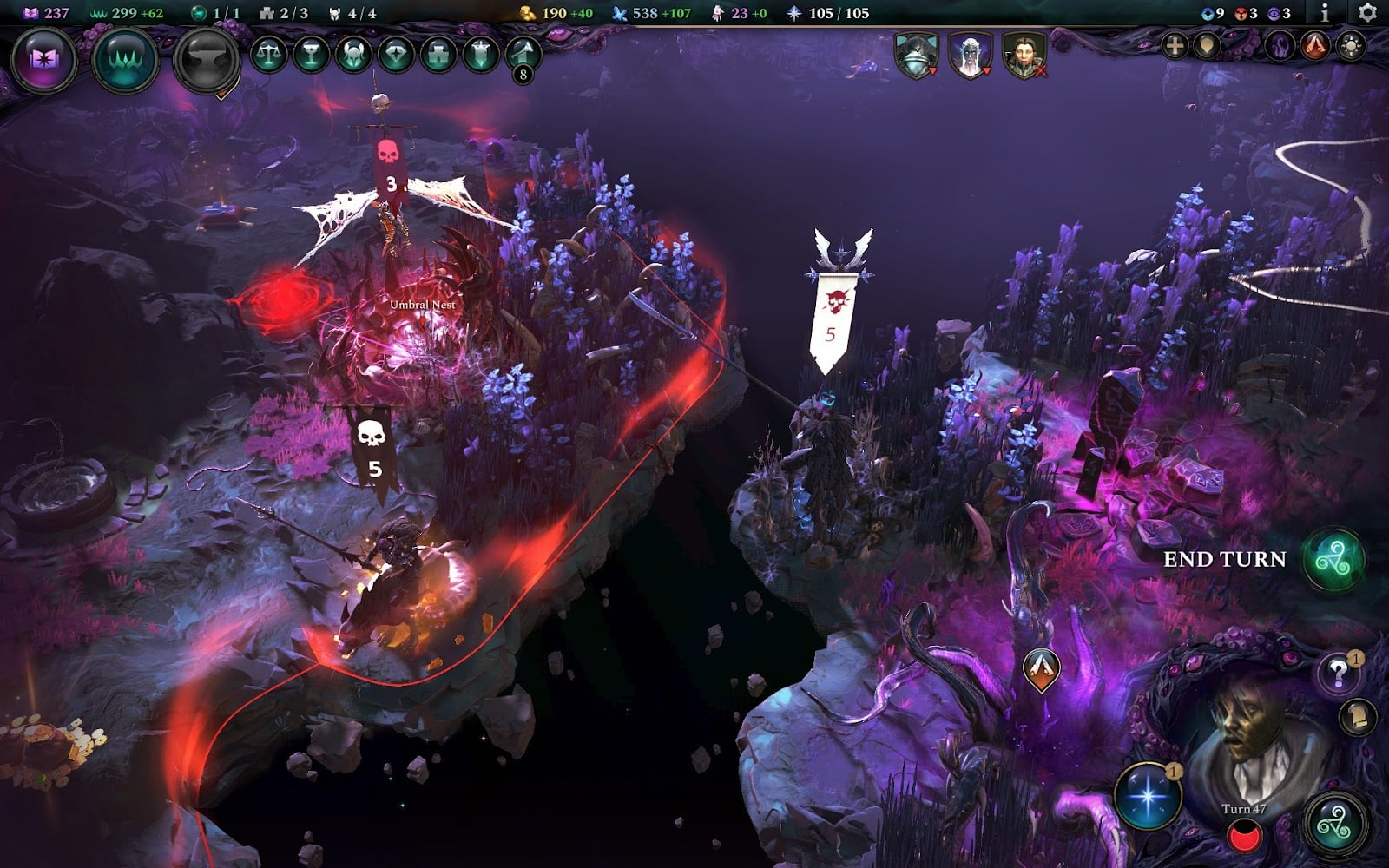
Close enough to touch, yet so far away.
Despite all the shortcuts – or maybe because of them – the new dimension still makes maps feel much bigger. I’d recommend playing one size down from your preferred map size if you’re playing a realm with the Umbral, since its labyrinthine nature can stretch distances just as easily as it can shorten them.
Unlike the Shadow Realm, building outposts in the Umbral is impossible save for a single exception: Sanctuaries. These special outposts may only be built on locations called Beacons of Light, which are revealed when Umbral Nests – a type of lair – are destroyed. So if you want to control any of the Umbral at all, you’ll have to clear out one of these holy rest stops, which projects a bubble allowing you to plop a Sanctuary down on it. But unlike the Shadow Realm before it, a Sanctuary may never upgrade into a city.
What’s strange is that this rule applies to everybody: even races with the Umbral Disciples trait and an Eldritch Sovereign leader. As someone who embraced the theme and played an evil Insectoid race intent on spreading the influence of the Abyss, it was strange to still need to utilize holy power to “survive” in an “alien” environment where my units were already being passively healed thanks to racial traits.
So unlike the Shadow Realm, there are no playable Abyss natives. The best you can get are adept tourists and expatriates. This further contributes to the Umbral feeling less like a place and more like a bonus level.
As a final note, it’s worth mentioning that the appearance of the Umbral Realm on a map is dictated by a realm trait during map creation. It’s not an omnipresent layer like the Underground, nor is it a simple toggle like Shadow Magic. If you want to guarantee your random map has the Umbral Realm on it, you’ll need to set the trait manually.
Star Road
Before we move on to Eldritch Sovereigns, I want to focus a little more on how the Umbral is built out; because I’m simultaneously impressed and disappointed. There’s some clever stuff going on, but as is common for Age of Wonders 4, it’s sometimes too clever for its own good: leading to a feeling of sterility and “gaminess.”

Immaculately labeled by a graphical editing professional.
As an example, take this Umbral island, one I’ve run into a few times (keep in mind islands are prefab). You’ll note a Sanctuary – the shiny bubble – which has an outpost build on it.
Umbral Outposts can claim up to two provinces. I went ahead and labeled each one for clarity.
Let’s look at our choices: clockwise from the Outpost is a province with a +10 Gold vein in it, followed by a province with a +10 Gold and a +20 Gold Umbral feature. Going counter-clockwise from the Outpost is a province with a rare Umbral resource in it which grants +20 Mana and relations with the natives of the plane. We’ll get to the natives later, just know this is quite precious.
Clearly the most valuable provinces are the +20 Mana and the +30 Gold ones. But take a close look at the province borders: since there is no shared border between those two, you can’t have both. These are prefab islands, so that’s fully intentional.
Thus this island’s very geography is a multiple choice reward for a predefined “clear the lair” quest: +10 Gold, +20 Mana, and a precious Umbral resource per turn, or a flat +40 Gold per turn. It’s a carefully balanced and interesting choice, but it’s simultaneously a profoundly immersion-breaking one: the hand of the designer entirely visible, the pre-curated choices laid entirely bare. This isn’t an alien realm of danger and wonder, this is a video game, balanced to make sure you, the player, don’t get too powerful too fast.
Does it kill my enjoyment of the game? No, and it probably won’t kill yours either. But it does blunt mine, and it’s a recurring theme with AoW4.
The Umbral also lacks a little of the bite its predecessors had. While it’s still true that engaging in any sort of combat without a source of Umbral Sickness immunity is nearly suicidal without overwhelming force, once that box is checked it seems somewhat tame compared to its various predecessors.
Given the rewards and strategic value, I’d expect the Umbral’s neutrals to be stronger than an average group you’d face in the surface plane, even when Umbral Protection is up. For now, this isn’t the case – they’re merely on par with other neutrals on the map. Again, it’s balanced and plugs neatly into all the other modular systems of the game, but not particularly flavorful beyond how it looks.
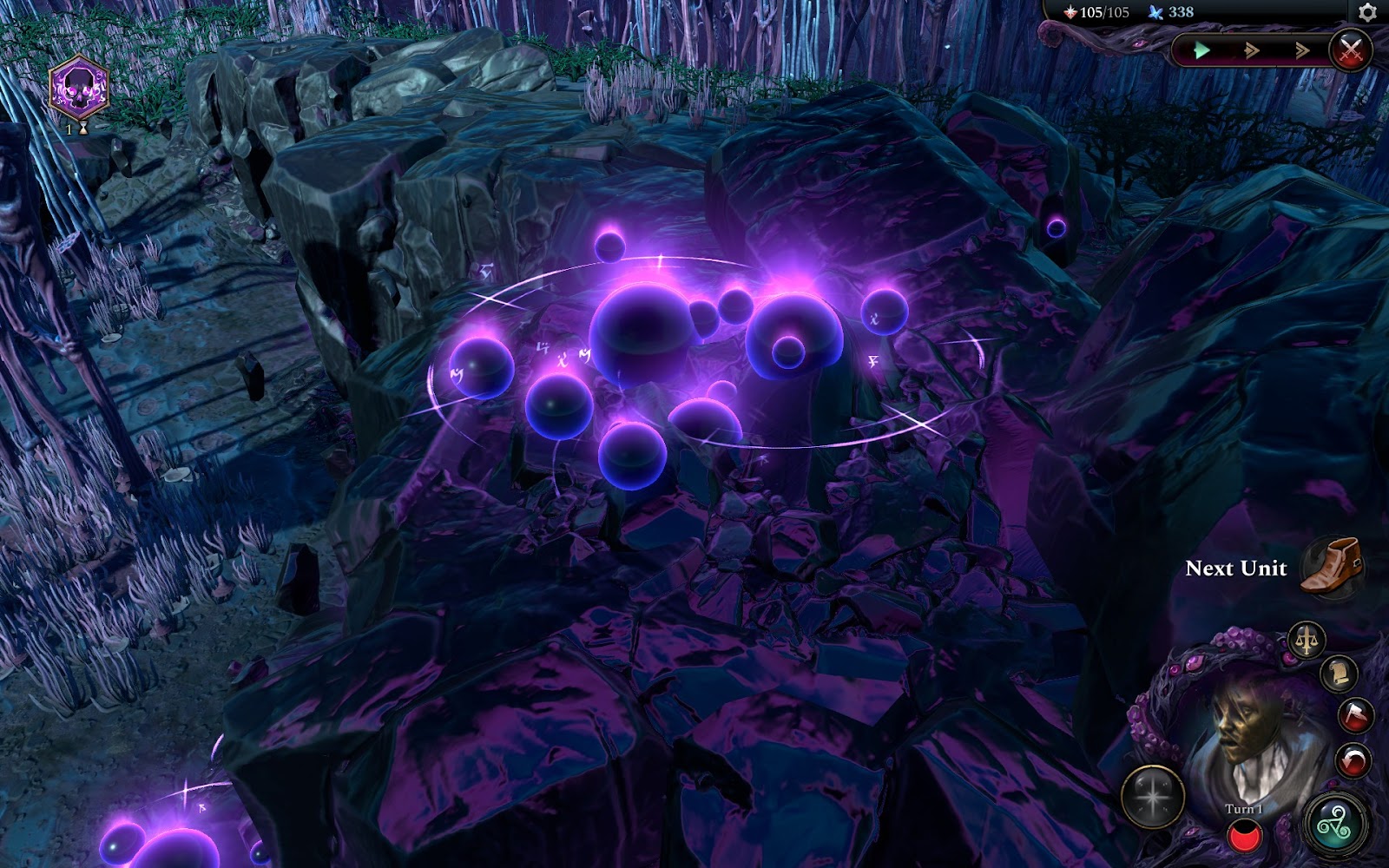
You’ll want a lot of these to get chummy with natives.
Of course, the Umbral’s only inhabitants aren’t neutral units. Nests are like any other lair, and will spawn aggressive units that eventually go raiding – but most interesting are the Shadow Demons themselves. While the game of course calls them Umbral Demons on the surface, going into the tooltip reveals these are indeed the same Shadow Demons from Shadow Magic. Sadly, like the Archons before them, they’ve gone unplayable, but given how unique they were in Shadow Magic, they’d require both a unique Form and a unique Culture to do them justice in AoW4.
Instead, the Shadow Demons fill a role that looks like a Free City, but is actually called a Dwelling, and work just like they did in Age of Wonders 3 and Age of Wonders: Planetfall. Once you wander into a Dwelling’s line of sight, you’ll immediately get a diplomacy event where you’re given a simple choice: pay a tribute of your choice (Gold, Mana, city population, and Thralls are the options I’ve seen, but I wouldn’t be surprised if Souls and Reavers’ War Spoils were also options) or immediately go to War.
War leads to the Dwelling beginning to send armies like a Free City, and is a Good action, but choosing a tribute gets you some Evil points (regardless of which you choose), sets you to a neutral state of Truce, and begins the path toward an Eldritch Pact.
Eldritch Pacts are much like Free Cities becoming a Vassal, with the limitation you can never integrate the Dwelling. Instead, you’re given the option to bargain for otherwise unavailable Spells and effects which somehow manipulate or benefit from Gloom terrain, the terrain in the Umbral Abyss.
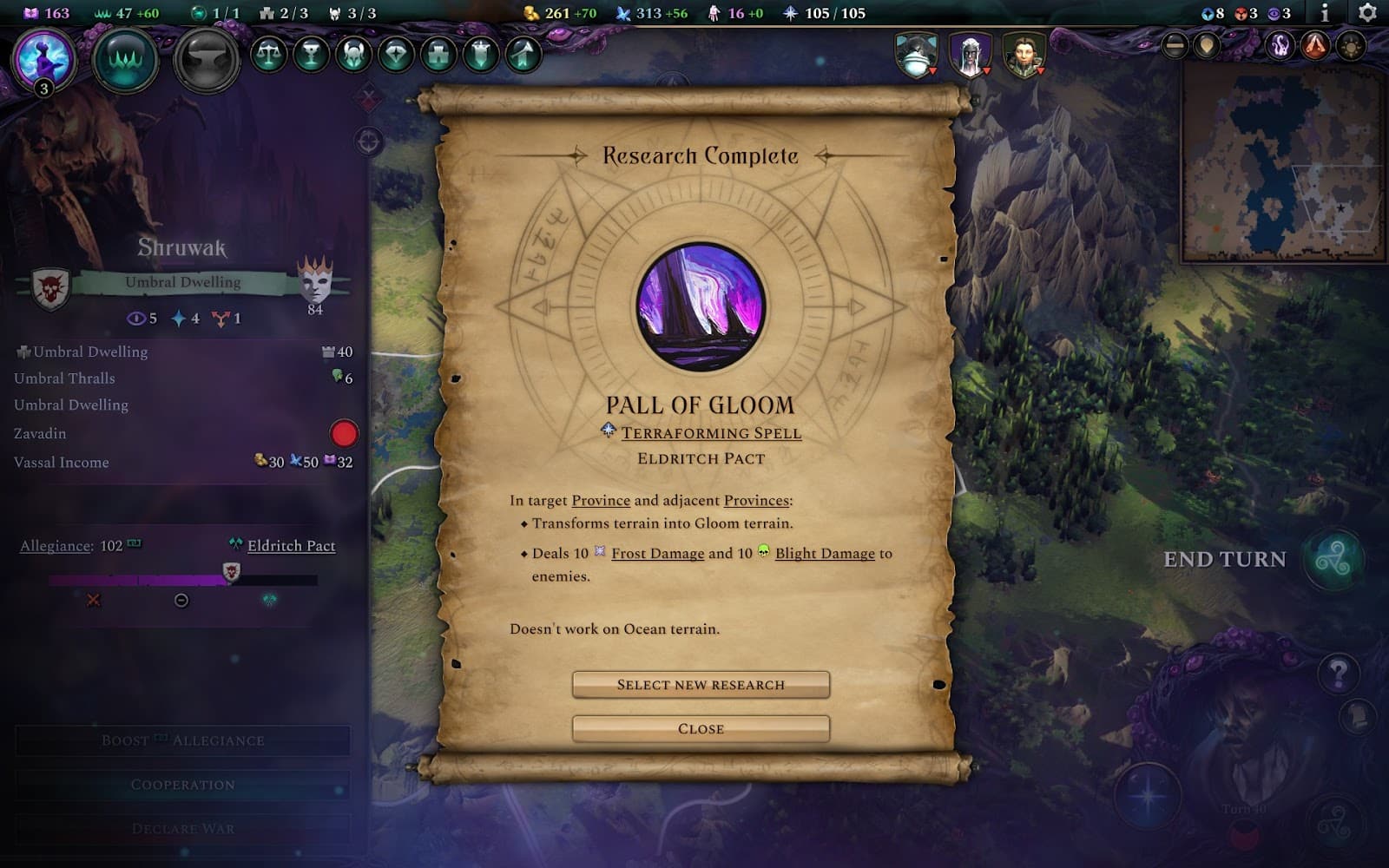
Though not a flashy spell, Gloom terrain can outright cripple a city’s contentment – or its economy entirely.
Additionally, territories home to Umbral Gates count as Gloom terrain, plus Gloom can be spread via various methods, notably an improvement provided by the racial Umbral Disciples trait – or, to tie it all together, by those rewards purchased via an Eldritch Pact. Besides that, Gloom causes the Umbral Malady regardless of plane, and negatively impacts City Stability for each annexed province in the Gloom unless that city’s race has the Umbral Flesh transformation – which, conveniently, the Umbral Disciples trait grants you by default.
A final add that went unnoticed by me at first was Cosmic Happenings – random events that throw a curveball at the entire map. While random events are far from innovative, these events are flashy, thought-provoking, and happen at a scale where they will impact the game more than a random improvement burning down or bumper crop every twenty turns or so.
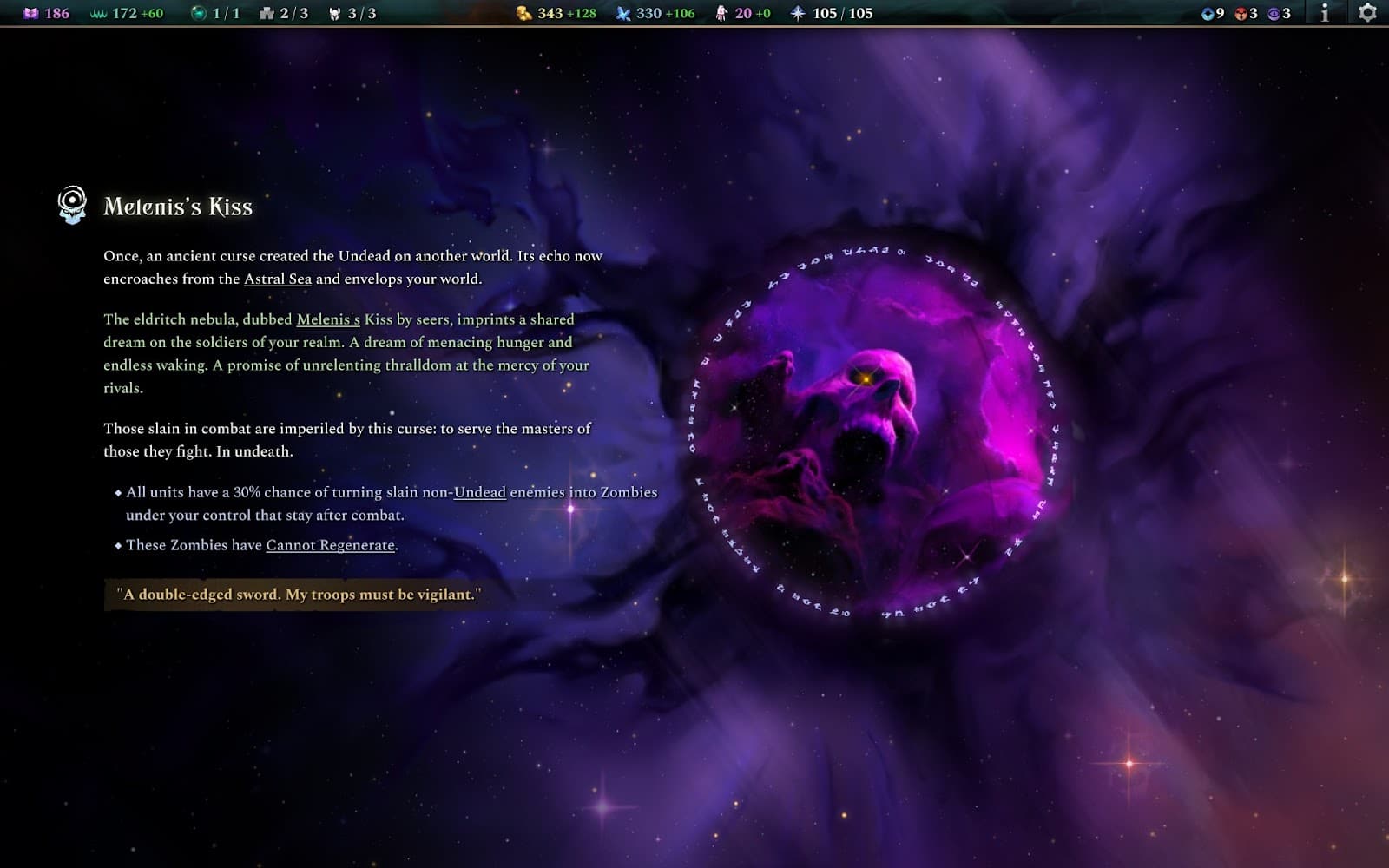
The entire map takes on a bruise-colored hue, and large swings in momentum can happen suddenly.
I actually really enjoy this system, if only because of its scale. A drought in a city is little more than a speedbump, but a drought that turns over half the realm into desert? That can actually shake things up in a way that matters.
Yeah, Yeah, Cthulhu Fhtagn.
After the Umbral itself, Eldritch Sovereigns are the next big addition. And these guys deliver: the build-a-bear leader creator lets you build out your very own Lost Wizard now, and they’re just as wonderful, terrible, beautiful, and hideous as you want them to be.
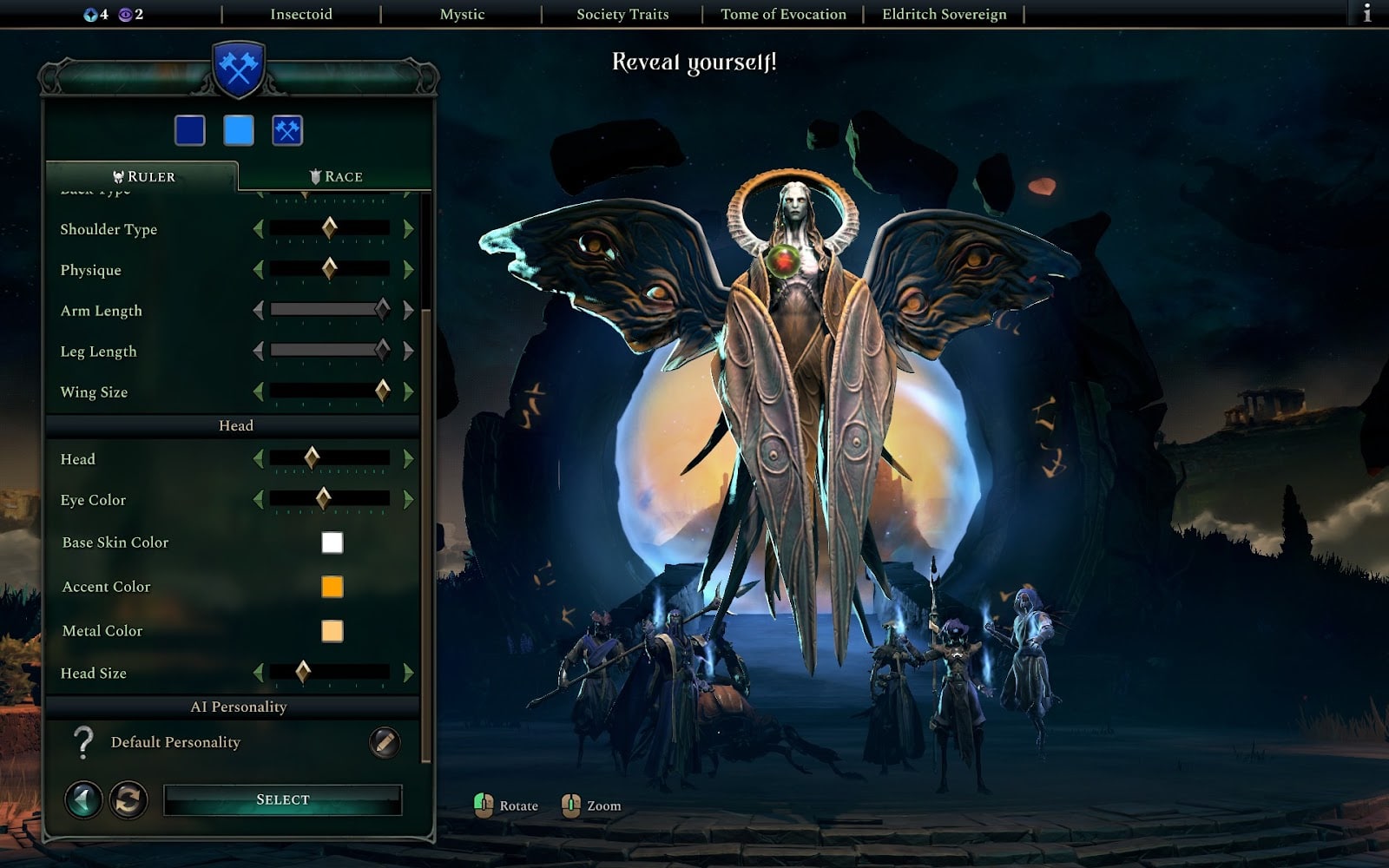
Biblically accurate angels are on the menu…
In terms of looks, I’ve got nothing negative to say about these guys. I’d of course like to see more options to mix and match, but there are currently plenty.
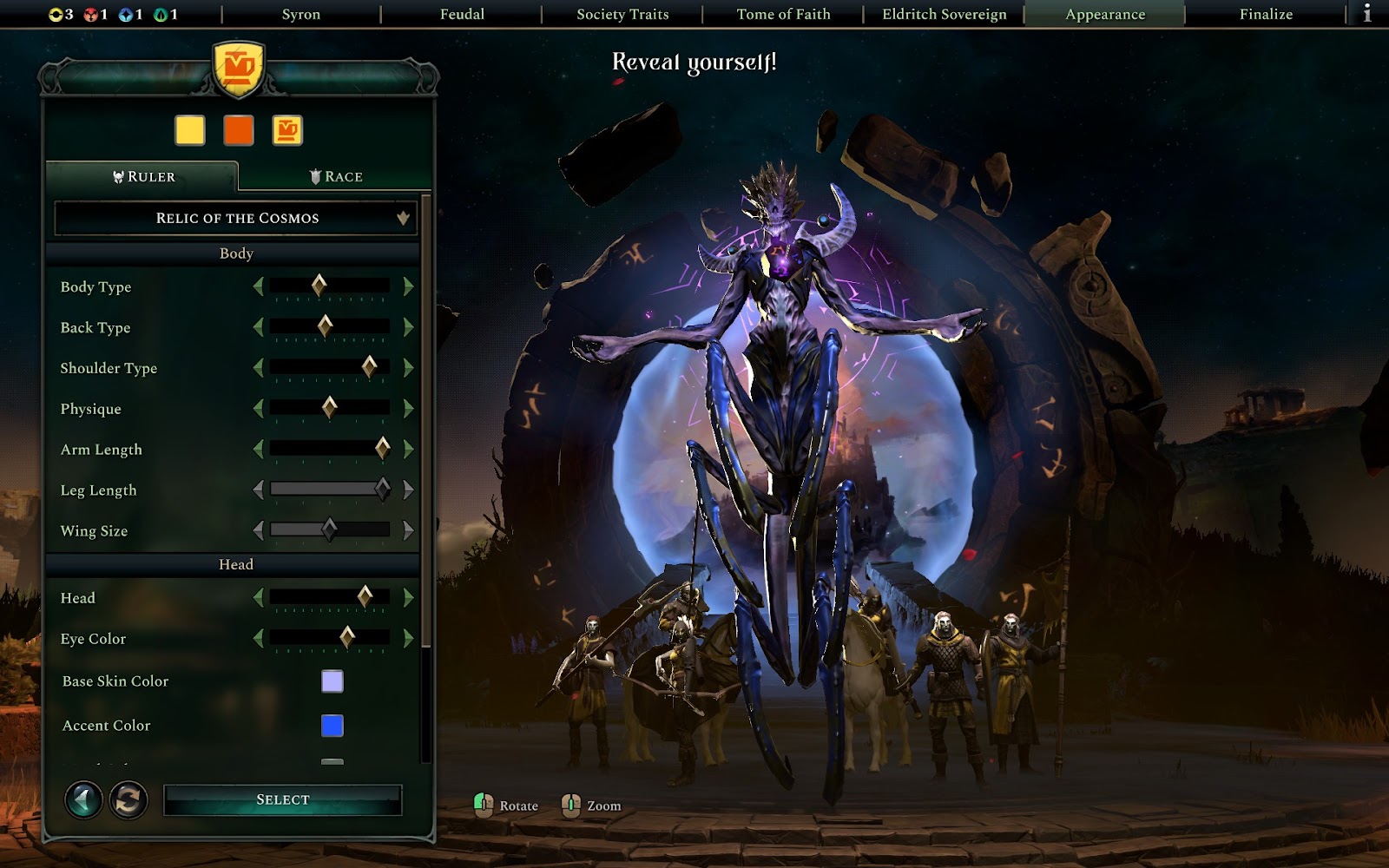
…as is, um… this?
If there’s anything to criticize, it’s these guys are all uniformly huge. They’re also all essentially humanoid in shape, which has a basis in the lore at least. But if you had Dominions-like ideas of something small like a Demilich, or something truly uncanny like an abstract lattice of colors and shapes, that’s not (currently) an option.
Once ingame they’re more of a mixed bag. You’ll quickly find event quest, and diplomacy options to be exactly the same as any other ruler with one exception: what I like to call the “wingdings option.”
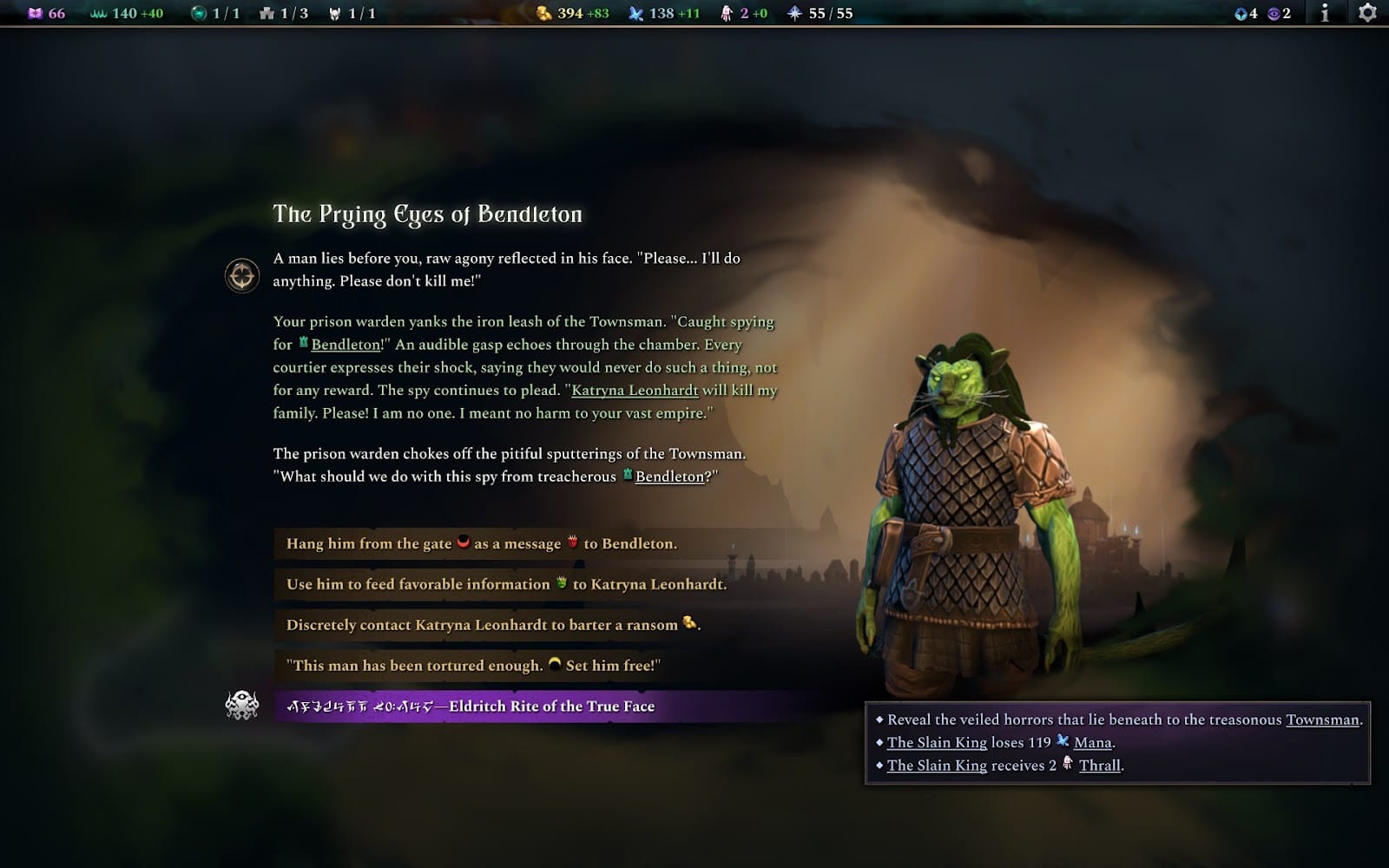
Open your eyes, traitor, and behold the horrible truth of Wingdings!
The wingdings option lets you spend Thralls – the unique sovereign resource representing mindless slaves – to make good things happen or bad things go away. Thralls mostly come from defeating armies (so for much of the game, primarily clearing independents), though there’s a ritual to convert city population into thralls as well. Even so, they’re not exactly common, so if you wanted to do a “mad god” type of Sovereign who has a completely alien indifference or even outright ignorance of his worshipers, it’ll constantly cost you thralls to keep spewing gibberish.
It’s also more than a little hard to believe when a hero decides to sit down next to your five-story nightmare of a leader like you’re drinking buddies and launch into a long story about the lost childhood pet they want to avenge. You can spout some wingdings and sacrifice some thralls to delete the memory and give them a morale boost, but again, nothing Eldritch comes free.
Ultimately the strategic layer remains sterile and procedural with an unambitious AI who hopes to win through saucy insults and gossip instead of just killing you and taking all your stuff. If only they’d spend as much gold on their military and expansion as they waste on fabricating and denouncing grievances.
In keeping with the rest of AoW4, all the flavor and character for these Sovereigns that’s not in the character creator is found in combat. And, as usual, it’s impressive! Like Dragons before them, Sovereigns have unique advancement tracks supporting a variety of approaches.
When your Sovereign gets level 4, the first choice appears as your Signature Skill, allowing you to pick one of three different masteries: Madcaster, focusing on combat magic and mass application of random debuffs, Mindbreaker, focusing on overcoming status resistance and applying Insanity, or Fleshweaver, which summons two free suicide bomber units at the start of every fight and can Possess a friendly non-hero unit, giving it a huge buff and Resurgence for two turns.

Mutually exclusive choices: something AoW4 needs much, much more of.
At level 8 you gain the choice of a Forgotten Tome. There’s one for each type of magic save Materium. Each one grants one of three special abilities, randomly chosen every four turns, with the possibility to get the same ability multiple times in a row. These abilities can be cast once per combat, and have unlimited range and generally powerful or unusual effects.
At 12 you’ll choose your specialization, which changes what the ability granted by your mastery does and grants you a new one fitting the theme.
This goes along with a new set of skills in the Eldritch Sovereign line, which replaces Combat. The line grants a wide possibility of new abilities, from combat tricks to new ritual spells requiring Thralls instead of Mana.
If the lack of the Combat line didn’t give it away, I’ll spell it out: Eldritch Sovereigns are different from previous leaders in that no matter how you build them, they simply can’t be the melee or physical ranged powerhouses you can create using the other types.
Eldritch Sovereigns are locked into a single unique weapon type – the Relic – chosen at character creation (though you can certainly forge and presumably find others later). These are otherwise the same as magical staves, meaning their combat role is limited to either Battle Magic or Support. While you need not take any skills from those two categories, all of the in-combat Eldritch Sovereign abilities are amplified via Battle Magic passives.
Overall, Eldritch Sovereigns are great fun. Even if the game’s various scripted interactions don’t really play nice with titanic extra-dimensional alien horrors, their combat presence is as satisfying as it is imposing.
Day of the Tentacle
Last up on the feature list are the three new tomes, fresh off the eldritch presses. The first you’ll encounter is the Shadow/Arcane hybrid Tome of the Tentacle at tier 2. Though the Abyss really phoned it in when they named the tome, its contents are somewhat more impressive. Mostly this focuses on the “Constrict” status, which roots a target in place and does physical damage each turn. Note this isn’t a stun or paralyze, so while they can’t move, they can still act.
You’ll get a Polearm unit called the Constrictor, a terrifying mutant that can pull units from several hexes away into melee and, you guessed it, Constrict them. There’s also a unit enchantment which grants any magic attacks a chance to apply Constrict and a combat-only short duration enchantment which gives a unit a slew of defensive abilities like unlimited retaliations and immunity to flanking – plus a chance to Constrict when attacked.
The star of the Tome of the Tentacle is its namesake: Conjure Tentacle, which causes a tree-sized tentacle to appear anywhere on the battlefield. This is a immobile Fighter-type unit that has a chance to apply Constrict on any melee attack – and that’s it. Against low-tier units it’s actually rather tough, but regardless of the target, it will at very least screw up their movement for a turn as they’re suddenly in enemy zone of control. And if the Tentacle hits and applies Constrict, movement can be screwed up a lot longer than that.
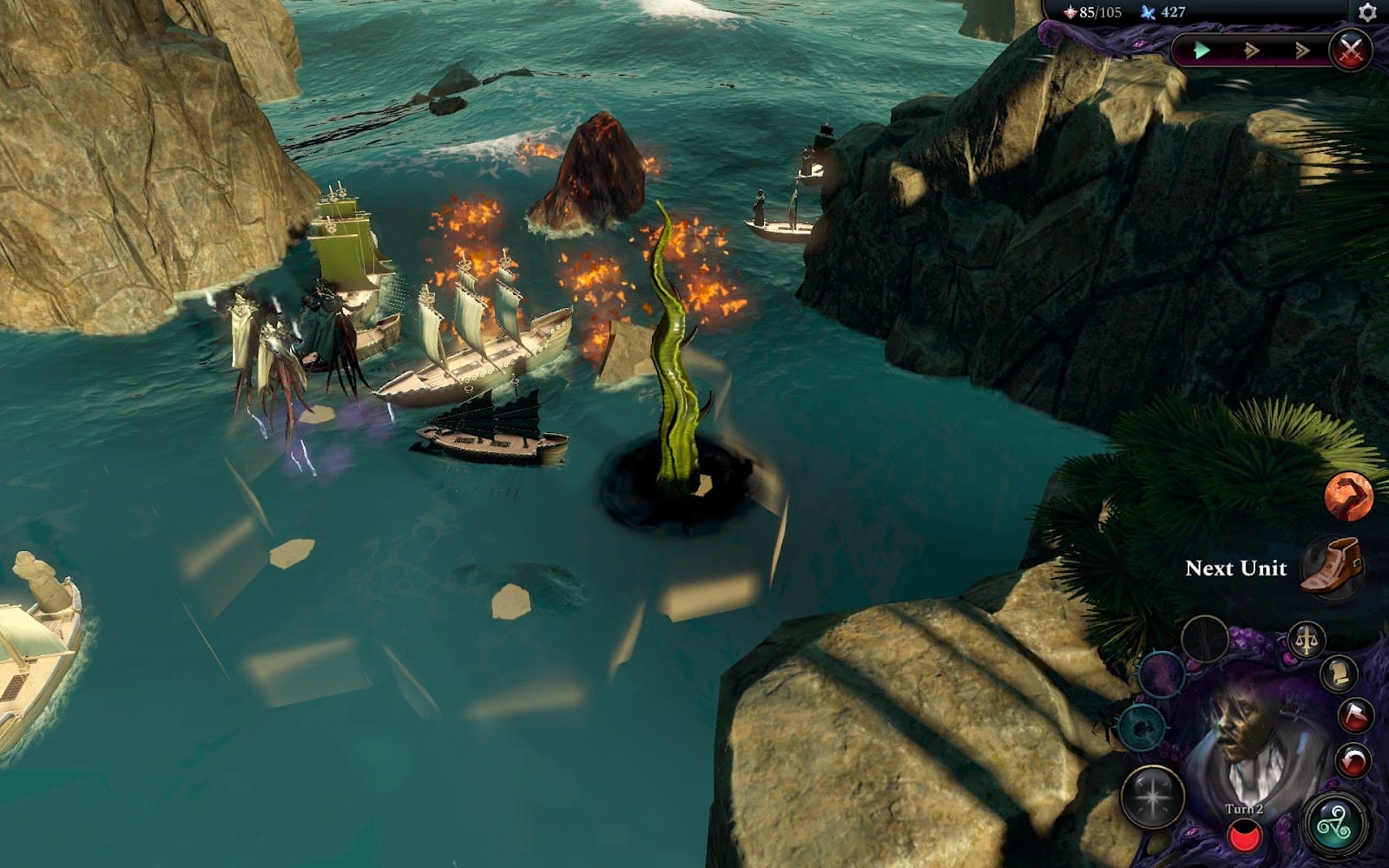
They also look positively enormous in sea battles.
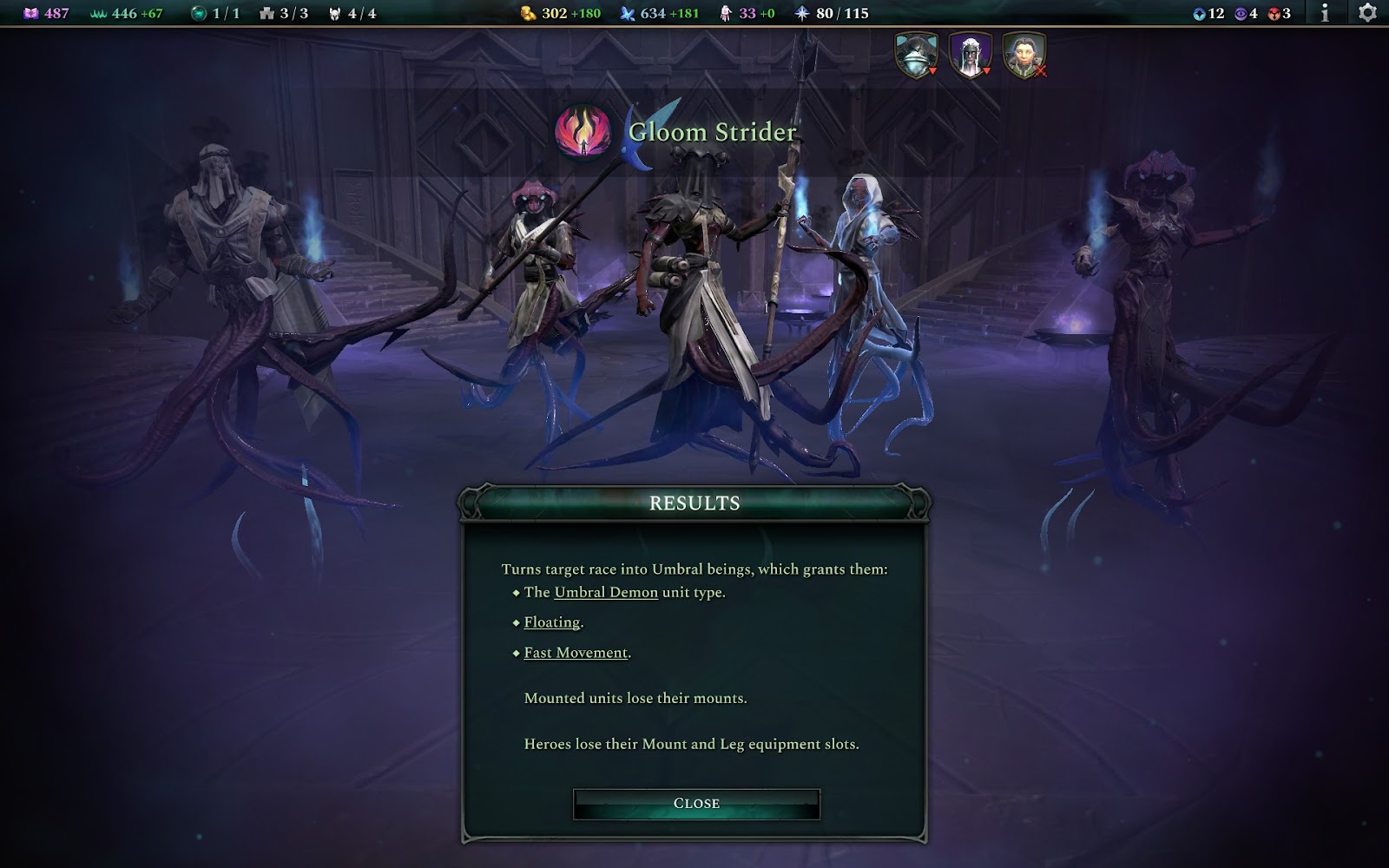
The second tome is another Shadow/Arcane hybrid available at Tier 3 called the Tome of Corruption. While Tentacle was a direct application of Abyssal antics, Corruption is more about its spooky and insidious side, including Gloom terrain, and is home to the expansion’s major transformation spell, Gloom Strider, which changes a race into umbral demons.
The practical effect is the race’s legs mutate into tendrils like an Eldritch Sovereign’s, granting all units Floating and Fast Movement. The downside is cavalry no longer use mounts (which matters if the race had unique mounts) – and their Heroes can no longer use their Mount or Leg slots. Additionally, given they now count as umbral demons, the race begins to appreciate Gloom terrain, gaining special bonuses from it. Resistances are also penalized, -2 to Fire and Spirit, but in exchange you’re granted Curse Eater, which removes one debuff per turn – and if one is removed, the unit regains 10 temporary hit points. Finally, they become totally immune to Umbral Malady, of course.
Still in the Tome of Corruption, the Treacherous Reflection spell can create an evil twin of all but the strongest units in combat, which of course immediately turns on the original. Corrupted Boon strips enemies of all positive status effects in its area of effect, replacing the positive effect with its corresponding negative effect (which can be seen under “Status Effects Countering” in the tooltips) if it has one. And the tome’s unique unit, the Umbral Mistress, is a creepy parasitic unit which first links itself to enemies and from there can begin to drain health and positive status effects, erode morale and apply debuffs, or inflict the Insanity debuff on the host.
The third and final tome is The Tome of Cleansing Flame, a Tier 3 Fire/Order tome. Admittedly this one feels like a bit of a stowaway as it really had no ties to the rest of Eldritch Realms. The titular Cleansing Flames is the theme of this tome, which is a battlefield hex hazard/buff – think Mist from Tome of the MIsts.
Cleansing Flames changes what it does based on the unit traits of the units standing in or stepping through them: units without Zeal or Faithful treat the hexes as regular patches of fire, picking up a stack of the Burning status. If the unit does have Zeal or Faithful, they become immune to the Burning, and further benefit from the flames, burning away one negative status. And finally for Condemned units, the flames instead burn away positive status effects.
So in a mirror match between two Zealous armies who both apply Condemn to the other, Cleansing Flames will burn away one positive and one negative effect per turn. If a Zealous army is attacking a bunch of heathens, not only will the heathens lose buffs if Condemned, they’ll be burned to a crisp.
From that foundation, we have the basis of nearly everything in this tome: the Pyre Templar unit, a naturally Zealous polearm whose defense mode pulses a wave of fire to adjacent units and creates Cleansing Flame for him to stand in, two different unit enchantments: one for Melee units that inflicts Burning and generates patches of Cleansing Flames when hitting an enemy with 5 stacks of Burning, and one for Magic units that inflicts Condemned and creates a patch of Cleansing Flames beneath the target.
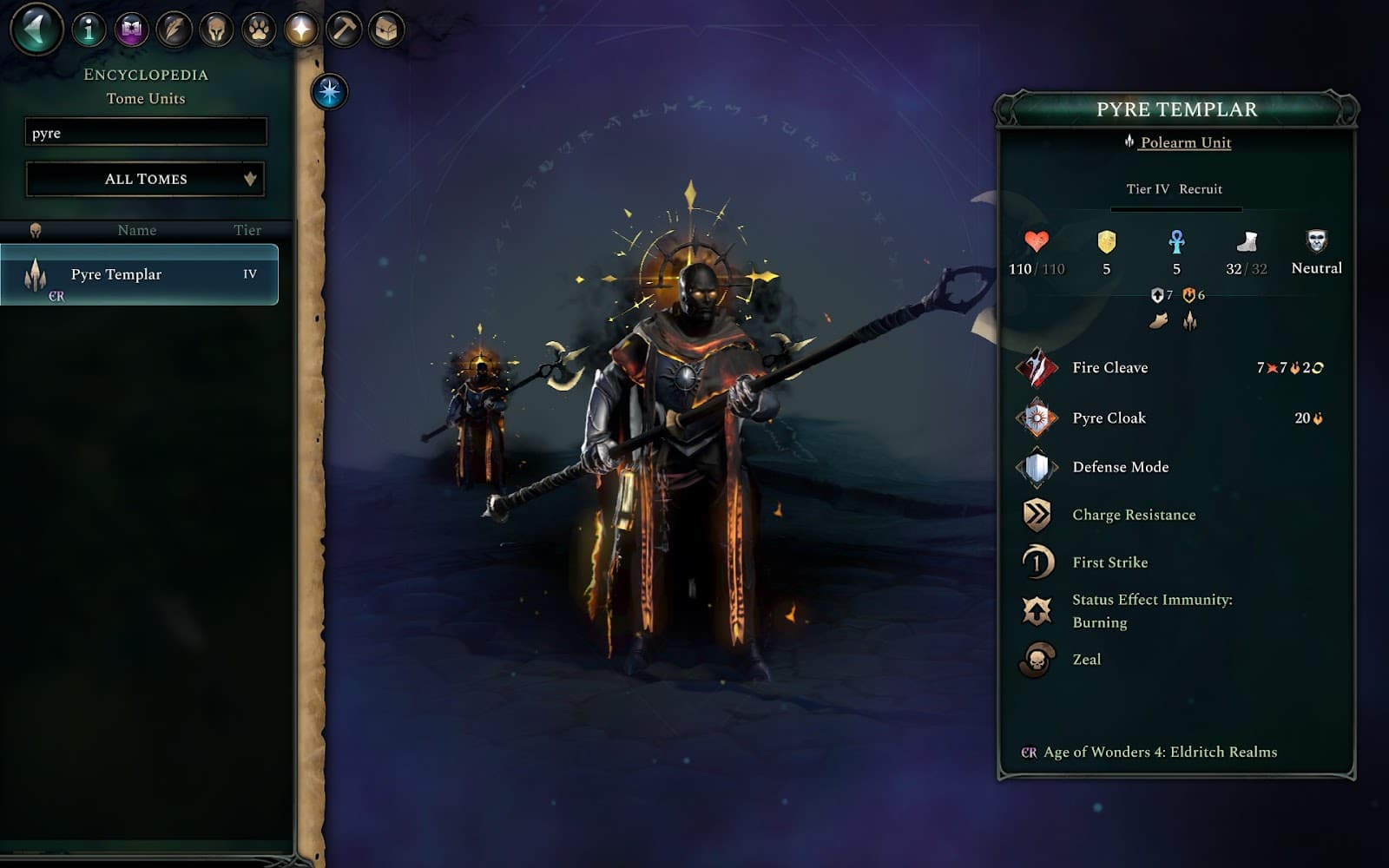
Pyre templars are especially cool, capable of just defending enemies to death.
Zealous Ignition targets a single friendly unit in combat, granting it Zeal til the end of combat, then Condmening all enemy units within a two hex radius til the end of combat, and ultimately causing the entire two-hex radius to burst into Cleansing Flames. Finally the strategic spell Consecrating Firestorm razes an enemy improvement and deals 20 Spirit damage to any enemies in the province. For three turns after, any combat in that province will have patches of Cleansing Flames sprinkled across the battlefield, and all enemy units will immediately be Condemned at the start.
My overall verdict on the tomes is a positive one, though moving forward I hope Triumph explores adding new level 5 tomes, as they’ve notably shied away from that level of power in their DLCs. AoW4 is still missing the absurd, game-ending power found in some of the earlier games’ top-end spells, to say nothing about the degree of power found in classics like Master of Magic.
Drinks and Dancing on the Aft Steamdeck
If you’ve read my other reviews, you might know I throw in a blurb about how a game plays on the Steam Deck. It’s simply something I wish other reviews would do simply because the “Steam Deck Verification” system is next to worthless once you venture outside the “Great On Steam Deck” product category.
But before we get to that, I wanted to mention my main rig (3080 GTX, i5-12600k, 32gb RAM) which had Primal Fury buttery smooth on max settings started to show some slight hiccups after Eldritch Realms, especially around zooming in and out on the strategic map. From tinkering around, I think it’s due to the use of MSAA, which is multiple times more expensive than more modern shader-based methods like FXAA or MLAA – and this isn’t even beginning to consider achieving an AA effect via more eldritch magics like DLSS or FSR.
Essentially, I want to see more AA options in AoW4, especially modern ones. I’m sure I could accomplish it myself in reShade or something, but ugh, reShade.
Now, on to the Steamdeck.
When it comes to AoW4, things aren’t pretty for the ol’ deck. With enough tweaking the strategic map isn’t too bad, but combats are slow and combats with multiple stacks are slideshows. You can also expect your Steamdeck to begin to double as a hand warmer and the battery to last about as long as a pair of pack-in C batteries from a company you can’t confirm actually exists, or ever existed.
If it wasn’t for the performance, it’d be fantastic. The controller UI is top-notch to the point of me occasionally using one while playing on a PC. But Sadly AOW4 is too much for the first-gen deck. I’m hoping the next will bring the firepower required.
These Aren’t the Voids You’re Looking For
Eldritch Realms isn’t the Shadow Magic I hoped it’d be. I still struggle to get engaged with the game. It still just doesn’t keep me coming back. It’s still missing that secret sauce for someone who isn’t enamored with the race creator. It’s still a bizarrely overbalanced game in a genre that doesn’t care about multiplayer. It’s still afraid to take risks, still afraid to let the AI play to win, still missing unit flavor text, and still a little lost in terms of its voice.
It’s also still a great game when I do sit down and commit to playing it, and when I set aside my own history, prejudices, and expectations for this DLC, I can only call it excellent, especially for the price. If only Stellaris was so generous.
If you’ve been waiting for Age of Wonders 4 to hit that crescendo the way the final expansions to the previous games did, the bad news is Eldritch Realms doesn’t. The good news is it’s no longer the final expansion.
But if you want new dark, Lovecraftian stuff for your Age of Wonders 4 games, definitely pick up Eldritch Realms. It’s a great expansion, even if I had to wait longer for the Promised One.