“The story so far: In the beginning, the universe was created. This has made a lot of people angry, and been widely regarded as a bad move.” — Douglas Adams, The Hitchhiker’s Guide to the Galaxy
What most people don’t know is that shortly after the creation of sentient beings, games came along. And they were perfectly formed — bug-free, concise, comprehensive, and blissfully complete. No DLC required.
And then a horse came along…
Oh, the good old days.
In this eXposition, we’re going to dive into the world of DLC: the good, the bad, and the ugly.
This is a companion article to the podcast The Good, the Bad, and the Downloadable, in which the eXplorminate team have a special guest – Al from Critical Moves – on to discuss DLC, the good, the bad and the Stel…sorry downloadable.
If you prefer, the podcast is also available as a video.
Please support us by joining our Discord and our Patreon.
What Comes to Mind
When talking about DLC, certain ideas immediately spring to mind:
● Horse Armour (thanks, Oblivion) and other microtransactions
● Species packs (Stellaris)
● Marketing spin
● Expansion packs
● Paradox
● DLC sprawl
● FOMO (Fear of Missing Out)
● Cut content and milking the customer base
● DLC giving a game “legs” — extending its longevity
● Paradox — wait, did we mention them already? 😉

So, What Actually Is DLC?
DLC, simply put, stands for downloadable content. By that definition, the entire gaming hobby is DLC. When was the last time you used a physical disc? Even Nintendo is moving away from cartridges.
So while that definition is technically correct, it’s not especially helpful.
When people talk about DLC, the argument generally comes down to this:
DLC = small, usually cosmetic additions, also known as microtransactions — and these are “bad.”
Expansion packs, on the other hand, are big, juicy, meaty, and great.
Other dlc, can be any content that is added to, or sold separately from, the game. Examples could include things such as soundtracks, wallpaper and artbooks. Generally, no one ever complains about these.
Obviously, this is an oversimplification, but it’s one rooted in reality.
For this discussion, the focus is on the above, especially within the 4X and strategy game space. But it is worth noting that there are various dlc models.
Free to play (f2p) games, for example, might rely much more on selling skins for popular characters, and in general, you expect that, and it is much easier to accept, when the price of entry is £0.
That is quite different from paying top dollar for an AA game and seeing that it releases with extra factions that you must pay to unlock. As in, that content is clearly cut.
The Case Against DLC
The dark side of DLC can be summed up in three points:
● Milking gamers for all they’re worth
● Cutting content from the base game and selling it back
● Killing the prospects for a proper sequel
Point 1: The Price of Everything
Exhibit A:

● Base game price: £41.99
● Total cost to own everything: £359.03
● Verdict: This is blasphemy. This is madness.

Exhibit B:

● Base game price: £41.99
● Total cost to own everything: £164.71
● Verdict: Ugh.
Just these two games, “fully” owned, would set you back £523.74. By way of a hyperbolic, entirely apples-to-oranges comparison, you can buy a car in the UK for less.
Point 2: Cut Content
It’s true that the final version of any product rarely incorporates every idea from its inception. There must be iteration, trimming, and refining. As the old quote goes:
“Perfection is achieved, not when there is nothing more to add, but when there is nothing left to take away.” — Antoine de Saint-Exupery, Airman’s Odyssey
But that wisdom rings hollow when a recently released game already has this much DLC on the shelf — all of it labelled as “content” packs.
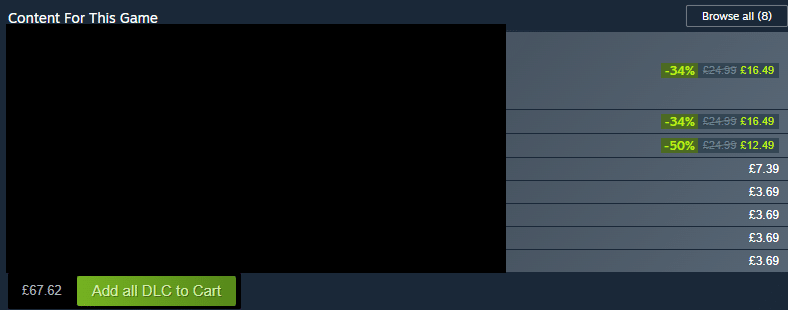
I wasn’t part of the development team, so I can’t say for certain. But it seems fairly obvious that much of this was created before release, then held back. It all contributes to the feeling of being taken for a fool — of being milked. Consider it part of the broader enshittification of things.
Point 3: The Sequel Problem
This one is more subjective. When a game accumulates dozens of DLC packs covering every corner of its universe, any sequel is inherently lesser from the outset. For the long-term, hardcore fan — the person most likely to have bought all that DLC — this feels like a slap in the face.
That said, well-managed DLC can actually work in a sequel’s favour. Distant Worlds 2 comes to mind as a positive example.
A Further Note
The rushed production of DLC — sometimes even outsourced to entirely different teams — can result in a user experience that speaks for itself.

So Why Do We Keep Buying It?
From a developer’s perspective, it would be foolish to ignore the revenue potential. But from our side?
I think — and this is not scientific — that in an age where a thousand things compete for your attention, when you find something you genuinely enjoy from a developer you respect, you feel part of a community. You want to support them, even if, deep down, you suspect a particular release might be a pile of crud.
Kevin Kelly wrote about this phenomenon in his essay “1,000 True Fans.” A less charitable framing would call those supporters “whales.”
And it would be hypocritical of me to pretend I haven’t bought DLC. I have. Lots of it.
I like to think I buy the DLC that’s “real” — more on the expansion pack end of the spectrum than the microtransaction end.
But this raises a thorny point: my “meaty” is your “anaemic.”
Maybe Parhelion is right.

Defining “Good” DLC
If I had to create a working definition, it would be this:
Good DLC is content that doesn’t appear to have been stripped from the base game, but instead feels as though it was added organically after release. It arises from the reception of the game, not from material that was held back. It adds meaningfully to the gameplay experience, as opposed to offering purely cosmetic changes. Such DLC arrives every six months or so, representing a sizable addition to an already sizable game. In other words: the expansion packs of old.
And it would appear PC Gamer agrees.
Some standout examples:
- Interstellar Space Genesis {Steam }
- What dlc?

- What did they add? New races, new rulers, new empires
- Why is this “good”? (relative to the base game) Came out several months after the base game, looks, feels and acts like an “expansion pack.” NB – the author has not played this amazing looking game yet. He fully intends to though. It, and it’s DLc, come very highly recommended
- Spellforce: Conquest of Eo {Steam}
- What dlc?

- What did they add? Entirely new mechanics (pay attention to the constellations), enemies and allies, including some very tough looking and hitting trolls. Also, new spell schools
- Why is this “good”? Similar to IS, good pacing out of content, and everything just fits together in the very focused game world.
- Age of Wonders 3 {Steam}
- What dlc?

- What did they add? new campaigns, new races and new classes, going deeper into faction asymmetry.
- Why is this “good”? A good example of adding complexity to the base game, but keeping it relatable. Solid, well thought out content, developed after game release (as in, not cut content).
Developer Perspectives
No discussion of DLC would be complete without hearing from the people who actually make the games. Fortunately, we at eXplorminate are blessed with access to many.
Enkidu |Curious Dynamics| Folk Emerging
“I do have some DLC planned, and I like the way games like Old World structure theirs: an expansion of a particular system with new related factions, content, and events.
Some pros: it makes it more financially sustainable to keep expanding and improving the game post-release; it keeps the community engaged and rewards long-term players; it signals commitment to the project; and it lets you test new systems and themes on a smaller scale that you can further expand in sequels or other games.
Some cons: as far as I know, even DLCs that sell relatively well are only purchased by a small fraction of the player base. There’s also the opportunity cost — it’s time that could be spent on a new game with a higher chance of keeping the studio alive, which is especially important for self-funded small teams or solo developers. And there can be an expectation around DLC that leads some players to call a game ‘abandoned’ if it doesn’t receive any, or not enough.
This reminds me — I ran a small survey a few months ago across several Discords, collecting people’s preferences for DLC types. I’ll share it in case it’s of interest. I also did some Steam DLC analysis.”

Jejoxdev | Hard Void
“I think DLC is a good tool for extending a game’s life after full release. Used properly — adding a large number of features without building an entire game from the ground up, and limiting yourself to two or three packs — it’s a nice approach. But you have to be careful not to overextend the game when you should be making a successor instead. That said, building a successor is a massive leap in effort and time, so DLC can fill that gap by sustaining interest and generating funding before the next project.”
Zeikko | Astro Protocol
“DLC can mean many different things: artbooks, soundtracks, small feature packs, or larger expansions — and each comes with its own tradeoffs. We’re only just about to release our first ones, the Astro Protocol Artbook and Soundtrack, but broadly speaking, DLC offers a flexibility that full releases and sequels don’t.
From a developer’s perspective, DLC makes it possible to extend the life of a game in focused, optional ways. You can explore niche ideas, expand specific systems, or add content for your most engaged players without forcing everyone to buy or engage with everything. Instead of designing one ‘all-or-nothing’ product, DLC lets players choose which parts of the game they want to invest in further.
One downside I’ve already noticed is fragmentation. As you add more DLC, the player base and the game itself can become more divided, and the growing number of DLC combinations increases testing complexity, maintenance work, and the risk of bugs or compatibility issues.”
Mat | Feudums
I think DLC, at its best, is a more obscure version for GaaS, a tool for sustainability and continuous delivery, as it lets developers actually ship a self-contained base game, see how real players engage with it, then iterate with focused, meaningful additions.
When done right, DLCs can extend the life of a game, keep the buzz going, and give devs room to explore ideas that didn’t fit cleanly into the original scope. Pre-Civ 6 Civilization, Endless Legend or Endless Space 2 are good examples – you didn’t need the DLCs, but they genuinely added new systems and depth. so they felt like legit “add-ons”.
The problem starts when DLC becomes a business strategy first and a design tool second. That’s where you get fragmentation, obvious cut content, and an endless chain of small expansions that even quietly lock more and more of the original options behind paywalls. That’s when trust erodes. Paradox tends to drift in this direction (I consider CK3 a “good” example).
Old World or Humankind feel like the better compromises between the two schools – Old World leaning towards the “long-term lifecycle”, and Humankind closer to the “business strategy” model (but without aggressive paywalling).
More broadly, I think the whole GaaS/DLC model has drifted into unhealthy territory. In theory, it’s about continuous improvement. In practice, it often becomes sales-first design: ship thin, launch incomplete, sell back the rest later.
I’m personally invested in this as a dev. Feudums wants to be a “good” GaaS – in the sense of longevity and sustainability, not monetization layering. I’ve had to clarify this explicitly in my pitch deck, because some publishers seem to equate GaaS and DLCs with revenue extraction instead of building a healthy long-term ecosystem. Maybe it’s a chicken-and-egg problem, but the terminology itself has clearly been eroded
Conclusion: Living with DLC
DLC isn’t going anywhere. The economics are too compelling for developers, and the appetite from players — even reluctant ones — is too real. So the question isn’t whether DLC will continue to exist, but how we shape the standards around it.
As consumers, we aren’t powerless. We can nudge the industry through thoughtful reviews, honest podcast discussions, and by voting with our wallets. When a developer releases DLC that genuinely enriches a game, we should celebrate it loudly. When content is clearly carved from the base experience and sold back piecemeal, we should call it out just as loudly.
The developers we’ve spoken to here are proof that thoughtful, player-first approaches to DLC do exist. By highlighting the studios and titles that get it right — and by fostering honest dialogue between developers and their communities — we can help ensure that DLC leans more towards “expansion pack” and less towards “horse armour.”
The good old days may be behind us, but with a bit of collective effort, the good new days don’t have to be.
Enjoy, and keep exploring!
This show wouldn’t be possible without our amazing Patrons.
eXplorminate is an independent games journalism and games loving website and community, but we cannot make things happen without your support. Please donate to the Patreon, visit our YouTube, listen to our podcast and join our Discord, if you want to support us.