As a 2021 holiday gift from eXplorminate to the 4X community, I’ve enlisted the help of one of our very best to help those of you that might be receiving Old World as a gift, or might finally have some time to sit down with it during the holidays. Without further ado:
Right to business: for your first game, after doing the tutorial scenarios, use the Advanced Setup to set the AI to have no starting development and no handicap bonuses. The AI does not need them, at least until you have a firm grip on every aspect of the game.
I recommend playing either Rome or Babylon for your first few games. Rome has outstanding military production with very strong unique units, while Babylon has extremely high early science, which will help cover any deficiencies in your play. Egypt is a very strong choice for a builder game, but they are relatively weak militarily and the AI will mercilessly attack you if it thinks you are weak, so avoid them until you know how to fight properly. Greece and Persia are both fairly standard factions with a decent mixed skillset. Avoid playing as Assyria or Carthage until you know what you’re doing; they are both very strong when played well but they’re also harder to play correctly.
Good Governance
- You need to expand very quickly. Military units and scouts can camp on a city site and hold it until you can get a settler to it, but be aware that the AI loves to occupy all the sites as quickly as possible. Be prepared to pump out a lot of military units early on to take and hold barbarian camps.
- Settlers are produced using both Food (an empire-wide stockpile resource), and Growth (a city-specific currency). Food primarily comes from farms and Growth primarily comes from granaries, and from fishing nets, pastures and camps on various natural resources. A city with 2-3 exploited wild animal resources and 2 granaries is a fine settler/worker pump for the early game, and can rapidly generate Citizens to turn into Specialists later on. You want at least some Growth in every city, but only 1 or 2 with very high growth for settler production.

- Do not play nice with the Tribes. Tribes will generate Barbarian raiding parties even if you’re friendly with them, will only attack with units local to you (in practice, within about 4-5 tiles of one of your units), and will be mercilessly wiped out by the AI civs very soon anyway. Think like Julius Caesar; any diplomatic agreement you make with a Tribe is very short-term and should be broken as soon as is convenient to you.
- Every city should have 3-4 quarries with Stonecutter specialists to generate a decent Civics output early on. Civics are used by cities to train specialists, and any unused civics go into the empire’s stockpile, where they’re used to pass laws, upgrade your religion, build wonders and perform some political functions. Later, Civics can be generated much more efficiently by Courthouses, Palaces and the like, but these only unlock at higher culture levels and later in the tech tree.
- Unlike in most 4Xes, in Old World Cities shouldn’t be too specialised. Some cities will eventually be better at military production, have higher natural growth and so be better for churning out workers or settlers, or you may choose to pursue culture heavily in a city to unlock wonder building, but it’s not really possible to neglect any output completely in any cities.
You want the full complement of barracks and ranges even in cities you don’t want to build units in, so you can store units there to gain XP and to provide Training points directly to the Empire stockpile for upgrading and maintenance. Even military production cities will need Culture to unlock better units and higher-level buildings, and a decent amount of Growth and Civics to generate pops and convert them into officers. And Science is difficult enough to get that generating it is everyone’s responsibility.
- Keep your noble families happy. It’s very easy to think you can ignore these aspect of the game and just focus on playing it as a normal 4X; but careful management of the Families is every bit as important as maintaining a strong army and cultivating your economy.
Pissed-off families’ units have performance penalties and their cities can spawn rebels (even with zero discontent). Happy families units get a performance increase and get a substantial maintenance reduction. Plus, unhappy families are more likely to cause unpleasant events to happen.
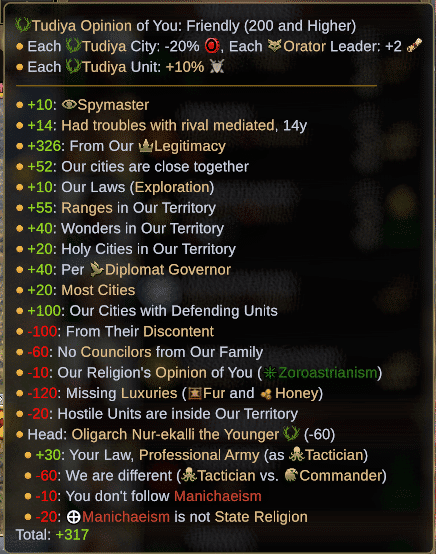
Families get -20 relations from every level of discontent in each city they own, and you’re likely to hit 4 or 5 discontent in most cities before you have the tools to manage it effectively, so this will generally be the source of most strife from your nobles. This will mostly be counteracted by your Legitimacy; you get +1 relations with each family for every point of Legitimacy you have (along with other benefits, like extra orders). Use your Legitimacy as a rough guide for how much you can get away with expanding, and try and keep cities more or less evenly split between three families to maximize the number of cities you can get from your authority.
- Cultural growth is very important, but it’s a double-edged sword. All wonders, most buildings and some units are only available for higher-level cities. But at the same time, population in high-level cities become increasingly demanding: while at low levels each pop point only needs a little food, as the city levels up they not only start consuming much more food, but also wood, stone and iron. Try to keep an eye on when cities are going to move from one level to the next, as a large city shifting from Strong to Legendary culture can have a substantial impact on your economy.
You may wish to deliberately starve some marginal cities of culture, using them as raw material farms that can produce a lot of food, stone, iron, or wood without consuming much. But eventually, even these cities will evolve, and they will be poorly fortified and lack research or discontent management buildings.
- Managing Discontent is very difficult early on, and for the most part you shouldn’t bother trying. Each level of discontent in a city will increase its maintenance cost and slows its growth down, but reducing it in the early stages of the game requires expensive and ineffectual Festivals. By the mid-game, you should start unlocking Baths, luxuries and religious buildings, which will reduce the discontent build up enough to make Festivals actually useful. Only use them early on if you’re having trouble with the city’s owning Family.
- You should be routinely buying and selling resources from the very start. You can buy and sell at any time, including during events, so if an event option requires a certain amount of gold or iron or whatever, do juggle stuff round and buy what you need. The AI trades heavily, selling its surpluses and buying what it needs, and the prices move dynamically based on supply and demand.
Early on in the game, stone and wood prices will be high, while iron and food tend to trade cheaply. Toward the late game, Food prices will begin rising as increasing urbanization squeezes supply while rising culture levels drive up demand, and iron will grow increasingly expensive as more and more units start to require it.
It’s also worth mentioning that warfare can massively disrupt the market. If you’re planning to attack an AI’s main food city, then stocking up on food beforehand to sell when their economy implodes can be outrageously profitable – I achieved a ten-to-one profit margin over about 15 turns in a recent game. This can go the other way tho – the AI will start buying large quantities of wood, iron, and food to make units during wartime, so if you’re relying on imports for any of these, then you can find yourself painfully squeezed if two large powers get drawn into an extended conflict.
- Replacing improvements is not only a good idea, you pretty much need to be doing it as your cities expand. Cities need urban tiles; if you have less than 1 for every 2 population then they will generate discontent, and many improvements need to be adjacent to or on urban tiles. While Builder kings can build Urban terrain directly, other kings will need to create urban terrain by building urban improvements and Hamlets, which will cause the terrain to spread under them. Building out hamlets to spread your urban terrain and later replacing them is the key to achieving strong civic and science production.
Urban-spreading improvements are either (Urban) or (urban build anywhere). (Urban) means that it must either be built on existing urban terrain or adjacent to at least 2 urban tiles. Use urban (build anywhere) improvements in twos or threes to create new urban areas when space is tight.
This is also a huge source of power for Clerics family cities in desert environments. Clerics can build Urban improvements on sand tiles, and so you can convert huge swathes of the Sahara into city tiles through a careful place-and-replace of cottages process.

Warfare
- In most 4X’s you build a unit and it’s done. Old World, on the other hand, is more like a typical wargame in that green troops are extremely bad. The AI will generally ensure most of its units are level 3 or higher before sending them in, which can equate to being 50% stronger than a level 1 unit.
Thankfully, you can spend training points to buy XP, but this stacks up quickly. Every point of XP costs 1 training, and you need 100 XP to move from level 1 to 2, 200xp to go from 2 to 3, 300xp for 3 to 4, and 400xp for level 5. You can get 10xp a turn for free by sitting in a barracks (for melee units) or a range (for, well, ranged).
Except for the direst emergencies, no unit should be sent into combat at less than level 2, and you should aim for level 3 for most units. This also means that you can’t really produce an army during a war, no matter how high your production values; even if you churn out a swordsman every 2 turns, he’ll be butchered by the enemy’s swordsmen without at least 3 more turns of training up.
- Since every unit is such a big investment even in the late-game, you’ll be wanting to prioritize keeping them alive more than you do in most other 4Xes. This means that you’ll want them to hang out in big groups of friends, who will guard their flanks and who wounded units can hide behind.
Wars in Old World are almost always a game of large armies fighting other large armies, not individual units fighting other units. Almost every unit can survive 3 hits from an equal unit before it dies, so if you can prevent a unit from being hit by more than 2 enemies in one turn, he can be withdrawn and healed up. So you want to deploy your units in lines; an individual unit out in the open is almost always a dead unit, no matter how great he is.

- Terrain matters tremendously in Old World battles. Ranged units on hills can shoot farther; units in Urban or Wooded tiles get sizeable defensive benefits against ranged attacks. Cavalry get very large attack bonuses against units on Flat terrain.
- Most units exert a Zone of Control onto each tile adjacent to them, and enemy units cannot move from one ZOC tile into another ZOC tile. This allows you to pin enemy units, or prevent them from breaking through even if you lose a unit in the line. However, be wary – cavalry units ignore most ZOCs, and Roman unique units ignore ALL enemy ZOC.
- Most units in Old World have bonuses at certain jobs. Learn what they do and use the right tools for the job:
Melee infantry (warriors, axemen, maces, swordsmen) are mostly meat shields. They have the Fortify ability (+25% defense, gained at 5% per turn) and many have the ability to ‘splash’ damage onto the units left and right of their target (‘Cleave’). They also tend to do a lot of extra damage to other melee infantry units.
Spear Infantry (pikes, spears) has several benefits: First, they excel when attacking or defending against cavalry. Secondly, their ZOC works against horse units, unlike other units. And finally, they have the ‘Pierce’ ability, meaning a portion of their attack bleeds through into the unit behind the target. You should definitely have a good mix of pikes in with your swordsmen and axes, or enemy cavalry will tear through your army and race through the gaps in the line.
Slingers, Archers, and Longbows shoot things from far away. Ranged attacks lose damage for every tile they travel unless you have the Eagle Eye promotion, so often you’ll want to bring your archers very close to the enemy before shooting. You want your archers to be doing the bulk of your damage output, generally.
Catapults are great at battering down city defenses, and also have splash damage onto all enemy units around their target. Dense formations of enemy units should be bombarded with catapults before sending cavalry in to mop up. They need to spend a turn unlimbering after moving before they can fire, but a line of catapults hammering into an enemy formation can tear massive holes in the enemy lines.
Cavalry not only tends to have high strength values and ignore Zone of Control but also almost all get an enormous damage bonus to infantry caught in ‘open’ terrain. Most also have the ‘Rout’ ability. This allows them to attack again if they kill their target, and can happen multiple times in a turn. The AI is very good at setting up big kill chains with Rout, and good late-game play is largely a matter of setting up such chains to efficiently kill 5-6 units with a single cataphract.
Camels are an interesting cavalry archer unit that specializes in killing horses and fighting in deserts. They also get +1 movement range. Their strength is quite low compared to late-game units, but when they initially unlock they are a reasonably strong unit.
Elephants displace enemy units from the tile they attack. Use them to push infantry out of urban terrain or off hills. They also have end-game strength values but unlock in the middle of the tech tree, so if you can field a lot of elephants in the mid-game there are few serious counters available.
Crossbows are late-game ranged units with Pierce which specialize in killing infantry. They’re very short-ranged but can be effective for clearing heavily entrenched infantry from urban environments.
Ballistae are short-ranged artillery with a bonus against infantry and firing into Urban. They also hit 3 units in a row, so they’re pretty much intended for hitting dense blocks of enemies fortified around cities.
- Specialise your units heavily. Ranks of each promotion stack (so +5% from combat 1 and +10% from combat 2 = +15%), and higher-level versions of most promotions are always stronger than the lower-level version they’re stacking with. Additionally, the generic ‘combat’ promotion (increasing both attack and defence) is half as powerful as the specialized attack-only/defence-only promotions.
Combine this with the unit’s inherent bonuses – elephants, cavalry and archers will typically be used offensively and so should promote for attack bonuses; most melee infantry should take defensive promotions and try to fortify in urban, forested or hilly terrain to block enemy movement; Pikes and Camels will typically be used against enemy horses and so should take anti-mounted bonuses.
- Also specialise your generals. They can become obscenely powerful, depending on their stats. Knowledge increases crit chance, Courage increases attack, charisma increases defense and discipline gives units a passive xp income, and these scale non-linearly, so that going from 4 to 5 courage gives more bonus than going from 2 to 3. This means high-stat generals can literally swing entire wars. A 10 Charisma general, leading a guard 3 unit from a happy family, fortified in a fort can hold back whole armies indefinitely just by sitting still and healing itself every turn. Conversely, a 10 Courage general leading a force of strike 3 Cataphracts can chain-kill large numbers of enemy infantry units if he catches them in the open, and a Discipline-10 general can be dropped onto different units as they march to the front to super-charge training.

- Since units are being heavily specialized, you don’t want your attack units to be on the borders, and you don’t really want to be taking defensive specialists into a major offensive. So you should also specialize your armies. Divide your forces into Defence Groups and Campaign armies.
The Defence Groups are your border guards. They want promotions like Guard, Tough, Shieldbearer, Herbalist and Combat, and should form tight lines of fortified melee units, with forts if possible, within your territory. Ideally, you will be able to draw a fairly straight line between two mountain ranges, or from a mountain to the sea, and use this to form your line. The job of a defence army is to stay alive as long as possible to slow down an enemy attack; you don’t even particularly want these units to kill the enemy. . If you can spare the resources, add a line of archers and some catapults behind, to soften up attackers; your melee line will be too busy healing up damage taken to be able to fight back. Since these units generally just sit fortified in one place, you can also skimp on the training here; you still want them to be level 2 or 3 but shouldn’t feel the need to push every unit to level 5.
That’s it for now, 4X fans! Hopefully these wonderful tips by our valued community member Ruzl – you may know him around the eXplorminate community as Naselus – have provided you an excellent foundation for learning the intricacies of Old World and to help you get started in this fantastic game.
Expect future updates as the game evolves and check back in a few days as eXplorminate hands out its Game of the Year award!

Ruzl, aka Naselus on the eXplorminate Steam forums and elsewhere, is a 4Xpert, with deep knowledge of many of the best, and most engaging, 4X games out there. He’s a regular around these parts and a valuable contributor to the community.
Awesome article! I’m going to look over it again when I revisit the game.
Great guide, never knew this game was so deep. Now is a great time to grab it too with the 10$ coupon from epic.
Very nice article, I had know idea this game was so deep. Simple question – is it on par with a Civ game?
Old World is very much an equal to any Civ game aside from possibly Civ 4 (also by Soren Johnson). It’s more mechanically complex than most recent 4Xes, but the design is extremely tight and everything is integrated; no mechanic fails to serve a purpose.
There’s a reason it’s even Amplitude mega-fan Rob’s game of the year 🙂
I look forward to trying it when it hits Steam.
What difficulty should you even play at to get an interactive experience? I keep launching it, playing 100 turns, and realize I’ve spent hours of my life with nothing really happening. I’ve got 6 cities, still a number of open sites to colonize, a score that seems pretty good, and never a chance to fail (which is a test to see if I’m doing it right). I’m just building 2-3 workers/city and a handful of military units and spamming building things and hitting end turn. All this on the default settings.
With a game like Slipways or Star Dynasties or Gladius you have to plan and/or connive from very early on. With Old World it seems like hours of low-consequence city-builder with maybe at some point having a non-trivial war that hopefully you’re prepared for and it doesn’t just end your game but how would you know since the barbarians don’t seem to put up much of a fight?