Back in the summer of 2020 whilst trawling Youtube, I came across a video of our friend DasTactic playing a strange-looking game that looked suspiciously like a Matrix-style military simulation. On closer inspection, it turned out to be a post-apocalyptic sci-fi 4X strategy title with some heavy wargaming aspects. I asked Rob if he’d heard of it and it turned out that not only was I correct on my guess at the publisher, but that we’d just been sent a preview copy by Slitherine, and since this one looked to be right up my proverbial alley, with his usual cunning he palmed it off on me instead, having clearly realised this wasn’t going to be a game one can learn in a couple of afternoons. Or ten afternoons.
Several hundred hours of play, a video series on Youtube, and one 14,000+ word preview article later, I still cannot claim to really understand Shadow Empire, but as predicted, it has become one of my favourite games of all time.

Since that initial evaluation was published, the game was released: first to Matrix and then, back in December 2020, over to Steam, where it proudly shoulder-barged its way onto Valve’s “top sellers” list for the month, standing up alongside heavyweight AAA titles Medal of Honor, DragonQuest XI and Cyberpunk 2077. That would have been an impressive achievement for any strategy game, but for one of this complexity, it is downright astounding.
The brainchild of Vic Reijkersz of VR Designs and a hard-worked evolution of both Advanced Tactics Gold and the Decisive Campaigns series, Shadow Empire is an ambitious blend of Alpha Centauri-style terrestrial sci-fi 4X game and modern hex-based wargame of the kind usually constrained to World War II simulations and other historic conflicts. The previously mentioned preview article went into extensive detail about the game’s features: the focus here then is what has changed in the time since it was published.
Updates to Shadow Empire can be roughly sorted into three categories: bugfixes and optimisation, balancing, and new content. The first is mundane stuff, but suffice to say the developer has worked hard to get the game into a state fit for a Steam release: attentive players are still reporting the occasional obscure bug but Shadow Empire is stable and runs smoothly.
There is one issue that has to be mentioned here. Turn processing times can be on the long side, and whilst there is a detectable pattern in the post-release development cycle where Vic will add a feature or tweak something in optional beta versions followed by a noticeable turn time increase and with later stabilisation for a major update, they’re still over-long for some players. The larger the planet and the more AI players present, the longer the turns: please note however that there is now an option to reduce the fidelity of the AI’s tactical positioning calculations to speed things up somewhat.
This is probably the game’s biggest problem right now, and whether it will affect you is largely down to what kind of games you’re used to playing. Less war-focused 4X fans, used to long sessions with rapid turnover of game-rounds might balk at the wait when the AI’s thinking time increases on the larger maps as they near the endgame.
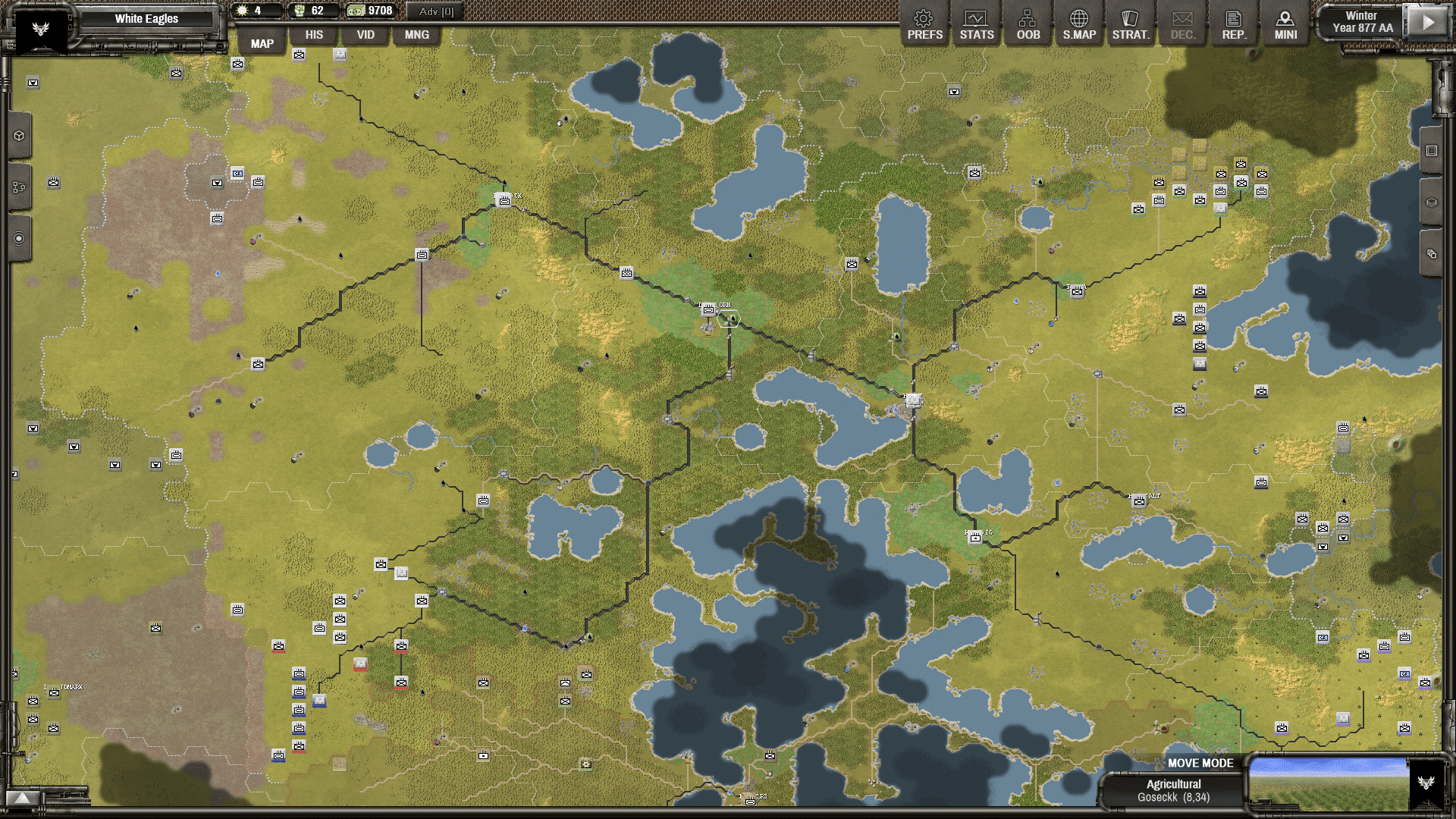
Things look better when examining changes made to the core game to address other issues. The logistics system underwent a major overhaul not long after I wrote my preview: where before logistics points were pushed out along roads, requiring excessive traffic management in order to send supply out across your road/rail networks and cover requests made in parts of your territory, now instead the game defaults to a “pull” based system, where units request what they need and supply is allocated to fulfill them. The old “push” mechanics are still there, and are not only toggleable on or off but can be used in tandem with the new system.
Unfortunately for a new player, the logistics system itself has doubled in complexity if you want to fully understand how it works, and the sheer amount of data, options, and boxes available in the Traffic Management screen now borders on the overwhelming side. That said the pull system means the player rarely needs to touch logistics routing for many turns now, at least not on the lower difficulty settings or unless the player is trying to squeeze the most efficient solution from their network, resulting in a superior experience for first-time players. There is even an option to double the logistics range, for those who really don’t want to touch it much at all.
Vic has tried to please everybody with this system I think, and approached the solution in a style typical to his irreverent approach to game design: this is not an elegant mechanic but it is a functional one and should suit both those who want to micromanage, and those who do not. The reward for this unwieldy monster is that the game features the most wonderful and engaging logistics and supply system we’ve yet to see in a 4X game, and perhaps better than many of the bigger wargames too.
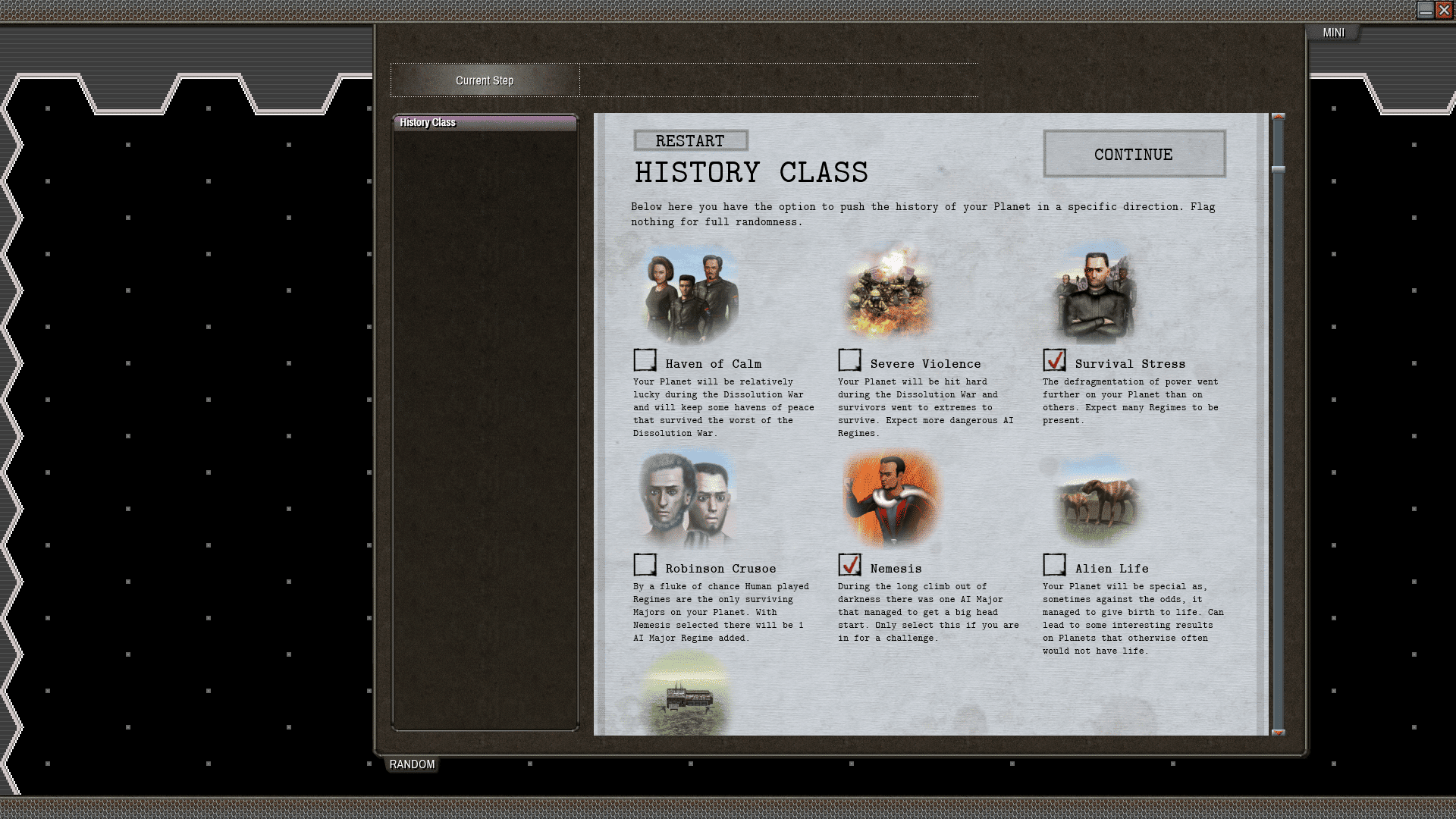
Planet generation adds a series of “History Lesson” options to more closely sculpt the game experience to one the player desires: players can have more or less populated planets, force life onto otherwise uninhabitable maps, and create “Nemesis” major regimes that are developed well in advance of everybody else. This can mitigate an issue with random content creation that also plagued the CRPGs of old: if you wanted a specific situation in your game, you had to either sit and re-roll over and over again or hack the game files and this is a most welcome change to Shadow Empire’s exemplary planet generator.
The alien life has had a visual and mechanical makeover: there are now dozens of new graphics to represent the various lifeforms that can evolve on your maps and mechanics in the form of strategic and tactical level bonuses to their in-game performance. This not only serves to provide a clearer picture of the creatures you’ll face for role-playing purposes, a drastic improvement over the text-only descriptions before, but also a very real set of characteristics that bestow a varying degree of danger to encounters with them in the form of deadly claws, toughened armour, fast movement rates, better stealth and so on.
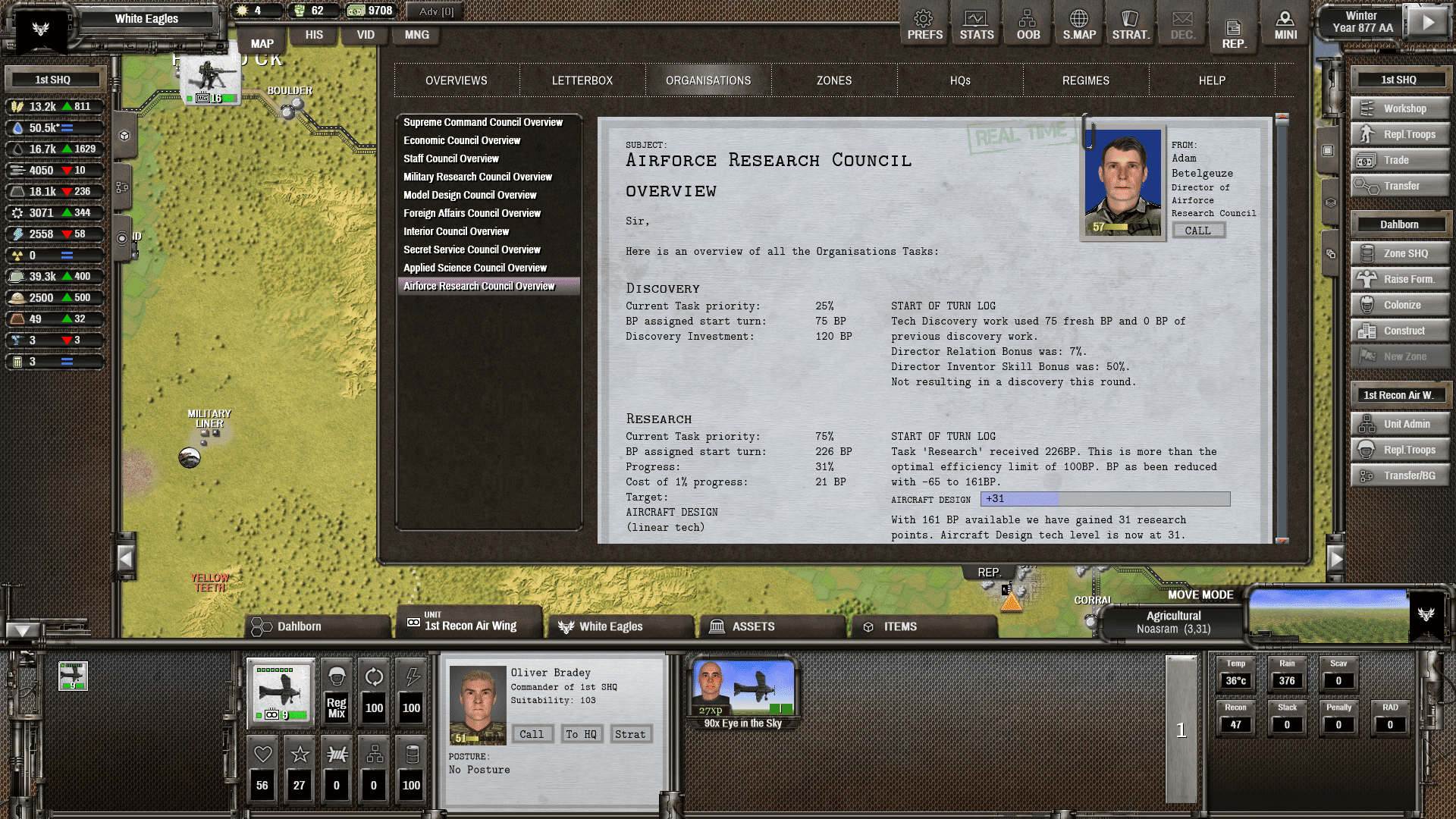
A surprise free update just before the Steam release added air forces to Shadow Empire. Aviation technology is closely tied to planet generation, where atmospheric conditions determine the kind of engine necessary to provide flight in non-earth-like conditions, Vic has excelled himself in providing a realistic, detailed model fitting for the science-fiction scenarios generated in-game. From propeller planes, jet engines, rocket-powered craft, helicopters, and bird-like Ornithopters, there is plenty here for the player to research, discover and experiment with. An entirely optional air force design council has been added to the game to facilitate quicker research of these technologies.
Aircraft can run a range of missions: air superiority, tactical and strategic bombing, reconnaissance and air-bridging supplies over non-roadable terrain. In practice, although the manual has been updated to explain how these new features work, with planet-type drastically affecting flight ergonomics, the process of designing effective aircraft initially boils down to a whole lot of guesswork: what works on paper can drastically underperform once deployed and a good design in your last game might fail miserably in the next.
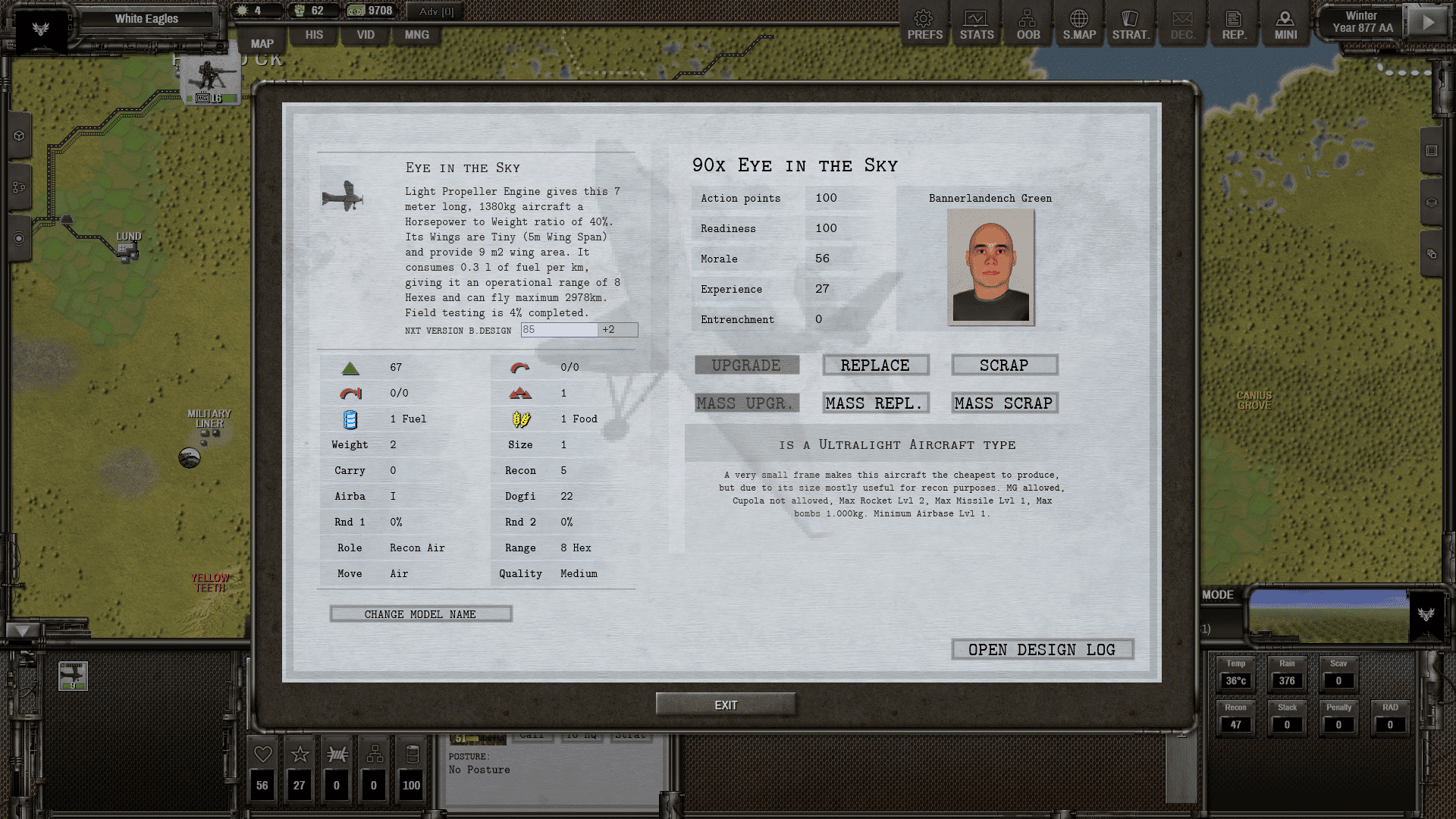
Aircraft model design is currently rather awkward: whereas the report-based component selection system (with the player selecting a single piece per page) worked fine for tanks comprising of only three or four components, aircraft can require twice that, and despite some patching to add in some quality of life features to show where previous options were made and added to the fact that aircraft are so hard to get right, the whole process is genuinely painful. The player can often spend a half hour flicking backward and forwards through the design pages, trying to find a working combination, where a simple one-screen interface would save a whole lot of hassle.
I know of one Youtuber who completely avoids aircraft design when playing to an audience because of how time-consuming, unreliable, and fiddly it can be. This is a real problem, but the developer is fully aware of this issue and has hinted at a redesign of the way models are created. This is something I’d consider an absolute necessity to make air forces a viable and fun part of the game.
Once you’ve got your newly minted strategic bombers in the air though, the game opens up a whole lot more, with the sky becoming an essential tool for attack and defense. Surface-to-Air Missile and handheld Man-Portable Air Defence systems have been added to help defend against air incursions too. This is really great stuff, and whilst the current implementation is rather hit and miss to get working to satisfaction, I fully expect that future patches will tighten everything up as we saw with the logistics system.
Multiplayer is a lot of fun: games will typically play out over long stretches of time, months rather than days, and I’ve yet to finish one, but so far the experience has been smooth and bug-free. Some players feel that the planet generation system, with its insistence on generating major AI start positions around where colonists would actually settle on the planet to exploit the best resources rather than placing everybody at equidistant locations, does not provide the balance necessary for a truly competitive multiplayer game. Shadow Empire then, in my opinion at least, follows in the footsteps of other such incredibly unbalanced, detailed, rich, and fun multiplayer experiences such as Illwinter Game Design’s magnificent Dominions, and your mileage may vary depending on whether you love or hate the concept of “balance” in video gaming.
In summary, Shadow Empire’s continued development after release has only improved on what was already one of the most innovative 4X titles I’ve seen in a decade or more into something even better. Any additions or changes to that formula were going to be contentious and risked upsetting that delicate ecosystem: the already difficult logistics system has dramatically increased in overall complexity but with the effect of making it much easier to deal with for beginners and allowing even closer fine-tuning for those wanting to get neck-deep into the grease. Likewise, whilst the current implementation of the air forces is more work than it needs to be in the design phase, this is likely the first time a 4X or wargame has approached the concept of non-earth-like aircraft design in a scientifically realistic way. Hats off to VR Designs for making the attempt there, where others might have taken an easier, safer option. The new other new features, particularly the options to assist more tailored planet generation are most welcome too.
Shadow Empire is still not perfect then but its overall shape is more well-formed than it was when I initially previewed it, and it is the most innovative 4X game to be released since Distant Worlds: Universe. I rate it eXemplary with little hesitation, where it joins a very elite group of high-quality games that push the boundaries of the genre into new and exciting territory. Furthermore, Shadow Empire received an honourable mention in our Top 10 4X Games of All Time article (link to follow): whilst we’re still in the honeymoon phase with this game we felt it wouldn’t be fair to give it a top ten spot, but only time will tell how influential it becomes and it certainly deserves all the praise it has received.
Well done VR Designs! And well done to Matrix/Slitherine for supporting such a fantastic project!


Otherwise known as BATTLEMODE, Ben contributes to eXplorminate via the eXplorminate Podcast and through his excellent writing! He’s a great asset to us here at eXplorminate, and we’re happy to welcome him on board! His Shadow Empire review is known throughout the internet for its depth and incredible detail!
I’ve not seen any of those issues: the AI likes to retreat to defend it’s cities if you get close enough to them, and although it can occasionally leave it’s formations in “Training” posture, it seems to use the defensive ones fine. The fact it ignores logistics is deliberate game design decision, that is in the manual and the reasons for it are explained there.