The Pegasus Expedition is a narrative-driven strategy game with a strong emphasis on fleet combat. The story it attempts to tell is a classic space opera, exploring themes likely familiar to science fiction fans, projected through the collective lens of a cast of characters with each reflecting their own unique worldview onto the narrative. The story is interwoven into the gameplay with every event having some effect on the strategic level. Strategy and tactics are where the game shines: Pegasus Expedition manages to deliver a streamlined experience with meaningful tactical decisions that reverberate up to the strategic and political levels.
A DNA of a Game
It is hard to pinpoint where The Pegasus Expedition gets its influences, but several come to mind immediately. From the name of the galaxy itself to the feel and look of the battles, two TV shows from the late 00s appear as probable influences: Stargate Atlantis and Battlestar Galactica. Fans will find familiar both the general aesthetic and story themes, from the low-tech design of ships and costumes to the militaristic point of view of the protagonists. These two shows themselves have a long line of influences and followers in film and literature, and so The Pegasus Expedition has a deep well of creativity and inspiration to draw from.
The second group of influences is obviously other 4X games. From the first moments in the game, 4X fans will find themselves in familiar territory: the game looks and feels like Stellaris, a game long established as a standard for the genre. But the similarity is rather superficial because unlike the former, The Pegasus Expedition is a single-player turn-based game with an welcome appreciation for the player’s time.
The second game that might come to mind during battles is the original Endless Space, a game that took the 4X genre by storm ten years ago and streamlined it down to the essentials. Unlike that title’s reductionist take on battles, The Pegasus Expedition has improved on the card-based system from Endless Space with added depth, allowing the player much more agency without bloating out the battles and subsequently distracting from the story. More on that later.
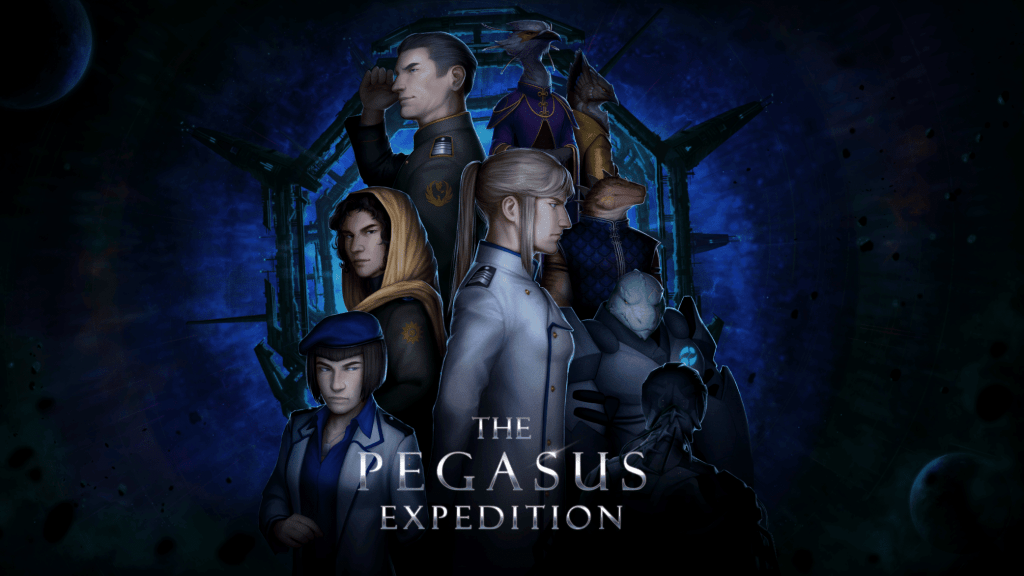
The Story
Humanity is facing an existential threat in the form of a mysterious and terrible alien menace. After a long and unsuccessful struggle, humans realized that the Earth would soon be destroyed unless something was done. Several world powers banded together and mounted an expedition to a faraway galaxy where they hoped to find salvation for Earth. The player is thrust into the Pegasus galaxy and while conflict and war seem inevitable, much still depends on the player and the actions they might take.
The story is told through interactive scenes with a decision to be made, usually a binary choice between a diplomatic one or a more “blunt” approach to galactic politics and strategy. While some of the decisions can have more meaningful effects than others, they all add up and influence the political composition of the galaxy and the player’s status in it. That becomes more apparent later in the game because the first few chapters are fairly linear and act as a tutorial. While the story unfolds the player will get to know the cast of characters, each with their own motivation for joining the expedition.
The dialog is often meaningful and tackles subjects like wartime ethics and trans-humanism, but stumbles from time to time as the tone and quality of the writing vary between chapters and events. The characters themselves are also somewhat flat, their emotions and opinions often painted with a large brush and feeling less like fleshed-out people so much as caricatures. That’s especially true of the aliens, but luckily the player will be spending most of his time interacting with humans during the story’s events. Despite that, it’s the characters that drive the plot forward and ultimately motivate you to push on.
Diplomacy and Economy
Diplomacy plays an important role throughout the game even though the actual options for influencing other factions are very limited: non-aggression pacts, wars, alliances, economic treaties, and rite of passage. These all boil down to either bribing factions or ignoring them completely. Furthermore, some wars are mandatory for the plot and will take place regardless of the political situation in the galaxy, but whether the player takes part in them or not is optional and that can change the course of the game.
With the Pegasus galaxy in a state of total war, the game demands that the player finds an optimal balance between war and peace to evolve the plot forward by achieving mission goals. The military nature of those goals tend to overshadow the rest of the game, with diplomacy and economy taking a backseat once the guns start shooting.

The economy is straightforward with only a handful of resources necessary for building ships and system improvements. The most important planets are rare and absolutely invaluable for the production of stronger fleets and advancing the story. On top of that, they require Governors to run properly and develop to their full potential. That doesn’t mean that the other star systems are not important since with different improvements any system can serve you in achieving your goals.
As expansion is not limited by a game mechanic, acquiring new territory is a question of ambition and means. But the galaxy is not empty: every star is inhabited and every new planet taken comes with a cost to reputation.
Galactic Reputation or “Are We the Baddies?”
The game will often remind the player that certain decisions might be unethical or even downright evil, but who cares when there’s Earth to save? Well, everybody in the Pegasus galaxy does care a great deal. Alien factions judge the player primarily based on actions rather than words. Whether they trade and ally with the player, or declare war and invade depends much more on reputation than action through diplomatic channels.
What really matters is Galactic Reputation, a simple scale that automatically dials a few points every turn towards the benevolent status of Diplomat. But, aggressive actions such as declaring unprovoked wars, invading planets, running down retreating fleets, and the use of weapons of mass destruction (including biological and chemical weapons) all cost reputation points, raising your perceived threat and eventually becoming a Nemesis to all life in the Pegasus galaxy.
It is in the player’s best interest to prevent this situation as it can snowball into a perpetual war against the whole galaxy. Even better, reputation is baked into the combat system, forcing the player to choose between short-term tactical and long-term strategic goals. Often the player will have his pointer over the icon for tactical nukes during a battle, calculating if it’s worth it to just “Nuke ‘em”!
Strategy and Tactics
As mentioned earlier, the place where The Pegasus Expedition really shines is fleet positioning and battles. At first glance, especially to those playing the first two chapters, it can seem overly simplistic and easy because the game does a fair amount of hand-holding, gifting the player overpowered fleets to crush the opposition, without much effort, in order to advance the story. But soon after that, the game becomes a complex strategic experience with real challenges.

The grand strategic map of the Pegasus Galaxy consists of star systems connected by star lanes. Star systems are where combat is resolved between two fleets, although up to three can be stationed in a system outside of battle. Every system holds several planets as distinct battle theaters which can have a decisive influence on combat, so choosing the terrain according to fleet composition is important when facing larger forces. For example, an artillery-centered fleet facing off against another with more cruisers will prefer to have more planets, or a system with many battle theaters, allowing for long-distance shots from beyond those cruisers’ range.
That’s where the cards, or battle tactics, come into play. Before combat begins, the player makes several decisions: fleets can either stay together and attack en masse, allowing for strength in numbers, or separate into several battle groups. Every battle group will have a point of entry and a route it will follow during the battle, from one planet to another. Additionally, every card has different bonuses and penalties for attacking and defense: selecting the right one for the right terrain and fleet composition has a meaningful effect, especially in the late game.
Finally, once the battle begins in real-time, the player has the option to simply observe and fire a few artillery barrages from the flagship, or fire tactical nukes and impede the enemy’s retreat, lowering his galactic reputation in the process.
Fleets move along star lanes, which come in two varieties: some cost one movement point, and others cost two. The difference is important because all fleets have a hard limit of two moves per turn regardless of faction or technology. So the longer star lanes serve as terrain variation, usually slowing down progress and allowing for more defensible points. While not really choke points, they do require more planning from the player in their traversal, because retreating through them is usually not an option and can lead to the loss of entire fleets.

A retreat is almost always preferable as the real strength of a fleet is in its admiral’s experience and fleet upgrades, both of which are lost if it is destroyed. Admirals apply bonuses to the fleet’s attack and defense ratings, ratings based either on a ship’s role or set globally. Additionally, fleets can have up to three upgrades, which are costly but can double their strength and allow them to specialize and adapt. Properly utilizing fleet upgrades can not only change the outcomes of a battle but even a war, by allowing fleets to survive more engagements before having to be retired from the battlefront for repairs.
Back at drydock, fleets can be either repaired or rebuilt. Ships are cheap and easy to build: they don’t accumulate individual experience and don’t even have individual names. They are the dispensable elements of a fleet, and the player will often find that replacing them is a better option than repairing them.
One crucial tactic is required to ensure victory is not won with too great a cost: envelopment is the military tactic of seizing objectives in the enemy’s rear and denying them the ability to withdraw. As the number of fleets rises, strategic play becomes a sort of dance, advancing into enemy territory while keeping the option of retreating and trying to deny the opponent their own.
Tedious Star Systems
Planetary defense or invasions are completely absent from the game. Once a defending fleet has been destroyed, all planets in a star system are simply lost. That might have been left out in order to streamline the game and focus on the story, as ground invasions can often bring the tempo to a halt in similar games. But then it is not clear why the game asks the player to do so much micromanagement on planets that can, and will, be lost many times. Luckily the player can choose to automate them: while not optimal it is better than having to click through unwieldy menus and repeatedly construct the same generic outposts. Planet management is one element of classical 4X games that the team might have chosen to ignore for the benefit of the game as a whole.
Science and Technologies
Science is present in the game in the form of a static tech tree with four branches. Technologies can be unlocked with research points, acquired with improvements, or from story events and side-quests. While there is a certain order to the technology branches, it is not very clear and most of them contain advances to both the economy and the military. Fortunately, the whole tech tree is viewable from the start, allowing for some transparency to a somewhat illogical sequence of discoveries. But these technologies can also be grouped in a different way, which may vaguely be described as the combat group, the economy group, and the war criminal group. Researching combat and economy-oriented technologies is indispensable for facing the challenges that the plot presents as the story advances. But if the player wants to live in relative peace and not be branded a galactic tyrant, the third group of technologies: chemical and biological weapons, should be avoided.

Operatives and Subterfuge
There are also a few technologies that improve subterfuge and sabotage. The player can have up to four operatives at all times, moving around the map at the same speed as fleets. They can perform one operation in a star system per turn, either influencing a random fleet or the system itself. Many more options are available if the player is willing to use forbidden weapons, essentially turning the operative into a plague rat. But most of the time they will be used for reconnaissance of enemy territory and light sabotage of fleets before a battle. This hands-on approach to espionage is better than that seen in many other games in the genre, but the fact that there are only four operatives, and that they cannot be used defensibly, severely limits their value.
Look and Sound
The art and music clearly show skill and passion. The soundtrack is minimalist and sets the dark tone for the story: there isn’t any upbeat music or lively battle chants, it’s all very somber and serves well to support the darker theme running through the game as a whole. When it comes to the character art in the cut scenes, it uses a style reminiscent of many science fiction graphic novels found around Europe. Although it is well done, the game’s small budget is made apparent here. The human characters all look alike, even though they’re supposed to represent people from the whole world, and there are fewer aliens than what is usually offered in DLCs for other games. The way that the aliens are designed and represented in the game is also limited: the influence of Stellaris here is unmistakable and I expect that The Pegasus Expedition might struggle to find an identity of its own as a result. But the most troubling part of this influence is the user interface.
For more on the look and sound be sure to check out Rob’s “Let’s eXplore” series, here:
The Stellar Curse of the User Interface
Understandably, the choice to take an established and well-known user interface from a popular game like Stellaris is a sound decision that should help new players feel comfortable in an otherwise quite unfamiliar game. But in this case, it might be doing a disservice to the game. Most icons are quite small and pushed to the side of the screen: lists of important planets and fleets are hidden in drop-down menus and icons on the strategic map disappear when zooming out. All of that had been designed to give Stellaris that eye-candy quality at the price of functionality.
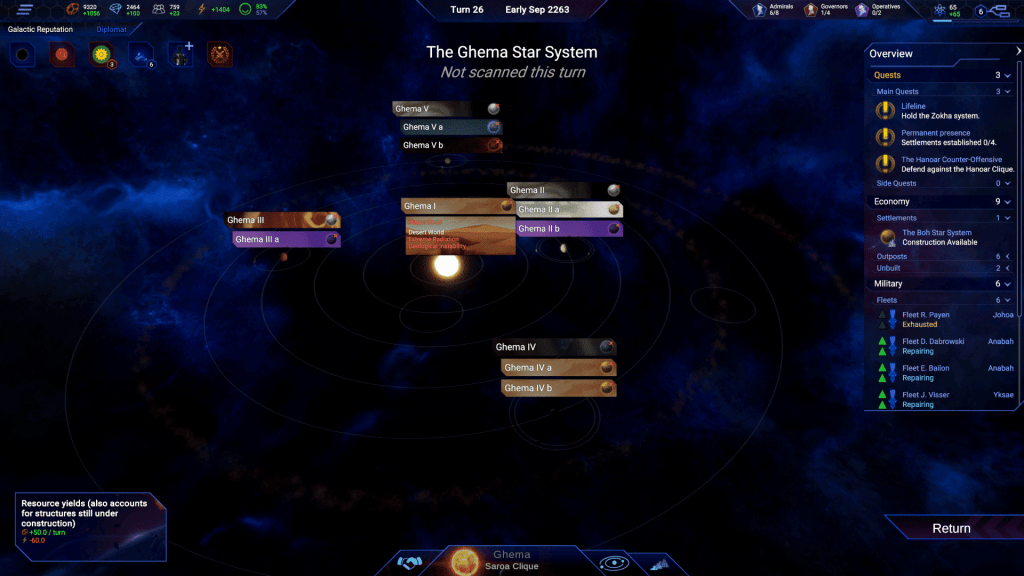
While the game is still beautiful, the overall graphical quality of the galaxy map and ship battles is not quite there yet, and the game is left with a problematic user experience with none of the visual tradeoffs you’d expect in return.
The Shape of Things to Come
The Pegasus Expedition is released into early access from a closed beta: it is, in many ways, a finished game, one that will take the player between twenty and thirty hours to complete. While the story is somewhat linear in the early and late game, the map develops differently enough in the mid-game to encourage a replay or two. The developers have posted their development plan for the coming year, until the time of the full release, naming five more scenarios that will be less story intensive and more typical 4X fare, the next being a classical 4X game mode in December ‘22.
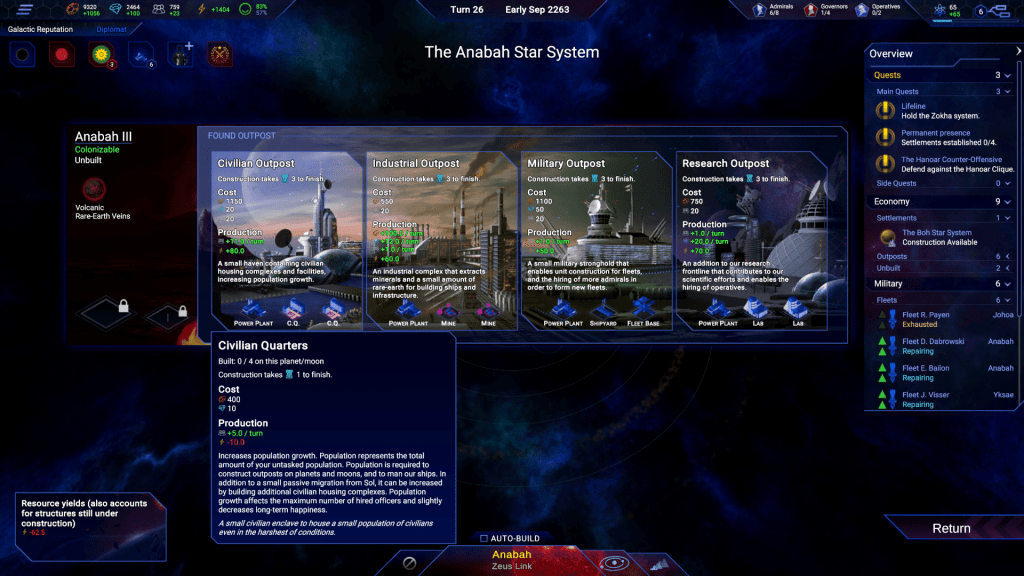
Additionally, they have stated that they will improve the graphical quality and functionality before the final release, potentially elevating it to a level of quality that can stand out among its competitors. Otherwise, the game is in a good state, with only a small number of bugs I hope will be dealt with before the final release.
Conclusion
The Pegasus Expedition is a good game that will become even better if the developers follow their development plan, iron out some user interface problems, and fix a few bugs. It is a more narrative-oriented experience than many of its peers in the 4X genre, so players looking for a good story with a solid strategy underpinning it all should find this one worth their time.