Ara: History Untold has been one of my most anticipated games of the year. To be honest, I don’t love grand-sweep-of-history games that take the player from the stone age to the space age. For me, it’s hard to feel invested in a faction that undergoes so many fundamental changes over the course of the game. That said, it was Ara’s combination of traditional empire-building 4X gameplay with crafting elements and supply-chain management that had me intrigued. I love games that give me things to make and difficult decisions about how to manage those things. I received the review key five days before the embargo lifted, and I was determined to play as much Ara as humanly possible.
At eXplorminate, we generally don’t like to do launch-day reviews since the strengths and weaknesses of strategy games often don’t reveal themselves without dozens of hours and multiple playthroughs. That said, with a good 20 hours under my belt, I wanted to share my initial impressions.
What is Ara?
As advertised, Ara feels very much like a classic 4X married to a crafting and supply chain management game – something like a turn-based Anno, though only vaguely. Ara’s crafting and augmentation mechanics are both brilliant and unique. Within the first few turns I was very excited to dig into setting up and refining my cities and the various improvements within them.
But let’s back up a little and break the game down.
Getting Started
Ara features an impressive number of leaders from which to choose but, to beginners, the differences and advantages between them are not readily apparent. I will need several more playthroughs to know for certain, but it doesn’t appear as though there is a huge amount of faction asymmetry here. Factions might be a little better at one thing and a little worse at another, but I’m not seeing any evidence there are significantly different experiences to be had in different playthroughs – at least not based on faction choice. That said, I reserve the right to change my mind in a full review.
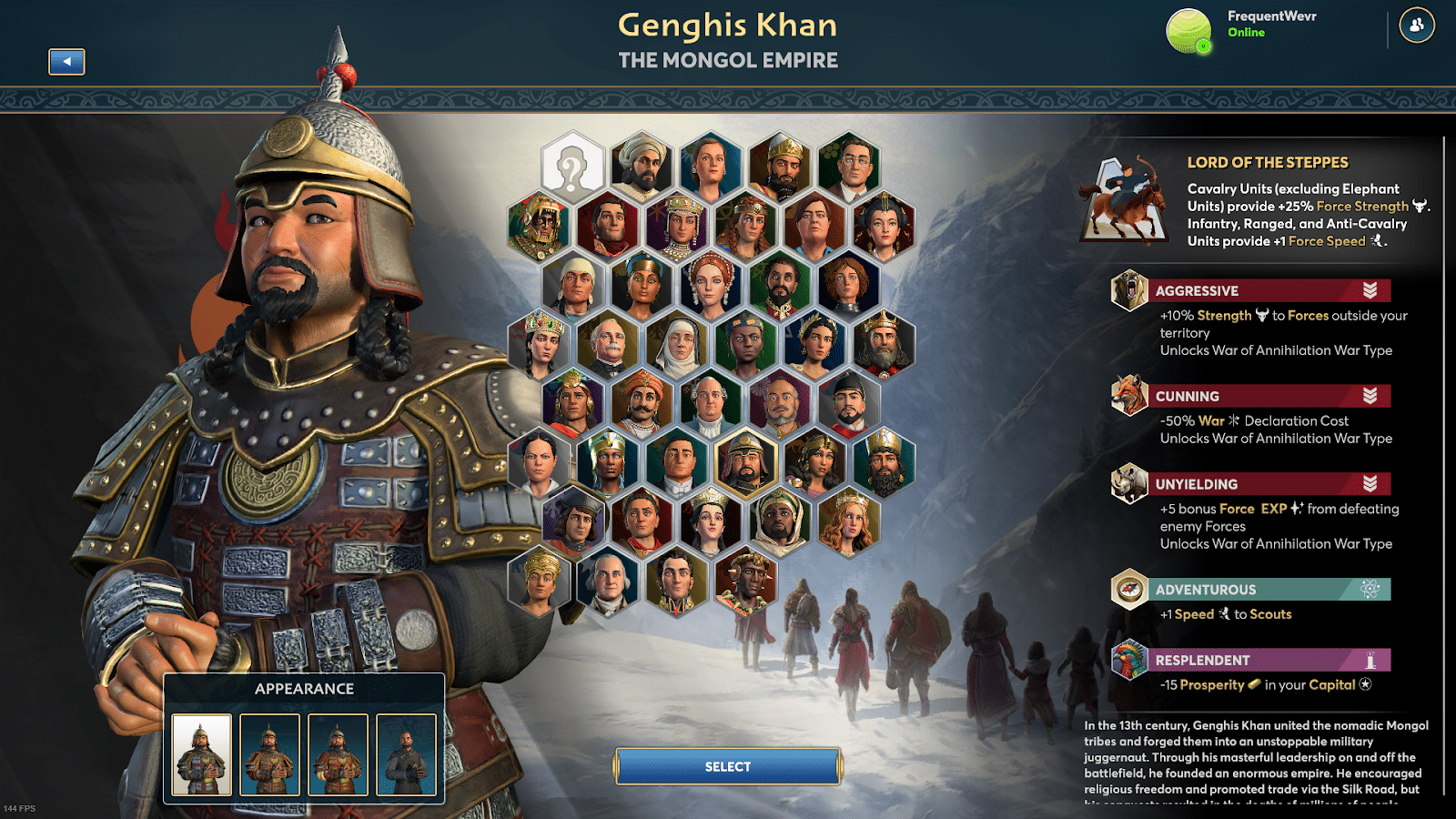
While Ara gives you a generous supply of possible leaders, game setup options are surprisingly limited right now. You can choose between a premade map and a randomly generated one, and while you can alter the number of opponents, you can’t select a map size. There is also no option to change the pacing of the game, an issue to which I will return.
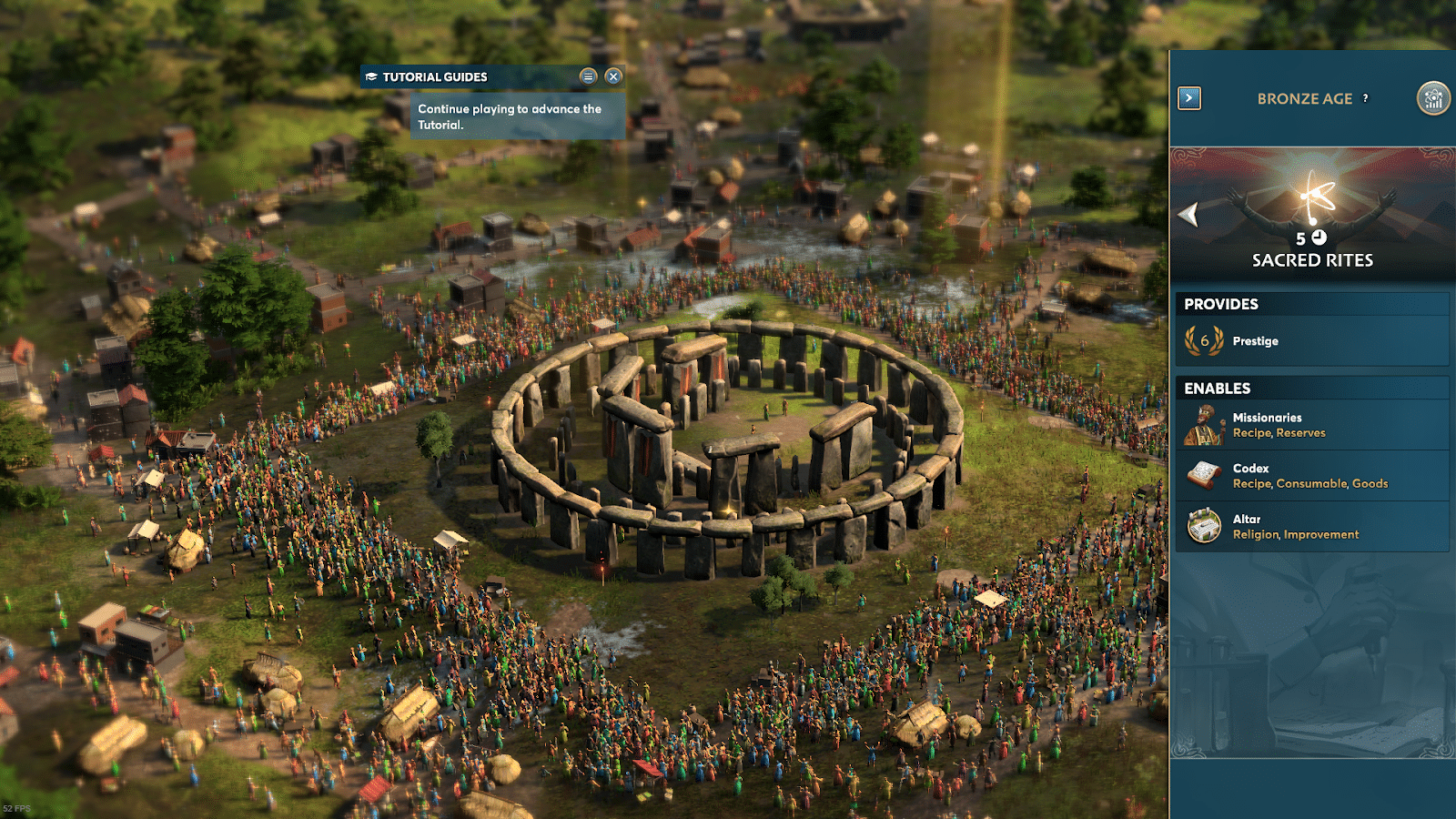
In most ways, the visuals of the game are quite nice. I enjoyed being able to zoom in and see the details of the landscape or my citizens going about their business in my cities. Building a triumph – Ara’s version of wonders – includes the ability to view my citizens standing around and admiring it. It gives the world a very lived-in feel. Some people on the eXplorminate team experienced low framerates, which I did not, but this game absolutely cooked my PC, which suggests there is plenty of room for further optimization. On the other hand, turns resolve almost instantaneously, which is a nice quality of life feature.
As one last performance note, I’ll add that multiplayer games are easy to set up and run smoothly.
The Early Game
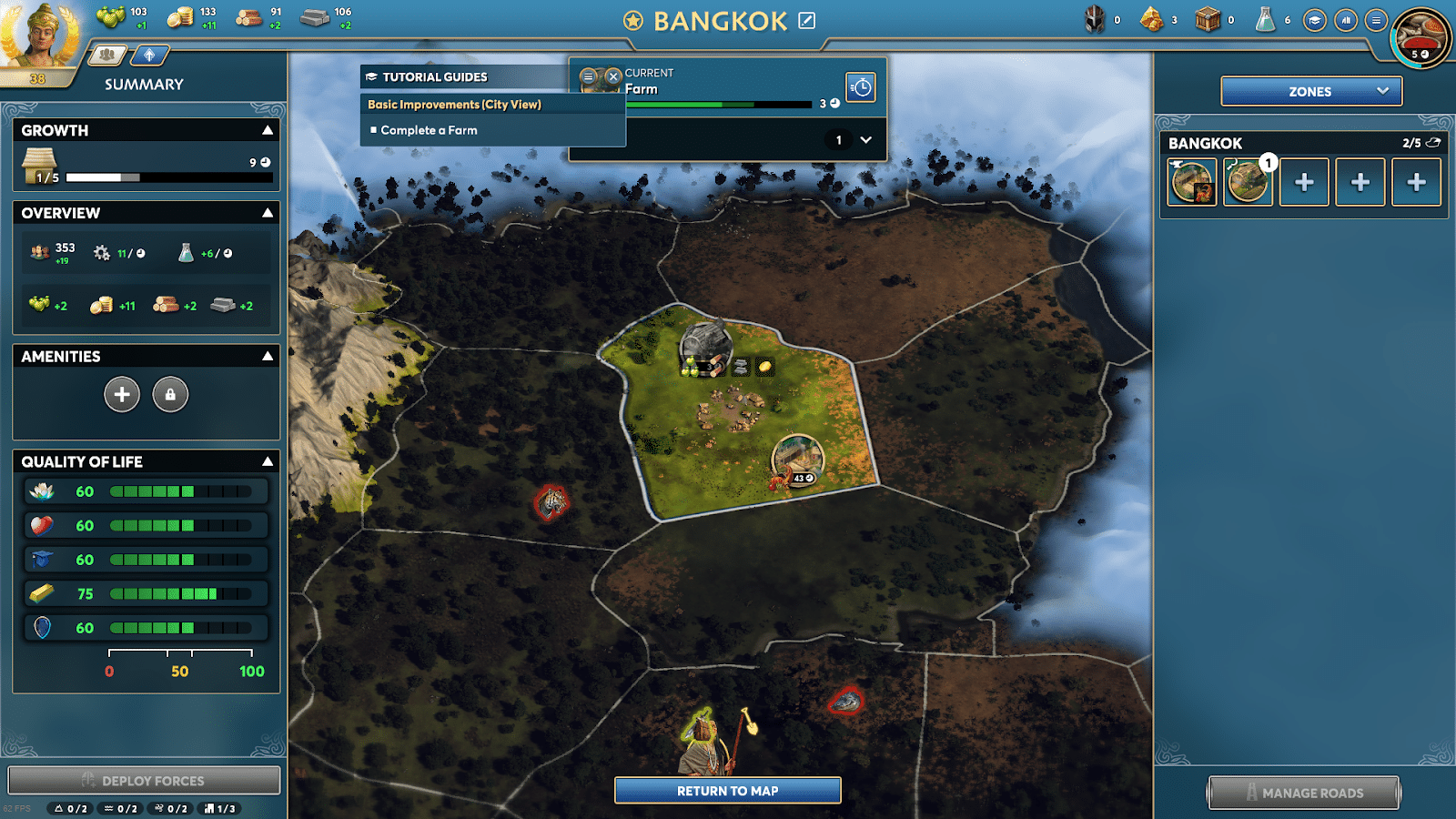
In Ara you start out with a city and a scout, and from there you begin to explore your surroundings and build up your economy. Cities grow and expand, though Ara doesn’t use a hex system. Instead, players expand into irregularly shaped pieces of land that have anywhere between 2 – 5 building slots. There are different bonuses in these slots giving the player strategic choices to make about where to expand first.
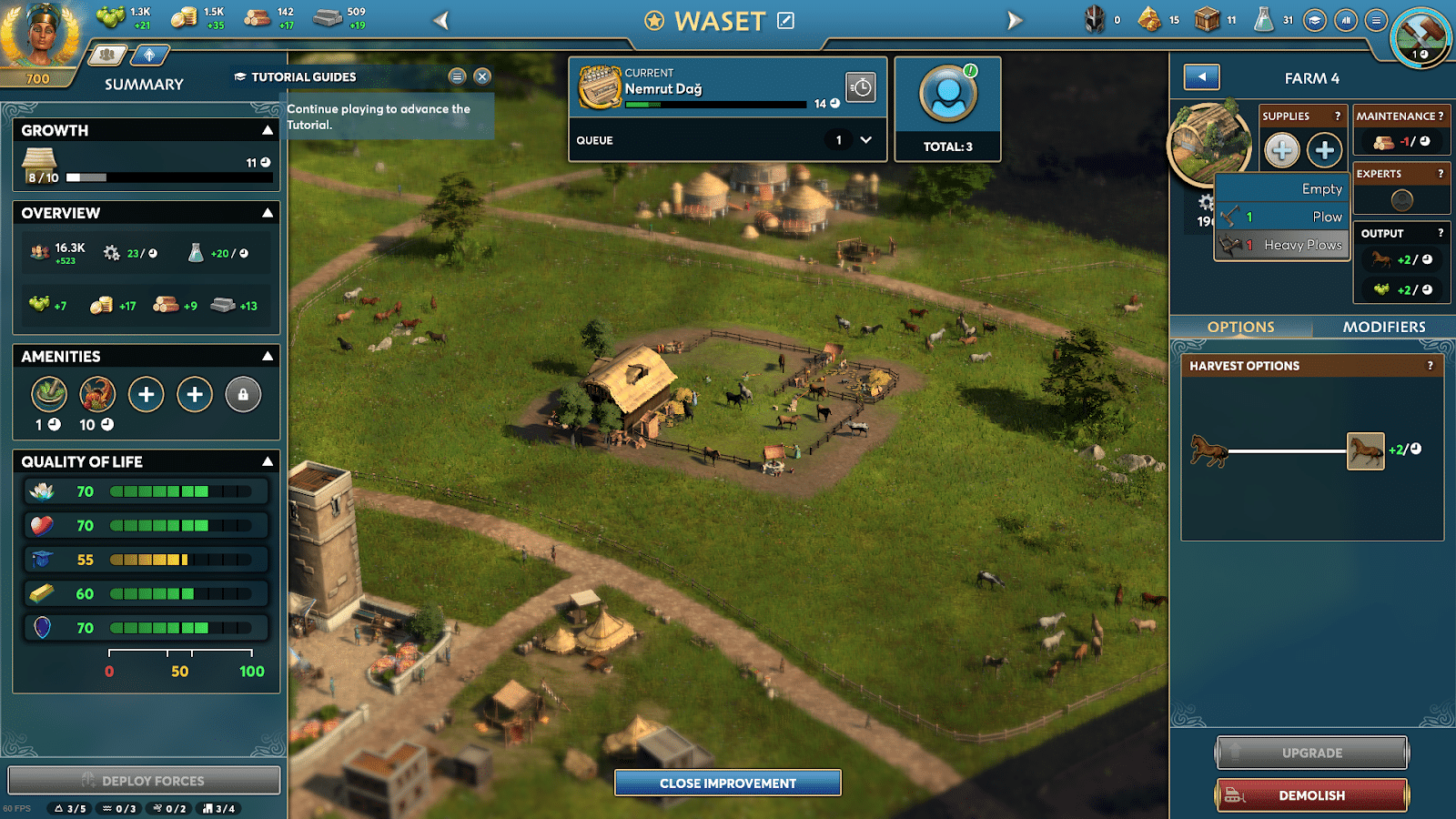
Any 4X player is going to find this familiar but, once you start to build up your first city, Ara’s unique features become apparent. Buildings have slots into which you can place modifiers – for example, adding a plough to a farm which increases outputs. You can sometimes find those modifiers when exploring but, for the most part, if you want to have plows or tools or ropes with which to build, craft, and modify, you need to construct the buildings that manufacture them.
This is the heart of Ara – thinking about what your crafting options are and which items to prioritize. You also need to think about your future goals to decide what buildings to queue up or which technologies to unlock. And let me be direct: this is great fun. This is what makes-Ara special. There are so many difficult and interesting decisions to be made as you decide how you want to shape your empire, boost your economy, or prepare your empire for war.
As your cities grow, there will be a wide variety of items you can make: items to boost building productions, increase city stats, or change a building’s output. If you’re having problems maintaining a city’s food supply (and you will), then you can add items such as a Grain Store into your amenities slot. Amenities give you a certain number of bonuses per turn in one or more categories. In nearly all cases, however, your amenities will burn up in less time than it takes to manufacture them, which means it’s hard to keep a steady supply. Nearly all of your cities will need these boosts, and it seems that most amenity producing buildings can only be built once in each city. On the other hand, you can use items, money, or specialists to boost that output, getting those powerful amenities rolling out that much faster. But doing so will mean sacrificing money or falling behind on an item you need to rack up your prestige, which is the currency that wins you the game. Again, these are interesting and difficult decisions, which are the stuff of strategy gaming.
As your game progresses, you will occasionally get narrative events. They are fully voice acted, which is nice, but it’s mainly a process of choosing which bonuses or penalties you most want or can live with. Over several playthroughs, I encountered the same events, so there does not seem to be a great deal of variety here.
The narrative events feel a little bit like an afterthought. The bulk of your time in Ara will be spent deciding what you most urgently need to build, figuring out where to place the necessary building, and how best to boost it. This is a really innovative approach to 4X games, but it is unfortunately where Ara fails most significantly.
Obscuring the Big Picture
To be blunt, the game’s UI is simply not up to the task. As you build out your empire, and you are managing multiple cities and dozens of production buildings, it becomes painfully difficult to keep track of it all. The crafting menu is wholly inadequate. You can see what you are crafting, and you can then jump to the city to make adjustments, but you can’t see everything at once, and you can’t make changes to one building while looking at data for the entire empire. Moreover, there is no way to view all of your cities, with their many outputs, all at once.

Part of the joy of a game like this is being able to tweak and refine your outputs, finding ways to optimize the system to achieve your goals. Alternatively, maybe you want to accept a temporary food or money shortfall in order to maximize the production of a desperately needed item but, in the meantime, you want to keep a careful eye on your production chains. Ara simply won’t let you do it. Instead, Ara requires you to remember how you have your supply chains set up and then go looking for specific settings to change as necessary. In the early game, when you only have a few cities and few production lines tweaked, this isn’t so bad. But once your empire grows, this lack of visibility places an unreasonable demand on the player. If you get distracted by a diplomatic kerfuffle – or if you simply take a break from what is a very long campaign – it’s easy to lose track of the various crises you now have brewing. The fact that there is no city review tab, but there is a Religion tab (something I might have used three times over hundreds of turns) is genuinely astonishing to me.
Units
Ara has an interesting and unique approach to game units, which it calls forces. Settlers and scouts appear as soon as they are produced, but when a military force is built, it first comes into the world as a reserve force. You can muster in any city in your empire at the time of your choosing. This presents some interesting strategic possibilities, though I’m not yet sure if this is something I like or if it feels like an unnecessary added step.
I’m not at all unsure in my feelings about combat in Ara. It feels unfinished. Forces smash against each other over several turns while random numbers are generated. Eventually one side wins. It’s passive and involves little strategy, and there is little or nothing the player can do to change the outcome of a battle other than sending in more forces.

It’s also worth noting that if forces can be upgraded, I haven’t been able to figure out how. That means your early game spearmen, who have earned experience by clearing out predators all over the map, become useless as the game develops. There is no real incentive to keep those early units alive other than not wanting to have to rebuild them if you lose them too early. Unit upgrades have been a standard part of 4X games for decades. Omitting this seems like an odd choice. Having early game archers eventually become late game snipers or missile launchers or whatever is a way of rewarding careful and strategic gameplay.
This is a relatively minor issue, but the representation of forces on the map is absolutely terrible. Forces appear as icons placed over the map rather than inhabiting it. The effect, quite frankly, is a bit ugly. I grew used to it and more or less forgot my objection until I began my first conflict with a neighboring faction. My enemy’s units look remarkably like mine, and while a careful examination will reveal which units belong to which faction, it is extremely easy to confuse them. This feels like a real lack of polish. It is another way in which Ara’s user experience feels like it’s in conflict with its core gameplay.

Diplomacy
Interactions with other factions shape how an empire building game plays out, and this is another area in which Ara has room to grow. Once my civilization began to bump into its neighbors, I found the AI behavior to be erratic. I might receive a notice one turn that a faction liked me a little less, only to learn the next turn that it now liked me a little more. I often had a hard time determining what prompted these changes. In one game I encountered Greece just as my relations with Assyria were deteriorating. As it happens, Greece was at war with Assyria, so I thought we would be natural allies. No. Greece hated me for mysterious reasons I could not determine. I also encountered a bug in which I would receive a message every turn that a faction’s opinion of me had changed, even though it remained static.

Once hostilities break out, you can also expect some non-competitive AI behavior. In one case, an enemy declared war on me and then sent scouts to wander into my territory, where my mustering armies could cut them to pieces. In another case, an enemy sent a single catapult to take out a city where I had six different forces fortified.
A more reliable and interactive diplomacy system seems to me vital for getting the most out of Ara because trade with friendly nations is vital for obtaining resources not found within your empire. It seems strange to me that there’s no way to know which factions possess which resources, since that would be a great way to decide which factions to befriend and which to fight.
Pacing
The final major issue I had with Ara is the pacing. After starting my first game and wrecking my economy, I felt like I’d learned enough for an earnest playthrough, which I wanted to complete before writing this piece. That turned out not to be possible.
Ara is divided into three Acts, which of which is subdivided into four eras. I was well over 200 turns – corresponding into seven or eight hours of gameplay – before completing Act 1. I’m told that completing an entire game takes 500 – 600 turns and 20 to 25 hours. That’s simply too long, and there is no way to change the speed of the game in the setup menu.
Moreover, crafting takes a great deal of time, meaning that it is very hard to pivot and adjust to challenges or unexpected pressures. Rather, Ara seems to require a great deal of planning in advance, deciding what you are going to need dozens of turns in the future now because once you need it, it will be far too late.
For example, one of the goals (think of them as quests) the game assigned to me was building the Hanging Gardens triumph. To build it, I first needed to produce 10 flowers. I built a flower farm, but I could not generate those 10 items for another 60 or so turns. I might have been able to speed that up by augmenting that particular building, but that’s easier said than done. You can’t augment everything, and I found myself prioritizing ways to keep the food coming in, because there is always a shortfall. In other words, it can be very costly to the entire empire to put too much of an emphasis on anything other than basic survival requirements.
Final Thoughts (For Now): A Masterpiece in the Making
Ultimately this is a much more negative overview than I hoped to write, in part because I wanted to love this game but also because there is so much here to love. At its core, Ara is fascinating and brilliant. The core gameplay loop would be fun and satisfying if Ara didn’t make its own systems so difficult to interact with.
On the other hand, I intend to continue to play, and I would do so even if I didn’t intend to write a full review. Ara at its best is great, and I’m hoping that as I continue to learn the game, I will discover workarounds and solutions I may have missed. If so, I will retract some of these opinions in my full review. I want to be wrong! I also hope the developers will continue to work on and refine Ara. At its core, it’s an impressive game. It only needs to be set free.