The year is 8277AD. In a distant and lonely corner of the galaxy, a small jungle planet named Raronia Minor and known colloquially as “Xeen” slowly orbits a long forgotten Orange-Yellow G5 class star at around 1.5 Astronomical Units’ distance.
After 3736 million years of cellular evolution and supported by an atmosphere comprised mostly of argon, a little oxygen and sulphur dioxide, alien life has bloomed in spectacular fashion: sponges, proto-vascular plants, coral analogues, strange mollusc-like sea creatures, crustaceans and squid. There are giant forests of trees, dwarfing anything ever seen on earth at over one hundred meters tall, alien jungles which provide home to nearly a dozen incredibly dangerous and bizarre beasts.
The Uni-tetrapod is perhaps the largest of these, a herbivore with a vertebrate and resembling a cross between a diplodocus and a multi-segmented crocodile. Even more deadly still are the twelve-metre-tall bipedal monsters that stalk the non-forested, rocky wastelands of the north. There are intelligent arachnids and hordes of smaller lizard-like carnivores, hunting in packs numbering in the tens of thousands.

Men and women make their home here too: huddled together in the decrepit ruins of once hi-tech cities, then proud and magnificent, now broken and derelict. Armageddon began some two hundred and fifty years earlier with the fall of the Galactic Republic, and two and a half centuries of total war have devastated this once thriving agricultural centre, a shining green jewel of the sector responsible for feeding dozens of nearby systems unable to sustain their own agriculture. The food shipments stopped, and those planets quickly fell into starvation, warfare and death.
Water is relatively scarce here and only a few small expanses of sea dot the planet’s surface and provide the primary catalyst for sporadic warfare. The atmosphere is unsuitable for human respiration, meaning instant death for anybody not wearing an envirosuit if caught outside of the few remaining hermetically sealed residential domes. The planet is metal starved, and what industry remains is fuelled by furtive scavenging through the radioactive ruins that mark where large cities of millions were instantly obliterated in the atomic exchanges that marked the epitome of the conflict. The Galactic Republic had ruled for two thousand years, but the Dissolution War swallowed hundreds of thousands civilisations such as the one on Xeen in half that time.

Raronia Minor is also populated by quad-buggy riding nomadic raider tribes reminiscent of the post-apocalyptic villains of the Mad Max movies, huge packs of evil slavers looking for victims to sell to the highest bidder, poor scavengers doing their best to scrape a living from the land around them and pockets of small free-folk settlements, once civilised peoples reverted back to tribal status, relying on mysticism and sheer luck to see things through to just one more dawn. Larger groups of people have banded together into farming communities, guarded by ragtag militias sporting makeshift envirosuits and crude weapons. Nuclear fallout has devolved some of the populace to sub-human mutants, who roam the wastelands with a hatred of their more fortunate former-brethren.
Out of all of this, through sheer tenacity and a will to power, rise six fledgling empires. Taking advantage of the strife and chaos that followed the Dissolution War, these factions have carved themselves a small and desperate home from the carcass of Raronia Minor. The Lions of Xeen are one such regime. With a small yet eager government and a stockpile of resources, weaponry and ammunition, they set their sights greedily upon their neighbours’ territory. It is time to rise and take what is theirs!
So opens just one play-through of Shadow Empire, the latest strategy game and first proper foray into the 4X genre by VR Designs, a one-man development studio aka Vic Reijkersz.
This is a huge and complex game, and so I apologise in advance for the necessity of such a lengthy review. Bear with me because this game is well worth it.
Planet Generation
The game described in the introduction above was procedurally generated in an extensive planet creation phase: the Dissolution War setting is part of a sci-fi background history written by the developer that is shared by every planet you’ll play on, and I added just the colloquial title and the regime name; everything else was assigned in-game to a startling level of detail usually reserved for almost-impenetrably complex games as Dwarf Fortress or Aurora 4X. Just like those two epic indie-game hits, Shadow Empire thrives on stimulating the player’s imagination by providing many tools to assist in personal role-playing experiences, something that isn’t often seen in the 4X genre as it stands today, and the planet creation system is no exception.
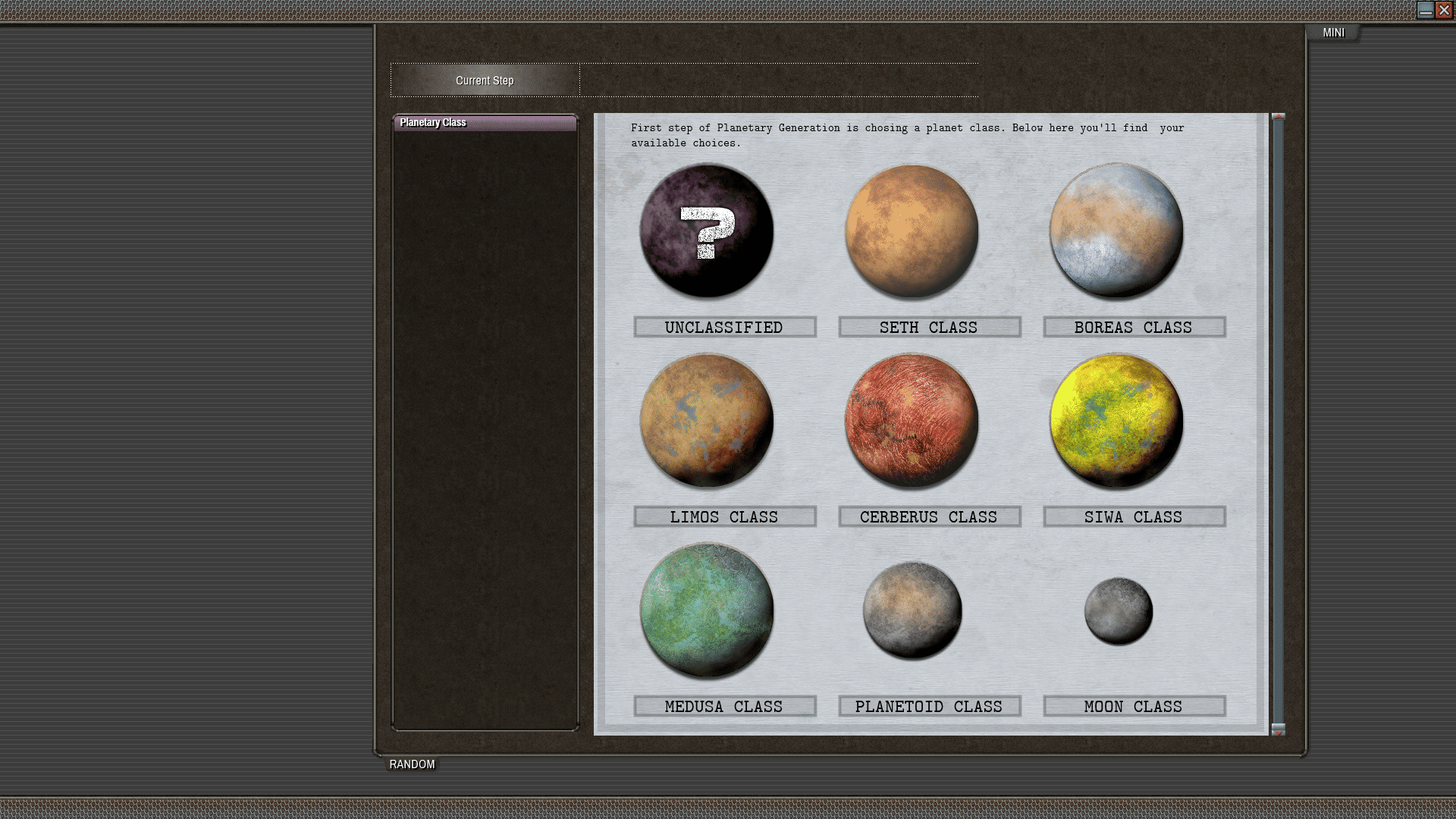
Players set the planet size and then choose from a list of template classes, dictating a model for the procedural generation to work from: options here include the Seth Class (desert planet with no water), Boreas Class (very low temperature planets where any water will be frozen), Limos Class (arid planet with some water but no life), Cerberus Class (geologically active planet, very hot with no water and magma-rivers flowing into seas of lava), Siwa Class (Earth-like planets that can sustain life, but with less water than Earth), Medusa Class (planets with a thriving and hostile alien biology), Planetoid Class (small rocky rather featureless planets) and Moon Class (tiny maps designed for quick games with a brutally hard difficulty and not intended for beginners). Finally, there is an Unclassified type which generates something completely random and unaffected by the constraints of the previous options.
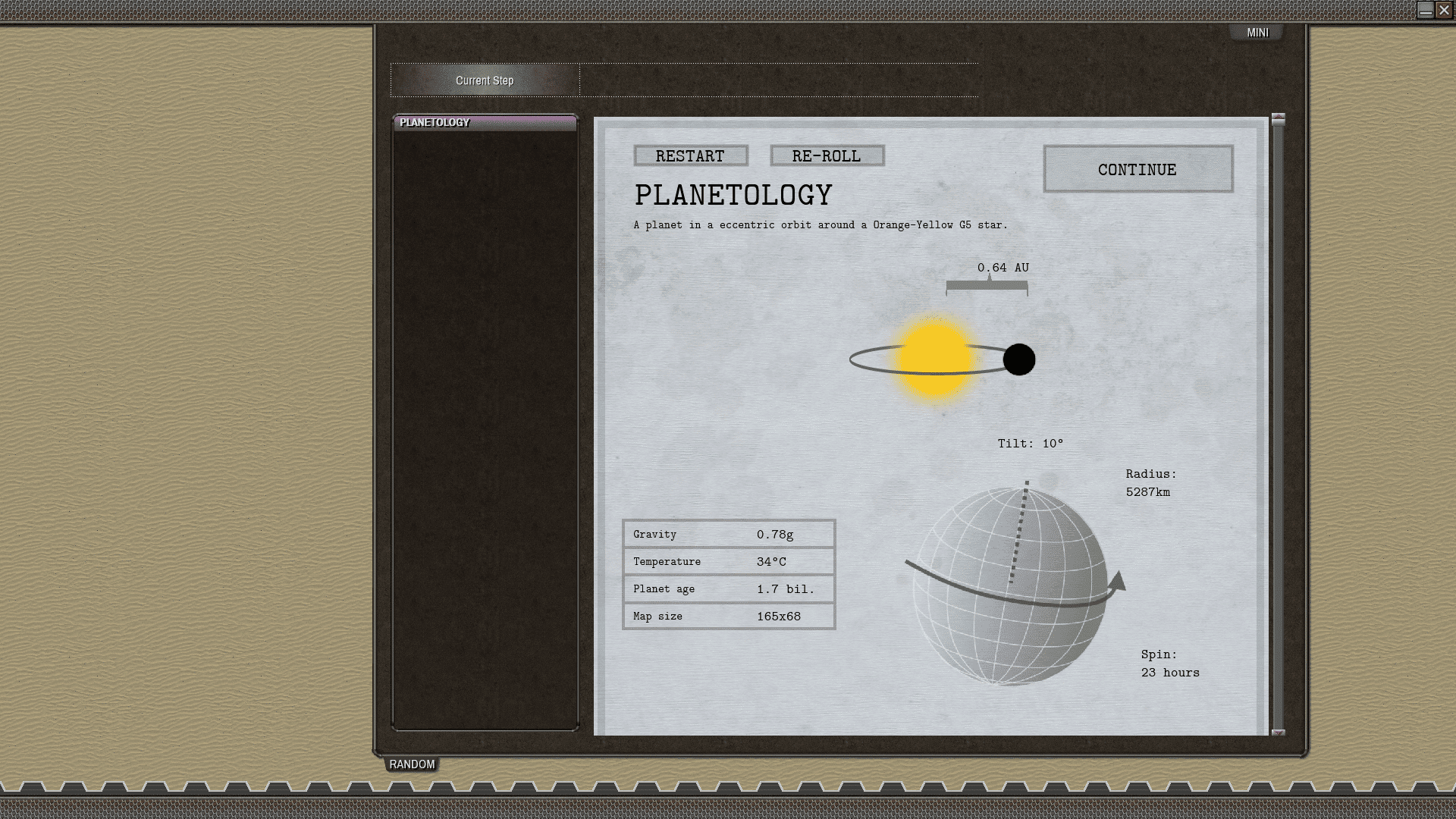
Planet size affects the strength of gravity, which in turn affects whether the planet holds an atmosphere (and what gases are present), which determines whether alien life is possible, humans can breathe unaided or farm their earth-borne crops or not. Distance from its star, the spin of the planet and tilts affect both temperature and seasonal differences in weather, wind speed, rain and erosion of the land which determine plant growth and distribution of water sources… and so on.
Later steps generate the atmosphere type, whether alien life is present (from microbial dangers which can kill your unprotected civilians) through to flora and roaming fauna, some harmless, some very deadly. The generator even simulates the evolution of these species and lists any that became extinct in the millennia leading up to human colonisation.
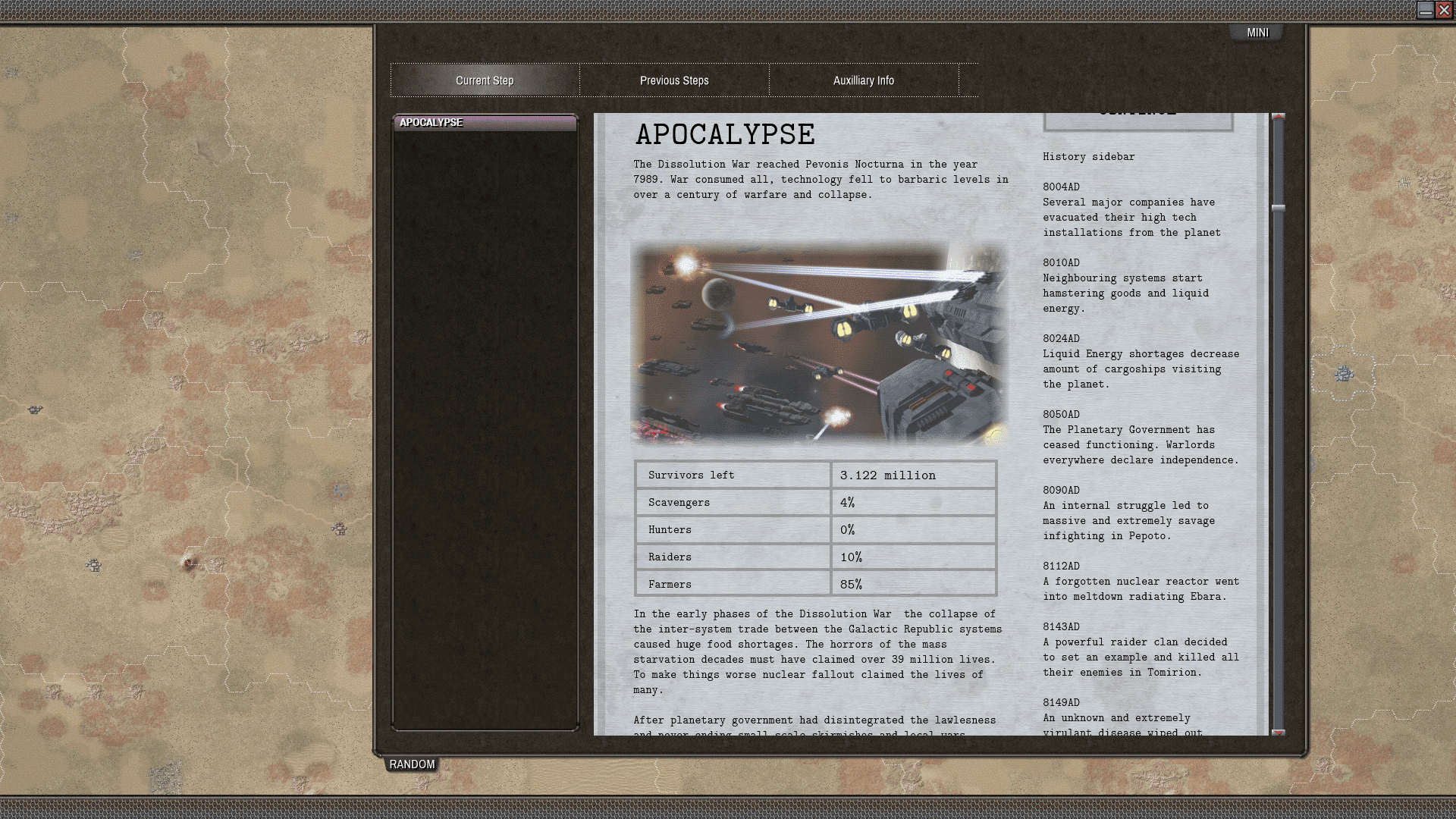
Finally the game generates human settlements and how many people were settled in them, including a summarised history of events that happened in the years of colonisation before flipping the table, destroying it all again in a simulation of the dreadful events of the Dissolution War: nations fight one another to the death, terrible warlords execute entire cities in retaliation for some unknown sleight, entire regions starve or succumb to deadly outbreaks, mad cult leaders detonate nuclear devices in highly populated centres. In other words, absolute chaos! Shortly after this, you’re asked to name your faction and a series of questions sets your initial governmental, societal and psychological profile types, before throwing you into a brutal post-apocalyptic world and the game begins.
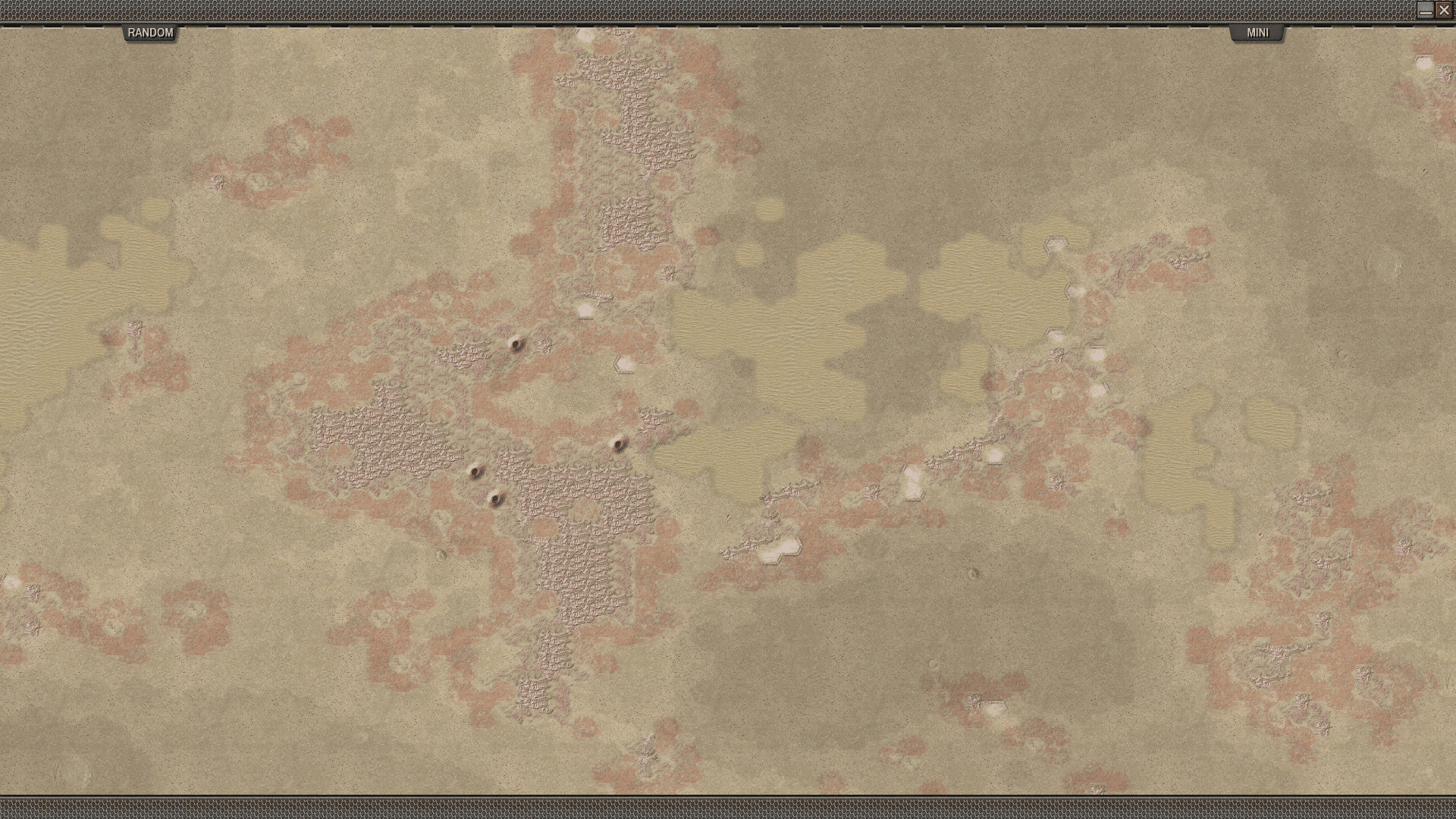
The planet generation system here is a work of art and no mistake. The maps it generates are varied and interesting and the level of detail contained in some of the auxiliary pages will fascinate those keen to enrich their experience with extensive background fluff. Fans of games like Aurora 4X will be right at home with this kind of minutia, but for those less bothered, most of this information is easily skipped with no detriment to game experience, with the exception perhaps of the atmospheric effects, bio-hazard levels and temperature, all of which can damage your colonists and troops accordingly.
Each step of the process can be re-rolled to further tailor both play-field and setting to your exact tastes. The terrain graphics are bright and clear, and suitable for a game of this type: simple but colourful, and effective at conveying the tactical information necessary to fight your wars. Seth and Boreal classes are suitably rocky and sandy, or rocky and icy respectively, whilst Siwa and Medusa class alien biospheres sometimes produce strangely beautiful maps, with brightly coloured fungus, grass or cloud-scraping giant tree
The scale in this game is huge: one hex has edges 200km long. A standard sized map will be around 160 x 60 hexes.
Game Overview
Shadow Empire is turn-based game where up to four players can compete together against an AI for planetary dominion, with each round covering one season, around two months in Earth time (each planet has its own unique calendar). Each turn, the player and AI factions move units, build Hex Assets (buildings and landscape features) to generate resources, use Political Points to either resolve Decisions (a series of events that require player interaction each turn) or play Stratagem cards (a comprehensive system for micromanaging decisions in your empire). Credits are hard cash, used to pay your soldiers and your leaders, who are the men and women that constitute your government, command troops as generals and lead your people as the Zone governors (in this game, a Zone is roughly equivalent to a country or state in another game, and each Zone has just one city).
Zones border one another, and are occupied by several types of AI: Major Regimes are the main rivals to the player in the game and play by most of the same rules the player does. Minor Regimes are the various Farmers, Scavengers, Raiders and Slavers that use a limited set of rules but can still be interacted with diplomatically in a more limited fashion, and the Non-Aligned Forces consist of the nomadic roaming free-folk marauders, monstrous aliens, insidious intelligent spiders and other assorted oddities that make up the rest.

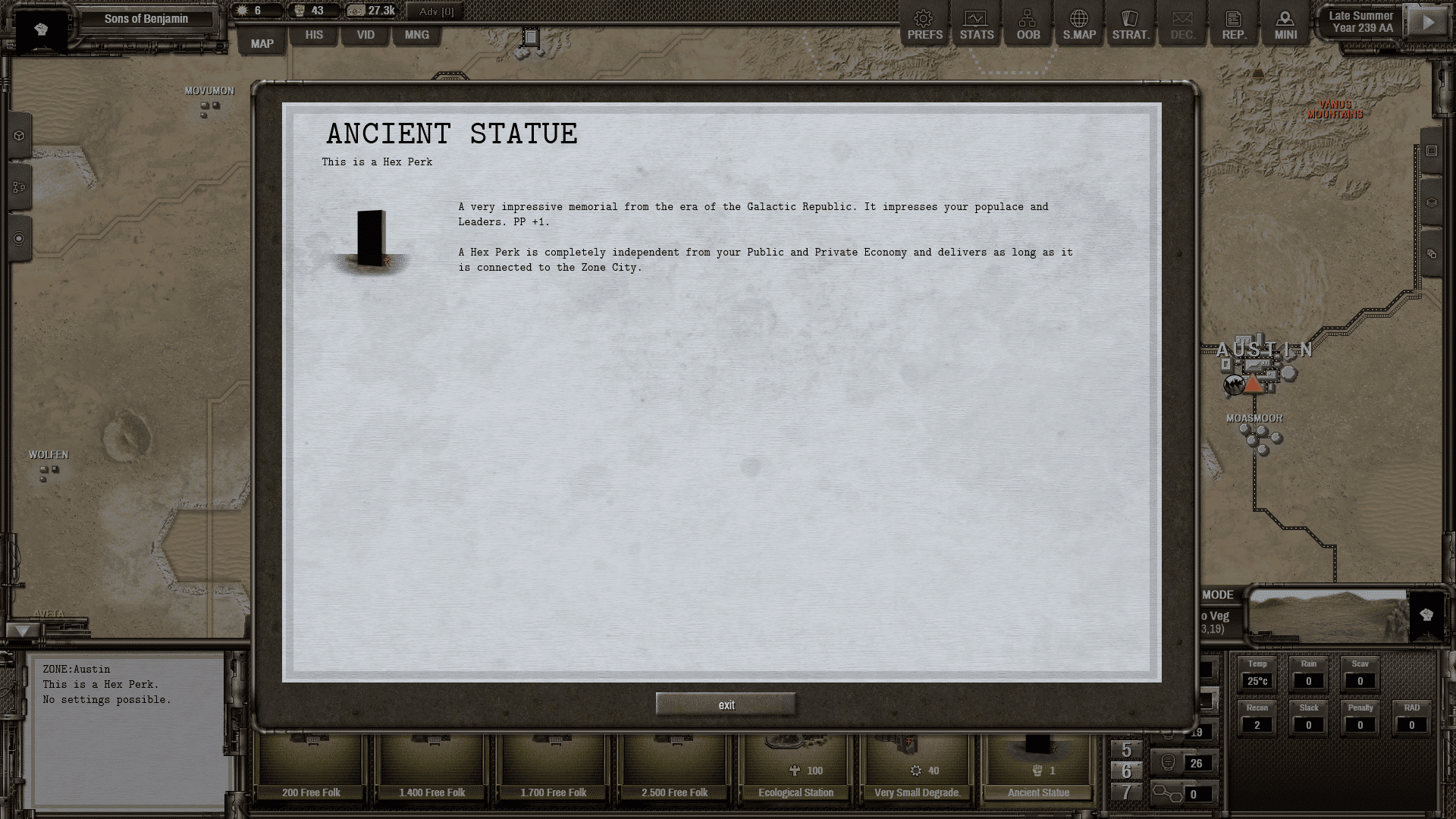
Dotted around the Zones are free-folk settlements, small villages with unaligned people banded together that may migrate to your cities if they are safe, healthy and appealing enough. If you let your cities slide into chaos, expect your people to leave in droves, going back to the free-folk towns where life is less harsh. There are also Hex Perks to be found: these are terrain features such as crashed spaceships, mercenary camps and natural landmarks which will provide a bonus of some kind when contained within your borders. Some of these will be essential to your survival: finding a Galactic Republic era factory complex can give your industrial output an early boost that can put you well ahead of your neighbours, whilst a crashed ship will grant bonus research points.
Most planets will also contain the ruins of the cities destroyed in the Dissolution War. These act like goodie huts, as on discovery they may yield credits, advanced technology or machinery. More importantly, they may be scavenged for metals and fuel. On some planets these may be the only such resources available in the early game, and scavenging can sometimes score you some very powerful artefacts (keep an eye out for the legendary Holographic Freud!).
Units can move under their own locomotion using action points, modified by terrain and other factors such as Readiness and Supply, or can be moved along road or rail networks using a strategic move mode, providing there are enough trucks or trains left that turn to do so. When playing with Fog of War activated, units will roll it back as they move, and all units have a reconnaissance rating that allow them to scout the hexes around them. Hexes have a recon value from 0 to 400. Anything over 40 allows you to see if there are any enemy units hidden in there, with more accurate information on unit composition as the recon level increases. Some units are designed for reconnaissance, making buggies and motorbike infantry essential early game fixtures. Attacking a hex without a good recce first is usually suicidal unless your troops are very strong.
Regime Profile
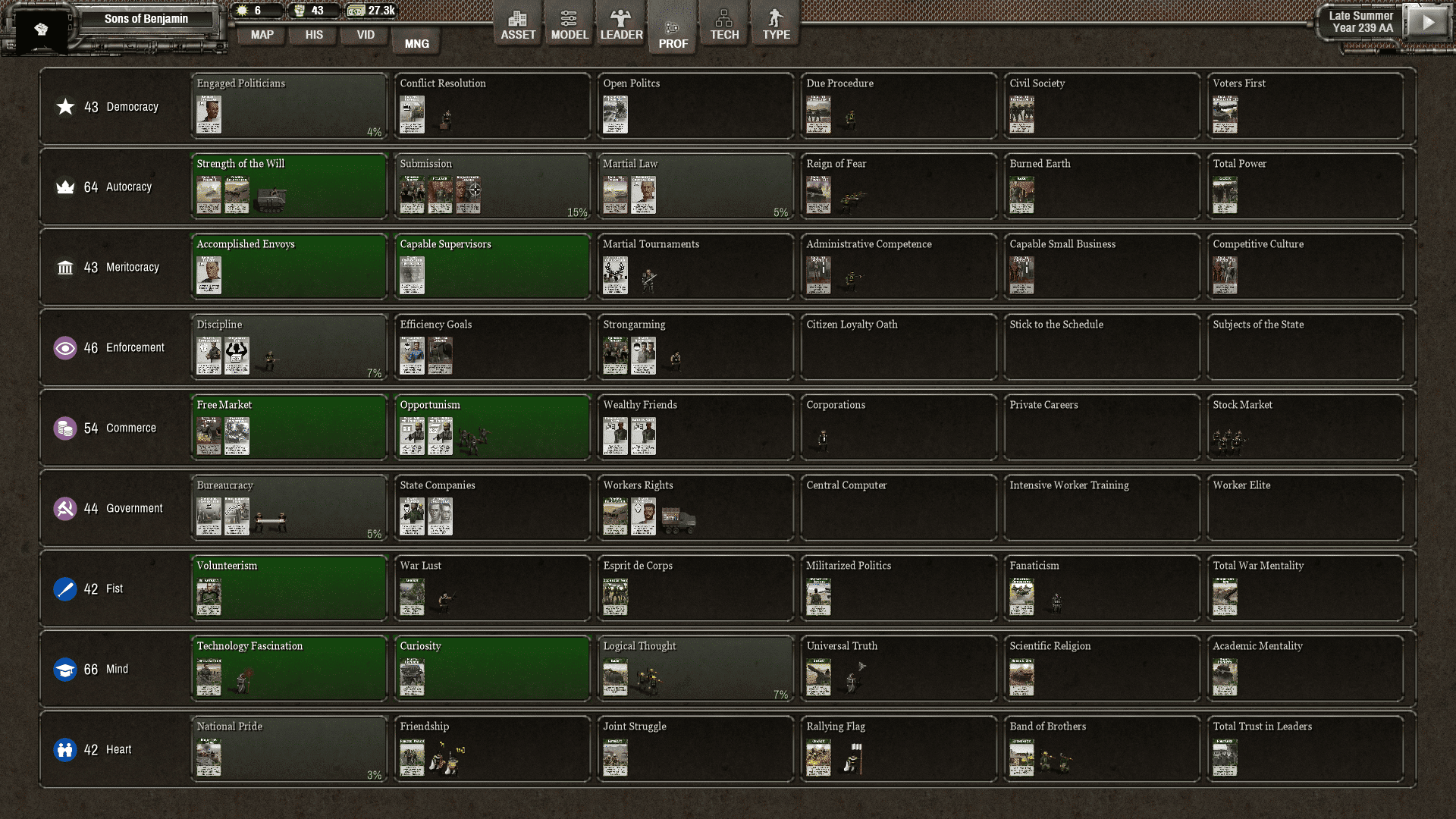
Regime Profile is an innovative abstraction that attempts to model how you approach three aspects of your empire: Politics, Society and Psychology. Each of these is further divided into three categories: for Politics we have Democracy, Meritocracy and Autocracy, for Society there is Commerce, Government and Enforcement, and Psychology is split into Mind, Fist and Heart. Each of these has a number assigned from 1 to 100, and certain Decisions you make in the game will raise or lower them accordingly. After 50, raising one in each field will drop one of the others. For example, raising Meritocracy past 50 will cause a fractional drop in Democracy, Democracy drops Autocracy, and Autocracy drops Meritocracy, meaning you cannot advance too high in more than one at a time, although this friction is not a “one up, one down” exchange meaning that decay happens rather gradually and allowing you to temporarily maintain high scores in several areas.
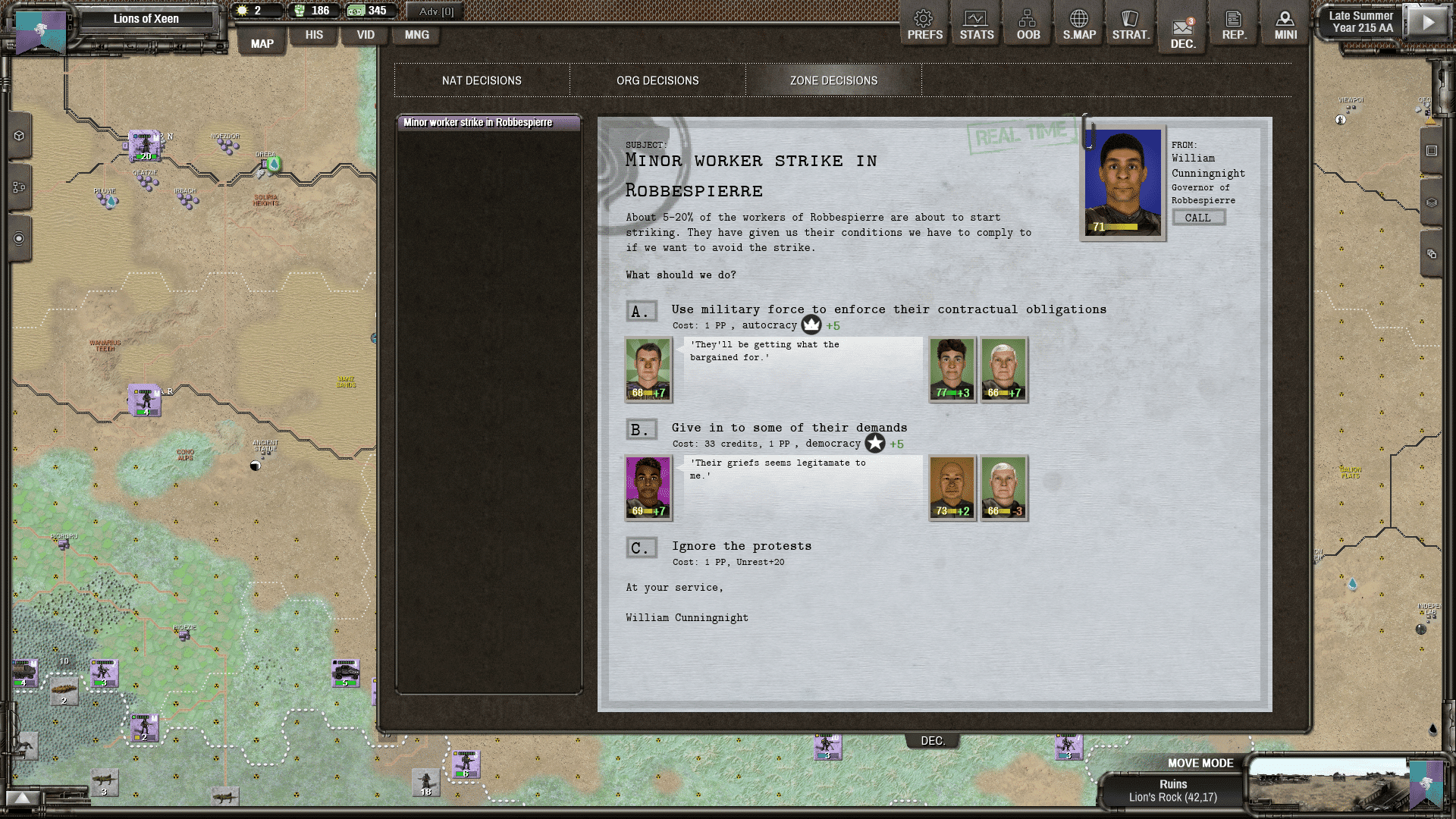
For example, a Major Regime may come to you to demand the release of a spy you have captured. You could release them free of charge, gaining +6 Heart and +11 Enforcement points (and make them happy) or you could accept their offer to pay for the spy’s ransom, gaining +2 Mind and +6 Enforcement, or execute the spying wretch gaining +6 Fist and -5 Enforcement (and causing a drop in relations with the Major Regime, something you may well want if you want to go to war anytime soon). Each decision will also either raise or lower the opinion of your various leaders, as they all have their own preferences for how you govern, and may have other consequences (such as spawning militia units, or causing a war between yourself and a faction).
You’ll want to plan your Regime Profile carefully as each field has certain Feats that have an increasing percentage chance to become unlocked as you hit multiples of 10 from 40 upwards. Hit the threshold, and there is a chance each turn to unlock, which increases the more points over the threshold you have. The first unlock at 40 points is very powerful and significant: for example, the first unlock for Government is called Bureaucracy and gives a whopping 40% bonus to your Bureaucracy Points (BP) each turn. This is huge. The other fields offer equally important bonuses and so you are forced to make tough choices in which direction to take your regime to unlock the bonuses, special units, Stratagems and other abilities you want. Rising too high in one area will eventually cause decay elsewhere, and those Feats will disappear if you allow each category to drop too low.
This system is nothing short of fantastic: where most 4X games bind you into a government system with a couple of production bonuses and penalties here and there, requiring standard research advances to unlock, Shadow Empire is fluid, with an ever evolving system radically different to that tired old trope. Your actions in-game decide how your government evolves, and whilst you can indeed push it in the direction you want to go to hit certain bonuses, this is limited by the decisions that come up, and you’ll often be making tough choices if you want to hit the higher Feats and unlock some of the more powerful abilities.
Once you have dedicated yourself to one path, circumstances might dictate you rise very high, in say Autocracy, but you’ll be lagging in Democracy and Meritocracy. The numeric level of each of these governmental, societal or psychological systems serve as a basis for your dice roll in some very important decisions: if a colony is beginning to riot, you could squash it using Autocracy providing you have a decent garrison, but at the cost of losing colonists and some troops. If your Meritocracy level is high, paired with a good governor with a decent Oratory skill, you could just as easily talk them around into dropping their pitchforks.
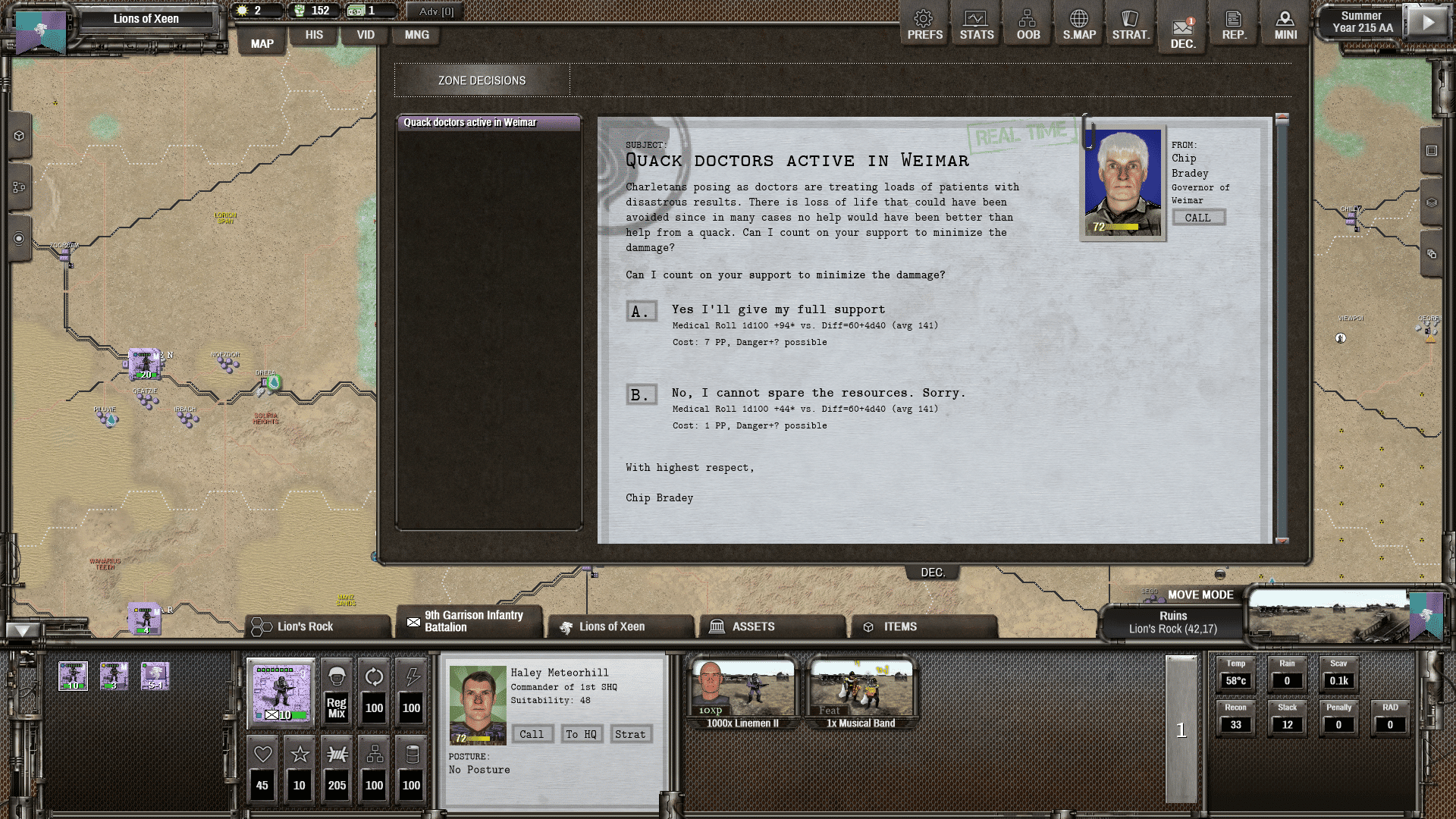
Every decision here then has consequences, and if you can get your government running how you want it, it will cause your economy and your overall progress to skyrocket. Gaining the lower tier Feats is usually a matter of a few rounds of focus and a little luck. All the above is dependent upon whether your NPC Leaders are happy with the Decisions you make as well. You might want a high Fist profile to keep your people in line, but if half of your government hate Fist-type decisions you’re going to upset them greatly by starting down that path.
You’ll begin to see the complexity of this game at this point. Take a deep breath, we’re only just getting started.
Leaders
Leaders are NPCs with a large set of statistics and skills (far too many to detail here) that suit them towards specific roles. A small few of them currently have no in-game effect beyond adding some role-playing flavour. There are general characteristics like Intelligence, War prowess and Charisma that are used whenever the game demands a dice roll to pass a challenge of some kind: beyond this, there are individual skills that may be trained (both by the passage of time and by attempting skill roles) which represent experience: the player will want to move these around to where they are most needed, but firing a leader from her job will upset her. Promote her to a better one, and she will like you more. Leave her without a job, or one she does not work well in, and she’ll start to lose Relation with you, a measure of how much she likes you. Leaders have loyalty too, and a leader with both low loyalty and low relation will not only perform poorly, but she might also either quit unexpectedly, or rebel and raise a force of her own to take one of your cities from you.
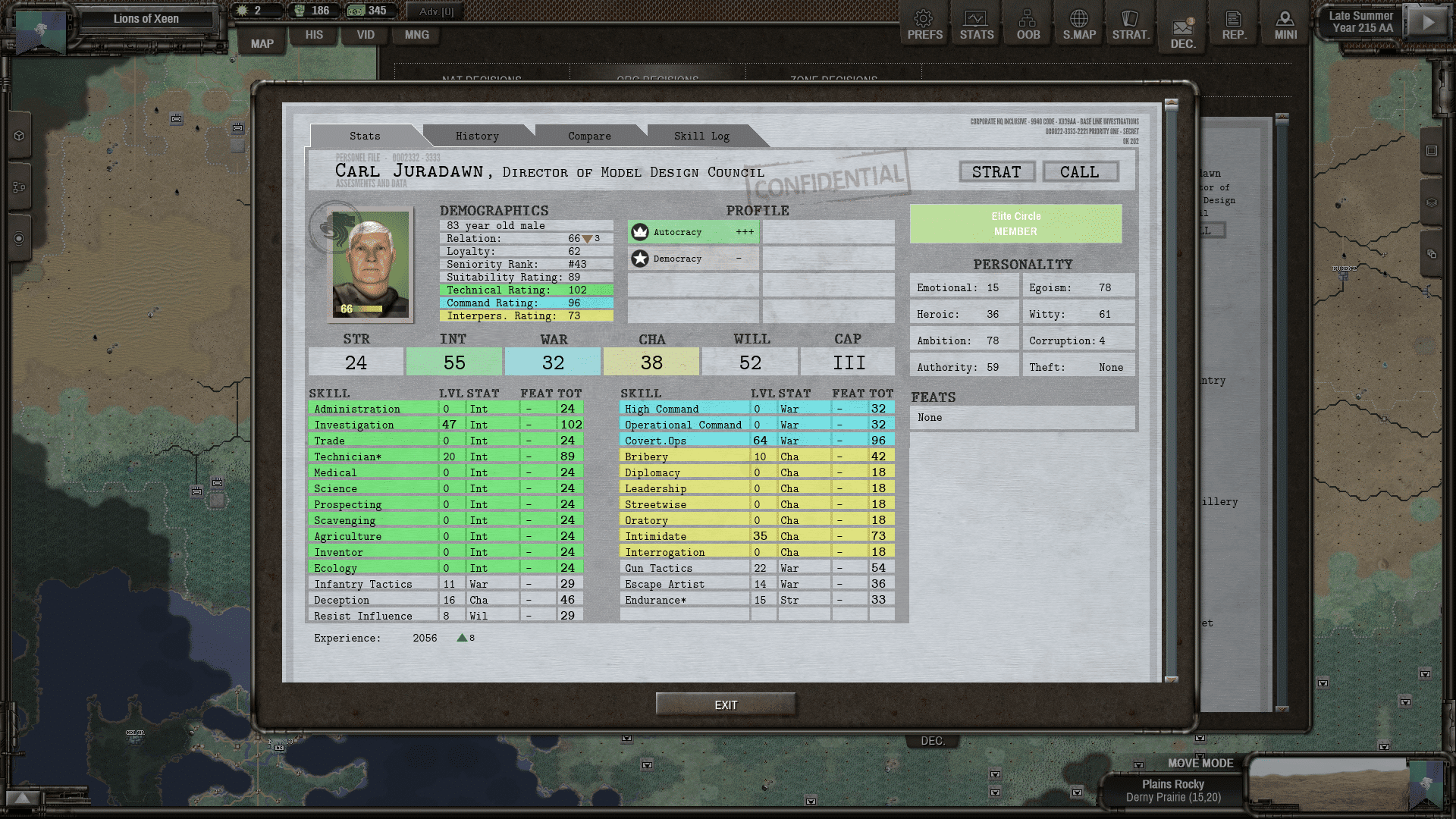
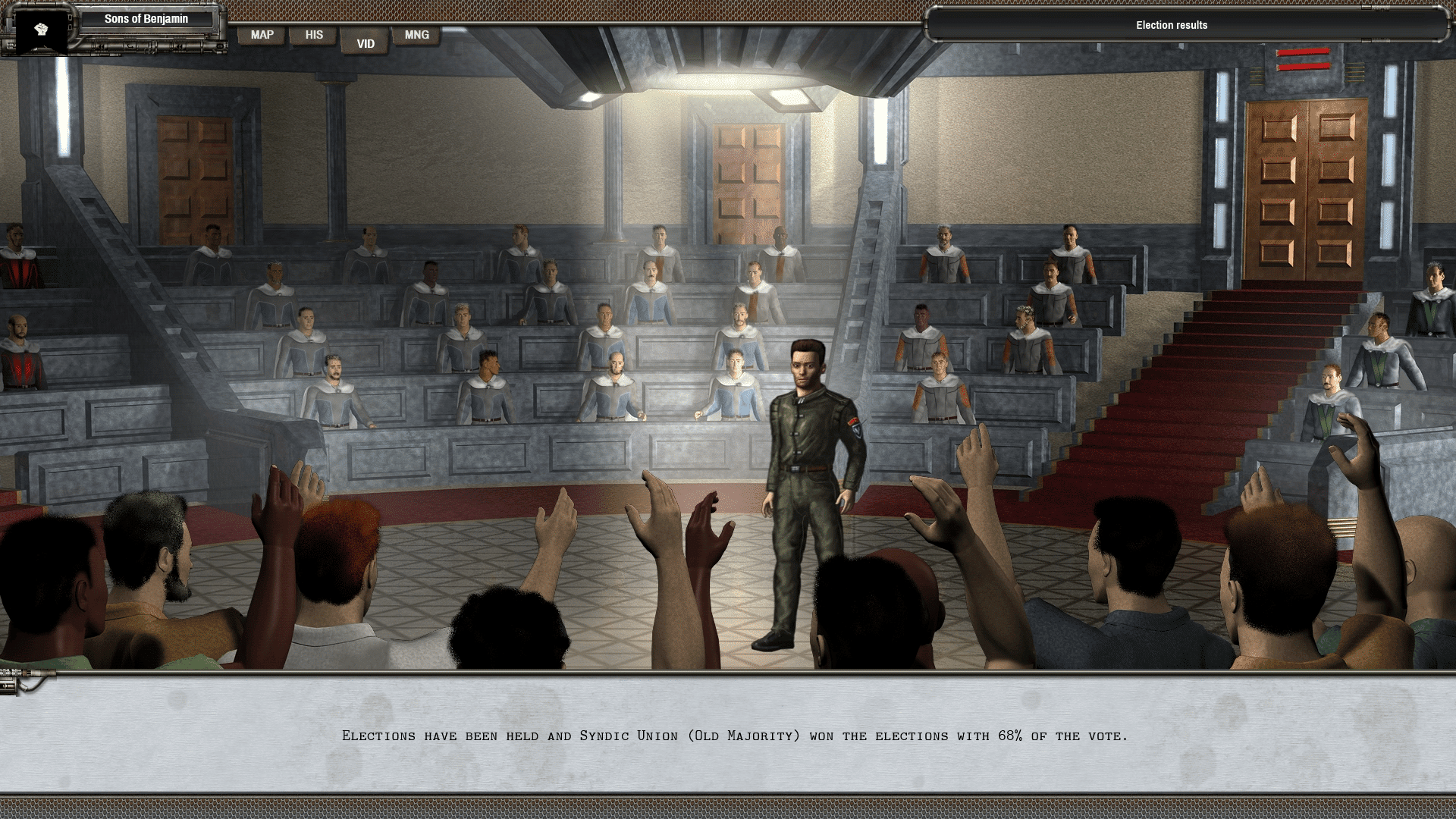
Carefully nurturing these characters is essential as your Organisations work more efficiently depending on who is running them. Get a genius in your Economic Research Council and you’ll find yourself rocketing up the tech-tree (you did remember to build Universities and Bureaucratic Offices to generate lots of BP didn’t you?). Leaders also form into Factions, which are political parties in your regime, which ever so often will hold an election to see who gets into power. Factions make periodic demands of you and will reward you with Stratagem cards if you keep them happy. They have preferences for certain Regime Profiles too, meaning that the aforementioned Decisions will begin to affect their relations. Factions can induct leaders and gradually change their Regime Profile preferences over time.
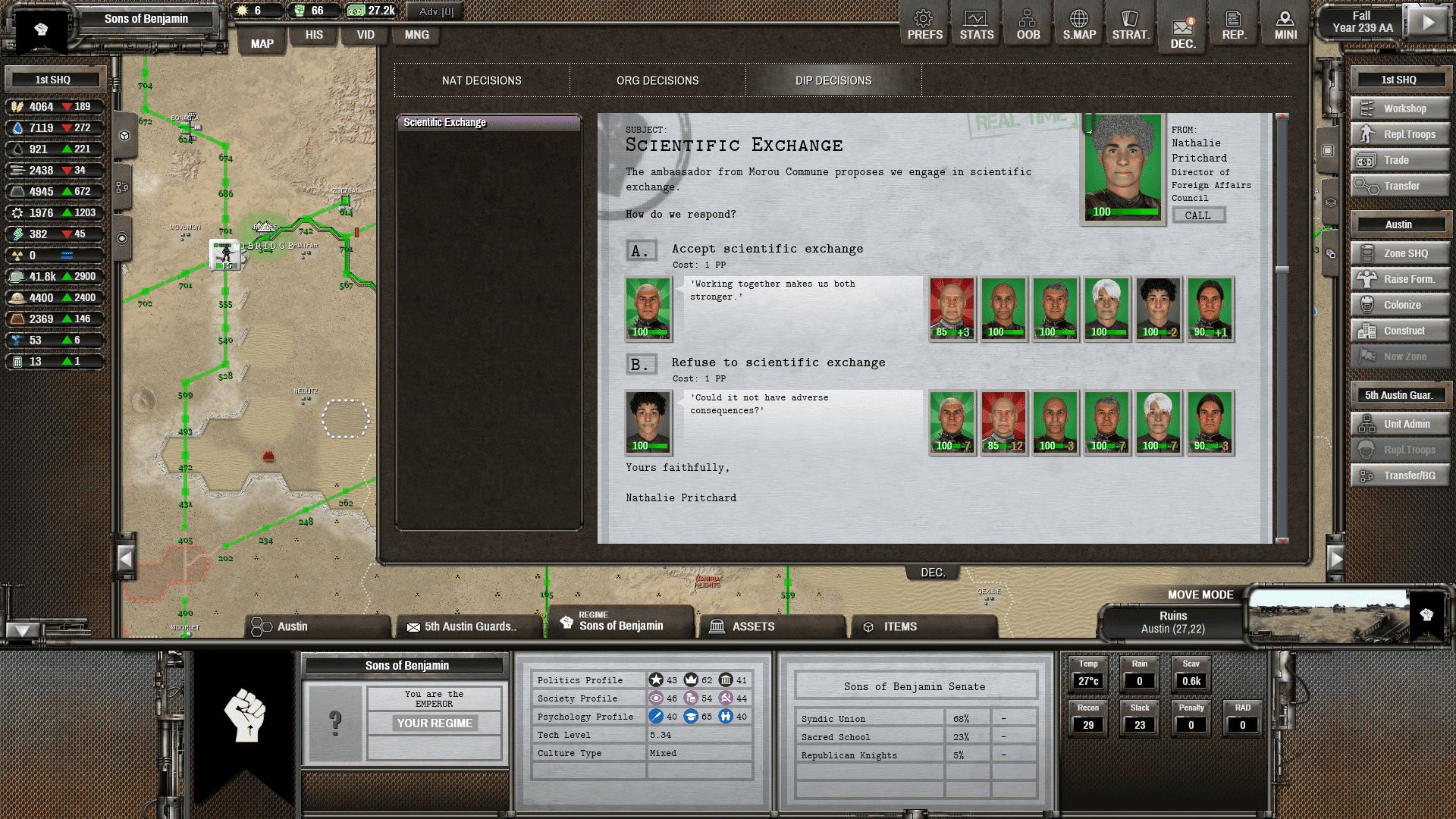
Major Regimes can be manipulated using Stratagems. So, you have a quarrelsome religious fanatic neighbour? Then why not feed their opposition information leading to a political scandal for the ruling party, helping to gain them more power in their next election and letting a more malleable leader take reigns? This is all possible in Shadow Empire (and the Stratagem system ensures you can’t just spam these tactics like in many 4x games).
This is where the game can start to become quite difficult. Some Decisions you take have no negative consequences but many do, and although you might get a lucky set of starting Leaders who more or less agree on where you want to go with your empire, more often than not you’re going to be forced to take decisions you don’t want to in order to keep certain important people happy. And you can’t usually keep everybody happy. Moreover, the game has scripted events called Epochs, some good, some bad, and some of which are deliberately designed to throw your factions into friction with one another, which can often make the game harder and (in my opinion) more interesting. I know at least one famous Youtuber that dislikes these Epochs intensely, and it is fortunate then that they can be disabled in the game setup options if you feel the same.
I did find that once I understood the game better, on Regular difficulty I was often able to master this side of the game well enough to avoid most strife with my leaders, keeping their relations very high by liberal application of the various Stratagems designed to raise their Relation and Loyalty stats, which might indicate the game requires some balancing still as the combat AI is absolutely brutal on Regular and there might be some disparity there, although the aforementioned Epochs can really throw a spanner in the works in this regard. Shadow Empire is also scripted so that the larger your governments get, the more factions spring up and they’re usually opposed to the existing ones, creating an increasing challenge which helps prevent Regime snowballing.
Low Relations with a leader will cause negative Decision after negative Decision, as their dislike for you causes them to make blunder after blunder with things spiralling out of control to the point you have to sack them or end up with a rebellion on your hands (usually both!). A bad leader can literally destroy one of your cities if you don’t take things in hand very quickly!
Organisations
Research & Development (both clearly delineated in a two-step technology system of Discovery and Research) and the day to day running of your government is funded by Bureaucratic Points, which are generated from certain buildings and automatically distributed across your various Organisations at the start of each turn. Organisations are set up with political points as you venture further into the game, and although you do get to choose which ones to get first, there does seem to be an optimal route for the first four, at least on most standard maps.
Organisations are branches of your government, headed by a leader and each with a set of jobs. All players start with the Supreme Command Council which generates Political Points and wide, yet basic selection of Stratagem Cards. The Economic Council covers both discovery and research of Economic technologies, prospecting zones for resources and generating economic Stratagems. The Military Research Council does R&D for your armed forces, the Model Design Council researches and develops Models (the game’s name for individual military units types: soldiers, tanks, rocket launchers etc.) and the Staff Council discovers and develops Orders of Battle (formation type for your Models to be organised in, from Brigade, through Corps to Army) and also generates Stratagems for Postures (a tactical setting for your units that provides a boost to their performance, examples include Defence, Blitzkrieg, Forced March) and Occupation and Governance cards.
There is a Foreign Affairs Council that generates diplomatic Stratagem cards for the Major and Minor Regimes you’ll face off against respectively where you can influence their opinion of you, make peace, trade deals and dozens of other pacts and agreements that are usually skipped in less detailed games. An Interior Council creates Stratagems covering Taxation, Tariffs, Human Resources and Interior Policies, a Secret Service Council that covers all things covert: Active Field Operations, Spying Operations and Internal Security, again all access directly using Stratagems. Finally there is one last research and development Organisation: the Applied Science Council, which broadly deals with optimisation of existing regime or military functions (better ammunition, deeper mining, heavier armour and so forth).
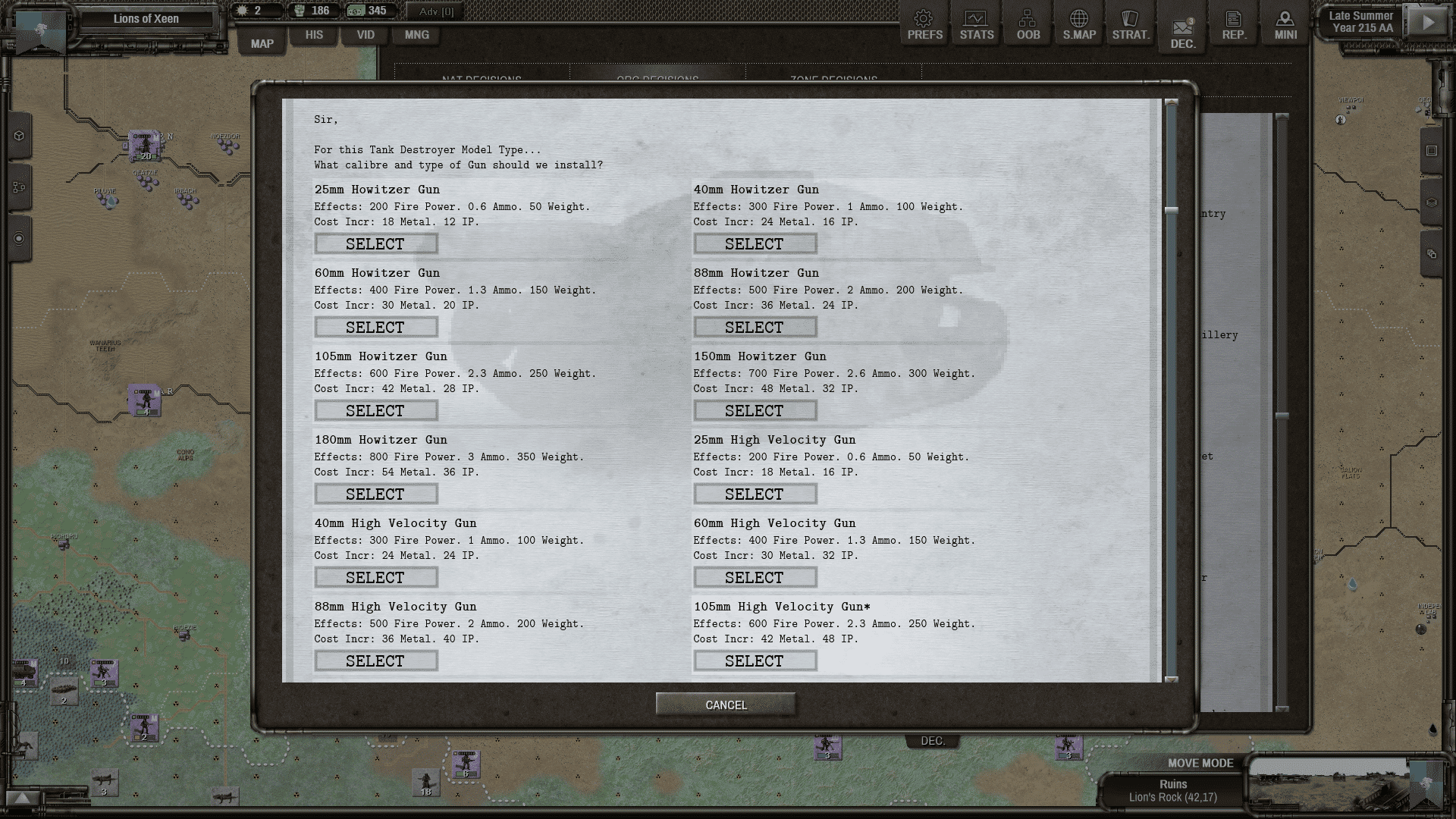
Balancing the budget of Bureaucratic Points between these Organisations is a tricky business: reduce funding to one of them, and its leader will be angry, with the opposite effect for raising it. This punishes constant fiddling to leverage the exact advantage you want every turn. However this system does allow the player to crash fund certain fields for a quick reward at the expense of a big hit to your Leaders’ relationships with you, meaning you can do it, but at a significant cost. This is a hallmark of great game design as players are thus discouraged from constant micromanagement (making for a boring game as the player feels forced to adjust a bunch of sliders every single turn to manually optimise their research) without strictly disallowing it.
User Interface
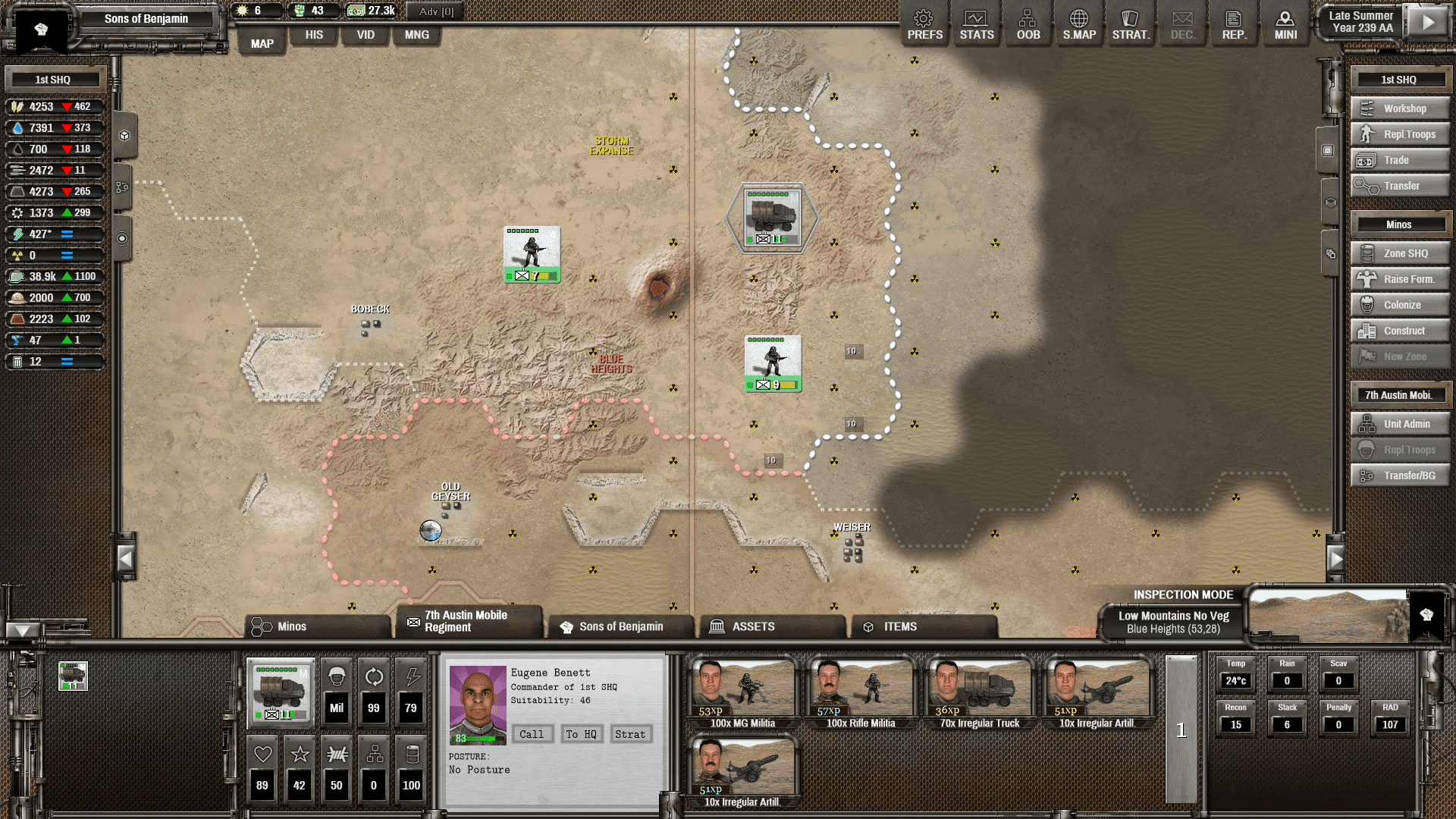
The user interface consists of the main game window through which the player views the hex-based planetary map, either fully visible or shrouded with a fog of war as determined in the game options. There’s a mini-map for quick navigation, handy as the old-school hex scrolling can sometimes be a little cumbersome when traversing a large map. There are three levels of zoom, and the game defaults to pictorial representations of the game units at the first two levels, with the most distant showing NATO counters instead. These counters can be changed in the options as necessary. Arrow keys scroll the map, and unfortunately there is no “click and drag” mouse scrolling as in many modern games. The game contains very detailed and extensive tooltips for nearly everything you can click on.
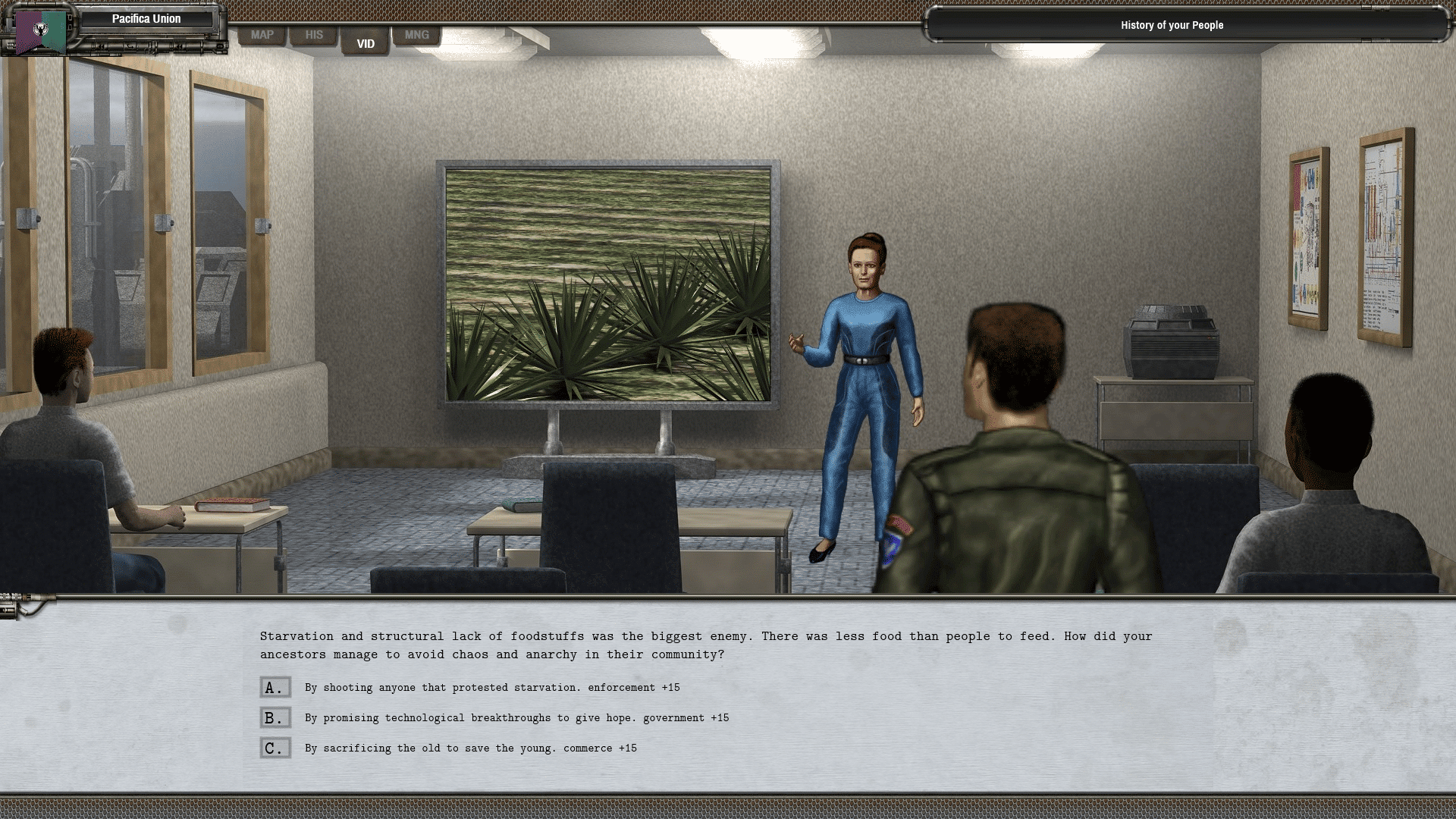
The top info bar contains the three main currencies used by the player directly in-game: Fate Points, Political Points and Credits, representing your hard cash (the fourth important currency, Bureaucratic Points, is not directly handled by the player and so not visible here). There are also tabs for navigating the many different screens the game uses to present information. The Vidcom displays a series of pictorial events at the start of the turn. The History tab shows a step-by-step breakdown of the AI’s turn resolution including every unit’s movement and any battles that took place.
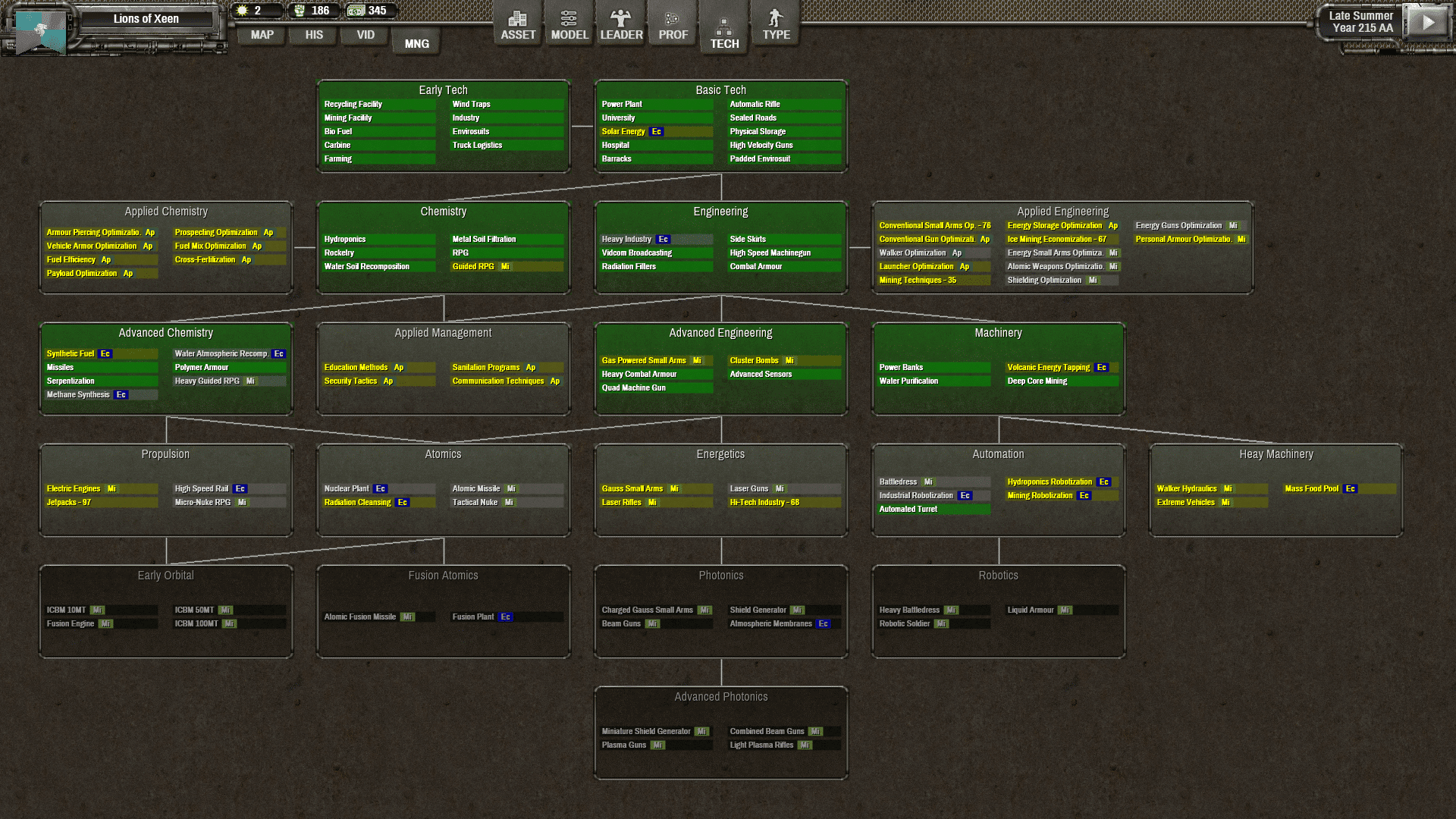
The Management Screen Mode encapsulates a series of important tabs that display information critical for your empire’s smooth running: the Asset Management Window focuses on your zone assets (the name for the buildings and features which produce and consume resources) and the zone’s economy. The Models & Quality Level Management Window displays and sorts your designed units, the Leader Management Window allows you to sort your characters by their many attributes and skills whilst the Profile Info screen shows a table of Regime Feats and shows your progress in each field: it also displays the many feats and abilities available at each unlock. The Tech Tree Info screen is self-explanatory, and finally the Model Type Info window indicates models you have researched in the form of a tree diagram.
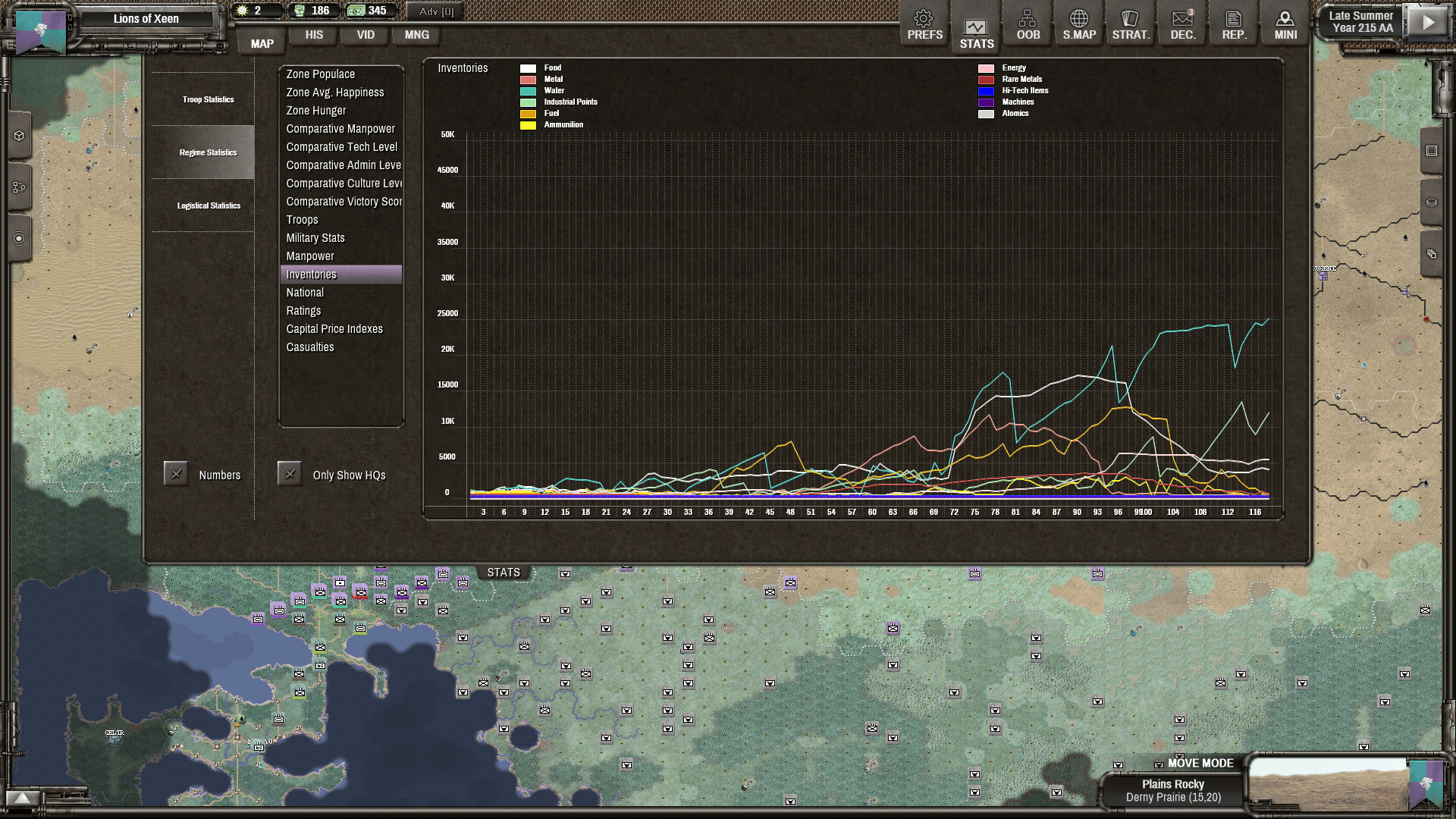
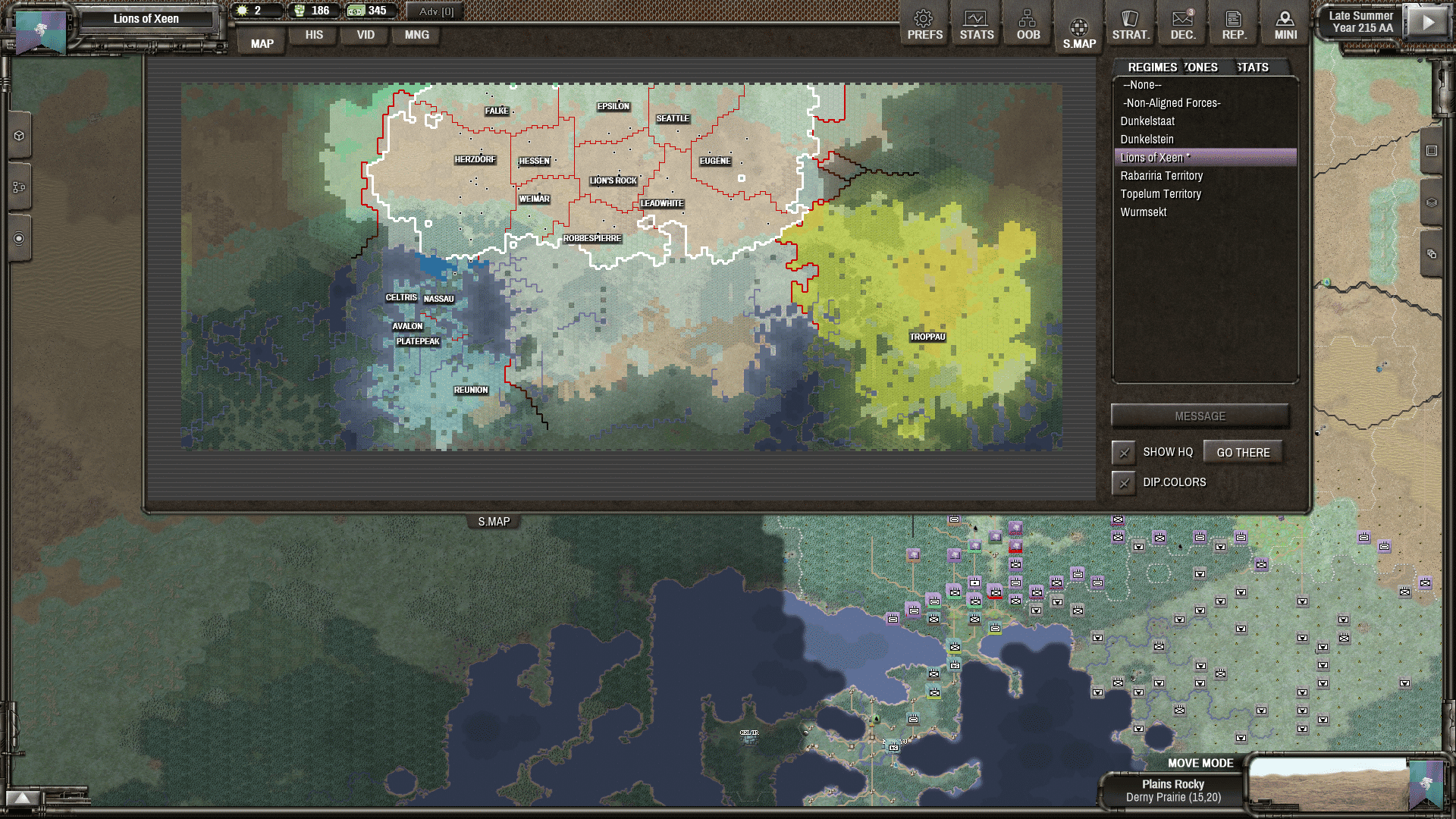
The top bar holds the game options and then a statistics screen which displays a series of line graphs for everything from the amount of troops in your regime sorted by type, through Regime Statistics such as Zone Populace, Hunger levels, Capital Price Indexes for trading, and some rather impenetrable looking Logistical Statistics detailing the ins and outs of your supply chain management. Next along is an Order of Battle screen which shows you your fighting forces organised as a tree, from your Strategic Headquarters (SHQ) down to each Operational Headquarters (OHQ) and their attached formations. The S.MAP is a well-designed strategic map that you will use a lot. It shows the entire planet (or what is known of it) organised by Regime, by Zone or set to show critical resources and terrain features. If the fog of war is on, the map will “guess” at neighbouring regime’s borders which will update as more hexes are uncovered. Regimes or Zones can be selected in order to play cards on.
Next comes a screen for listing Strataegems, Shadow Empire’s ubiquitous card system for handling all decisions related to diplomacy, espionage and covert operations, economics, orders for your generals and zone leaders, your Zones themselves and many others too numerous to list. Stratagems are displayed as a series of pictorial playing cards, their cost in Political or Fate points listed, alongside a short description which is bolstered by a detailed tooltip on mouse over.
The Decisions tab which allows the browsing and handling of the turn’s decisions. Finally, and before the Mini-Map tab, are the Reports. This is a large series of text-based information screens (sometimes with charts and diagrams), presented in the form of printed reports and which wouldn’t look out of place in a historical WW2 focused military game.
Reports
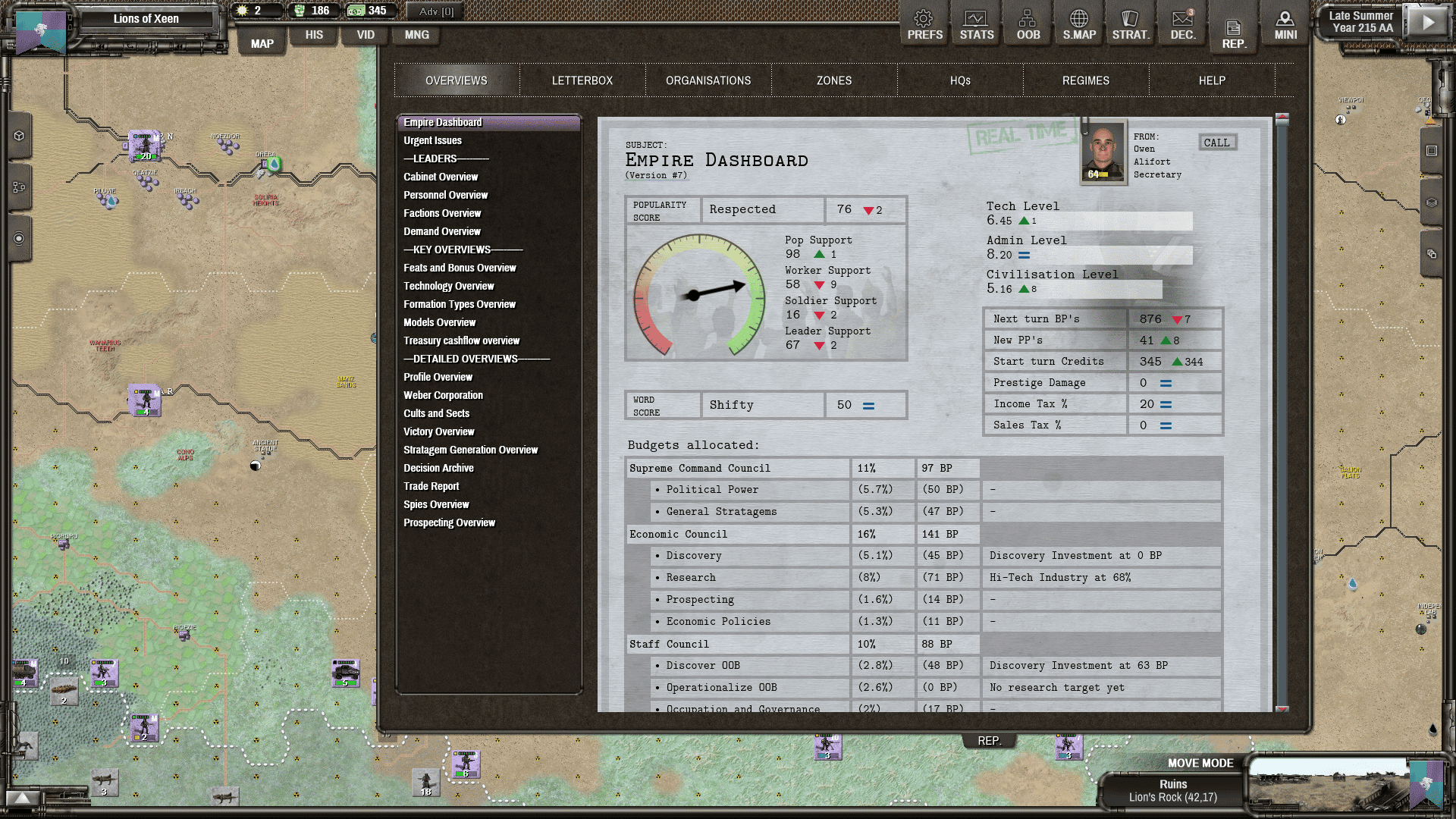
Reports are the game’s main way of presenting the various data on your faction, your opponent’s factions, the planet and many other things in exhaustive detail. They are at once both a wonderfully rich treasure trove of critical data necessary to running your empire and an exhausting pile of text files that squirrel away crucial information in (initially) difficult to find places. Some are more useful than others. The Empire Dashboard provides an at-a-glance overview of the most important of the statistics that affect your regime: Tech Level, Admin Level, Civilisation Level, Popularity, your “Word” (a measure of how well you’re sticking to your promises), your Bureaucratic Points (BPs), Prestige Damage, Tax levels and more.
Other Reports include a record of the planet generation screens, the Stratagem Encyclopedia that allows you to find which Council or other method generates an important card you might want, a report from each of your Organisations, from each of your Zone governors… there are dozens and dozens of them.
The presentation of the reports serve to immerse you in the role of ruler and administrator of a post-apocalyptic empire, and once you’ve learned where something you need is, it is available with just a few clicks. Much of the information you need to run your regime is here in read-only form. I love this system. Others might see it as being a poorly organised and obtuse jumble of crucial and non-crucial information. Your mileage may vary but it is likely to be a most divisive and contentious design decision and one that will likely separate fans from haters in much the same way that the user interface and presentation in Distant Worlds: Universe does to this day.

The bottom bar, and both sidebars are collapsible to allow better view of the game map. The left bar shows the many resources used in your day to day empire management: food, water, fuel, troops, metal and many more. Industrial Points are notable in that they are generated each turn by your industry and taxed from your populace much like credits, and are used in almost everything you build.
Another tab here contains your Regime Profile scores and a hotbar showing your SHQs and each Zone that is administered by them for quick selection.
On the right are SHQ specific buttons: this top level HQ unit administers your entire supply and logistics network, as well as all military formations not led by their own OHQ commander. The buttons here manufacture ammo and machines in your workshops, to create replacement troops for your formations, to buy or sell resources from the games simulated Trading Houses. This trade window is a simple buy/sell by quantity screen, but this hides a complex economic simulation where each Zone has a trade house which trade resources and credits with one another, meaning the items you sell may eventually get into the hands of your enemies and planet-wide shortages can and will wrack every nation alike. You can also transfer troops items between SHQs if you have more than one, as more can be built if your empire expands very large and you can’t cover everywhere with just one. Be aware that this comes at the expense of increasing the amount of work for the player each turn and I’d advise against it unless absolutely necessary, or you enjoy the idea of creating separately administered territories.
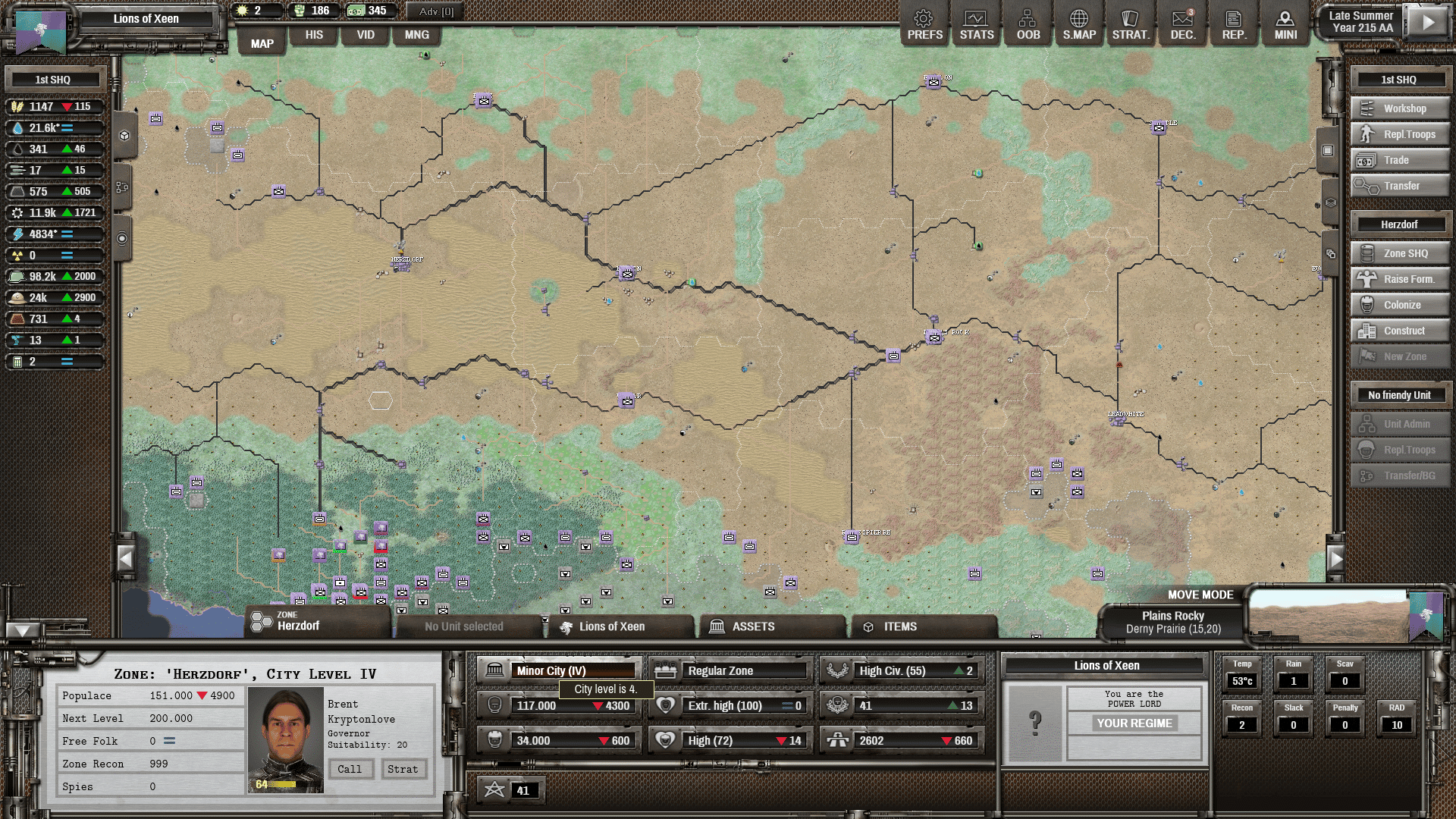
There are also Zone-specific controls where you can raise formations, assign colonists to cities, construct hex assets and create new Zones. This can be useful later in the game: whilst it’s generally far easier to take cities from your rivals than it is to colonise new ones at the start of the game, later this can become trivial as you gain access to more colonists and it becomes important to put cities closer to valuable resources.
Finally for selected unit counters there are some unit administration tools, for replacing troops, changing your HQ, upgrading equipment and controlling the experience levels of the troops they can take.
Lastly, the bottom bar contains tabs for your Zones, many details for any military unit selected, a general Regime overview tab, for selected Assets and a Items list of the resources present in the current zone.
Zone Management and the Private Economy
Hex Assets can be built in any hex you control providing that building can provide some benefit there and is connected by road. Your Strategic Headquarters will allocate the resources necessary and they will be transported physically through your supply chain to the destination, meaning you have to get your logistical network up to speed first. Buildings either produce a usable resource (Dome Farms for food, Solar Stations for power, Wind Traps for water, Industry for Industrial Points and so forth), generate something that indirectly improves your city Quality of Life score which is a crucial factor in attracting more population to migrate into them (Universities, Hospitals, Barracks etc), produces supply points (Truck Stations, Railways) or some other benefit. Assets can be continually upgraded up to the maximum level of your city as determined by population. You recruit and pay workers from the population to staff these Assets, which takes them from the civilian population. The game tracks Population and Workers separately and each have their respective Loyalty, Happiness and in-game events.
Parallel to your own industry there is a separate private economy representing civilian industry and endeavour, which you cannot directly control. Civilians will build farms for food, their own industry, schools and public services and their own transport networks, all of which can be taxed. There is some indirect control: you can raise and lower tax levels, allocate monthly credits to the private economy so they can build their own Assets more quickly, and buy out some of their buildings if you need them for your own uses (Beware! Do not buy the only food production source in a zone unless you can ship enough in from out of town else your people will starve!) but generally speaking they are left to their own devices. Vic, the developer, explains that this feature is partly to reduce micromanagement in your zones as the private Assets will also contribute Quality of Life, small amounts of food or metal and so forth, but it also breathes some extra life into the world you inhabit.
Research and Development
Research is a more familiar affair, although perhaps more nuanced than anything we have seen before. The sciences are split into Economic, Military and Applied, with the first broadly covering Assets and your industry, the second your military Models, and the third works upgrades various aspects of both. Your regime must first discover a field, and then research it separately. The tech tree is large and split into tiers: research three techs in a node on the tree and you unlock the next one. Economic and Military fields are researched just once and the benefits are applied on completion, whilst Applied Science fields can continually be researched with an incrementing bonus applied with each percentage point of completion: hitting 100% can take a very long time, so usually you’ll stop long before that, once a desired thickness of armour, or an increase to mining efficiency is reached.
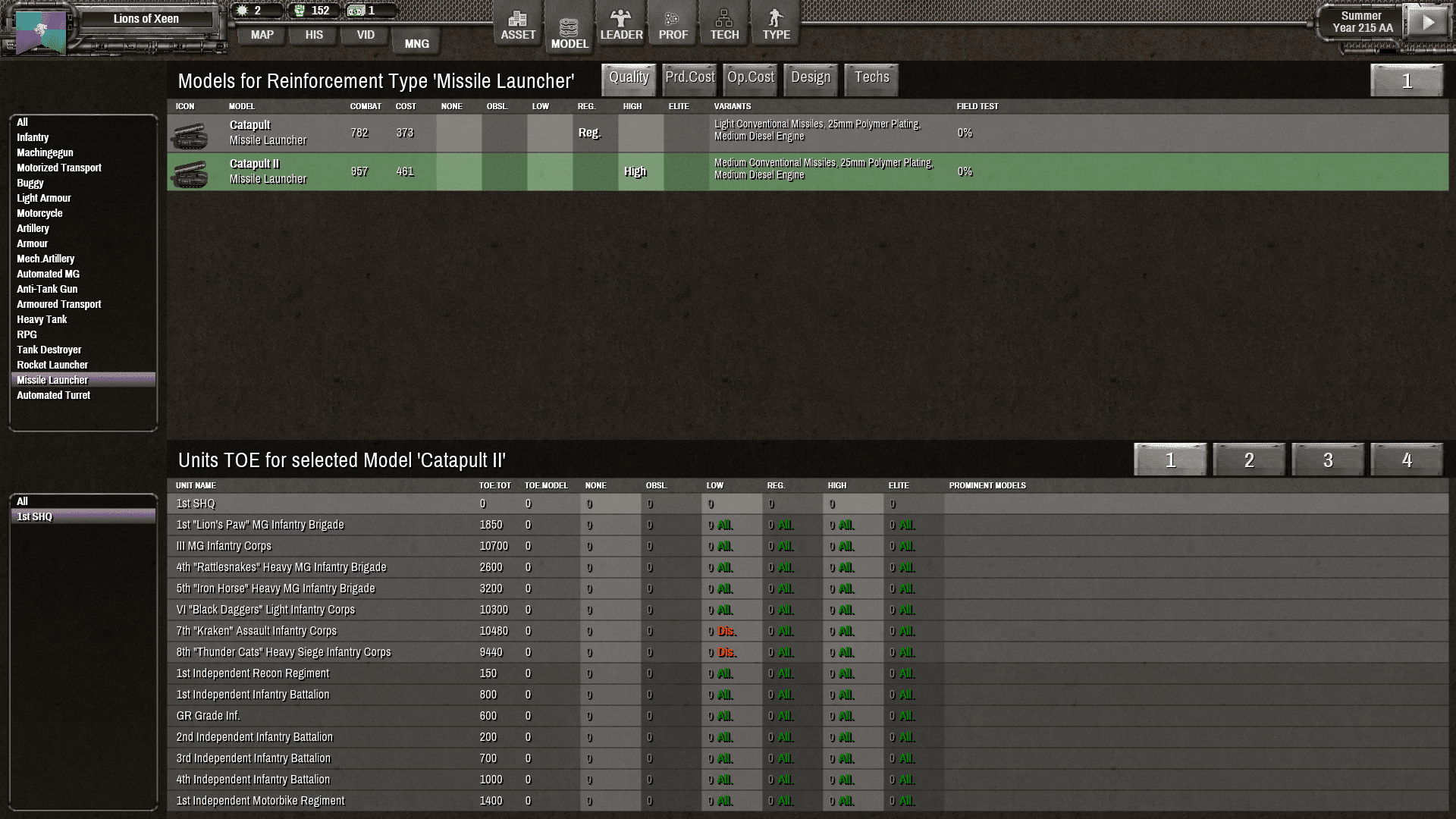
Model Types are military units like Infantry, Tanks, Nuclear Missile Launchers etc. Once a Type is unlocked by research, the player can then design a Model, a working version from the Type blueprint, using other components you have researched. This is not as complex as it sounds, and in practice is quite simple: for a tank, you’ll simply choose the gun size, armour material and thickness, and engine size. The design process has procedurally generated elements from combat effectiveness, to cost efficiency, to weight and many many more. Once a model is produced it can increase its performance through field testing, and your Model Design Council can gradually redesign existing models to increase their performance statistics. This means that two Regimes may field what on paper should be the same tank, but one may have a drastically better attack power whilst the other could be cheaper to build. Eventually both models will evolve off in different directions, and so constant field testing and redesign is encouraged.
Logistics
Logistics is, by Vic’s own admission, probably the most difficult concept to wrap your head around early on. It works a bit like this: your SHQ is responsible for managing the supply of food, resources, manpower and ammunition to and from all of your Zones and to the OHQs which lead your combat formations. Everything that can be transported is meticulously modelled and requires transport via road using trucks, or by rail using a MagLev train. Dirt Roads are built using Industrial Points, and later Sealed Roads better transmit logistics at an increase IP cost. Both require a Truck Station to provide the necessary trucks. Rail costs IP and Metal, require a Train Station for the trains, and either another station at the end of the route, or a Rail Head hex asset to unload supplies to your troops in the field.
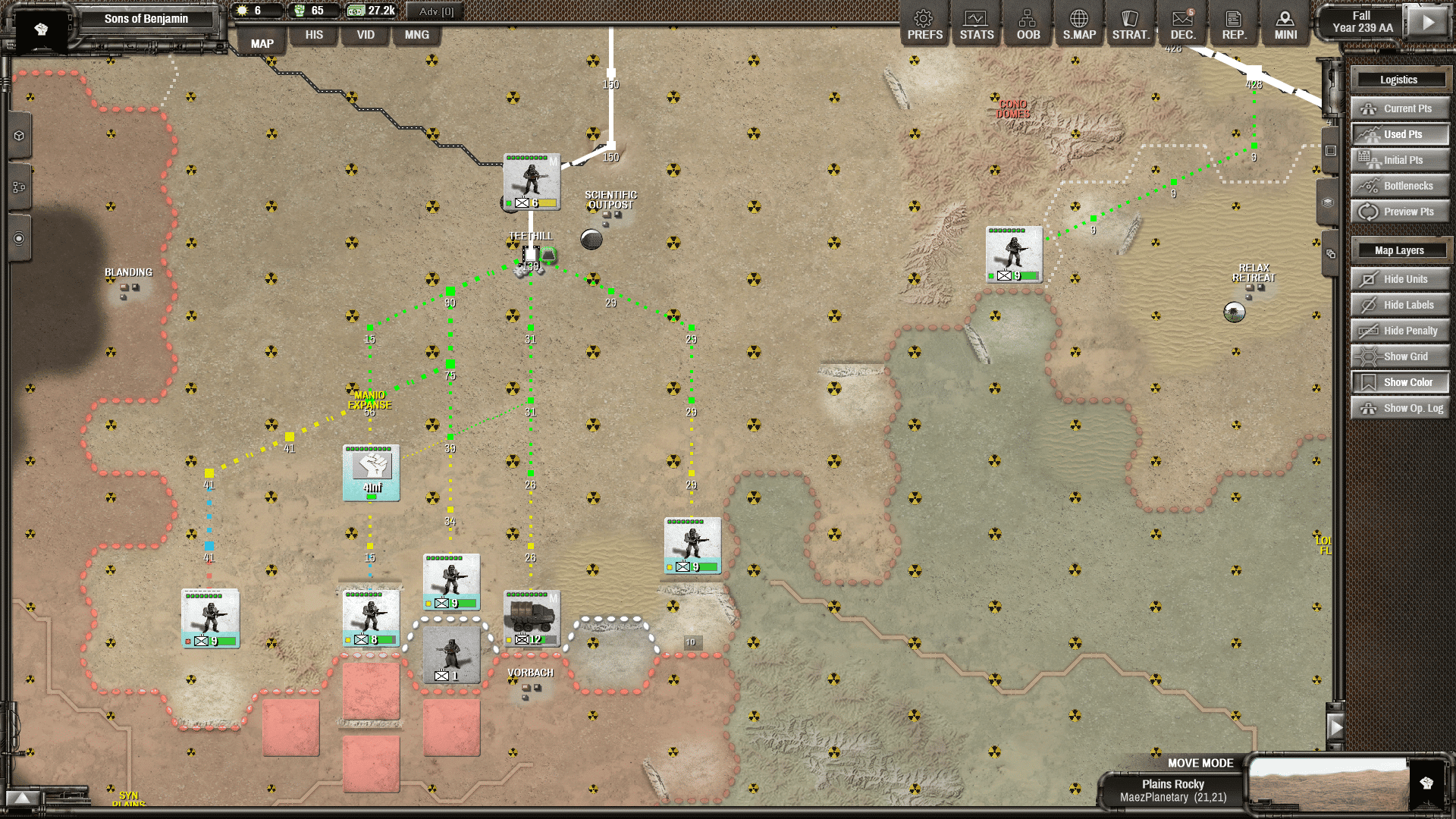
As Zones will periodically request materials for new Assets, have food shortages or require others bits and pieces, your logistic network is in constant use. This turn by turn rigmarole is mostly hidden from the player providing there are enough trucks and fuel to move everything. Although specialising cities seems to be less necessary in Shadow Empire than other 4X games, there will be times when one is heavily dependent on the SHQ to supply it food, and others might be located near to abundant resources so it is critical to build adequate roads and enough trucks or trains to keep your empire fed, supplied and fighting fit. Fail in this task and your citizens will starve, troops have no bullets for their guns and your trucks no gas for their fuel-tanks. A Game Over screen can swiftly follow, and owing to the fairly steep learning curve this can be an early source of frustration for the player, an issue discussed later in this article.
Armies on campaign require supply too, and so the player will be tasked with building roads and rail out to meet the needs of the men on the front line. Cutting supply lines and starving your enemy of food, fuel and ammunition is the aim of the game as direct confrontation can often cause you horrendous casualties. Replacement troops and equipment also require the logistics system to reach their intended Operational Headquarters in the field.
The difficulty in learning to navigate these complex systems is not there just for its own sake. Logistics is so carefully modelled that each item supplied, from ammo through fuel drums to equipment such as tanks and missile launchers all have their own weight and so heavier pieces require more trucks or train supply to reach the front line. Model weight can become a critical factor in battles far from your SHQ as extended supply lines demand use of smaller, more lightweight units. Whilst the systems in Shadow Empire can be difficult in places, that detail almost always grants a level of depth to the gameplay currently unavailable in any other 4X game ever made, with the possible exception of Aurora 4X.

After some practice with the logistics system, building your empire around it becomes a fun mini-game in its own right, particularly when you consider that resources can be scarce and because it’s far easier to take a city than it is to build them in the early game as your empire is often large and scattered. Careful logistics planning and management become critical. Despite Shadow Empire’s apparent heavy military focus, this excellent management simulation might well appeal to that small but vocal sub-section of the 4X community that are clamouring for more detail and depth in the non-warfare side of the genre.
Combat
Combat in Shadow Empire is simple to initiate: select a unit, select a target hex, a popup allows selection of Eligible Forces with a representation of their relative position to the hex under attack, and a summary of all the modifiers affecting the combat chances. Terrain modifiers, a unit’s entrenchment, Readiness (a handy abstraction which simulates its positioning, organisation, unit strength and more), its supply, any Leader bonuses and many more. You can select either a Regular Attack or an indirect Ranged Attack for artillery and other units. The game calculates some combat odds, and then the battle plays out turn by turn.
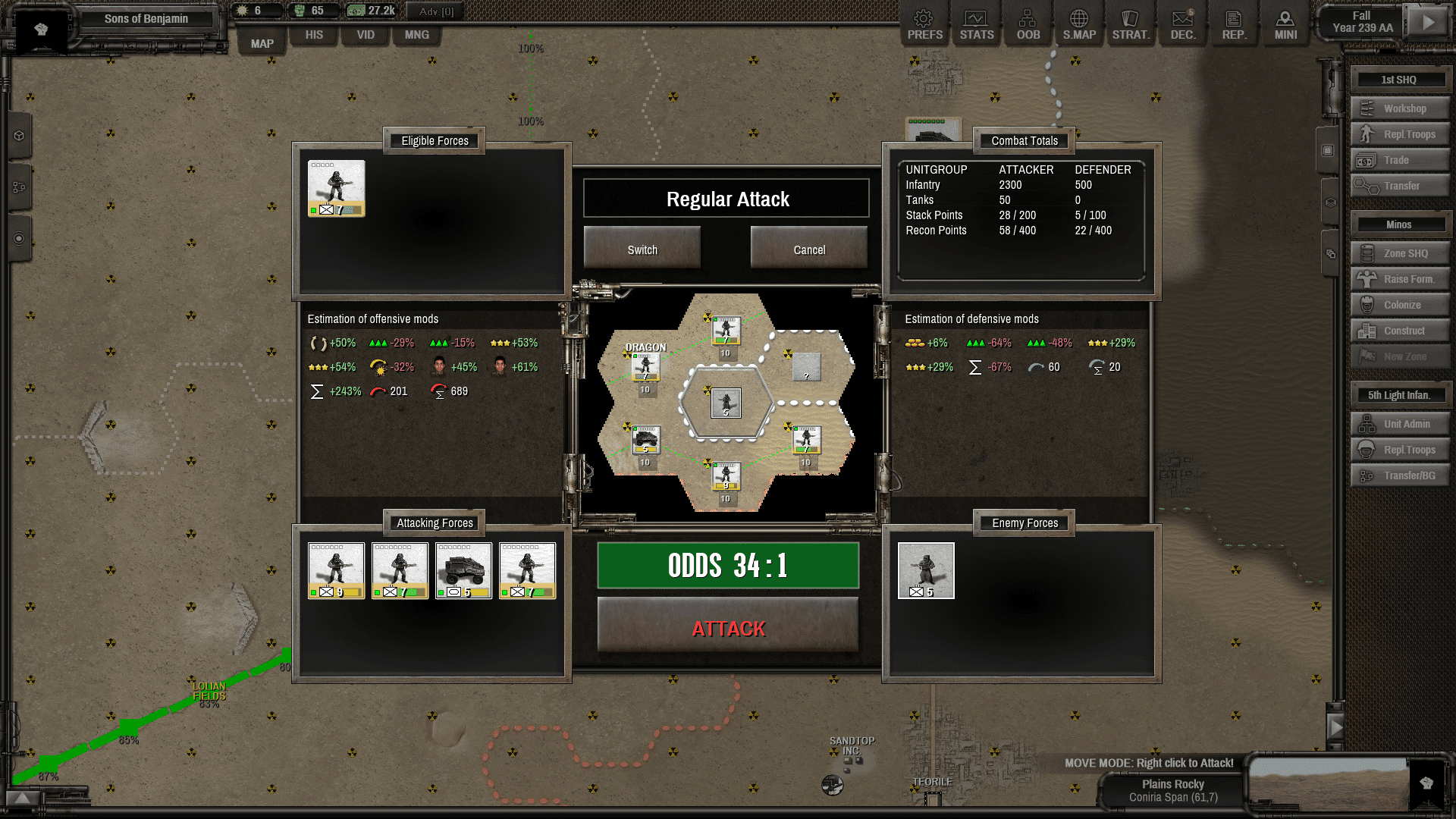
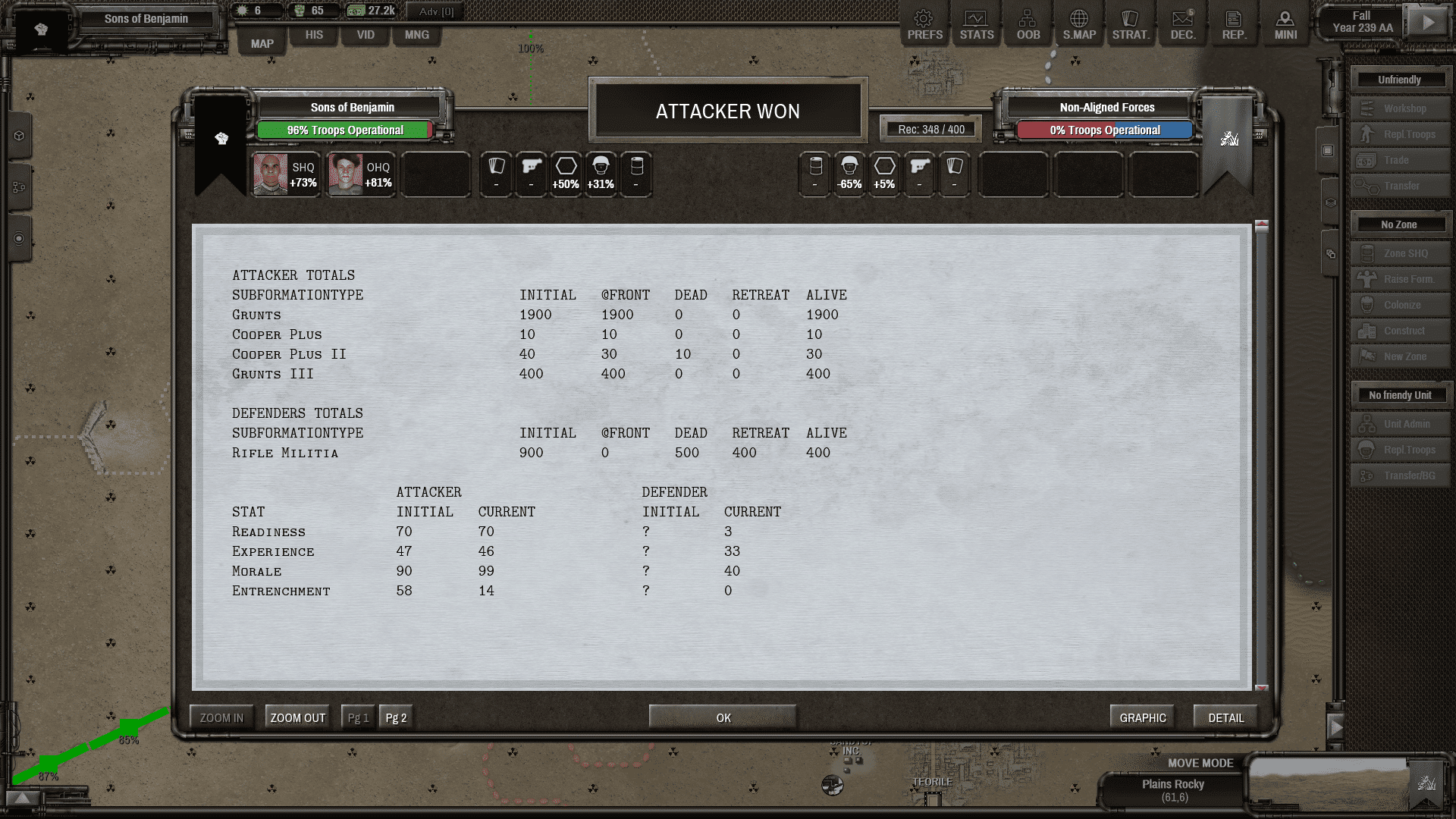
The resolution is too complex to detail here but essentially each unit in the formation will spend action points to move in and attack. Once out of action points, depending on the result, the units will retreat or break through. A graphical display shows how the combat is going, with some suitable gunfire sound effects to accompany it. There’s a rather spartan looking Details screen which gives a blow by blow account for each unit over each round and can be useful in determining the performance of your troops, but this is usually unnecessary. There’s a text version of the combat display too, detailing losses, changes in attacker and defender stats and much more.
Many things will affect the performance of your troops: how much recon you have on the target hex, different model types are better suited to attack or defence and different gun sizes penetrate more armour. Terrain is a big factor, with difficult terrain like mountains, dense forests, rivers, and escarpments proving defensive bonuses to infantry and penalties to tanks and other wheeled units. Heavy Radiation, lack of atmosphere, biohazards and extremes of temperature will all affect Readiness. All units have a supply level which measures food, ammunition and fuel and a lack of any of these drastically reduces their combat readiness and moral: encirclement is your best friend here, as cutting off supply to your enemy is your primary strategy for defeating them.

Stationary troops will gradually dig themselves in, making them extremely hard to dislodge. Artillery and other big guns can bombard indirectly to reduce this entrenchment. Units also have their own experience levels, and your formations can be filtered to accept or reject Green or Elite troops, allowing you to form very strong, experienced units, and keep the rookies for garrison duty.
The detail in the combat mechanics is absolutely bewildering, and more casual 4X players might initially balk at all the complexity on show. For those familiar, I would say this game isn’t too far away from Gary Grigsby’s War in the East in the combat resolution department. Fortunately for non-grognards, Shadow Empire’s combat plays easily enough that these mechanics can be revealed and learned rather gradually: the player will eventually have to learn them all if he wants success on the harder difficulty settings but I completed my very first game (before reading the manual) on Regular just by experimenting and a little use of save-scumming to retry battles.
Combat AI
The AI is very competent: The Major and Minor Regimes play quite differently, with the Minors intended to be more of a roadblock to your expansion. The Majors play to win, and once at war you can expect them to use a variety of tactics to break your lines. They will match your front lines with superior formations whilst attempting to flank with motorised units to encircle you. It will also defend in depth, particularly if they are facing a potential blitzkrieg, forming line upon line of entrenched infantry, RPGs and anti-tank guns, cleverly holding units back in reserve to fill any gaps that occur. It will cycle damaged units out, and replace them with fresh ones, and makes effective use of Stratagems.
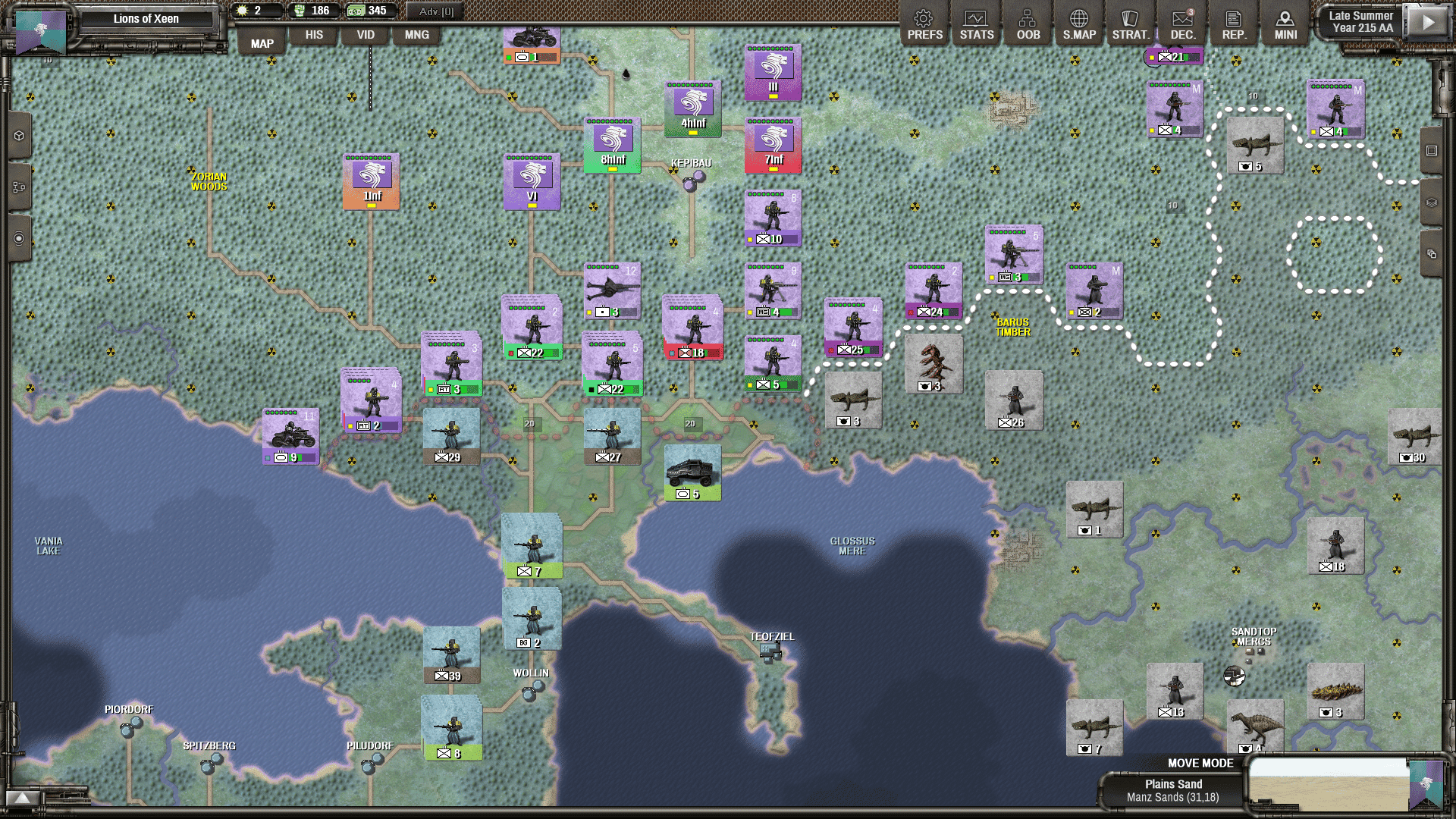
I did notice that the AI doesn’t always remove unsuitable Postures after use, meaning a unit probably best set to Defend or Hold the Line might actually still be set to one of the attacking postures, meaning a huge penalty to their defensive statistics. This was not a frequent issue as far as I can tell, and might have been the result of the AI not having many Stratagem cards and intending to use that unit offensively later, much like an inattentive player might.
Technology and War
All in all, knowledge of modern military formations and tactics will be of great use to a player as Shadow Empire follows real life historical formations quite closely. The post-apocalyptic setting adds in buggies (an early game tank-recon hybrid unit) and Motorbike Infantry (not used a lot in real-life but in this game a highly effective recon unit).
Late game technological breakthroughs can be exciting: gauss and laser weapons, robot troopers, machine-gun toting walkers and enormous AFV’s never seen on any battlefield here on Earth. These all seem carefully designed to counter a specific tactic unique to this game: the walkers can traverse and fight in terrain that tanks cannot, making them effective for clearing infantry (which excel in a defensive role) out of mountains and forests. Robotic infantrymen require no manpower, and so on planets where manpower is almost exhausted you can carry on the fight, at the expense of them being rather poor in offensive operations due to their limited intelligence. Shield generators, plasma guns and other advanced systems await you at the top of the tech tree.
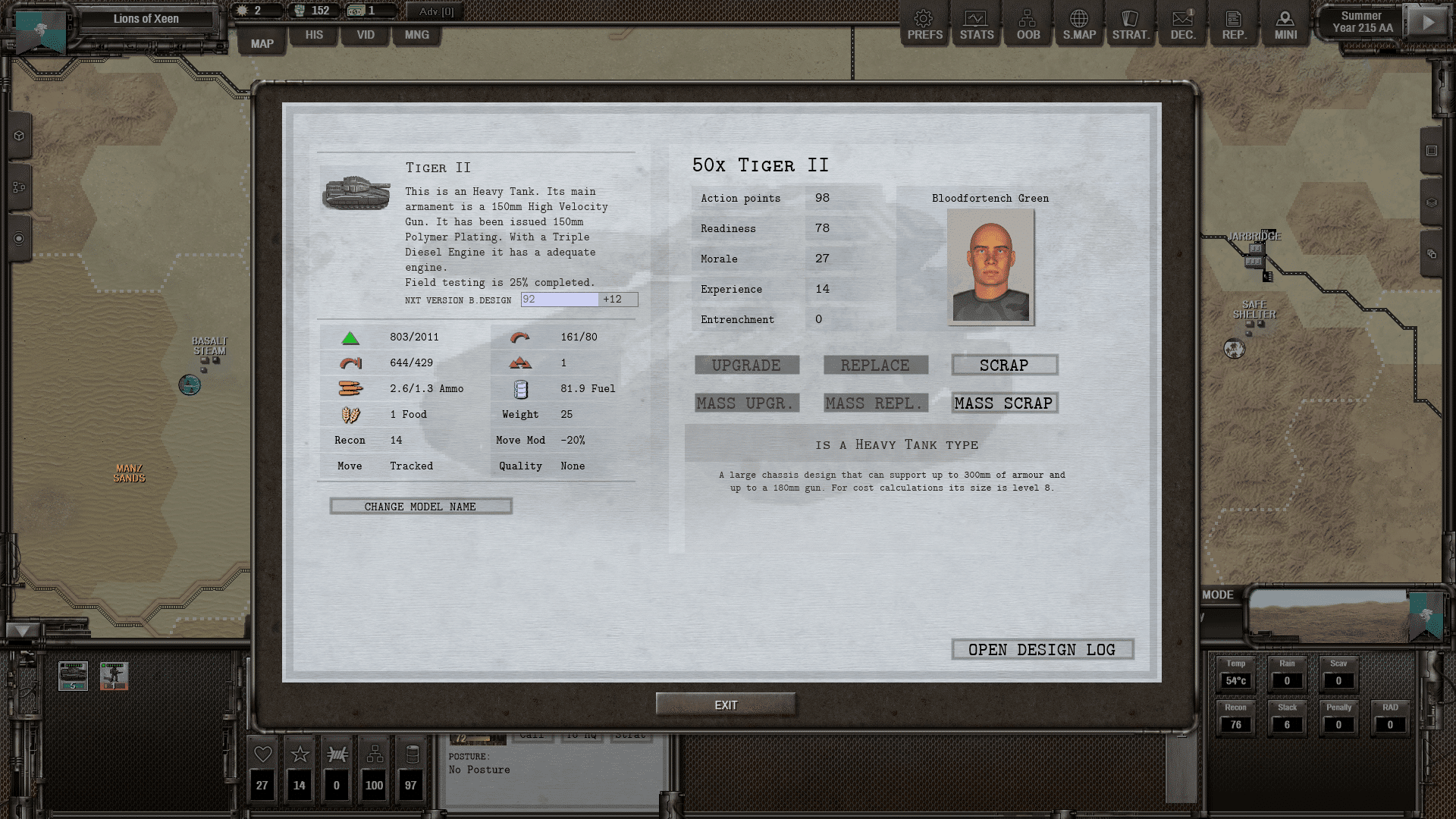
If you can find radioactive materials, you can start to play with atomics. These are as devastating as they sound, and range from shoulder launched micro-nukes for cracking the hardest of AFV armours, Atomic Missiles launched from a specialised launchers, Tactical Nukes, all the way up to 100MT ICBMs and advanced Fusion Missiles for those special occasions: show one of your neighbours just how much you care with a little gift from heaven. And remember! Cleaning up nuclear fallout can be fun for all the family!
The terrain you fight over can drastically affect how wars will play out. If you’ve a thousand miles of mountain to fight over between you and your opponents city, you need to either surprise him or quickly go around him. Battles centred around infantry defending terrain like mountains and heavy forest can quickly turn into horrendous wars of attrition: tanks don’t work well in such terrain, and infantry have a penalty to attack anyway, meaning WW1 style trench-warfare suddenly comes back into fashion. These wars can last for decades until a technological breakthrough comes along to break the stalemate, or one side either runs out of replacement troops or their cities rebel because of the mounting unhappiness from war casualties begins to stack up. And then you realise that all along that if you’d just developed a better version of one of the units you were fielding, you could have won years ago!
Diplomacy and Espionage
Most 4X games make some attempt to model diplomacy and those systems don’t always work very well: the player is smarter than the AI and can either cheese the system to leverage an easy victory, or they’re essentially the same recycled systems used in the two big genre classics of the early 90s. Espionage is less often attempted, with similar results. Shadow Empire approaches both ideas using the excellent Stratagem system. Here the player directs Bureaucratic Points into her Organisations, which then generate randomly Stratagem cards to be played with her pool of Political Points. Once generated, cards are stockpiled until they are used, with an indefinite lifespan. Generally speaking, given an adequate supply of BP, each turn you’ll have at least some of the cards necessary to propose a peace deal, ask for a trade deal, or send spies into a neighbours territory.

There are too many cards to list here but diplomatic options for Major Regimes include the usual peace deals, non-aggression pacts and alliances of more vanilla 4X titles, but add a host of new options too: raising or lowering trade tariffs, opening and breaking trade deals, scientific cooperation, cultural exchanges, expelling diplomats and more. The AI mostly uses the same cards on you too. Minor Regimes have more limited options, including offering to protect them or to take them as a client state. Covert operations include spying, causing enemy NPC leaders’ ambitions to raise (which makes them rebel easier) and supporting foreign factions to influence elections. AI factions have a complex system of relations with yourself and one another, and these cards can subtly alter their moods. However, if they’re not in the right state of mind to deal with you, you can’t use the card.
The Stratagem system is neat and it works: diplomacy isn’t terribly important in Shadow Empire if you don’t want it to be, and it remains to be seen how exploitable it is, but early indications are that none of the actions you can take can drastically alter the AI to suddenly change its attitude towards you, at least not without some serious dedication of Political Points and that will take time. Nothing can convince an aggressive, vengeful AI to be friends with you, and you can’t just destroy your relationship with a friendly one without some hefty PP investment or declaring war and taking a huge hit to your citizen’s happiness. This is a good system, which supports the game flow without breaking it completely. There may be some room for balancing this: the skill of the Leader making the dice rolls does drastically affect the chances of a card’s success: get a Leader with a high Special Ops stat and you’re laughing as you flood your enemy’s regime with spies, whilst a poor diplomat can make it almost impossible to force a peace deal with an belligerent neighbour.
The Lions of Xeen
Let’s return to the Xeen: shortly after securing three zones around their starting province of Lion’s Rock and making a move on a fourth in the south, their expeditionary forces found the climate and terrain to change. The jungles of equatorial Xeen had frequent rain, something never seen in Lion’s Rock and rarely in surrounding territories: worse still, it was heavily polluted with radioactive materials. Expansion south was brought to a halt until radiation filters could be developed to protect the men from an early death. Just as they began their march south once more, they were unexpectedly set upon by a horde of giant alien beast of many kinds, some over twelve metres in height and others with armour as heavy as a tank.
Mustering two more brigades of infantry was necessary just to hold them back. Meanwhile a series of revolts and protests forced the government to lurch further towards authoritarianism. Nearly two years passed as the war against the raging monsters of the south wore on, and further expansion to the west and east into the outlying desert territories was hampered by poor logistical development. Just as the aliens were finally pushed back in the south, a group of savage slavers delivered an ultimatum to the ruler of the Lions of Xeen: buy our slaves or prepare to die. The Lions coffers were empty but they would never bow to such a threat anyway!
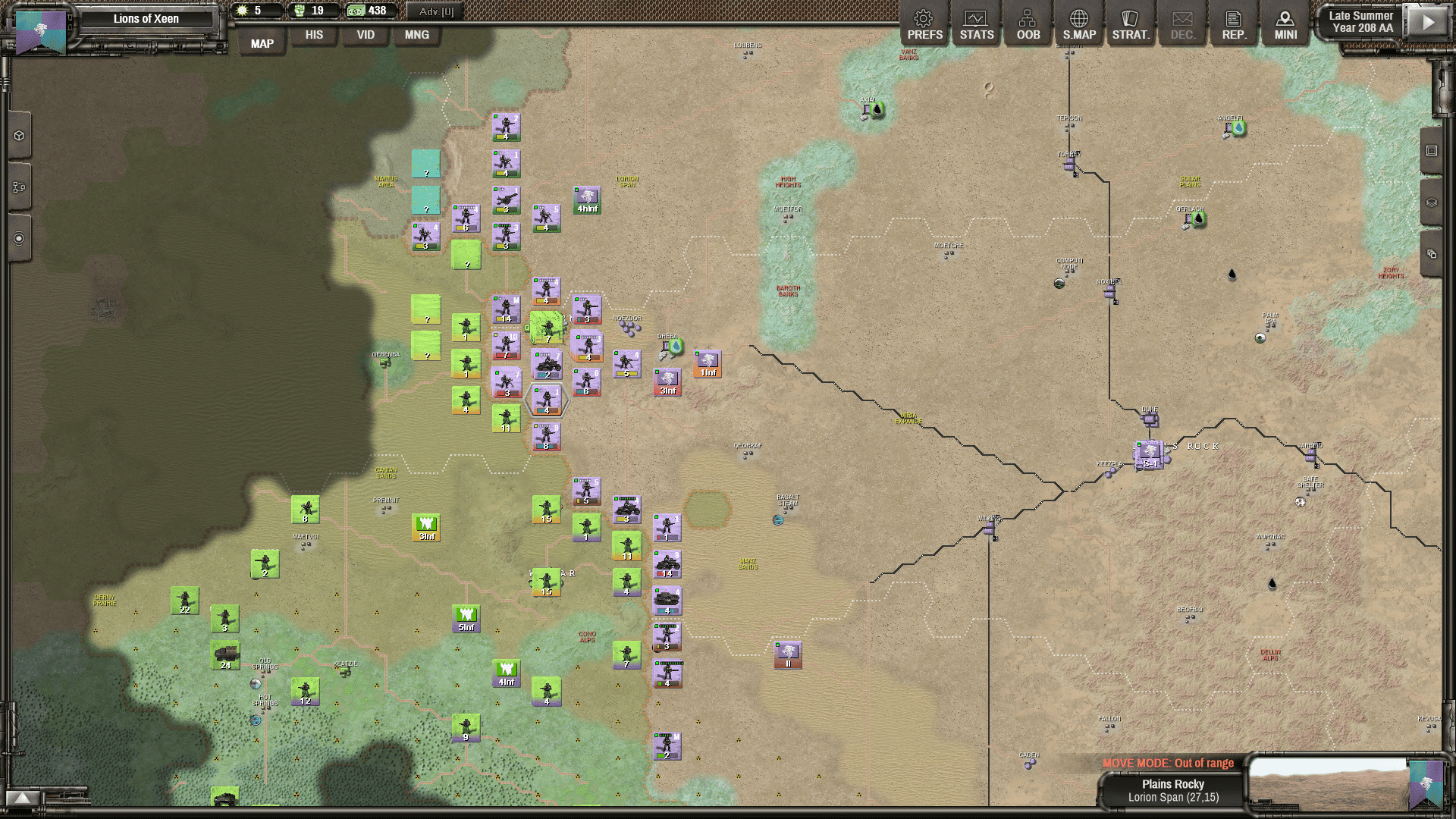
Out of the east came a tide of howling, screaming marauders on modified buggies and motorbikes, almost too numerous to count. In just four short months, the Lions lost nearly all the eastern territory they had fought and died for in the previous few years. Diplomacy was out of the question: the slavers did not respond. All they knew was how to kill. Forming a hasty battle line, all available troops were redeployed from the other end of the empire using the Lion’s newly constructed road and truck supply system. They made it in the nick of time, and forming a battle line, they dug in just two hundred kilometres from their eastern most city, where the slavers had begun to assault the walls.
Rapid conversion to a full war economy allowed the rapid production of anti-tank guns, RPG troopers and even a few battalions of light tanks. After months of bitter fighting and suffering such horrendous casualties that workers across the empire lay down their tools in protest, the Lion’s broke the back of the invasion. The riots were so severe that further changes were made in government: all pretence of democracy was gone. One of the most senior generals did not like this change at all, and just as the slavers lines broke and were finally pushed back from the walls of the city, a rebellion sprung up in the mountains to the west of the city. War was here again!
The battle with the aliens was manageable: I dug in and slowly watched them destroy themselves against my well entrenched infantry units. The Slavers were another matter entirely: I nearly lost that battle and would have lost a city in the process, something I could have carried on from but would have caused me severe issues as my only metal supply was found in that zone. The rebellion was fairly easy to squash in the end, but it took a long time to fully root out all opposition to my new autocratic government. The battle for Xeen showcases some of the incredible gameplay and stories that Shadow Empire can generate, and that every decision you take can have consequences further down the line. No other strategy game I have played provides an experience as multifaceted as this one.
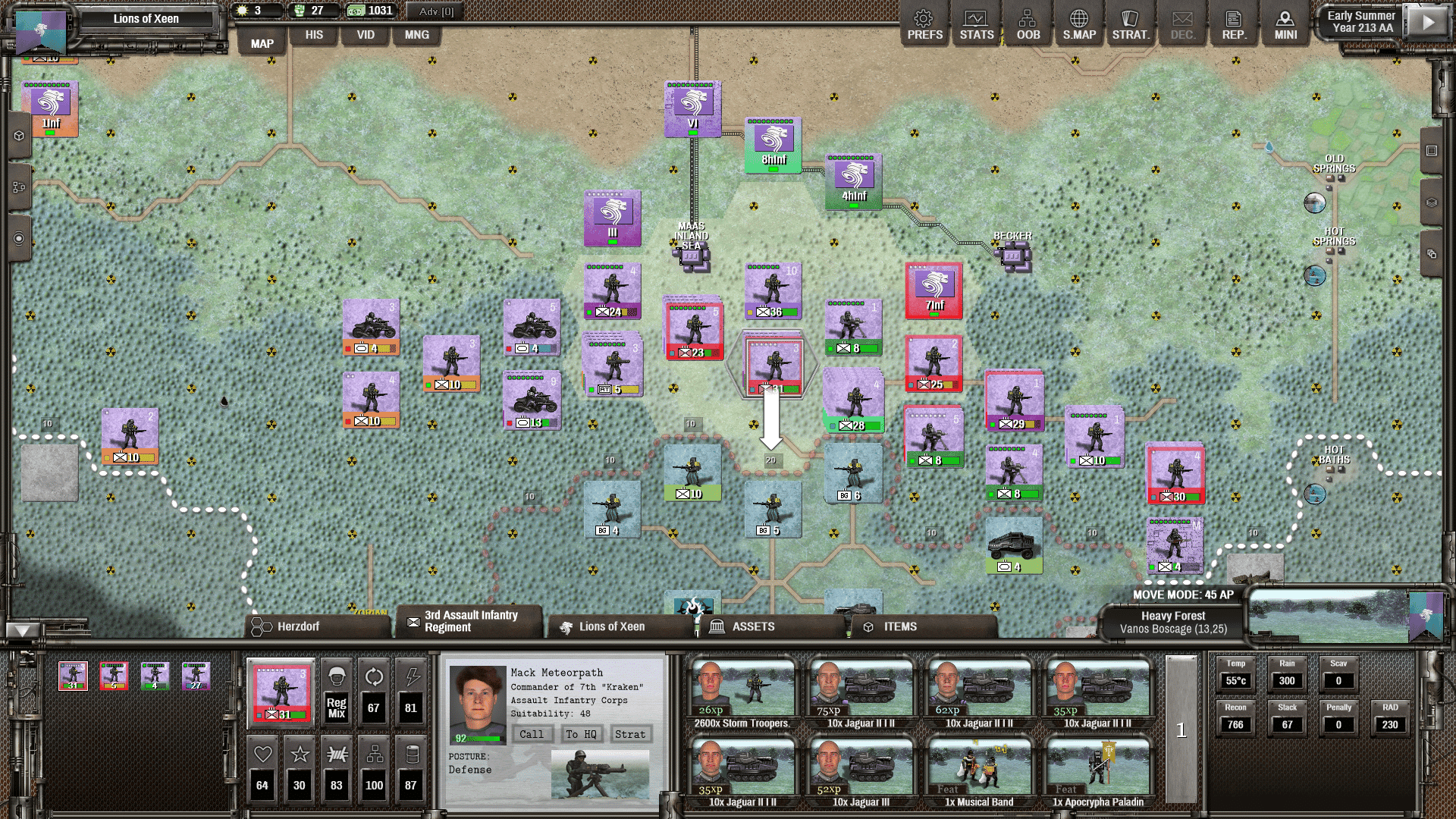
Eventually, locked into a terrible trench war, fought over a choke-point in dense jungle terrain after an invasion by an aggressive and technologically advanced Major Regime, I attempted to radically overhaul my economy by rapidly building up my infrastructure, something I’d neglected before. Unfortunately my logistics and depleted population levels could not stand it, and despite desperate mothballing of facilities my dwindling workers and soldiers began to starve, then desert by the thousands. My tactical play was strong, but my zone management and development was poor which cost me the game.
Difficulty
Shadow Empire is a difficult game, partly because of the complexity and sheer amount of systems you need to have a handle on, and because the AI is very capable at waging war. Veteran 4X fans might be used to immediately ramping new games up to “Hard” or beyond but are strongly recommended not to do so here. “Beginner” is difficult enough and “Regular” is akin to the harder modes in more common 4X games, at least until the game mechanics are fully absorbed. Difficulty is also highly dependent upon the conditions of the planet being fought over, and this cannot be understated! My first game on a Siwa Class planet full of farmers on Regular was won quite easily, leaving me with a gross underestimation of the game’s difficulty and a mistaken idea that the same tactics would work on a Seth Class planet. Big mistake!
Firstly, a look at the difficulty as created by the sheer number of tools and systems you must contend with and the problems this presents to the game design as a whole.
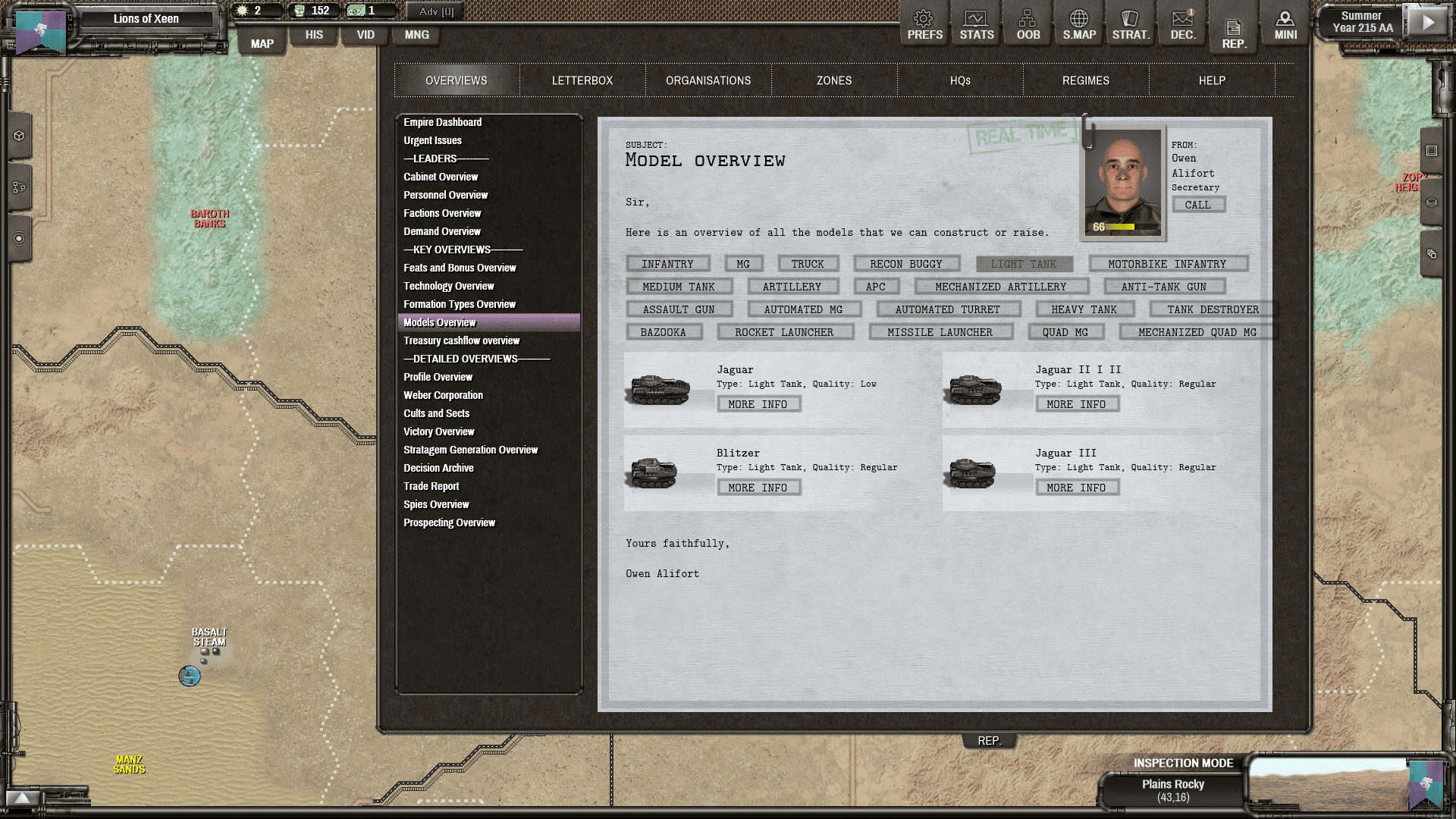
The complexity in Shadow Empire is bottom-loaded to ensure that, at least on Regular difficulty, you rarely need to worry about all of the myriad mechanics all of the time, attentive players can dive deep to leverage all sorts of advantages for their regime. You could probably play through on Beginner and rarely have to worry about much of the detail in the many reports or having to sweat over minute changes to your Regimes governmental trajectory, whilst on Regular and beyond you do have to take more care of your relationships with your staff, of the Loyalty and Happiness levels of your cities and dozens of other considerations.
It’s rare to find a game of this complexity that is spotlessly clean in its execution. Shadow Empire is no exception here, and despite its excellent, retro user interface the main issue lies in how it communicates some of the more difficult ideas.
Firstly, there is a certain opacity in its supply and logistics implementation. I lost one game though not understanding exactly why my SHQ wasn’t getting food, fuel, ammunition or replacement troops out to the zones and OHQ’s that needed them, causing a game ending spiral where my people starved and troops left their units in droves at a critical moment, leaving my borders undefended. Whilst the manual has a fairly thorough explanation of how it all works, in practice there just isn’t enough obvious in-game feedback as to exactly what is happening to cause blockages in your supply chain. Turns out I didn’t have enough trucks stations in the right places, which seems obvious in hindsight but I do think new players are going to fall foul of this more often than they’ll like (and if in doubt, BUILD MORE TRUCK STATIONS and pray you have the fuel for them!).
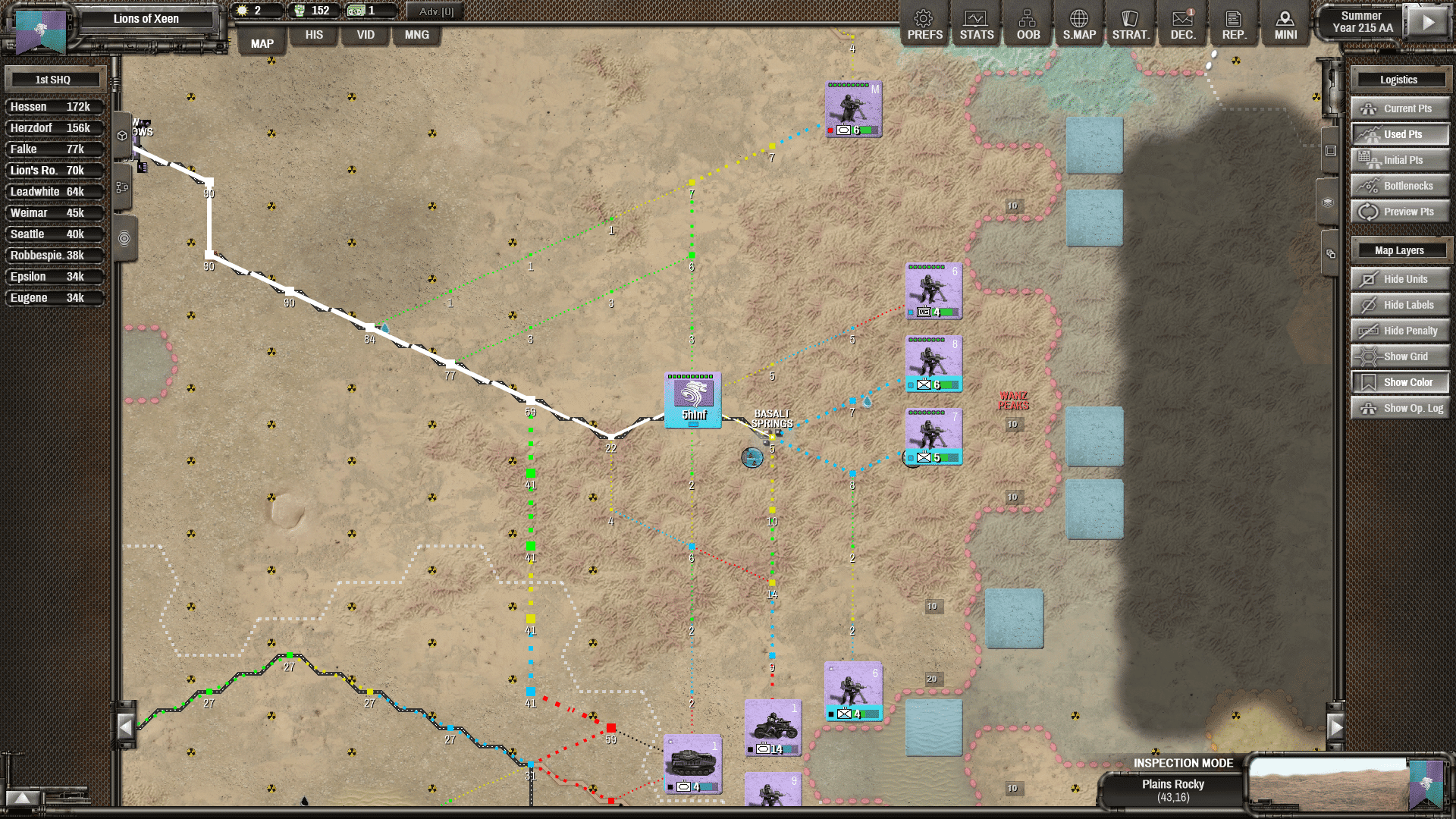
The developer is fully aware of this issue. To his credit he has tackled it head on with a host of useful tools in the Map Layers Bar to assist you in your sleuthing, including a handy “Bottlenecks” tool to highlight where your supply trucks are being overextended to the point of causing blockages in your logistical chain, the Logistics Preview function, which not only calculates the next turn’s supply but highlights a selected truck station and where it reaches in a funky pink colour, and the Traffic Light mode where you can manually set roads to limit access by your trucks in varying amounts, which can be very powerful in sculpting the perfect supply system.
Otherwise, information regarding the SHQ’s supply chain is buried in amongst the Reports, of which there are dozens and dozens, and I initially felt that the information there was still somewhat meagre. Whilst Shadow Empire generally presents information well, there is the occasional issue such as this logistical conundrum that just downright confounds: usually it won’t be critical to your survival but the issue with SHQ logistics is absolutely essential as starving troops with no fuel or ammunition for their vehicles don’t seem to fight too well!

Another issue is the way the combat resolution system calculations are presented to the player. The game crunches all the numbers under the hood, and whilst most of the modifiers in use by each side are visible to the player, the Odds that are displayed to provide a player with a rough estimate of the likelihood of victory are often wildly different to the results you experience. This is partly to do with your Recon level on the hex you are attacking: if you only see 2,000 men then the odds will be calculated accordingly. Three rounds into the combat and all of a sudden, you’re actually facing 20,000 heavily entrenched men supported by artillery and that 8:1 “dead certain win” you hoped for results in your attacking force being utterly crushed. With experience the player will learn what works and what doesn’t, but this might be very frustrating for a beginner.
Some other minor gripes include not being able to use the mouse wheel to navigate certain scrollbars and sliders (this should be a standard in these games now) and no mouse click map scrolling as it is locked to a hex-by-hex system and therefore unlikely to be changed in my estimation. The Stats graphs are detailed but I don’t find myself using them so often, and are there for the most hardened of logistical wizards I’m sure: they could also do with the option to click individual plots on and off to make them more readable.
Graphics and Music
Graphics are not the focus in a game like this but for the purpose they serve, they are mostly very good. The planet tiles themselves are excellent: within their scope the game can generate some surprisingly beautiful looking maps, some of them very brightly coloured. Other times, they look suitably bleak, oppressive, and post-apocalyptic. The unit counter drawings are solid and it’s easy to tell at a glance differences between different types of the same Model, and I recommend using these over the NATO counters as a result. There’s a surprising variety of images there too, particularly for the different alien species.
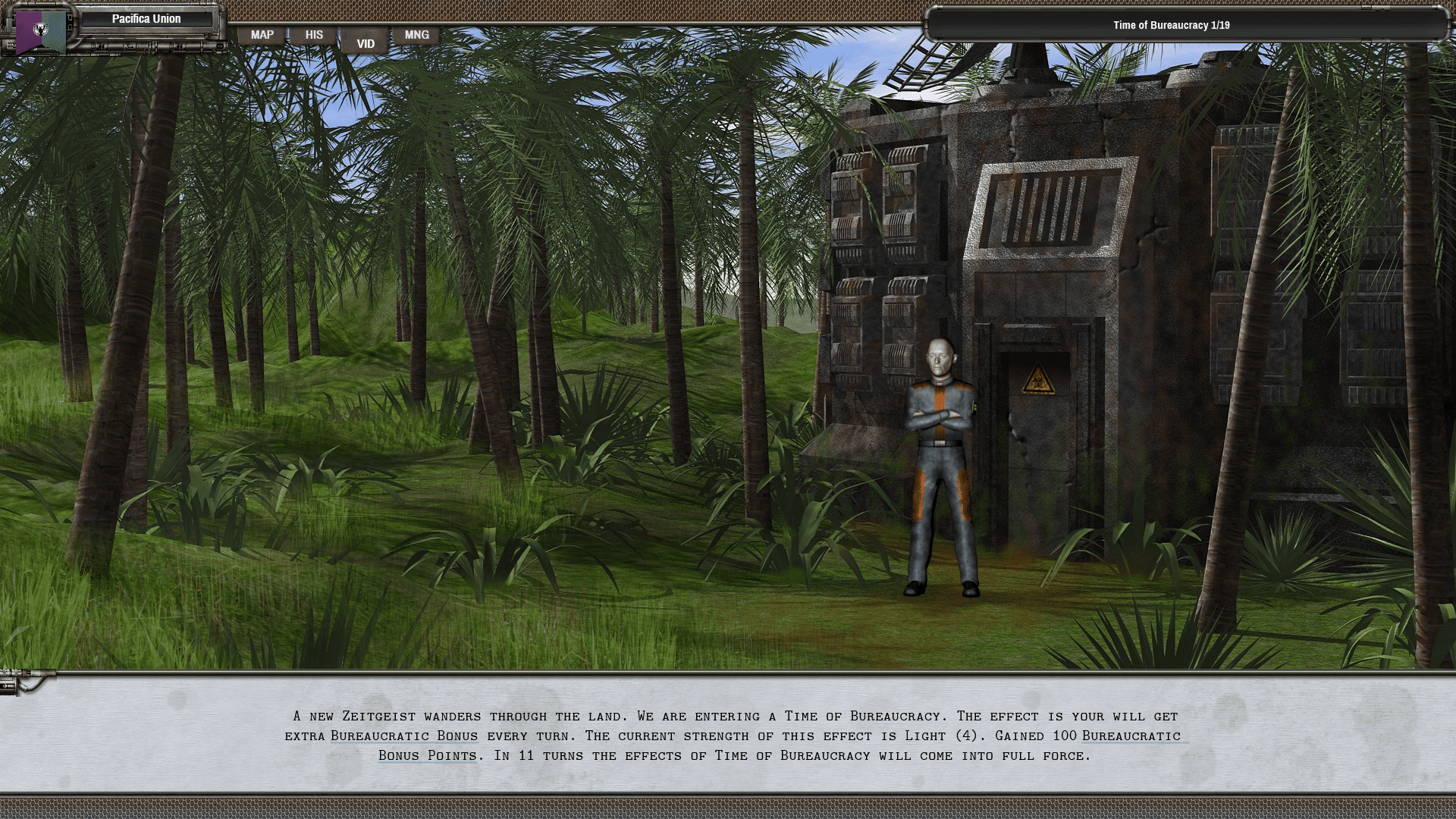
The Vidcom announcements are somewhat crude but they have a retro charm to them, and the same goes for the Stratagem card pictures. Without these, I feel the game would be a lot less appealing and so I applaud the effort it took to include them (VR Designs is a one-man team). NPC models appear to be randomly generated and generally produce believable looking people, and there are some crunchy, radio-static vocal responses for both men and women to provide basic in-game feedback, and some of these are better than others but they add to the immersion nicely.
The in-game music is subtle and interesting: I’d call it “Spooky Radioactive Melting Military Synthesizers”, lying somewhere between Boards of Canada and Vangelis’ soundtrack to the original Blade Runner, interspersed with the occasional parade ground snare drum roll. I often turn the music off in these games and replace it with my own selection but never found the need here, as although there aren’t that many tracks, they’re long and varied, and suit the tone perfectly.
Conclusion
Shadow Empire is the one of the finest strategy titles to be released in a very long time and stands head and shoulders above its competition in either the 4X or the wargame genres. It is a big, deep, complex and difficult game, and not without problems, but it is truly original and there is nothing else out there to match its unique, daring blend of the 4X, wargaming, grand strategy and role playing genres. Despite the many balls the player needs to juggle, once the systems are learned the game rarely feels overwhelming and can be played through relatively quickly.
Make no mistake, this is an essential purchase if you are a fan of deep and immersive game experiences. Not since the aforementioned Aurora 4X or Distant Worlds: Universe have PC gamers been treated to a product sporting such incredible depth and replayability. The procedurally generated content is shockingly well produced and displays a quality and scope far in excess of necessity for providing a good wargaming experience, whilst the underlying and often hidden automatic systems, such as the private economy or trading houses display an attention to detail bordering on the fanatical.

Whilst the focus here isn’t on emergent gameplay the sheer scale of the title paired with the well executed planet generation system and dynamic Regime Profile system ensures every single play-through is very different: one game might be a race against time to find water or some other critical resource with less initial pressure from a physical enemy; another might pit you into an early meat-grinder with a thirty yearlong trench-war over difficult ground with the deadlock finally broken by a decisive nuclear strike. It is clear then that Shadow Empire will provide years of play for those who revel in such variety. The fact the game supports multiplayer as well is just the icing on the cake.
That being said, this will not suit everybody: the first barrier for entry I see will be the graphics: there is a fair-sized section of the 4X community who won’t touch a game that doesn’t have modern graphics and will likely turn their noses up at the simple, hand-drawn hex-based sprites. I’d urge them to give it a shot regardless. More traditional wargamers are somewhat less fussy (if they can come to terms with the sci-fi setting): compared to the standards of that old genre, and with the exception of some of the goofier character models on the Stratagem cards, Shadow Empire’s graphics are actually very good, and are entirely functional for their purpose of both immersing the player into the game whilst displaying critical information necessary to wage war with a minimum of fuss. That said, not everybody will like them.
The UI is reminiscent of the late 90s/early 00s era of strategy gaming, and the fact it effectively conveys such a huge amount of information whilst being so easy to navigate is an impressive achievement. Again I expect people to fight over the presentation, particularly the Reports screen.
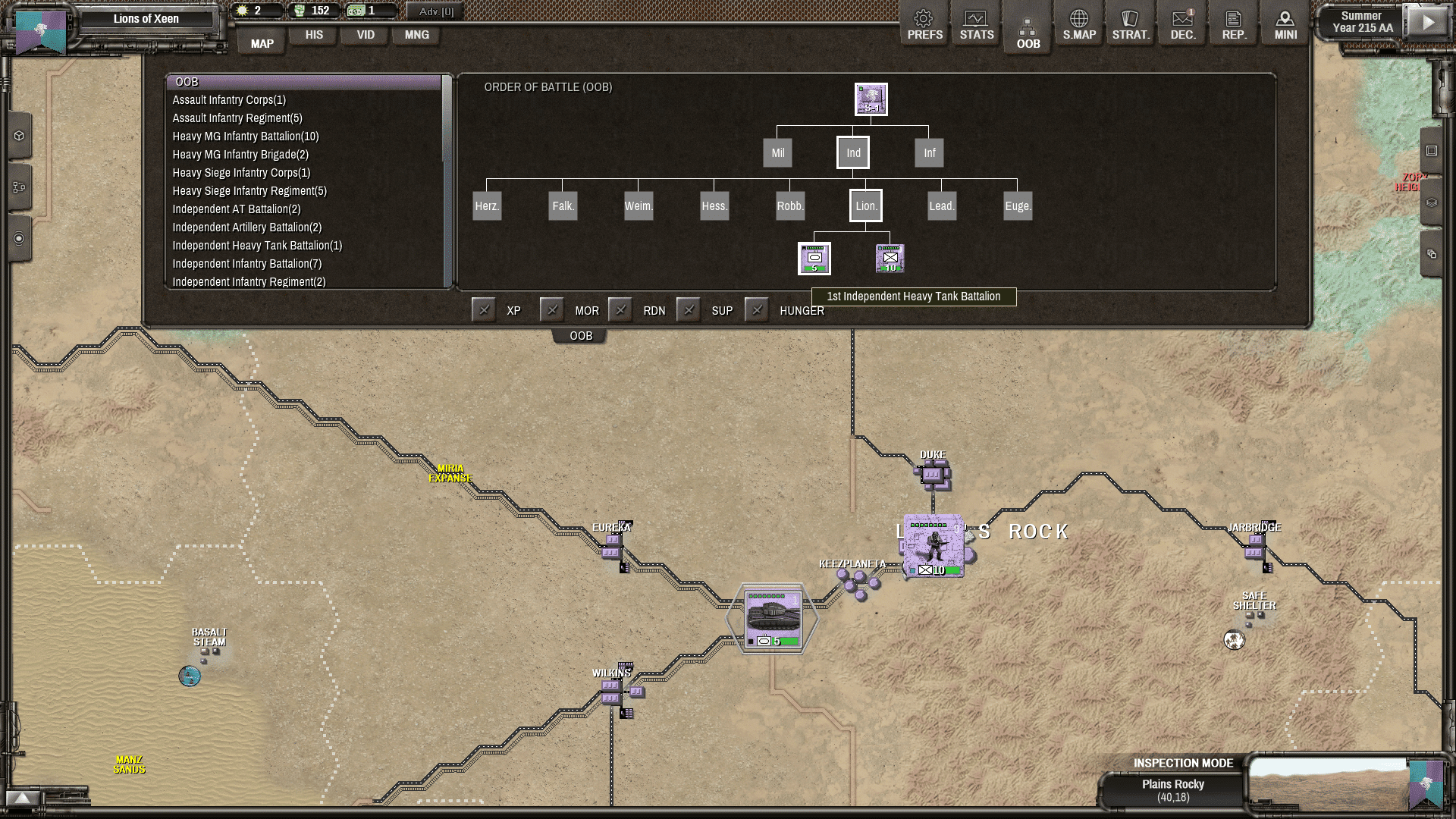
Some might find the game’s complexity intimidating, especially considering the unusual, and sometimes inadequate, way in which it presents all that data to the player. Shadow Empire requires a thorough reading of the extensive manual, some dedication to trial-and-error learning and having the patience to delve into the shadowy depths of a UI that occasionally buries useful information. The confusing way in which combat odds are calculated and displayed is mitigated by experience, but until that time may be a source of frustration for a player used to games that precisely telegraph the result of a combat before it is fought. This isn’t a deal breaker, but it may be off-putting to others.
There’s something else, and it’s not a problem per se, but more of a philosophical musing that I think is worth mentioning. The player directly deals with a lot of complexity already, but under the hood and out of his sight the game models systems he never fully sees. The Trading Houses is one example: they have a definite effect on the game beyond a simple “buy-sell” screen, that much is clear when playing it, but why put so much work into something if it isn’t presented to the player as something to appreciate directly? I’d loved to have a more detailed report about who these trading houses were, perhaps some way to interact with them directly as NPCs, as with the Corporation, Crime Syndicate and Cults (I didn’t mention these last few but they are starting option settings adding story and features which greatly enhance not just the detail of the world, but the amount of problems to handle, and the difficulty too).
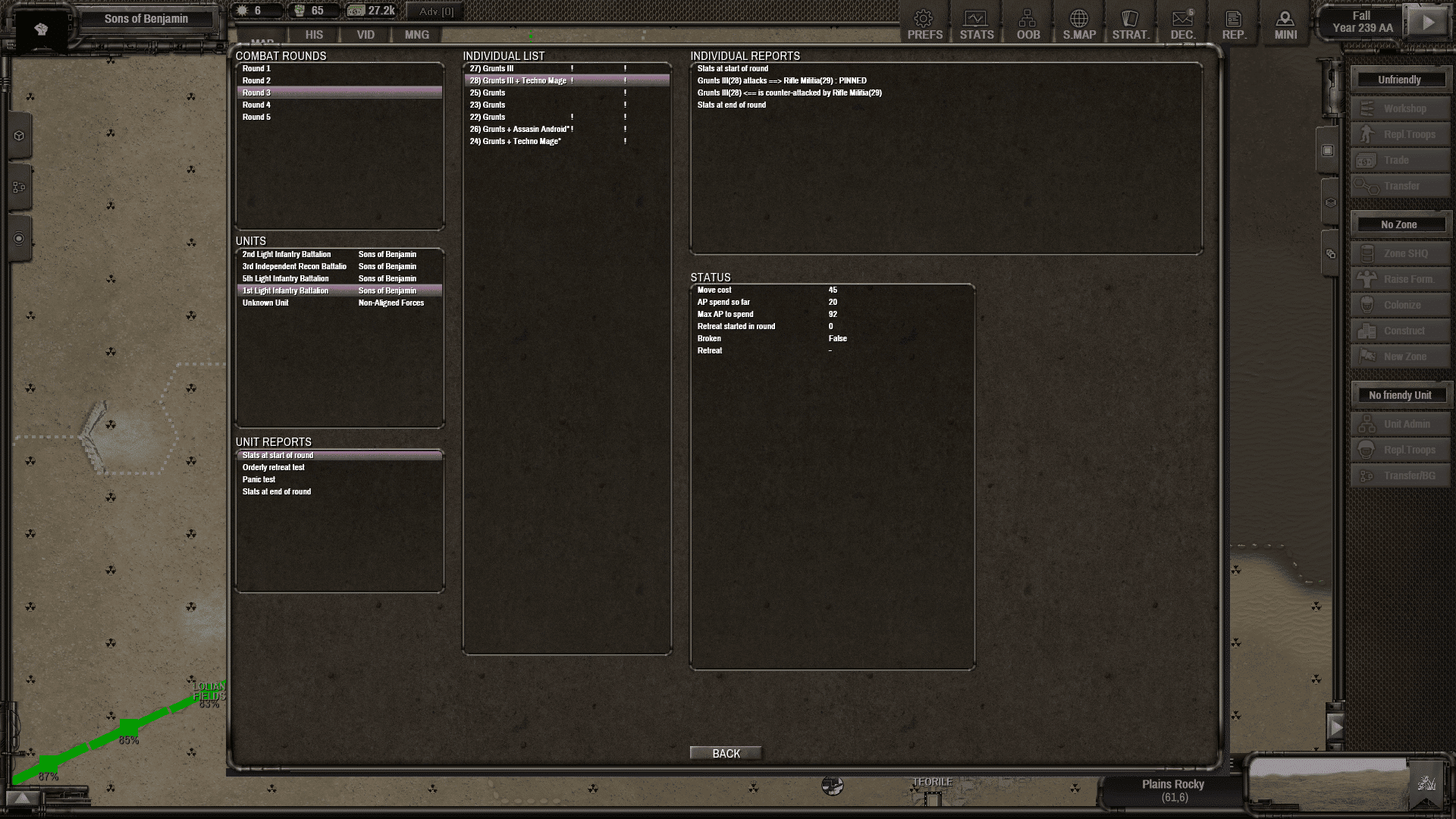
The Combat mechanics are another. Gary Grigsby’s War in the East had a ridiculous amount of information in the combat resolution, but it was all presented in great detail to the player if he wanted to see it: I’m sure most people would have watched that detailed shot-by-shot resolution a few times, realised it took too much energy to appreciate, and turned it off. So, should it have been there? I think so. Vic has taken a sort of halfway approach here: high complexity with partial reveal to the player. For example, the Details screen in combat resolution needs some work and perhaps if it was a bit easier to read, or had a different presentation altogether, it might be more fun. I have mixed feelings about this. If you are not going to use something, should it be there at all? Could I live without the Details screen? Well, no. You need it sometimes, to analyse the performance of your Model designs. So it needs to be there, but it is unsatisfying and is crying out for a redesign.
I see no answer to this one, and though I hesitate to level such abstract criticism I feel that this can be applied to other areas of Shadow Empire’s design (notably the private sector). There are many added details, particularly in the Leader statistics and in planet generation, that either currently have no game-play effect or are just added for role-playing purposes and I have no quarrel with that whatsoever as it all adds flavour. It is likely that this whole issue stems from the fact that Vic probably just hasn’t had the time to put everything he wanted into the game before release, perhaps aware that adding even more “stuff” into a game already jam-packed with very busy gameplay might just confuse or tire people.
It’s not perfect then and no game is, but Shadow Empire is the culmination of years of work by just one very dedicated developer getting very carried away with himself and then tying it all up together just before the project became over-bloated: his achievement here is absolutely startling and I state that with no hyperbole. This game should be an absolute mess and yet VR Designs has crafted a masterpiece that is so radically different to anything else in the 4X or wargame genres that it might well have spawned a brand new category all for itself.
There is more innovation in this one game, made in a relatively short space of time by just one developer, than in the last decade of 4X releases combined. And if that cannot encourage the games industry to finally break free of the same tired old iterations of either Civilization or Master of Orion, then I don’t think anything can and we’re doomed to an eternity of easy, safe, derivative strategy games with the occasional breakout hit such as this.
It also leaves one wondering at the possibilities for future expansions, given both the detailed backstory and the hard sci-fi setting the game is framed within. In our recent podast interview with Vic, he stated that any new content will likely be decided by both the wants of the player-base and anything that can be added that grants him license to dive back into the astrobiology books he studied so diligently early on in the games development. Perhaps we might see ocean planets with naval and air combat added? Vic certainly agreed that might be fun for him to make, and if the secret of Shadow Empire’s success turns out to be him breaking Sid Meier’s rule that “it is the player that should be having the fun, not the developer” then I’m hoping he has plenty more fun for himself and gets thoroughly carried away again in doing so. On the Matrix forums, fans refer to Vic Reijkersz with reverence as the “God of Wargaming” and now I know why.

As for Matrix/Slitherine, this is yet another absolutely amazing game to add to their increasingly large collection of absolutely amazing games, and they are to be commended for supporting an indie project with such ambition. There is no other publisher with a library of titles that comes remotely close to theirs in terms of quality today, and if they can continue to bang out releases of this calibre and stick to their roots, I can see them going on to dominate the PC strategy gaming market and replace the bigger publishers who may well have forgotten their own humble beginnings in their insistence on constantly regurgitating the same old products over and over again.
eXplorminate have a policy not to assign a rating immediately on a games release (we call these early reviews “What to eXpect”): in today’s climate they are often bugged or unbalanced, and subsequently receive a series of quick-release patches that can drastically alter the gameplay experience. That being said, unless some kind of disaster happens, Shadow Empire looks set to achieve our highest score of eXemplary as it clearly innovates in multiple areas, pushing forwards the genre in bold new directions, with an incredible amount of deep, well designed systems and extraneous fine detail that only adds to the overall experience. Do not miss this game!
Be sure to tune back here at eXplorminate in a few weeks when we’ve had more time with Shadow Empire to finalize our review score.
To Be Continued…
Our Review Policy
Benjamin played Shadow Empire for around 100 hours on a custom-built PC: Intel i9700k, GTX 1080 TI, 32GB RAM, 2560x1440P monitor @ 165Hz

Otherwise known as BATTLEMODE, Ben contributes to eXplorminate via the eXplorminate Podcast and through his excellent writing! He’s a great asset to us here at eXplorminate, and we’re happy to welcome him on board! His Shadow Empire review is known throughout the internet for its depth and incredible detail!