Wildermyth, by Worldwaker Games, is a turn-based tactical RPG where the player controls a party of mythic heroes seeking to defend the procedurally generated Yondering Lands against one of many possible threats.
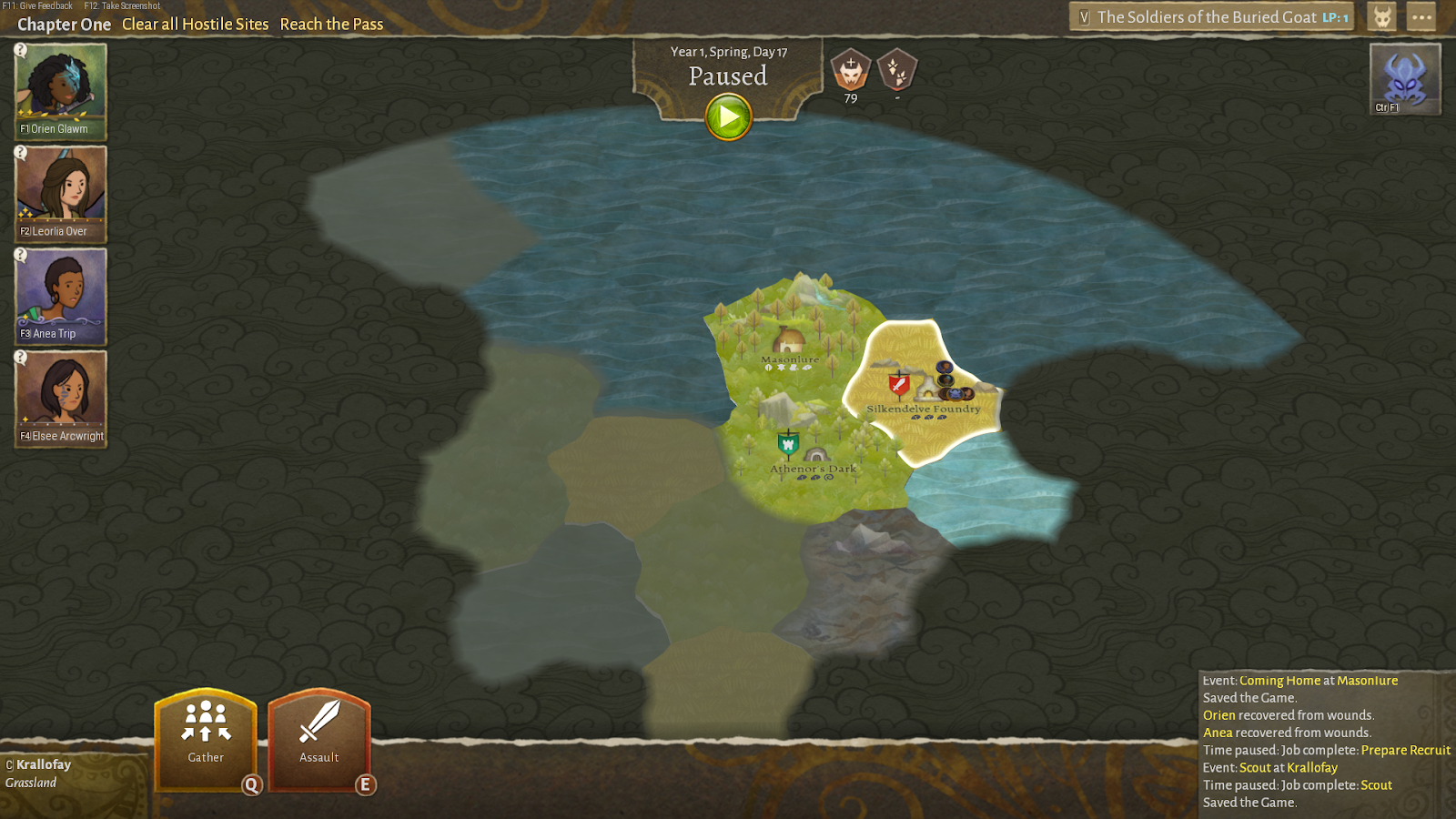
Wildermyth comes with nine campaigns, five pre-designed and four procedurally generated, though even the designed campaigns feature a large element of procedural content. Each one features a circular map with a number of zones, and has either an event or a battle against one of the game’s five factions, with the majority focused on whatever the main enemy of the campaign is. The map isn’t available in its entirety from the beginning, as the game is broken up into three or five chapters with each additional chapter revealing a larger part of the map to explore.

The game features numerous events with a varying degree of rarity. Events serve as character development, fleshing out the character’s past or defining how they will exist in the future. They will also develop the character mechanically or provide some sort of bonus for the next fight, and sometimes both! The events can also add landmarks to the map after they occur. For example, after an event which featured spirits dancing in a standing circle, the standing circle appeared in the hex. Since events usually occur once, they are not mechanically relevant but are still nice to see, as they provide context and a bit more depth to the world in a relatively simple way.

In fact, there are many of these little tidbits that help to flesh out the characterizations and add depth to characters and the world. This kind of exposition prevents each individual campaign or playthrough from drowning you in reading, as can sometimes happen in other RPG-like games. This is all built on a character’s three hooks, which are a mixture of personality traits and, well, plot hooks, and serve as influences to both a character’s chance to have events as well as how they react to them. For example, Leorlia Over has the hooks Mysterious, Clown, and Lucky. As a result, she tends to have clownish, joke-y dialogue, and has events related to how lucky and her philosophical, mysterious nature.

Characters are one of three different classes: warrior, hunter, and mystic. Characters develop from this baseline in three different ways. The first of these is by leveling up. Characters can only gain seven levels in the course of a playthrough. When a character first selects a class, they are given the choice of three (or four) different perks. These are picked from a list of class and generic perks, and each one adds some combination of active and passive abilities. On subsequent level-ups, characters are given the choice to upgrade one of their perks rather than selecting a new one, and these are frequently strong and interesting enough to justify picking them.

The second of these possible upgrades is gear. Each character usually has two hands available for weapons and off-hand gear, armor, and a number of other body parts to which you can affix various types of trinkets. Weapons have a big impact on how you interact with the world, though warriors tend to feature the biggest variety of weapons. Hunters will want to have bows and a dagger, which give a bonus damage on flank and thus takes advantage of a hunter’s speed, while mystics want to use weapons that will boost their spell damage or potency. Weapons can be further enhanced with spiritual infusions that provide special effects when a character performs a stunt (the equivalent of a critical hit) and artefacts, of which only one can exist in a campaign and provide special benefits that alter a weapon in unique ways, rather than the generic ways that spiritual infusions do.
The third possible character upgrade are themes. Themes are often mutually exclusive mechanical transformations or additions, which range from pets, wings, to various plant, animal or other fantastical transformations. For the more encompassing transformations, characters have the option to slowly swap out each of their limbs, granting a potential bonus in the process. For example, a wolf-themed character can replace their head with a wolf’s in order to get a free action attack, their legs to get additional speed, and their arms in order to get claw attacks. Replacing arms is risky, however, as replacing one causes you to lose the ability to use two handed weapons and replacing both leaves you without the ability to use weapons at all.
In addition to themes, characters have a few other ways they can evolve or change over the course of the game. A character falling in battle doesn’t necessarily mean their final demise: in doing so they will get a permanent injury which leaves them with a penalty for the rest of the campaign. Time is also a big factor; characters can grow old and eventually retire, and enemy plots are not usually measured in months, but can instead take place over the course of years and decades. In a five chapter campaign it is very common for the starting characters to grow old and retire before you come to the final confrontation. In this process, newly hired and trained adventurers, or even the character’s children can join, creating an interesting tug of war between training these newer adventurers-to-be ready for the final battles vs. using your more seasoned, though physically weakened veterans, who can more easily handle these battles but may not be around when you finish things up.

Combat is built on a core that is very reminiscent of the XCOM series while still being unique in its own right. Turns follow a “I-Go-You-Go” format, where your characters go first, then enemies follow. Battles continue until all enemies are defeated, but some fights, particularly those for chapter capstones, can have unique or layered goals. Battlefields feature a wide variety of destructible terrain that provide some level of cover, and serve as tools for your mystics or for enemies that happen to have any mystical skills.
Characters have a single move, a single action (which can be a second move), and another single free action every turn. On top of this, all sorts of options and abilities that are defined by class, gear, perks, and themes are layered in. There are many possibilities to explore, but the Class abilities are the most distinct and are most worthy of detailing here. The warrior’s base unique ability is Guardian, which gives a bonus attack when enemies wander into your melee range. This helps to mitigate the negative impact of a warrior’s relatively low base attack range (assuming you don’t give them a bow), by letting them hit enemies when they wander into your range. Hunters get Silkstep which essentially turns them invisible. In this state, they ignore reactive attacks, cannot be targeted and if they attack an enemy they ignore armor, though this will also end the invisibility. Mystics have the ability to Interfuse with the destructible terrain. What exactly this does varies based on the terrain (and the mystic’s perks), with wood creating an Area of Effect that does damage and shreds armor, lamps letting you steal and throw fire to deal damage and create a terrain hazard, and so on.
Enemies come in five general flavors: Gorgons, Morthagi, Deepists, Thrixl, and Drauven. These have no recognisable parallels in other fantasy games and the Wildermyth development team has done a very good job of making each and every one unique to Wildermyth itself. Different enemy groups have a mixture of general faction abilities as well as specific ones that can be unique to that unit, though usually in a way that makes it thematically appropriate to its team.
As the game progresses and players conquer enemy sites, they generate legacy points. These are multipurpose and can be used to slow down enemy development, reducing the ability of enemies to gain buffs over time or even prevent new enemy types from being added in for a short while, or they can be used to add characters when the game deems it is appropriate. They can even be used to recruit characters used in previous campaigns which were previously added to your overall legacy. As you use characters you are able to include them in slightly more developed forms, at the cost of making them more expensive while starting off slightly older than brand new characters do. This is generally worth it though, and is sometimes even required on higher difficulties.

Failures and Limitations
Wildermyth’s biggest strength is its procedural character and story generation, and while the game’s mechanics mostly do a great job supporting this, I think it would be better off if the designed content, specifically the quantity of events, was larger than it is. As it stands, there are some events that you will see almost every game and after numerous campaigns and hours of gameplay I wish they would just show up less frequently and the pool was larger. People who are just getting into the game or who just play through each of the included five campaigns will barely notice this, but if you are someone who dives deep into a game, they will eventually feel repetitive after a while and you may find yourself skipping through them (which you can do, thankfully) in order to get to the decision or reward for the event. This is somewhat sad given the overall structure and goals of the game, but I am not sure how it could be solved without an unreasonable expenditure of time and money.
Another potential limitation is that you actually have a pretty small amount of control over your gear. There is no way to handle items after they are equipped to a chosen character. So, for example, there are no backup weapons you can keep in case a new main weapon isn’t quite what you want, and you cannot swap accessories around between characters. Personally, I find this acceptable, and it makes sense in the context of the game being about fables and tales of individuals of the past, but for those people who strongly prefer a more traditional RPG experience, this might be a problem.
Achievements
Even with the limitations and repetitiveness noted above, Wildermyth is able to generate fabled heroes in a way that no other game does. Other games either have predefined characters or make them blank slates intended as player cutouts. Wildermyth does something a bit different; characters start with a general personality and a trio of hooks, and are built up from there through events and player choices. Some of these events do not have a real choice in this characterization and just provide a window into how the characters interact with one another and their individual personalities. For events featuring major changes, the player is given a choice in how they want their characters to react and what sort of mechanical development that would lead to.
For example, Anea Trip is a character from my most recent campaign, a mystic who served to help kick off the Deepist campaign. Some of her story beats are tied to the particulars of the campaign, but that merely served as a baseline; she has flowered since then, trading a mysterious coin for a functional foxtail from an immortal merchant who owes much to Lostlings, and has attained a celestial aspect thanks to her friend Lorelei’s dance with spirits in a mysterious standing circle. Further research led them to an obscure pool that turned into a sea of stars at night. She will develop further, and may lose a limb, or adopt a pet, and may be further transformed into a celestial entity as time goes on, or she may not. Her future is not written in stone.

After this campaign is over, her development will continue. She will show up in future adventures that are completely unrelated to this one, with friends that she may no longer recognize. It is easy to poke holes in this logic. After all, she already fell in love and married one character; why would she not recognize them in future tales? How could she grow old and be young again multiple times? It doesn’t make much sense. But Wildermyth, as its name implies, is a myth-making game. You are building characters and running through great adventures in a world steeped with mythology, creating even more myths and legends. The game’s legacy system lets you build the character’s mythology over time, further cementing their capabilities, while also increasing the cost of including them in your tales, either by increasing the difficulty of your enemies or in the cost to actually recruit them. Frankly, this is perfect, and gives a good reason to further develop your characters, and go through potential campaigns again and again. You may have a particular vision of what you want a character to achieve, in which case you can tell as many stories as you needed to until they are able to pull it off, or you may just want to revisit an old friend one more time, to let them fight a new threat, and build a new legend for themselves. Both of them are fun and viable, and make Wildermyth a joyful experience, one that feels enjoyable and tells interesting stories in a way that is more effective than that of tightly scripted, non-procedurally generated games.
Wildermyth is a mechanically solid game. Having randomized choices for level ups will almost certainly drive off people who prefer more defined character customization, but I like how it pushes me out of my comfort zone and forces me to build characters differently and find new ways to do truly unique things with specific characters. Battle decisions are fun and meaty, and having to account for a variety of different enemy capabilities and types, as well as terrain and how your character’s abilities interlock, creates a rewarding tactical environment which is fun at Normal difficulty, but can get really tense and challenging as you push into the higher difficulty levels.
I also think the magic system is worth calling out as special. Rather than being a D&D-like retread or a cliched power system, no different to anything that’s come before, Wildermyth’s magic is specialized around interacting with and manipulating terrain. The sorts of effects the terrain can generate are interesting, varied, and frequently provide capabilities that nothing else in the game does. That said, mystics are (mostly!) limited to terrain that is actually there on the map. So this introduces a need for a bit of improvisation, and an additional level of opportunistic chaos that characters can take advantage of. There are different perks that mystics get to modify their capabilities further and, while I like all three of the classes quite a bit, mystics are special in a way that the other classes are not, and it is hard not to appreciate them.
Conclusion
Wildermyth is something special. Every part of the game is well done, and while I wish there were more events, this lack of quantity does not prevent it from being a great game. If you like tactical turn-based RPGs and want to play something unique and interesting, you definitely owe it to yourself to explore Wildermyth. I expect there are going to be some people out there who dislike it for some reason or another, but even then it is worth playing simply to see what Worldwaker Games has pulled off.


Jesse is another of our turn-based game aficionados and is often found playing many different types of turn-based games, whether they be strategy games, deck-builders, RPGs, and much more. He also really likes cats.