Pathfinder: Wrath of the Righteous, by Owlcat Games, is a computer role-playing game (cRPG) in the vein of classics of the genre like the first two Baldur’s Gate games, Icewind Dale, the recent Pillars of Eternity series, Divinity: Original Sin I and II, and Owlcat’s previous Pathfinder game, Kingmaker.
In Wrath of the Righteous, you take part in an epic and long-running war against a demonic invasion, rising from a severely wounded individual found just outside of the region known as the Worldwound, before eventually assuming one of nine mythic paths and possessed of a power beyond that not only of the average individual but also seasoned adventurers.
A Note About Bugs and Content For This Review
For the purposes of this review, eXplorminate was given access to the Wrath of the Righteous beta. This beta was last updated about a month before the game’s scheduled release date and was incomplete, lacking the final two chapters of the game. Because of this, the review will be light on both commentaries about how the overall story fits together as well as the state of the game with regard to bugs. The beta was quite buggy, with some major features simply not working, but it is unlikely this will be true of the release version. The game was still (mostly) playable, and the release version of the game is unlikely to retain the largest of these bugs, but it is likely that at least some will be present on the game release.
Overview
Your Wrath of the Righteous experience will begin character creation, and to be quite frank, it is a very involved process. With almost 200 different classes and subclasses, 46 racial options, and the various different specific character customization choices, character generation can be overwhelming. The game includes six pre-generated characters, but if you really want to explore what Wrath has to offer, you will want to dive into character customization.
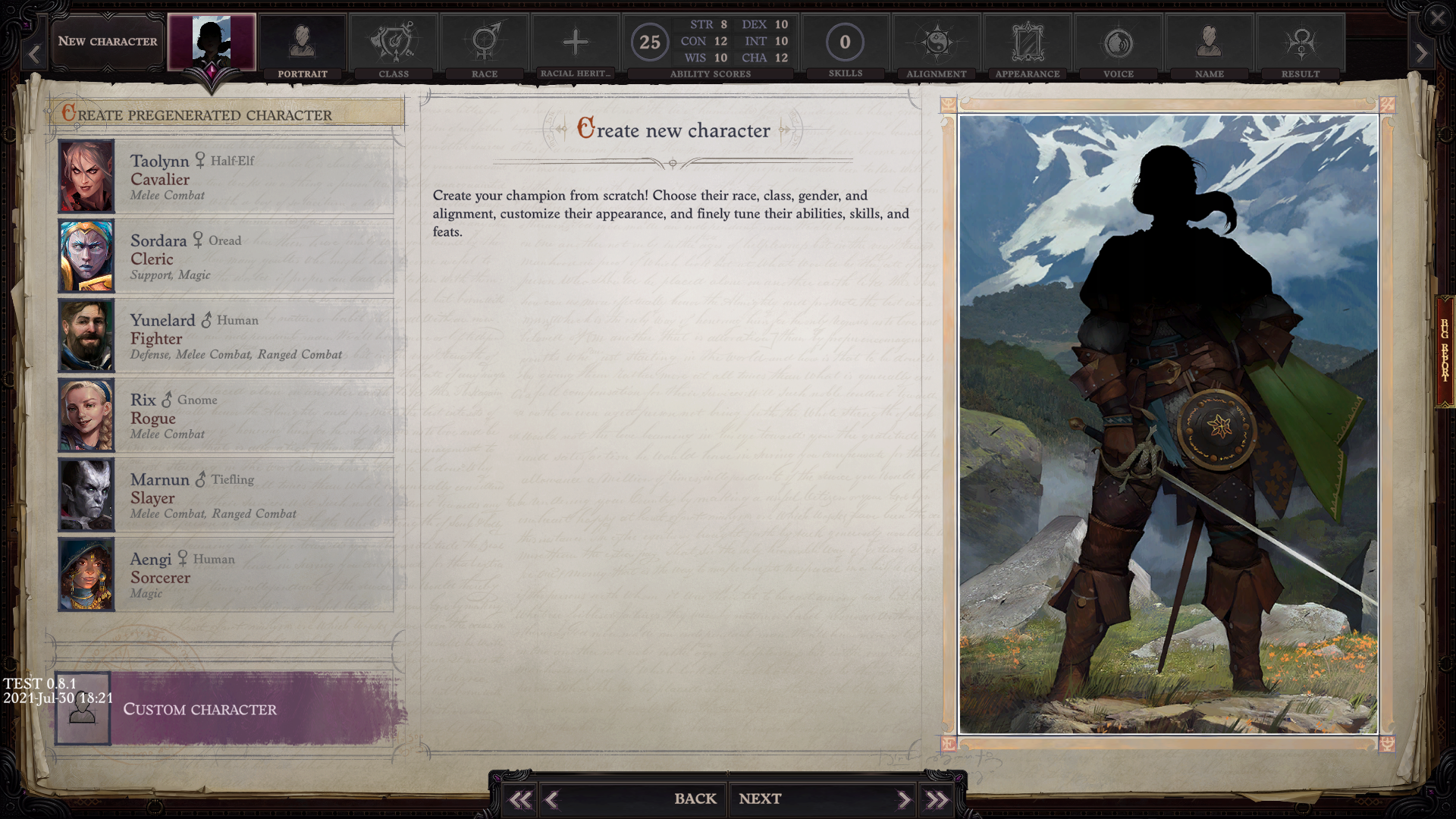
On the bright side, these customization choices leave plenty of capability to generally build the kind of characters you want. A suave vampire(-ish) swordsman who dabbles in magic? Done and done. A character that has capabilities similar to a werewolf? Easy. A fey trickster who rides a dragon into combat? A breeze. Now the more specific you go, the less likely you will be able to build to your needs, but general concepts should be easy to reach, and figuring out how to make them work should be quite fun for those who like tinkering with builds. For others, it will probably be a bit less pleasant, as those who prefer more streamlined or straightforward options are potentially wracked with paralysis as they are unable to identify what a good choice is or how to implement the sort of character they want to play.
After character creation is complete you are introduced to the main arc of the story and to Wrath’s available companions and its world in a gradual fashion. The game is divided into six chapters, each of which is structurally different to varying degrees, providing a nice change of pace and tempo to keep players engaged. You, as the player, have a fair bit of control over how things happen and the general path you take to get there, but the actual beginning and end are largely driven by the needs of the story, with player action only impacting on the details. Now, all indications are that this is not true of how the story eventually ends and that players’ choices and their consequences will result in a wide range of potential final results, but with the limited content available at the time of the review, there is no way to know that for sure.

One of the most exciting and interesting parts of the game is the inclusion of mythic paths. Each of them causes a character to transform in some way, becoming a legendary and powerful creature from the Pathfinder universe, ranging from an angel to a demon, to weirder things like an enforcer of cosmic order, a trickster who mostly focuses on breaking all the rules they can get away with, or a swarm of very hungry bees. These paths have a heavy impact on gameplay and your choice of which one to take will reshape the world of the characters around them.
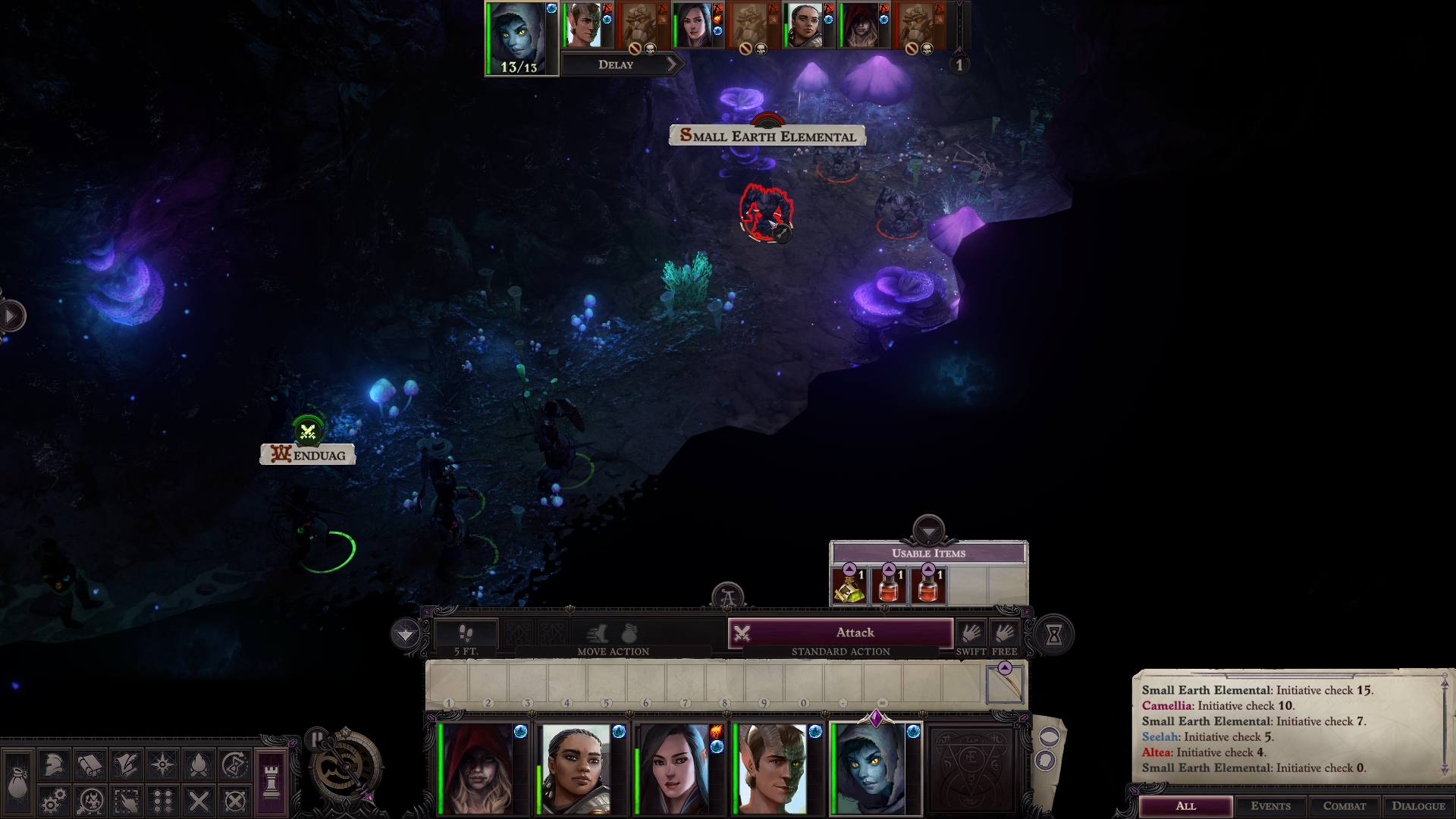
Combat in Wrath of the Righteous is chosen based on the desires of the player, be it either turn-based, real-time with pause, or a hybrid of both. Turn-based mode runs on a distance-based mechanic where the game calculates a line between the character and the target and uses this line to determine if the character has enough movement, range, area of effect, or whatever in order to reach the target location. Characters get initiative rolls that are largely based on an in-game d20 roll modified by a character’s dexterity but there are numerous ways to modify this if it is important to have your character go first. Initiative is not rerolled during individual combat, but characters have the ability to wait, allowing them to jump around on the initiative order in order to go after units that are going to set up ability combinations.
Much like with character creation, the sheer scope of options available in combat is rather large. Most of these are gate-kept by your class and race combinations, but there are also items of varying power levels and impacts that can change the way that you play. On the whole, though the combat system is an extension of your character capabilities, and the variety of the different classes results in a large number of potential ways you can approach and win battles.
Most all of this is an effective implementation of the Pathfinder rules. Pathfinder was built off the 3.5th edition Dungeons and Dragons ruleset but has become its own beast in the many years since then. It is in-depth and fairly complex, particularly for more casual gamers, but for those who do not mind going deeper, it can be intensely rewarding.
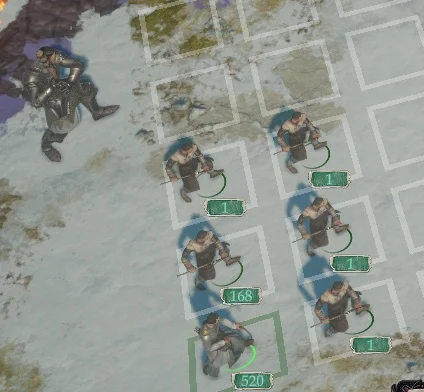
One thing that is particularly interesting for this style of game is the presence of an army-level combat system reminiscent of the Heroes of Might and Magic series. You have generals, which are not your companions, leading recruitable troops into battle. These troops are used to fight against static demon armies and fortresses, with both strategic level rewards and items that can be used by your own party. Available troops are modified by hireable mercenaries and a combination of game choices, mythic paths, and buildings.
Comparisons to Pathfinder: Kingmaker
If you played Pathfinder: Kingmaker you are probably wondering how Wrath of the Righteous changes things compared to Owlcat’s previous game. The first big change is the graphics and user interface. Both received a big upgrade in Wrath of the Righteous to the point where Kingmaker feels primitive in comparison. Wrath is still an isometric game with a 3D perspective, but everything is sharper, crisper, and more attractive. The addition of camera rotation adds to the clear indication of the game’s improved graphics while also providing a useful tool for identifying what exactly is going on.


The second is the sheer number of options. Rather than four subclasses, each class now has six or seven, and there are nine more base classes. Additionally, there are three more races, and most of the older races now feature some subclass options. If the number of different combinations of races and classes was not enough, Wrath of the Righteous has nine mythic paths, each with a big impact on the game’s overall story and similarly striking mechanical impact. While in theory Kingmaker and Wrath of the Righteous characters should be of equivalent power level, the Mythic Paths amp things up considerably resulting in Wrath characters becoming as super powerful and “mythic”, as the path’s names suggest. This is appropriate for the increased stakes of the Wrath of the Righteous campaign, as the caliber of foes that you fight increases dramatically as the campaign continues. The sort of enemies you were fighting in the end game of Kingmaker barely can keep up with the ones you end up fighting in the late mid-game of Wrath of the Righteous, and the differences only become more extreme from there.
Limitations and Failures
Frankly, Wrath of the Righteous’ limitations and failures are largely reflective of the failures of Pathfinder: Kingmaker and even more than that are largely representative of those of the Pathfinder system itself. Those that are not are due to systematic failures rather than in design.
These systematic failures are mostly legacy bugs from Kingmaker where abilities or capabilities do not work as described in some way or another. Since Wrath of the Righteous is at its core a real-time with pause game with the turn-based implementation built on top, it has remnants of whatever bugs exist within the real-time with pause system with additional turn-based bugs layered on top. Now, as mentioned above I am not sure if these bugs will be in the release version of the game. I truly hope they are not, but if any bugs are left in the game I suspect they will be with turn-based mode.
The Pathfinder failures are largely a result of the complexity or tedious overhead that is either not effectively addressed by the game or is not able to be effectively addressed by the game. For example, casting buffs on individual targets or the team is an important contributing factor to team success and as you proceed later and later into the game it becomes increasingly tedious to cast all of the required buffs that are needed to deal with the game’s more challenging encounters. This is compounded by the limited duration of most buffs, as you end up placing them on your team, fighting a few tough encounters, and resting to recover them, which both adds to the tedium of recasting them and also is immersion breaking if you are doing something like attacking a stronghold, but have multi-day rests in the process. This feels like it is something that could have been resolved in design, either making the locations shorter with no rests allowed, or by making it so there is some other explanation as to why you could rest faster in order to maintain plausibility, but there is not which reduces a good amount of the tension and verisimilitude of the game. (Editor’s note: this was a problem inherent in the original design of TSR’s D&D games and I think Pathfinder just inherited it as a consequence of its parentage.)
I do not personally have a problem with alignment systems, and generally find Wrath of the Righteous’ implementation of them to be acceptable. The exception to this lies in how they manage conversation choices and alignment effects. During a conversation, you will frequently see one or more specific alignments displayed along with a number of conversational options related to them, with some combination of Lawful, Chaotic, Good, or Evil. Now the expectation would be that selecting a Lawful conversation option would move you in the direction of law without consideration of good or evil, but that is not the case. Instead, Lawful really means Lawful Neutral. So if you are Lawful Good or Lawful Evil and select Lawful options too much you will eventually find yourself shifting alignment, which means to maintain one of the combination alignments you will have to alternate between picking Law/Chaos and Good/Evil or avoid alignment-coded conversational choices altogether. This is not bad in and of itself, except for the fact that a large number of the Evil options are comically nefarious that I cannot imagine more subtle evil characters would ever pick them. Which ended up being reflected in my Lawful Evil follower of the God of Cities eventually slipping to neutrality because the Evil options were just a bit too ludicrous.
While the mythic path system is, on the whole, very good it also strongly favors certain character types over others. Most of the paths allow one or two classes to merge your spellbook or spell list with that of the class, giving you more spells to cast and, more importantly, adding to your total caster level. This really amps up the power level of casters, leaving you with a situation where playing a character without full spell progression is a worse idea than picking the specific full progression spell casting class associated with the path. This is further amplified by differences in overall power level between the paths. While some variation is accepted and welcomed, the sheer level of difference between the Angel and Trickster paths on one end and the Aeon and Demon paths on the other is more than I consider to be acceptable.
The last real limitation is the game’s complexity of character builds. This is fine if you are willing to put a lot of investment into learning the rule system and investigate how things work, but there are so many vagaries and subtleties to character classes that it is very easy to miss what your character is capable of or make a choice which is going to result in a poor character build. There is the ability to rebuild your character in case this happens, but this really is a game without a lot of guardrails, and it is almost easier to build an ineffective character than it is an effective one, and you must be okay with the fact that you may need to push down the difficulty or redesign your character.
Successes and Triumphs
Of the previous generation of cRPGs that featured turn-based tactical combat, I found Pathfinder: Kingmaker to be the best. Its combat system was not as tight as the games which focused specifically on turn-based combat, though it was still very good and the kingdom system was perhaps not as electrifying as it could have been, it runs up the score with excellent world-building, plotting, and effectively getting across the feel of being a Dungeons and Dragons experience. Wrath continues with this strength and ultimately exceeds the highs that Kingmaker was able to achieve. A lot of this is due to the companions and their stories being better than what you can find in Kingmaker and, frankly, most any other companion-based game I have ever played. None of the characters are duds or jokes, and all of them have interesting stories that I was excited to interact with. The character’s builds are also quite good at a baseline level, with one exception, leaving you in a position where you don’t necessarily have to choose between having a good team and using the game’s story characters.
Wrath of the Righteous reactivity is really, really good. Your race and religion are all reflected in how NPCs and the world react and interact with you, and the mythic path system kicks this into overdrive. While the chapters available at the time of the review all featured generally identical beginnings, ends, and general structure, how you get there and what you build towards is very different based on which path you choose. This is reflected in your mythic path-based quests as can be expected, it goes so much beyond that. Each mythic path gives dramatically different abilities and how you can deal with important decisions outside of your specific path quests. This adds replayability, flavor, and a sense of true epicness that has me already planning out potential builds so that I can try out each and every path. This is specifically noteworthy for me, as I tend to follow more heroic paths, but the excitement of seeing what is new and interesting about some of these less heroic paths has me actually interested in trying them out.
The expansive character system reinforces this replayability very effectively. While there are some classes and subclasses that feel like they are little more than a replacement for multiclassing, there are a lot of them that really do interesting things that open up new styles of play and tactical considerations. This is also where the complex battle system really shines. If the game was simpler or more streamlined these differences would be a mere change in how your numbers look. And while there is some of that, the game mostly does a good job of making the different abilities and actions have different and real tactical effects.
I also really liked how the game ends up varying how the chapters play out. In the first chapter, you are effectively engaged in guerilla warfare vs. demonic invaders. This is completely switched up for the second and third chapters, and just when you think you have gotten a feel for the cadence of the game, Wrath sends you to a place I never expected it would go. While one of the things that I loved about Kingmaker, specifically its very strong feeling of having a party of adventurers going through an area filled with lost kingdoms and hidden treasures, is lessened here, I think the variance in the story more than makes up for it.
Conclusion
Wrath of the Righteous is not for everyone. If you don’t like big complicated cRPGs that are going to keep you busy for over 100 hours then you are probably not going to enjoy it. I very, very much do and think it has thrown quite a challenge to this next crop of cRPGs. Can they exceed the expansiveness, depth, and sheer strength of the story that Wrath of the Righteous offers, or are they going to compete with it in some other way? If they fail to meet the standards of quality gameplay that Wrath has laid out, then Wrath leaves you with plenty of game to chew on particularly if you, like me, are excited about the idea of exploring the stories of all of the different mythic paths. This one is very, very good and if you like big tactical turn-based RPGs you do not want to miss it.