Expeditions: Rome by Logic Artists and their publisher THQ Nordic, is the latest turn-based tactical RPG title in the Expeditions series. Previous titles in the series present alternate histories for the conquistadors and Viking eras. In Expeditions: Rome, your character is forced to flee from Rome in the face of a political action taken against your family, who is friends with a consul currently waging war against Mithridates in Greece. From there, you rise in power and influence as you lead campaigns against a series of Rome’s famous historical enemies while maneuvering against internal opponents.
Overview
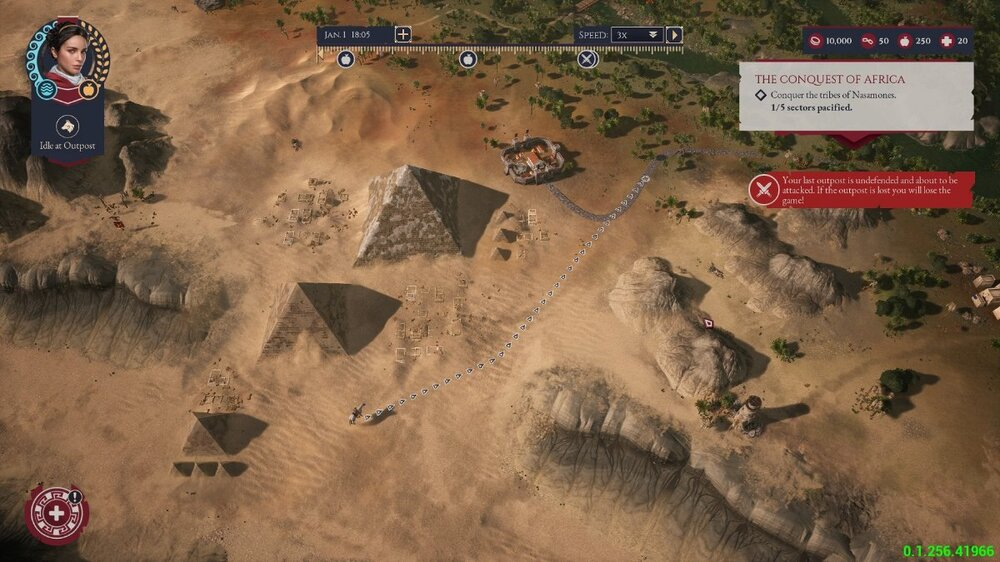
Expeditions: Rome has a strategic and tactical layer that is consistently interwoven through the game. On the strategic map, you are managing one (or later, two) legions of men, using them to conquer and sometimes pacify various provinces. The tactical layer involves a lot of battles to take regions, as well as various combat encounters related to the overall story arc of that area. Between these battles, there is some exploration, crafting, and tech unlocking that takes requires resources gained on the strategic map and after battles. Strategic battles use generated recruitable characters called centurions, where tactical battles involve a mixture of your main character, your companions, and recruitable characters called praetorians. The game is divided into three main chapters, each of which features a different theater of combat and is focused on a different historic Roman enemy, but the game is willing to play fast and loose with history, allowing them to tell a story with the player’s character at the center of it.
Strategic battles are largely focused on defending or seizing regions. They take place over three rounds followed by a resolution phase which varies based on whether you won or lost. During each, you can pick between three different cards that are appropriate to the stage and can have an impact on your legion’s attack, defense, casualties, and the likelihood of your forces to survive, all of which are combined to determine if you achieve a victory or defeat. In the case of victory, you get to achieve your strategic objective and can potentially open semi-randomized loot chests. If you fail you are forced to retreat, pick from the loss effects, and can potentially try again later. Losses are rarely completely devastating, and if your strategic decisions earlier in the game (such as prioritizing the health and well-being of your troop over decimating the enemy) result in more routes than utter destruction then it may even be required if the enemy’s concentrated forces become too large.
Once you have conquered a region the question of taming it comes up. Taming involves either a failable mission that you have to send your legion on or a tactical battle you have to win. Once the region is tamed several non-combat opportunities become available for them. You can send your legion to periodically refreshing locations to collect resources that are important on the strategic map (food, slaves, money, and medicine), and can also claim resource generating locations that are important for advancing your tech tree.
Tactical battles are divided between story battles and regional pacification battles with a single siege battle per chapter. These vary in who you are allowed to bring to them. Story battles require your main character, and some require one or more of your companions whereas regional pacification battles specifically prevent you from bringing your main character, and you are only able to bring one of your companions. Siege battles require your companions but usually involve dividing your team up into multiple tactical forces, and a large number of praetorians to fill the gaps.
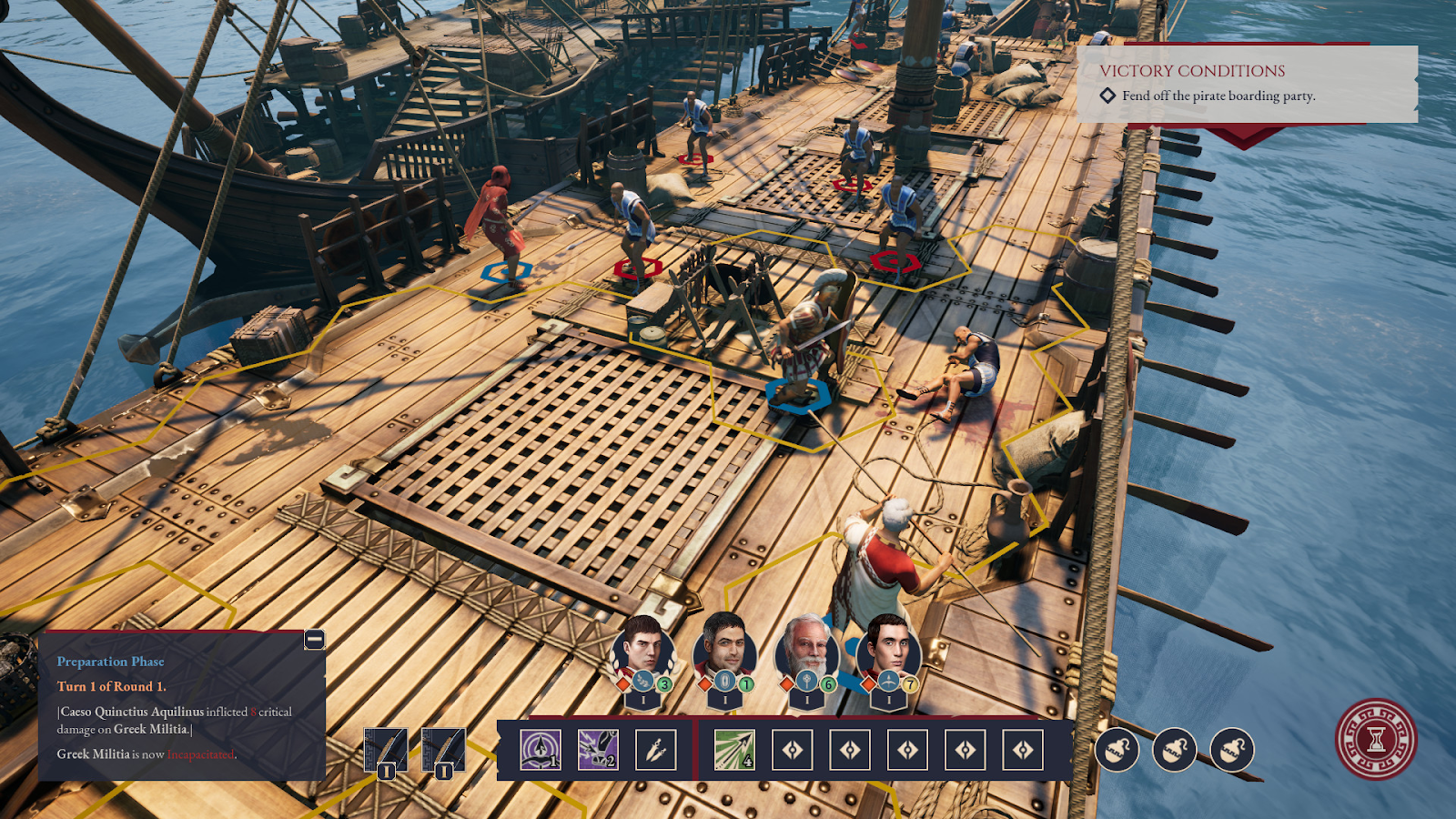
The game uses alternating turns between teams, with you being able to use your entire team at the same time, interweaving between characters as the tactical situation demands, and the enemies doing the same. Characters have movement points that can be used freely and a single attack, which will always hit in melee but can hit for a range of damage. Abilities and equipment can greatly flavor what you can do in battle, adding a variety of alternative actions and options. The tactical landscape is important too, with verticality being particularly important to ranged characters. The placement of cover and special map-specific tactical items create a tapestry of choices that make battles meaty and engaging. This is enhanced by the fact that, for the most part, each tactical map and situation is different. Even if you have a repeated goal (Kill All Enemies is frequently present), the situation changes enough that it never feels repetitive and is rarely dull.
In addition to dealing with damage, there is a large variety of different statuses and area of effects that can be used and applied. Ranged characters can gain access to two flavors of overwatch (as can melee characters with the right weapon!) and battlefield control can be as important as eliminating enemies, even if the latter is of paramount importance. Enemy status can also be extremely relevant to overall decision-making and how you interact with the battlefield. While many enemy characters have classes and capabilities like the player’s team, there is a class of enemies that restore your action point if they are killed. Defeating enemies like this allows you to potentially set up chains of kills and even action movie-style sequences as you move from enemy to enemy killing them in a blaze of destruction.
If one of your characters gets knocked out, they aren’t necessarily dead if you can bandage them before four turns pass. The support class also can get an ability to revive them, but the fact that any character with the right gear can stabilize or heal another character gives you a lot of flexibility in how you want to use and build your support-class characters. Revived characters are wounded, however, and require the help of a medical character until they recover or you make your way back to your camp where you can use the medical tent.
Characters come with four different classes and are distinguished by their gear and character abilities. Each of the four classes has three different ability trees, and you will gain enough experience to get reasonably deep into two of them and dabble in a third over the course of a game. The abilities typically increase in power the further into the tree they are unlocked, which incentivizes the player to progress as far through it as they can. That said, there are a few powerful abilities that show up early enough to choose how to choose abilities for a specific character to be a reasonably enjoyable puzzle.
Characters are also split between companions and praetorians (who can situationally be centurions if you assign them to one of the four leading positions of a legion). The only real thing that distinguishes them is that companions will never leave you for decisions you make during the course of non-specific conversations and that they have one or two character-specific pieces of artifact gear that essentially provide them with one or two passive benefits other characters lack. Luckily there isn’t usually a reason not to use companions either, as unlike in certain other computer Role-Playing Games (cRPGs) there are less truly awful builds or ways to permanently mess up a character.
A lot of the action of the game is centered around the location of your legion and their camp. This is where you get access to a lot of the non-combat actions you can perform, as well as meet with various NPCs who stop by to visit you. At the start, you will mainly be using your camp to drop off characters to recover from wounds or to find out where you need to go for your regional pacification mission, but eventually, you will start unlocking other available actions. These mostly require you to leave characters behind to work on them but it is largely worth it, giving you access to new or upgraded battle orders, new gear, lets you improve the opinion of characters who are unhappy with your decisions and refresh your used tactical items without expending resources.
Limitations and Failures
It is clear that the developers put a lot of thought into what makes a good tactical game with Expeditions: Rome; the resources made available through THQ Nordic seem to have ensured the quality of the game is very high. This high benchmark, unfortunately, contrasts with the areas where the game doesn’t work quite so well.
The first of these is the repetitious events. These are an assumed part of games that have events, but considering how much clear effort went into distinguishing each tactical battle and other parts of the game, the fact that you can run into a druid grove, pack of wild boars, or a waterfall over and over again and then have to decide what to do, with no variation between them, really stands out.
The second of these is the disconnect between how the game reacts to characters making rapid progress in conquering territories. Story events appear to be based on the passing of time, but some make little sense after you have conquered the entire region and there were two separate occasions where I would achieve the strategic conquest objectives but was then was forced into waiting for a story event to trigger before I could finish the campaign. This may be an artifact of playing on normal difficulty, which was mostly pretty easy, but it still feels like something that shouldn’t happen.
This issue of difficulty also showed up in a late-game story mission that I honestly felt was poorly designed and really needed special attention beyond the difficulty settings. Essentially you are put in a situation where you are ambushed and the game designers expect you to lose. After the ambush occurs your goal switches from “defeat all enemies” to “die with honor”, but the problem was that I defeated the entirety of the enemy force. They still had reinforcements arriving every few turns, but at that point, I was powerful enough that I would have been able to easily manage them, basically forever, and I had to deliberately do nothing so that the encounter would move on and I would die. This never should have happened, either an alternative ending should have occurred in case the situation ended up being a player victory, or the enemies should have been so truly overwhelming that it was impossible to lose. The weird middle ground I ended up with would have been problematic even in a game with more poorly designed encounters but stood out especially with how well-designed Expedition: Rome’s encounters are in general.
Achievements and Triumphs
Expeditions: Rome is one of the most polished and well-designed games I’ve played in a while. I am so used to certain compromises being made even in bigger budget tactical games, but there was nothing of the sort here. I expect this was due to the larger budget and keeping the campaign to a reasonable length (around sixty hours), something that is rarely seen even in games from much larger developers.
This is particularly evident in tactical battles. It would have been pretty easy for them to repeat some of the region pacification missions but they made the active choice to spend the resources not to, and the game really benefits as a result of this. Even if the overall goal of “kill all enemies” shows up frequently, the context of the battle itself varies so dramatically as to avoid repetition and the feeling of tedium that can sometimes result in games where you have less variance in how battles play out. This is extremely important for me as a gamer and Expeditions: Rome really nailed it.
Similarly, I was concerned at how different characters build, with only four classes and three trees. But between the variety of available actions from different weapons, and how getting to the end of different trees specialize the characters, the result is that characters feel related without being identical. You also can make real decisions in character development right up to the end of the game, which means you still look forward to each level and each opportunity to provide more mechanical customization.
I also find the inclusion of the pawn/scrub enemies to also be a particularly interesting and innovative twist which adds a level of action-movie excitement to what might have been a rather dry historical title. Your warriors push forward, spectacularly hacking through mooks while preparing to engage with a more powerful enemy. It feels and looks great, and is a win on both a tactical and a thematic level.
The story is solid and well-designed. I generally only require a story that doesn’t make me cringe in my turn-based tactical games and this easily clears the bar. Voice acting is ever-present and good, the characters are fun, and I found myself truly wanting to find out what happens next and how things were going to play out moving into the end game.
Conclusion
Expeditions: Rome is an excellent game for tactical turn-based fans to kick the year off with. I bounced off previous Expeditions games, but Rome is an unqualified win for me. If you have enjoyed previous Expeditions games, Rome should definitely be one to check out, and if you didn’t then I urge you to anyway. It is a great start to the THQ Nordic and Logic Artists collaboration, and having more Expeditions games of this quality should keep me happy for years to come!