Let’s eXamine | Endless Legend 2
Endless Legend 2 | PC | Amplitude / Hooded Horse | Released September 17th
Listen to our podcast talking about Endless Legend 2 here.
And there is a video version of the podcast, available here.
This is Marmite. It is…weird, and polarising.
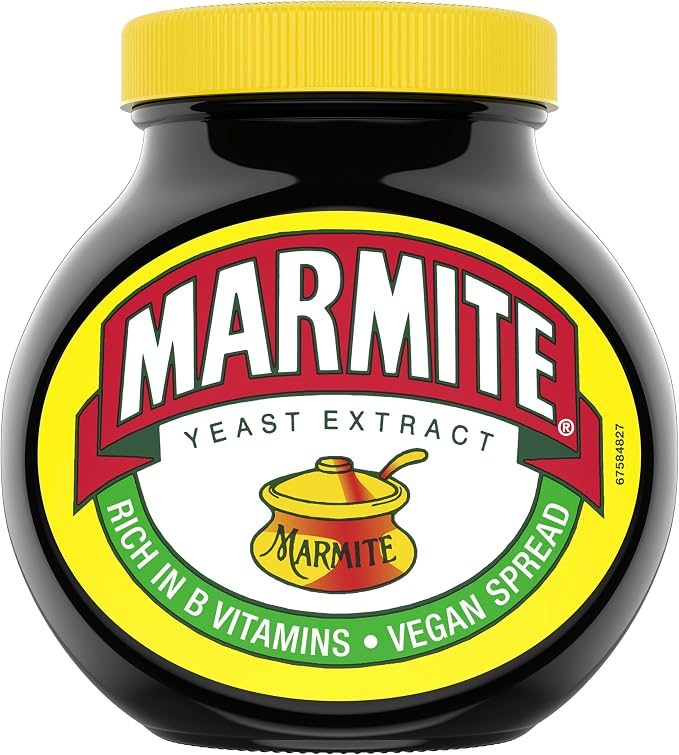
I love Marmite.
Spread thick on hot buttered toast, it is one of life’s simple joys.
I also love ice cream – a scoop of good vanilla on a summer afternoon is hard to beat. But put the two in the same bowl and you don’t get twice the pleasure.
You get something that makes you question your life choices. Each is delicious on its own; together, they cancel out what made them great. It is one of the peculiarly British culinary experiments that sometimes gives you a guilty pleasure like a deep fried Mars bar.
Not this time though.
Marmite is also what won the battle of Waterloo. The French were so confused by this thing, that they lost cohesion, and the rest is history.
I should note that not ALL historians agree on this interpretation of events.
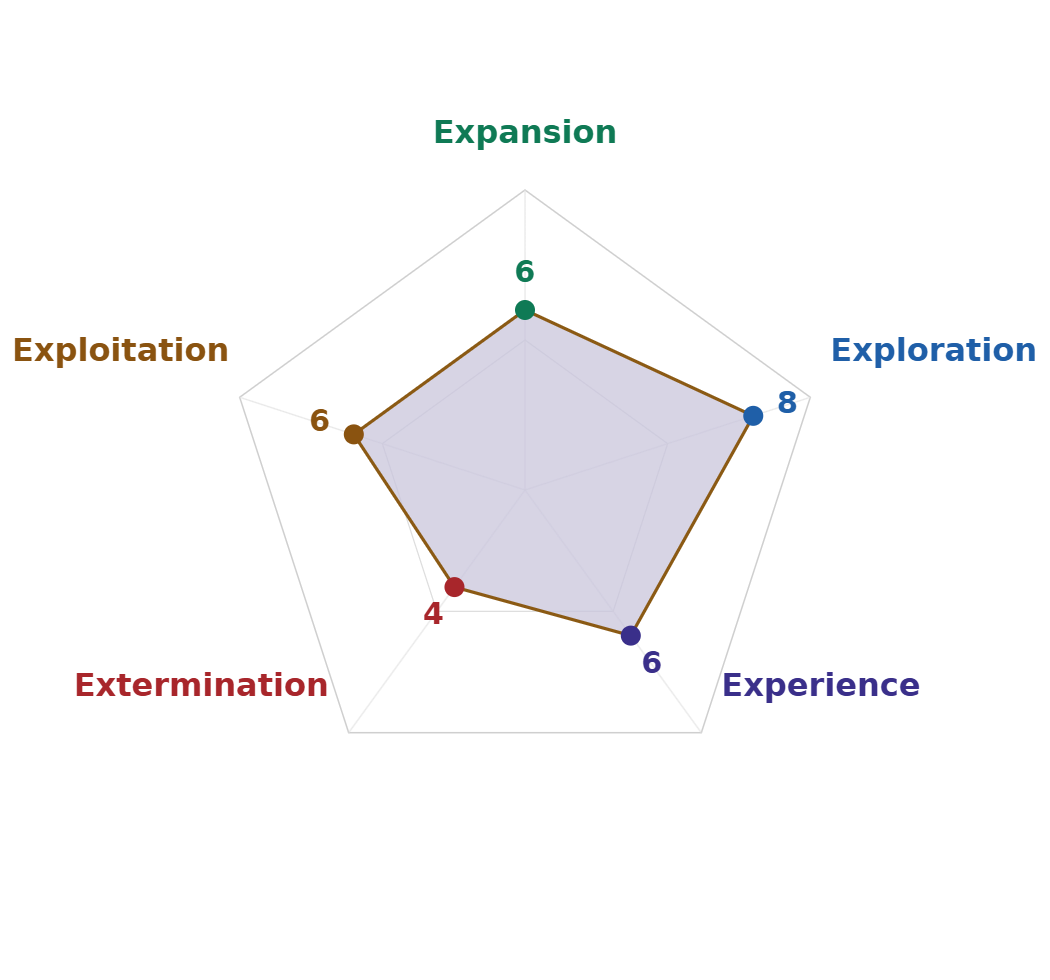
Endless Legend 2 has a Marmite-and-ice-cream problem. Its factions are some of the most distinctive in the genre, each one bending a core rule and pushing you into a different way of playing. Its central story is well told, set in a world that literally shifts beneath your feet. But a 4X lives on replayability – on the hundredth game playing out differently from the first – and the story is welded so tightly to each faction that the two end up fighting each other. The narrative turns every faction into a script, and the factions keep dragging you back into that script.
Amplitude burst onto the 4X scene with Endless Space, followed shortly by Endless Legend. Reception was generally positive. People loved the graphics and the mood – the vibe, if you will – but frequently criticised the games for a lack of depth. Once you figured out the hook for a faction, it was a solved puzzle. Asymmetric factions sounded better on paper than they worked in reality, and many became one-trick ponies, funnelled into specific play styles with little room for innovation.
The sequel’s hook is the Tidefall. Saiadha’s oceans recede in stages over a campaign, exposing new land, resources, ruins and minor factions just as most 4X games settle into end-turn clicking. Around that sits a familiar Endless frame: region-based cities, FIDSI economics, hex battles fought on the strategy map, and six major factions that each bend a core rule.
And, as before, a fairly on-rails RPG story running through the middle of it all.
So: is it better than Endless Legend? Is there a place for a narrative game in a 4X wrapper, or do we want more as gamers now? Does the marriage of RPG and 4X work, or does one half feel tacked on?
The quick verdict: Endless Legend 2 is the most inventive, yet somehow also the most mundane, Amplitude 4X since the original. The Tidefall delivers some of the best moments I have had in the genre this year, but between those moments the game drifts. Factions that are brilliant the first time become predictable by the third, the story that defines them repeats itself, and passive AI opponents and an underwhelming combat system leave the mid-game with little to push against.
A note on how I played: 12 games, all on large maps with 6 factions (i.e. 5 opponents), all at Hero difficulty. Bear that in mind when I talk about the AI and how demanding the economy is – some of what I describe may change further up the difficulty ladder.
Exploration | It is in our nature to explore…
Fog of war and map presentation
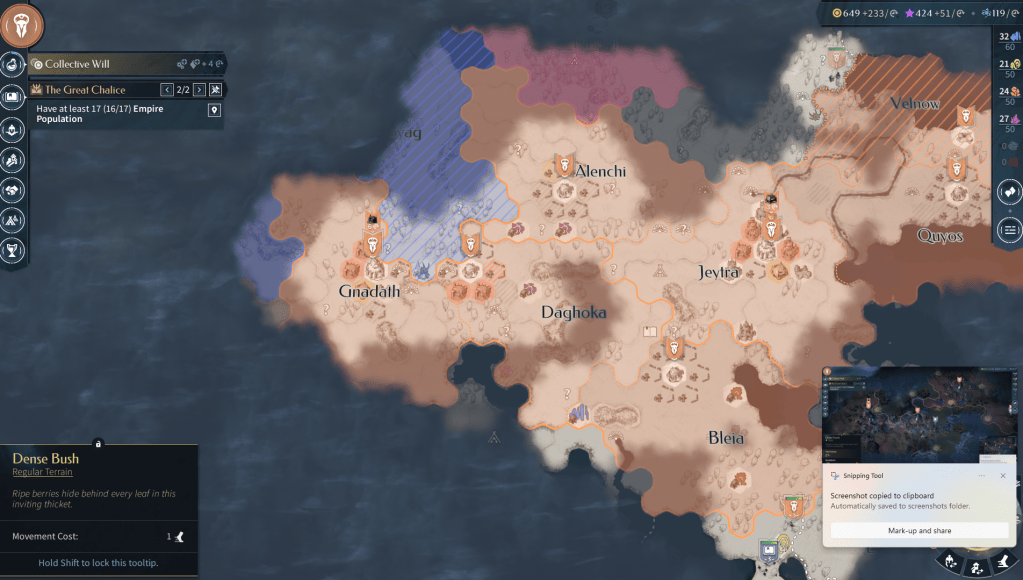
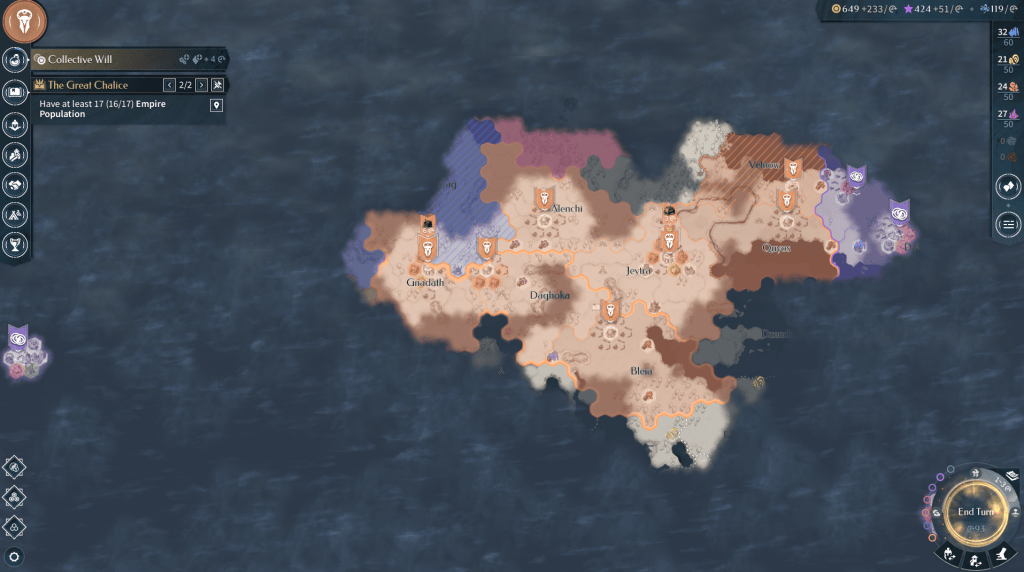
Stardock set the standard with Elemental back in 2011, and a cloth map is now an industry standard. EL2 does not disappoint. Maps are good looking and largely legible, full of interesting things, and the FIDS display works very well. {ss terrain with and without FIDS}
Map generation and room to breathe
There is a recurring discussion on the Steam forums about AI empires starting too close to the player, and my experience bears that out. I found my neighbours by turn 10 or so, and the neighbouring provinces – obvious candidates for expansion – were gone by the time I had 4 or 5 outposts. That was despite deliberately founding outposts to turn into cities as fast as possible. I suspect outpost spam might be the most effective way to lock down territory. It feels constrictive, and artificially so, as if the developers are trying to shepherd you towards the Tidefall to open up new space. More on that shortly.
Points of interest
PoIs are usually quite obvious – build near anomalies, put extraction structures on strategic and booster resources, grab anything shiny you can see. Sites like the hydromiel, which can be mined for empire-wide boosters, are the ones you really care about – more on those under Expansion.
Pacing
For the opening turns, exploration works as you would expect: scout, grab what you can, bump into your neighbours. What makes EL2 different is that it doesn’t stop there.
Tidefall & Monsoon
So, this is the headline feature, the big deal, the one generating all the buzz. PC Gamer covered it at length, and the big idea is simple: periodically force the player to rejig their priorities and go exploring again, rather than confining it to the start of the game. Exploration is where players spend most of their time (many more games are started than are ever finished in our beloved genre – a topic for another day), so it makes sense to inject that excitement again later on.
And you know what? It works. It is great. But there is a downside, something I don’t think Amplitude anticipated.
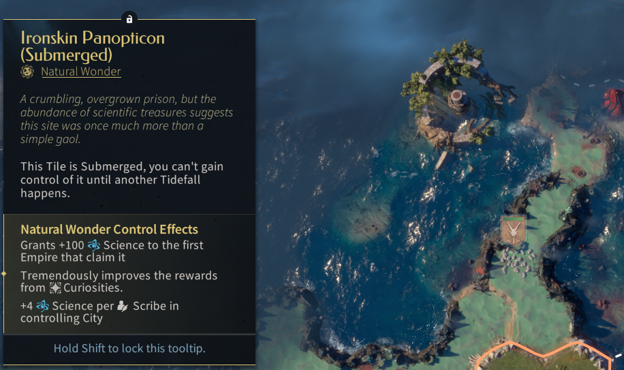
In one game as the Last Lords, I was quickly hemmed in by the Aspects and the Tahuk, with the Necrophages showing up not long after.
Starved for influence, I could only look on as the Phages took a hydromiel I badly wanted.
Then the monsoon came, and with it a bunch of shinies. I split my armies, set every unit to auto-explore, and hoovered them up – an actual Dust rush. Then the waters receded, and suddenly I had oodles of land to my north. A quest choice handed me around 3,000 influence, and I doubled the surface area of my empire in about ten turns.
Meanwhile, my main hero had picked up a very special whip with the Colonial Might ability, allowing him to recruit minor faction units after defeating them. Combined with the Last Lords’ ability to press-gang the population of pacified villages, I went from 8 population to 24 in short order. Yes, they rebelled (how rude), but I, ahem, whipped them into shape and boosted my army in the process. A mad scramble for land and semi-industrialisation. Exciting stuff.
And then…
And then…
Nothing.
A lull.
The Aspects, Phages and Tahuk did nothing, other than bother me with treaties. The Sandweavers declared war, but I never saw a single one of their units before they sheepishly proposed a white peace. The only units I saw were Phages, patrolling their own lands.
My turns became shuffling some armies three tiles, fighting the newly revealed minor factions (until I realised I could just bribe them when my whip hero wasn’t around), and cycling through cities hoping to rush-buy something.
So this brief, glorious burst of mad dashing only serves to highlight the rest of the game, which floats along like Mark Antony on a Nile pleasure barge, the crocodiles having been politely moved along.
Expansion & eXploitation | Expansion is the default state of life, unless you actively nurture limitation.
As the anecdote above shows, it is almost impossible to disentangle exploration from what you do with it – namely, expanding.
Districts
Amplitude made the district system famous in Endless Legend, and it is back here. Less revolutionary, but really quite functional. There is depth for those who want it, and I am sure some people will enjoy working out the optimal district placement. Myself? Apart from making my very first districts industry focussed, I just turned on the FIDS display {screenshot}: if a tile had more Dust, it got a Dust building; more industry, an industry building; and so on. Then I queued up whatever improvement was needed – usually influence. At Hero difficulty, that was all that was really required of me.
Influence
The biggest factor in your expansion, both of territory and of individual cities, is not population, industry or even Dust. It is influence. It is everywhere, and you almost never have enough of it.
One thing I do like is that each city can annex up to 3 other provinces (which you must claim first), at an influence cost. Each of those provinces could instead become a city in its own right – considerably more influence-heavy, and a big contributor to over-expansion penalties – but you have a real choice: one city covering a very large area, or several smaller ones. Several cities means several production centres, and several places to raise armies. Unless you are the Necrophages, in which case you get just the super city.
Those over-expansion penalties do jar with the lore, though. Most of these factions are all about expanding and reclaiming their rightful place, and the Last Lords in particular, with their devour-the-locals mechanic, hardly seem the type to worry about over-reach.
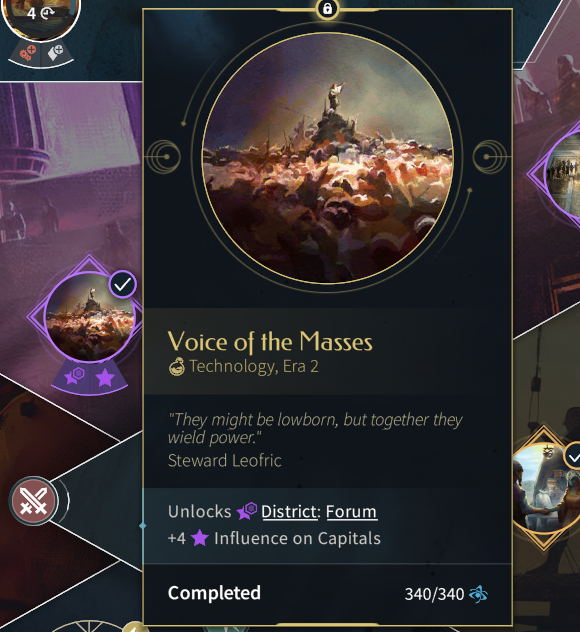
Resources
Of far more interest to me than districts were the extractable resources. There are… loads {screenshot showing all the resources}. They all look beautiful, you want as many as possible, and each new one gave me a little dopamine hit. In that sense they do a great job of driving expansion, and they made me think carefully about how and when to grow.
Some of the boosters are simply awesome, like the crystal cap that gives +2 industry per population, or the hydromiel, giving +20 Dust per city. Because boosters usually work per city, they feed straight back into that one-big-city versus several-small-cities decision. In one game I held 3 hydromiels, 3 glass-steel mines and 2 titanium mines, so every few turns my stockpiles filled up and I could fire off boosters {screenshot booster}.
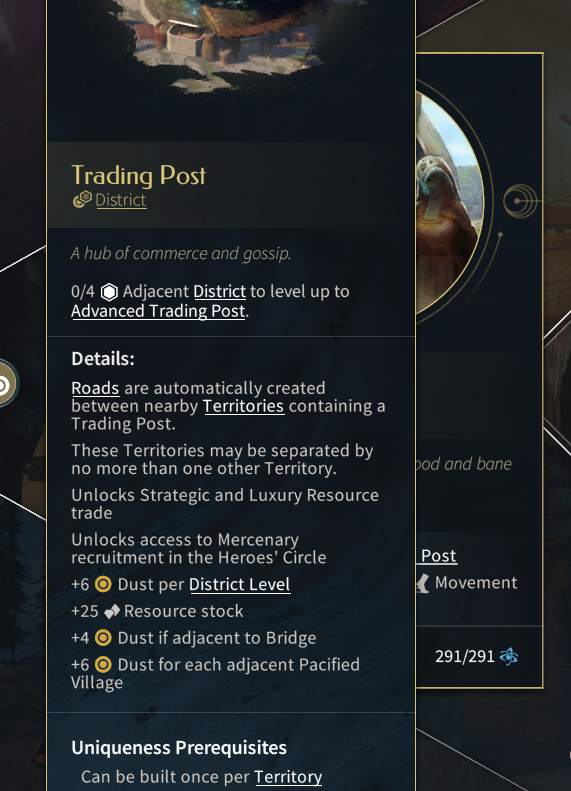
Others are of less obvious use. Glass-steel and titanium return from the first game, but your unit upgrades are now pre-set per faction. The Last Lords need titanium to upgrade their foot soldiers, so if you are swimming in glass-steel with no titanium, you have to wait until era 2 to build a trading post, sell the surplus, and hope there is some titanium for sale. More on what that means for your armies below.
Landfall
If you have played Endless Legend, territory management will feel very familiar – including how quickly the land runs out, as I mentioned under Exploration. The Tidefall is clearly meant to be the release valve, and it is. At best you get the story above. At worst, it feels like obligatory busy work.
And curiously, as soon as new territory appears, the myriad minor factions spawn villages and armies there – and because this is later in the game, they are stronger than the ones near your start. That can be quite immersion breaking.
Beyond that, I settled into a comfortable rhythm: research influence, build the relevant improvements, queue some soldiers, develop a tile. Repeat.
But, and I think this is a big part of how the game very quickly bogs down – you want to, need to build your districts up (which is fun enough – seeing the districts come up and the map change is fun) which takes a long long time. And you cannot recruit armies while you are doing this. So, the whole game slows to a serious crawl.
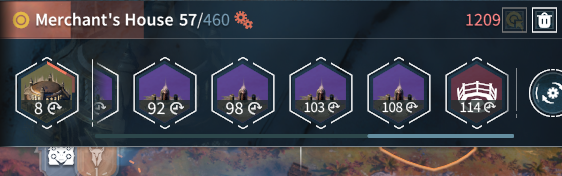
I think the game would have benefitted from an additional city queue, just for recruitment. It is pretty boring clicking end turn to get to the next building. That, and maybe shorter build times overall.
The Factions | Marmite, meet ice cream
So, that brings us nicely to the factions. They are super interesting, super cool, and yet… somehow don’t quite elevate the game.
Fans of free-form, build-a-bear design will likely find them railroaded. The upside is that the game demands you engage with each faction’s design: the Last Lords play nothing like the Necrophages. There is some shared DNA – the way the Kin accumulate their special resource to summon their chosen is very similar to how the Sandweavers build up enough to terraform an area into sand. Probably the most bizarre are the Tahuk, whose central gimmick relies on population control.
The downside is that after 2 or 3 games you know exactly what to expect. The Tahuk and Aspects will bug you non-stop for treaties (because they benefit from them more than the treaty itself indicates ), the Necrophages will likely try to eat you, and so on. It all gives the impression of a more “solvable” game than something open-ended like Age of Wonders 4.
And this is where the Marmite meets the ice cream. As in the original, each faction comes with its own storyline, and that story isn’t garnish – it is the faction’s identity. The quests, the vignettes and the heroes all reinforce who the Last Lords or the Necrophages are. The first time through, that is genuinely lovely. The good news is you can hurry the exposition along and largely ignore it. The bad news is that you can’t escape it: by the sixth time you start a Last Lords game you will be dreading the same story beat (that half born hero you get with 1 hp…)
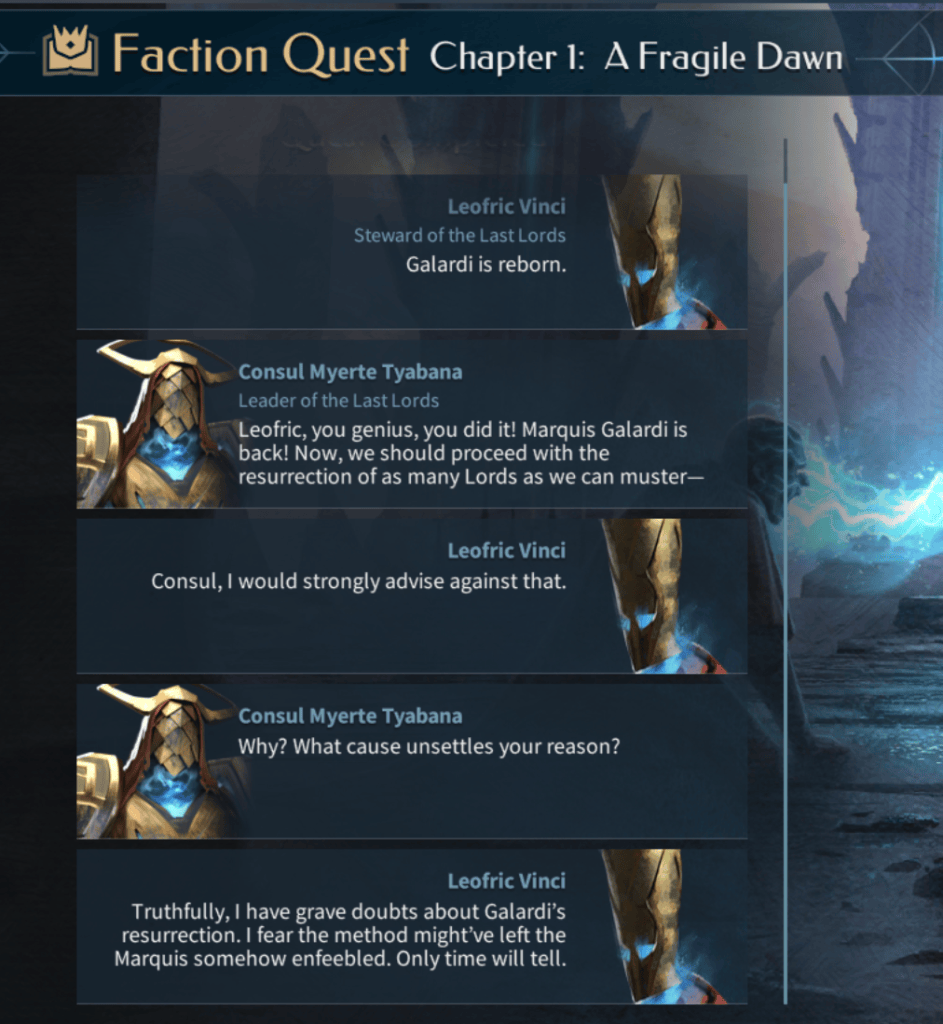
A 4X needs each game to be a new story you write yourself – indeed, one could argue this is the heart of a 4X, the core conceit, or fantasy, that the player starts small and ends large. Endless Legend 2 keeps handing you the one it already wrote.
Extermination | We should forgive our enemies, but not before they are hanged
The AI
I said in my verdict that the AI holds the game back, and the Tidefall anecdote above is typical. My neighbours crowded me early, then largely sat still. Diplomatically, the Tahuk and Aspects were constant presences, forever offering treaties; militarily, almost nobody was. The Sandweavers’ war that never arrived wasn’t an outlier. In 11 out of 12 games I was never seriously attacked after the early land grab. That makes the mid-game lull worse – there is no pressure to respond to. Again, this is at Hero difficulty – your mileage may vary.
That 1 time out of 12? Hungry Necrophages, who ate some armies, then asked for a white peace, then came back 5 turns later for more food. I beat them back.
Combat
The original Endless Legend tried something quite daring: semi-automatic tactical combat that played out on the strategy map. The on-map part is still here, but the semi-auto part has made way for fully tactical combat. Which means this combat system has to compete with 20 years of genre innovation.
And it doesn’t quite fail, but it doesn’t quite succeed either. It does nothing wrong per se, but little here advances the genre or grabs the player’s attention.
Elemental: Reforged has powerful heroes, an interesting initiative system and occasionally fabulous spells. Age of Wonders 4’s combat could be its own game (arena mode when???). Even slimmed-down games like Urtuk have more immediate pressure and payoff, and non-tactical games like Astro Protocol make combat feel more deadly, because it usually happens near critical things like research stations or planets.
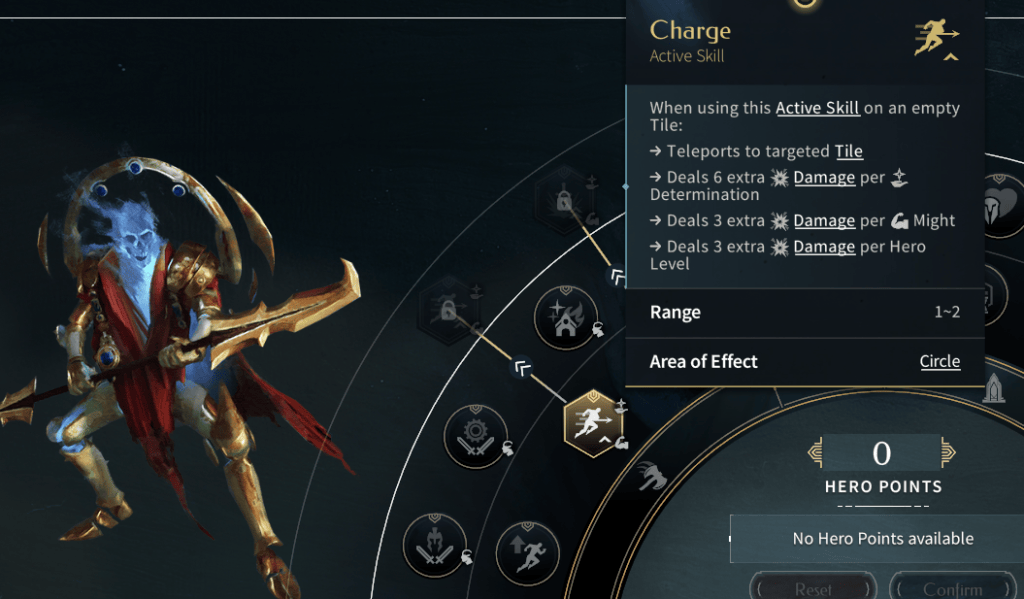
In all of those, I often felt excited (and, to be fair, in Elemental and AoW4 sometimes fatigued – too much of a good thing) to play out the fight, looking for something to exploit or a combination to try. That rarely happened in Endless Legend 2. Note: rarely, not never. There were a handful of fights where I could pull off some hero cheese, like Uwe Rach the ranger getting what is effectively a shotgun. The hero skill tree also has room for min-maxers; I tended to pick one skill and maximise the attribute that powered it.
So what do I dislike?
Battlefield size
It feels too small. Cramped. No room for fancy manoeuvres or real flanking, so you line your guys up and hope to out-tank the other team. Flying units can reach ranged units more easily, but they often just die anyway.
Unit variety
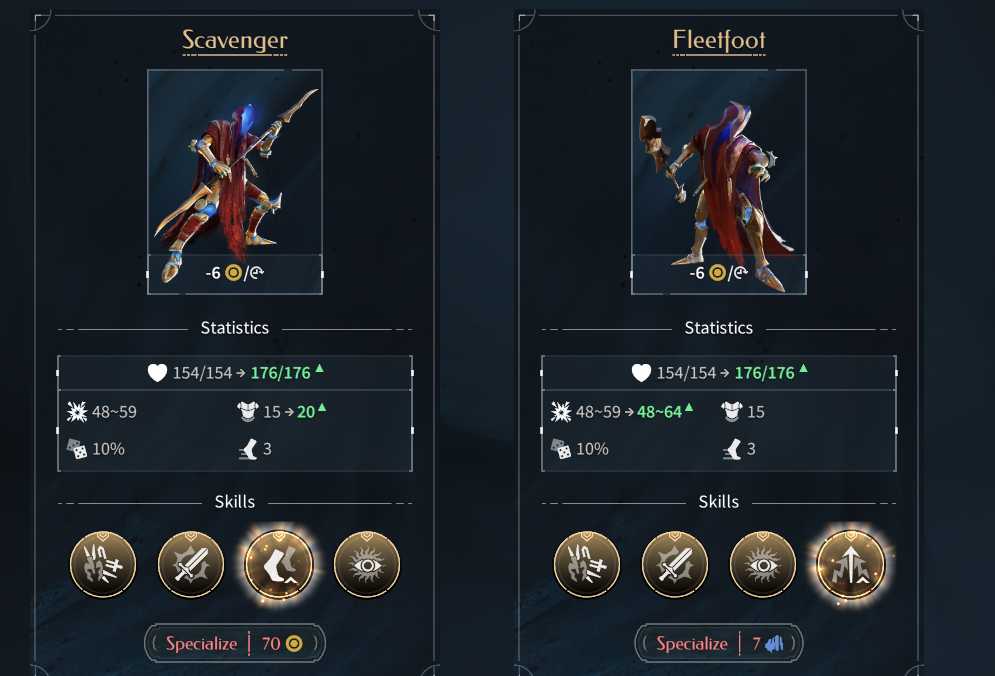
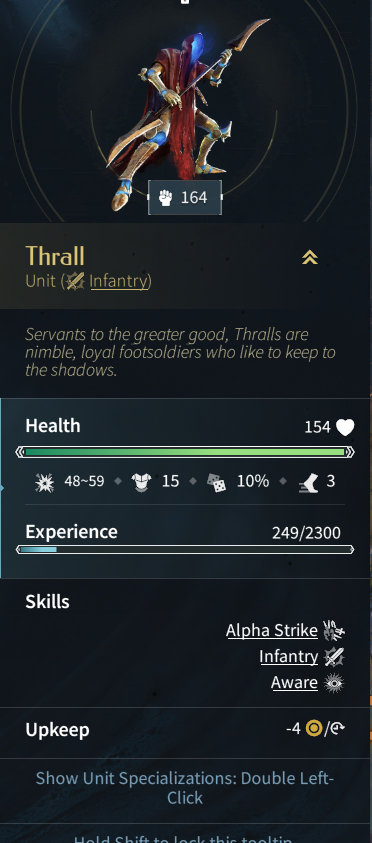
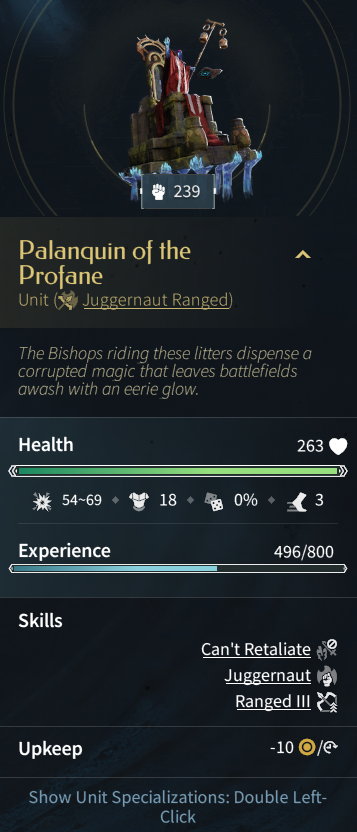
You don’t get many units, and they have very similar stats, differentiated by a handful of key abilities such as life leech or flying . On a small battlefield, you end up smashing melee units together, with ranged damage a nice bonus.
See below for a selection of units:
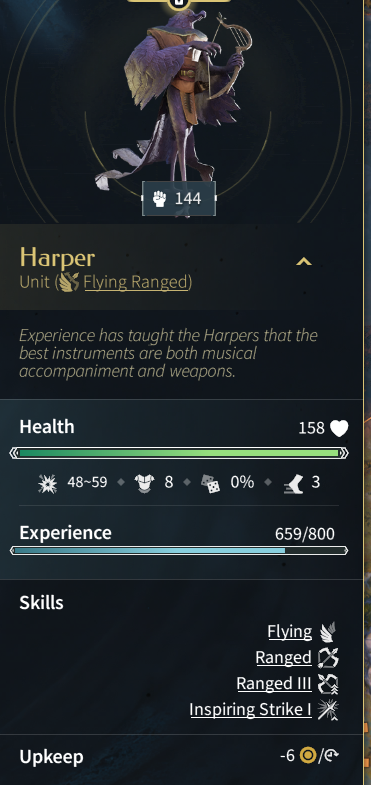
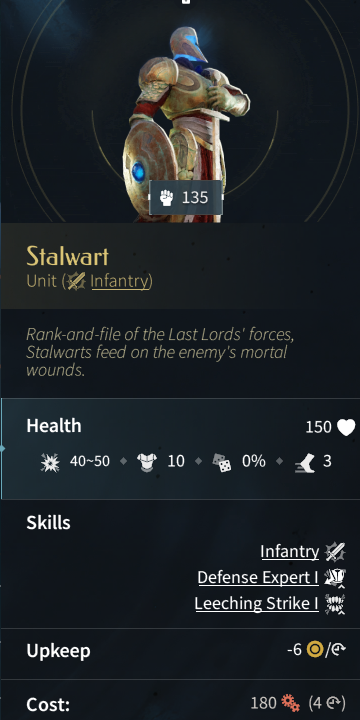
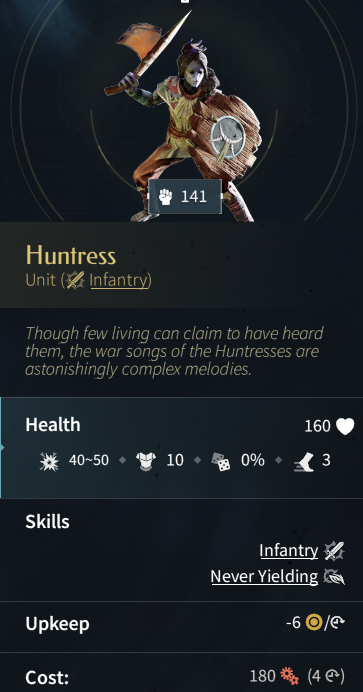
Terrain
A mixed bag. Terrain matters, as it should – more than in most games. But it is easy for a unit to get stuck in a valley and spend the fight out of the action. Great if you trap an enemy below you while you rain death from a cliff; not so great when you only have 8 rounds.
That timer
You get 8 rounds to win. If the enemy survives on 1 HP – quite common when clearing a fortress – you have to wait until next turn, because you are now “exhausted”.
Exhaustion & healing
Half the fun of games like this is finally pulling off some sort of blitzkrieg. Here you are hard-limited to one fight per army per turn. Combine that with how expensive and slow it is to build an army, and it adds up to a frustrating mix of grindy battles. (The Necrophages are the exception early on, but they tail off once their lack of production bites and the easy fights dry up.) Take damage and expect that army to be out of commission for a few turns – unless you are a rich Last Lord in friendly territory, in which case you can pay Dust to heal.
Legibility
Largely a result of the cramped battlefield.
Age of Wonders 4 gets plenty of (fair) criticism for its icon-heavy battlefield, but at least you can see what is happening at a glance.
Lack of interaction
I am not asking for Divinity: Original Sin stuff here, but some way to manipulate the battlefield would be cool. Sandweavers doing something sand-related in combat? Summoning sand-devils? Calling an in universe equivalent of a sand worm or scorpion? Capturable towers, altars granting spells after X turns? There are terrain modifiers, such as defence (in forests, for example), but it all feels a bit dry.
All in all, combat feels disincentivised.
Units and upgrades
The other huge change from Endless Legend is how units work. The original had a fascinating, if cumbersome, design-your-own-unit feature that let you tailor armies to the resources you had (though glass-steel was generally just better for everything, since it boosted initiative).
In the sequel, upgrade paths are fixed. You recruit a base unit, which stays the same all game. You then pay resources to choose one of two upgrades, and that choice can be upgraded again later. Upgrades are locked behind research and cost resources.
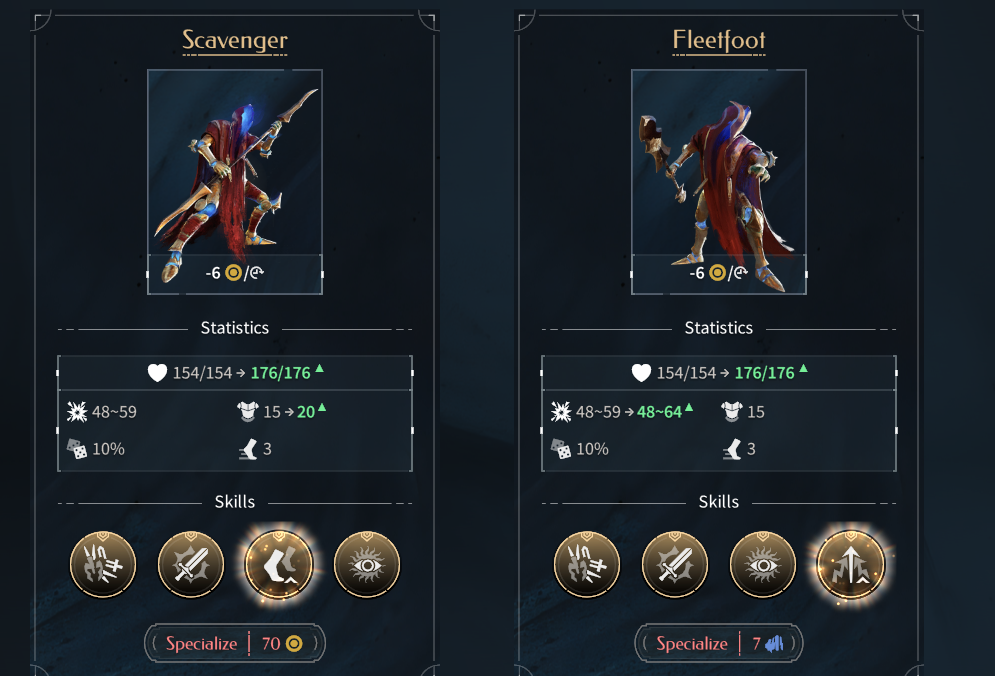
It is easy to understand and plan ahead for. But, as covered under Resources, if your faction needs a resource you don’t have, you are either stuck or buying it from a market that may not stock it. You can end up with an otherwise powerful empire dragging along tier one units.
You can mitigate this by incorporating minor factions, like the Gorog. Incorporation means I can recruit them, and they are tanky – about as tough as the Kin Of Sheredyn special Chosen troops, but with no unit cap.
Sieges
Sieges happen when one side tries to take a city. A timer starts, which hero skills can modify, and the defender can choose to sally out. When the timer ends or the defender sallies, a battle starts – with no walls in sight. This was an issue in the original, and it still feels too abstract and dry. I recommend everyone read this series on how sieges actually unfolded and what fortifications were for. Hopefully someone, someday, will make an in-game siege system that makes sense and is fun!
eXterminate Summary:
Combat feels disincentivised, and battles are cramped and grindy
Compare these 3 battlefields:
Ask yourself:
- how much space do I have to move in?
- What can my units do?
- How well can I read what is happening?
So, with combat, given how infrequent fights are in this game, I actually think a full scale system like Age of Wonders 4 would have worked very well. AoW4’s grand problem is the increasing frequency of fights as the game goes on. Endless Legend 2 has fights that are few and far between – they could have been better.
Experience | The intangibles that bring it all together
First impressions were very good. A shiny start screen and lovely ambience – it felt like coming home.
User interface
Functional, though with some irritations: armies carrying out projects, and the left-click select-and-activate behaviour for active abilities. Also, splitting an army – you need to move units out one by one. This was “solved” 25 years ago in a certain other game…
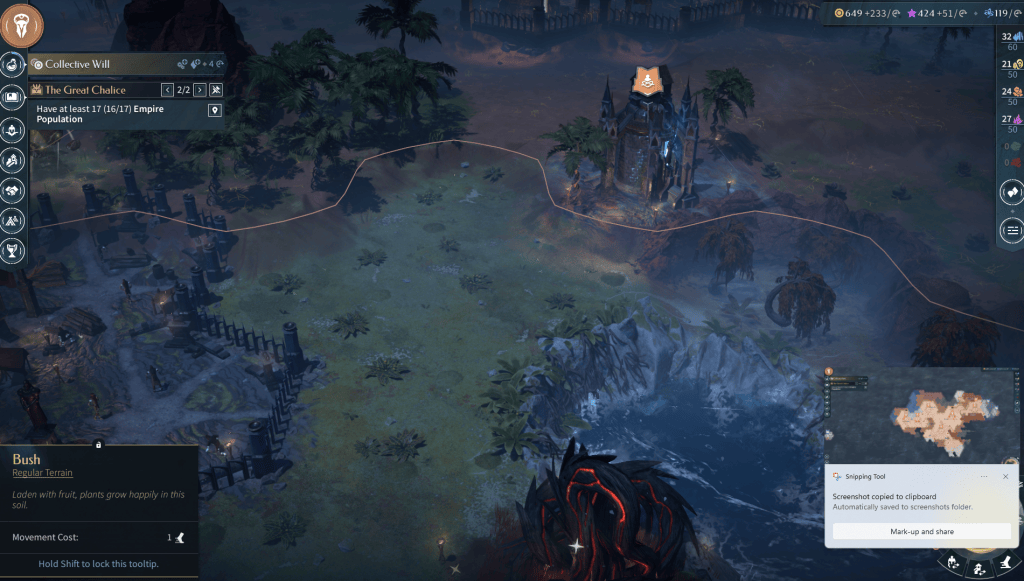
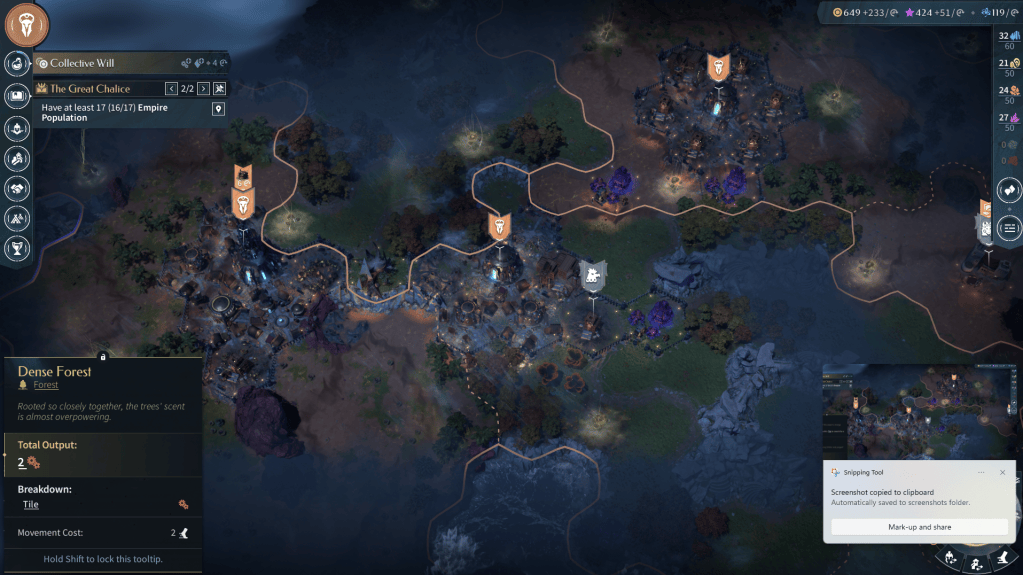
Visuals and art direction
The graphics are great, though the map can look muddy. The cloth map is awesome.
Soundtrack and audio
The music is great – I just wanted more of it. There are noticeable periods of silence.
Performance
From around turn 100, end turns got slow. Because my actions in any given turn were few, I would engage for ten seconds, then wait half a minute before I could do anything else. That amplifies the mid-game lull considerably.
What do I mean by “slow”?
Well, here’s a video:
If you don’t want to watch it – 20 + seconds for end turn to resolve. And maybe 20 seconds on moving stuff around, checking my cities after that
Replayability
See the factions section: the faction design and the story are what bring you back, and also what make each return feel familiar. I played Last Lords and Kin of Sheredyn the most, so when I return, I aim to spread sand everywhere, then spread coral.
The quests might be fun the first time around, but get quite stale, quite fast.
Also, in fairness this did not happen too often, only twice I can remember, but see below for a rather questionable quest spawn location, relative to where I actually am. This matters because the game is all about quests, far more so than about beating stuff up.
Summary
So, back to those questions. Is it better than Endless Legend? In places, clearly: the Tidefall is a genuinely new idea that reinvents the mid-game, and the influence and resource economy drives expansion well. Is there a place for a narrative game in a 4X wrapper? Yes – but Endless Legend 2 shows how hard it is to make the two halves serve each other.
What it does brilliantly
The Tidefall and monsoon moments. The cloth map. Resources and boosters that make every new region exciting. Factions that genuinely play differently. The monsoon/tidefall, or something similar, might end up being a new basic standard for the genre, similar to how the cloth map came from Elemental.
Where it falls short
A long mid-game lull between Tidefalls, made worse by passive AI and slow end turns. Combat that is functional but cramped and rarely exciting. Factions and stories that are wonderful the first time and predictable by the third.
Marmite on toast, ice cream in a bowl. Both delicious – just not together.

You might like this if
- you love that moment when the map opens up and you’re off on a mad scramble for new land (the Tidefall is brilliant)
- you want factions that really play differently, and you enjoy learning each one’s quirks and stories the first time through
- looks and atmosphere matter to you: the cloth map, the art and the music are Amplitude at its best
You might not like this if
- you want a sandbox you can replay a hundred times, because the factions and their stories get predictable by your third game
- you play 4X games for the fighting, because the battles are cramped and grindy and the AI rarely comes for you
- you hate a slow mid-game, because long build queues and slow end turns can leave you clicking end turn for a while between the Tidefalls