Age of Wonders is a venerated 4X series with a strong emphasis on combat. In fact, all the mechanics present in each game exist to facilitate and provide meaning to the turn-based tactical combat system that lies at their heart. The first entry in the series is Age of Wonders, released in 1999-2000 (US and EU respectively), the newest entries are Age of Wonders III, (2014), and the first foray into a sci-fi setting entitled Age of Wonders: Planetfall (2019).
The basic gameplay loop of the series is quite similar to most 4X games. You start with a city, or a colonizer, and an unexplored map. You explore your surroundings, secure vital resources, and expand your territory, all while researching technologies that unlock new bonuses, units, and spells. This in turn boosts your economy, allowing for bigger, better armies, until you are in a position to pursue one of the victory conditions.
This article will discuss what game features and mechanics Triumph, the developers of the series, should take from Age of Wonders 3 (AoW 3) and Age of Wonders: Planetfall (AoW:P) into a hypothetical (but quite probable) Age of Wonders 4. What should be changed, and what should be fused into a new system? This discussion will only take into account game mechanics and user experience (UX) and will not explore the lore and setting or the technical side (graphics, sound, engine, etc).
Before we jump right into it, there are a few points to keep in mind. First, throughout this article, I will cover the topic from a single-player perspective, but with possible multiplayer ramifications in mind, as informed by many discussions I have had with veteran members of the multiplayer community. Secondly, to keep the article from becoming large and unwieldy, a basic familiarity with the series or at least one of the last two entries (AoW 3 or AoW: Planetfall) is required. This is necessary because otherwise, it would be impossible to dive deep into systems, mechanics, and gameplay impact without spending an inordinate amount of time explaining how each game works. Finally, a lot of this discussion is subject to personal taste, as I have often encountered arguments for both sides on a given mechanic, even if in many cases there is a general consensus.
With all that out of the way, let’s dive in. I have separated the points I wish to discuss into three groups. First, come the major features and core mechanics that largely define the games. The second group is composed of minor features and quality-of-life improvements. And finally, the last group is features that are either absent from both games or are more radical changes to the current formulas.
Let’s go!
Major Features/Core Mechanics
Cosmite and Unit Mod System
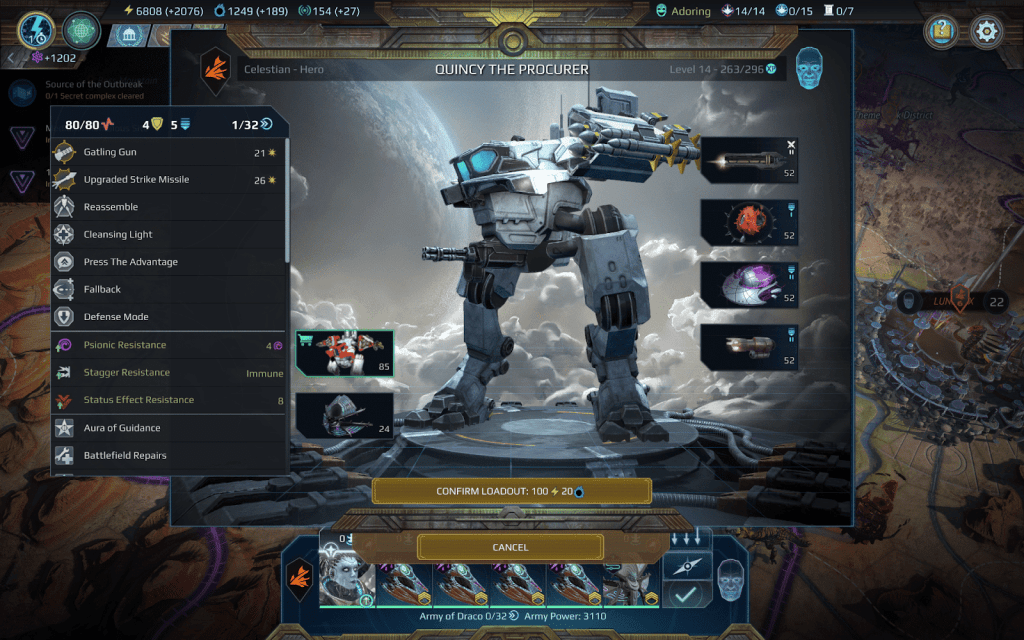
The first, and arguably the most important new mechanic that was introduced in AoW:P, is the cosmite/unit mod system. Cosmite is a new resource that is in limited supply and is mostly found in the select few sectors that feature a cosmite node. Unit mods are upgrades that are equipped on units and Heroes, enhancing their Abilities or giving them new ones, and take up one of the three available slots each. Colonizers, flying units, Tier 3 and Tier 4 units all have an attached construction cost in cosmite, while tier 4 units also have an upkeep cost in cosmite too. Furthermore, unit mods also cost Cosmite. The Cosmite system simultaneously addresses several classic problems in 4X design.
In all 4x games, city/colony spam is an issue that has to be tackled in some way to keep the focus, and its pace moving along nicely. Having colonizers consume a progressively increasing amount of cosmite, a resource desperately needed for armies, leads to interesting decisions that have to take into account map settings like size, enemy aggressiveness, the surrounding terrain, and the location of your opponents. You cannot simply pump out colonizers without a plan or your early-game armies will be too weak to defend colonies or expand your territory.
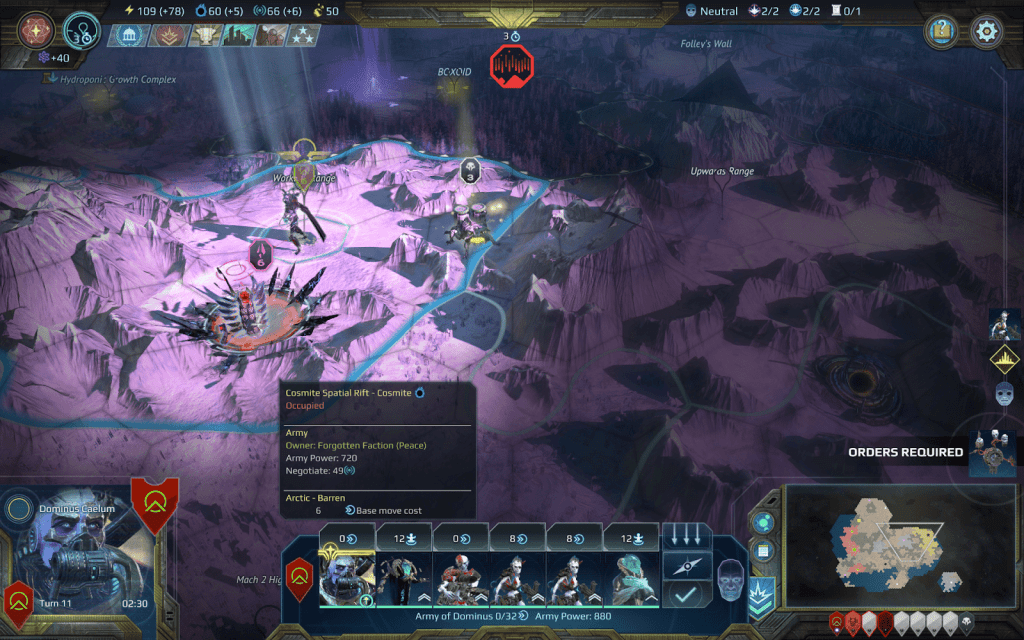
Speaking of armies, Cosmite also combats one of the major issues AoW3 had: late-game Tier 4 unit spam. If you had an appropriate end-game economy, there was only one strategy to follow, and that was to keep building the single most powerful unit available to you in stacks, a mind-numbingly boring tactic. In stark contrast, in AoW:P your armies can feasibly be a lot more varied, making use of different units across the tiers. This is not only because of Cosmite costs for higher tier units but also because of the unit mod system. In AoW3 a Longswordsman can never be anything else: it is of use in the very early game, and obsolete soon after. Even if for some reason, come late game, you still have a few lying around, they are still the same unit with the same basic function and power.
Not so in AoW:P. Every unit has three slots for unit mods which can be changed whenever you wish in the strategic map. Mods offer a great variety of bonuses and effects from simple stat buffs, to new defensive or offensive options, to mods that drastically change the unit’s function on the battlefield! An Assembly Scavenger without mods, and one with good defensive mods, are two very different units. If you give that lowly Scavenger a mod like Phoenix Bombs, it suddenly becomes a long-range artillery unit that can still perform its default role of melee / close-range flanker. This system has not only the effect of providing excitement and much theory-crafting potential as to how to build a unit but also the opportunity to outplay your opponent by, for example, equipping targeted defenses against their primary damage channel.
This makes intel and scouting suddenly very valuable in both single and multiplayer matches. And that lowly Tier 1 unit you started the game with? You can very often keep using it effectively until the end game since you can change the initial mods you gave it with stronger, more powerful ones as you research them!
It should be apparent by now that this leads to a much more dynamic and interesting experience that presents you with a lot of potential builds to experiment with, instead of just spamming your most powerful unit because doing anything else is like giving yourself a handicap. This is a feature that absolutely needs to be ported over to AoW4 in some form.

Unit Variety
At the core of the two most recent AoW games, is the system of picking a race/class (secret technology in AoW:P) combination for your commander and faction. The two games went in somewhat opposite ways in this regard. In AoW3, race feels like a modifier to your class, adding flavor and variety to it, whereas in AoW:P it is the secret tech that adds flavor and variety to your race instead. In essence, you have a group of units exclusive to your race and a group of units exclusive to your class, with the class units usually having your racial flavor. A Draconian Berserker is different from a Halfling Berserker, and a Vanguard Purifier is different from a Dvar Purifier.
This variation makes the different race/class combinations feel fresh and different, doing wonders for the game’s replayability. However, the manner in which each title tackles this each has its pros and cons: AoW:3 feels like it has more racial variance in class units than AoW:P, which in turn feels like it has a greater degree of variety still in those more varied examples. For instance, the Light Bringer is a powerful Celestial ST melee unit for most races, but the Oathbound stick their Paladin Light Bringers in a battle suit with a strong single-attack ranged weapon, one that no other faction has!

There is certainly a balance to be struck between having class units that feel like they have cohesion, with racial differences, and having a vastly diverging racial variant. Ideally, I’d like to see an amalgamation of the two philosophies, with more racially distinct class units than AoW:P and a greater degree of said variance (for at least a few of them per race) than AoW:3 gave us.
In addition to that, I’d like the racial variance to at least extend a bit into classes with (largely) race-agnostic units, like Dreadnought or Heritor. We already had examples of this; the Frostling tank in AoW3 was a frost tank instead of a flame tank. I don’t think it would be too much to ask to have at least one unit with a racial flavor in such classes. Or, at least avoid and limit how many of this kind of class there are. (Yes, this probably means more work for the artists and balancing team, unfortunately.)

This helps keep the game fresh for a lot longer, since playing a Human Dreadnought will feel different from playing a Tigran one, and even before you have enough experience and deep knowledge of how the game works to discover its fine mechanical differences and nuances. Because, let’s face it, a good portion of the player base will not reach that level if they play a class once and subsequently feel like they have seen all there is to see, moving on without trying said class combined with a different race.
Sectors and Strategic Layer
One of the new concepts brought to us by AoW:P was the sector system. In AoW3, cities were placed in a particular hex and had a hex radius they could cover that would grow as the city itself grew in population. The world in AoW:P, however, is split into distinct sectors, each of which can contain, at most, one city. A city can expand past its initial sector to a set number of adjacent sectors, claiming all the resources in each one. This is a system that initially gave players some trouble, and saw changes throughout the development cycle of the game. But as it stands now, I find it hard to go back to the way AoW3 did things.
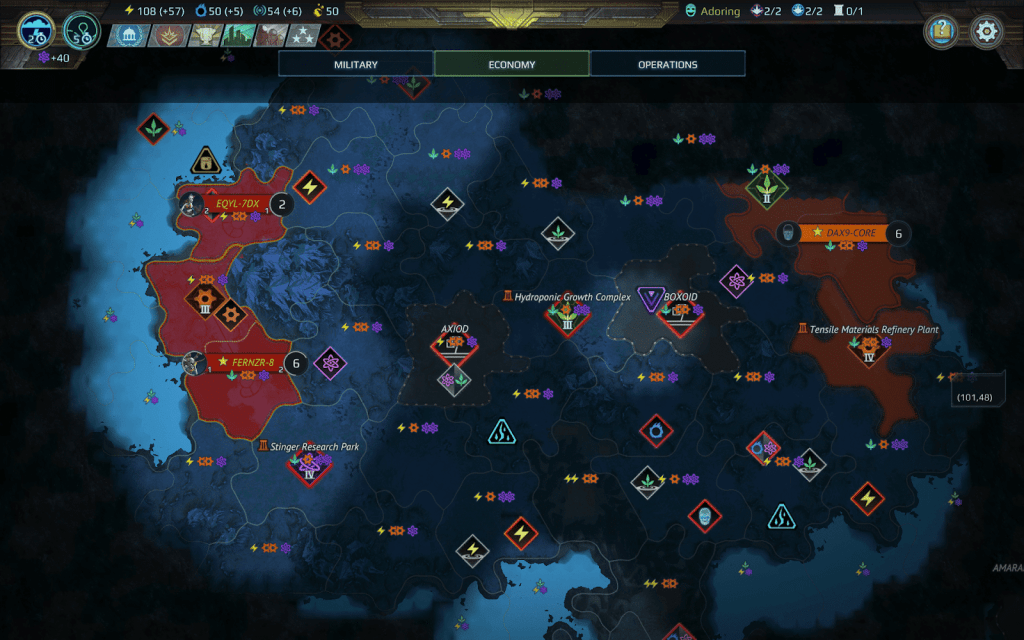
Unless you play with colonizers disabled (you know who you are!), you need to explore and find good locations for cities in both games. But in AoW3 that is a big headache. First, you need to start counting tiles and find that one perfect hex that covers the maximum number of resources, while also potentially counting the numbers of each terrain type in range because that affects racial happiness. And woe unto you if you forget which particular tile it was! And once you settle your city, then that’s it, the city is going to grow automatically outwards in rings until it reaches the maximum size. In contrast, AoW:P’s sector system offers a lot more agency after you found the city because when the city grows, you get to choose which sector to expand to next. Not only that, but you also get to choose which exploitation to build in that sector, even ignoring the natural resources of the sector if you need to. That’s right, you can build an energy exploitation on a sector that has zero energy by itself. It will produce less energy than an energy-abundant sector, but if you need energy and need it now you can, and will, do it. Besides, you can always change a sector’s exploitation type in the future.
This gives players a lot more control over their economy and allows for a dynamic macroeconomic build-up, where you can address current needs, plan for the long term, or even go for more ambitious goals and build residential sectors to expand your reach to more distant sectors. The sea is now a valuable territory, and having a couple of aquatic sectors under your control can really jump-start your economy. But, settling next to water does not force you to expand into it. More player choice is the name of the game in AoW:P.
Some people dislike the sector system, the economic changes it brings with it, and the more involved strategic layer it presents. Personally, I disagree with this point of view: if you have a strategic layer, it better be something more than a token “go-through-the-motions” affair. AoW:P makes the strategic layer interesting and involving, and a more meaningful part of the game. I personally can’t argue with that, and I want this system in AoW4 without a doubt.

Empire Mode
Another new concept brought to us by AoW:P is the Empire mode. This is a meta-progression system, where you conquer various procedurally generated planets with randomized modifiers and possible persistent rewards. Essentially, you play map after map with a sense of progress and purpose not found in the normal mode and without the limiting, scripted structure of the campaigns. Your heroes level up and start stronger in future maps, each race and secret tech levels up and gives you access to their units, mods, and operations on a future map, even if you do not pick that race or ST. You can even have access to NPC units and mods even if that dwelling is not present on a planet, and access to wildlife and neutral units not normally available to the player. A new currency, Renown, balances this and is awarded to the player for completing various goals and secondary objectives.
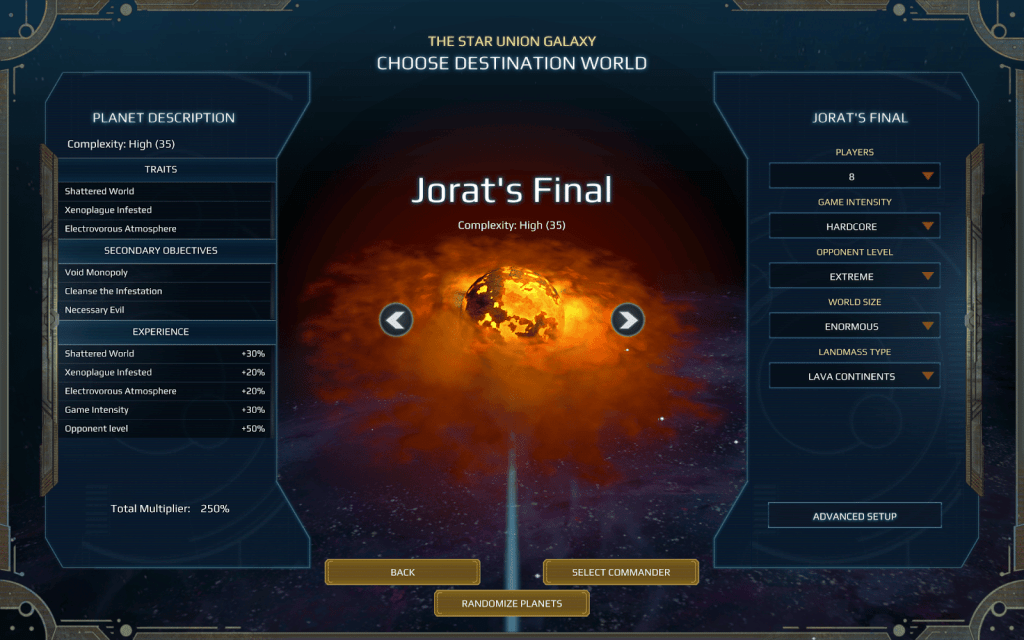
Now, I will be the first to point out that Empire mode is not really balanced. It doesn’t take long for the player to become incredibly overpowered and there is not much the game can do to challenge your superiority. But, the idea is commendable and Empire gives a satisfying sense of progress and cohesion between maps. If better balanced in the future, it will certainly be the mode I will be playing most frequently in AoW4. It provides another layer of build theory crafting and planning, where you can play not only with what your race, secret tech, and possibly NPC factions present on the map give you but also what you brought with you to this world from previous exploits, from different races, previous classes, etc. The possibilities seem endless, as long as there are some constraints to it all, and you don’t end up dominating the AI so easily that the game becomes boring.
One minor note here, I would really like the map options in a hypothetical Empire mode equivalent in AoW4 to be a bit more open to player choice. Too often in AoW:P’s Empire mode, I felt that the game ended way too soon because I could not disable the Domination victory condition or felt annoyed that I could not set the maximum possible heroes you can recruit to something higher than the default since that is how some people enjoy playing. If you can do that in normal random maps, why not in Empire mode?
Tech Trees
In both games (and virtually all 4X), you have to research new units, spells, and empire bonuses. Yet static tech trees, like those found in the Civilization series, are a puzzle that, once solved, lead to stiff and repetitive gameplay loops where you take the same optimized routes through the tech tree every game, depending on the faction or victory condition you are going for. This is another area where the two games we are looking at seem to take opposing routes: where AoW3 had a spell book system that presented a semi-randomized selection of spells to research, AoW:P went with two different, but static and visible from the start, tech trees for military and economic research.

Both approaches have their pros and cons, but when you can reliably and predictably research your preferred technologies and (more importantly), your units and spells, the game has the potential to become repetitive. A semi-randomized tech tree forces the player to adapt and use what he is given, at least until later on when he researches other, more powerful options. This also leads to more unique experiences from map to map, because you have access to different techs at different times, instead of always beelining x unit and y spell every single time. Needless to say, I would, at least, like to see an option for a form of randomisation in the tech trees in AoW4 (but keep the military and society technologies separated, that was a good call!)
That is not to say that the way AoW3 handled this is strictly superior, though. While the spell book research offering was semi-randomized, there were some well-defined rules in place governing how the system worked. The issue was that these rules were not communicated particularly well to the player, and the opacity around them led to some frustration and resentment when they felt that the randomizer prevented them from planning out their course through the game. It doesn’t matter if things are not really random if the player feels he has no real choice or control. This obviously needs to be fixed. Clear and transparent rules, and reasonable degrees of variance across them, should do the trick and provide a better experience than either the AoW3 or AoW:P system.
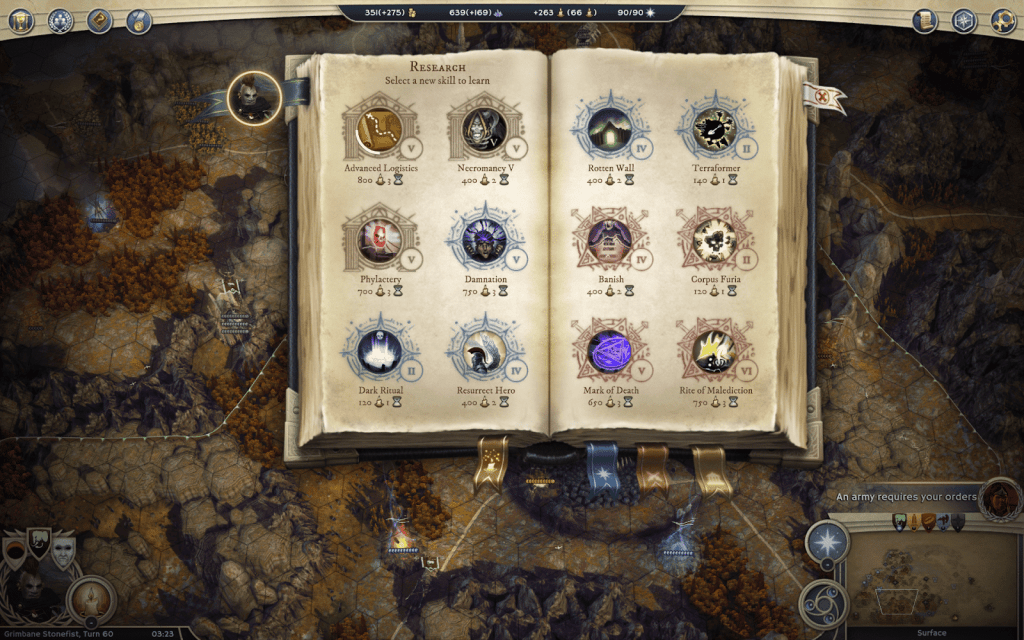
A final thing to keep in mind is that randomization of the tech tree can have serious ramifications in multiplayer mode. For this reason, I think there should be an option to toggle randomization on, or off. This is less than ideal, of course, as the game will have to be balanced around both modes. Let’s not kid ourselves here: this is likely to end up with the game balanced around a static tech-tree mode with the randomized option left as an afterthought. This is an unfortunate, but acceptable compromise, since properly integrated and balanced randomized tech trees are a huge pain to get right, and a massive drain on development time and resources, and thus very rarely attempted for this reason. I will always point to Sword of the Stars as a perfect example of how to do this. But something is better than nothing, in my opinion. Less solvable and more adaptive gameplay is a good thing.
Pop Management
This is going to be a short one, but very important, nonetheless. Please, for the love of all that is holy, remove population micromanagement! It was not a part of AoW3, and was introduced in AoW:P, but, in my opinion, was a huge step backward. This is an antiquated concept harking back to Master of Magic, a game from 1994 for those not familiar with it. It is a tedious and extremely boring system, where distinct population units, increasing in number as a city grows, are freely moved between resource production jobs, energy, production, and research. This, in theory, allows for more player agency, and the ability to make tradeoffs to advance their plans. Unfortunately, and in practice, optimizing your resource generation requires you to spend an unreasonable amount of time fiddling around with population assignments in each city, instead of actually playing the game.
An extra “pop” on production in a particular city lets me build this unit one turn faster but delays my tech for one turn because I removed that pop from research. So, I now have to find another city that can spare one pop to assign to research: if you shift the maximum pops allowed in this city to food it will grow one turn earlier, but I have to remember to switch it back once it does, and AAAAHHHH! The frustration! This is a micromanagement-heavy system that does not offer interesting and enjoyable gameplay. Instead, you have a nagging feeling of obligation to engage with it or resign to playing badly. Population management is a chore that you find yourself putting off, turn, after turn, until you eventually cave into the need to fix your pop allocation in each city. Why is this mechanic still showing up in 4X games? It scales up horribly as the game progresses and offers very little enjoyment in return. Please stop!
AoW4 could improve on this with a simple focus system, where you can focus a city on the production of a single resource, or a priority system that allows you to rank resources in order of importance. Anything but individual pop management!

NPC Dwellings and Influence
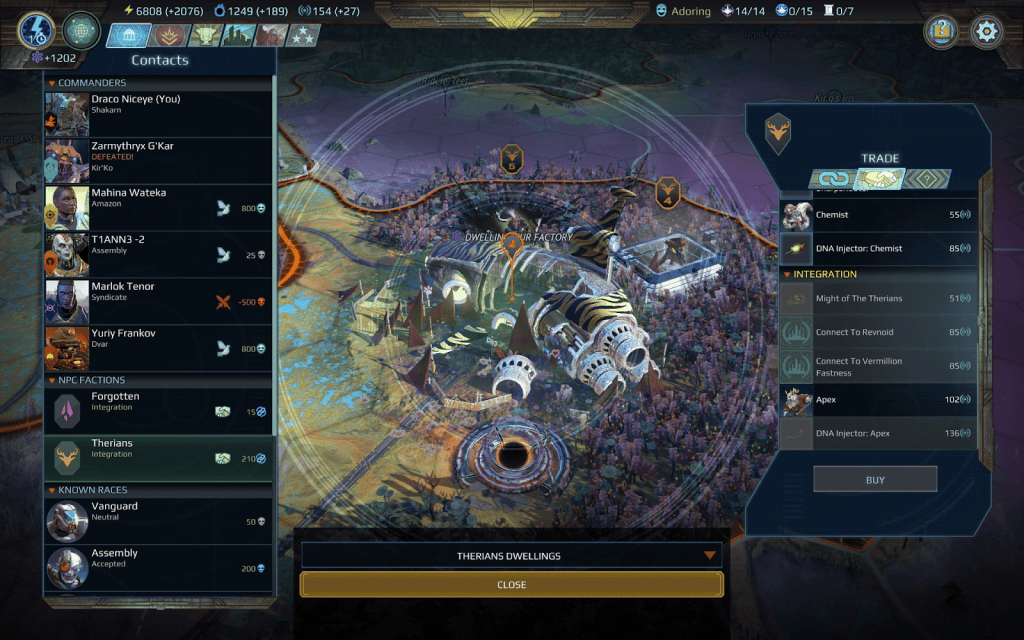
Both AoW3 and AoW:P feature NPC dwellings you can interact with and ultimately obtain units and other things from. In AoW3 you had to either conquer them or do quests for them to become friends. Once you are in control of them, one way or the other, you get to build some limited buildings and produce the units they provide you access to. Meanwhile, AoW:P takes a more hands-off approach. In contrast to AoW3, you do not get control of dwellings as cities if you conquer or assimilate them, instead, they become a (powerful) sector you can annex to one of your nearby cities. I like this idea much better than having an undefended city (more on this later!), quite possibly far from your territory, that’s very hard to protect.
You can still be friendly with, conquer, or even ignore NPC factions, but the pros and cons of each decision are different and have to be weighed with that particular NPC faction’s presence on the map. Armies of each dwelling are found occupying resource nodes, or the sectors themselves, throughout the map, and you have to decide if you want to go to war and destroy those armies to claim the area or bribe them to leave. Also, once you are friendly with them, you can instantly buy their unique units, unique mods, operations, and doctrines by spending influence points. Influence is gained from a few buildings in your capital, some rare nodes in sectors, and from completing the quests NPC factions give to you. You use influence to bribe NPC armies to leave resource nodes, convince neutral cities to join you, buy upgrades and bonuses from NPC dwellings, and for some specific units and operations.
This AoW:P system for NPC dwellings plays better, in my opinion, than the older AoW3 system does for a few reasons. The fact that NPCs camp on resources and sectors provides the player with choices on how to deal with each faction. You can go to war with the first faction you see to save on influence, or you may decide you really want to get some of their units, mods, or operations, and try to raise your relationship level with them as quickly as possible. You can fight them until you conquer them completely, while suffering the threat of increasingly more powerful armies attacking you until that happens, or clear them from your immediate area and then sue for peace. The player can plan out their tech research and future armies with specific mods they provide in mind, or ignore them completely and focus on what their own race and class provide.
Influence is a great system that provides opportunities that each come with costs. The greatly expanded benefits of being friends with NPC dwellings offer an additional layer of, and possibilities for, build variety. Importantly, NPC factions can provide access to mods for damage channels your race doesn’t have by itself, or for unit types that are naturally very limited as to what mods they can take. They can also provide extra military strength based on a different resource than those used for standard unit production, be that Influence to buy them instantly, or the turns spent with an army to complete a quest with units as its reward. Managing how you spend your influence adds a strategic consideration to the game, further enriching the strategic layer.
Furthermore, this offers opportunities for more racial differentiation. The Syndicate has higher influence production capabilities, for example, and can use that to play a heavily NPC-oriented game. The exclusive units, mods, and operations offered by NPCs add to both the strategic and tactical layers. This system is better and feels more interesting than just owning yet another extra city, just like your own but worse, and slower to build up. All in all, the way AoW:P handles NPC factions is a good system that can be ported straight over to AoW4 without much alteration.
Spells and Operations
In both games, spells (called operations in AoW:P but I’ll just call them all “spells” from now on for simplicity) play a prominent role. There are two broad groups of spells: those used in combat, and those used outside of combat on the strategic map. There is a finite, but upgradeable, allowance of spell points you can use each turn, which limits how many spells you can cast, in addition to normal resource costs. AoW:P introduced the splitting of spell points into separate pools for tactical and strategic spells. This is definitely something that needs to be carried over to future games in the series since having one unified pool feels too limiting. The freedom to use your combat allowance without impacting your strategic options allows some leeway in taking harder fights or defending against stronger attacks.
More importantly, though, there has to be some rework of strategic spells. Currently, in AoW:P, offensive strategic spells feel boring and uninspired. They are all variations of “do 20% of HP damage, plus x effect if the target fails a resistance check”. In both games, there are spells with continuous effects and they follow one of two common dichotomies: they are either too oppressive if they can (too easily) remain active permanently, or feel pointless if they can be trivially dispelled. Or, they have a relatively small chance of having a meaningful effect, and a greater chance of just failing, causing some minor effect of limited value.
I am not sure what the best way to go might be, but having a big, dramatic game-changing spell cast only for the opponent to instantly dispel it for a fraction of the cost, or for it to outright fail because it only has a 15% chance to succeed feels bad, and dissuades the player from wanting to try. This rework and rebalancing can hopefully bring back some of the more dramatic strategic spells from AoW3.
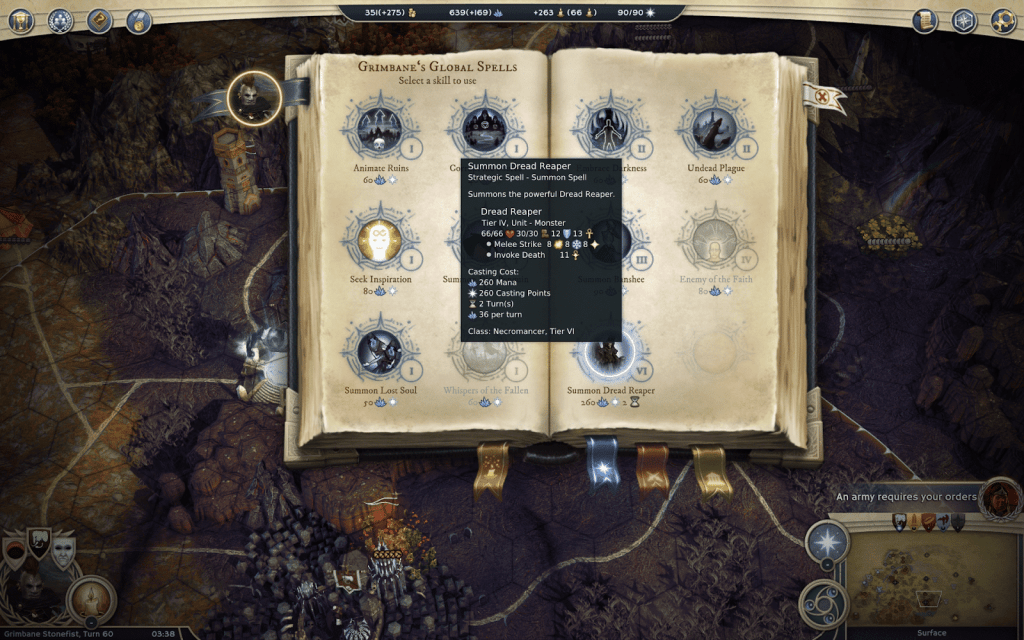
AoW:P, interestingly enough, introduced us to a new system for strategic spells called the doctrine system. Flavor and theme aside, this is essentially a limited and upgradeable slot system for empire-wide buffs that the opponents cannot really interact with. This would be great to see in AoW4 too as it feels good to secure buffs that you don’t have to keep recasting. The doctrine system also offers more choice on the strategic layer of the game because doctrine slots are limited and you have to decide how to use those precious slots, what techs to research for new doctrines, and which NPCs to befriend for their doctrines (or the fantasy-themed equivalent for AoW4). It also provides a new layer of racial distinction that does not rely on your opponent’s permission. And let’s face it, a race that has a doctrine that makes your eyes go wide when you read its effects is a good feeling. It feels fun, and it makes you want to keep playing to try that out for yourself.
Victory Conditions
In general, both AoW3 and AoW:P do a good job of having variety in the possible victory conditions you can work your way toward. In the transition to the sci-fi entry though, the series lost an important one from its third entry: the Seals victory. The AoW:P analogue, the doomsday victory, is really an entirely different beast and does not provide the same fiercely contested hotspots, well removed from player starting positions. Doomsday is the turtle fanatic’s victory because you never have to leave your territory to pursue it. Seals, on the other hand, force you to go out, explore the map to find them, stake your claim to them, and defend them from the other empires that want to do the same. This is no mere minor difference: initiating the Seals victory countdown differs in that you have to get out of your homelands and out into the world, preventing your opponent from winning is different because you have to actually strike deep into the opponent’s territory to Doomsday victory. Seals definitely had a dynamic of their own, since you knew where to concentrate your forces for both pursuing victories, and denying it to your opponents, as did everyone else on the map!
Keeping with AoW tradition, victory conditions should remain toggleable in custom maps, and hopefully in Empire mode. This lets you customize your experience more to your play style. Not everyone likes playing huge sprawling maps with easy victory conditions like Domination (control x% of all land) turned off to facilitate longer games. Similarly, not everyone likes smaller maps with a “knife fight in a phone booth” feel to them. The victory conditions system should help facilitate players according to how each player wants their game to play.
Furthermore, in 4X tradition, the omnipresent matter of the endgame mop-up can become a chore, where you have effectively already won, but have to actually play it out until the specific victory condition you are pursuing is triggered. Having varied and toggleable victory conditions are one way to help limit this potentially dull phase of a game.
Map Traveling or Forward Bases and Outposts
Speaking of dull, do you know what is not fun? Spending ten turns moving your armies around and clicking “end turn”, only to have to do it again five turns later. Moving around the map at a reasonable pace is important for any game that, at least, pretends to respect the player’s time. Both games offered ways to speed things up, with AoW:P having the edge here. In both games, you can build outposts (or forward bases) in faraway lands that are not connected to one of your cities. In AoW:P, you also have the option to specialize one of your city sectors into a relay, an option that also exists for outposts!
Relays provide instant travel to any other relay you control on the map, with a per-turn usage limit. Did you spend so many turns slogging around the map to conquer your western neighbor, only to dread having to spend double that number to move them all back to have a word with your eastern one? Just use relays! You can use them both offensively, by building an outpost and upgrading it to a relay near enemy lands, and defensively, to relocate your homeland defense forces to promptly respond to enemy incursions. It significantly speeds up the game and makes you less hesitant to move your armies away in fear of being attacked. AoW4 could easily adopt this feature, calling them gates or teleport circles or whatever the developers think thematically appropriate.

There is another feature that speeds up map travel though, and this one is present in both games: roads. Each game tackles it a bit differently, and I am not sure which method is better. In AoW3 you hand-build roads with worker units, whereas in AoW:P, when you annex a sector the game automatically builds roads and tries to connect them to your city. Hand-building roads can be tedious, especially if it has to be done hex-by-hex due to budget constraints, but offers slightly more agency than the newer system in AoW:P. I think they could fuse the two systems, where you get automatic roads when you annex sectors, but also have the option to build them out of your territories using a worker, possibly spending some resources to do so.
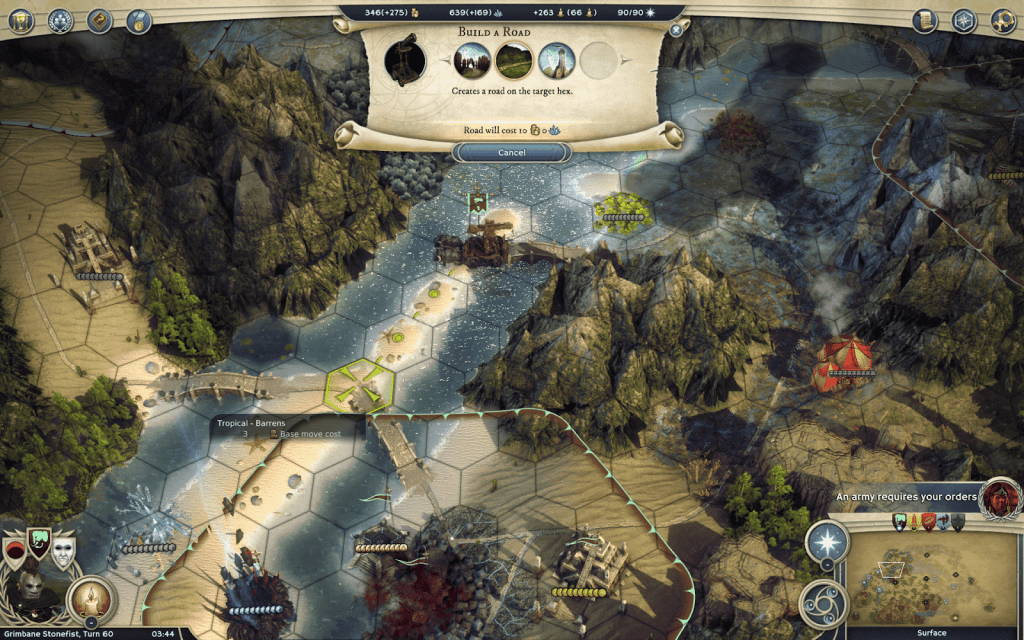
Finally, I think there should be a way to claim some resources without having to settle nearby, and an upgrade to an outpost near them is a good way to do this. This can help cut down city spam, which in turn helps reduce micromanagement. You will build cities more strategically and claim other resources with outposts, without having to settle yet another city that will do nothing but produce income. There is a balance to be struck here.
Heroes and Commanders
As mentioned above, when creating your commander you select a race and class combination. After that though, the two games we’re discussing follow different philosophies. In AoW3 you then proceed to select 3 specializations from various possibilities like elemental magic basic and advanced specializations, alignment ones, or strategic focused options. In contrast, AoW:P offers you an option in each of four different perk fields: commander background, colony bonus, starting commander gear, and a negative trait to get bonus points to spend on the previous 3. Where’s the contrast you might ask? The answer is, the specializations system feels like it has more long-term ramifications, while the AoW:P perk system has, for the most part, a more immediate early game impact. Two AoW3 commanders with the same race/class combo, but different specializations, feel a lot more distinct than two AoW:P commanders with the same race and secret tech combo but different perks. As most players are fans of replayability and interesting variety in gameplay, I strongly believe that AoW4 could do well with a fusion of these two systems so you can have options for both how your initial game plays out, and long-term goals to include in your plans while having more gameplay diversity between combinations.

Next, let’s look at the hero inventory system. Again both games seem to diverge, with AoW3 having an almost unlimited capacity for things to carry and use in combat, while Planetfall gives you a strict one main item and one sidearm slot (plus mods). And while restriction breeds creativity and interesting choices instead of just slapping everything on, there is certainly room for a bit bigger allowance to equip things without going all-out with a limitless equipping capacity. For example, you could have a different slot for mounts, another slot for hero exclusive mods, and the normal mod slots every unit gets. This would create a bit more variety in load-outs for hero units. You could even have class-restricted items for even greater diversity!
Mounts for heroes is an area where Planetfall tried to innovate but the execution leaves something to be desired. You can either equip a weapon in your primary slot, or a vehicle (in essence, the sci-fi equivalent of mounts). In practice, however, this is often a no-brainer choice. In most cases vehicles are the clear-cut best option, giving you both offensive and defensive bonuses and adding extra abilities. And while they require an investment of points when a hero levels up, the returns are, in most cases, well worth it. Some race/class combinations can do very well on foot if you happen to find one of the great weapons some sites can drop, but this is up to the RNG gods. So AoW4 can definitely make mounts more interesting than AoW3 but not as strong as AoW:P.
Quality of Life and Other Minor Issues
Let’s briefly cover some additional things that AoW4 would benefit from taking or changing from the previous two games. For starters, the undo button in tactical combat is a godsend. Mis-clicks happen, that is a fact, and being able to undo your mistake of clicking next to your target instead of on top of it is the difference between having your squishy ranged unit move right next to that scary big melee monster instead of shooting it. This is a no-brainer quality-of-life feature AoW:P gave us and should absolutely be included in AoW4. Moving on, AoW:P featured higher quality visuals than its predecessor but the world map can sometimes be hard to read. It is particularly egregious in the case of pickups; they are extremely easy to miss. AoW4 could improve matters with an icon overlay (toggleable) that points out features on the map. Another great little new feature in AoW:P is the ability to prime various spells and just keep them primed (a single instance of each particular one) until you choose to cast them at a later turn. This is a great feature I feel AoW should keep.
Yet another new feature is the ability to retry a combat that didn’t go how you wanted, even if the first attempt used auto-resolve. This little feature is amazing. Throughout a game of AoW you will probably fight dozens of battles, not all of which are important. You have the option to auto-resolve the easy fights, and save a considerable amount of time. The retry button allows you to give auto-resolve a chance in even harder fights and just retry the combat manually if the AI completely blunders it. This is a great timesaving feature because it’s quick and easy to try automatic combat without constantly saving and reloading the game.
A new important small mechanic is the upgradeable garrisons for cities. AoW:P is less frustrating and tedious because your cities have a fighting chance without having to keep armies around. This means that not just any old little unit can capture a city uncontested. Plus, the city garrison gets automatically replenished next turn if some units die. This saves a lot of micromanagement and is definitely a feature to keep moving forward.
Less important (but fun for us min/maxers and OCD gamers), were the veteran levels in AoW3, which were removed in AoW:P. It feels a lot better when your units keep improving after reaching max level, even if a tiny bit, instead of all those XP points going to waste. This feature, however, has big ramifications in multiplayer, so if brought back it should definitely be a toggleable option.
Something I expect will work as it should in AoW4 is the removal of the chances to outright miss an attack. AoW:P has a significantly greater focus on ranged combat, and the graze-and-miss system was put in place to keep the balance between ranged and melee. If AoW4 is, as expected, more melee-heavy, we can safely remove this mechanic completely. An attack that does nothing feels bad!

Finally, another minor thing is the innovative map types presented to us exclusively in the empire mode of AoW:P. Shattered void sectors, lava seas, worlds with a turbulent wind that penalize fliers, the list goes on. There were a lot of good ideas locked behind empire mode that could be brought over and made more freely available.
New Features and More Radical Ideas
I know that many players have been asking for a skirmish mode, where you set up a battle and just play it out without a strategic layer attached. There are two ways to go about it. First, a more involved system with units mods and spells assigned a points cost, and players agreeing beforehand on a specific point allowance to build armies with. A second option would be a much simpler system to just set up a combat scenario with a combination of any units, mods, battle-wide effects, and so on. If played in multiplayer mode, it would be up to the players to agree on what to bring. The first option is preferable, but would understandably be a much bigger undertaking and require a ton of development time to balance and assign point costs to every single thing. So realistically, the second option is probably better and most players would be happy to have it. Combat in the AoW series is not only the focus but also so much fun! The ability to engage in one-off combat is great for time-limited players, testing unit compositions and loadouts versus particular scenarios and challenges, and easily testing their viability in auto-resolved combat which is a big part of multiplayer matches. Plus, some people are here just for the tactical combat system and merely tolerate the strategic layer.
Another major new feature that I believe could be a lot of fun is a new game mode more focused on the PvE aspects of the game, fighting more against the map than other players (human or AI). In this mode, heroes would play a more prominent role, giving us, in essence, a pseudo-RPG-like experience. Clearing sites, exploring the map, tackling strong armies, and discovering anomalies was a lot of fun and, with a more interactive world map (like how some anomalies transform sectors), it could be a fresh and exciting take on the game. I fondly remember how fun the PvE experience was in Fallen Enchantress: Legendary Heroes, and that served as an inspiration for this proposed mode. Plus, I know at least some players will appreciate the ability to play at their own pace without time pressure from competing AIs.
This brings me to a more controversial point I want to make. I strongly feel the campaigns in both games are their weakest points. They take a lot of development time away from other features and balance passes and provide content that I know a lot of players do not even bother with at all. The issue here is that a campaign mode with a story is simply expected from games like this, and the series has always presented us with a background story and an advancing plot. So if the campaigns absolutely must remain, they could do with some improvements like presenting a different kind of gameplay than the random maps or empire mode. Maybe taking cues from the previously discussed PvE mode, which I believe is conducive to more scripted and plot-heavy gameplay.
Another thing I would like to see improved and fleshed out in AoW4 is the levels of interaction with the world map. I am talking about big powerful terraforming spells or abilities, like how Frostlings slowly turned the world into snow in AoW3, or even more radical versions of the terraforming sector spells, like being able to flood a sector, or raise the land and make land bridges in aquatic sectors. Maybe the player’s choices could have an impact on the climate, sea levels, and the map in general similar to the way Civ VI does this, but hopefully with more impact than that game ever manages. I always loved it when I was presented with such possibilities to make a bigger splash on the world map in strategy games: it makes the game world feel more alive and dynamic.
And finally, one last thing that would be nice to have, but not strictly necessary, is a more user-friendly modding system (not to be confused with unit mods!). Mods have been a positive force in gaming for many years now, and both AoW3 and AoW:P have a plethora of interesting mods to try out, even balancing mods and unofficial patches that extend the life of those games and keep the multiplayer scene alive. The tools we were given in both games were, as I understand them, the tools the developers used themselves. This means that they were really powerful, but not particularly friendly, to new users. The modding scene would certainly appreciate any improvements in this area.
Final Thoughts
So, whatever the initial state Age of Wonders 4 releases in (which if past releases are any indication will be great), you can be sure it will steadily improve and get more content. Will it include everything we have discussed here? No, probably not. But we already have confirmation that they are considering implementing sectors, unit modding, combat retry, and auto-explore as a baseline. After that, we will have to wait and see. And waiting is the hard part!
Please Take a Moment to Consider Supporting Us
4X, strategy, and tactics fans, we hope you’ve enjoyed this article. As you may know, eXplorminate has sworn allegiance against ads and ad money in order to provide a better reading experience for you and to avoid any possible influence or pressure that we might get from those willing to advertise their games on our site.
We hope that you’ve enjoyed what we do here enough to consider supporting our Patreon, which provides us the funds we need to pay our fantastic authors what they’ve earned and the funds to keep the lights on here at eXplorminate. Consider pledging here:

If you’d rather not use Patreon, we also accept One-Time, Monthly, and Yearly support through Stripe here: