With Eldritch Realms already on the horizon and even more premium DLC confirmed after that (a second season of DLC is a first for the series!), let’s look back at the Wolf and Primal Fury era.
Hungry Like the Wolf
Well known for being the sickest animal to have painted on the side of your van, Wolf is also the name of the latest Age of Wonders 4 (AoW4) content patch because research shows decimals are confusing. It’s probably better to hand out goofy names because Triumph’s versioning mathematically seems like barely any progress has been made (Wolf is “only” 1.006). This is certainly not the case.

Triumph listed five “highlights” for this patch. How’d they pan out?
Mutiny on the Bounties
“Bounties” was a brand new feature added in Wolf whose purpose is to essentially paint targets for other rulers, not just vassal cities. In short, you’re shown a list of potential targets and may choose one, then choose to offer a small, moderate, or great reward in either gold or mana.
On creation, the Bounty is given a time limit and offered to all eligible rulers in the game. Other rulers may then decide to either accept the bounty or ignore it – neither is binding nor must a bounty necessarily be accepted to be completed. From the human player’s point of view, accepting one just adds it to your quest tracker. If an AI ruler accepts your bounty, they will let you know and offer updates on how their progress is going.
There are no relation penalties involved with accepting, declining, or failing bounties. There are, however, regular relation penalties with anything you might do as part of a bounty. And here’s where the promise of the system sort of fell apart.
When I heard of this feature, I imagined a neutral faction of mercenaries and bounty hunters or perhaps a faction of evil war brokers that pull strings to cause wars and then profit off them. What about a group of “good” guys who struggle with the morality of honoring your word when it’s leading you to do something clearly wrong?
Well, none of those things were possible. Accepting and executing a bounty entails a formal declaration of war, and war in AoW4 is still typically to the death. There is no option to hide your faction’s involvement behind private mercenary forces or declare your faction as swords for hire and mitigate some of the diplomatic consequences.
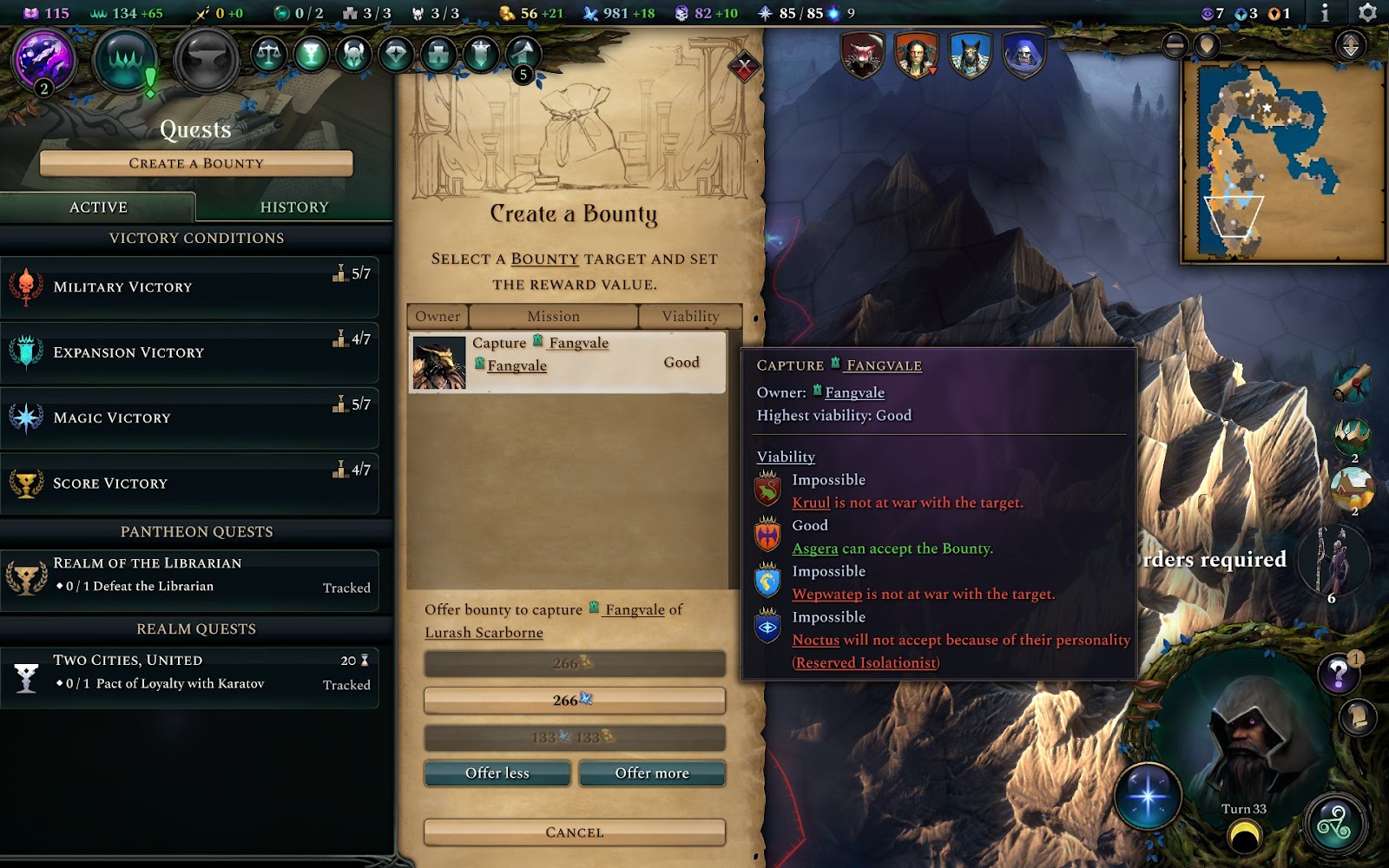
How about assigning bounties of your own? Well, this wound up weird, too. Though you will get bounties against targets you’re not at war with, it doesn’t work that way when creating new ones. To create a Bounty, both you and at least one other ruler need to be at war with the same target. So, there are no proxy wars, intrigue, or frenemy antics, nor can you hire someone to swat an isolated free city that woke up on the wrong side of the bed and instantly declared war on you at first sight.
Can you at least put a bounty on obnoxious lairs that occasionally raze an improvement, but you just can’t commit a dedicated force to destroy? Nope.
Ultimately, Bounties was an awkward, internally inconsistent version of the War Coordination system. Though touted as “ruler-created quests,” there weren’t any new opportunities for roleplaying or gameplay here.
Arise, My Champion
Did it ever feel like your Ascensions weren’t as potent as they used to be? Did you find yourself increasingly disinterested in joining Pantheons for fear of how your Godir partners might judge you? Ever wish you could feel Pantheon Level 18 again?

With Wolf, there was hope.
Ascension itself became fancier and got a dose of good old dopamine-inducing metaprogression. When a leader ascends, they are granted a choice of a variety of new “Ascension Traits” based on their affinities and tomes chosen in the game. These grant some special power to the leader, with the caveat that only one may be chosen at a time. However, if you ascend again with the same leader, you can choose to switch to a new one.
Additionally, Pantheon members will now carry their racial transformations forward with them from game to game. Note these transformations only apply to the leader unit itself – your entire faction won’t be starting the game with a Tier V transformation or anything drastic.
Transformations aren’t all that will be carried forward – now AoW4 will keep track of the Tomes you selected for your Godir. Later, if one of your Godir appears on a new map, it will use the same tomes you did.
Here at the tail end of Wolf, I’ve had mixed experiences with these changes.
Tome choice tracking was a great idea. Now your Godir will better reflect the theme you chose for them, or, if you’re more of a min-max player, you’re now equipping the AI with min-max choices. Essentially, both audiences moved more toward the kind of game they wanted to play: either roleplaying-centric or a more multiplayer-centric “play to win” approach.

I can’t say the same of the carry-forward transformations and Ascension Traits. While it’s a similar case to Tome tracking – in a way, you’re essentially equipping the AI to be as nasty as you were – I’m just not sold on it. It wound up feeling like power creep for its own sake.
What was unquestionably welcome was the healthy chunk of new stuff to unlock in the Pantheon tree – notably, six new mount types and a new culture trait. While all these additions are in the theme of the Primal DLC, it’s worth noting again that the DLC was not required for any of it. Honestly I’m surprised the mounts weren’t a part of the Primal Fury DLC, given they’re of equal quality to the existing mounts in the game. Triumph even added an additional high-quality Raptor mount for free, to celebrate the anniversary of the AOW4 release. Excellent work!
Wanna See a Dead Body?
Two long-standing problem areas had Triumph’s attention for Wolf: Necromancy and Heroes.
More than any other line of Tomes, Necromancy has generally been seen as clunky and unsatisfying, and it has gone through several changes, especially around the Souls system, since its launch. With Wolf, the goal was to make Necromancy feel less like just another Tome series (that is, a few different flavors of battle spells but mostly focused on synergies with a major transformation spell) and more into actually raising the dead (instead of just recruiting like them any other unit, but at the added cost of a tedious resource).

The result was a much more traditional Necromancer experience. You now roll across the map spending Souls to raise the fallen and build a skeletal army. Racial units of any Tier become Tier 1 skeletons of one of four types: Pikeman, Shieldsman, Archer, or Mage, with the slain unit converting to a skeleton of the closest type at a cost of 15 Souls. A Healer unit becomes a Mage, for instance.
Importantly, these Skeletons remain members of their original, living race, meaning you probably won’t have control over the biggest force multiplier: racial transformations. How about non-racial units like monsters or animals? Non-racial Tier 3 and 4 units can be raised as Tier 3 Bone Horrors for 50 Souls, and Tier 5 units can be raised as Tier 4 Bone Dragons for 100.
The other big notable change was to Soulbound – the once wimpy on-hit enchantment that grants you more Souls when something dies now actually had a combat application: if a target dies while Soulbound, there’s a 30% chance it will rise as a Decaying Zombie. You’ll still get the Souls bonus too, so it’s overall just a much more interesting effect.
And those were only the big, obvious, easily explained changes. There was a lot of Necromancy love this patch. For instance, the Necromancer unit appears much earlier now, and the Reaper has become much scarier.
But how does it play? Honestly, it’s overpowered. Based solely on tempo it’s almost impossible for it not to be: easily obtaining extra stacks of units in the field, even if they’re throwaway Tier 1s, puts you way ahead of the curve for clearing the map on anything except Ancient Wonders, and makes for an incredibly deadly rush. Even so, this is the first and only time Necromancy has felt satisfying in AoW4, so I can’t complain too much.
I (Maybe Don’t) Need a Hero
If you’ve played AoW4 for an appreciable amount of time before Wolf, you may have noticed two things about hero units: they easily become your strongest units by far, and you get a lot of them.
The inevitable result was “hero stacks” – jam a bunch of heroes into an army, fill out the gaps with support or just your beefiest units, and set them loose on the world. So far, so good – but there was a problem: AoW4 lacked the tools needed to counter this. Worse, your hero cap was tied to the number of cities you had, so as you grew stronger economically, you immediately grew stronger militarily as well.
So, Triumph set out to solve two problems: making heroes much less common so they feel special again and diminishing the omnipotence of hero stacks. This would need a two-pronged approach.
To make heroes less common, the hero cap is no longer tied to cities at all. Instead, it goes up on a steady basis every few turns, with the option to immediately buy a cap increase at an Imperium cost. The hero cap is also no longer a soft cap – it’s an absolute one. You will be unable to recruit new heroes past your current limit at all.
To diminish the power of hero stacks, a new mechanic was added: Leadership Clash. Keyword “was” – this feature was unceremoniously removed in the 1.2 update. With Leadership Clash, heroes would get a stacking morale and XP penalty for every additional hero in their party. To no one’s surprise, players hated the change – but what really twisted the knife was the rule simply not applying to the AI.
I’m a big fan of these changes. Ultimately these mean the choices you make in terms of culture, race traits, and tomes matter more than they did before, which is something AoW4 really struggled with at launch.
Overall, Wolf was certainly a net positive, even if Bounties turned out to be a dud. But how about the DLC?
Primal Fur(r)y
Let’s talk about the Primal Mammoth in the room. If you’ve ever browsed the new content in this pack, you probably saw the new forms: lupine and caprine. Of course “caprine” isn’t a word that’s used very often, so they went with “goatkin” instead.
If you look at the lupine form and just happen to be reminded of a certain subculture, you’re not alone. Fortunately, the community is more than happy to say the quiet part out loud: Primal Fury is lovingly referred to as the “furry expansion.” So no, it’s not just you.

Both of the forms were very well done from an artistic standpoint. You will almost certainly be satisfied if you want wolf or goat people. And if you didn’t really care about either, you won’t be offended by the quality. They fit in very well with the rest of the forms, though I’m glad Eldritch Realms is shaking things up and giving us insectoids instead of another mammal.
How Much is that Doggie in the Window?
The namesake Primal culture was the selling point of the content pack and, unlike other cultures, offers a spectrum of variants based on the animal spirit you choose to worship. The animal spirit you choose defines many aspects of your primal faction: your favored terrain, the special primal buff your culture units will trigger, and your second default point of affinity (Primal is always +1 Nature, then +1 of another depending on the animal you choose), the spirit animal that’s summoned by your support unit, the Primalist, and, in a nice touch, the visual appearance of the totem staff the Primalist uses.
If you skipped Primal Fury, let’s go through a quick example of creation and first turns:
Say you go Primal and pick the Tunneling Spider. This spirit animal grants +1 Shadow Affinity to go with the base +1 Nature from Primal, and defines your favored terrain as Mushroom Forest. Because of this, all our racial units will have no problem moving around underground, no additional movement cost in Mushroom Forests, and start with Excavation. This is essentially the same as the Underground Adaptation racial trait, so in order to select the Primal culture, your race must not have an Adaptation trait (as it would either clash or be redundant). Additionally, any annexed Mushroom Forest provinces will grant a Stability bonus to their city.
Every Primal unit – or, with the proper enchantment, almost every unit on your side – has the ability to gain a stacking buff called Rising Fury when hitting an enemy. Repeating attacks get 1 stack per hit; single attacks get 3 per hit. When a unit hits 5 stacks, the buff transforms into 5 stacks of Fury of the [Animal], which grants subsequent hits some kind of special effect, consuming one stack per hit. In our case, that’ll be Fury of the Tunneling Spider, and our buff grants our next 5 hits +3 Blight damage and Life Steal. It’s a simple build-then-spend mechanic – the depth comes in choosing which effect to utilize given the tomes you intend to use.
As promised we start underground in a Mushroom Forest – but with a curious bonus resource nearby: a lair of the primal spider. We’ll quickly get a quest to visit and annex it, where we learn annexing the temple will grant our city a healthy Stability bonus and, more interestingly, allow us to build a structure that steadily terraforms all provinces within 1 hex of our city to Mushroom Forests. If we rank our city up to 2 the terraforming radius also grows to 2 hexes, and so on.

Explore around, and you’ll rapidly find more of these locations. Your expansion efforts are thus strongly directed to these sites, as they can turn otherwise terrible terrain into a paradise for your people. It’d also be a great idea to secure these sites just to deny them if you’re not playing Primal.
Rank and File
Primal’s roster put an emphasis on mobility as well as utilizing Rising Fury in other ways than a simple buff – notably, summoning.
Primal’s Tier 1 contains a shield unit in the Protector and an archer in the Primal Darter. The Protector can choose to consume all stacks of Rising Fury to heal +5 Temporary HP per stack consumed, but is otherwise straightforward. The Darter has a “disengage” type ability, usable in melee, that causes them to leap back up to three hexes without provoking an attack of opportunity. This greatly increases their early survivability, though keep in mind they’re still only Tier 1 units.
Tier 2 brings the Primal Charger, a shock unit, and the Animist, Primal’s very important support unit. The Primal Charger is a non-mounted unit with a basic charge attack but also has “Charging Cleave,” which is a frontal cleaving attack that can hit up to three units. While it gets a damage bonus from movement like a charge, it does not break Defense/Retaliation like a true charge effect.
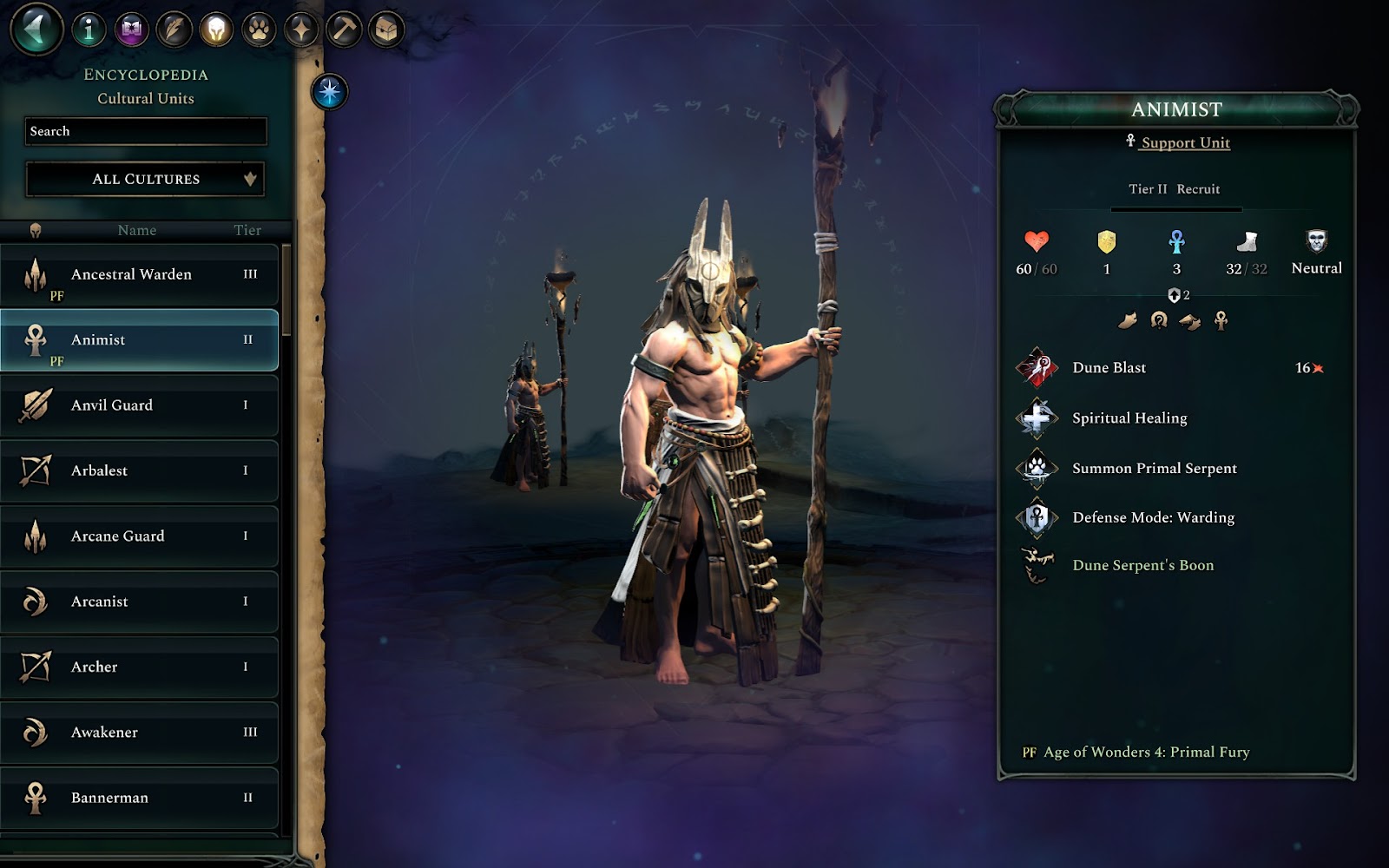
The Animist is be Primal’s bread and butter: not only does their basic heal also grant three stacks of Rising Fury (as well as healing the typical +20 Temporary HP), but when the Animist itself achieves animal fury, they can spend all stacks of it to summon an avatar of their spirit animal patron. These units are useful in almost any situation, always have their animal fury buff active, and generate hexes of Mist where they’re standing, a new effect that grants stacking evade to those standing in it. Don’t worry, we’ll go into more detail about Mist when we talk about the new Tomes.
The sole Tier 3 unit is Primal’s only Polearm unit: the Ancestral Warden. These units are tougher than anything else at Tier 3, save for Industrial’s Bastion, making them hard counters to the bevy of cavalry at Tier 3 – which is good, because you have no cavalry of your own without racial traits. The Warden’s special ability is a range-3 vaulting leap, which damages all surrounding units on landing and, to add insult to injury, then immediately enters defense mode.
So what was the verdict on the new units and the Rising Fury mechanic? Opinions seemed to be mixed. Primal has what might be my favorite Tier 3 unit, but it also feels dangerously close to Barbarian at times. The ability to choose your own terrain, buff, and spirit animal to summon is great, but Rising Fury is an uninspired mechanic that lacks identity and, outside of the Animist’s summon, a sense of real impact. You won’t really be doing anything special or changing up your strategy for Rising Fury: you just hit stuff and, in the process, get better at hitting stuff. Effective but not interesting.
Taken by a Fey Mood
Primal Fury brought two new tomes: Tome of Fey Mists and Tome of the Stormborne, both Nature/Water hybrids. Each comes with serious limitations, some more annoying than others.
Fey Mists is a Tier 2 tome that primarily revolves around a new mechanic called “Mist” with a side of random buffs and debuffs. Mist is a cloud of fog on the battleground that grants a stacking buff called “Clinging Mists” as long as a unit ends their turn on it. Each stack of Clinging Mists reduces that unit’s chance to be hit by any kind of attack by 20%, up to three stacks. The basic gimmick is to put Mist on the battlefield and then hide in it as a powerful form of mitigation.
Of course, your opponent can and will take cover in Mist clouds, too, granting them the exact same buff, but the Tome has an answer to that: a minor race transformation called Feytouched, which does two fancy things: gain a random buff when ending your turn in mist or in cover, and ignore the accuracy penalty from the “Clinging Mists” effect.
Did you miss the limitation? Read the Feytouched bit again. It grants a race Feytouched, not unit types. So, if you’re utilizing non-racial units, Mist buffs your opponent as much as it buffs you.

The “big” spell in Fey Mists turns a province Misty for a few turns – which means battles in the province have patches of Mist splattered across the field. When I hit the point where I’m using fewer and fewer racial units – a pretty typical mid-to-late game occurrence in AoW4 – I eventually stop using this spell entirely, resorting to the highly localized, extremely controlled version instead.
That said, it’s a Tier 2 tome. It’s not the end of the world if it ultimately goes obsolete. The problem I had was it feels bad to use, especially when you whiff the fourth attack in a row against a Dark Rider on your flank since you made the mistake of using the spell you yourself researched.
Any Port in a Storm
The ocean-oriented Tome of the Stormborne, available at Tier 4, was the other new tome, and while it’s good, it’s also more situational. If your empire is coastal, or at least on a water-heavy map, you should take a serious look at Stormborne: two of six types of research – the economic boosts – scale with the number of coastal improvements you have but do nothing outside of coastal provinces. And a third, potent province-targeted battle spell can’t be used underground at all.
There are four big themes in Stormborne: the aforementioned coastal economic focus, the Naga transformation, the Wet status effect, and Lightning damage – notably, chain lightning.
The Naga transformation forms a backbone for further synergy exploitation, but on its own, it’s still pretty good: every member of the race gains Fast Movement, Amphibious, Slip Away, Immunity to Electrified, and +2 Blight and Electricity resistance. Do note that having a half-snake body means mounted units no longer actually ride mounts (but for other purposes, they still count as mounted, like, say, for Cavalry Slayer), and for heroes, it means the shoe and mount slots become unusable.
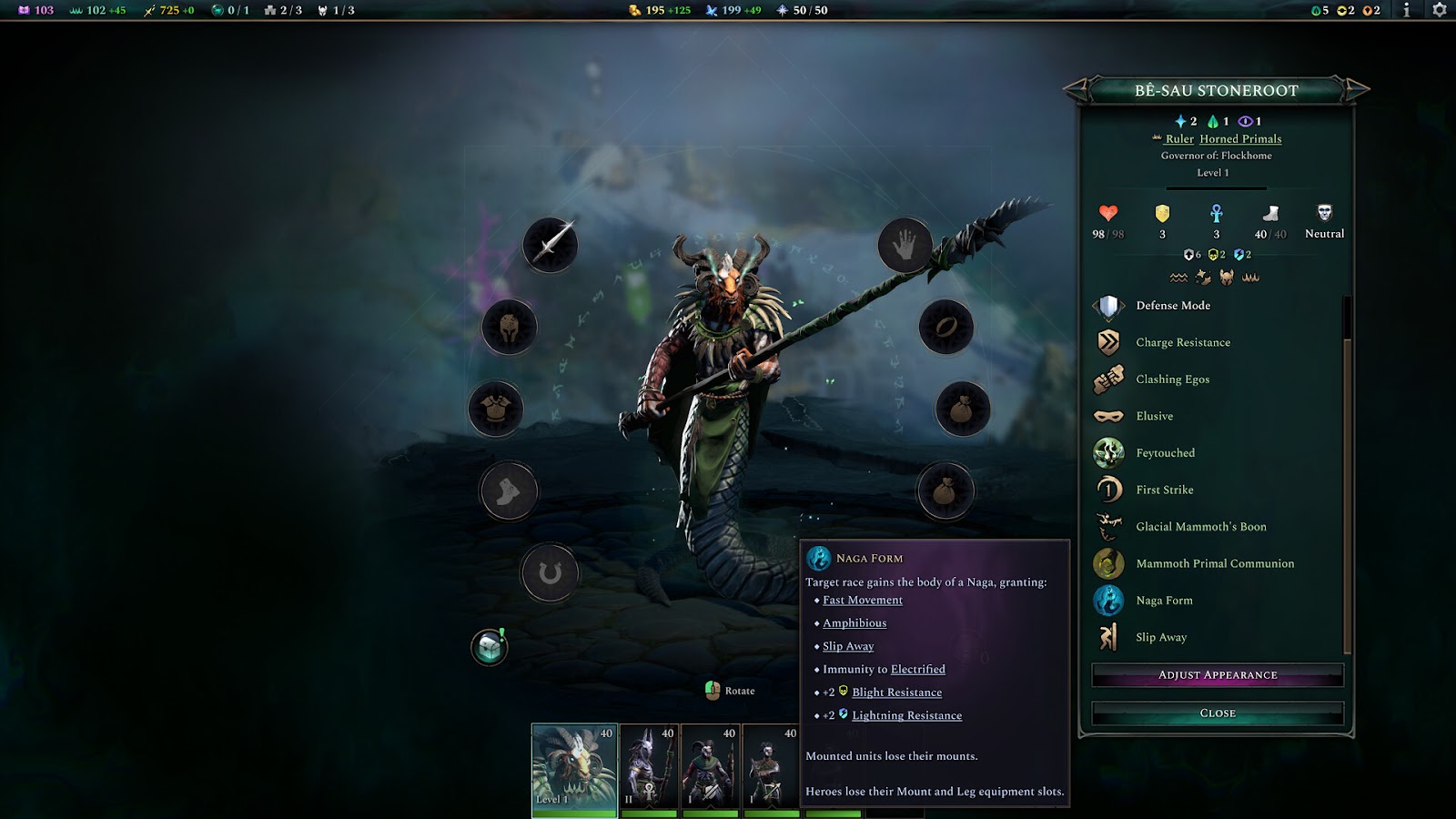
Making a large chunk of your forces much faster and potentially opening up new avenues of attack is great on its own, and Slip Away will make them extremely annoying to kill (bonus points if you pair it with other “nah, I don’t think I’ll die” abilities in Light or Shadow). But the Naga transformation really comes to its own with Downpour, the province enchantment that does what it says on the label.
Casting Downpour results in torrential rain that turns a province into a Swamp. If a battle occurs in the province during Downpour, all units in the battle gain the Wet and Slowed status effects – unless, as you may have guessed, you’re Amphibious or have natural Water Movement, in which case you ignore both. Fighting Naga on a swamp map is dangerous enough, but fighting them while also Wet and Slow? I hope you brought some Cold damage.
Finally, the lightning damage aspect of the Tome comes with a traditional Call Lightning, or Storm-type spells for battle, as well as the Tier 4 Stormbringer, a racial Skirmisher with an arcing hybrid lightning melee attack and a high-damage hybrid lightning ranged line attack.
Though the usefulness of the Tome of the Stormborne is throttled by the amount of water on the map and whether your big fights will be above or below ground, it’s still an overall excellent Tome and a worthy addition to Tier 4. This one turned out to be a proven winner when applicable.
Wrap It Up
Wolf was the first time in AoW4 that I’ve felt like the game respected me as a player enough to not separate every single choice into tiny modular pieces, and it’s so much richer and more satisfying for it. Creativity and memorable gameplay is not found in boundless options for expression, it’s found in tightly restricted situations where choosing one thing means sacrificing six others.
But did it bring AoW4 to the lofty heights of end-of-life Planetfall, or AoW3, or Shadow Magic? Just asking that question makes me feel like a kid in the backseat while driving on a family vacation because the question is also the answer: No, of course, we’re not there yet. But from what’s been revealed about Eldritch Realms thus far, AoW4 finally ascending to Triumph’s pantheon might be as early as the next exit.