Age of Wonders 4 (Steam Link), developed by Triumph Studios and published by Paradox, is a modernized fantasy 4X game of dramatic size and scope, long unafraid to skew from genre tropes and that stands out from competitors with compelling battles and distinct playable factions, a hallmark of the series right from its very first title.
Some have described AoW4 as “XCOM meets Civilization.” This might please some of you and, if so, you’ll be even happier to note that it’s an accurate description. It’s a fun game and I would be happy to recommend it to almost anybody. But it’s not a perfect game and, in some aspects, it fails to step out of the shadow of its predecessors. This review will focus on what the experience will be like for players returning to the series.
EDITOR’S NOTE: Those of you new to the Age of Wonders series should take heed: if you like fantasy settings (and even maybe if you don’t) and enjoy well-made and polished 4X games, you’re going to like Age of Wonders 4. Full Stop. Returning players should read on if you haven’t already taken the plunge.
Also note, there are two different writers’ perspectives here. At the bottom of this review, you’ll find Rob’s opinion on AoW4. The rest is covered by an anonymous contributor with hundreds, if not thousands, of hours in the Age of Wonders series and over 400 hours with Age of Wonders 4. We’ll let you figure out how they’ve managed to acquire that amount of gameplay time…
On to the review:
If you’ve played previous games, you will have noticed how each new game in the series is not a mere iteration of the original (except for AoW2 to Age of Wonders: Shadow Magic), and kudos to Triumph for trying to keep things fresh. AoW4 is not a straight upgrade from the previous game Age of Wonders 3 either.
The history of AoW can be divided into three phases, with the original game (Phase 1) then AoW2 and Shadow Magic (Phase 2), and then AoW3 and AoW: Planetfall making up the final one.
The Phase 3 games share a similar player-choice-focused design philosophy of de-linking your faction from genre tropes and alignment (so orcs are no longer always evil) and instead make them modular (a dwarf and a goblin can both hold the Sorcerer class, while Planetfall’s Vanguard and Syndicate can both be Psynumbra).
This is important to understand when you approach AoW4 and realize that for all the claims of revolutionary choice regarding customization, Triumph is throwing the same ingredients into the pot, with a slightly different recipe. Let’s examine this in a series of steps. There are steps forward, where the game has improved on the previous titles. Sidesteps, where mechanics and features are unchanged or where their alteration has no real effect on the quality of gameplay compared to before. Finally, there are steps backward, where things work out worse overall. It is rare that anything is wholly better or worse, and even the things I dislike do have some redeeming features.
The good news is that the end result adds quite a bit of gaming goodness.
In each iteration of the series, entire mechanics get jettisoned, replaced, and moved sideways. Thus, I am not beholden to any particular mechanic, and care instead whether it is as fun, thought-provoking and interesting (or more so) as the thing it replaces. To that end, this review is quite heavy on the mechanics and feel, with a liberal amount of comparison to previous games.
Let’s start with arguably the most controversial change:
Faction Creation
The old races such as Dwarf, Elf, and Orc are now Forms. Forms are like skins (an in-game model) and Dwarf is now Dwarfkin, in an attempt to sever the link those old racial terms had to the previous game. This has caused some concern because, in the previous two titles, part of the fun to be had was the synergy gained from combining a race with a Class (or Secret Tech in AoW: Planetfall) and players feared this would be done away with.
The player now picks a culture at the game’s start and modifying factors previously covered as Class/Secret Tech are added in piecemeal fashion over the course of a campaign. The new faction creation system is very Instagram-able, meme-able, and flashy, and supposedly lets you create anything. However, while on paper there are many choices, in reality, you are effectively customizing six cultures and then building on them as the game goes on.
It is worth mentioning that this is not a bad system inherently, and I am not particularly committed to any one system. So the question is, does this new system provide the player with something as interesting and mentally stimulating as the previous one?
Sadly, the answer is no, not quite. However, the new system does occasionally provide some interesting choices, mostly in the society traits and, to a lesser extent, in the cultures. The latter are actually quite well-defined and I think the quality here is slightly better overall than an AoW3 race at release (but worse than where the races were at the end of the game’s development cycle after patching and DLC). For reference, at release, AoW3 races were heavily criticized for being inconsequential to gameplay, and it does make me curious why they returned to an arguably worse system.
*MATH SECTION REMOVED*
So, on the plus side, faction creation is fun, looks interesting and pretty, and will be easy to market to players with its promise of a plethora of choices for each play-through. Also, we get the novelty of the usually gluttonous Halflings cosplaying as cannibals! The downside is that these choices are less meaningful and lack the synergies of the previous Age of Wonders games. Forms are essentially just costumes and entirely cosmetic. This a missed opportunity to inject the game with some genuine faction asymmetry, such as the possibility for Moles to burrow in combat, for example. Ultimately, Triumph have presented the player with a strange halfway world that lies somewhere between a bona fide faction creator that is not merely cosmetic, and has pre-set factions with their own solid identity, strengths, and weaknesses.
I think the game needs either a full-blown race creator or for the races to be more strictly defined and not just a cosmetic option. This “you can do everything and anything” approach lends the game a muddy and disconnected feeling, with various in-game systems that are arguably fine on their own never quite managing to gel together as a consequence. This is a prettier system, but it results in less actual content than the games that came before.
Cultures
Put simply, Cultures are the new Race. The game gets a bit confusing as it uses ‘race’ to mean the end result of your creation efforts up to the point before you pick your starting tome. Crucially, you can see that the same paradigm as AoW3 (Race and Class) and Planetfall (Race and Secret Tech) is still here.
After what I wrote about faction creation in general, you’d expect me to dislike this intensely. The truth is, I quite like the cultures. There are six of them and they are very distinct from one another. If anything, I think they play too minor a role and they should be expanded to take up more space in the game, thus providing a more coherent, central system for the other game mechanics, Tomes specifically, to hang off.
In the current state of the game, Cultures function well on their own, as do Forms and Tomes, each existing as separate entities to enhance the player’s repertoire of tools. However, the core elements of the game, which revolve around combining and blending, don’t actually integrate with one another. This is ironic, given that the game’s premise is centered on mixing and matching these different systems. I honestly wish we had a cultural fourth tier and that the makeup of your forces didn’t edge towards Tome-based units quite so quickly. In my opinion there should be several cultural tomes to really lean in on the gimmick, advance it, and evolve it. There is some fun to be had with the Cultures but we need more of it!
This is potentially a worthy replacement for the previous games’ Races, with interesting gimmicks and units. Unfortunately, it works less well than before because it feels less capable as a skeleton to build on or as a glue that holds these new ideas together. Planetfall’s Races were self-sufficient, and AoW3 Races were an excellent foundation for the classes to build on. But in AoW4 the Cultures feel anemic by comparison.
For example:

Here there are twelve units to recruit, and only five are Cultural. True, four of them came from the same nature Tome, but even if you discount that the point still stands, and that is disappointing. By way of reference, this was around turn 30-40, with relatively low research. Zephyr Archers are from the Tome of Winds, which is a Tier 2 Tome, so possibly the third tome the player can access.
Cultural units are visually distinct and their core component mechanics and gimmicks are mostly fun to use. The downside is that they lose their relevance and usefulness far too quickly. They also lack synergy with Tomes and Forms systems respectively. Cultures really should have a much larger role in the game, ideally with more cultural Tomes and units to field. We need more Cultures in general and I also think there’s a missed opportunity here to link Cultures to Forms, which would help mitigate the latter being a merely cosmetic choice, or have the Cultures change in some way through the course of the game based on the chosen Form. As a final point, there needs to be some balancing work done on Cultures. Mystic is overpowered right now, for example.
This might all sound rather negative but there are some highlights to this system. I had fun trying to figure out a counter to the Dark culture’s instability malus or a reliable way to get five cities by turn twenty by combining the options before me. Ultimately though, this is a step backwards for the series as the previous systems in AoW3 and Planetfall remained relevant longer into the game.
Tomes
In Age of Wonders 4 Tomes emerge as a standout feature to breathe new life into the acclaimed series. Acting as a spiritual successor to the classes of AoW3, Tomes introduce an innovative twist to the formula by allowing players to pick elements from each class as the game progresses. This versatile approach to faction customization is a welcome addition that has the potential to redefine the franchise.
Synergy and interconnectedness are crucial aspects of the Tome system. For instance, the Chaplain Tome grants the Faithful ability to every culture but, unlike its predecessor the Age of Wonders 3 Theocrat, players will not rely solely on this aspect or other single abilities like Condemned. While this may suggest that the game’s cultures don’t seamlessly intertwine with the Tomes, the latter remains an engaging aspect in its own right.
Things get more exciting with the Tier 3 Tomes which mark the point where the influence of your chosen culture starts to wane. Though the Tier 3 unit remains relevant, it necessitates a costly city center upgrade whereas Tome units demand minimal infrastructure investment. For example, the adorable piggies showcased in the previous screenshot require only a Special Province Improvement (SPI) to be implemented.
The independent nature of the Tome system is somewhat inescapable, given that each element must be compatible with every other element. While this design choice does detract from the game’s overall feel, it is an understandable trade-off to maintain balance. Furthermore, the variety of Tomes available can make it challenging for players to commit to a specific theme, occasionally forcing them to incorporate elements that might not perfectly align with their envisioned strategy.
One downside to the Tome system is the pacing. Often, players will have effectively secured victory by the time they gain access to the most interesting Tomes. This unfortunate timing means that some of the most compelling content won’t be experienced until the late endgame as players work towards fulfilling the last victory conditions. So, playing with these new toys might be a rather underwhelming experience as they’re solely used to mop up the sad remnants of their last few enemies. Despite this shortcoming, the Tome system remains an inventive feature that adds depth and complexity to the Age of Wonders 4 experience.
Have a look at the shadow tome tree/family:

Among the nine Tomes offered, there are a variety of highly thematic spell-casting disciplines. Five of these Tomes are dedicated to Necromancy, with three specifically focused on enhancing the player’s soul capacity and capabilities. Cyromancy also plays a significant role, featuring in two of the Tomes, while another Tome revolves around morale debuffs. Lastly, the enigmatic Tome of Oblivion delves into the dark realms of the void and oblivion.
For players who wish to explore and preview the entire Tome library, the research screen provides a convenient “Show Tome Library” button, coloured in yellow for easy identification. By clicking this button, players can access an overview of the diverse selection of Tomes available, allowing them to strategise and envision their journey through the game.
The effect here is that if you want to be a Shadow Lord, you need to pick spells from Cyromancer, Death, and Shadow. If you want to use the Frostling transformation (tome of the cold dark) you are going to pick up Shadow affinity points. The game does encourage the player to diversify their spell repertoire as a result but purists might argue that the five Necromancer tomes here don’t really match up to the Necromancer class in AoW3, and don’t mesh as well; the synergistic qualities of previous class pairings, such as picking a Draconian Necromancer to offset fire weakness, seem to be missing in AoW4’s Tome system.
In practice, you’re just going to pick whatever suits your needs at that moment which means some Tomes just end up having ubiquitous utility nearly all the time. You will usually just pick whatever is flashiest or most convenient.
In the next screenshot, I want more forests (to create more foresters and boost my draft) and I am choosing the Glade Runner because of Tracker’s Mark (debuffs the enemy) and good range damage.

The Tomes do provide the player some flexibility in their build and to cover for some economic deficit or to plug weakness against a coming enemy. For example, if you are hurting for mana, look for Tomes that provide access to a conduit-based SPI.
This is a neat feature at an immersion-breaking cost: your faction will consist of a rather thematically random motley crew with an equally varied set of magic spells gained from the many Tomes available.
Those Glade Runners I mentioned earlier are uniformly useful. They do not synergize with the cold Tome I picked earlier, nor with the Mystic culture (which is what I was playing when I took the screenshot). Any culture can do this, and so pretty much every culture probably will. As the game meta evolves, it’s likely that specific Tomes will emerge as popular choices among players due to their optimal impact on gameplay. I’m expecting that Tomes boosting Battle Mages, Zephyr, and Glade Runners are likely to be particularly popular.
Another problem here is that the rate at which Tomes unlock feels a little on the quick side. I unlock the Tome, research the Glade Runners, get to build maybe three of them (they are Draft heavy, and you have few cities) and after I finish researching three of the five choices in that Tome, along comes another Tome already.
No discussion of Tomes is complete without mentioning the magic system and the one we find in Age of Wonders 4 is pretty cool! The most analogous example from the previous games would be AoW3 (the most obvious comparison as both are fantasy 4X) and by comparison, the sequel does boast a superior system. However, there’s an issue with Enchantment that I must mention.
Across the entire series, I think this is the fourth system of enchanting your units. The first two games had you enchanting your stack (with a range limitation) and those enchantments tended to be quite powerful and expensive. The expense was worth it; you could lean heavily on this mechanic and customize your units to make them very powerful. You could also kind of break the game. Hasted Goblin Wyvern Riders that could be everywhere all the time, for example.
Age of Wonders 3 removed strategic map Enchantment casting and so forced the player to cast them in battle every single time they were needed. This slowed the pace of combat significantly as players were incentivized to delay engagement until all the required buffs were cast.
This wasn’t great, and so I understand the need for the change in Age of Wonders 4. But there was a perfectly good system in Planetfall. There, units were limited to just three unit mods (Planetfall‘s equivalent of Enchantments) which provided enormous scope for customizing individual units and allowed for some very powerful combinations. However, this new system does not. Enchantments are no longer cast on a single unit, or even a single army, instead, they are fire-and-forget upgrades to entire unit types, such as equipping every archer you own with poison arrows.
Because there is no limitation, and the player can stack as many as they can get into a single army, their impact and performance are balanced around the player having access to them en masse leaving them feeling rather underwhelming when examined and used individually. The one exception to this is racial transformations, which are basically enchantments with no upkeep that affect every member of a race of whose population you own a lion’s share.
The player also needs to consider the economic cost of maintaining these Enchantments since they can become quite expensive quite quickly. Also, the upkeep of enchantments affects all the unit types and tiers the same, so upkeep on a Tier 1 unit can very easily double whereas the higher tier unit is comparatively cheaper to enchant.
To summarize, Enchantments are cast across your entire force with a single click, so they’re easy to use at least. Unfortunately, there’s no synergy with other Enchantments as they are essentially a stand-alone effect. They’re also rather weak and lackluster. I think if the rate of research was slowed while adding in some synergy with Cultures and Forms, having them scale in cost, and ensuring there are spells that target lower-tier units, we could Make Enchantments Great Again™.

Combat
Age of Wonders 4 is a heavily combat-focused game at its core, and so you’ll be pleased to note that the combat system is solid. It plays out at a snappy pace and the UI and layout make everything easy to read. The AI is also pretty good.
The combat is streamlined and simplified, in no small part due to how units work now. On the combat map, they’re easily identified by their unit type and status effect icons. You can see that unit X is a Battle Mage, (magical ranged damage, sometimes including a three action point attack,) such as the Pyromancer:

Usually, Enchantments are visually discernible. You can see the fire arrows on your archers, for example, which is a nice visual touch for both easy identification and immersion.
Battle maps are smaller than those featured in Planetfall and there are a lot of choke points, while units are generally tankier and cross the battlefield at a slower pace. There are new terrain features that are worth special mention here. You can set a field on fire to create a flaming obstacle for advancing foes and move your own troops through bodies of water to wet them in preparation for a fight with a Pyromancer with the downside of becoming more vulnerable to electrical damage. There are also hexes like clover fields to buff your units with Luck and ranged aggressors targeting troops hidden in foliage will struggle to find their mark. Morale is also a factor in the game and the player can build to exploit this mechanic to cause an enemy to lose the battle as their troops lose faith in their ability to win.

Age of Wonders 4 finally has a way to simulate casualties in a unit beyond a mere cosmetic formality. When your unit takes damage, it loses members and, the more members lost, the less damage it can output afterward. So, damaging a unit is now much more worthwhile than in previous games where a unit with 5% health could still do 100% damage and was utterly immersion-breaking. This is a welcome change, indeed. Some of the toughest units consist of only a single figure, meaning they always output a maximum amount of damage and are a lot more dangerous now when damaged compared to units with larger model counts.
Combat in AoW4 is more streamlined, easier to read, is fun to play, and is somewhat easier than in previous iterations of the series. This last point may well be considered a negative by some in the community who will lament the smaller maps featuring fewer combat units and the lack of brutality displayed in AoW3 and Planetfall. Furthermore, battles tend to play out the same way every time. Shield units act as blockers while mages and archers inflict damage from behind them. This can eventually start to drag as the number of battles increases. I’d like to see larger battlefields with less obstacles and more elemental or terrain-based interactions.
Unit Design
Hand-in-glove with combat is the unit design, which is another aspect of the game that changed for this new version. It retains the feel of the previous titles but with some important differences. Age of Wonders 4 emphasizes streamlining and simplification compared to its predecessors. This new direction is evident, not only in the game’s battlefield mechanics but also in other aspects such as unit variety and customization options. Where Planetfall had varied units with myriad ways to upgrade them using Mods, and with units often having two main attacks or functions, AoW4 has a stripped down, cleaner system in its place where units are differentiated by type.
Fighter types, which actually fairly rare, are all-rounders that are supposed to be focused on defense. Support Mages apply healing and buffs, Battle Mages blast enemies with elemental damage and debuffs, Shock Units charge in and knock targets out of Guard Mode, which in turn are countered by Pike units and their Counter-Charge and First Strike abilities (who are in turn countered by a rarer trait called Heavy Strike Charge).
The player will learn the UI’s unit iconography quite quickly and will rarely need to even open up the unit card to check its abilities and status effects and, if you do, the card itself is uncluttered and easy to read. Do pay attention to the row of icons at the top of the unit card though, as these can be quite helpful for quick reference. All in all, this is a functional system and helps facilitate the rock-paper-scissors style unit counter gameplay.
There is one caveat to this: late-game units can get very busy with the number of status effects and traits they have. For example:

So, the system starts off quite fun as the initial tier 1 unit design is deliberately simple and each unit solves one problem. But higher tier units have more options, more hit points, more damage, more abilities, and thus aren’t as specialized which means they’re able to solve more problems than the earlier tiers and usually solve them better too.
Examining the above screenshot from around turn 40, the Tier 1 units (at the top) are already obsolete and there’s little point building a Fury when I can pick a Zephyr Archer instead. The War Shaman has dropped off in utility too so I might bring an Evoker or White Witch for Elemental Damage. But Zephyrs mean I am not likely to use any more Tier 2 units once I have access to them.
As the game progresses, the lower-tier units simply stop being effective, even against the thing they are supposed to counter. Pike units will get swept aside by a strong Shock unit like a Tyrant Knight. Your initial Dark Warriors (Shock) will crumple to Battle Mages (even the lowly Tier 2 members in my experience) and something like a Zephyr Archer or Glade Runner (which, I remind you, are likely to get before your cultural Tier 3 unit) can actually tank quite well and that just doesn’t feel right.
Compounding this problem is the fact that Production can be quite difficult to mass in this game (as you have so few cities and need to work to make them recruitment centers) which suggests the optimal solution is to get the best city unit you can afford and then surround it with summoned troops.
Furthermore, you are only ever going to use three armies in any one fight so, again, quality is the name of the game. You are hugely incentivized to “go tall” with both your army composition and city building as a result and, in a game sold on the premise of being a huge, open customizable sandbox, this is very disappointing. Also, because Enchantments cost the same regardless of unit tier, there is no real catch-up mechanism like there was in Planetfall.
All these changes feed a game that feels more like Chess now. If you see the enemy has many Battle Mages, invest in something to close the distance (like Shock troops if you have them), out-damage/out-range them, or disperse your troops so they essentially waste their area of effect abilities. That said, unfortunately, it seems that the correct answer is nearly always to field more Battle Mages. Picking the Mystic Culture, for example, where starter Arcanists are cheap and punch above their weight compared to other Tier 1 units means the player can basically spam them in great numbers in the early game, with the occasional Spearman in a choke point to hold the line while your mages pummel the enemy troops from afar. This issue is somewhat mitigated in the late game as Tier 4 units require Imperium, but that only really delays the issue rather than negating it completely.
There’s also the slight oddity of some units that don’t really fit their tag. The Horned God and the Troll Mage both look like they should be able to hit you (I mean, the first one is a walking tree) but they’re countered in the same as any Battle Mage: stand next to them and blast off spells point blank. There are a handful of Battle Mages that have this ability, like the Chaos Eater.
To summarize, unit roles have clarity derived from their simple design with well-defined strengths and weaknesses, at least in the early game. Unfortunately, higher-tier units supersede lower tiers in pretty much every way, and this kicks in way too quickly. Unit design can feel quite simplistic and it’s arguable that some, like Scouts, are useless in combat. There are some pretty nifty tricks you can pull off by utilizing the strengths of your units though. Managing to get a surround and charge with multiple Dark Warriors, after inflicting an ungodly amount of the status effect Weakened on the target, and then having all the Dark Warriors heal. It’s surprisingly difficult to pull this off though!
Age of Wonders 4′s handling of its various unit types is undeniably easier to use than the previous games but this comes at the expense of a shallower system and is worse as a result. I’ll admit this is because I rather enjoyed having my starting army in Planetfall gain more tactical options, due to multiple attacks and abilities, and their continual utility right through to the endgame.
As a recommendation, I’d have Tome units require the same infrastructure as cultural units and consider adding dual-role units to the game’s roster to mitigate some of this loss of depth.
Sieges and Reinforcement
When I heard about sieges I was very excited. The previous game’s meta involved some rather annoying, obligatory shuffling of armies in a triangle or diamond formation. Age of Wonders 4 does away with all of that (hurrah!) but, once again, exchanges one set of problems for another. Sieges are a great idea but their implementation relegates them to more of a roadblock than some epic moment in your conquest of the Realm and the rules that govern them are not obvious and break immersion.
So, here’s the problem: a hero is required for every siege. Given how quick and easy it is to throw up a palisade, that means your opponent must bring a hero to each and every city assault. Remember how I said earlier that the game pushes you to have three or four stacks of elite units? Well, this is a big part of the reason why.
It is strange that an empty city with no garrison can hold off an endless horde of stumpy-legged Balors, yet a level one hero can demolish a fully developed Metropolis-sized city solo. I mean, I get it, it is a game and rules are abstractions to facilitate the game flow and fun. Unfortunately, this is another area where the game is writing checks that the player’s suspension of disbelief cannot cash. Even worse, the AI doesn’t seem to know what to do here. In one playthrough the the AI had two of my cities under siege but then proceeded to not actually take those cities. Very concerning.
Not all is doom and gloom here because, when it comes to reinforcement range, things are looking up. A maximum of three armies that are within three hexes of the combat can reinforce their comrades in battle. However, there are some inconsistencies with the rules, specifically the central stack when you siege a city or attack an infestation:

If this were a non-siege battle, the stack in the bottom right would be drawn into combat. It is not, however; I assume to prevent exploits. However, I would consider being able to cherry-pick stacks like this also an exploit. The AI has no qualms about exploiting this issue and will use it against the player.
There is one last big issue to discuss before I summarize here. To facilitate the new philosophy of quicker-paced battles fought over smaller battlefields by fewer units, there is a strict three versus three stack limit. Armies now politely line up in front of one another, while excess forces will presumably sit around a barbecue or something while their compatriots make desperate battle. This may, or may not, mimic real life…
So the upsides to the changes in AoW4 are that there is no crow sniping and no diamond formation shuffling to ensure forces reinforce one another in combat.
The downside is that battlefields have a more limited scope for interesting engagements in obliging a frontal assault while sieges are relegated to the status of a temporary roadblock the noticeably timid AI doesn’t seem to be able to handle well. I’d like to see bigger battlefields, and tactical positioning within those battles, to take advantage of the number of units the player can potentially field.
And now we leave the battlefield to take a closer look at cities.
Cities: Yours, and Independents
The reader will be pleased to note a lack of grumpiness from the author here. In fact, this is one part of Age of Wonders 4 that is so well done that falling back to previous titles will be a painful endeavor. Triumph have taken what was arguably the clunkiest, least clear aspect of Planetfall and made it a thing of beauty and I have no hesitation in saying this is the best city management of the series. It’s not too bold to claim that you can play this, and even enjoy it, as a city management simulator.
So, how does it work?
Population grows a city, and each time it does grow, the player may annex a Sector… sorry, I mean Province! Annexed provinces can each hold a single resource production facility, such as a quarry or gold mine, with the options available depending upon the province type, and providing the respective resource to the player once it is in place. Some province types give a choice from several of these resources, whether that be Gold, Draft, Mana, Research, and so on.
Some provinces have terrain features that will always provide a passive income of one type in addition to whatever was built on it, such as a Pasture that provides Food, or sometimes something even more useful, like a magic material that provides Imperium and some special resources that reduce the Draft cost of your recruitable units. There are even Ancient Wonders on the map for the player to clear out with an army which then unlocks special units to recruit using the Rally of the Lieges, an event that triggers every so often that allows them to buy units from your available vassals and wonders using Gold. This is the only way to get the most exotic units in the game. Hello! My beautiful four faeries!
The player is therefore incentivized to actively look for new cities to develop (hint: use Imperium to buy population) and planning ahead is the order of the day. The dilemmas this creates for the player are delicious! Do you expand to that cluster of mana nodes (especially useful in the early game) knowing they can boost your Mana or your Research, or do you go the other way and clear the Ziggurat? My advice would be to clear that later, it is totally worth it!
And on top of that, you are not locked into your choices. Need a Forester instead of a Farm? Well if the province supports it, simply swap them around, an action that takes three turns and reduces resource income to 0 for the duration of the change.
And you will probably want to swap a few times, because certain city buildings get “Boosted” by having x amounts of structure y, and the reward is usually something like a half-price reduction to the cost of a city asset which is usually well worth it!
The cherry on top here is something called Special Province Improvements (SPIs) which are… well, special improvements to provinces! These get bonuses from being surrounded by certain other province types, and often they count as a type of improvement.
Say, for example, that your city has few Mana nodes surrounding it. You can put down a conduit type SPI, which as the name suggests, counts as a Conduit, and then put another SPI next to it that benefits from being next to Conduits. This flexibility is awesome!
Do you recall the screenshot with the glorious piglets? Well they, and the rest of those animals, come from a Tier 1 nature Tome that unlocks an SPI, the completion of which unlocks those units for city recruitment.
I think that feature is seriously cool, and I wish there was more of it.
Crucial to the discussion of player-owned cities is the topic of the neutral cities that dot the map. You will notice that they are all populated using the same faction creation system discussed earlier. That means whatever you see is something you can make yourself, and this is also seriously cool! However, as I discussed earlier, that means variations in your Cultures and the downsides this can bring. That said, they do evolve and will get random Tomes and Transformations and are very much a living part of the world in their own right. Furthermore, treating a vassal well is important because their eventual absorption into your empire nets the player a Hero.
If you are a veteran of the previous two Age of Wonders games, you will immediately notice that there are no dwellings. That is because their function of providing unique units and loot is managed by the Rally of the Lieges system. You might, however, miss the presence of Naga or Giants and other familiar creatures from those older titles. I think this, more than anything else, showcases what I see as the limitations of the current faction system.
Imagine if that system could reproduce something like the Naga dwellings. Well, with modding it probably could put in a set of Cultures exclusive to a Naga form. When you start thinking along these lines (how would a playable Giant race look and play?) you start to get some crazy ideas, and after that, furry costumes on the current six cultures just don’t cut it anymore.
There is also one slightly immersion-breaking aspect to the independent cities, which is how they can sprout defenders that are very high level, with no infrastructure to support it. It is a manifestation of game cheating, and I totally get why it is done. But, once seen, it is hard to un-see and this is likely to cause some player frustration for those less enthusiastic about having a game’s inherent asymmetrical ruleset exposed for all to see.
Overall, the way cities and their development is handled in Age of Wonders 4 is intuitive, flexible, and fun. The player can pull off some very cool things with it has the ability to develop very powerful cities in a very satisfying way. One downside is an inability to abandon provinces once they’ve been picked, meaning that mistakes cannot be later rectified. The heavy emphasis on city management might not appeal to more aggressive players. This change steers the game very firmly into Civilization territory and that won’t please those who prefer warfare to diplomacy. As a final observation, the neutral city development does further highlight the limitations of the faction creation system. The game could be improved by allowing the player to abandon provinces, further unpack the city by allowing the building of city structures in provinces, and allowing walls on hexes.
Overall though, this in is a huge step up for the series and gets a thumbs up from me!
Infestations
As the player explores the wilds… Here be dragons (and other Infestations)!
These exist to make the wilds a bit more dangerous and to provide the player with something to fight without being dragged into a war. They also offer set-piece battles and, although this isn’t particularly ground-breaking, I rather like them. The idea of Marauders that would evolve over time first popped up in AoW3 and, if you remember the marauding Undead stacks in AoW3, you might also remember how they were very numerous. In some ways, they constrained the player’s build, forcing them to develop a way to counter them as you expanded your realm.
Here they have more variety and they escalate in a more predictable, believable manner. Like Mystic sites, they have some lore baked in via flavor text to assist with immersion and world-building. Bandit armies can be lead by heroes and their area of operations is outlined in a striking red color, often the first tell-tale sign of their presence and lending exploration of the game map a feeling of danger and intrigue. Do you dare to explore there with your starting army? That might be the territory of brigands, and thus a delicious snack for Melvin the Halfling, but it as well might be a horde of Dragons that could see Melvin as the one on the menu. In the latter case, that’s not so great because these kinds of units will get your scent and ignore everything else in their path to come and harass you. Well, I suppose I do smell delicious.
I’m not a big fan of this bee-lining behavior. I’d quite like to see a Marauder war where a bunch of bandits come together to destroy the nearest Dragon Lair and then found a city there. Hmm…shades of The First King.
Overall, this system is a big improvement over the previous games in the series and I approve wholeheartedly.
Now let’s look at the map generator.
Map Generation
I’ll be brief: I love this. I think it should get more attention.
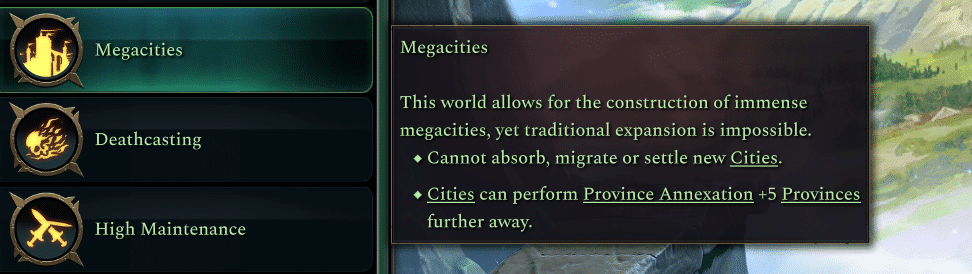
Age of Wonders 4 features a wide variety of Realm traits and the player is incentivized to go crazy here and get creative. The built-in challenge maps are also customizable and fun. Never before in Age of Wonders has the player been able to start a fight between three warring brothers, burn Artica’s lands to ash, or make friends with a Demon Prince. The map sizes do appear smaller but the general movement speed means they take longer to explore, much like the original Age of Wonders in this regard, although this slower pace is further accentuated by the overabundance of mountains, which I suppose might be useful for Industrious players at least.
To summarize here, there is plenty of variety to the way that the map can be set up, some of which have a significant impact on the way the Realm will play. The downside is that there are too many mountains, but overall this is another big improvement for the series.
On Lore and Story Realms
The map, the cities, and the marauders are all worthy improvements to warrant this new iteration of Age of Wonders. It all adds up to a world that is mostly fun to play with, but there is one thing missing: the lore itself is sparsely explained and this is to the game’s detriment. There are no unit descriptions in AoW4, as in Planetfall and AoW3.
From Planetfall:

This combines the unreliable narrator trope with some useful information about the faction this unit belongs to.
Age of Wonders 4 gives us this:

The sad thing is, I really want to know what the story is here. Who made the first copper Golems? Why? What happened? And have a look at the Flame and Frost Cannons from Shadow Magic. I mean, don’t YOU want to know what a Magebane is?
Thankfully, the Story Realms provide some much-needed structure and backstory to the game. Your enjoyment of these really depends on how attached you are to the very concept of a campaign. I think, done well, they can be excellent for setting the scene for the game. AoW1 had a great campaign and the happenings there are referred to in the scenario maps, such as First Conflict. The campaigns in Planetfall were somewhat less impressive and, personally speaking, they never grabbed me in the same way as those past titles did.
The Story Realms are best understood as maps with special rules, using the same base mechanics as the custom Realms with some story elements thrown into the mix. As a result, they end up playing very much like a randomly generated map, with the extra story, and some events that fire off. In that sense, they are better than your average map. A few sites do have lore descriptions, and these are well done. Overall, the Story realms are more fun than normal Realms.
My verdict here is that overall, this is a step backwards when viewed as a cohesive world-building experience, but a step forwards compared to a Planetfall campaign, so a net neutral.
Imperium, And How to Spend It
Imperium is Age of Wonders 4’s replacement for Cosmite and Influence from Planetfall. Think of it as an abstraction representing your empire’s power used to absorb cities, speed up city growth, boost the allegiance of vassals (and absorb them when the time is right), pay for the upkeep on your Tier 4 and 5 units, and used as a currency to purchase empire-wide upgrades from the Empire tree. Yes, Imperium is an important resource.
Imperium is gained from conquered Wonders, building a wizards tower in your Throne City, and from magic materials. There are a lot of things to spend Imperium on but very few sources to generate it.
Thankfully, you start with a generous base level of 40, and you can’t use it for about three turns anyway. Part of making the game more accessible is a delay in game systems coming online (you may also notice a lesser density of critters around your start area, to allow you time to breathe at the start of the game). This means that around turn three or four the first of many interesting decisions will start to appear.
So what is Imperium spent on?
The most common use for it will be to buy population, allowing the player to grow their city by two or three provinces in a single turn, which is a really big deal in a resource management game like this. More nuanced options is also available. Picking the society trait Bannerlords starts the player as a neighbor to a friendly independent city, and here Imperium can be used to boost their allegiance and buy them out as early as turn twelve. This is a double dip bonus as the player will receive not only a city, but a second hero too, a powerful boost to the early game.
Later on, Imperium will mostly be used to purchase bonuses from the Empire Tree. This works like a parallel research tree, with each branch representing a Tome that also links to alignment. Pick the Tome of Puppy Drowning, get Shadow alignment points! At certain breakpoints the tree unlocks a skill for an Imperium point cost and contains a mix of almost mandatory abilities (such as road building) and more thematic, Affiliation based ones. Some are situationally useful, such as a Chaos pick that spawns a bandit army under your command. I think this army always includes a Tier 3 unit and, If you were to pick Barbarian (which starts with one chaos point) and two chaos tomes, you could get this to trigger fairly early, quite possibly before you get to recruit a Tier 3 through your Culture or Tome selections.
Some seem great but I don’t think I’ll ever get to use them (like the ultimate Shadow pick that reveals the map) and some just seem a bit lackluster, like the final leaf on the nature branch, which boosts city growth towards the end of the game.
Some skills leave me scratching my head. like the penultimate Materium pick Resourceful Vigour, costing 350 Imperium, which boosts healing, an effect of dubious utility by this stage of the game and one that is much less effective than simply healing up in friendly territory.
All in all, the Empire tree provides another fun lever for the player to pull on that connects up to the other game mechanics, most notably city management and acquisition. Just be warned that it can be easy to forget what it was that you were saving your Imperium points for an spend it on something else that pops up, all shiny and appealing! There’s also the possibility that the player might forget it exists entirely. Those warnings aside, I think this is a more cohesive and fun mechanic than Influence ever was in Planetfall and an improvement overall.
I did say imperium should be more important in diplomacy, so let’s look at that quickly.
Diplomacy
Diplomacy has always existed in Age of Wonders. In the first game in the series it was more of a sideshow than a main feature, with the second game following suit. From AoW3 onwards, Triumph has tried to make diplomacy more interesting, more engaging, and more important.
Diplomacy mechanics have been sharpened and refined once again in AoW4, with AI template personalities making a comeback from Planetfall that informs how your opponents will approach their own attempt to conquer the Realm. Or rather, they should. Unfortunately, in my experience, they all ended up pretty much the same.
The most noteworthy mechanic is the implementation of casus belli. If you have played any Paradox game, you likely know what this is and, if you like it there, you will like it here. If you think this is some weird imposition from Paradox into a Triumph game then you won’t like this diplomacy system at all.
Alongside the changes made to the AoW4’s various attendant systems, such as the slowed pace of city acquisition and smaller armies, diplomacy contributes towards putting the brakes on the player’s game. An unjustified declaration of war is punished with a heavy economic penalty, dis-incentivizing the player from engaging another Godir recklessly. As a result, many peacetime turns can pass by between bouts of extended combat between rival factions.
Let’s face it, diplomacy is rarely great in any 4X game. At least Age of Wonders 4 spares us from a poor experience. The AI is much harder to abuse than we’re used to, offering fixed prices on the resources, treaties, and items offered up for trade which goes some way to try to prevent the usual exploitative behavior we see from veteran 4X players.
To the game’s credit, diplomacy does work to show off each leader’s personality and there’s some fun to be had going through the encyclopedia to check out the work done for each of the pre-made Godir the game ships with. But, as previously stated, it also acts as a brake on your expansion since wars must be planned for much more carefully and cannot be entered into without just cause without severe economic punishment. Whether this is a good thing for you or not will likely depend on how much you value rapid map painting in your 4X game.

Overall, this system hasn’t really improved on the previous two titles in the series, but it hasn’t taken a step back either. It’s just a different approach to tackling the same concept.
Attentive readers may have noticed a glaring omission from the review so far, namely leaders and heroes, so let’s correct that.
Leaders and Heroes
In a marked difference to several other games in the genre AoW4 gives you, the player, an avatar. Your leader is you. And my oh my, how pretty you can be!

I conjured up this sexy little number using the Dark Culture with Nightmare mounts. The plan was that the Dark Knights would be able to charge in, hit hard, and scare whatever was still alive into routing from the battlefield with morale attacks. A fairly niche build and really to make use of should you pick Mortal Champion to turn your leader into a real melee bruiser and then lean hard into the available morale debuffs.
I like leaders and this iteration of Age of Wonders noticeably improves them. The two existing Leader types are functionally and visually distinct, and the visualizations used for them work very well indeed.
Heroes are the second character type and represent your loyal lieutenants and comrades-in-arms. They’re just as pretty to look at as your leader avatar, and pretty useful, perhaps too useful since many of the coolest features of the game, such as exploring the Ancient Wonders, laying siege to enemy cities, and so on, strictly require the presence of a hero. I touched on this earlier in the review, but having high-tier units unable to knock down a wall feels very immersion-breaking and arbitrary.
Another mechanic that feels arbitrary is the Hero cap, which locks the number of heroes available for recruitment to the number of owned cities in play. Thankfully, this is a soft cap as more heroes can be recruited over and above this limit at an increasingly steep Gold cost.

On the plus side, heroes are randomly generated now and can be recruited any time. Even better, heroes have access to a set of unique skills that cannot be learned by others such as the ability to recruit Ogres when the hero is set as a governor of a city (another new feature which gives the city a small bonus).
Here’s one of those cool hero abilities:

Heroes also receive a signature skill at levels 4, 8, 12, and 16, providing a nice power boost for the player to look forward to. Furthermore, Heroes now level up faster and players can reap the good feelings that come with throwing a powerfully leveled up unit wielding a deadly set of signature abilities, like Assassinate or Summon Elemental, into combat against the increasingly dangerous threats that the game throws at them.
In summary, Leaders and Heroes are aesthetically pleasing and have a larger pool of skills and abilities to draw from, ensuring a greater variety of potentially very powerful commanders to field. The downside is that they’re often required for other roles, such as initiating sieges or exploring Ancient Wonders. Despite that, this is an improvement over past games in the series.
I’d like to end this article by discussing the production values. The game looks and sounds amazing! The art department deserves a beer/tea or other preferred beverage and Michiel Van der Boss has knocked the music out of the park again. I have no serious complaints here and only a couple of minor nitpicks. I’m not keen on the arrow trails in combat and some of the unit transformations perhaps don’t always mesh too well together visually and can be a bit busy looking. Overall, this is the best-looking and sounding game in the series by far!
Conclusion
In reading this review you will likely notice that some of my likes and dislikes are a matter of personal preference. You might care less about the things that annoy me and you might even love some of them. But speaking as someone who has accumulated literally thousands of hours across the series, I hope you appreciate my humble thoughts which I have summarized below.
Sometimes Age of Wonders 4 does not feel like an Age of Wonders game.
The emphasis on cities and their management, along with limiting how many the player has access to and how fast, the changes to diplomacy and the throttling of combat, and the deliberate slow down of expansion all add up to a wargame where wars are almost optional. The player is incentivized to turtle up and go for a magic victory and doesn’t really need to get out into the Realm to take the fight to the enemy, leaving warfare as infrequent and indecisive until someone suddenly loses the game.
This is a game with aspirations toward Civilization-like gameplay but, unfortunately, those gameplay aspects are better served elsewhere. And while it is notably different from previous entries in the series through the changes we see, AoW4 is fundamentally the same game underneath. To be clear, that is to Age of Wonders 4’s credit! The core fantasy 4X gameplay loop beloved by eXplorminate readers is more or less intact and the combat, served up with the occasional big battle, remains a fun and exciting experience. In some ways, this feels like the game that Endless Legend was aiming to be, though it fell a little short of the mark.
There is a lot to like in this game but it feels somehow lesser than its predecessors in several ways. It is glossier, smoother, and more beginner friendly, but at the cost of oversimplifying many mechanics that brought joy to veterans of the series. The whole also feels somehow lesser than its often interesting parts due to the nature of the modular mechanics which require everything must be able to match with everything else.
With the caveat that veterans of the series might discover that certain elements of their beloved game have changed, possibly for the worse, Age of Wonders 4 is an easy recommendation for fans of 4X games, both old and new.
Rob’s Opinion
Hey, 4X fans! Age of Wonders 4 is easily the biggest release in the 4X space since Humankind, as the power of Paradox’s hype machine has been in full swing. Sure, there have been other major 4X releases, like Master of Magic, Galactic Civilizations 4, and even the heavyweight, Distant Worlds 2 since the release of Humankind, but none of those games had the type of coverage and pre-release hype that a publisher like Sega or Paradox can muster.
With that being said, it’s not just the power and capability of Paradox’s hype machine that’s at play here. I’ll cut to the chase: Age of Wonders 4 is a fantastic game and a great representative of the 4X genre. Its masterful mix of engaging strategic gameplay – which definitely leans into empire management a bit more than previous iterations – and second-to-none tactical combat is a fun, addicting mix. The level of polish, the high-value presentation, and the lean towards a more “Stellaris-like” faction creation will certainly attract new players to the series and perhaps even the 4X genre itself.
Some aspects of the review above mine here are points I don’t agree with; not because they’re invalid points, but simply because the issues described don’t really affect my enjoyment of the game. However, some of my concerns from my “4Xeriences With Age of Wonders 4” article remain in the final game. Namely, that cultural units don’t remain relevant long enough and that the new faction creation system would be a bit polarizing.
Cultural units still become obsolete too early in the game and, while the faction creation system is much more popular than I expected, there are still fans of the series that haven’t really meshed well with the new system. I also think that the early game still feels a bit too familiar every game. The map could benefit from more features and sites to find and more map variety in general (this would help with exploration) and the cultures themselves could benefit from more asymmetry and more relevance to keep each game feeling a bit more fresh.
Thankfully, however, Triumph has addressed the late-game Tier 4/5 unit spam by making those units more expensive and by adding an Imperium cost and maintenance to them.
My remaining concerns, after about 110 hours with AoW4 so far, stem from an inconsistent strategic level AI that can be brain dead (the tactical AI is very, very solid) and that the culture choices don’t really change gameplay as much as the tomes do.
Obviously, the AI can be improved upon and that will likely happen. However, I’m not sure what the answer is to the culture problem. The system needs a bit of an overhaul. For games to feel more unique in each play-through and for the cultures to remain relevant, Triumph Studios will need to really focus on making their strengths more asymmetric and unique. I hope that they plan to do that, as the current system feels a bit limiting in its replayability.
That being said, Age of Wonders 4 has supplanted Endless Legend as my personal favorite fantasy 4X game and will probably rank among my favorite strategy games of all time.
I think Triumph made the right decision to scale back on the complexity a bit regarding unit customization, i.e. unit modifications, and the game feels much more approachable now. It would be great to see them add new layers as expansions are released, but I believe that Planetfall went too far with unit micromanagement.
Furthermore, the game feels like an upgrade in nearly every regard over Age of Wonders 3, which I enjoyed, but didn’t love.
I truly believe in the direction that Triumph Studios looks to take Age of Wonders 4 in with its expansions and DLC and I feel like we’ll be talking about AoW4 for a long, long time.
And well, yes, I’m still here for it.