eXplorminate Note: Join Boho, our resident expert in all things Age of Wonders, for this excellent recap of what has happened in Season 2, Age of Wonders 4. There is more Age of Wonders 4 content coming soon, including some eXplorminate multiplayer games.
AOW4 Season 2 & 2/3rds: Ways of War (WW) / Giant Kings (GK) / Herald of Glory (HoG)
This year, Age of Wonders 4 is set to do something brand new for the series: finish up a second year of content releases. Until now, Triumph Studios released its final expansion for each entry in the series within a year of the initial release. Ok, you got me, it was fifteen months for Planetfall, but to be fair that was in the plague years.
If your Steam Library tab is anything like mine, there are multiple anniversaries in the news feed at the top every time you open it, almost every one a milquetoast marketing piece in the endless, desperate war for your attention. But as someone who’s been with the series since 1999, it was actually kind of special to see Age of Wonders’ first second birthday pop up.
Of course, it was still marketing, and in that regard it worked – reminding me that, oh yeah, there was a second season. Was that fully released yet? How was it doing? Wasn’t there supposed to be something with the Archons in there?
Before I returned to AoW4 for this article, I hadn’t played the game since Eldritch Realms. Multiple large, Triumph-sized patches have occurred since then, and that’s not even getting into the DLCs. In short, it is a lot. To organize everything, I’ll be reviewing both the free, base-level changes and DLC in chronological order.
In the beginning…
…there was Herald of Glory, the DLC that wasn’t. Much like Archmage Attire, it’s a bonus for buying Season Pass 2 and is (currently) unobtainable otherwise. There is, however, a twist on the usual cosmetic pack: while it includes mostly cosmetics such as a leader costume set, the “Lance of Glory” weapon model, and the “Regal Pegasus” for Heroes and racial mounts, there’s also the “Swift Marchers” society trait, only available here.
While the rest are purely cosmetic, Swift Marchers is absurdly powerful. For one trait pick, your faction gains Road Walk (roads cost 4 movement instead of 5), access to Forced March from Turn 1, the ability to take no damage from Forced March, and the ability for your units to never die when they rout (that is, they’ll always successfully escape).

One of the recurring themes of Season 2 is power creep. If you’re not familiar with the term, it’s the tendency for the newest content added to or changed in the game to be more effective (or difficult) than content before it. In “pay to win” games like competitive gachas, this is by design – it’s the business model. In a game like AoW4, it’s a normal consequence of the development team becoming more familiar with their game and how their audience plays it.
And honestly, I’m there for it. As late as Eldritch Realms I complained about AoW4 feeling overbalanced and prescriptive, but today I feel it’s managed to hit that critical mass of content and choices where balance becomes impossible. There are hard counters and dead-end builds. Racial traits are no longer just dull stat bonuses, but can substantially change the strategies you’ll want to use and the way your armies function in combat.
Ways and Means
The first real DLC in Season 2 is Ways of War, and it’s a meaty one. It introduces a new culture (the “Oathsworn”) with new units and some unique mechanics, four new tomes, two racial forms, “Intrigue Happenings,” which I’ll explain in a bit, a smattering of new map objects and premade rulers, and a new realm template.
If you saw the banner art and concluded this was the ninja and samurai expansion, well, you’re right. Everything in this one is themed on East Asian culture and myth, which fortunately manages to be recognizable to westerners like myself without resorting to being a kung-fu movie.
The two new racial forms are Simians and Ogrekin, though these aren’t your typical western ogres – they’re closer to the oni of Japanese mythology. Meanwhile the Simians seem based on depictions of Sun Wukong, the Monkey King, from the classic Chinese novel Journey to the West.
The four new Tomes is where you’ll get your kung-fu and ninja fix.
At Tier 1 there is the Tome of Discipline. Based in martial arts, the highlight is the new racial Monk unit, a Tier 2 Fighter which uses its fists, can leap over a single square as a free action, and can spend a turn on its Meditate ability, which heals the Monk, removes up to two debuffs, and leaves them in defense mode. Though its stats are nothing special, its combination of agility with a bit of self-sustain can keep the Monk effective and relevant past many other Tier 2 units, especially if your race has bonuses to flanking.
At Tier 2 you’ll get the Tome of Shades, which focuses on causing and exploiting the Blind condition – a devastating debuff to ranged attacks (-50% accuracy) while also disabling retaliation attacks for melee. Meanwhile the Shadow Blades enchantment will cause all your melee units to ignore 50% of a unit’s defense and resistance values when they attack, which can rip through armies like Industrious that depend on overwhelming defense to function.
You’ll also get the Shade unit, a Tier 3 skirmisher whose ranged attack inflicts blind and whose melee attack does more damage to lower health targets. These are the ninja you’ve been waiting for – and like any good ninja, they even throw a blinding smoke bomb when they’re at low health and teleport away!

At Tier 4 you get a pair of mirrored tomes: the Tome of Prosperity and the Tome of Calamity.
Tome of Prosperity focuses on the Grace positive status effect, which heals a unit when it takes damage. You also get to summon the Prosperity Dragon, a mythic Tier 5 white-gold dragon in the more serpentine style of East Asian myth, who happens to have also taken the shape of a curly fry. Good luck unseeing that.
With its “Rain of Prosperity” move, the Prosperity Dragon can apply Grace to all your units on the battlefield while also cleansing a single negative status effect every other turn. It can also bind itself to a unit and absorb damage for it (at a 35% reduction) and has a decent Spirit-based attack which splashes adjacent enemies for 50% of the damage.
The rest of the tome focuses almost exclusively on heaping more and more sources of Grace on your units which is either utterly hilarious or utterly infuriating, especially combined with Mark of the Keeper. Add Wightborn on top of all of that and you’ll never lose a racial unit in auto-resolve again, even if the auto-resolve takes 30-60 seconds to finally finish its simulation. There are certainly good spells here, including an excellent 2-hex radius buff suite in Grand Protection (2 Grace, 2 Regeneration, 3 Bolstered Defense, 3 Bolstered Resistance), but nothing quite as dramatic as the dragon’s Rain of Prosperity.
On the flip side is the Tome of Calamity, the bad boy book. Calamity focuses on hybrid Cold and Fire, especially the application of a new status effect, Ghostfire, which is basically Burning++. Ghostfire is a stacking damage per turn effect just like Burning – it actually replaces and overwrites Burning – except instead of dealing 4 Fire Damage per stack per turn like Burning, it deals 2 Cold and 2 Fire. Additionally, unlike burning, Wet and Frozen can’t extinguish Ghostfire.
Ghostfire is… fine? I guess? It’s another potential source of the redheaded step child of damage channels, Cold, which is nice, and it can comfortably combo with the Wet status effect which makes Cold hurt more. In general it comes down to what you’re fighting: against supertypes like Undead, Umbral Demons, and Plants, raw Fire damage is deadlier than split Fire/Cold, but far more individual units have resistance to Fire than Cold.
You will of course be getting a unit from this tome: the Calamity Dragon, if you hadn’t guessed. It also looks like a curly fry, which is a plus, and it’s more offensively skewed. Its basic attack applies Ghostfire but has no AOE like its twin. Its big ability is “Ghostfire Storm,” which causes three random enemy units to take 10 Fire damage, 10 Cold damage, and be inflicted with two stacks of Ghostfire every turn. That’s not too shabby – it’s the kind of all-around good special ability I expect from a Tier 4 tome unit – though in large fights it pales to Rain of Prosperity, which is Grace-Cleansing up to 18 units every other turn.
The rest of the tome has much more variety than its counterpart. Standouts include Ritual of Calamity, a siege project that pillages one random province improvement per turn spent sieging, then summons two Accursed Ogres and applies a stack of Ghostfire to all enemies when battle finally starts. Comet of Calamity deals 30 total damage split between Fire and Cold, applies two stacks of Ghostfire, and has a chance to freeze anything hit by it, all in a two hex radius. Oddly enough, this comet has little to no fanfare, and has the audiovisual impact of someone gently tossing an ice cube at the target hex from a second story window.
There are also two enchantments – Accursed Projectiles, which adds 2 Fire damage, 2 Cold damage, and has a chance to apply Ghostfire on each ranged hit, and Accursed Armor, a neat little enchant that gives units +2 Defense and a small chance to apply Ghostfire and/or Misfortune to their attacker when hit in melee.
Overall these are great tomes, especially Calamity and Prosperity, which keep weaseling their way into my builds since they’re so generally useful.
Under Oath
The Oathbound is our new culture for Ways of War, and it follows the trend of getting a selection of sub-cultures to choose from. If the name didn’t give it away, this culture is bound by your choice of Oath, which defines the rules for your playstyle. Honor your Oath and all your towns and units get scaling buffs, their power dependent on how “Devoted” you are to the Oath. Break your Oath and watch those buffs disappear – or, if you’re a serious Oathbreaker, start suffering actual penalties to everything instead.

Each Oath also gets a unit unique to that Oath at Tier 3. Additionally, each of these units has one of its abilities “powered up” when you reach the maximum Devotion tier for your Oath, called “Paragon.” These abilities are all exceptionally powerful.
You’ll be picking from one of three Oaths: Harmony, Righteousness, or Strife.
Harmony
Harmony is the most conceptually interesting choice, even if its gameplay might not be for everyone. This is essentially an oath to peace, cooperation, and the destruction of marauders – you will gain Devotion (the rating of how close you’re cleaving to your Oath), as you clear Infestations and Wonders, have cities or vassals of races other than your starting race, make truces, and forgive grievances.
You’ll break your oath and lose Devotion if you start a War (it’s fine to defend yourself and go on the offensive if someone else started it), raze or migrate cities you capture, or fabricate grievances.
To aid with your diplomatic overtures, you’ll gain a flat 100 Relations to all rulers and free cities just for playing Harmony. Further, if you vassalize a city after conquering – er, liberating – it, the grateful(?) city will immediately bump up to the Vassalage stage, skipping Tributary entirely.
To me this is the most interesting of the three as it’s the hardest to follow. Though it naturally dovetails with being a good guy, you are by no means bound to that. Convincing the AI to attack you so you can destroy their empire is an interesting angle, and some leaders aren’t dumb enough to fall for the obvious: if you ignore their claims, openly walk through their borders, and generally piss them off, they’re happy to bully you too while also refusing to declare war.
That said, in most cases your win condition as Harmony will probably wind up being a Magic, Territory, or Seal victory. Any of these will eventually cause all AI to declare war on you (and ally with each other), but by the time they get around to all that it’s almost always too late.
Your special unit is the Peacebringer, a mounted Archer with a shot that hits three hexes in a line. If you’re a Paragon of Harmony – the maximum Devotion tier available – you’ll gain the Arrow of Harmony ability, a long-range shot that inflicts the Pacified condition. Peacebringers are unique in that this is the first and only way to directly apply Pacified in the game. Assuming you’re at Paragon, these are strong enough to enable an archer-centric build entirely on their own.
Harmony’s unit buff for honoring their Oath is a special Grace-like effect. Once per combat, when a Harmony unit takes damage that leaves it under 60% of its max HP, it will be healed for a scaling portion of its total HP. Essentially, it’s a Grace that scales with max HP, but can only be used once per combat. This is often actually worse than Grace for low tier units, but when you start fielding beefier forces, it will pull way ahead. The consequence here is it’s bad for a rush strategy, which plays directly into the Oath’s theme.
Righteousness
Righteousness is the most boring pick because we’ve seen it before in High with their Alignment Agenda passive. For Righteousness, your Devotion is simply your numerical alignment value. Basically it’s the Neutral Good of cultures: it doesn’t matter how you’re a good guy, just that you click the buttons with the Good symbol on them and don’t click the ones with the Evil symbol. Do, however, note that if you find the black and red smiley face irresistable, your negative alignment gain will actually be doubled for not heeding your Oath.
Your reward for clicking the yellow crescent thing is additional Spirit Damage on each attack, starting at +1 and scaling to +5 at Paragon for the goodest of boys.
This Oath’s special unit is the Avenger, a Shock unit with the ability to do a devastating full-turn single-target attack called Helmsplitter which ignores 50% of the target’s defense and resistance. When you’re a Paragon of Righteousness, the Radiant Slash ability is unlocked, granting Avengers a 2-by-1 hex cone attack for one action point that does pure Spirit damage and applies Sundered Resistance.
The Helmsplitter is quite strong even before you reach Paragon, and while the upgraded Cleave at Paragon is certainly even better, it’s not as make or break as it is for, say, Peacekeepers in Harmony. But when you do have the opportunity to hit a clump of units all at once, it’s certainly satisfying.
Overall Righteousness is the most flexible Oath in terms of playstyle. You honestly don’t sacrifice all that much by sticking to Good – pillaging rampages are off the table, as is razing cities or backstabbing allies. The biggest thing you lose is the most generally useful evil choice, migrating a city, which can be so important strategically that you might have to accept missing Paragon in exchange for winning the map much sooner.
Strife
Strife is all about challenging themselves in battle. At least on paper. Unlike the other two Oaths, your unit buff not only depends on your Devotion value, but on the circumstances of the combat you’re currently in.
Specifically, if you want your unit buff of +1 to +5 fire damage per attack, you may not outnumber the enemy at the start of combat. An equal number of units or less is fine. Summoning units in combat, or defeating enemy units in combat without losing your own, will not cause the fire damage to instantly disappear.
Additionally, your Oath doesn’t care about army power. If you send three level 20 heroes and three Tier V units, a stack pushing 4000-5000 power, to attack six skeletons, a stack of maybe 360ish power, you’ll still get the fire damage buff since you don’t outnumber them.
So while Strife nominally has an element of challenge in combat, in reality it’s more about proving superiority in combat. It’s not your fault if the enemy wasn’t bright enough to bring a gun to the knife fight.
For Strife, honoring your Oath is all about chaos and violence. You’ll get Devotion for entering wars (you need not start them), razing cities, not allowing enemies to escape when routing, and winning combats (with more for winning combats you had lower army power in). You’ll lose Devotion for accepting a Defensive Pact, Truce, or Alliance, as well as forming a Pact of Vassalage or losing control of a city you owned.
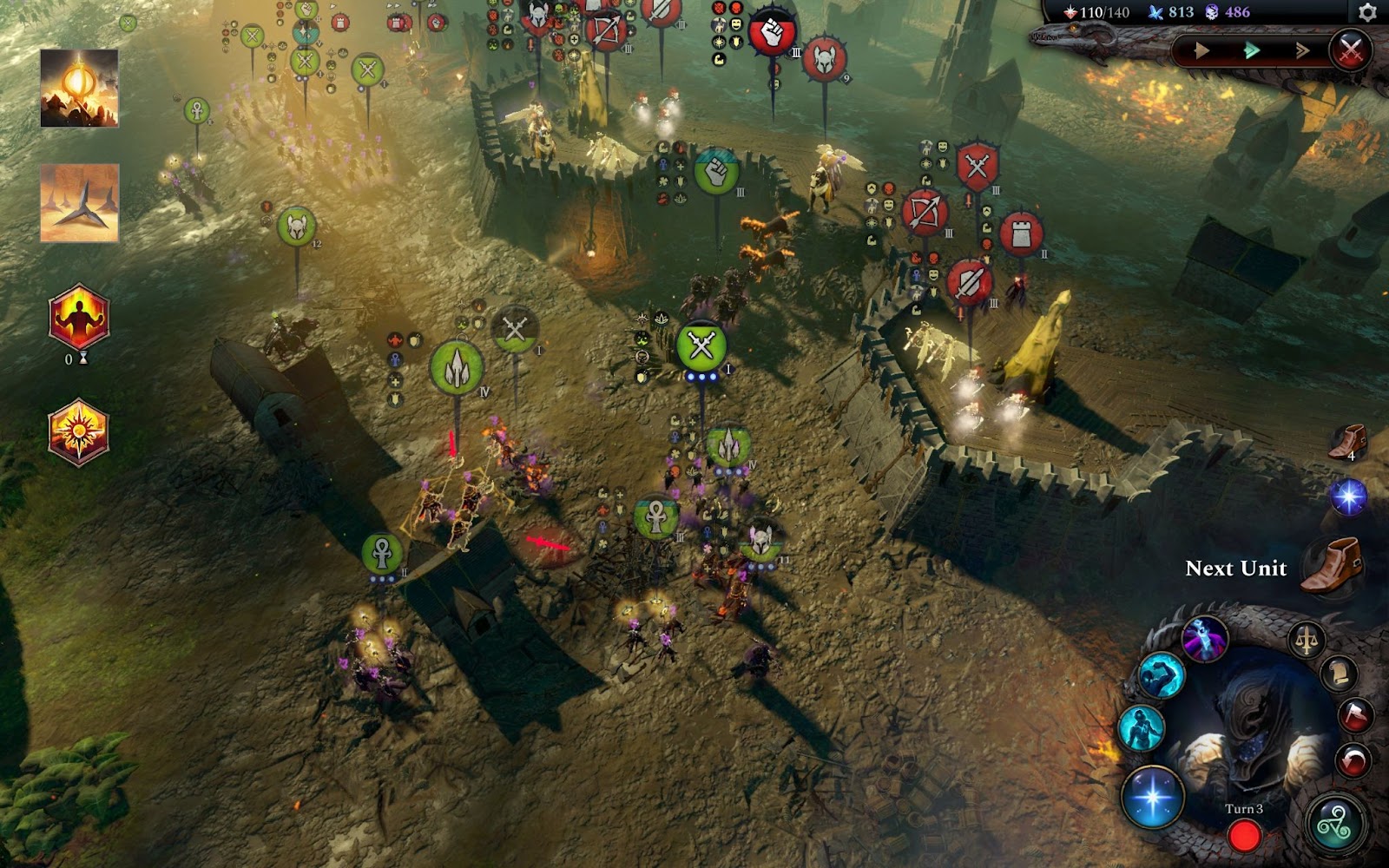
To facilitate burning civilization to the ground, you’ll also get a bonus to razing cities and pillaging provinces: it takes one less turn to do either of those things, and both now reward Imperium. So like Harmony, you don’t technically have to be evil to play Strife. But it sure is way more profitable!
Strife’s special unit is the Warbound, not to be confused with the Warbreed. You’d be forgiven if you did: the Warbound is also a shock unit capable of pushing through enemy lines. But while the Warbreed charges, gets stuck in, then pushes the line back one hex at a time, the Warbound comes with Bulldoze, an ability that moves it four hexes forward while damaging enemies in the way. It won’t displace anything, but it will let the Warbound entirely bypass it – plus it leaves the Warbound with one AP.
Once again there’s a special power at Paragon: Infernal Blaze, an ability that grants the Warbound three stacks of Infernal Might granting +1 fire damage to attacks per stack for three turns, and damages any adjacent enemies with a burst of fire. The downside is it’s an ability that costs 1 AP and ends the turn, making it easily the weakest of the Paragon abilities – were it a Free Action with a longer cooldown, it might stack up better. Of course, Strife is probably the easiest to reach Paragon in, so this might be an intentional balance choice.
Getting Intriguing
Though the new Culture and Tomes are the headlining features of Ways of War, there’s a final bullet point on Triumph’s sales pitch: Intrigue Happenings.
If you own Eldritch Realms, you’re probably familiar with Cosmic Happenings: those random events that apply to all players equally. This is a staple mechanic in the 4x genre. Indeed AoW4 has had “Narrative Happenings” since launch – those pop-up events (like the hero losing their sibling in the gold mine which I get every single game) that only impact one player at a time. Cosmic Happenings, on the other hand, were the traditional global events that apply to every player equally.
Intrigue Happenings shoot the gap between personal Narrative and global Cosmic Happenings. Instead these occur between the player and a single AI opponent with the intention of disrupting diplomacy specifically. Of the events I’ve seen, all have involved the AI leader being replaced by a different, often radically different one. Shortly after a quest chain begins that promises to expose the truth behind what happened.
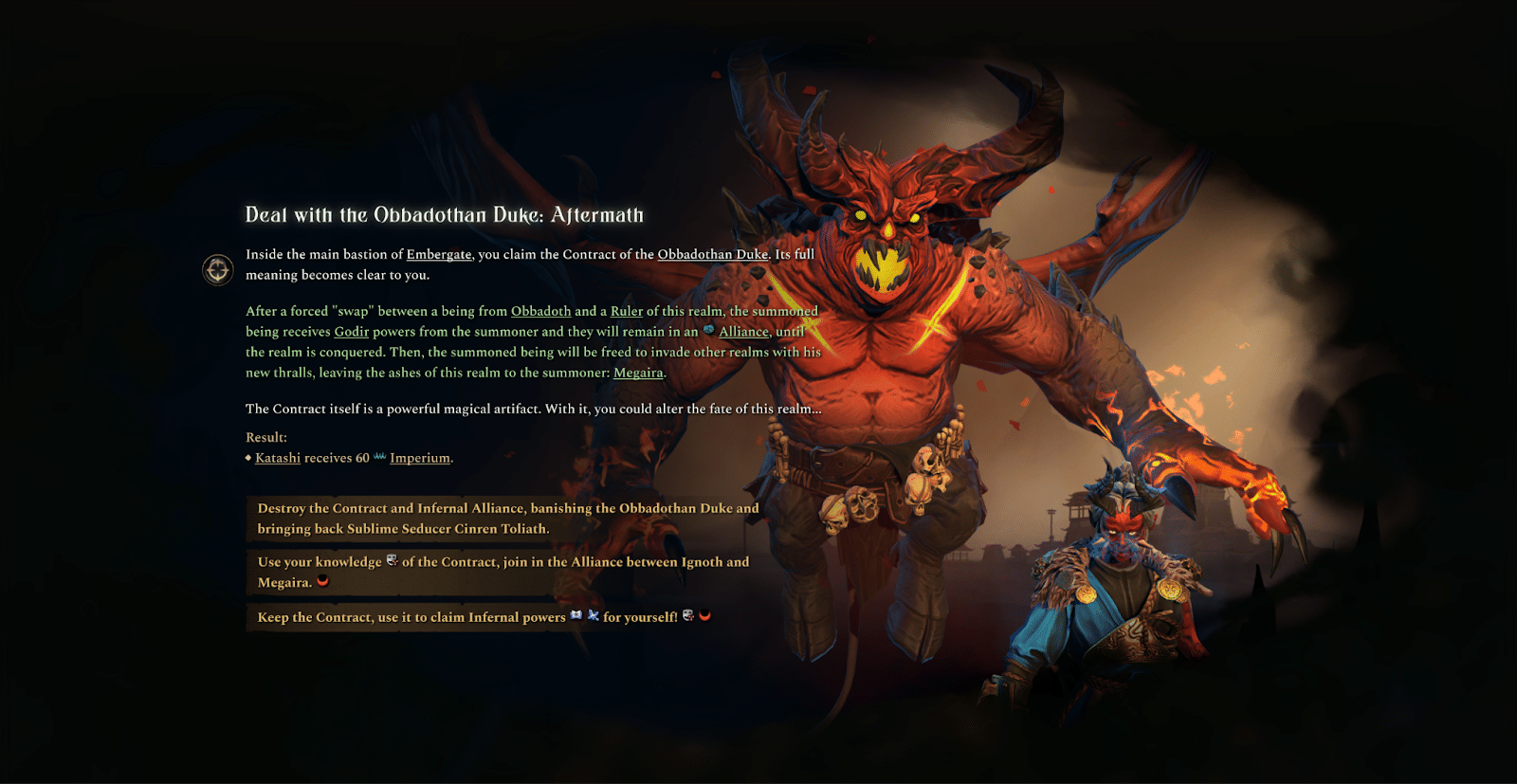
The chains I’ve seen start small and include off-ramps every step of the way, letting you basically turn a blind eye for an instant infusion of resources. These eventually escalate to conquering a weak city of the new ruler, at which point you get to decide between a handful of endings and radically imbalanced rewards. The rewards I’ve seen thus far have always included the option to instantly force the enemy leader to become your vassal with no previous requirements whatsoever. Their entire, likely completely intact empire instantly becomes your vassal. Full stop.
The other options? A +800 relations bonus with some good guy points or maybe a couple turns worth of resources.
Obviously there’s no real choice here. You take the OHKO, a cut of all their empire’s income for the rest of the game, and access to their military. The only reason you’d pick anything else is roleplaying.
I’m of two minds regarding Intrigue Happenings. From a design standpoint I think they’re awful, essentially RNG popups which hand the game to the player in exchange for a little walking, a neutral fight or two, and sieging a wimpy town. From a player standpoint, there’s a not insignificant part of me that was happy I wouldn’t have to go through the slog of conquering a huge empire.
They also have a tendency to just kind of break. If you’re asked to capture a town and another AI captures it, or it gets released as a vessel, the quest just ends with a generic quest failure message. Failure isn’t interesting and doesn’t lead to unique consequences or events – it’s more like an error message and the entire thing is never mentioned again. It feels half-baked as a storytelling tool.
The Great Hero Rework
Though not a part of Ways of War, a free major systems update to Heroes released with it. The previous system of selecting abilities from a list (some of which have prerequisites) was instead replaced with multiple hero classes with unique talent trees, and with those talent trees came bunches of mutually exclusive choices.
You’ll now choose between one of seven classes, each with their own talent tree containing multiple different mutually exclusive paths. For instance, the Warrior is an offense-oriented melee fighter and is asked to choose between two mutually exclusive options right from the start: either the Knight, a path that leads to the potential of specializing in the Charge attacks delivered by 2-handed swords and Lances, or the Berserker, a path that boasts higher damage potential with repeating attacks, but only if the Berserker is already in the thick of it and can use all three of their swings from a repeating weapon.
Going down those paths leads to all kinds of other mutually exclusive choices. Do you want your Knight’s charge to displace the target unit and move the Knight into their place, or do you want your Knight to enter Defense Mode for free after charging? These then cascade into more mutually exclusive choices, and so forth, until eventually converging back to a kind of “capstone” ability for the class (at least, in most cases – the Ranger class is more complicated, for instance).

In the case of rulers, you’ll also be getting a unique tree for ruler talents based on your ruler type. Finally there’s the “Signature Skills” abilities on the far right, which grant affinity-based abilities or traits and an extra talent point for free upon reaching the listed level target. Each of these splits into a choice of two bonus talents (not mutually exclusive) tied to the affinity of the Signature Skill you chose.
With classes comes class requirements on gear. Warriors can’t equip magic staves, for instance. I love this as it eliminates the old silliness of finding a great sword with the hero you’ve leveled as a caster, just to respecialize them into a pure melee machine because you found a nice weapon.
Of course, the system isn’t perfect. It hasn’t been iterated on post-release and the balancing is quite off, leading to somewhat samey hero builds. For instance, for three talent points the Ritualist gets Rejuvenating Wildgrowth, an ability that spawns a 1-hex radius of bushes to take cover in, while also healing everything in the area for 10 HP, applying 1 Regeneration, and applying 2 Bolstered Defense. And it can be used every other turn. There’s not a whole lot of counterplay available for that short of killing the Ritualist ASAP.
The good news is Griffin, the patch that launches with Archon Prophecy, brings our first iteration on the system. Underused or out-of-place abilities (like the Ritualist’s very confused summoning tree or the Mage’s Curse line) have been fleshed out into their own separate classes: the new Warlock handles Curse-like effects, Life-stealing, and Undead summoning, while the Elementalist (which replaces the Mage) handles elemental summoning on top of the previous role of heavy elemental damage.
It remains to be seen if the patch will address the relatively rigid builds for some classes – for instance, Warrior and Defender both have several “who would ever pick that instead of this” choices in its mutually exclusive options – but the changes shown in previews and the patch beta have been great so far.
Onward and a Couple Stories Upward: Giant Kings
Giant Kings is the second (third if you count Herald of Glory, which you shouldn’t) DLC in Season 2, and it focuses much more on expanding the world over player options (Ways of War being the inverse).
The immediately obvious addition for players is the titular Giant King ruler type. In the game lore the giants supposedly built the world, and sure enough, most of their kit is tied to the act of creation: building out cities, making magical items, and terraforming land.
Sticking with the lore, they’re perfect for a builder-type player, beginning the game with access to the Item Forge and getting big bonuses to Production in their cities (though not Draft). If you spend talent points in their leader tree, you’ll gain access to Item Forge enchantments that are unique to Giant Kings, eventually even expanding the regular limit on item enchantments from 5 points to 6.
You’ll choose one of four types of Giants: Storm, Rock, Fire, and Frost, each of which gets a bonus in a certain resource from all provinces with features matching their element (for instance, Storm likes Coastal and River provinces and gets +1 food from any it controls). To further facilitate getting those bonuses, you begin with a “Runestele” spell that drops a totem on the map and steadily converts land around it to include the feature you get a bonus from.
For instance, Fire’s Runestele converts everything to Ashlands or Chasms, which destroys most other terrain features, while Rock’s adds the Mountains or Stalagmites feature to provinces, which causes no destruction at all (note these aren’t the huge nearly impassable mountain mountains, they’re the Mountains feature, so visually your province just gets slightly rocky, if you notice it at all).
While this is useful – who doesn’t like free resources – the bonuses don’t tend to be dramatic. The most important resources, Draft and Gold, are notably absent. There’s also the issue that all terrain flips back to its starting type if you cancel the Runestele or it’s destroyed, which isn’t particularly interesting. So you’re not really terraforming provinces as putting a blanket over them that can be yanked off.
The less obvious side of Giant Kings is that they’re absurdly good in combat. They’ve dethroned Dragons as the cheese of choice owing to their unique weapon types with unique attack properties as well as their strong giant-specific Signature Skills.
Giants get access to three giant-sized weapons: a warhammer with repeating attacks which deals damage in a 1-hex frontal cone, an axe almost as tall as the giant themselves that performs a Heavy Charge Attack on a unit and the unit directly behind it, and a dislodged magical obelisk which is used as a staff to deal ranged damage to a target unit and 50% splash damage to all adjacent enemy units.

In exchange, Giants can’t use mounts or shields. Truthfully it’s a very small price to pay for these powerful weapon chassis – I only found myself missing the opportunity to put my ruler on a flying mount for mobility’s sake.
It should come as no surprise that Giants have the Large Target trait, meaning they’re 20% easier to hit with Physical Ranged and Magic attacks and take extra damage from polearms. Failure to keep that in mind isn’t as lethal as it is with lower-tier Trolls or Ogres, but it can lead to something almost as bad: the need to spend a couple turns healing lost hit points because your Giant leader was roleplaying a pin cushion.
Playing as a Giant King isn’t substantially different from other ruler types: if there’s any criticism I could make, it’d be that they play like a strictly better Champion. But that’s more an indictment of how out of date Champions are than anything else.
The Other Stuff
Giant rulers are the headliners of this pack, but they’re just a small portion of the content added. Most of Giant Kings focuses on map generation, and the difference is immediately noticeable.
In the past I’ve criticized the province system in AoW4 (and Planetfall) for generating pretty boring maps. They were very good at generating a map that was cohesive as a whole, but bad at generating a map that was interesting at a turn-by-turn scale. Most of the DLC is aimed specifically at that second criticism, and while it’s not a perfect solution, it’s a great one.
The first part of the solution was to implement a way for handcrafted regions (collections of provinces) to appear in convincing locations during regular map generation. We first saw handcrafted regions with the islands in Eldritch Realms’ Umbral Realm, but notably these islands were surrounded by void, which avoids the problem of getting them to fit together. It’s a much more challenging task to build a handcrafted region that can fit into randomly generated provinces and not feel extremely artificial.
There’s a modding tutorial on YouTube about making your own regions that goes into how this all works, but for this review, suffice it to say that it does indeed work, and that these regions appear convincingly in the context of the rest of the map. Sure, some of the more elaborate ones will stick out as “oh, that’s a region,” but I’ve never found it offensive to immersion.

Sometimes these regions are just a curiosity, sometimes they’re designed to be especially tactically advantageous, and sometimes they have special events or quests associated with them. Sometimes they’re natural enough to pass as “oh, that’s a cool bit of random terrain.”
While there’s occasionally gameplay implicit or explicit to these regions, there are also regions with overt benefits called Landmarks, which reward you in some way for controlling a given number of provinces in that Landmark region. These are essentially the equivalent of Natural Wonders in other 4Xes, but given the context of Age of Wonders, there’s often little natural about these landmarks: they could be things like giant skeletons, or an old dwarven city built along the faces of a bottomless crevasse under the earth.
These are pretty and have big bonuses attached to them, though I generally only found them after I had finished the expansion rush. I found myself wishing they had a secondary, combat- or unit-oriented bonus for Outposts in the landmark region given how frantic and quick the expansion segment of the game is.
Crystal Castles and Venture Capitalism
On top of the great map variety added by regions, there are two additional presences that Giant Kings bring to your random maps: the ubiquitous Shops and the much rarer Crystal Dwelling, home of the Council Prolocutor.
Shops are exactly that, but what they’re selling might not be what you’re expecting: here you’ll have the chance to buy Hero skills or class changes, army-wide mount upgrades, and even revealing the entire world map. More traditional fare is available as well: for instance, you can find hero gear alongside the additional free skills or class retrainings, or personal mounts among options to kit out your army’s cavalry with something exotic.
These shops are not always available though – they’re transient, generally setting up in your territory for ten or so turns before moving on. They may revisit in the future, or you may never see them again – it’s all up to chance. In a roguelike twist, you even have the option to attack these traveling merchants. Just like a roguelike, victory wins you their stock, but these are extremely tough fights, and you become persona non grata with all traveling shops for the rest of that map.
As for the Crystal Dwelling, there’s only one of these per map, and only if the map has the trait to spawn them. Lore-wise, these crystals are home to the souls of ancient giants, but that’s not really relevant to gameplay. Crystal Dwellings function just like Umbral Demon nests, save for the fact they’re peaceful.
The Crystals are interested in learning about the current state out of the world, and dole out simple quests toward that end. Frequently they’ll provide blueprints to forge an otherwise unforgeable item, and ask you return it to them for assessment, so of course you have the dilemma of keeping this unique item or handing it over for potentially greater rewards in the future.
With the Crystal Dwelling comes a small collection of new “Lithorine” units, one at each tier. These units are based around the “Volatile Charge” mechanic, a new status that is essentially a bomb attached to the afflicted unit. After a short amount of time, the Volatile Charge explodes for damage in a 1-hex radius. More advanced crystal units can interact with Volatile Charge in special ways (like causing it to go off early) or apply Volatile Charge to all enemy units in an area. It’s an interesting mechanic, especially if you’re fighting against it, but I haven’t found it super useful against the AI.
The Crystals sell a variety of gear, including a controversial item that adds one to all magical affinities for your empire. This loosens up tome access requirements, but the real value in it comes from the fact it essentially gives you access to all empire skills… eventually.
What’s proved controversial is the fact this item is the cheapest influence reward from the dwelling, available after only one or two quests. If you happen to start close to the Crystal Dwelling, you might have this item by turn 20, which means unlocking a lot of empire skills by the end of the match. Since many of the best empire skills are early in their branch of the affinity tree, that’s a whole lot of snowballing for a very tiny scouting investment.
Like the Umbral Demons, you also have access to purchasing spells, upgrades, and the right to build Lithorine units in your towns from an exclusive “Crystal Pact” tome. Much like the units, the spells are largely focused on applying Volatile Charge, save for a resurrection spell that raises a dead unit as a Lithorine unit of the same tier. You’re free to keep the unit after combat for a flat mana cost.
Finally, you can eventually unlock an advanced city structure from the Crystal Pact called the Eternal Embassy, which grants 15 Knowledge and Mana (not bad) and a whopping 10 Influence per turn. It’s quite a nice payoff.
Books and Stories
There’s an additional new realm trait (besides the one causing the Crystal Pact to show up) called “Legends of Myrrida,” which is essentially the story map for Giant Kings. It’s actually pretty cool: there are nine “fated regions” which come with their own stories as well as a larger story of what happened to the Giants linking all of them.
Finishing these gives you artifacts with powerful boosts to your income – and if you get all of those artifacts, you’ll supposedly trigger an endgame event that wraps up the story. I’ve played Legends of Myrrida and quite enjoyed it, but I haven’t gotten the “true ending” yet simply because it felt a little silly not to win when it was clear I could. I haven’t figured out the best settings to wrap up the story without essentially winning the game first, but I sense it probably involves using the Harmony Oathbound to keep the AI off my back while I run around questing.
Now, on to the magic: there are two new tomes with Giant Kings, Dungeon Depths and Geomancy. While I love the premise of both, unfortunately only one seems to work – or at least be properly and clearly explained.
Good news first: the Tome of Dungeon Depths is a bunch of fun for builder-minded players who love the underground. The pitch here is pretty simple: turn your underground cities into heavily fortified dungeons and profit wildly off that fact. The biggest draw is getting four (!) new special province improvements in this tome, all of which are absolute bangers and either print resources or give you new units.
These new units are Clay Soldiers, and they’re fantastic, especially if your chosen culture is missing a Shield, Shock, or Archer unit (or it’s only Tier 1). You’ll gain access to all three of those types in Clay Solider form (Defender, Charger, and Arbalest respectively), which are Tier 3 Constructs with two nasty tricks: they all have Undying, so upon dying for the first time they pop back up two turns later at 50% health, and they all have the unique Legion trait, which grants +1 Defense, +1 Resistance, and +1 Physical Damage per other friendly unit with the Legion trait, up to 4 stacks. In short, this means you can make a stack of 5 Clay Soldiers in any combination you like, and they’ll all have the base stats comparable to Tier 4 or 5 units.
Of course, if your race didn’t start with Underground Adaptation, you’ll be suffering a not-trivial movement point penalty underground. But Dungeon Depths has you covered there: the racial “Raiders of the Deep” gives any race you control Cave Walk, +1 Defense, and +1 Resistance underground, or +10% damage above ground. They also get a very stupid looking hovering torch on their head which you’ll immediately want to turn off, but hey, that’s what the hide transformation feature is for.
The final spell is a dud, but given how good the rest of the Tome is, I’m not even mad: you deal 15 Physical damage to an army or 30 if they’re in a Dungeon province when it’s cast, plus if they get into a battle in the next turn, all their units will start the fight Slowed for 3 turns. Materium is generally light on map nukes so it’s better than nothing, but not tremendously so.
Now, the bad news: the other tome, the Tome of Geomancy, is a poorly explained mess. I’m not sure if it works, nor am I sure how it’s supposed to work.
Geomancy’s schtick is supposed to be that terrain matters, with the idea being the various stuff in the tome behaves differently depending on the terrain.
The problem is, “terrain” is not clearly defined.
Take the Tome’s unit, the Geomancer Battle Mage, or the Tome’s unit enchantment, Resonant Blades. Both describe themselves as doing something different depending on the terrain the unit is standing on: Geomancers’ magic attacks change to a different damage channel and Resonant Blades supposedly apply a terrain-appropriate negative status.
To me, this reads a lot like the good old Geomancer from the classic Final Fantasy Tactics: if you stand on Grass, he casts a spell that strikes enemies with poisonous vines. Stand on bare rock and he flings stone shards instead. And so on.
If AoW4’s Geomancy is supposed to work the same way, I’ve never seen it. Geomancers start a battle with a certain element and keep it for the entire combat. If you’ve got Resonant Blades, your inflicted status never changes from what it started with.
To me this says Geomancy is referring to either the province you’re fighting in or the specific hex that the battle is occurring on. Either one is awful for a pretty simple reason: without terraforming magic, you have zero control over where a battle is going to occur. There is never a situation where I’d hold my army back and just sort of hope the enemy ends its turn in the correct province or onto the correct tile. And the only way to convince a foe to attack me is to drop my army value low enough to be considered an easy win, which isn’t worth the tiny bonus of changing Physical damage to Frost damage.
That leaves me with one conclusion: this Tome expects you to terraform the province your enemy is standing in solely to swap your Resonant Blades and Geomancers to an advantageous element. Which is just about the most distant edge case I can think of when you could just pick a better tome that doesn’t make you do that.
There’s also a building that gives you resources based on “the terrain features of the city’s core location.” I’ve interpreted this as “the tags of the province containing the hex the enemy has to siege to capture the city,” but I’ve seen claims it actually cares about the specific hex the city center is sitting on. In truth, nobody really knows or cares to figure it out.
If there are any reasons to ever take this Tome in its current state, it’s the last two spells, both of which are quite specific.
First is Summon Elemental, which summons a Tier 3 Elemental based on the province you target. Casting this spell on a water province is the most reliable way to get water elementals in the game. In fact, it’s the only way – short of Domination or finding one specific landmark in your map. If you’re on a water-heavy map, you may consider this worth it owing to water elementals’ built in Water Camouflage.
Second is the Geomantic Crystallization major racial transformation. The deal here is your units get damage resistance and bonus damage that matches the terrain they’re standing on. We’ve established I have no idea what that actually does, but fortunately for me the real reason you’d ever cast this spell is the third effect: your race now counts as Elementals. If you’re going all the way to Tier V Materium tomes, this is the only way you get the Shaper’s Touch capstone buff (Natural Regeneration, +10 HP, +2 Lighting Resistance) to apply to your racial units.
So yeah, Geomancy is a mess unless you’re going all the way to Tier V Materium. Even then I wouldn’t get Geomancy on the way to Tier V, I’d only get it after researching Shaper’s Touch. This may be the single worst tome in the entire game. It needs a total rework.
Snowballing UI
The last point I’d like to bring up before we break for Archon Prophecy is mentioning how the UI seems to be buckling under the pressure of all the wonderful stuff that’s been added to the game.

With the number of possible map modifiers being upped to 12 to support the heaps of modifiers that have been added, the map generation UI has grown cumbersome and needs some love. There’s a Random Trait Filter, which helps, but the filter itself needs better filters as well as the option to check/uncheck all options, both overall and by category.
Conspicuously missing is the option to save and load Filter configurations. Every time I want to make a new map, I have to configure the filters again, starting with everything active. There’s also no search bar, so I can’t, for instance, just type “seal” and immediately see all the Seals-related modifiers.
Assuming this screen ever gets a rework, I would love the option to assign each modifier “bubble” a list of modifiers to randomly draw from. This is sort of implemented with the first few bubbles anyway, as they’re limited to environmental features so at least the basics of the map are always defined (like what terrain is predominant, whether the map is continents/pangaea/islands, etc). But I’d love it if I could say “I always want one of the Seals modifiers, but would like to be surprised by which one” or “I’d like one of the highly disruptive modifiers at most.”
Or my dream UI feature: conditional contingent modifiers like “if I happen to get a normal or large-sized Umbral Realm, make sure I also get the small Underground trait.”
Wherever You Go, There You Are
And that’s where we’ll leave it for now. Season 2 has been greater so far, and with Archon Prophecy less than a week out, it’s about to come to its dramatic conclusion. And shortly thereafter, the deluge of questions about a potential Season 3 will begin. I’m kind of holding out for an Azracs/Nomads/Tigran DLC, personally.