Released in the summer of 2018, Aggressors: Ancient Rome (hereafter “Aggressors”) is a 4X strategy game developed by indie developer Kubat Studios. Set in the period immediately preceding the Punic wars, Aggressors allows players to take control over one of the twenty-odd different factions in an attempt to create an alternative history of the era. Aggressors’ focused design philosophy allows it to largely succeed in its objective of creating a mix of deep gameplay and “rich historical flavor.”
Scope vs. Complexity vs. Depth: The Trilemma Framework for Evaluating Strategy Games
When contemplating the merits of strategy games I find it is helpful to think in terms of “scope,” “complexity,” and “depth.” Let’s un-package these terms. For me, scope refers to the size of a map, how many units are typically under a player’s control, how many turns games usually last, etc. Generally, the pacing of a game. Complexity signifies how many systems (i.e. espionage, religion, diplomacy options, cultural perks, various tactics that define combat simulations, etc.) a player needs to learn to achieve proficiency. Basically, how difficult and time-consuming is it for a player to master a game’s mechanics. The depth denotes the degree to which a game’s systems are interdependent. Another way to express this is how a game forces meaningful choices when pursuing different victory paths. For example, is there any real difference between attempting a “cultural” type victory, “scientific” hegemony, or “military” domination?
It is important to realize that game-designers face “trilemma” type tension when deciding the scope, complexity, and depth of strategy titles. For those unfamiliar with trilemmas, the term refers to a situation where three objectives are defined, but realizing one or more of the objectives forecloses achievement of the remaining objectives, or at least makes accomplishing them extremely difficult.

Some trilemmas are inherent and internal to a logical construct. For example, the necessity of the International Monetary Fund’s System of National Accounts to balance. The next time a politician, economist, or journalist suggested the federal government needs to balance its budget, consider that to achieve this either the private sector will need to run a deficit, or the current account needs to be positive (exports greater than imports over the time period under consideration).
The tradeoff between scope, complexity, and depth for strategy game design, on the other hand, is softer. There is no innate reason a designer cannot create a complex strategy game that is deep and with huge scope. Emperor of the Fading Suns exists. But is it fun? Let’s be honest, the game is kind of a mess. The AI is braindead, turns take forever, and micromanagement is out of control. In practice, due to the difficulty of creating a competent AI and limited player attention spans, game-designers are best served by setting a clear focus for their games. Aggressors takes this lesson to heart.
eXplore

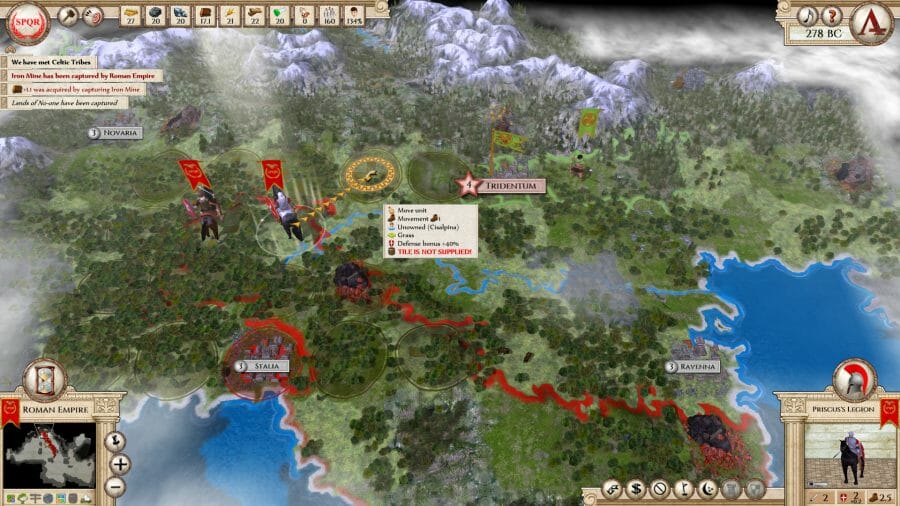
An evaluation of the exploration phase in Aggressors should differentiate between the default “Ancient Mediterranean” scenario and the random map generator mode. The Ancient Mediterranean scenario incorporates grand strategy elements, while the random map generator mode is a more typical 4X experience. Different factions in the Ancient Mediterranean scenario start the game with varying amounts of the map explored. For example, the Roman Empire begins the game with the entire map revealed, whereas the various barbarian tribes only see their immediate area. Regardless of whether a player selects the Ancient Mediterranean scenario or uses the random map generator, a fog of war covers all areas outside the vision range of cities, mines, or mobile units. Different units have different ranges of vision, depending on both intrinsic properties and terrain.
The purpose of exploration in Aggressors is to reveal resource nodes and advantageous locations for city placement. Resources in Aggressors are split between those that are produced directly by cities (knowledge, influence, and citizens) and those harvested on the strategic map from mines or quarries (gold, stone, iron, and coal). Production of city-manufactured resources scales exponentially with the population of a city. This gives some incentive to playing “tall,” especially for cultural or technological victories, but “wide” is generally the more optimal style for military victories. Cities also serve as bases where wood and food are collected automatically from tiles within range, with harvesting-range increasing as cities grow larger.
Certain tiles are more productive than others (i.e. forests produce more wood, grasslands produce more food, etc.). Eventually, improvements such as fields and farms can be researched and built on certain tiles to improve yields. Yields from quarries and mines can be increased by connecting them to cities or to a “blacksmith” improvement (once researched) with roads. Blacksmiths and “temples” are currently the only non-military improvements that can be built outside of a city. This allows some “unstacking” of cities, a la Civilization VI, which forces players to make interesting placement decisions, but the improvements themselves are a bit bland, simply adding a multiplier to the production of citizens in the case of temples or strategic resources in the case of blacksmiths.
Aside from the faction asymmetry inherent to the Ancient Mediterranean scenario, exploration in Aggressors should be familiar to anyone who has played the Civilization series or any other similar 4X game. Due to the comparatively small number of resources and undistinguished graphics, I don’t feel the same sense of excitement revealing an Aggressors map as I do discover new territory in a Civilization or Endless series game, but the Aggressors exploration experience is nonetheless perfectly adequate. As will be seen, this relative lack of complexity is a tradeoff that enabled the developer to create a resource management system that is satisfyingly deep.
eXpand
Perhaps the most unique expansion design choice in Aggressors is how players acquire territory. Unlike in the Civilization, Age of Wonders, or Galactic Civilization series where territory grows organically form cities, in Aggressors territory is taken by moving military units onto tiles, forcibly claiming the tile, or through diplomacy where federation, confederation, or annexation treaties can be negotiated.
Similar to exploration, the primary purpose of expansion in Aggressors is to extend control over resource nodes. Most quarries and mines start the game as independent, unclaimed structures and are fixed in certain locations on the strategic map. The race to expand your control over these resource nodes produces natural conflict points, as factions vie for control over regions containing high concentrations of mineral wealth. It’s an enjoyable mechanic that adds a suitable amount of dynamism to Aggressors, but not particularly groundbreaking.
As players expand they will naturally run into foreign empires. Diplomacy in Aggressors is integral to a player’s success. There are over a dozen types of diplomatic agreements players can reach, including military supply-line support, map/intelligence sharing, and federations where the AI maintains domestic control of its infrastructure, but grants the human player control over foreign policy decisions.

Diplomacy is perhaps a bit too frenetic, with peace offers, declarations of war, and various demands or offers being thrown at the player almost every turn. That said, the diplomacy interface is presented well with clear tooltips explaining what is impacting the attitude of foreign empires toward the player. Diplomatic choices also have strong impacts on game-play and AI players engage in diplomacy with each other in the same manner as with the human player. There have been many occasions where my invasion plans have been foiled by my victim entering into a confederation or federation with another AI I am too weak to fight. Overall, expansion in Aggressors is an enjoyable experience, but diplomacy, in particular, could use some additional refinement.
eXploit

Aggressors’ most outstanding feature is its resource management system. Decisions about resource usage are interdependent. For example, training military units will deplete citizens from surrounding cities. As cities are the only way to produce knowledge (research) and influence (culture), overdeveloping military might will rapidly result in a player falling behind in technological or cultural development. Similarly, construction and maintenance costs for military units and buildings/improvements are quite high in Aggressors (scaling with difficulty level) and normally require multiple types of resources. Overbuilding research, cultural, or military infrastructure will quickly result in deficits for the various resources. Resource deficits, in turn, decrease global and local happiness, resulting in city rebellions and military unit desertions. Players can very easily find themselves in a Jared Diamond “Collapse” death spiral type situation if they aren’t judicious about how to balance infrastructure development and military improvement with resource gathering.
All resources in Aggressors accrue to a global pool automatically and cities grow faster, allowing them to produce more citizens, knowledge, and influence, and expand their harvesting range for food and wood, if they are left alone (not assigned any tasks such as building improvements or military units). Food expires over time, but all other resources remain in your global pool unless traded away or pillaged by enemies invading your cities (the larger the city conquered, the more resources from the losing player’s global pool will be subtracted). Besides growing your cities or pillaging enemies’, the only other way to gather resources is through trade.
Trade is vital to a player’s success in Aggressors, especially on the higher difficulties or with smaller civilizations in the default Ancient Mediterranean scenario, where autarky is virtually impossible. All resources, even citizens, can be traded (citizens traded are transformed into slaves, decreasing the global happiness of the empire losing the citizens). As with many aspects of Aggressors, trade is streamlined to avoid micromanagement. Once a foreign city is visible, diplomatic agreements allowing a trade to become possible. Players’ only role is to determine the resources to be traded and the number of turns the agreement lasts (resources are transferred over time, not all at once, as in some games, adding realism to the transaction).
The game determines the shortest route and calculates a “trade-loss” due to piracy and overhead based on the presence of roads, distance to a closest foreign city, and whether or not the route traverses water. If cities with extent trade routes change hands, the game will automatically recalculate routes, potentially increasing overhead loss. Players can set a stop-loss value to ensure trading doesn’t become unprofitable. An innovative design decision of Aggressors that warrants special mention is the ability for players to make open-ended proposals where the AI will come back the next turn with a counter offer. Traditional “trade five units of gold for three knowledge points” type deals are also possible, but more often than not, the offer/counter-offer option leads to more meaningful and satisfying negotiations.
Exploitation in Aggressors is easily the most enjoyable phase. The number of types of buildings you can construct and technologies you can research is comparatively small, but decisions over what to build or research, who to improve relationships with, and which resources to prioritize through trade or expansion, are agonizing (in a good way). By keeping the number of decisions relatively small, but difficult to make, Aggressors’ designer has again made priorities clear, and the game is better for it.
eXterminate
Although combat in Aggressors is modeled very well, unit differentiation is weak. There are only five different military unit types (Roman, Greek, Persian, Carthaginian, or Barbarian) and each of these factions can only produce infantry and cavalry. Moreover, within the infantry and cavalry classifications, there are only three or four different units available per faction. In addition, units progress through technological upgrades in a purely linear fashion (i.e. Roman legionaries are superior to Roman Principe, which are superior to Roman militias, in every way). That said, each unit type has certain innate characteristics (barbarians are faster and fight better in forests, Romans are slower, but stronger, and fight best in open terrain, Persians have the best cavalry, Greeks are the most well-rounded, etc.).
Players also need to take into consideration terrain, supply lines, and various types of intangibles such as morale, soldier experience, including successes or failures fighting specific enemies (i.e. if Rome has lost many battles to Carthage in the past, the Roman player’s units will be less effective against the Carthage player’s units in the future), and civilization happiness levels. Players can also take certain “state decisions” such as giving a motivational speech or consulting an oracle that can produce randomly generated positive or negative effects.

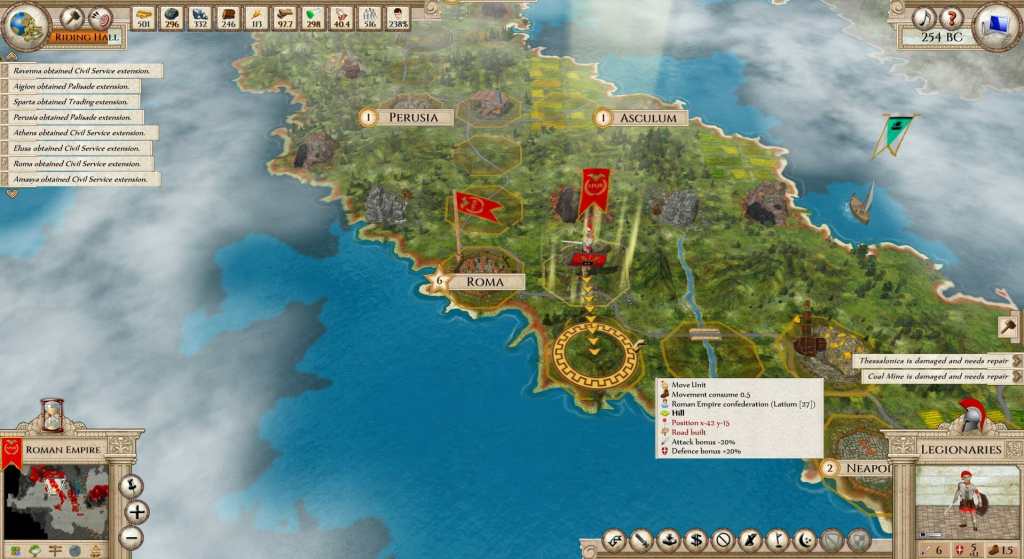
So while it is basically impossible to create combined forces armies with differentiated roles, a la the Age of Wonders series, there is still a lot for players to consider. The supply line and unit stacking mechanics are particularly well-done. Cities, naval units, and supply wagons all provide supplies to other units on the strategic map in Aggressors. The supply range is displayed through an intuitive overlay. Supplies decrease the farther away a unit travels from a city, naval unit, or wagon. As supplies run low, units lose morale and strength and eventually desert or disband.
Aggressors successfully navigate the treacherous “doom-stack” vs. “one-unit-per-tile” debate through innovative design choices that allow up to three units to be stacked on a single tile but limits the number of attacks and defenses units can make to one per turn (without special training). After being attacked, a unit’s defense value is significantly lowered. If multiple units are stacked on the same tile, the unit with the strongest defense value will defend first. Certain units are good skirmishers; they not very strong, but have a high withdrawal percentage rate, allowing them to engage in combat without suffering significant losses. Calvary is particularly good at this, and, as the stirrup was not yet invented at the time Aggressors is set, their role as a player’s primary skirmish unit feels very appropriate. This system makes players carefully consider troop placement to ensure the appropriate forces can follow up with additional attacks to take advantage of reduced defense values. Again, Aggressors’ designer is prioritizing depth over complexity.
The way in which players choose which military units to build is also handled well. Cities need to be “specialized” to produce units. Similar to the Age of Wonders series, the only way to produce a unit from a faction other than your starting faction is to take control over a foreign city through military conquest, influence, or diplomacy. So if you are the Roman faction and want an elite forest fighting force, you are going to need to coerce or entice a barbarian city to produce barbarian faction units. Within your own faction, technologies unlock superior units and various military improvement training. There are a vast number of training types that can be utilized, some of which can only be learned through experiences in battles. Many military improvements are interesting, unleashing powerful skills like the ability to attack or defend twice, travel along enemy roads without a movement penalty, or ambush adjacent enemies without retaliation, but some are pretty dull such as a bonus to attach or defense strength.
Finally, the relatively simple combat system allows for a tactical AI that is very capable. Aggressor’s tactical AI can carry out amphibious assaults, coordinate maneuvers to cut supply lines or harass weakened units, and focus attention to lock down strategic choke points. The strategic AI is also solid, but like all 4X games, there are areas that can be improved. The AI is pretty good at city placement to maximize resource intake but can use more work on making sensible choices about which improvements to build or train. The AI does not cheat and plays by the same rules as human players. Even without production or resource cheats, though, the AI tends to be better at throwing numbers at a problem than at developing elite units or productive/efficient cities. Overall, the AI is very strong (much stronger than Civ VI’s AI or even Civ V’s AI with the “Vox Populi” mod installed) and should give even veterans of the 4X genre a challenge on normal difficulty.
eXperience
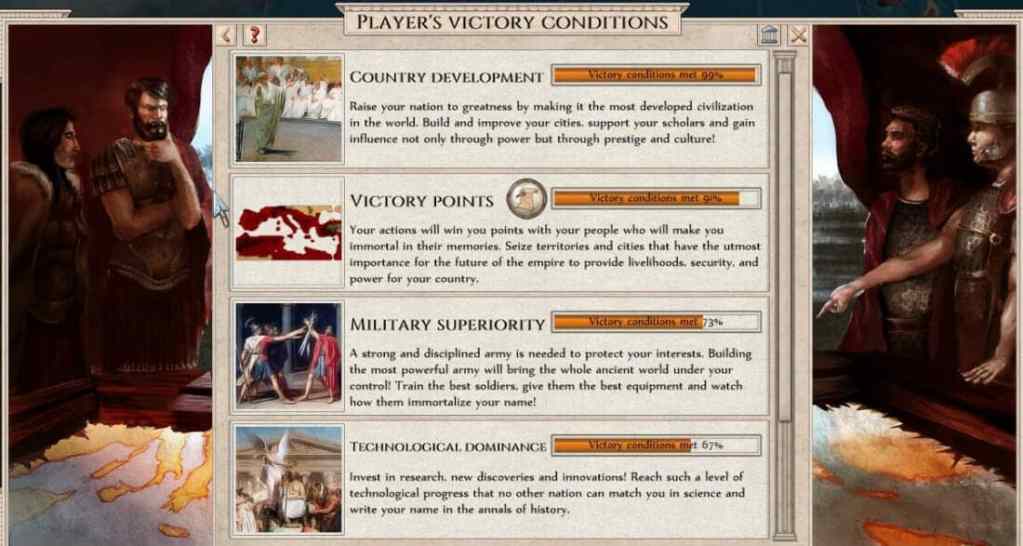
Victory conditions in Aggressors are limited and standard 4X fare (technological dominance, military superiority, cultural/economic hegemony, etc.) but flow naturally from other phases of the game. The user interface clearly explains the conditions and documents the players’ progress in achieving them.
More generally, Aggressors’ general user interface conveys a great deal of information surprisingly effectively through abundant tooltips and a complex filtering system. For example, players can create map displays sorting cities, quarries, and mines by productivity and other attributes. Players can also use similar map filters to identify which military units or cities have received specific upgrades/training (or any combination of upgrades/training). With this functionality, players can easily identify where specialized units are located, distance to the front, their health and experience levels, etc. Turning on or off filters will include or exclude map items from the display. It’s a very powerful tool that conveys useful information in a remarkably efficient manner, but it takes some time to get used to and the presentation is a bit bland.
Perhaps the biggest complaint from Aggressors’ player-base about the general user interface was the decision, at release, by Aggressors’ designer to utilize a non-standard left-click to select and left-click to execute mouse schematic (as opposed to the more standard left-click to select, right-click to execute). The non-standard option led to frequent miss-clicks and other misunderstandings. Within two weeks of release, Aggressors’ designer had patched the game to include an option to play Aggressors with the more standard mouse functionality. This experience is indicative of Aggressors’ designer’s overall philosophy of enabling player choice.
Aggressors is without a doubt the most customizable game I have ever played or seen in over twenty years. Aggressors ships with an in-game editor that will allow you to easily change almost any aspect of game-play without resorting to editing XML files or running scripts (although this is possible too for those more technically inclined). Aggressors’ map builder let’s players create a map of anything you can take a picture of, from maps of Middle Earth, real-life continents, or even body parts. It is one of the coolest features I’ve ever encountered.

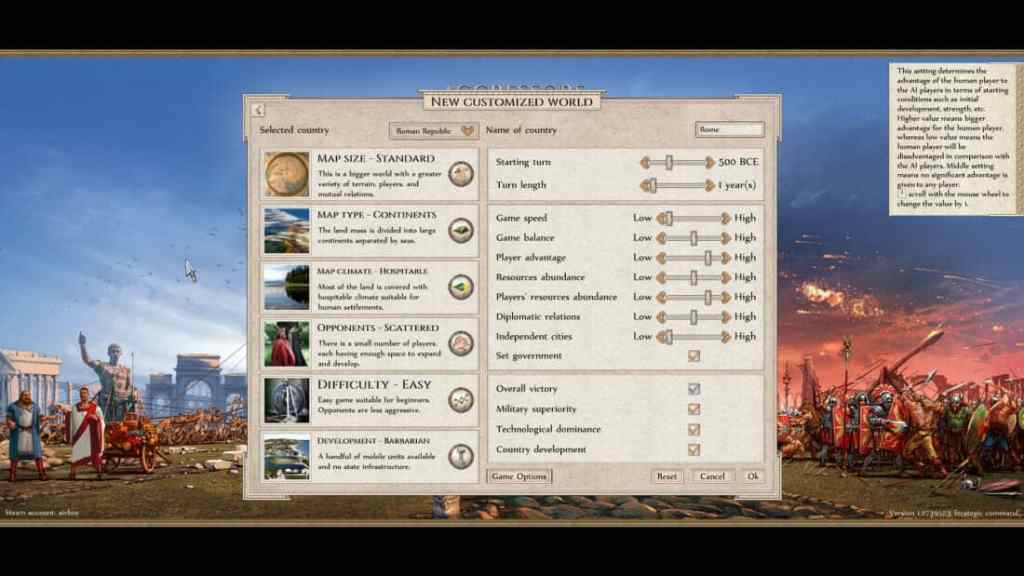
Aggressors is also incredibly customizable at the start of each play-through. Players can turn on or off random events, select or deselect entire game-play mechanics, set difficulty levels for individual opponents, etc. It’s so refreshing to find a developer that obviously trusts the player community.
The most serious defect of Aggressors is the comparative lack of faction differentiation. It is not much of an issue for the Ancient Mediterranean scenario, as that scenario is so well crafted and balanced, with interesting objectives and unique geographic features interspersed throughout the map. This leads to the creation of unique dynamics during most matches.
If Aggressors had a more robust modding community, it also wouldn’t be much of an issue. The most obvious problem is the lack of a starting bias toward a faction’s desired geography. This creates the wrong kind of randomness in a game. The issues go deeper than this, though. The only real difference between factions is the favored terrain type for military units. There just isn’t enough variety between military units to keep random games fresh. I’m not sure what the solution here is, other than the obvious response of generating larger numbers of well-developed scenarios. I don’t think radical asymmetry, along the lines of how the Endless series is designed, is appropriate for the historical setting of Aggressors. The solution probably lies in developing a few more mechanics such as influence, state decisions, and perhaps government selection in more detail and then mixing bonuses or maluses into the different factions for each of the systems.
Conclusion
Aggressors’ designer had a clear vision for the game and implemented this vision very well. Game mechanics clearly emphasize the importance of strategic decision making over complexity or scope. Aggressors is a streamlined game with relatively few systems to master. It is easy to learn, but difficult to master. While there are clearly some areas for improvement, overall Aggressors has been one of the most enjoyable games I’ve ever played in over twenty years of 4X and strategy gaming experiences. I can’t think of a single game on the market right now with as satisfying a mix of strategic choice, challenging AI, and plentiful customization options. If these things are important to you, I highly recommend Aggressors.
TL;DR: Aggressors is a very well-designed game with a distinct, old timey Civilization series feel. The gameplay sacrifices “complexity” (not many systems to master) for a streamlined experience, very strong AI, and strategic “depth.” Production values are adequate, if uninspiring, but the game runs well on most any system. Victory conditions are standard for a 4X game; no real innovation in this department, but serve their purpose well. A lack of faction differentiation may lead to some re-playability issues, especially on randomly generated maps, but customization options are plentiful, the default “Ancient Mediterranean” scenario is extremely well-balanced, and mod support is unparalleled.

Our Review Policy
You Might Like This Game If:
- You enjoy resource management systems that force tough choices
- You prefer streamlined decision making over micromanagement
- Customization, player choice, and modding are important to you
You Might NOT Like This Game If:
- You prefer to have more direct control over city development
- You enjoy a wide variety of unit types and technological upgrades
- Faction differentiation is very important to you
- Graphics and sound direction are very important to you
NKlein played on his personal PC laptop for a long, long time with a copy he purchased himself.