Kingsvein (Steam Link) by Rad Codex is the latest in the developer’s series of strategy role-playing games (SRPG) loosely based on the Final Fantasy Tactics system. Each game is further refined for the modern era, compared to previous entries, while being remixed with various genres to create fairly distinct and unique games.
In Kingsvein you play a diecast wisp hunter, a member of a sentient race of rock people dedicated to hunting down a threat known as wisps, creatures that can control and animate the bodies of the dead. When all contact with the city of Kingsvein is lost after wisps are sighted in the area, you are dispatched to travel to and investigate the city, discovering what happened and resolving it.
#1: Kingsvein is an SRPG Done Right
Many modern SRPs end up either being a bit too beholden to previous titans of the subgenre (either Fire Emblem or Final Fantasy Tactics) or fail to learn lessons that SRPG designers mostly moved past decades ago. Steam is littered with games that are derivative or broken, and it is easy to give up on the subgenre as a whole. Kingsvein is a strong argument against that.
The first way that Kingsvein stands out, much like similar Rad Codex games, is that it merges SRPG-style character building and combat with the exploration and discovery of an adventure game. The player will search rooms and treasure chests, solve miniature puzzles, and use new skills and items to revisit previous locations to discover new opportunities, enemies, and loot. Many character skills and items that are useful in battle also transfer this usability into the game world. Ice spells can be used to freeze water and let you cross it temporarily; teleport spells can let you move to ledges you were not able to access before; force spells with a push component can trigger distant buttons or devices.

Battles also take place exactly in the location where enemies are engaged. This makes the game a lot more like modern turn-based tactical games that do not have any real separation between the battlefield and the environment, rather than something that takes place in a separate specific battlefield that is independent of the environment.
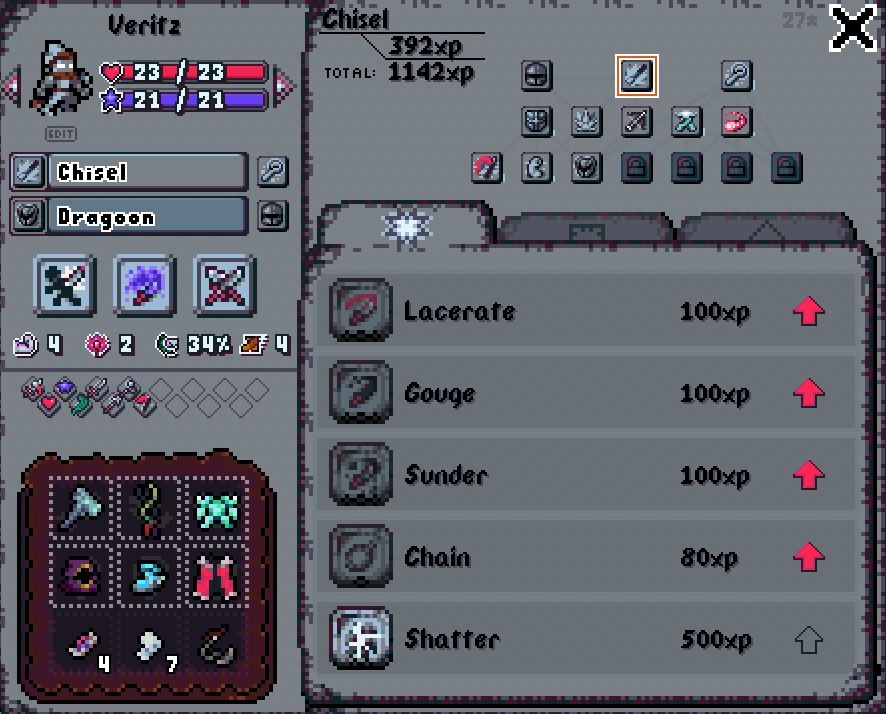
The class and ability system also feeds into this. While many of the abilities are battlefield-agnostic, many ways exist to make terrain and reposition enemies or allies onto it. This gives quite a bit of choice in approaching enemies and even the possibility to set up some battlefield elements before engagement. The player has a lot of ability to manipulate this in fun ways, both incentivizing trying to control where and how the battle happens, and also in creating new terrain to take advantage of enemy configurations.
The class and character system is reminiscent of Final Fantasy Tactics (FFT) but with the developer’s own streamlining and development. Going into the specifics would blow this article up and make it more of an explainer than a review, but suffice to say, the game retains the overall spirit and generalized structure of FFT, with the specifics being quite a bit different.
If I had one complaint about the overall system, it is that delay abilities are not great. They are timed to trigger after the end of the enemy’s turns, and enemies will move to avoid them. Some abilities reduce movement, and there is some utility to moving enemies out of an area or from moving forward in the face of the larger area of effect delayed abilities. Still, on the whole, a lot of design and ability space is used for a set of abilities that don’t quite work that well in practice.
#2: Kingsvein’s Music Stands Out as Being Particularly Good
I am not someone who tends to pay a lot of attention to music in games, and half of the time, I will end up muting a game to avoid repetitive voice lines or annoying music, but Kingsvein’s music was able to break through my normal indifference. The music intertwines with the overall gameplay and is enjoyable to listen to, especially if you like classic video game music.
#3: Kingsvein is at a Sweet Spot For Game Length
Optimal game length is a hotly debated topic among fans, with different perspectives on how long a game should be especially in comparison to overall character progression. There are games where all meaningful decisions about character build are made before the game ends, with the later parts focused on exploring the completed builds against end-game content. Other games end at about the same time the final decisions are made, and others still end before a build can ever be finished. Kingsvein mostly falls into the latter groups in that you are unlikely to finish your build before you reach the end of the game. Now, there is certainly the possibility to push beyond this. There are grindable encounters where you can earn extra XP, and if someone wants to see what a fully specced out and developed character looks like, they certainly can do so, but the cost of tediousness is likely not worth it for most people.

There are also questions about whether the game fully explores the story and overall themes and ideas presented. Kingsvein is admittedly light on direct story. There are few cutscenes or conversations, but the overall setting is dripping with theme, and you can get a lot of information using the Look command and reading the journal entries that come with it. This means that players can have as much or as little involvement with the story content and the world as they want, and it is easy to brush it aside if you want to replay. Even if the player only dips into the wealth of story content presented at the margins, that, combined with the specific traits of the world being explored, firmly establishes a distinct sense of place and conflict that makes the game feel anything but generic.
As for the amount of time it takes to finish, the developer describes the game as taking between twenty and twenty-five hours, which matches my experiences. It is almost certainly less on replays, especially as you discover how to unlock certain secrets in the game. Replayability is reasonably high. Because you are unlikely to ultimately unlock every ability with every class in a single play-through, and the different unique options you can give to your main character and your mount, it is possible to explore somewhat different capabilities on different runs.
#4: Kingsvein Stands Well Alongside Rad Codex’s Previous Games
With three prior SRPGs under their belts, Rad Codex has gained a reputation among subgenre fans for producing high-quality games. Their worst-reviewed game, Alvora Tactics, has 92% on Steam, and both of their other games (Voidspire Tactics and Horizon’s Gate) exceed 95%. These accolades are not empty either, as not only are each of the games high-quality SRPGs on their own, with deep combat systems and exciting battles, but each has been a steady step forward in game design and tech. Voidspire Tactics is a classic exploration/adventure game. Alvora Tactics plays with a bit of a roguelite formula, and Horizon’s Gate is a big open-world RPG. Kingsvein is most like Voidspire Tactics in that it features a self-contained mega-dungeon. Still, it also expands by containing some Metroidvania elements, specifically several secret bosses and items that let you visit old areas to find new secrets.
This is not to say that all the changes are ones I like. A big shift between Rad Codex’s previous games and this one is removing the action time-based turn system. While there are some advantages to this, both in ease of understanding and having one other factor to balance, it still feels like a loss. AT-based systems tend to have a bit more play and dynamism compared to alternating teams. While it is not a dramatic decline in overall play experience, I am left hoping that the next Rad Codex game will reintroduce this particular dynamic.

So, between the designer’s clearly developing skill in making this style of game and the general progression in technological capabilities, I would easily place this game as either Rad Codex’s best or second-best game to date. I think I preferred Horizon’s Gate simply because of the larger class tree and overall game scope. Still, for those who prefer tighter, more focused stories, it is easy to see how Kingsvein would end up being to someone else’s preferences.
Conclusion
Kingsvein is an excellent title and continues showing off both Rad Codex’s design chops and their ability to grow and progress with each title released. Their game designs may be niche, but they are very, very good in that niche, and Kingsvein leaves me excited to see what they are going to do next. My big hope is that the developers will take some of what they learned in Kingsvein and use it to produce another title of a larger scope like Horizon’s Gate, but regardless of what they choose, I will be here for it, ready to dive into the game as soon as I get the chance.