If you were to ask me at any point over the last four or five years to name my most anticipated game, Children of Morta would be near the top of the list. I first heard about the game when its Kickstarter campaign launched in January 2015. While I didn’t back the campaign, I was nevertheless completely intrigued by the game’s conceit and style and spent the next four-and-half years stalking it’s development and eagerly awaiting its final release.
Let’s cut to the chase. Children of Morta (Morta), from developer Dead Mage and publisher 11 Bit Studios (of This War of Mine and Frostpunk fame) is a fantasy action RPG with a bit of rogue-lite thrown in. The whole game is wrapped around a narrative format that follows the Bergsons, a family of warriors destined to protect the land from a reawakened evil and corrupting power.
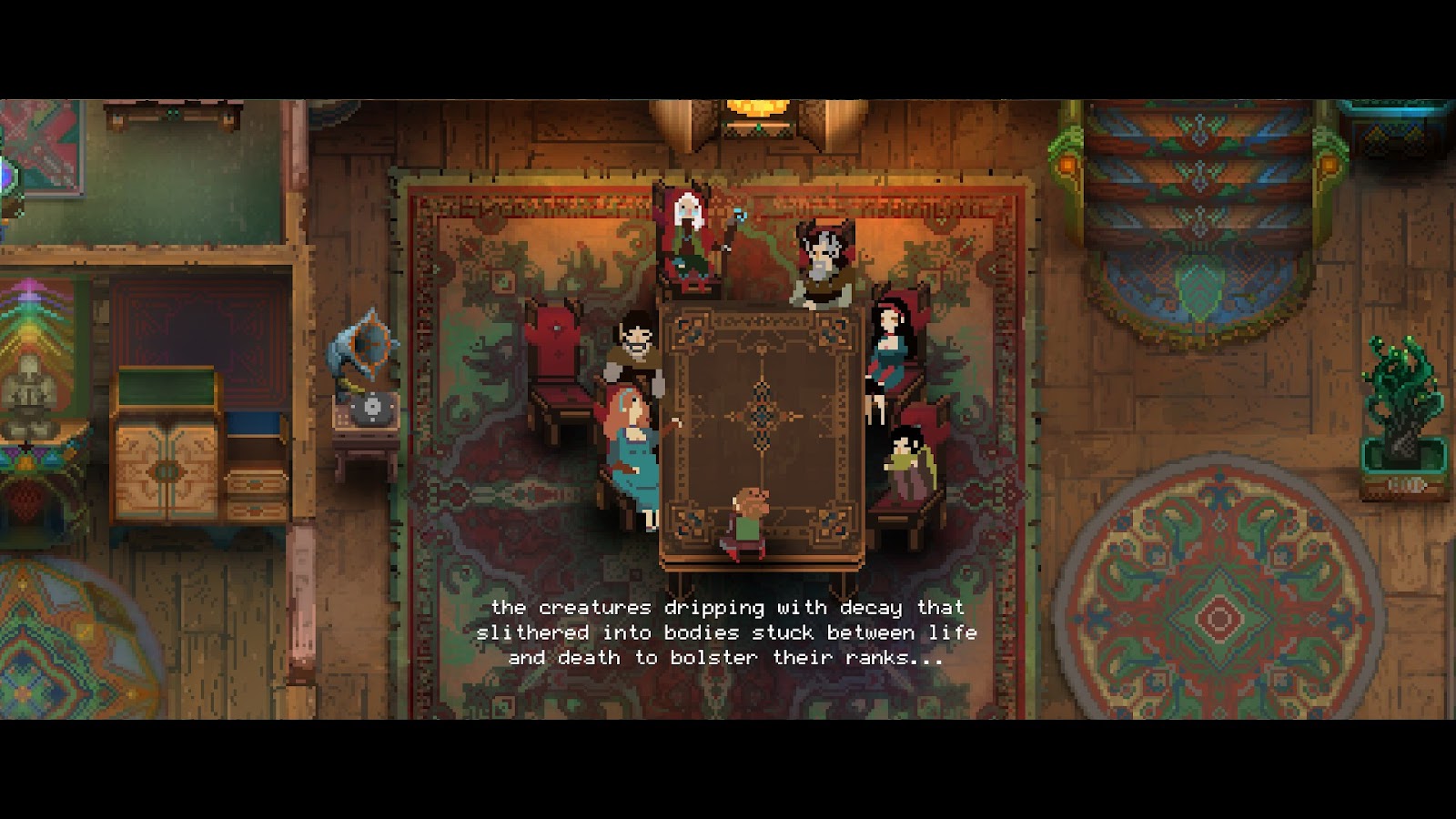
What made the game stand out was two-fold. First was the absolutely jaw-dropping pixel art. I cut my teeth as a wee-lad playing Sierra Quest games, and the art style and feelings conjured up a heavy dose of nostalgia, especially for the Quest for Glory series. Morta and Quest for Glory both share a pseudo-Bavarian overtone laced with an unhealthy dose of dark magic. But I digress. The pixel art in Morta never failed to draw me in and make the world come alive in my mind, stirring the imagination in ways that games with more realistic styles routinely fail to do.
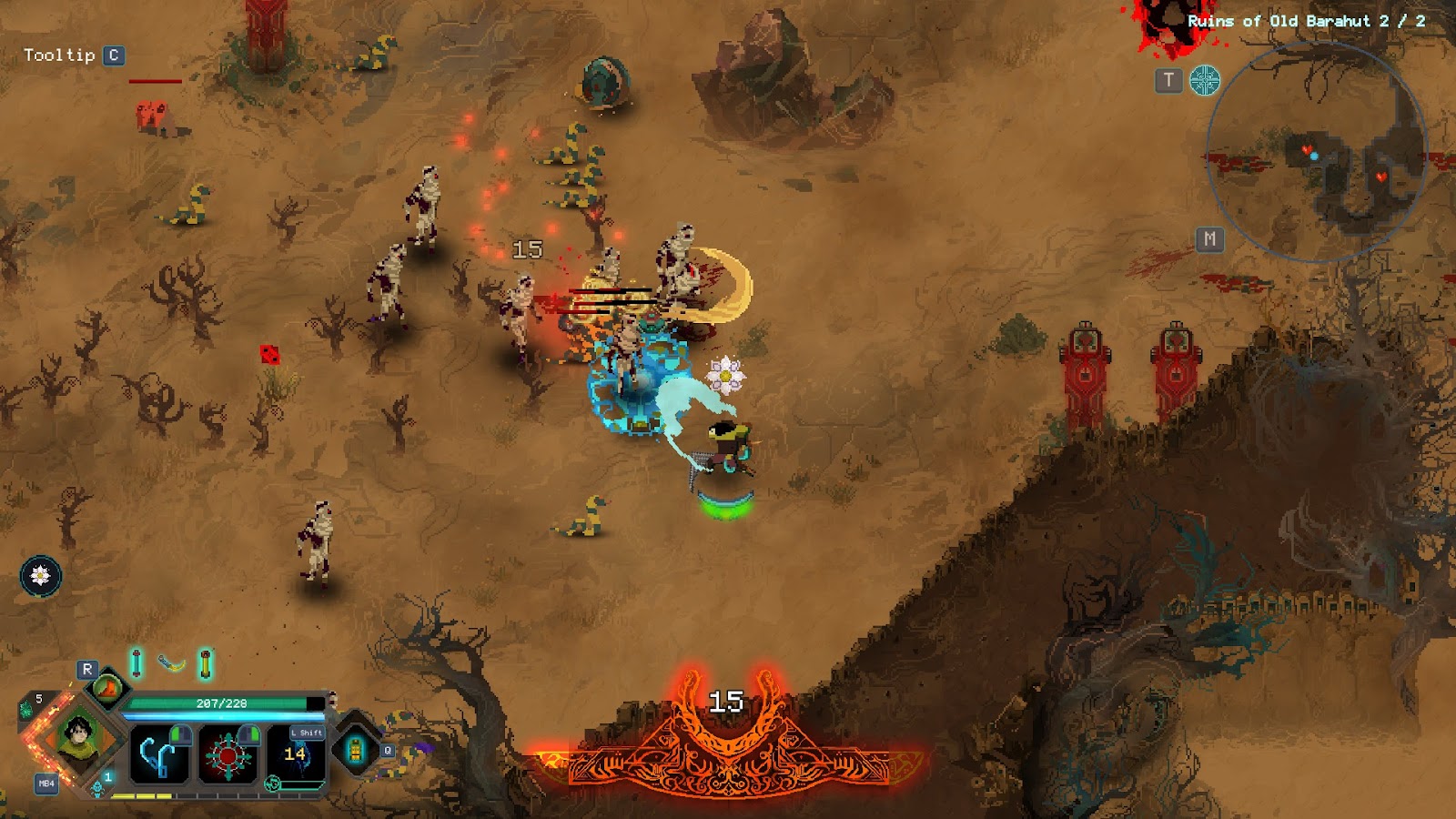
The other aspect of Morta that had me intrigued was, shocker, the gameplay itself. The primary dungeon-delving gameplay is a mix of action RPG and top-down twin-stick shooter (think Gauntlet, Smash TV). Unlike most action RPGs, where you use your mouse pointer to indicate where you want to move or where to target your abilities, Morta has you using FPS-like controls with the WASD-keys moving your character around and the mouse controlling your direction of facing. Like other twin-stick shooters, this makes combat a fluid- and fast-paced affair. You’ll be dodging and weaving around enemies in one direction while firing off attacks and triggering abilities in another. It’s quite invigorating.

When it comes to the gameplay structure, it’s worth setting the narrative stage a little bit more. The titular Bergons are a family of protectors, gradually coming to grips with a growing corruption spreading over the land. Grandma Margaret breaks the news to the family that they will have to begin exploring a series of caverns in order to find and release ancient spirits that can help reverse the corruption. There are three such spirits, corresponding to three different acts and associated landscape regions, through which the story and game progression unfold.
At the start of the game, the patriarch John and his eldest daughter Linda are the only characters that are available to undertake these dungeon-delving missions. You’ll guide these characters into procedurally generated dungeons, along the way triggering narrative events and special encounters. These narrative events range from the macabre and gut-wrenching to endearing and tear-jerking. It can be an emotional roller-coaster at times. A stoic narrator provides the perfect vocal pairing to these somber plot events while the lavish pixel art brings the scenes fully to life.
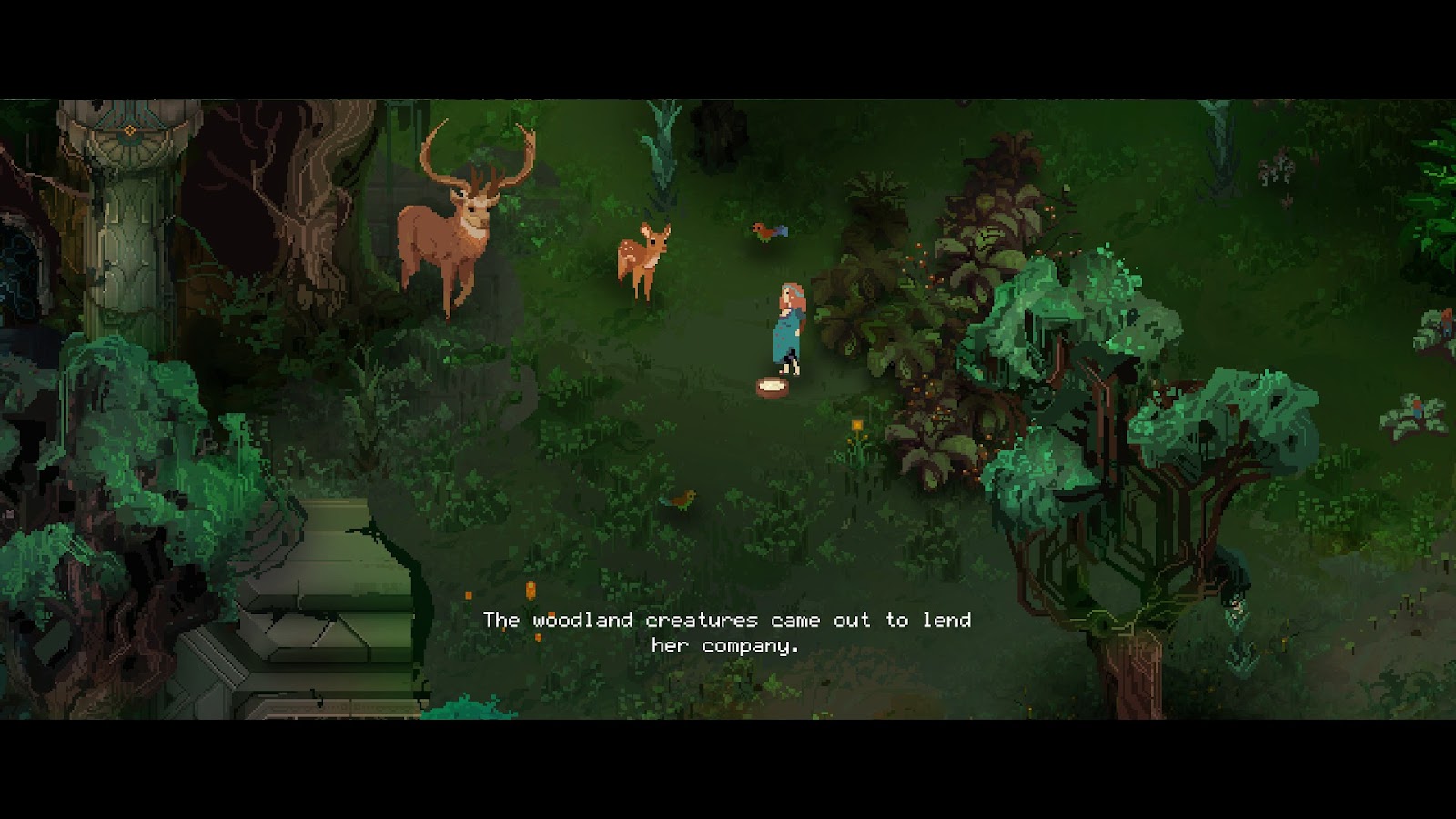
Ultimately, these narrative interludes are the driving reward and justification for play. The stories themselves often trigger a change to the Bergons home as you collect mementos from your explorations, make daring rescues that add new visitors to the domestic scene, or discover upgrades and advancements for your warriors. Of most significance is that when you end a run there is a chance for a bigger narrative event that unlocks one of the four other characters/family members for your use.
So to summarize! (1) Procedural multi-stage dungeons with mini-bosses spread over three acts? Check. (2) Narrative events that unlock the game’s progression system? Check. (3) Up to six family members on a quest to save the land from a hideous corruption? Check. With me so far? Good. Now, what do I think about it?
Here’s a cliffhanger: I can’t recall ever feeling so sad that a game had ended.
In many ways, particularly as a strategy game player, we’ve come to expect that games can provide near-limitless replayability. Whether it’s climbing up to higher tiers of difficulty or testing new builds and strategies. Whatever the mechanisms, we tend to expect that if we want, we could keep playing forever. When Morta came to a close, it was with a heavy heart because I didn’t want it to end. At least not so soon (after a mere 15 hours). This is a bittersweet testament to how much I enjoyed the game.
The thing to realize about Morta is that despite the rogue-lite overtones, it is a very linear game. When I talk about narrative events, I should note that there are no choices that the player is asked to make. Morta is about telling a story – a touching and heartfelt, if a bit cliched, one – but a story nonetheless. So while a given dungeon run is roguelike in its randomization and in the variety of powerups you find along the way, there is only one linear narrative that gets rolled out in the same manner. Once it’s over, it’s over. This isn’t a knock against the game, because the narrative was exceptionally gripping (and this is coming from someone not usually enamored with game narratives).
When it comes to the characters , each of the six has their own mini Diablo-like a skill tree, which they can advance along as they level up. Experience persist across runs, so even if you die, you’re still making progress towards unlocking new skills permanently. This isn’t a bad thing entirely, as it means if you come to a section of the game that’s particularly hard, you’ll eventually increase your character skills to the point that it becomes trivially easy. This syndrome was particularly notable with boss fights. While I usually despise boss fights in games (especially roguelikes) in Morta it was less of an issue because after a few runs you’ll unlock new skills that make the fight far less irritating.
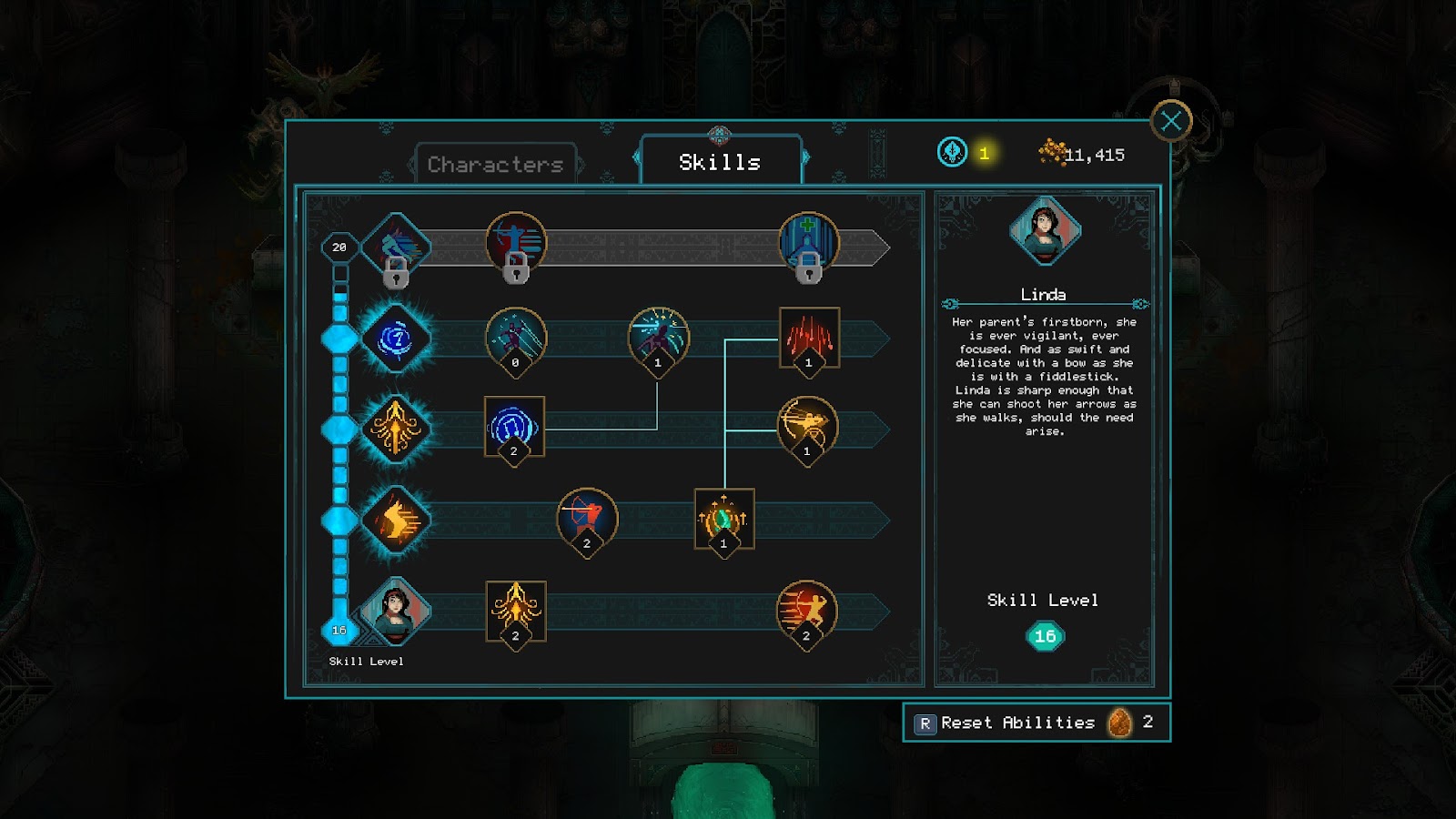
On a less positive note, however, the linear approach of Morta’s design applies to the progression system as well. There just isn’t much leeway to explore different skill combinations for a given character. You level them up, they unlock stuff in a pretty fixed order (and you’ll eventually unlock nearly everything by the end). There just aren’t many decisions to make at a strategic-level. And so when it comes to the end of the game, there is little incentive or reason to restart and “try a different build” or character approach. There are no different builds. Like the storyline, it’s going to play out the same way each time.
Having said all of this, Morta is still an awesome ride while it lasts. The twin-stick action RPG gameplay is a blast. There is definitely player skill to be levied throughout the game, both in the moment to moment fighting as well as figuring out which character will be able to best deal with a certain set of enemies or bosses depending on the current dungeon you’re advancing through. At times the gameplay can feel a little too reliant on kiting hordes and using evasion abilities, perhaps because health is so scarce that avoiding hits is extraordinarily vital. But this is a minor issue.

Thankfully, each of the six characters provide a different feeling to play. They each have their own rhythms and patterns of attacks that are rewarding to master. I love Mark’s martial art style and ability to flip/blink between enemies as he strikes. I love Lucy’s storms of fireballs and whirlwinds that carpet bomb the screen. I love Kevin’s near-infinite ninja-rolling combined with the ability to rapidly stun-lock enemies. Runes and power-ups you find during a run mutate each character’s abilities in different ways, so there does end up being some variety when using a particular character. Overall, each character feels very distinct on their own, and of course, the pixel art magnifies each of their quirks and nuances in a delightful way.
I enjoyed every minute of playing this Morta, as its linearity didn’t hit home until I made it to the end and realized it was over. There isn’t even another difficulty level that you can restart over with. I’d love to see a nightmare mode, Diablo-style, that lets you keep building on your progression by letting you restart the narrative from the beginning but with much stronger enemies. If they could do that and layer in some additional narrative twists that unlock at higher difficulty levels, that would be awesome. Perhaps for the future.

As it is, I now get to live this game experience vicariously through others. Morta provides local cooperative play on a single screen, and I’ve already sucked a few friends and family members into sitting down for a cooperative session. But this is a bit like re-watching a favorite movie with a different friend. Your enjoyment derives more from watching others enjoy the show for the first time, rather than from you watching the show itself. I just wish I could unwatch Morta so I could experience it for the first time all over again. All in all, that’s high praise.
TL;DR: Children of Morta is twin-stick shooter style action RPG with jaw-dropping pixel art and a finely crafted narrative. You’ll guide six different members of the Bergons family on a quest to save the land from a growing corruption. The narrative flourishes and story moments are among the most tender and emotional I’ve seen in a game, particularly of the rogue-like sort. While the overall experience is unfortunately quite linear and doesn’t much replay value, it’s a tremendous and wonderfully executed journey while it lasts.
You Might Like This Game If:
- You enjoy action RPG’s implemented as a challenging twin-stick shooter.
- You are down with pixel art, bigly.
- You don’t mind being along for an interesting but linear story-telling journey
You Might NOT Like This Game If:
- Fast reaction times and twitchy combat isn’t your jam
- You can’t deal with emotionally distressing conundrums
- Did you say rogue-lite?
Oliver has played over 30-hours on a Clevo Notebook ( i7-6700HQ Skylake CPU, 16GB DDR4, GeForce GTX 980m). Oliver was provided with an early access key by the developer.