Dominions 6 – Rise of the Pantokrator, developed by Illwinter Game Design (Dominions), is without equal in the fantasy 4X genre. I write that easily and without hesitation because I don’t think it can be compared with any other game in the genre. Sure, it sounds like your typical fantasy 4X affair if you list its features, but how they are carefully crafted and welded together makes for a profoundly novel experience. Moreover, I would not say that Dominions improve upon other games or that I wish other games would copy their mechanics. Dominions lives in its own space, does its own thing, and does it exceptionally well. Even describing how the game feels to play is a challenging feat, but here is my best attempt.
Dominions is a game that presents you with simple tools to interact with masterfully designed magic and combat systems via hundreds of unit types, spells, and magical items, that when mastered allow you to turn even the most mundane human into a weapon capable of single-handedly annihilating an army of hundreds. You will cast spells that raise skeletal legions, summon hordes of demons, blot out the sun, or freeze the world. It is not a game concerned with what is fair or balanced, but rather with allowing a player to contrive many absurdly powerful solutions to overcome an obstacle if they take the time to be creative.
If you want a quick verdict, Dominions 6 is a fantastic game that offers unparalleled opportunities for creative problem solving and lets you cast world-altering spells that you wouldn’t think possible outside of tabletop RPGs. It is a game that is difficult to learn even though it shouldn’t be. While the single-player experience has seen marked improvements from Dominions 5, it is missing vital features such as trade and basic diplomacy with the AI. Community-organized multiplayer games offer the richest overall experience. For returning players, major new features include dedicated multiplayer servers that allow for a far more streamlined experience, a new magic path called Glamour, larger armies in battles, and an in-game peace treaty system. For new players, Dominions 6 is the most accessible entry in a truly unique series but still requires a good bit of effort to learn.
In the remainder of this review, we will dive into the details of how Dominions feels to play, discuss the major obstacles to entry for newcomers, consider the pros and cons of being a game reliant on its community, and then bring this thing to a close. Dominions is the combination of three highly interconnected puzzles: the Magic Puzzle, the Combat Puzzle, and the Map and Diplomacy Puzzle. We begin with magic.
The Magic Puzzle
Underlying the entire game is its unique magic system. The spells you can cast and how you go about casting them are unlike in any other fantasy 4x. There are your typical spells: launching fireballs, increasing physical and elemental resistances, and summoning various magical units. Then there are the spells that you wish a fantasy game would let you cast. These include summoning an eternal winter that spreads cold across the map and incites frost giants to randomly attack all other nations, turning the forests to your side by having them spread your god’s influence and rebel against other pretenders, cursing your army with second life so that your troops rise again if they fall in battle, instantly banishing any unit to the void regardless of their power, stunning an entire enemy army every few combat rounds, or enchanting your army with flight so that they can descend upon the enemies backline in the first combat round. Yet do not discount the power of combining seemingly mundane spells. A few early-game defensive spells and the proper gear can turn a commander with only middling defensive stats into the bane of those who oppose you.
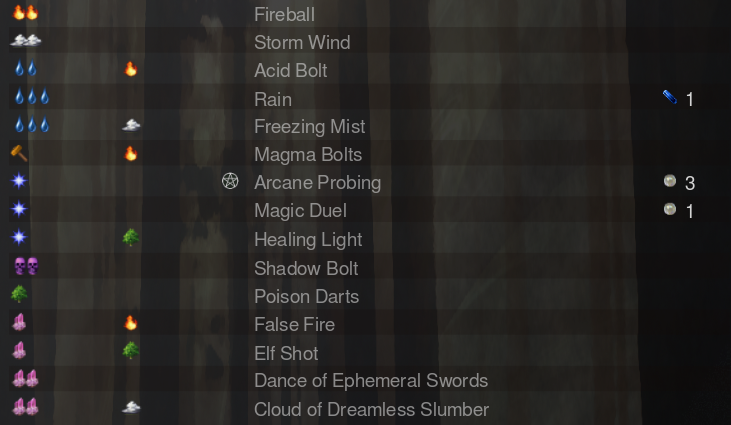
Just as interesting as the spells you can cast is the gameplay puzzle of how to cast them. There are 9 types of magic including Fire, Water, Death, and Astral. To be cast, a spell may require a mage with at least 3 levels in Water magic and at least 2 levels in Death magic. Mages have levels between 0 and 9 in each type of magic, with most having no more than 3 levels in 2 types of magic. How then will you cast a level 9 Death spell when you only have level 3 Death mages? Before we tackle this dilemma, you first need to gain access to the spell you want to cast.
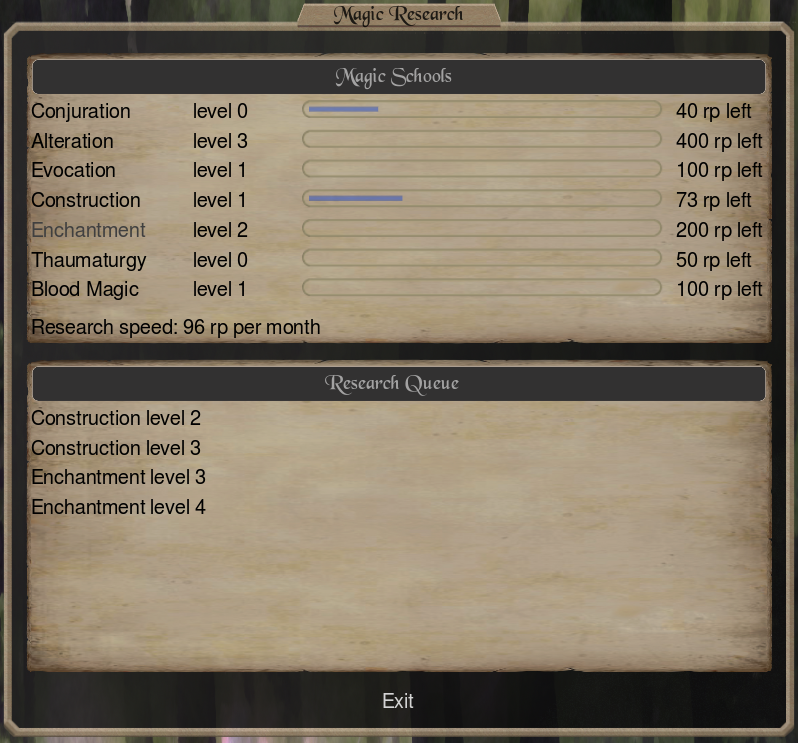
The hundreds of spells in Dominions are organized into 7 schools of magic. For example, the Enchantment school contains spells that buff your troops and raise undead legions, among other things. Each school is divided into 9 levels, with the strongest spells requiring you to reach level 9. Setting your mages to research one of the schools will gradually raise your level in it, granting you access to new spells.

Another requirement to cast some spells is spending resources called gems. There is a gem for each of the 9 types of magic. To gain gems, you must send your mages to a region and order them to search for sites of magic. A mage uses its magic level to search, meaning a level 1 Water mage may fail to find a site that a level 3 Water mage could easily locate. There are also spells that allow a mage to remotely search regions for sites, but these must be researched and require gems to be cast. Once a magic site is found, you will gain its benefit, which is usually passive gem income. This presents yet another conundrum: how will you gain enough Water gems to cast a spell if you only have a single level 1 Water mage?

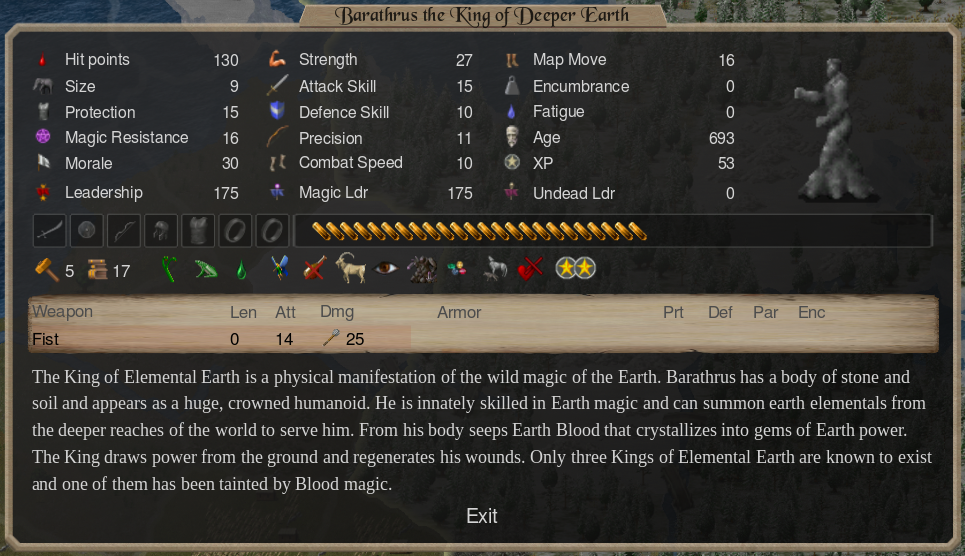
Now that we have a basic understanding of the magic system, we can consider the above questions about how to cast powerful spells. The answers are entirely up to the player. Let us consider how I solved the problem of casting King of Elemental Earth, a level 5 Earth spell that costs 50 Earth gems and summons a powerful level 5 Earth mage, even though my nation does not have access to Earth mages.

Luckily, a random event granted me a level 2 Earth mage. I had this mage craft some Earth Boots that raised their Earth magic to level by 3. Next, the mage sacrificed 50 population to raise their Blood magic to level 1. How is Blood magic going to help the mage cast an Earth spell? Well after raising their Blood magic to level 3 by equipping some armor and a dagger, they crafted a Blood Stone that raised their Earth magic to level 4, just 1 short of what we require.
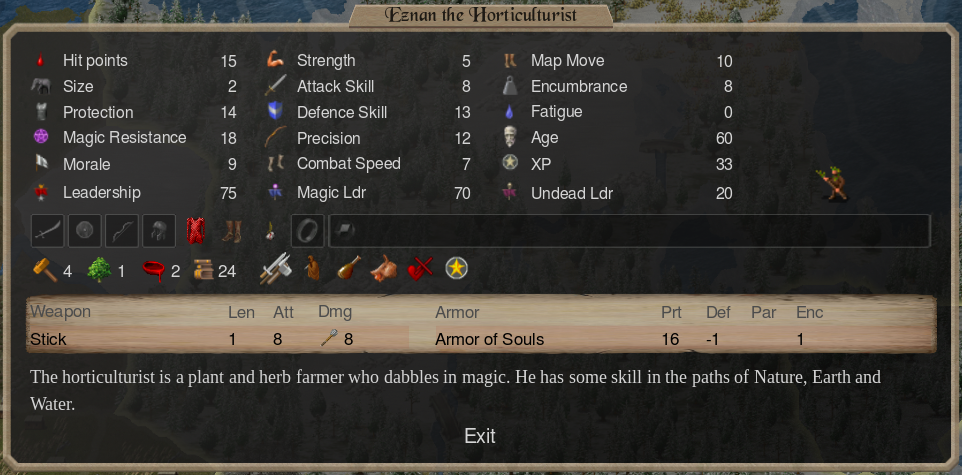
Unfortunately, the other items that boost Earth magic level were out of reach, as they require magic levels that I could not easily attain. However, I had my mage cast Troll King’s Court, a level 4 Earth spell that costs 65 Earth gems and summons a level 3 Earth mage along with their army of trolls.

Finally, giving this new mage the Earth Boots and Blood Stone raises their Earth magic level to 5, allowing them to cast the desired spell.
If we tally up the cost of crafting the necessary items, boosting Blood magic, and casting both Earth spells, this process was very costly. Also, do not forget that since my nation had no natural access to Earth mages, I could not easily search for Earth magic sites, and so my Earth gem income was not sufficient to cast the spells that I did. I solved this problem by conquering my neighbors and stealing their Earth magic sites and trading with my allies for the remaining Earth gems. Was this whole ordeal worth the effort? Now that I had access to a level 5 Earth mage, I could easily boost them to level 7 and cast some very powerful spells. My enemies would not expect me to have access to these spells, which would give me an advantage in battle. I could also use my acquired mages to summon additional Earth mages to support my armies and to increase my Earth gem income via site searching. In short, I profoundly expanded my gameplay options by finding one of many solutions to a complex magic puzzle.
The Combat Puzzle
In contrast to the magic system, combat in Dominions is seemingly simple. The game works on a WeGo system, meaning that all players plan out their turns and then all turns are processed simultaneously in several phases. A battle occurs when two armies enter the same region. An army consists of one or more commanders and the troops that they lead. Victory is achieved when the enemy army routes due to either suffering sufficient losses or losing all its commanders. Rarely is an entire army destroyed before it routes, but careful planning may lead to such an outcome.

Battle planning occurs before the battle even begins. You do not have direct control over your army in a battle. Instead, you give each of your commanders and squad of troops a script of orders that they will attempt to execute. However, you can only give squads basic commands such as Attack Closest or Hold and Attack Rear, which orders a squad to wait 2 combat rounds before attempting to attack the enemy’s backline. In addition to these orders, Commanders can be given 5 specific orders that they will attempt to execute in sequence. The complexity of the combat system arises in the interplay of the commanders’ scripts. For example, you may order several mages to summon Hordes of Skeletons for 3 rounds and then have another mage imbue all the skeletons’ weapons with magic damage on round 4. If the magic weapon spell is cast too early, then your hundreds of skeletons could be wiped out by a commander that is only vulnerable to magic damage.

I stated that armies will attempt to follow your script of orders. There are many factors that may cause a commander or squad to improvise, for better or worse. You may spend most of your turn carefully scripting your army for a massive battle only for a squad of imps to descend upon your mages in the first round and throw off your entire plan. Sometimes you doom yourself by forgetting to script certain spells such as fire resistance when facing an army of pyromancers. Other times you may script short range spells that never get cast because the enemy never gets close enough. One time, I cast a spell that put almost all units to sleep, including my own, but the enemy army poisoned my troops before entering their slumber, and I lost my entire army before my sleep-immune troops could win the battle. Losing a crucial battle due to the above factors can be infuriating, but after enough embarrassing losses you will begin to predict battle outcomes and see potential counterplays.

Counterplay is the name of the game in Dominions. To succeed, you will need to know the strengths and weaknesses of your nation as well as your enemy’s nation. Your enemy will work to shield their weak points, and you must anticipate that and plan around it. Consider my devastating loss to poison brought on by my own sleep spell. That sleep spell had been winning me battles previously. However, the enemy nation had access to Nature spells, such as poisoning an entire battlefield and summoning endless swarms of forest creatures to relentlessly attack an opposing force. I could have easily predicted this counterplay to my sleep spell and planned around it, perhaps sending a single poison-immune commander with high defensive stats into battle.
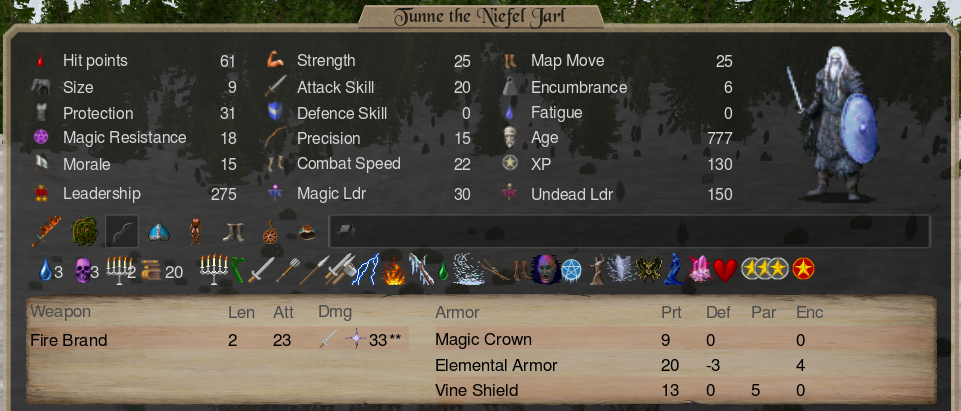
Speaking of stats, a new player can get by without fully understanding damage calculations and instead relying on large numbers of troops and powerful spells, but understanding the carefully designed damage and stat systems presents another avenue for creative solutions to gameplay puzzles. Without delving too far into the details, let us consider the Defense and Protection stats. Defense influences the chance that a unit is hit by an attack and Protection mitigates the damage dealt by a successful hit.
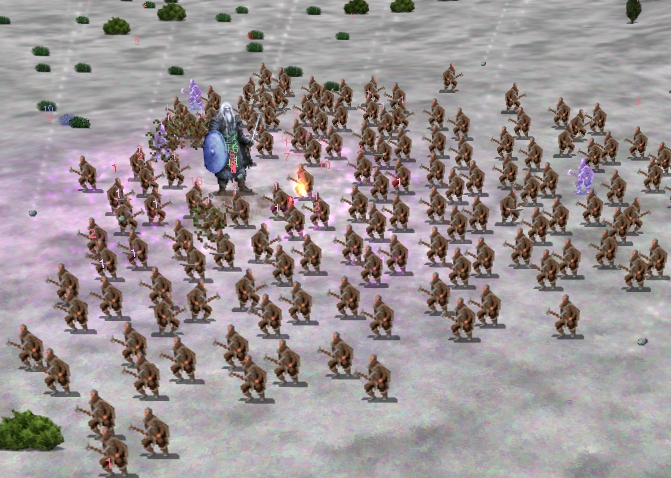
With the appropriate gear and spells, a commander can be made incredibly difficult to hit let alone damage. I once defeated an army of 600 humans dual-wielding axes with a single frost giant commander. The commander gained extra Protection in cold regions, froze units in its vicinity with its natural cold aura, and regenerated health by casting Soul Vortex to suck the life from nearby units. Even though the humans could surround the giant and attack twice each combat round with their two axes, their low health often prevented them from living long enough to attack more than once, and their attacks could not penetrate my giant’s indomitable Protection stat.
The Map and Diplomacy Puzzle
The map in Dominions is divided into regions of various odd shapes. Aside from shaking up the visual uniformity in a genre dominated by squares and hexagons, this makes the simple act of moving across the map far more interesting. One region may be connected to eight others, acting as a hub for mages and troops passing through, while another may be a key chokepoint for whoever can hold it.
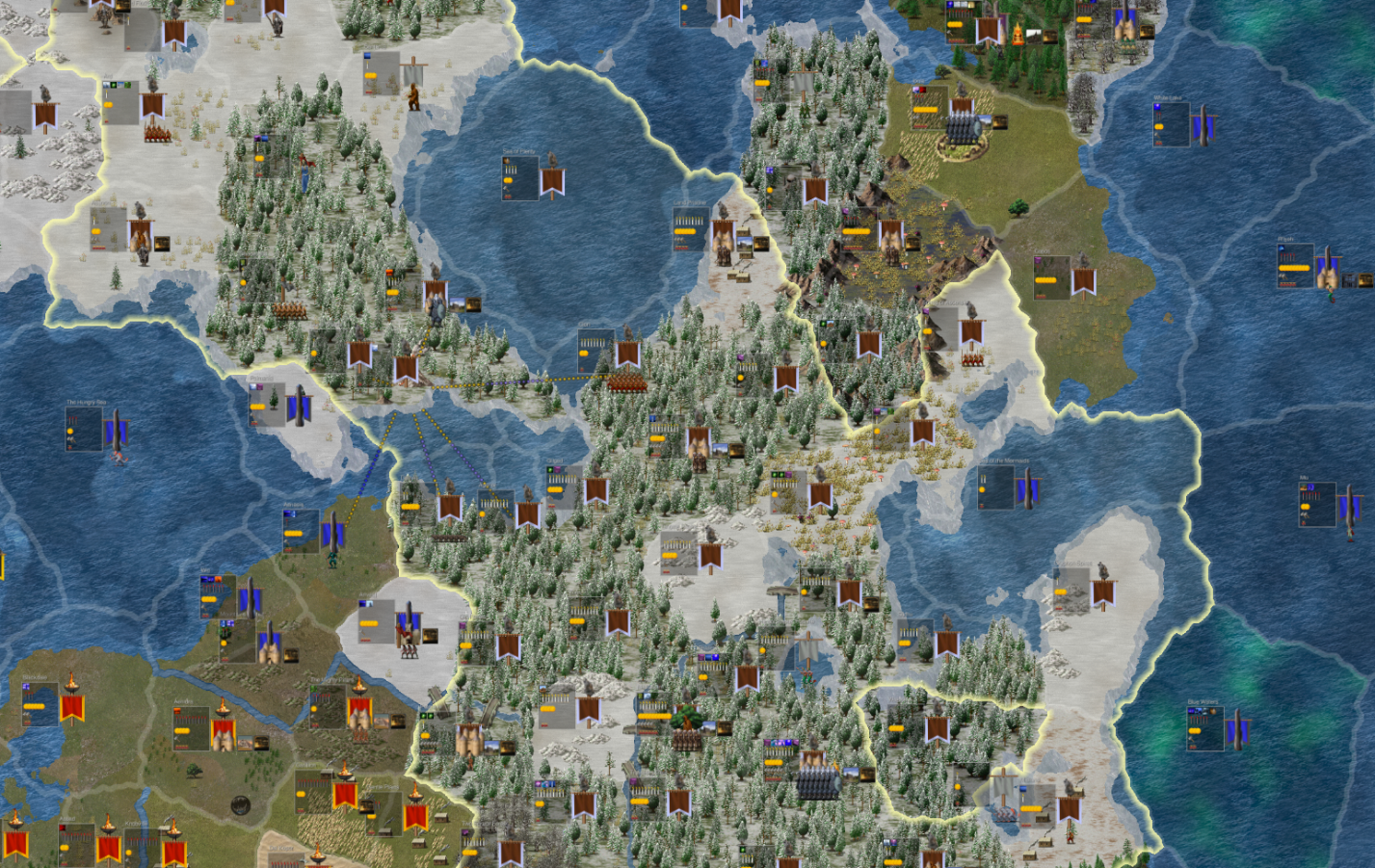
Adding to the map complexity, each region has a terrain type such as plains, forests, mountains, or oceans. These influence the presence of magic sites, the size of the local populace that provide monetary income, and the effectiveness of some spells. Each region also has a temperature that changes with the season and can be affected by spells or nation mechanics. Water regions become traversable when they freeze in the winter while mountainous regions become impassable during this time. Certain regions contain Thrones of Ascension, which provide victory points and positive or negative effects when claimed. Claim enough of these to win the game. A region can contain three player-made buildings that alter its properties. A fort provides defense against invaders, additional income drawn from adjacent controlled regions, and the ability to recruit troops. A lab allows for the recruitment of mages and a temple enables priests to be recruited.
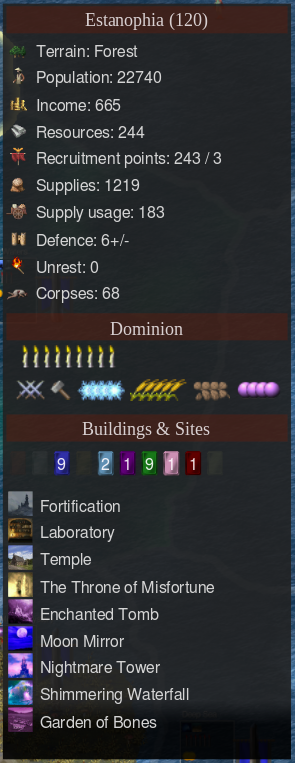
In terms of the map puzzle, we have already discussed how mages are used to find magic sites. Priests also contribute to this puzzle by spreading their pretender’s dominion via preaching. A region is either in no pretender’s dominion or in exactly one pretender’s dominion. However, dominion is not the same as controlled territory. In particular, a pretender’s dominion can be absent from a region they control and present in an enemy controlled region. The uses of dominion are many: some units will respawn when killed in their pretender’s dominion, some spells grant buffs to a pretender’s troops while in their dominion, and the temperature of a region can be affected by dominion. The most important feature of dominion is that if your pretender’s dominion is erased from the world, possibly by enemy priests preaching their falsehoods, you immediately lose the game.
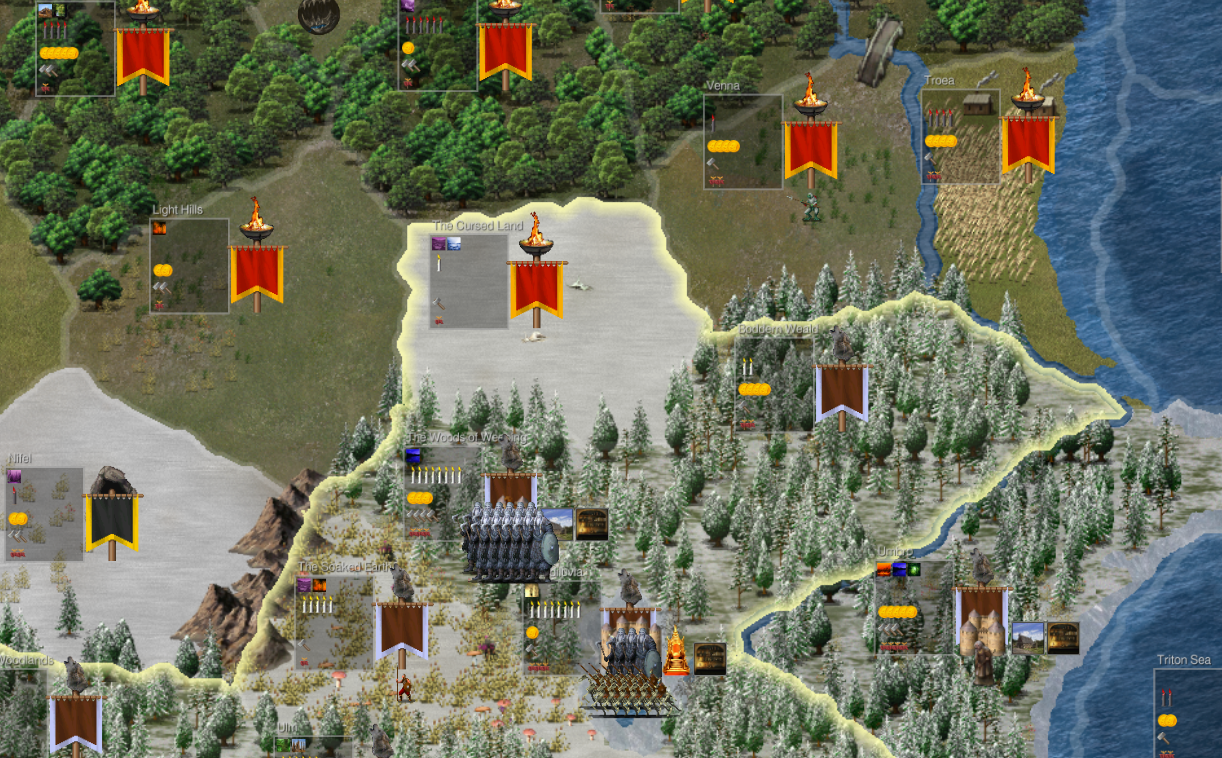
Determining how to traverse the map, spread dominion, and claim Thrones is the most important puzzle in Dominions. If all that stands between you and victory is a pesky neighbor, then crush them using the combat and magic systems. This is easier said than done if the only path into their land is through a heavily garrisoned fortress with bodies of water on either side. Armies can chance crossing the water when it freezes in the winter, but without some method of breathing underwater they run the risk of drowning when it thaws. Worse yet is if your neighbor lives underwater, like Atlantis, in which case you will be fending off their coastal attacks until you acquire the gear or spells necessary to bring the fight to them. On the other hand, if your neighbor is a natural threat, such as a fire-based nation that can engulf your frost giants in flames, then you may want to pursue temporary peace. At least until you gain a clear upper hand.
It is worth noting that peace treaties are the only form of diplomacy available in singleplayer games. Trading, planning joint military operations, or agreeing on borders are not possible with the AI, which is a shame because these features would greatly enhance the singleplayer experience. In multiplayer, trade is an invaluable tool that can gain you an early lead or help you win a game.
The in-game trade system is very barebones. You can send gems or items to another player, yet there is no way to request anything in return. Instead, you must rely on good ol’ fashioned honesty, although it is probably better to rely on and expect deceit. There is also no in-game live chat, but you can send messages between turns. Most multiplayer games of Dominions rely on Discord for live communication between players. They also usually enforce trade deals that can be made on a single turn, such as trading gems for items. However, this enforcement relies on one player pleading their case to the game host, who then reviews the evidence – usually chat screenshots – and makes a ruling. Trade deals that cannot be made on a single turn, such as paying a player to attack another player, can be broken without consequence. These aspects of trade can lead to drama that often enhances a game or to tantrums on Discord for all to see.
Touching on the more abstract diplomatic options, as soon as two neighboring players come into contact they usually make an initial border agreement. If there is a Throne on this border, then the players may agree to leave it unclaimed for the time being or make an exchange where one player claims the throne and the other player gains some compensation. Alternatively, a player may choose to forgo communication and opt for extermination. Much of the excitement in a multiplayer game is in the ever-changing relations between human opponents as the balance of powers shift.
How it Feels to Play
The above puzzles culminate in turns that can take either a few minutes once battlelines are drawn and armies are on the move or several hours to analyze the outcomes of large battles, conduct diplomacy, plan out how to cast powerful spells, script and move armies, forge items, search for magic sites with mages, and move ever closer to claiming enough Thrones to win the game. Playing a turn can be both exciting and overwhelming as you grapple with all the game’s systems and all the viable paths to accomplish your goals. The anticipation of committing to a major play and the exhilaration of seeing it succeed are matched only by the despair when all your hard work falls apart.

The first third of the game is spent expanding your borders from your capitol by fighting the neutral armies that occupy them, running into other AI or player nations and negotiating peace, searching for magic sites to kickstart your magic economy, setting initial research goals, and constructing forts to solidify your territory and start pumping out troops. Perhaps you get lucky and win an early war that gives you a significant early game advantage. The second third of the game is defined by wars and alliances, and if you had a successful early game and planned accordingly, then the spells you now have access to will establish you and a real contender for victory.

The last third of the game is all about casting army-obliterating and world-altering spells. Some of these spells, called global enchantments, persist until they are dispelled by another player and may affect all players. Only 5 global enchantments can be active at any time, and the top nations will aim to have multiple active at once and will invest enough gems into their casting to ensure they are not easily dispelled. We discussed one such spell previously that conjures an eternal winter. The frost giant nation called Niefelheim can usually recruit their most powerful unit only in their capitol fort, but this spell allows this unit to be recruited in any of Niefelheim’s forts that are located in sufficiently cold regions. Combining this spell with another global enchantment that greatly increases gold income will typically spell doom for all other nations.
Obstacles to Entry
Hopefully the previous sections have piqued your interests enough to endure this next bit: even though I think Dominions is a phenomenal must play for 4X and strategy gamers, it is a difficult game to start playing. Here we will discuss two major obstacles to entry followed by a few minor subjective issues.
The first major obstacle to entry is the game’s 444-page manual. Don’t worry, only 87 of those pages are game rules… only 87. I don’t mind manuals, in fact I love a good one, but I acknowledge that most others do not share my enthusiasm. And I would call Dominions‘ manual serviceable rather than good. It is sorely missing a “getting started” section that would tremendously help with onboarding new players, because while Dominions is a complex game, it is surprisingly simple to play turn to turn. Even a short summary of the main mechanics with a few illustrated examples, like what I have written above, would be far more instructive than what players are given, which is more of a rules reference book than a proper manual.

The second major obstacle to entry is setting up a game. Before you can start playing, you must pick an age to play in, a nation to control, and a pretender god for all to worship. This last task often frustrates new players who want to know how their choices will affect their experience, because choosing and customizing a pretender is nuanced and obtuse, and a bad design can easily lead to a horrendous early game or even a quick defeat. Even so, my advice to newcomers is to not think very much about these choices and just start playing as quickly as possible. Your first game is going to be spent wrestling with the mechanics and learning how they affect each other. Even if you end up stuck at your capitol with a dead pretender and no troops, you may think to take a powerful dragon pretender next time and end up learning something about your nation’s early weaknesses.
These last few topics are not so much obstacles as they are subjective factors that may impact the overall experience for some players. For starters, I find the 2D sprites and map to be charming and detailed, but others may prefer 3D models with photorealistic visuals. Next, the UI gets the job done while being very simple. Some may say the UI is too simple, since it seems to be designed around the heavy use of hotkeys. You can view a list of all hotkeys relevant to the current game screen by pressing “?”, which facilitates memorizing these shortcuts. Last, once you have a few dozen hours in the game, there will be several quality-of-life features whose absence becomes painfully apparent, especially when you control a third or more of the map in a game. Most menus would benefit from a search bar and more advanced filters. Simple acts like forging an item become burdensome in the late game when you must scour your vast empire for a mage with the necessary magic skills. This would be made simpler if the game had a dedicated window for item forging, where you can search and filter for the item you want to make and then choose an eligible mage for the job from an auto-populated list. Little annoyances like these weigh down an otherwise amazing game so much so that the community has created a searchable database that would usually be present in a game of this scope. That leads us to the last topic of this review.
A Community Game
I almost included this topic as the third major obstacle to entry, but decided against it because the fact that Dominions lives and dies on the back of its community is as much a boon as it is a burden. The community is sizeable, passionate, and ready to fill the holes left by the developers. As mentioned, Dominions lack an in-game compendium, so the community made one. The game is also missing a battle tester where you can build two armies, script them, and then throw them into an arena, so the community made one. And in a game with hundreds of units, spells, and items on top of a complex combat system, you will be glad they did.
Another aspect of the game that the community carries on its back is the multiplayer system. Thankfully, Dominions 6 has a dedicated server lobby, unlike its predecessors. Even so, finding people to play with will require you to join one of the various Discord servers and jump into a game channel that is looking for players. Don’t worry, there are always new games being created and the community is very welcoming. Before there was a dedicated server lobby, the community even developed a Discord bot to automate and facilitate multiplayer game hosting, and many players still prefer the bot to the new server lobby.
Lastly, even if you are playing Dominions solo, I still recommend joining a community Discord server, because you will undoubtably have many questions, and the people on there are veritable fonts of knowledge. Throughout my first multiplayer game, I asked dozens of questions between each turn as I learned the magic battle systems, planned research, and negotiated with my opponents. You can easily get by without so much effort, but discussing the game with other new and veteran players enriched my experience.
In closing
I absolutely love Dominions 6. In no other fantasy 4X or strategy game are you faced with seemingly insurmountable situations and then given a vast toybox of spells and magical artifacts and asked to devise a method to not only surmount these situations but to become insurmountable. At the same time, the game is not the most welcoming to new players who aren’t willing to study its manual, wrestle with its systems, and engage with its community. I highly recommend the game despite these issues, because where else can you watch a group of mages summon hundreds of skeletons only for an opposing mage to instantly turn them against their creators?