Empires in Ruins is an early access release that bills itself as a fusion of 4X strategy and Tower defence. While I’m not claiming to have an encyclopedic knowledge of the two genres, I’d be happy to wager that this is the first time this has been attempted.
Before I get into the details of the game, I want to make a special mention of its current state. This is true early access. There is much that is still changing at a rapid pace. I’ve lost count of the number of patches that have been pushed since release. As such, some items that I mention as weaknesses or areas with room for improvement will likely be addressed in future patches. If you are reading this more than a few weeks after publication, some may already have been addressed.
The developers Hammer and Ravens, and in particular ‘DocHogan’, have been insanely proactive in pushing specific patches for issues I’ve had that were preventing progression. It’s a level of service and support that you really only get from a small developer. For those that are interested, the process has been to send a save file, which allows them to identify the bug, fix it and push a steam update that fixes the problem in your live save.

So without further ado, onto the game itself:
The Story Campaign
The primary game mode offered by EiR is the story campaign. This is a heavily story driven campaign that is most easily explained using a comparison to a Total War style campaign, with a single start position. You manage the campaign map by developing provinces and moving troops. Any time there is a combat event, either offensive OR defensive, you fight a tower defence map as a defender.
That’s right, In Empire at War you attack by defending. I struggled to get my head around this initially. The in game explanation is your faction is always outnumbered and has to wait for the enemy to come to attack them in their fortified position to even the odds, which seems a little flimsy as far as explanations go. Surely if you were the enemy, you’d just attack before your opponents set up their local fort? Fortunately, once you come to terms with it the system works quite well.
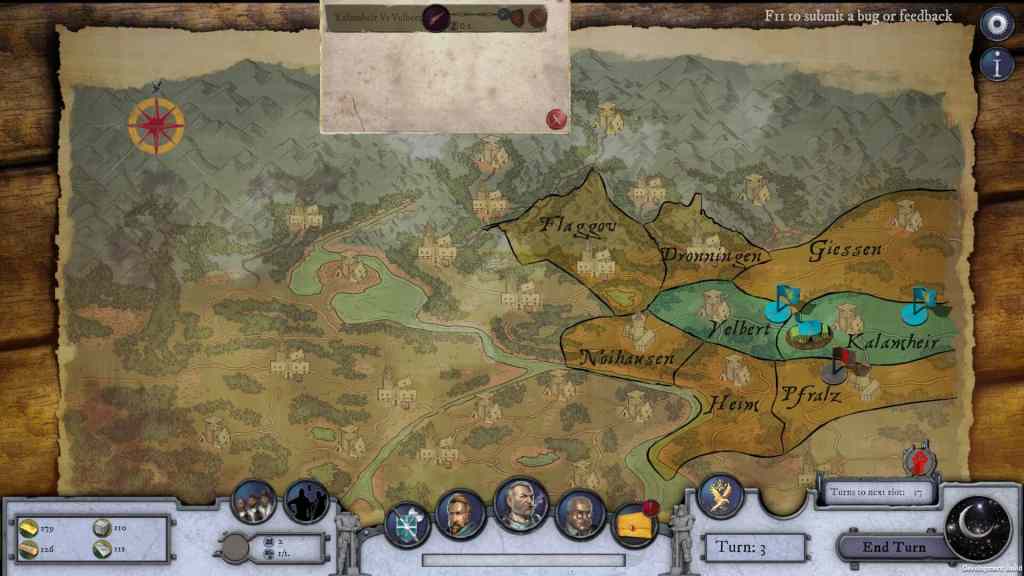
The campaign map, the part that leads to the ‘4X’ label… While it contains 4X elements, I definitely wouldn’t call this a true 4X experience. For example, the campaign map of the fictional “Western Marches” is a fixed array of 26 Provinces. So as soon as you’ve played it once, you know all the provinces and possible pathing between them. This seriously curtails the explore element inherent to the archetypical 4X.
Provinces are covered in a fog of war and if you plan to use the autoresolve-combat feature, you can spy on these to optimise your chances. But in the current version its completely viable to skip scouting and just send a full strength attack instead, once you get a properly geared attack province.
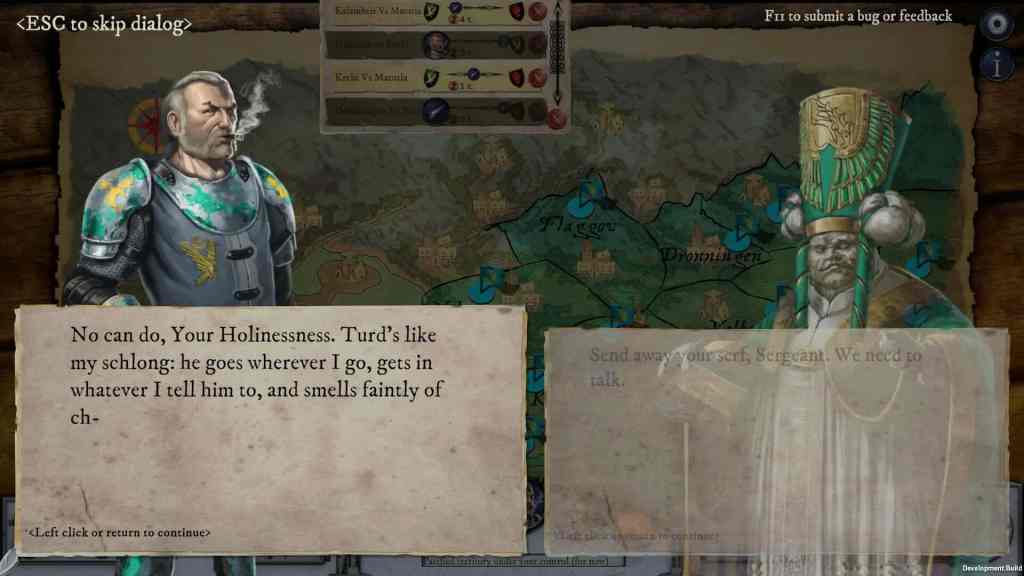
The story campaign is divided into 5 chapters, with various scripted back and forth dialogue options between the characters driving the story forward. In many of these dialogues you are given meaningful choices as to who to infuriate – angering and insulting people does seem to be the player characters modus operandi. This then leads to opinion buffs and penalties, which can impact the future dialogue options you are given or impact the loyalty of your generals/governors (generals and governors are pulled from the same character pool, similar to many of the Total War titles.)
While the characters and their actions (particularly the uncouthness of the main character) might not be the cup of tea of some people (read: me), its undeniable that this story is a strength of this game, and they have made some sacrifices for its benefit that I will cover later. The strong story of EiR is a definite plus, because too often in 4X games the story feels like a clunky afterthought. This is definitely not the case here.
The chapters also provide a logical path to introducing/gating tech upgrades. Basically, the tech tree is tiered with the start of each new chapter unlocking the next tier. While some tech upgrades are somewhat unimaginative (such as each tier having a plus 3% tower range upgrade with the prior tier’s equivalent tech as a prerequisite), there are also some really cool ones that are mostly but not exclusively related to your tower upgrades. An example might be adding an oil attack to one of your towers, that can then synergise with a flaming arrow attack that can be added to a different tower. With smart positioning, this allows you to achieve damage over and above the base damage of each tower.
An odd anomaly with regard to research is that it’s the only management subarea, where once the player decides they want to check out their techs or make some changes, or the like they get confronted with a loading screen. Every other typical task such as managing provinces, moving troops, sending spies or inspecting notifications etc is handled via a popup window on the main screen. The loading screen wouldn’t be too intrusive if it weren’t for the fact that it also has a ‘click to continue’. The number times I got caught on that click to continue screen, getting distracted by something on my other monitor, only to remember 15seconds later that I had to make it progress and it wasn’t just a long time loading. I imagine this system won’t be in the game long as it makes little sense, and Hammer and Raven are quick to admit they are still making changes, but just be aware.

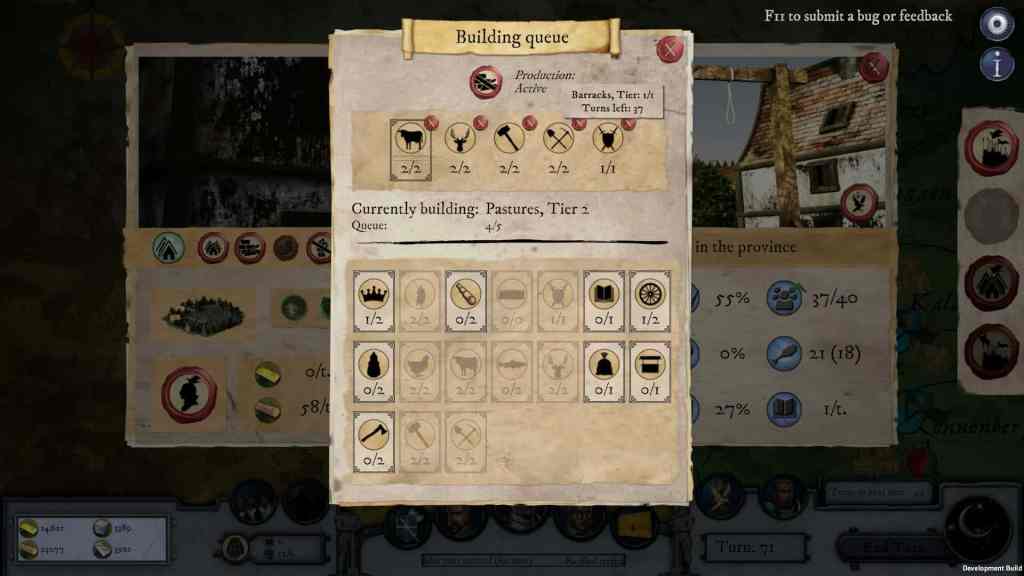
Province development is another departure from what I’d consider normal for a turn-based empire management game. Each province has a set of stats covering things like ‘attack’ ‘defence’ ‘authority’ and ‘happiness’. These stats are influenced by the province developments – which sounds pretty regular thus far. However, in order to develop your province directly, you need to move your headquarters (your protagonist) there. This gives you access to your build queues and you can queue up a series of developments that might take a few dozen turns to complete. The obvious implication is that wherever your protagonist isn’t, you can’t change your build queues. This can be frustrating, as progression through the chapters will sometimes require an average provincial ratings in in particular stats (apologies for the vagueness, I’m trying to preserve the magic of the first playthrough). This requires construction of buildings that increase that stat. In order to optimize the build queue for chapter progression, your Headquarters will need to do a whirlwind tour of the provinces.
The second, less labour intensive method of province development is to assign a governor, whom you can give certain priorities (Food, Military, Economy, Misc). The governor will develop the province on his own initiative while keeping in line with the priorities. Invariably, when you need him to build a particular building, he’ll definitely decide something else is more important!
I really like province development. While it is has an endless space-esque ‘build everything everywhere and you’ll do just fine’ vibe, actually managing the logistics to make it happen is a challenge. The headquarter mechanic leaves you with choices, given that you also want your headquarters where you are launching/receiving attacks for the bonus it provides your military, and moving it about takes turns. So don’t use that combat bonus? Rely on a governor? Focus only on frontline provinces, negating long trips to and from the frontlines to the rear? It might not be the same min/maxing[BS4] province development that some players like, but it’s definitely a worthy mechanic.
Another thing particular to the campaign, and unfortunately, in my opinion, the game’s current biggest weakness is that with the game’s current storyline, the opposition is totally passive for 80% of the game. For the first four chapters you go on your merry way expanding, the only risk being provincial rebellion. By the time the enemy begins to fight back, you already have a huge map control/resource advantage, so most players will not be challenged when conquering the remaining portion of the map. I kind of understand why Hammer and Raven have done this, as it fits the narrative they’ve created, but in my opinion, it really needs to change. The player needs a challenge before they get 80% of the way through. It honestly feels like 80% tutorial, with a super short campaign at the end. With the support and discussions I’ve had with DocHogan while compiling this review, I have every confidence that the campaign will be tweaked as much as they can while working within the bounds of the narrative they’ve created.
The Tower Defence
As previously mentioned, the tactical combat layer of EiR is handled exclusively by tower defence games where you play the defender. At present, there are 26 Tower Defence maps in the game. Each map represents one of the provinces on the campaign map. Any time you attack or defend a province, you will play a TD game on that corresponding map. I feel that 26 maps is a pretty good variety, especially considering the TD is theoretically only 50% of your game – I mean if you look at my recent review for standalone tower defence game ‘Siege of Centauri’ that included only 24 maps.
The downside of having the each map tied to a campaign province and the previously mentioned peculiarity of only being actively opposed in the late game, is that there are quite a lot of maps that you’ll only ever fight on once in a successful campaign run. Maybe twice, if RNG hits and you need to quell a rebellion. The flip side is that you’ll get to know a couple of provinces very well, since in the late game you will probably be fighting back and forth over the same province quite often. Hopefully this imbalance will be rectified if and when the developers are able to address the pacing of the campaign.

When I wrote the first draft of this review immediately post launch, I had noted that the Tower Defence portion of the game seemed somewhat easy, however I’m happy to report that in subsequent post launch patches both enemy stats and tower stats have been amended. I feel the balance is in a much better place now. As an experienced tower defence player, I win most games on normal, and am REALLY challenged on the top difficulty – much more than some other TD games top difficulty that I’ve played recently. I imagine a newer player will be challenged but not discouraged even on the normal difficulty.
With the selection of tower availability, Hammer and Raven have gone down a slightly different route than the majority of TD games. There are only three base level towers. All other options are implemented via upgrades to one of the base towers, or as an upgrade to an upgrade. While this probably makes the game more accessible, some of the upgrades result in towers that have vastly different characteristics than the prerequisite tower. This means that you will sometimes need to build a situationally useless tower, and then nervously watch resources increase until you can afford the upgrade that you actually need. It’s not a bad system, it just requires getting used to, so if you’re like me and a little averse to change it may cause some friction.
Another feature of the TD mode is builders. If you want a shiny new tower on the other side of the map, a worker from your base must traverse the map, and construct the building for you. If your tower gets damaged, another worker will need to risk the trip again to repair it. I have seen this mechanic in some other TD games (Marz: Tactical Base Defence comes to mind), but it’s not the more ubiquitous ‘drop magic towers from a spaceship’ style. The upshot is you have another consideration when choosing where to place your towers, beyond simply their combat effectiveness. Building towers near your HQ become are easier to repair, but carries the risk of not being able to take down the ‘tankiest’ enemies in time. There is a support building that allows you to have field base for your workers to work from, but this doesn’t become available until mid-campaign.
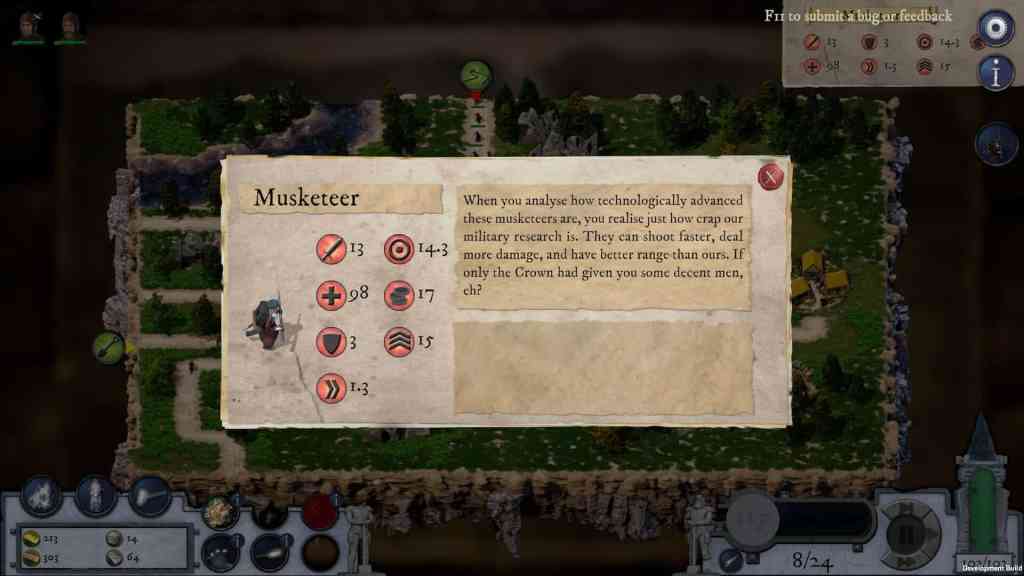
The range of enemy unit types is good, As with any TD game each has their own properties, such as waiting out of range of your towers until their slower friends arrive and then sprinting for your base, or temporarily disabling towers, or even digging tunnels/creating paths that subsequent enemies can follow to potentially circumvent your carefully prepared defence (another influencing factor as to why defences near your HQ may be a better choice). I did feel the lack of a dedicated higher tier ‘boss’ unit or two, the closest being a steam tank of sorts and an airship. However, these are just particularly strong regular units, rather than the kind of unit you dread when you see them enter the field like you do with the top tier units in other TDs.
All the maps are available from the arcade menu, for if you’re looking to perfect your strategies on a particular map. This is attractive both for the people that don’t like the taste of Turn-based strategy in their TD diet, as well campaign players looking for a training tool. The latter is especially useful, because if you make a mistake in campaign mode there is no rewind/restart feature (as is present in many tower defence games). A single mistake early can result in grim prospects for the outcome of the battle, and consequently a waste of however many turns it took to march your army to the battlefield. (I can’t help but get visions of an ‘army’ of woodworkers and bricklayers drearily trudging along with their materials to setup the HQ in the next province ready to defend again!).

The Sandbox
Once you’ve beaten the main campaign, you may decide you’ve not yet had your fill of what EiR has to offer. This point may also come before you beat the campaign if you find the protagonist’s conduct unbearably uncivilised. In any case, Hammer and Raven have included a ‘sandbox’ mode where lots of the story elements, as well as the chapter progression have been stripped away. It was pretty apparent to me that in the early access version, the sandbox mode is a secondary priority for the team, as there are quite a few GUI oddities.
In the sandbox mode, you are given a random province to start the game, and then you are left with the objective to conquer the map, just as with the story game, only this time you are free to do it in any order you deem appropriate. I should note that in five attempted starts I was given one province four times and a different one once.
With the removal of the chapters gating tech progression, you can research more freely, as all techs are open from the start assuming you meet the prerequisites. However, there are various combat bonuses tied to the narrative that won’t be present in a Sandbox game. At equivalent difficulty, the sandbox mode is inherently harder than the campaign mode.
Other Observations
EiR uses a discrete three save system, where one campaign either story or sandbox occupies one save slot, and unless I missed it somewhere (which is entirely possible) there is no way to manually save your progress apart from on exit from the game. This means that should savescumming be a tactic you commonly utilise you may be frustrated – though the save files can be copied to the other slots through your system file browser, as I found when sending save files to the Doc for diagnosis.
While Hammer and Ravens would have probably desired a few more tunes to fill out the soundtrack, the folk-metal crossover theme suits the games’ setting perfectly. After my 25ish hours in game I’m yet to get tired of it. Although I’ll admit I may not be the best test case for this one as the soundtrack could sit quite nicely on my Spotify playlist and not be too out of place.
Conclusion
I like it when games try new things, and I like both the turn-based strategy, and tower defence genres so I am right in the middle of the target market for EiR. While it is at the time of writing still very rough around the edges, there is definitely enough here that with time and the appropriate feedback I can see this becoming a good game.
But would I recommend it in its current state?
If you are purely a 4X gamer and you don’t like to stray too far from the core of the genre then no, I probably wouldn’t recommend it as it is today. However, definitely keep an eye on it. Lots of games aim to improve over time and usually I’m pretty sceptical, but from the rate of improvement just in the first few weeks of early access I’m confident Hammer and Ravens can tie up the loose ends and add missing features. Their engagement with the fans (myself included) really has been mighty.
If you enjoy Tower Defence as well as 4X? Then yes, I can recommend the game even in its current state. The TD portion of the game is strong enough to stand on its own, among many of the better games available to a TD fan, and the TD here is definitely better than the many microbudget alternatives you’ll find outside the top dozen tower defence games.
Finally, as with all early-access titles, purchasing this game requires some level of faith that the game will continue to realise its ambitious improvement goals. They’ve laid them out here, in this roadmap:

You May Like This Game If:
- You don’t mind jumping in early on a new project and helping to shape it.
- You enjoy Tower Defence games.
- You enjoy a good narrative in your games, and accept a couple of compromises to facilitate it.
You May NOT Like This Game If:
- You prefer a polished, bug-free experience.
- True 4X genre hugging is important to you – EiR misses quite a few genre staples.
- Excessive vulgarity is a turn off for you.
Jamie played for around 25 hours on his desktop PC (Intel i7-7700K, GTX1080Ti, 32GB RAM). He was provided a copy for review and definitely didn’t hold up his end of the bargain when it came to timeliness (Editor’s note: but he is most certainly forgiven)