Developed by Digital Sun and published by strategy juggernaut Hooded Horse, Cataclismo sets out to be a niche game, but fills a niche that instantly grabbed my attention. Anything that promises to combine base building, tower defense, and RTS-style resource management strikes me as an ideal chill-out game – the sort of thing that beckons when I’m in the mood for gaming but feel too distracted for more demanding strategy titles. The game was released into early access in July, so it’s a work in progress, but the progress that has already been made is absolutely encouraging.
Cataclismo is set in a post-apocalyptic world infected with noxious mist and inhabited by nocturnal monsters called horrors. These come in a variety of nasty versions, but their main features are that they will kill anyone, and destroy any building materials, they can latch their jaws onto. This fallen world has been poisoned, devastating the air quality, and making breathing difficult (one of the most frequent barks you’ll hear is “Masks On!”). With masking and the general sense of lonely isolation that permeates the game world, it’s hard not to think of Cataclismo as something cooked up during the darkest days of the COVID lockdown.
The look of the game also sets the mood. Cataclismo is gloomy, with a palette dominated by browns and grays. The graphics are simple enough, but they effectively set the mournful tone. It’s not a game that will wow anyone with its realism, but the overall visual design gets the job done, even if there are some drawbacks, which I’ll discuss below.

Catacliso’s vibe leans very gloomy and murky, sometimes to its detriment.
At its most basic, Cataclismo allows you to build with wood and stone pieces. Wood is more fragile and is mainly used for secondary structures far from your frontline defenses. Stone is for anything meant to offer protection from the horrors. Cataclismo features a system wherein stone structures grow stronger the higher they’re built. If you want to place certain units lower down, where they are more effective, they can discharge their weapons through windows, which offer a range bonus and also count as building blocks, adding to the structure’s overall strength. There are various tactical pieces, such as battlements and banners, which also strengthen units, improve range, or add additional types of damage. The core of the game is about figuring out where to place your defenses, how to structure them for the best tactical advantage, and how to place your units both in general, and at a particular moment.
Survival can depend on strong fortifications at strategic chokepoints.
Depending on which of Cataclismo’s modes you’re playing, things can vary but, in general, the player will need to defend their citadel, which must be defended at all costs, a hero character, Lady Iris, and some ranged units. There are no fighters or tanks in Cataclismo, and none of the ranged units can take much damage, so keeping them away from horrors is always a top priority. Units have different specialties and upgrades, and each type is most effective at a specific elevation range. In general, a game of Cataclismo will involve resource gathering, building placement, and base building. You collect primary resources to construct buildings to generate secondary resources, which further tax those primary resources, and so forth. Ultimately, this will allow you to build your defenses and place your units in such a way that you can hopefully kill the waves of horrors that assault your base every night. These horrors will literally eat your defenses, and while learning the game, I found the margin between survival and collapse could be very thin.

There are four primary game modes, and they play quite differently. There’s a story campaign, an endless mode, a skirmish mode, and a creative mode.
I’m not generally someone who enjoys campaign modes in strategy games, but Cataclismo’s does an excellent job of introducing the core gameplay elements. It is currently only half finished but, as of this writing, it provides a half dozen or so hours of play and a variety of different challenges. The player can expect missions centering on base building, resource collecting, environmental puzzles, and pure tower defense. I doubt that I will go back to the campaign once more missions are released, but players who enjoy narrative in strategy games are likely to enjoy learning more about Cataclismo’s world and history.
In the campaign mode, upgrades are linked to completing levels and gaining experience. In the endless mode, which most attracted me to the game, upgrades are linked to survival. The endless mode is built around a series of short day/night cycles. The daytime is for building, resource production and exploration, and the nighttime is when horrors will storm your defenses. If you survive, you gain points you can invest in research to unlock new buildings, upgrades, units, powers, and construction pieces, allowing you to improve your base and test your fortifications against the next wave. This mode has a lot to recommend it, but there are some deficiencies I hope will be addressed as the game continues development.
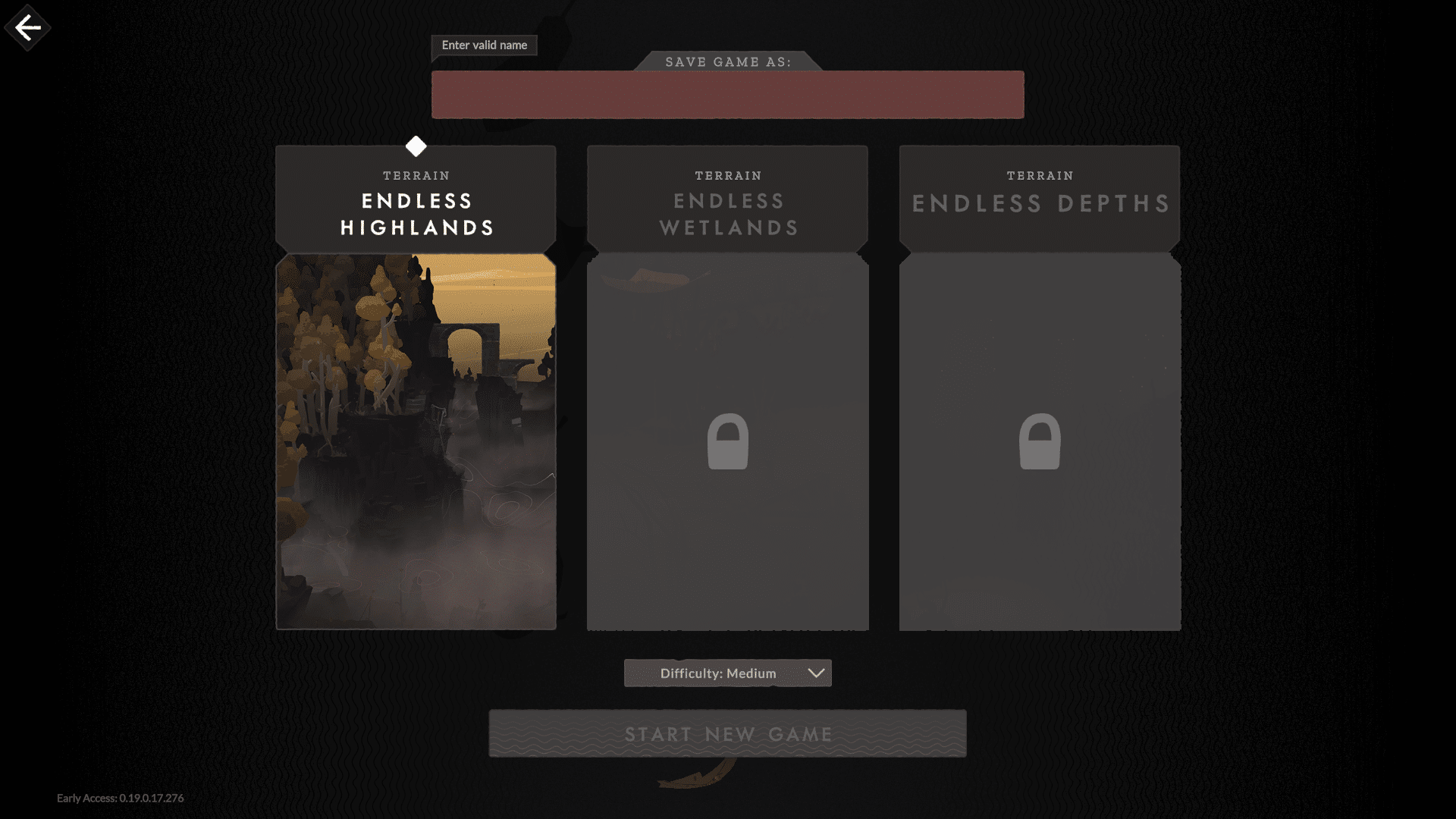
Only one map type is currently available.
Right now, there is only one map type available to play on, though more are grayed out and clearly in development. The maps are procedurally generated, and it’s important to note that there seems to be no interest in map balance. In one game, the player might have abundant resources, making collection and stockpiling resources a breeze. In another map, one or more resources can be scarce enough to make survival extremely challenging. Some maps include many caches of resources to collect while exploring. Others contain few or none.
The resource collection is not particularly involved or interesting. The player sets down worker buildings to gather wood and stone and place elevated air filters for oxygen, which also serves as a game currency. There are various upgrade buildings you can place to improve resource collection and storage, and the necessity of these will be determined by your resource availability and, to some extent, playstyle. The player must build houses to increase population, but those increase oxygen demand, and so forth. In that sense there is a supply chain management element to the game, but it’s simple and doesn’t require too much strategizing. In general, your goal will be to keep your head above water in these various resources and avoid discovering you’re too far behind when an emergency arrives. If you need to construct something now, but you don’t have the population or oxygen, meaning you have to build secondary structures before getting the thing you need, you may find your base getting eaten before you can muster the necessary defenses.

Resources can have a feast or famine feel. In this game, I had to build stockpiles because resources were coming in faster than I could use them.
One of the more interesting strategic elements is in how you expand your building area. It is usually necessary to grow your base’s borders in order to exploit resources or claim more real estate for structures. This can only be done by building beacons, which slightly increase the range of exploitable territory. However, beacons are resource intensive, meaning that they cannot be placed arbitrarily, especially in the early game. Where and how to stretch your borders can be one of the most important early game decisions.
There’s also the issue of map exploration, which right now feels undercooked. Most of the map is hidden at the beginning of the game. You can send out teams of explorers during daylight hours to collect resource caches, if the map contains any, and destroy horror nests, which can send small groups against your base even during the day. These can be a session-killer if they show up early in the game when your troops are away. A cluster of diurnal horrors can wreck your economy in seconds. The problem here is that exploration is risky but often not rewarding. The risk is that you could lose expensive units or have them too far from your base when you need them. The rewards simply aren’t enough to encourage the player to do more than clear out nests close to the base.
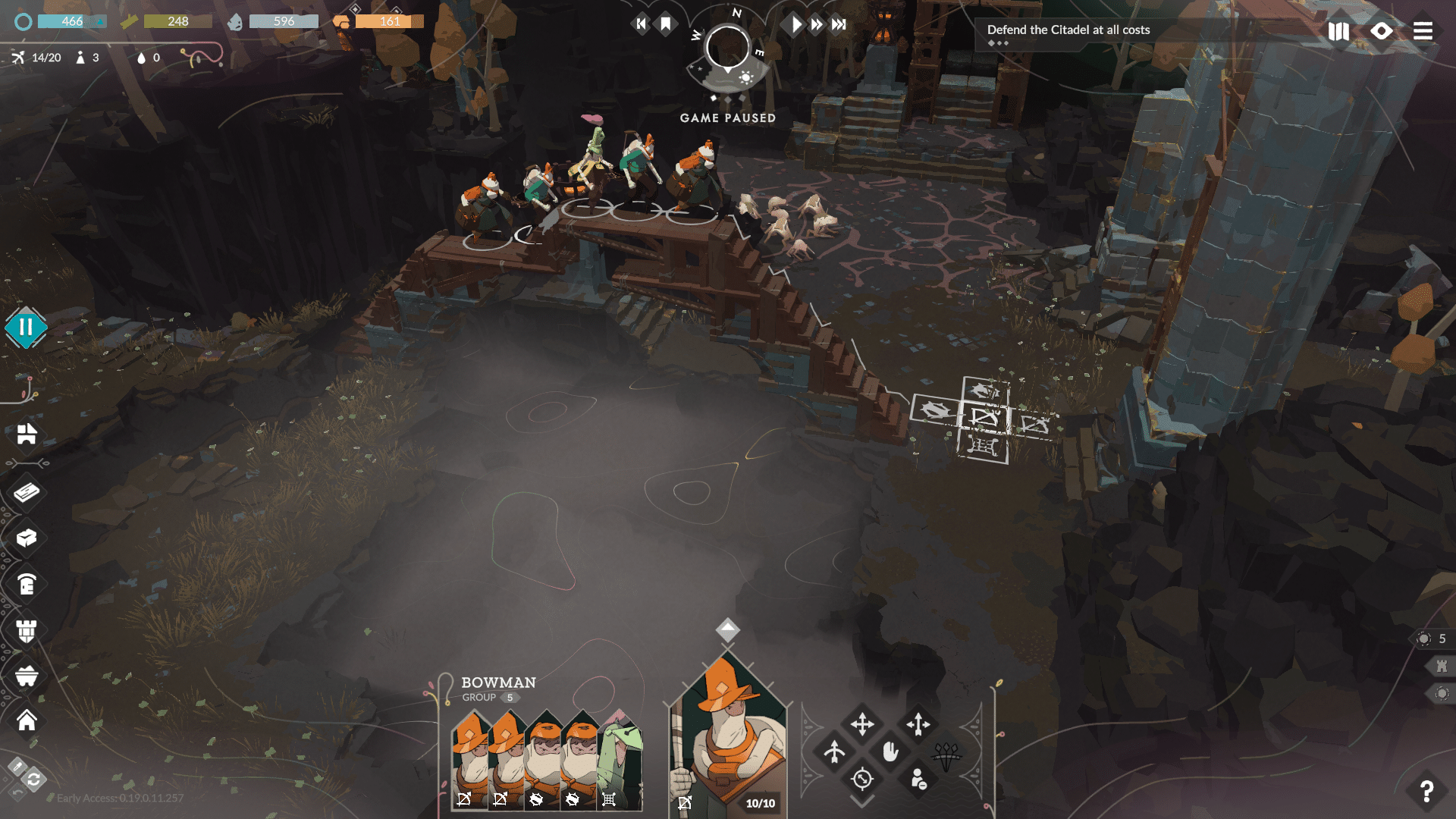
Sending a party out to explore often felt more dangerous than the rewards warranted.
The system whereby you earn skill points in the endless mode also feels less satisfying than it should. Many of the game’s most basic building pieces are locked behind skill points. Having to choose between unit upgrades and building pieces feels important without actually being meaningful or interesting. I found myself wishing for a more dynamic and strategic advancement system. In addition to getting points for surviving waves, the developers might consider granting points for map exploration, constructing certain kinds of defenses, unit leveling, or even for focusing on a particular building or unit type.
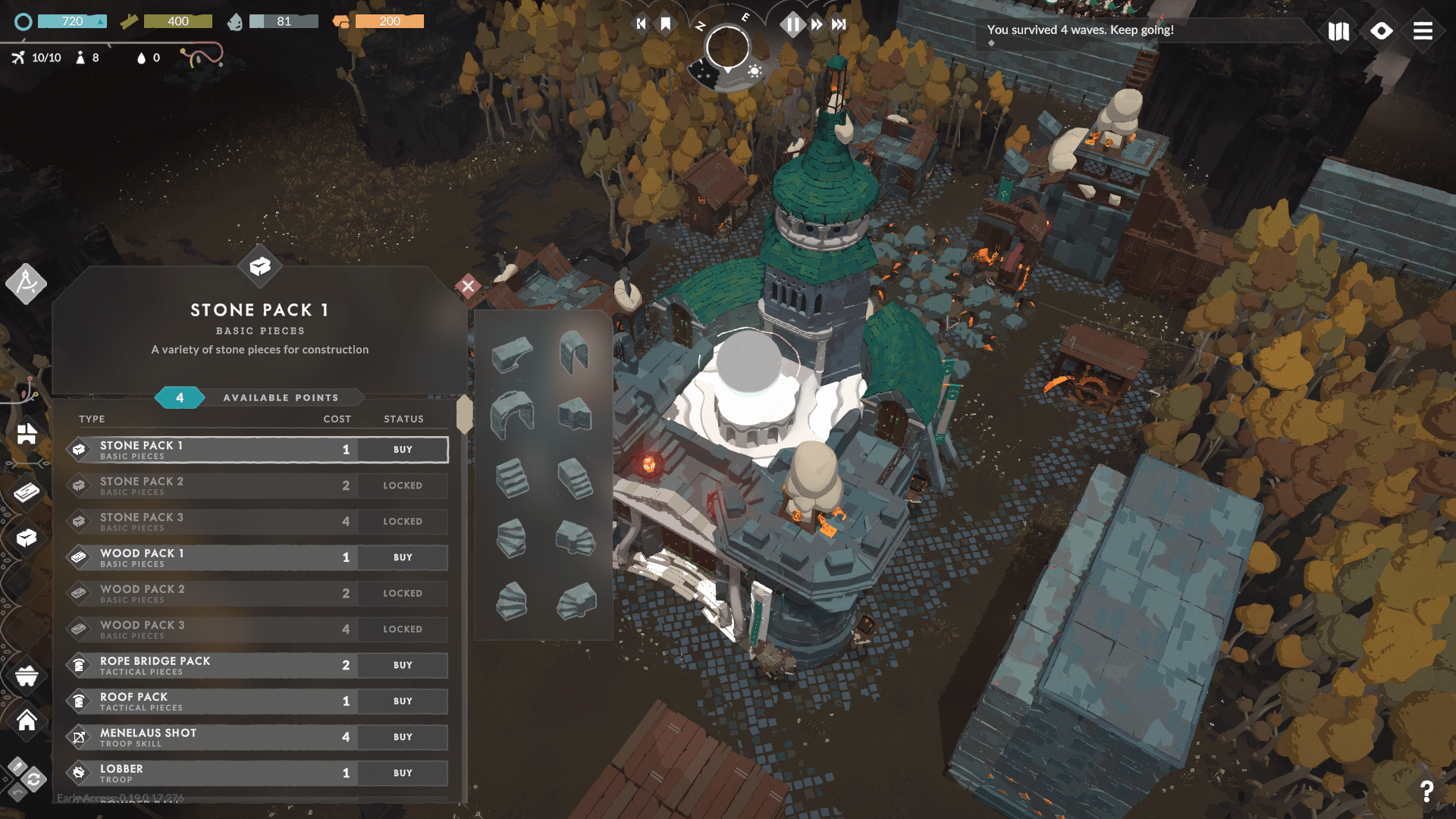
The rewards system in endless mode needs some rebalancing.
There are other quality of life issues badly in need of attention. For example, you can create hotkeys for groups of units with a traditional RTS CTRL-numeral binding. Pressing the appropriate number will allow you to give a group commands, but it doesn’t take you to those units. Instead, you have to move into map mode to find those units. If you want to move them to a distant part of the map, you then have to leave map mode, which cancels the hotkey selection. That means if you want to check on the circumstances of a group before issuing orders, you’ll have to move in and out of map mode several times, which feels burdensome.
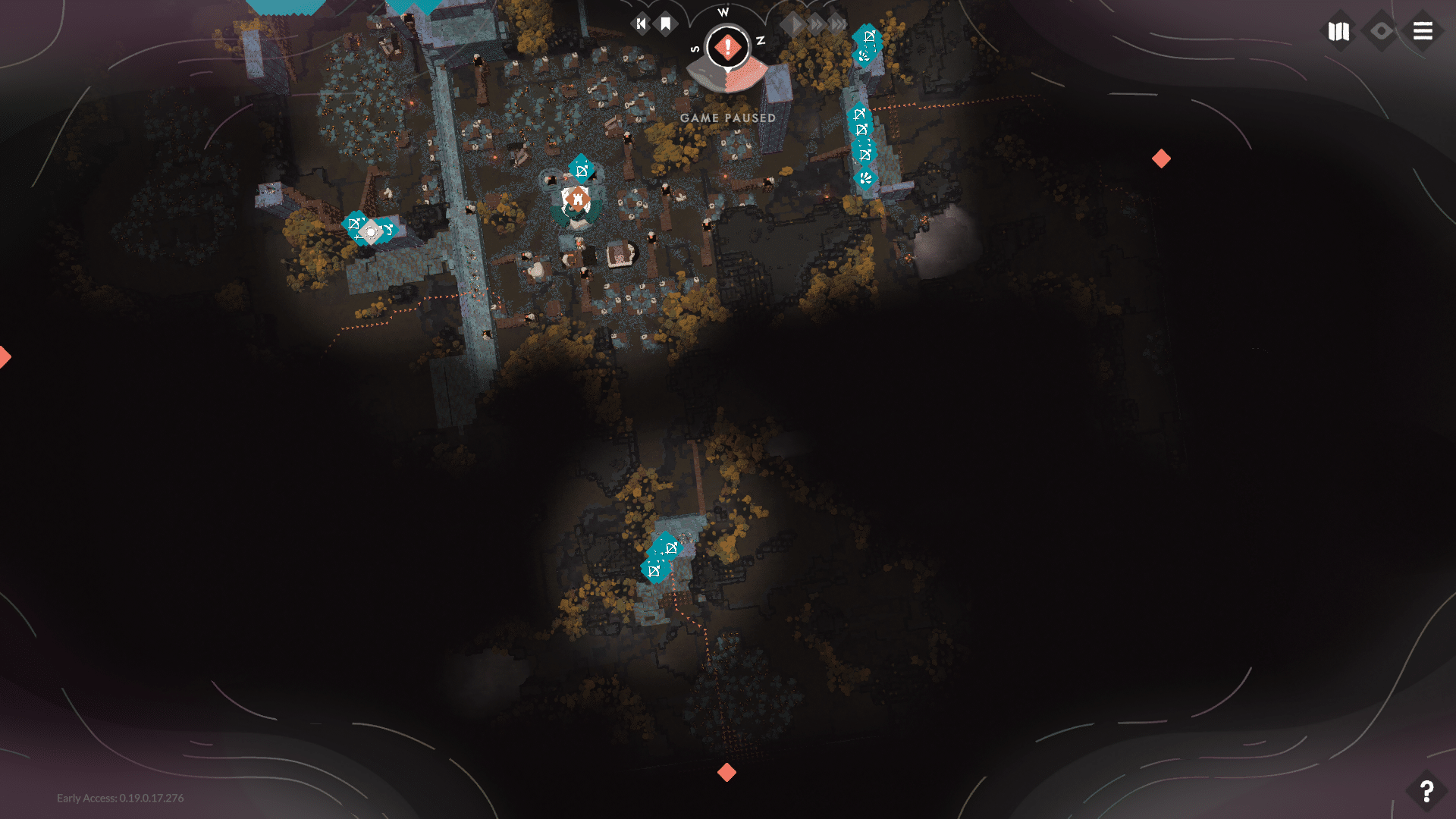
Finding and manipulating units via the map mode often felt clunky.
These are small details, and whether you enjoy this game will likely come down to how easily you can lose yourself in the Lego-style building. The bottom line is building with Cataclismo is often fun and sometimes requires strategic thinking. The player will almost certainly feel pressed for space in most games, which means finding the most efficient way to build, both horizontally and vertically is part of the challenge. Some building pieces, such as angled staircases, are locked behind upgrades, which can be frustrating (also, why does no one in this universe know how to construct a ladder?), and I’m not convinced these things should not be available to the player from the beginning of an endless session. I understand the lure of giving players something to advance toward, but it feels like the game is refusing to let you do the things you want to do in order to artificially impose a progression system. Regardless, finding effective, strategic, and aesthetically pleasing ways to build remains a delight.
It’s also worth emphasizing that the game allows you to build while paused, which means you can take as much time as you like to construct your base during the day, assuming you have the necessary resources. In reality, I often found myself scrambling to collect resources and then building my defenses while paused, only seconds before the first wave of horrors arrived. Changes happen instantly, but you can’t build if horrors are near, so once they find the weakness in your defenses that you should have noticed earlier, you have to rely on your units if your base is going to weather the attack.

Building while paused is necessary for survival, but the interface is sometimes clunky and opaque.
The game does give you some warning about where the horrors will be coming from, so you can move your units from locations where they’d be idle. This is especially vital in early rounds, when the player is certain to feel short of units and hasn’t yet built up defenses.
One major deficiency in the game, which may not be fixable, is the visual sharpness. I mentioned above that the game’s look and palette feel narratively appropriate, but the effect is a world that is sometimes blurry and imprecise. It can be difficult, even when zoomed in, to read the terrain and find the right place for a building piece. This is especially true if you’re modifying an existing structure – let’s say removing some bricks to insert windows. It theoretically can be done without collapsing an entire wall if you’re paused, but I often found I couldn’t find the right spot to reinsert a supporting piece, which meant I had to tear down an entire wall and rebuild from scratch. Cataclismo allows you to recycle building pieces without penalty, but it is nevertheless frustrating to have to do this constantly simply because of how hard it is to read where the piece should go.
While I suspect most players will be spending the majority of their time in the endless mode, Cataclismo offers two other game types. The skirmish mode is more limited in scope, tasking the player with surviving four nights. The day/night cycles are more drawn out in the skirmish mode, giving the player ample time to plan and explore. There are currently only four maps available, and, as near as I can tell, there are no differences in resource or enemy placement from one playthrough to the next, so these will have limited replay value. That said, players can create and upload their own maps through the Steam Workshop, which is sure to add some variety to this mode.
The game also features a Sandbox mode, which offers the experience of playing with all skills unlocked and unlimited resources. This presents an experience too chill for my taste, but some players may enjoy exploring possibilities and challenging their constructs with the horrors of their own choosing. It could also be a good way to test out different possibilities for those in search of an optimal build.
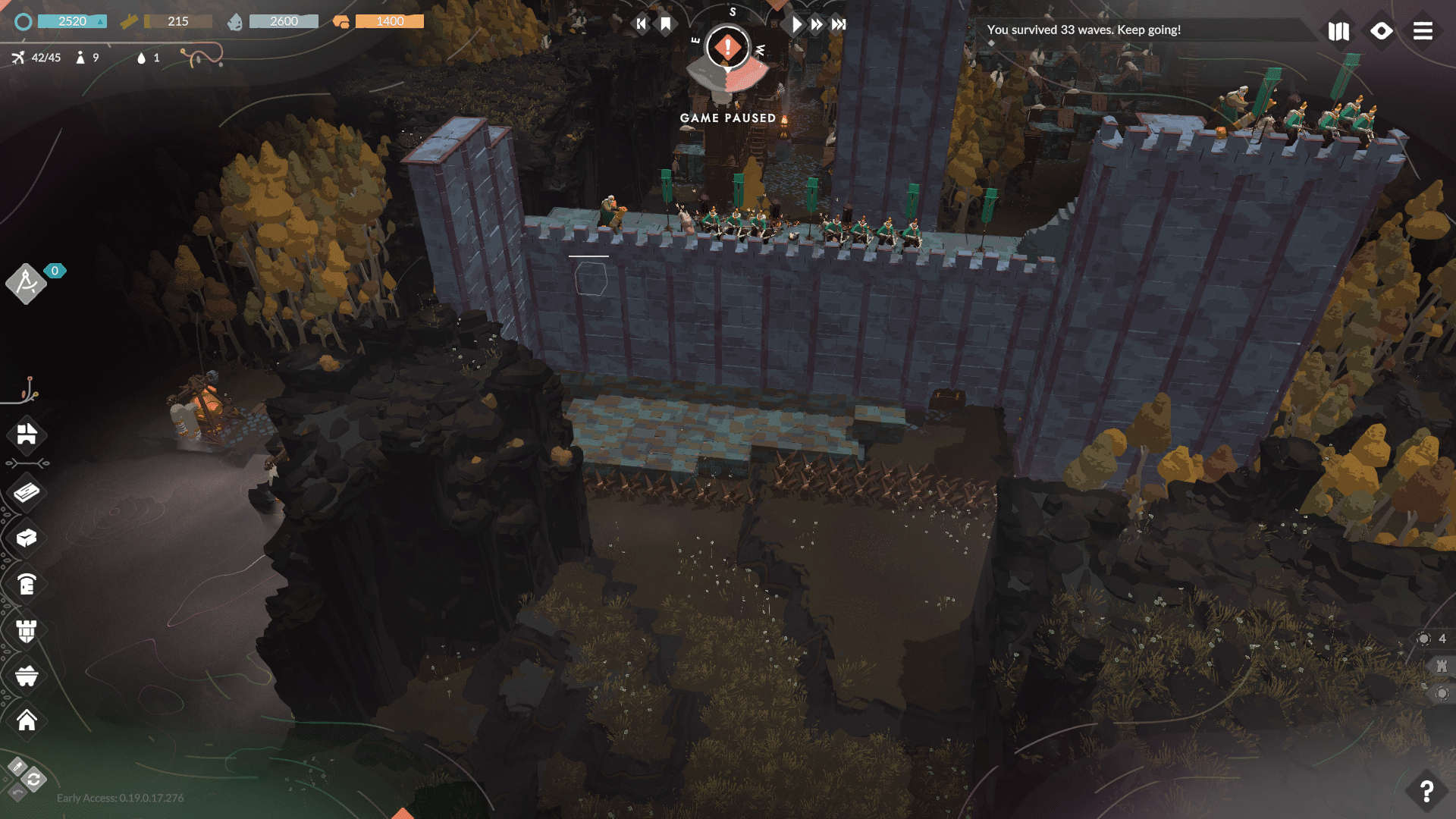
There’s something fundamentally satisfying about building a well-defended fortress.
So, is Cataclismo worth buying now?
I tend to be impatient with Early Access games, but I would say anyone who finds the concept of Cataclismo appealing will almost certainly get a few dozen hours of entertainment at a minimum from the game in its current state. It does not appear that developers Digital Sun have released a roadmap, so I’m unclear what content – other than more campaign missions and the maps that are now grayed out – is coming. I presume there will be various quality of life improvements, but only time will tell how extensive or meaningful they’ll be. I will be keeping an eye on the game’s development, however, and while I can see myself eventually feeling like I’ve seen all Cataclismo has to offer, for now it will remain installed for those days when building a castle and firing projectiles at monsters is precisely the itch I’m looking to scratch.