I love Old World. I consider it a masterpiece, rank it among my all-time top five 4Xs, and consider it the best historical 4X I’ve ever played. And yet, I approach every new DLC with a certain amount of trepidation because I have something of a love-hate relationship with some of the game’s systems.
And these systems are deep and complicated, which means it can take a long time to grasp them fully. I will offer some criticisms of the latest DLC, Behind the Throne, in this review, but if you’re an Old World enthusiast, I’m not sure how seriously you should take those criticisms. I initially had my doubts about The Sacred and the Profane, and I now consider it a must-buy DLC. The bottom line is that Old World is a challenging game, and its many systems and intricacies are sometimes hard to tease out.
If you’re reading this review, you’re likely at least somewhat familiar with Old World’s mechanics, but as a refresher, keep in mind that this game has a character system that is often compared to that found in Crusader Kings. Every player in the game will have an opinion of your leader, and your leader is part of a dynasty, eventually replaced by an heir or, if you’re not careful, a usurper.
Alongside all of this is the event system, which, as far as I can tell, is sometimes triggered by conditions on the ground over which the player has some control (opinions of characters, families, other nations, etc.) and sometimes triggered randomly. These often force the player to decide between unattractive options, and they feel less naturally emergent than AI-driven action. I fully acknowledge that I wouldn’t get an event about the actions of a character who dislikes me if I were doing a better job of managing that character’s opinion, but that ignores the reality of the game. Leaders are always fending off angry characters, and it’s simply not possible to alter everyone’s opinion. Someone is going to have beef, and that beef will manifest in the form of an event with a limited number of (often unappealing) choices.
All of this can create the impression of the game itself, rather than the conditions of the playthrough, working against the player. The Sacred and the Profane, for example, offers a number of new possibilities for the player to incur the wrath of various characters, but it also includes lots of ways to gain favor. Is Behind the Throne equally balanced?

ON THE RISE
Fairly early in each run, a character who had particularly powerful bonuses emerged in my empire (or sometimes capable of being recruited from a rival’s empire). In my first playthrough as Rome, this was Marc Antony, whom I attached as a general to a military unit and used him to absolutely crush my enemies.

As the name suggests, Rising Stars are exceptional characters with massive public appeal – so it’s easy to see why these characters can be trouble. They can serve as generals, governors, or councilors, and their bonuses are difficult to resist, but maybe resisting can sometimes be the better move. When I played as Rome, Marc Antony proved invaluable as a general in defeating nearby barbarians and tribes. Honestly, I could not have done it so quickly without him, but this is Old World, which means he was not content to be a valuable part of my empire. He wanted it to become his empire, and I found myself choosing between abdicating my throne or a protracted civil war.
In many ways, the Rising Stars mechanic is about as quintessentially Old World as you can get, because this is a game in which every advantage plants the seed for a future disadvantage. That means you cannot take your Rising Stars for granted. In my subsequent playthroughs, I always kept a close eye on these characters, running influence missions when necessary to make sure I wasn’t missing signs of an alley preparing to come out as an enemy.
As with so much in Old World, the double-edged sword of the Rising Star system reflects the game’s commitment to representing the complicated demands of empire-building in the ancient world. Personal, religious, and familial relations are every bit as important as conquering territory and completing the ambitions that yield victory points. And why shouldn’t a general whose prowess is responsible for an empire’s expansion claim that empire for herself? If your leader archetype and random circumstances, and RNG goes against you, it can happen.
It is entirely possible that if I were a more attentive Old World player, I might have noticed problems with my Rising Star related to family or religious affiliation. I love the complexity and interconnection of the game’s many systems, but I’ve always felt that Old World could do a better job of alerting the player to possible problems before they turn critical. Even the UI placement of the alert system, such as it is, feels odd to me, tucked away in the bottom left of the screen rather than the top right, like most games. I also find myself taking my eye off interpersonal relations when the challenges of game map require my full attention. A system that provides notification of significant changes in key characters’ dispositions might help easily distracted players like me avoid missing the game’s many looming dangers.
Ultimately, however, the Rising Star system is a great addition that contributes both to the ancient world feel of the game’s politics and provides the player with interesting and meaningful choices. Taking advantage of these characters will always come with a risk, but every time I had the chance, I couldn’t resist rolling the dice.
HOW GRAND IS IT?
After numerous playthroughs, I’m less sold on the value of the new council position, the Grand Vizier. In Old World, your council members have always provided a variety of options for handling personal, religious, and diplomatic conflicts. If tensions are high with your neighbor but you can’t afford a war right now, use your Diplomat to improve ties. If your heir’s spouse is plotting against you, have your Spymaster send assassins to rid you of the meddlesome schemer.
The Grand Vizier works very differently in that the position gives you fewer choices, not more. In exchange for significant bonuses in major stats – science, culture, training, happiness, and civics – the Grand Vizier seizes control of management and production in your cities. Honestly, if I were not reviewing the game, I might never have opted to appoint a Grand Vizier, since the idea of letting the AI take over my city production seemed like watching the computer play a significant portion of the game for me.
Sometimes, the game forced my hand, however. In a Greek playthrough, I attached Arete, my Rising Star, to an early game warrior and used her to crush my nearby barbarian encampments. After my leader’s natural death, however, I received an event that gave me a choice between appointing Arete as Grand Vizier or facing a civil war for which I was absolutely unprepared. There is an especially frustrating category of Old World events that feels like an offer you can’t refuse. Consequently, I did not refuse.
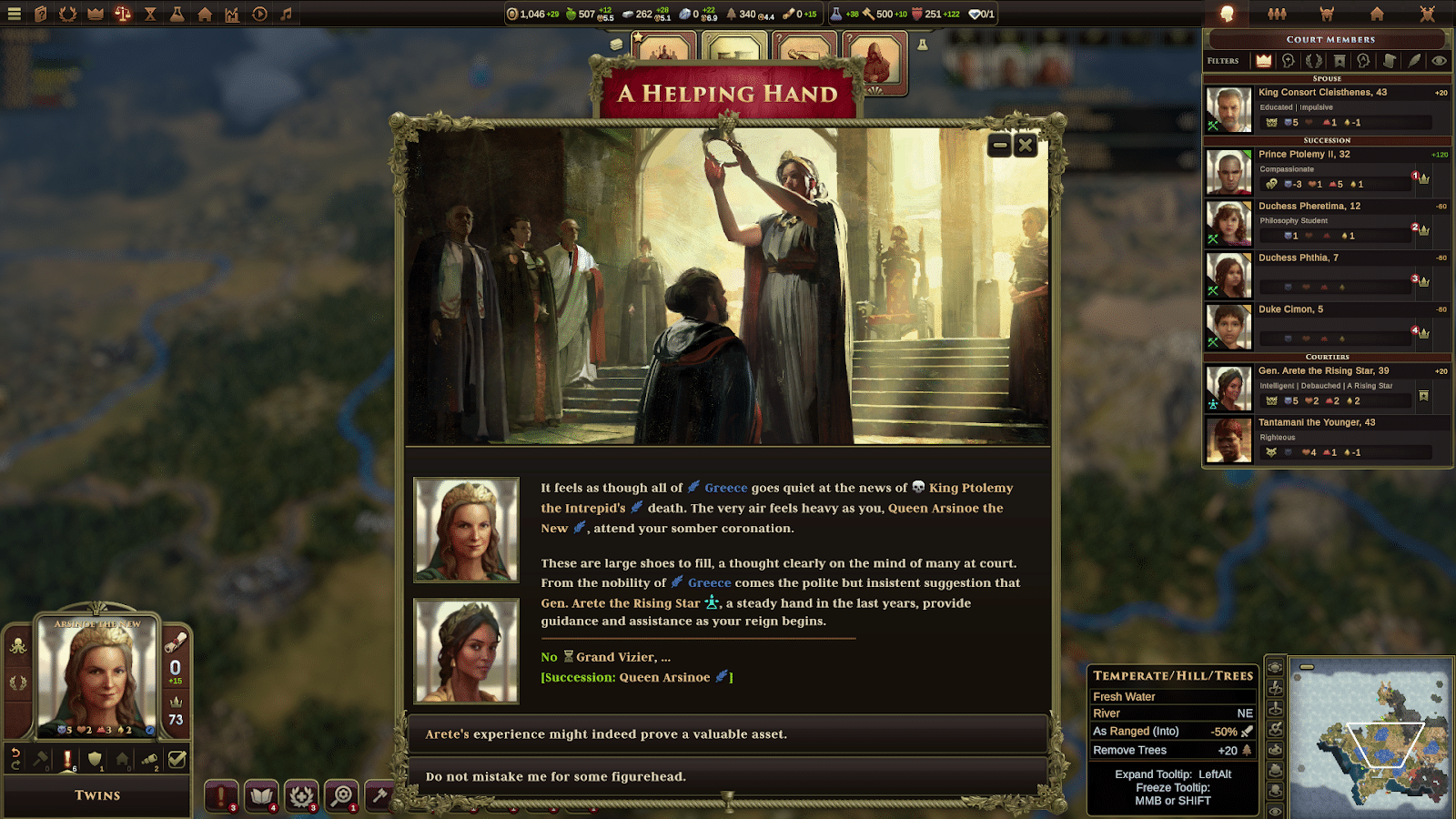
Old World’s AI is, in general, superb – one of the best I’ve encountered in a 4X game. The AI always seems to know when it would be the worst time for an enemy to attack, and it then attacks. The units do a great job of retreating to heal up when they have a possible avenue of escape. All of this made me wonder what the AI would do when tasked with managing city production.
The answer, from what I’ve been able to observe, is not well. When Arete was Grand Vizier, she seemed to enjoy queuing up settlers, even though I had no available city sites to settle nearby. In another playthrough, I found myself in a border war shortly after the game strongarmed me into appointing a Grand Vizier. I desperately needed more military units, but my Grand Vizier was determined to crank out religion- and culture-focused units.

To make matters worse, when a character is ambitious enough that the game forces you to appoint them Grand Vizier, the odds are they won’t like it if you try to get rid of them. In my Roman playthrough, my Rising Star Rhea first muscled her way onto my council and then attempted to muscle my leader off the throne.
On the other hand, after my Greek Rising Star Arete grabbed the Grand Vizier council position, I immediately ran an influence mission on her and then removed her from her post, slotting in her once again as a general. In that case, there were no repercussions.
Ultimately, I’m less sold on the value of the Grand Vizier mechanic than I am on Rising Stars. The bonuses of having a Grand Vizier don’t in any meaningful way compensate for the loss of control of your cities, especially when I haven’t seen that the AI is capable of effectively, or even rationally, managing production cues. Making use of a Rising Star can sometimes feel like swallowing a poisoned pill, but the Grand Vizier just feels like poison.
There is potential here, though. In order for the mechanic to be effective, players should feel more of a temptation to make use of it. If the Grand Vizier’s control over city production were less absolute – if, for example, you could charm or bribe your Vizier into letting you insert items into the production cue, it might strike a more interesting balance and provide a compelling game mechanic. As things stand, I would be hard-pressed to think of circumstances in which I’d want anyone occupying the council position.
THE END OF AN ERA
Behind the Throne also includes a new event type called Political Eras. When the right conditions are met, an era will trigger, producing new conditions which will require the player to pivot fairly aggressively. After multiple playthroughs, I have still not seen all of them, but the possible Political Eras are Civil War; Era of Decadence; Era of Reforms, Era of Corruption; and Defense Rallied. The most notable issue with these is that they are almost all things you want to avoid.
The Era of Reforms sounds good, but it comes with a major orders (the game’s movement and decision currency) penalty and has a chance of changing your empire-wide laws when it ends. This might work to your advantage, but it’s also possible that you liked your laws the way they were. The Era of Decadence is particularly hilarious, creating conditions in which all characters have a chance of becoming drunk and behaving irrationally. It almost has a Dungeons and Dragons wild magic feel to it. Only Defense Rallied, which provides you with a militia unit for every military unit killed, is unambiguously beneficial.
My time with Behind the Throne suggests that the Civil War is the most common Political Era. Maybe it says something about my empire management style, but I faced at least the realistic possibility of a Civil War in every game I played. These produced some exciting narratives, in which I had to abandon a foreign war I was winning and return my troops to my empire’s interior before things got even more out of hand.

I like the possibility of Civil War as a game mechanic and as an accurate representation of politics in the ancient world. My issue with the Political Eras is that they are heavily weighted toward the negative. I’d love to see the addition of positive Political Eras, producing boosts in science or building speed, for example, or the possibility of accessing wonders that the player would otherwise be locked out of. The mechanics of major, empire-altering moments are very appealing to me. I just wish they were not principally events I wanted to avoid.
SOMETHING I WANT TO STRESS
Given all the dangers and hidden traps an ancient monarch faced, it’s hardly surprising that rulers might find themselves stressed. During times of political turmoil, or perhaps when faced with a troubling event, you can receive a notification that your leader is stressed, and this condition comes with non-negligible empire-wide penalties. There is an inherent chance each turn that the stress will relieve itself, but if you want to take matters into your own hands, you indulge in revelry.
This mechanic creates a 1/3 chance of eliminating the stress, but there is also the chance of becoming wanton or drunk. Stress can even drive your leader insane. This means your character might do something game-changing, like murder another character or start an unnecessary war. In one playthrough, my stressed leader had to choose between a trio of terrible ideas, including establishing an ambition to lose a city to a rival power.
Much like with Political Eras, I think this system needs some tweaking. Here, too, I’d like to see at least the possibility of a Revelry yielding benefits beyond the negation of the initial stress penalty – perhaps an insight that manifests as a new technology or a recruiting drive that grants units.
Moreover, the mechanic comes across as artificial, even trivial.. The game announces that your leader is stressed, which feels like a switch being flipped. The player ticks Indulge in Revelry, and there’s a decent chance the switch will flip back. It is flat and uninteresting. Maybe it would seem more meaningful if there were multiple options for relieving stress, or if those options were based on your character build. Perhaps a leader with the Schemer trait could relieve stress by assassinating a troublesome character, whereas a Tactician could find relief in conquering a city. This strikes me as a missed opportunity. I consistently wished Stress offered the possibility of making interesting choices as opposed to having arbitrary outcomes forced on me.
Your leader can now also become a gambler, which may be a tempting option when finances are low. Gambling comes with equal chances of winning, losing, and incurring an event. It’s not a particularly compelling mechanic, but it does provide the player with new opportunities. I wonder if these kinds of mechanics would be more appealing if they came in greater variety, such as a chance to speed up research that comes with an equal risk of slowing it. On its own gambling feels like a minor addition to the game, but a whole series of high-risk/high-reward choices the player could periodically make might lean into Old World’s strengths.

THE BAD PART OF TOWN
Behind the Throne includes many new events, a handful of historical characters, and some new projects and improvement types. Among the most interesting of these is the addition of Slums, which, as the name suggests, are bad. They slow down the production of workers and militias, and they come with a small chance of generating rebels every turn. On the other hand, they will eventually metamorphose into a money-making hamlet.

I like Slums as a design choice. They are often imposed on the player via events, but they represent a penalty that will eventually transform into a bonus. It makes for an interesting decision, especially if the slum-producing event includes another bonus, like a military unit or population boost, as I found they often did.
SHOULD YOU GET “BEHIND THE THRONE”?
I’ve nitpicked across this review, so I think it’s worth restating that I love Old World, which I keep permanently installed on my hard drive. But do I love Behind the Throne? I’m not entirely sure. For players who enjoy the game’s event system and welcome the challenging situations they can impose on empire-building plans, this is an easy recommendation.
If you’re like me and lukewarm on the event system, then it’s more of a mixed bag. I enjoy the character elements of the game, and I know that often enough, the events are triggered because of things I’ve chosen or neglected to do, but they still often feel like the game, rather than the characters in it, is conspiring against me. If I neglect my border with an irritated neighbor, and that neighbor takes advantage of my negligence and invades, that feels fair. If my irritated neighbor declares war without warning via the event system, it somehow feels arbitrary. Even with all that, I found myself facing new and unexpected situations – such as the time the Hittites offered me a choice of conquest or vassalization. I wasn’t happy when it happened, but it made for an interesting playthrough.
Even with my reservations, I find there are many interesting elements here. I’d love to see some balancing in the Political Eras and the Grand Vizier to make these additions feel less uniformly penalizing. That being said, as I write this I’m looking forward to diving back in and seeing if I can figure out new ways to make them work for me. Again, your enthusiasm will be proportional to how much you enjoy game events, but while I would not consider Behind the Throne a must-buy like The Sacred and the Profane and Wonders and Dynasties, I also would now never consider playing Old World without it. I might swear under my breath when I dislike how the game backs me into a corner, but I’ll enjoy rolling up my sleeves and tackling (or being tackled by) the challenge. If that’s not the sign of a great game, I don’t know what is.