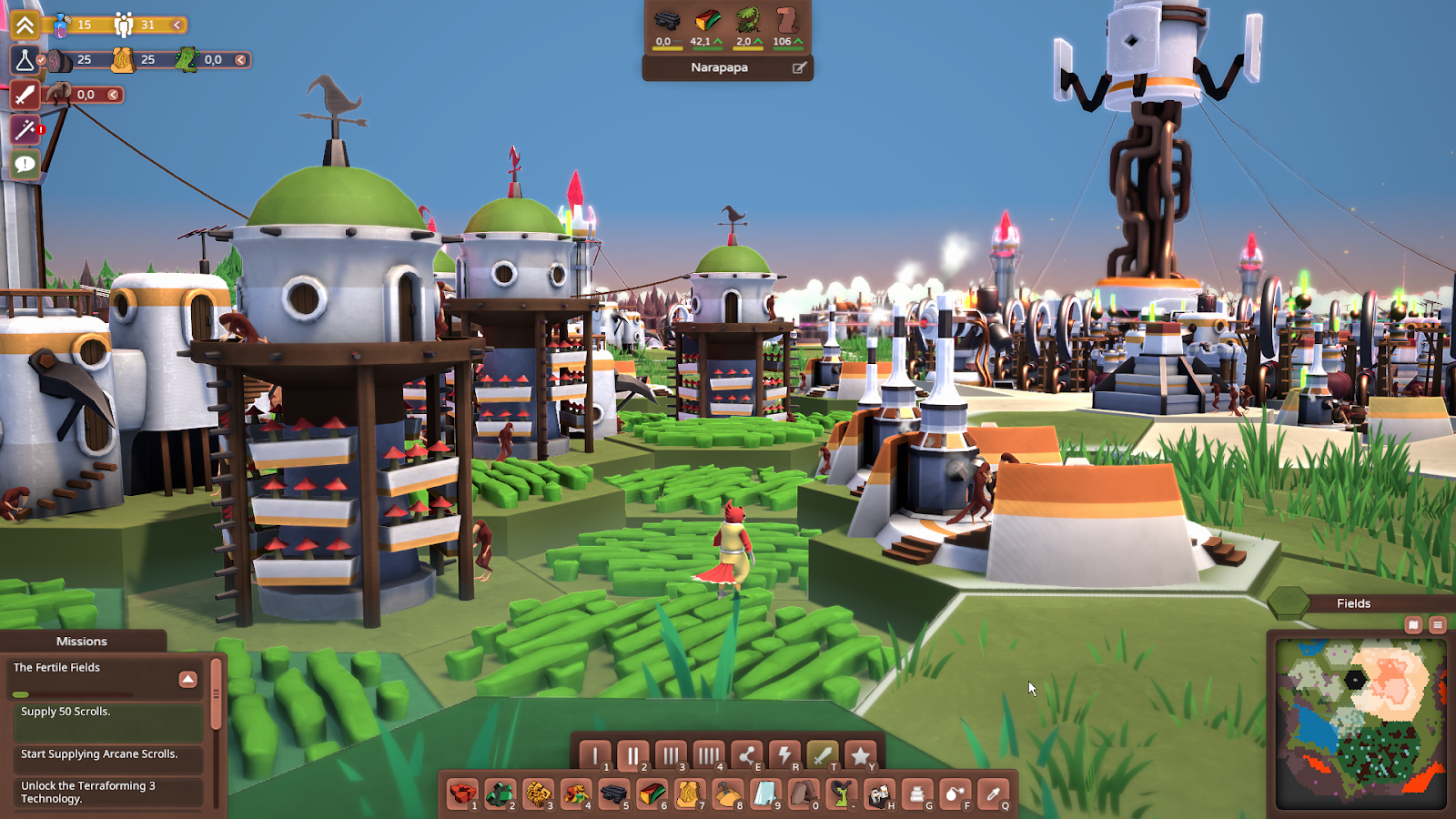
Scorchlands can best be described as a relaxed city-builder with puzzle elements with a hint of the recent hit, Dorfromantik, and a little Factorio sprinkled in. The player spends his time dropping buildings on hexagonal tiles across a colorful map, each producing a certain resource that needs to be refined to progress in the game while taking care to balance a simple supply and demand economy. But that’s where the similarities end. There are no opponents, no market, and no trading. The player is presented with a magical world, placed in control of an anthropomorphic avian alien, and tasked with terraforming a moon and colonizing it with his feathered compatriots. The camera itself follows the main avatar, which is both fun and mildly vexing at the same time.
Five Reasons You Might Like It:
Relaxed Gameplay
Every structure placed on the map, be it a building or colony, can easily be moved or destroyed with almost no ill effect. This makes for a relaxed experience that encourages experimentation and optimization. The most important buildings are the colony spires around which buildings are built in a limited radius. Because every building has synergies with either terrain features or other buildings, the total colony production depends mostly on building placement.
Another important element is that there is no randomness in the resource yields and production. Hard work and attention to detail will always give better results.
Unusual Laser Mechanics
While the similarities with Offworld Trading Company are noticeable, one noteworthy feature is the way that resources are shared between colonies. Laser beams allow for the instant exchange of resources between two separate colonies at any distance. While it is easily managed at the beginning, providing a clear line of sight and guiding a beam of light in straight vectors, with the help of mirrors, becomes quite the puzzle later in the game.

Elevation Matters!
The map is divided into hexagonal tiles with variations in height. One of the reasons the lasers become tricky is because the terrain becomes less flat as the game progresses, forcing the player to think in three dimensions. The laser beams interact with both natural features and artificial structures in their path, which means that positioning the lasers to take advantage of slight differences in angle and elevation can help the beam reach its destination with a smaller investment in space (and loss of production that comes with using the limited colony space for logistics).
Cute Nintendo Aesthetic
Bright pastel colors dominate the landscape crisscrossed with laser beams. The map starts as a ruddy wasteland with rugged hills and pools of lava and is quickly transformed into a green pastoral landscape once your central spire is established. Soon, technologies allow the creation of additional biomes reminiscent of Minecraft: first a desert, then a swamp, and finally a mushroom pit (at the time of writing). The structures you build and the creatures that live in the wilderness are colorful aliens that could easily be found in any game from the latest iterations of the Legend of Zelda and Starfox franchises.
Non-Violent Combat
There isn’t much in the way of combat and it has no representations of either hostility or actual physical violence. It boils down to a game of positioning pawns and removing the enemy pawns when they are surrounded. The enemies themselves are passive and are set up in the form of puzzles, forcing the player to develop the economy to hire more soldiers to envelop them. At the moment of writing, they simply pose a static puzzle challenge that blocks the player’s expansion to new territories but will never threaten the colonies themselves. More a speed bump than a roadblock, they’re a welcomed break of pace from time to time, but ultimately tie very little to the city-building elements of the game.
Timeless
Fresh out of the oven, Scorchlands is a new addition to the list of Early Access games out there, promising much more than what it has to offer at the moment. My first playthrough took less than ten hours and, once you know how the systems work, it can be done in half that time. While some might say that it’s too short, the developers should be applauded for not padding the game out with build times, research times, and similar artificial slow-downs that ruin so many similar games. As it stands, time has no importance to the gameplay and is completely dependent on what the player does. A game could take as little as a few hours to upwards of a dozen and, paired with the late-game content not yet implemented, it seems like it could provide lots of entertainment once finished.
Three Snags/Problems (At the Beginning of Early Access):
Unclear Goals/Absence of a Story
As with any game in Early Access, the game has its problems. The most important is that, with the absence of late-game content, there isn’t a clear goal as to why this civilization of bird people is colonizing this moon. Most of the science-fiction elements in the game are simply brushed away as “magic” by the character’s sparse communications with the player. The story is mostly absent and doesn’t tie into most of the game mechanics, so players without a strong drive for production optimization will find themselves wondering why they are doing it at all.
A Bit Too Short and Easy
A second problem is the absence of higher difficulties. While relaxing, it can also be described as boring once most of the buildings have been constructed with little challenge unless timing yourself in pursuit of a speed run. The maps are randomly generated but they seem to follow a very similar structure that doesn’t really change how the game plays out. Considering that there is no randomness in the game itself, except for the layout of the map, this means that there is little interest in playing Scorchlands more than once or twice.
Minimal Visual and Sound Effects
Third, it should be noted that there isn’t much variety in the colonies themselves. While every production building is different, every house looks identical to the next with the same low-poly and minimally animated inhabitants working or standing around in an otherwise beautiful landscape. Even outside of the cities, there are only a few enemy models with idle animations. Any kind of reaction to your character moving around them or threatening them would go a long way to giving them some charm and making them fun to interact with. The soundscape is equally barren. There is only a simple soundtrack and very minimal changes to the environmental sound effects the player’s avatar currently occupies.

Conclusion: A Solid Game With a Lot of Promise
All of the problems described above are in the nature of Early Access games and, as it is pretty early, they will probably be addressed before its final release. What’s important is that the core gameplay loop is fun and works well, rewarding those that take time with it, and for the moment not punishing anyone that rushes through it.