Hexarchy is a turn-based 4X game based on the Civilization model of guiding a single bronze-aged city through time to become a sprawling empire. Civ players will find the choice of nationalities and many of the technologies, units, and improvements instantly familiar. But Hexarchy is also a fast-paced deck builder with all the genre’s hallmarks. Your goal is to deploy your best card strategically and refine your deck by trashing cards so you can exploit the more powerful and valuable cards.
The developer, Main Tank Software, has done a remarkable job of combining the genres effectively. Hexarchy games are short and intense and situational strategy is vital for doing well. Players can adjust the pacing in the set-up screen but a standard game is designed to end before 30 turns. Generally speaking, the game will likely be winding down by the time you hit turn 20 and will wrap up in around 30 minutes.
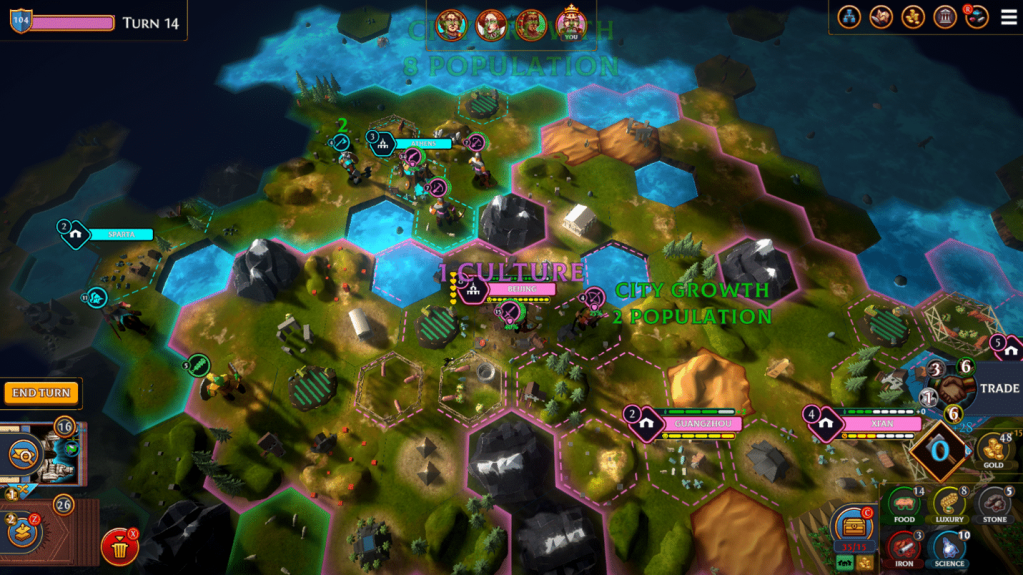
Hexarchy boasts an interesting resource system that presents a huge number of strategic possibilities. Cards can be used to build improvements, recruit units, construct wonders, and research new technologies. Improvements produce resources that are useful for building your economy and keeping your pops happy. Deploying most cards will cost a certain number of hammers, which represent production, but some cards also require additional resources. A wonder, for example, might cost both hammers and gold, or a mounted unit might cost hammers and a horse. Cards might also have an alternate currency. Tech cards, for example, can usually be played with either hammers or science whereas some units can be played with either hammers or iron.
This makes things interesting and dynamic. Developing a plan for the best way, and the best order to play your cards, is a big part of Hexarchy‘s game loop. Moreover, cards can be trashed for more hammers so it’s often smart to keep a turn going by ridding your deck of cards you don’t expect to play or no longer need. You can draw new cards by spending gold, which you can also use to purchase resources that may enable alternative means of playing cards, thus keeping your turn active. If you’re careful and lucky you can extend your turn and play far more cards than your initial hammer count would suggest. There is something extremely satisfying about playing eight or nine cards on a turn when your initial hammer supply suggested you might be able to play only two or three.

Generally speaking, the object of the game is expansion and conquest. A standard skirmish game ends when a player reaches a certain victory point tally, and those points are earned by doing standard 4X building things like controlling tiles, growing pops, and building wonders. Consequently, you want to start churning out settlers as quickly as possible. The maps are small and crowded, so opponents will claim those choice hexes if you don’t. But building a settler means not spending your hammers on improvements required to grow your resources and give you more flexibility to strengthen your civilization. The pressure of limited resources and shrinking possibilities means that nearly every turn presents difficult decisions. Sid Meier famously described games as a series of interesting choices, and Hexarchy delivers that experience in spades.
Procedurally generated maps mean every play-through will be different, with some setups far more challenging than others. You might start out with lots of powerful resources conveniently clustered together. Alternatively, you might being with relatively few available resources, which makes growing powerful enough to take them from your rivals a daunting challenge. The randomness of which cards cycle into your hand also plays a big part in how a particular session might go. Anyone who has ever played a deck-builder knows that the perfect strategy can fall apart if you don’t get the right cards at the right time. In one game, my starting situation presented a challenge I knew I could overcome only by expanding quickly, but I didn’t get a settler until turn 5. By that point, I was impossibly far behind. In another game, I started with an unusual bounty of resources and lucked into an extra settler in a nearby goodie hut. I’d more or less won in the first few turns.

One game had me starting alone on a large and fertile peninsula, accessible only via a single-hex isthmus. The freedom to expand freely while blocking all rivals with a single doom stack made things a bit lopsided.

This leads to one of the real downsides of Hexarchy. The brevity of the game means there will be few reversals of fortune. You’re unlikely to experience the satisfaction of having your back to the wall and somehow surviving and ultimately triumphing. There just isn’t time for those sorts of developments, so Hexarchy offers fewer emotional highs and lows than traditional 4X games. A list of your opponents at the top of the screen gives you your ranked position, but there are no scores provided, so you know if you’re ahead or behind your rivals but not by how much. One of the most exciting games I played was one in which I was in second place when I hit mid game and I had to figure out how I could build up my own standing while diminishing my rival. I didn’t win but it was fun trying.
The different civilizations offer some variety. Every civilization has a unique mechanic and a unique unit. These can be units that give you a leg up in the early game or turn you into a mid-game powerhouse. The variety is welcome and the civilizations do feel different from one another, but not as different as I would have liked. A little more faction variety would go a long way.

Fortunately, Hexarchy offers a variety of game modes. I found myself returning most often to skirmishes but there are also daily and weekly challenges in which you play a game with specific goals. For example, the challenge might be to build a certain number of wonders or grow a city to a certain size. These present some interesting tactical choices since you may want to forego proven skirmish strategies in order to rush for the victory conditions.

As successful as it is, Hexarchy does have some notable issues. The most glaring is the poor optimization. Games take a surprisingly long time to start and load, especially since the requirements are so minimal that Hexarchy plays as well on my laptop with integrated graphics as it does on my overpowered gaming PC. There is also no save option available, though games do save automatically at the end of every turn. Maybe the system was designed to prevent save scumming, but no saving and loading means that if I play the wrong card by mistake – something likely to happen once or twice a session – the only way to correct the mistake is to exit the game and reload.
Hexarchy comes with a tutorial and, while it does a good enough job of introducing the core gameplay, it does a barely adequate job of walking the player through the game’s complexities. There is also very little in-game help. Some cards do a poor job of explaining their mechanics and contain only unclear symbols. Until you know the cards and the systems, I’d recommend playing with the wiki open and checking card explanations frequently.
When playing solo, the challenges mainly come from your cards and circumstances, not your rivals. The AI is rather poor and I’ve seen numerous instances of goodie huts inside an AI’s borders going unclaimed in the late game, or lone under powered units picking an unnecessary battle with a vastly superior stack. That said, the times I decided to take advantage of the AI’s stupidity by leaving cities undefended did not go well for me.
These issues are avoided in multiplayer and Hexarchy is, in many ways, the holy grail of multiplayer 4X gaming: an online match that can be completed in under an hour. The game offers a player-matching feature, but more often than not I couldn’t find someone interested in playing at the same time I was looking. More players would certainly solve this issue.
All in all, Hexarchy is a delightful gem of a game. If a smart, interesting, dynamic, and compact 4X with deck-building mechanics sounds even vaguely interesting, then it’s easy to recommend a game this good. The relatively inexpensive price of $20 USD doesn’t hurt either. I hope Main Tank continues to improve and expand the game. I intend to keep it installed on my hard drive for a long time to come.