“HUMANKIND bursts onto the scene with the goal of directly competing with the 4X juggernaut Civilization in the realm of alternate history. Does it hold its own or is it crushed by the genre’s reigning king?”
Overview
The Civilization series has always been close to my heart. I played the original on a Super Nintendo when I was barely old enough to sit in a classroom and I was completely obsessed with it. Sure, I restarted every single time I started it up for some reason, but it never got old.
As the years passed and each new version improved on the Civilization model, the series aged and matured alongside me. Other 4Xs have certainly made an impact during that time, but none have attempted to step directly into the ring on Civilization’s own turf until now.
I was both skeptical and optimistic when I first heard about HUMANKIND. It sounded like it had plenty of potential to be great thanks to the vision the development team had outlined, and I had already been quite impressed by their past works. Taking on the king was a lofty goal though. One that could result in a devastating failure even if the game was halfway decent. Those worries were quickly put to bed within the first hour that I was ruling over my realm.
An Evolving Nation
HUMANKIND’s inspirations are clear. Civilization had a massive impact on its design. Food, industry, money, and science are the four basic resources that are used to develop your nation and they are exploited from the terrain surrounding your cities and produced within them. Food supports population growth to provide new workers, industry is used to construct new buildings and districts as well as training units, money is used for maintenance, trade, and speeding along whatever project you may be working on, and science is what continues to move you along the tech tree to the future.
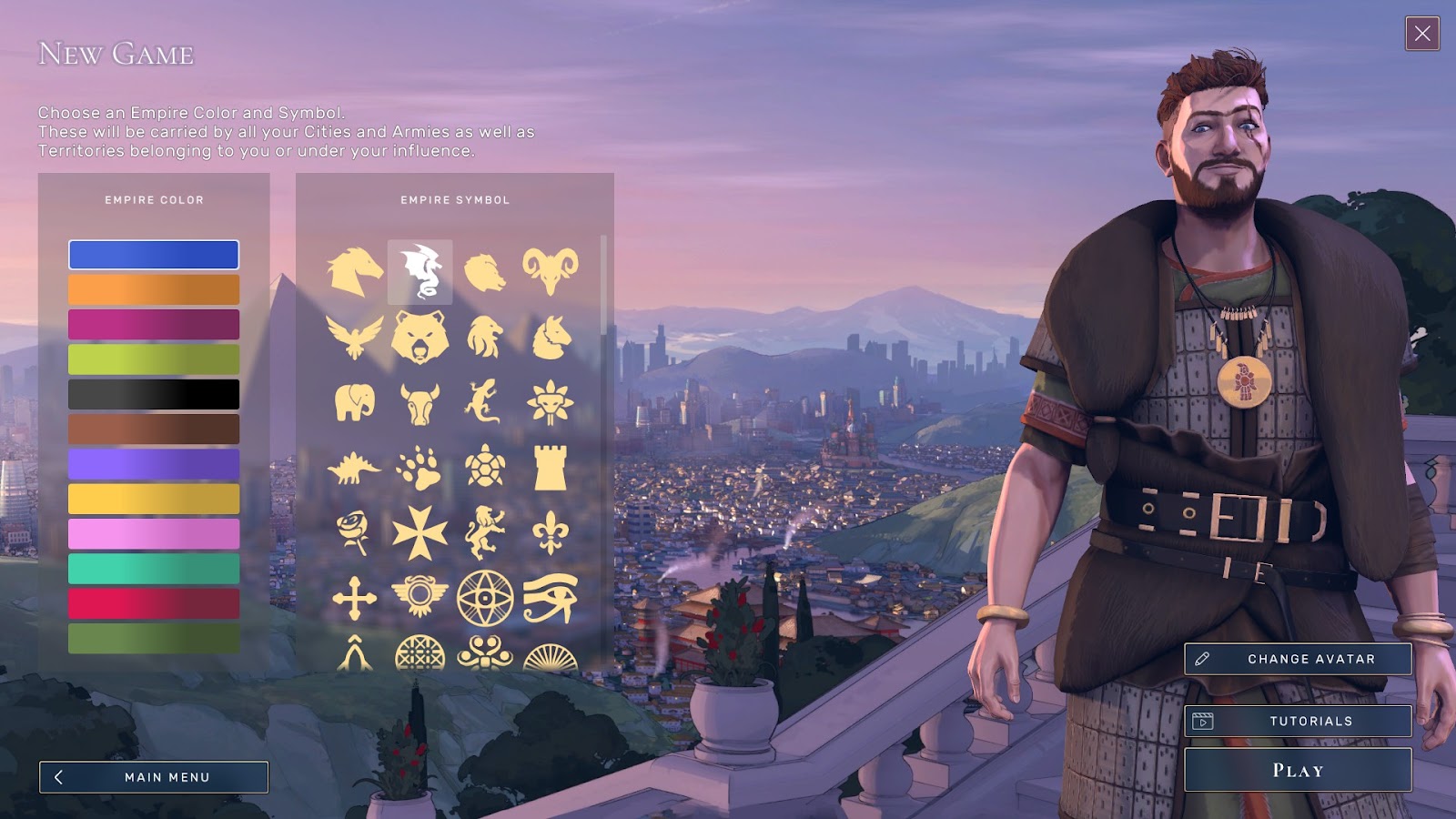
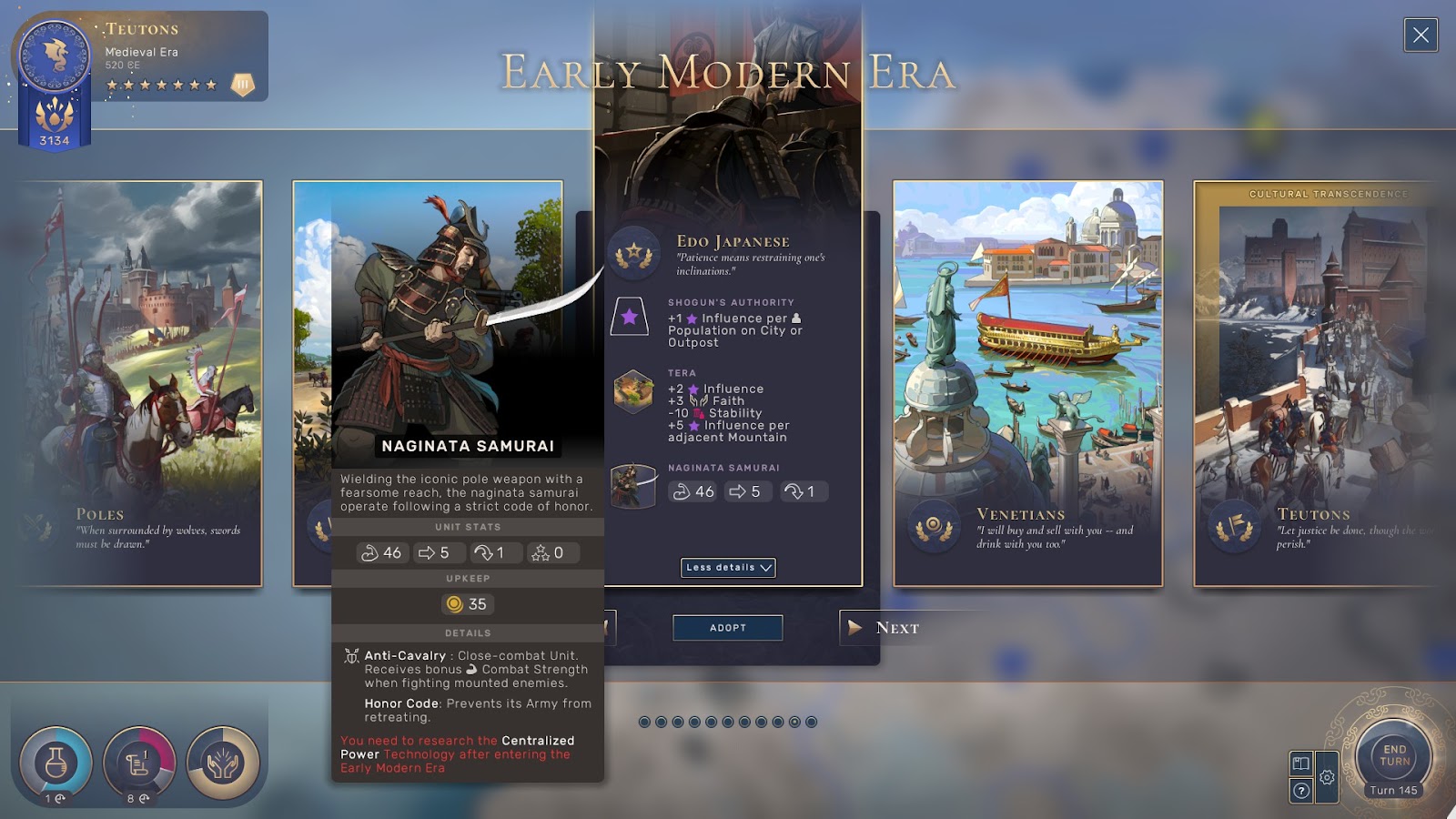
That said, HUMANKIND takes the classic formula and puts its own spin on it. Whereas you experience a specific culture’s evolution from start to finish in other popular 4Xs, such as the Germans or Broken Lords, HUMANKIND has you follow a path of your own design. Each era will have you selecting from a different set of cultures upon advancing to it. This ends up resulting in a beast of your own creation by the time you finish the playthrough, a Frankenstein’s monster of historical cultures. There’s quite a variety available in each era and I always felt spoiled by choice.
These cultures offer benefits similar to those in something like Civilization, though with you unlocking them per era instead of per game you end up with half a dozen unique units, buildings, and passive bonuses along the way. I absolutely loved this system. Although a part of me misses playing as Napoleon Bonaparte or Teddy Roosevelt, designing your own avatar and progressing down a path of your choosing is an absolutely brilliant take on the semi-historical 4X genre. My Egyptian-Roman-Teutonic-Venetian-French-American culture had its own soul by the end of the game and it is an experience that I will not forget for a long time.
From Wanderer to Megalopolis
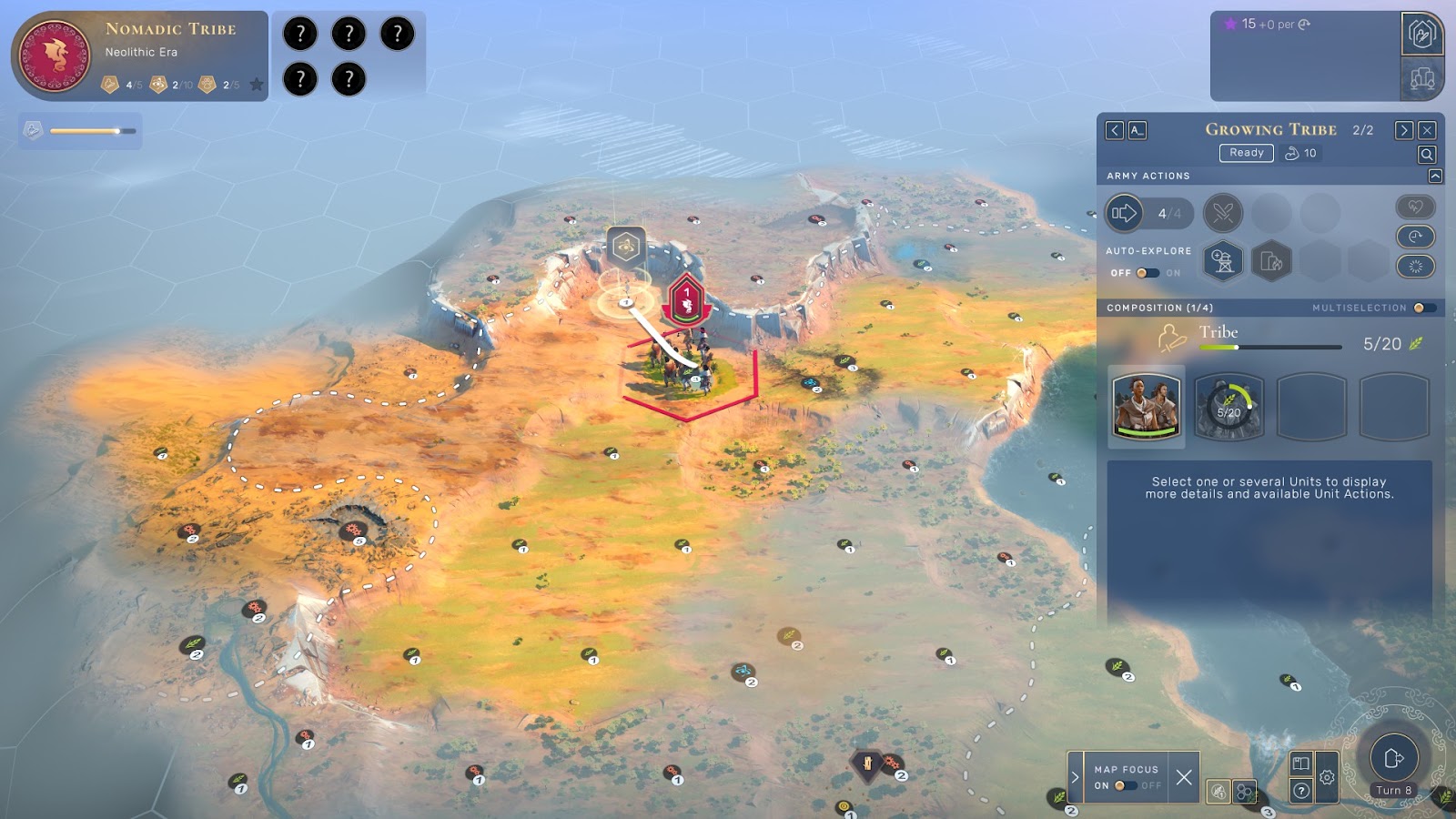
Do you remember the Neolithic Era in the other history-focused 4Xs? I don’t either but HUMANKIND changes that this time around. Your faction begins as a nomadic tribe trekking around the untouched world in search of food and other discoveries. As the tribe grows, you’ll have the opportunity to set up an outpost or two that can perform basic resource collection and claim territory, though you’re unlikely to hold much land before you’ve achieved what’s necessary to advance to the Ancient Era. Once you accomplish such tasks, you’ll choose your first culture and gain the ability to turn outposts into far more formidable cities.
Territories are claimed in a style more similar to Endless Legend. Each has its own predetermined borders and all of the lands that it encompasses is owned by the holder of the outpost or city within. The primary focus of outposts is to claim territory and gain access to the luxury and strategic resources within, though once they’re upgraded to cities they’ll gain significantly more functionality. Cities are capable of producing buildings and units, a capability integral to the success of any nation, and they’re also capable of expanding with districts that allow the exploitation of more of the land around them and boosting their population cap.
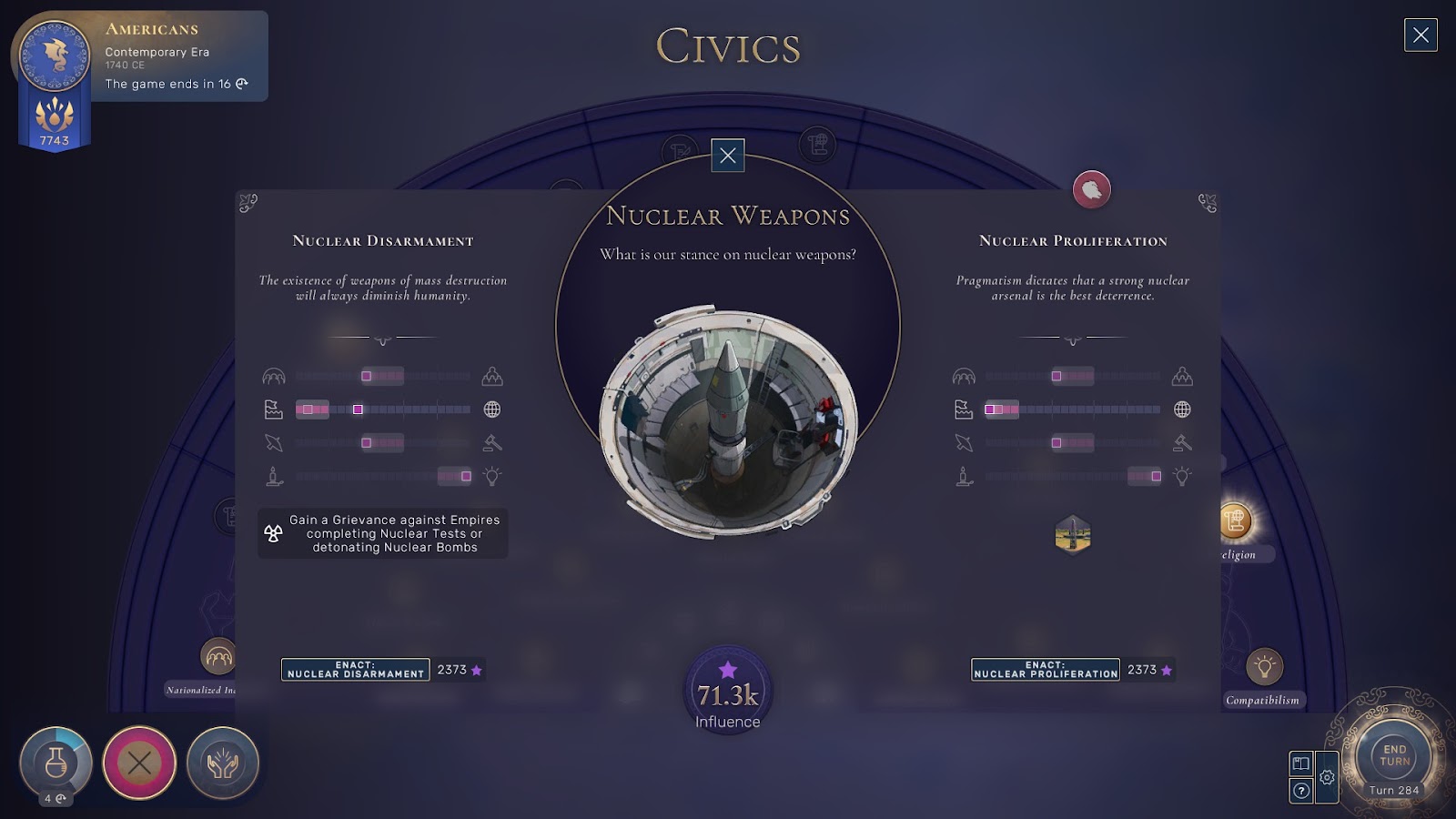
This may sound more or less like what you’d expect but there is a game-changing addition here as well as territories are no longer permanently independent from one another. Outposts can be attached to a neighboring city resulting in the regions being combined into a larger, unified province that functions as a single city for production queues but draws from a far larger pool of resources. This process uses influence points, the fifth type of basic resource in HUMANKIND, which also passes new civics that provide empire-wide benefits. Each attachment increases the influence cost of future attachments, though they allow you to create megalopolises that are serious powerhouses. I often found myself attaching mountainous or dry territories to more verdant regions so that they could shore up each other’s weaknesses while sharing their strengths. If you’re really looking to create a sprawling city that’s the size of an entire nation, you can eventually have one absorb one of its neighbors. The two cities will become a giant, glorious monstrosity. Attaching and absorbing is an excellent idea for the territory-based land claiming system and I hope to see them become a new staple of the 4x genre.
Good Diplomacy Systems Don’t Exi…
With just about every 4X comes a diplomacy system, and they tend to range from tolerable to absolutely terrible. HUMANKIND breaks this mold and succeeds at offering one that not only works but is fun to be involved in. Alliances, grievances, and trade play an important role and the system both feels natural and tends to be exciting throughout the playthrough.
Relationships between competing rulers go up and down as the world’s events play out, but with a little elbow grease, you might find yourself in good enough standing to be part of an alliance. With this declaration of cooperation, several doors open to further tie your nations together in friendship. Research agreements, influence agreements, and shared logistical networks are all here and have the potential to offer significant benefits to long-term allies.
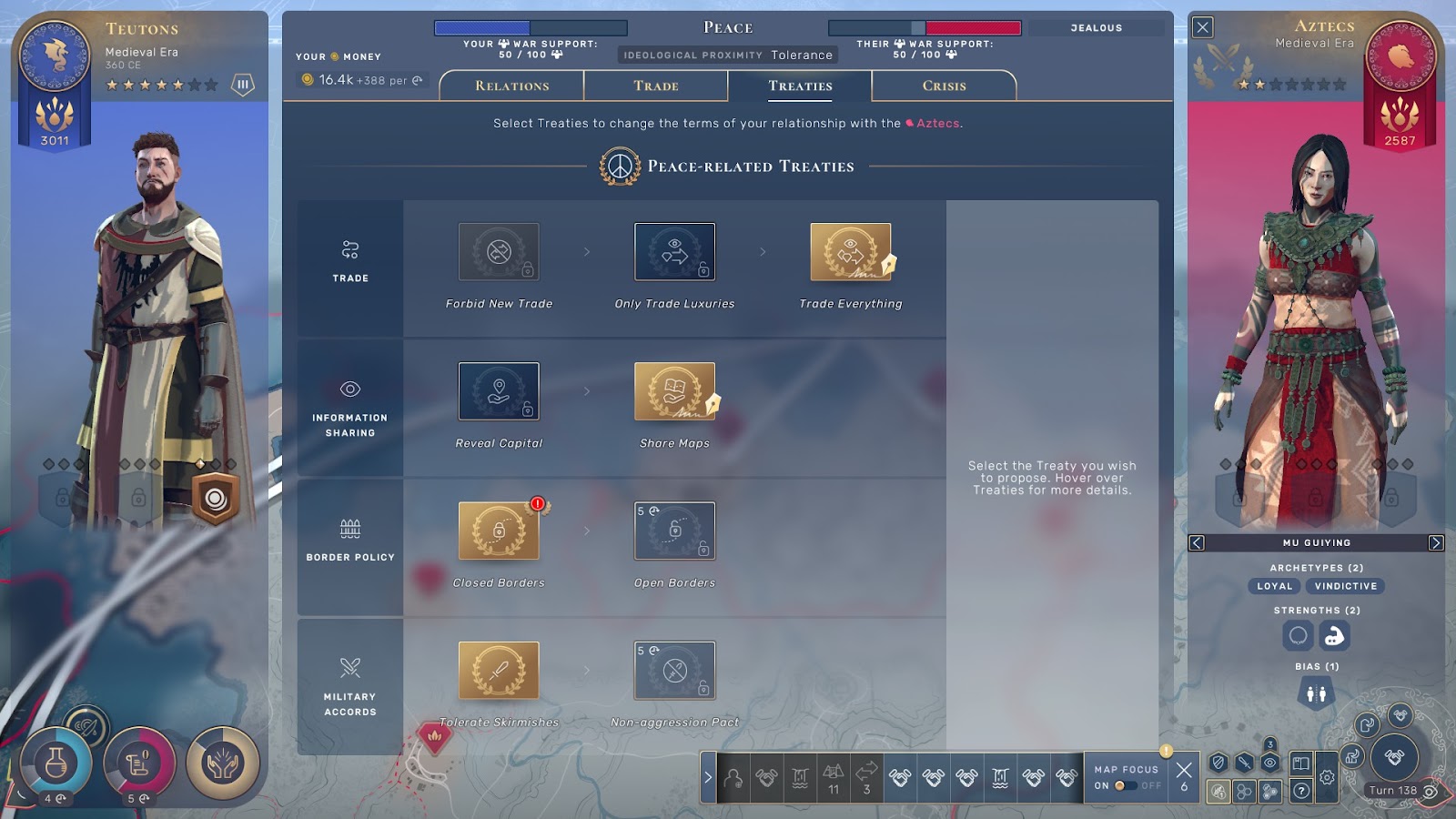
On the other hand, grievances are what push two nations away from the feast hall and closer to the battlefield. Whether it’s settling too closely to one another’s borders or following an opposing faith, these issues can be turned into demands or renounced. Demands cause an increase in war support if they are not met which can lead to swords being crossed, or they can be renounced and declare water under the bridge for the sake of good relations. Grievances were another aspect of HUMANKIND that I fell in love with as I played my military heavyweight. Those who I could easily crush would often give in to my demands to avoid all-out war meaning that I gained several territories and plenty of gold simply by showing my teeth to another nation. It was glorious.
The third and final piece of diplomacy, trade, involves the exchange of strategic and luxury resources along trade routes. As you acquire more advanced technologies, your units and buildings require more resources to produce them. For example, an early unit might require only one source of iron to produce, though a more advanced one might require you to have access to three. Meanwhile, luxury resources provide bonuses to your empire that are cumulative even among the same type. As such, four sources of pearls have four times the effect on your empire as one source. This makes it so that every resource on the map is important to you, not just ensuring that you have one of each type. Trade routes themselves are mostly what you’d expect, though I appreciated being able to build airports to add air routes to the standard land and sea routes as well.
The Wheels of the War Machine
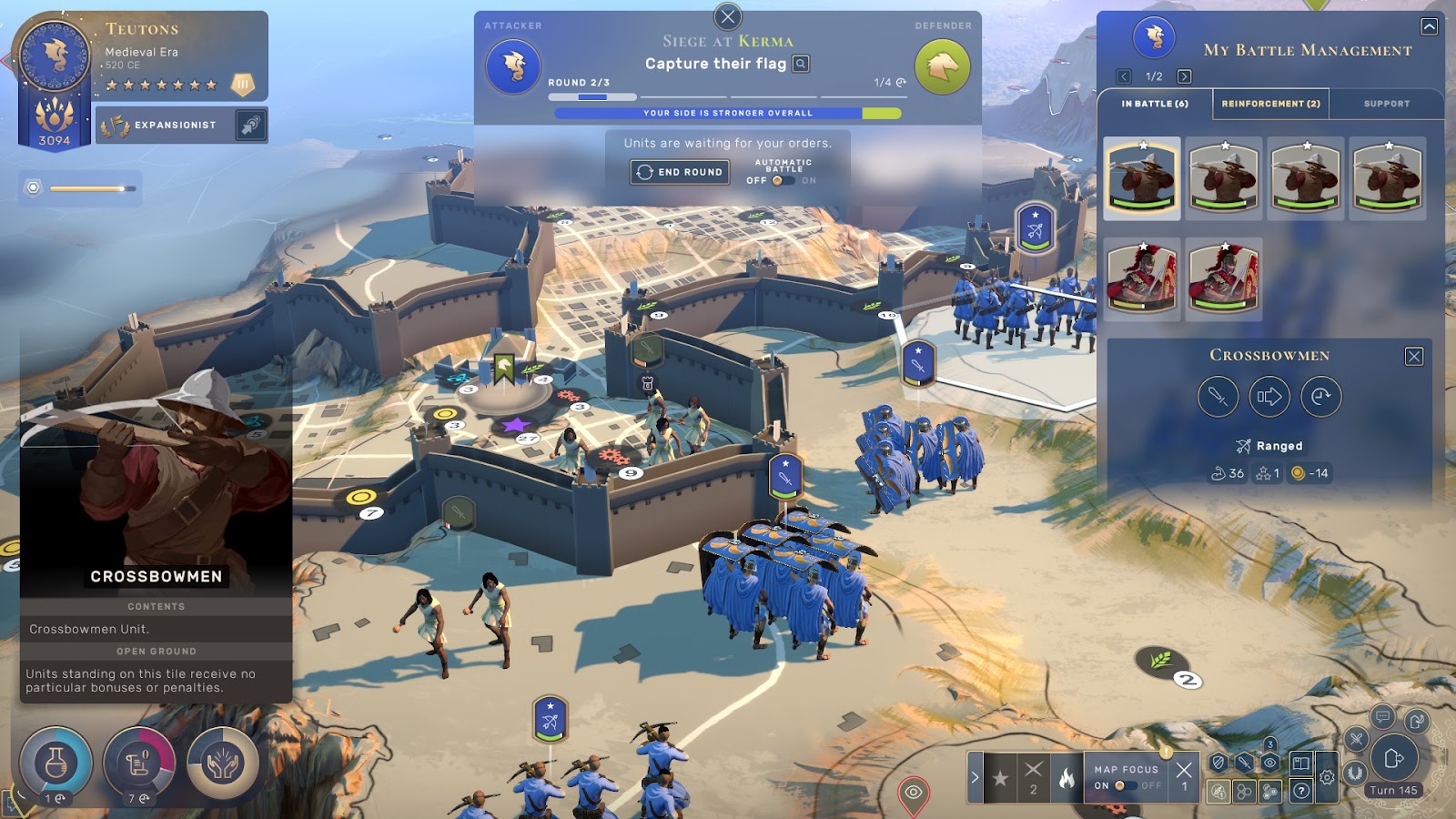
When diplomacy fails, there is always war. If you have enough war support built up from grievances, you can declare war to enforce them. If you do not have popular support and solid reasoning, you could alternatively go the surprise war route to satiate your aggression. You’ll just want to make sure that you’re prepared for the world to be displeased by that course of action.
Combat plays out similarly to Endless Legend in that two armies meeting results in a tactical battlefield made up of the surrounding area. Multiple units are grouped into armies and each side will take a turn moving and attacking with their units before the other side takes over. Although there’s certainly fun to be had in these battles, there’s an option to instantly resolve them instead if you’d prefer to focus on the empire management and strategic side as opposed to tactical micromanagement.
Units come in a decent variety and most of them have special passive abilities that keep things interesting. The Roman Praetorian Guards, for example, get flanking bonuses when they are working with their allies, even when they are not truly flanking by the game’s standardized definition. Another element that stands out is that the power creep between eras isn’t as extreme as what you may be used to and a unit can be passably effective in a pinch even if it’s an era or two behind. In other words, one nation’s units are not immediately obsolete once their enemy has developed the next tier up and this results in wars with less extreme outcomes in those situations.
The Bottom Line
HUMANKIND has already sealed itself into a spot as one of my favorite titles and I might even be so bold as to claim that it is now my top 4X of all-time. Nearly every element of the genre has been improved and expanded upon and there are few issues that I encountered either within the gameplay or on the technical side. If you’re a 4X fan, you absolutely have to play this one. As for general strategy fans, I give this one a strong recommendation to at least check it out to see if it strikes your fancy. I was completely blown away by it. I am excited to see where HUMANKIND is going from here as a few years of expansion support could really make this one stand the test of time.
Rob’s Second Opinion
My hat’s off to Aurumlamina for taking this on and getting a detailed review in a week. He’s done a pretty great job of laying out the foundation of what makes HUMANKIND such a great game.
I didn’t want to write the full review, despite having over 250 hours with HUMANKIND, because I was nervous that it may seem biased, as someone who’s a member of Amplitude’s VIP program. But as a second opinion, and as an open and honest one, I think some of you may value what I have to say.
Though the VIP group is small, those within it will tell you that HUMANKIND didn’t click with me throughout the vast majority of its development. I’m a bit tired of the historical 4X “genre” in many ways, and I have Civilization to blame for that. I’ve been playing the Civilization series since the very first game was released, so I’ve been a bit burned out on the journey of humans making their way through the trials and tribulations of history. Furthermore, I really, really enjoyed Amplitude Studio’s Endless Legend and how unique its setting and gameplay were, and Humankind felt like a shift back to something a bit more traditional and…boring.
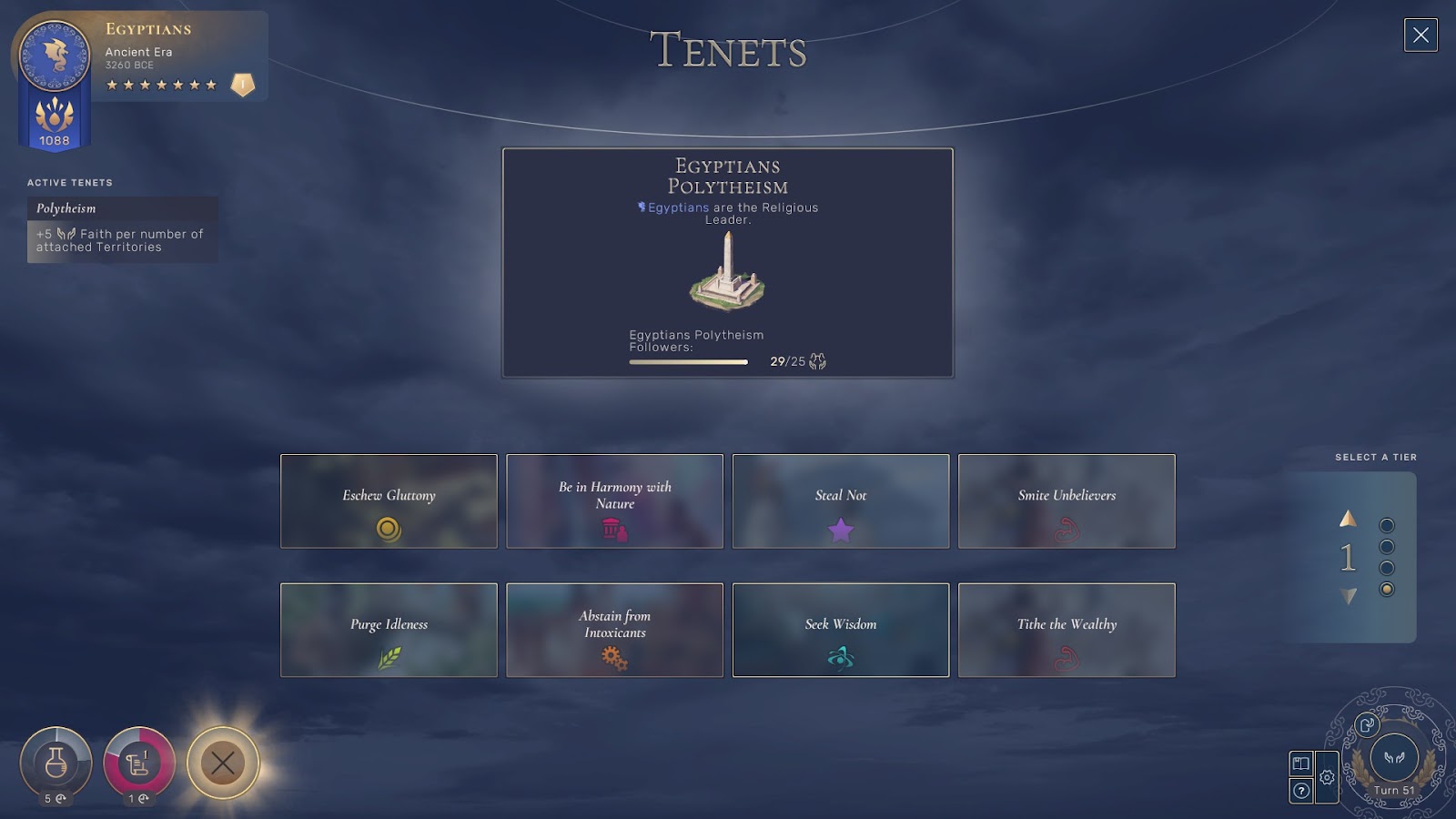
But somewhere around the release of the Victor OpenDev, I started to understand what made HUMANKIND special. The various cultures and their synergies with the map presentations, the way that diplomacy (despite having some strange voice-over responses in some instances) felt fluid, unique, and nuanced, the joy of combat and the various tactical considerations, and the distinct way in which Amplitude Studios approaches city development, especially here in HUMANKIND, along with Amplitude’s subtle, yet flavorful, way of telling a story of your civilization through events, civics, religion, and more, have all combined to reinvigorate my love for the historical setting.
For the first time since Civilization IV, I’m finishing games frequently, as the fame mechanic is a fun measure of victory, especially since it, itself, is much more nuanced than “just a score”. In addition, there are usually at least one or two AI empires that do well enough to keep you on your toes at even the normal difficulty.
All of this is to say, that I was wrong to think that Amplitude Studios couldn’t draw me back into historical 4X. This is the Civilization killer that they were likely hoping to produce. I don’t say that lightly, as I know many people love the Civilization series and I grew up on it, cutting my 4X teeth on its many iterations. But Amplitude Studios has done what Firaxis hasn’t been able to: reinvent the idea, improve the formula, but still feel familiar, new, and fun.
The future is very bright for HUMANKIND. The future is very bright for historical 4X (Old World and HUMANKIND in the same year?!). The future is especially bright for our favorite genre, 4X.
I’m just damn glad that Amplitude Studios pulled this off because I remained pretty unconvinced until just a few months ago. Now I’m just happy to have been so wrong.
I Completely Agree With Aurumlamina’s Score Below
- My single biggest issues with the game are that some of the pacing still feels a little off, that pollution, a late-game mechanic, feels woefully limiting. It’s far too easy to exceed the threshold to make that game unplayable. Also, I wanted modding in at release. I wish that had made it in and it’s disappointing that it’s not.
- My favorite aspects of the game are the cultural choices and their strategic considerations, the tactical combat, and city management, which doesn’t just boil down to “build everything, everywhere”, while still providing a lot of choices. And good god, it’s a beautiful, beautiful game. Hot damn!
(For full disclosure, while I’m an Amplitude VIP, I’m easily one of the hardest to impress in the group, and also DO NOT get paid for being one.)
Be sure to check out my ongoing Let’s Play here:
And for those interested in seeing Contemporary Era gameplay, you can see a sneak-peek here, where I show a little, without giving away too much: