(Editor’s Note: Yes, eXplorminate is back to writing. We won’t be as prolific as before, but we’re still going to produce written content.
Our eXposition series is a series of op-ed writings that allow our community to write about anything they’re interested in. Delta_V reboots eXplorminate with his thoughts here)
Interstellar Space: Genesis (IS:G) is seemingly close to the release of its first DLC, Natural Law. Also, the free update 1.2 is in the open testing in Steam (“unstable 4” version as of the time of writing). Sounds like an excellent opportunity to look at what the game is now and what it may become.
Being one of the few new 4X games released in the last years, IS:G was covered more than once on eXplorminate and you’re very welcome to read the original review for the added context. After you’ll read this article, that is.
This article is less of a review, because, plot twist, there aren’t many major or even moderate changes in the 1.2 patch to review. A lot of minor changes, yes, but game-changing? No. This is more of a refresher… no, more like an opinionated commentary written to pique your curiosity about the game.
Anyway, let’s begin.
So, IS:G’s story is a common one, but with the unexpected twist.
The premise is usual, a group of people writing about space strategy games decided they know this artistic medium well enough to make a space strategy of their own. The twist is that they actually made the game, released it and it is for all intents and purposes playable.
That is frankly inspiring.

IS:G is quickly typecast as a Master of Orion 2 (MOO2) clone or successor or rival, just like any turn-based space strategy without hexes and that’s very far from the truth. Whatever the initial scope or goal of the game was, it’s at its lowest points where it tries to behave like Master of Orion 2.
Of course, I’m right by default, as this is my soapbox, but here is why you might want to care.
It’s not exactly a brand new game. It’s been around for more than a year. Those who bought it as IS:G or “MOO2 successor” and enjoyed it as IS:G or “MOO2 successor” whatever it means, are having fun with the game.
But those who bought it as “MOO2 successor” and didn’t enjoy it, or glanced over “another MOO2 derivative” are not having fun with the game.
My primary intended audience are exactly the people who are not having fun with the game. And it’s a pretty unique game when you “hold it the right way”, well worth another look.
We’ll get to it in a second, but allow me a quick jab. IS:G’s interface is, frankly, a mish-mash of styles, but most of it’s heavily influenced by Amplitude design. Rounded icons, crowns over homeworlds, “influence” spheres, quests with three-four choices… Takes quite a bit of squinting to see MOO2 in there.

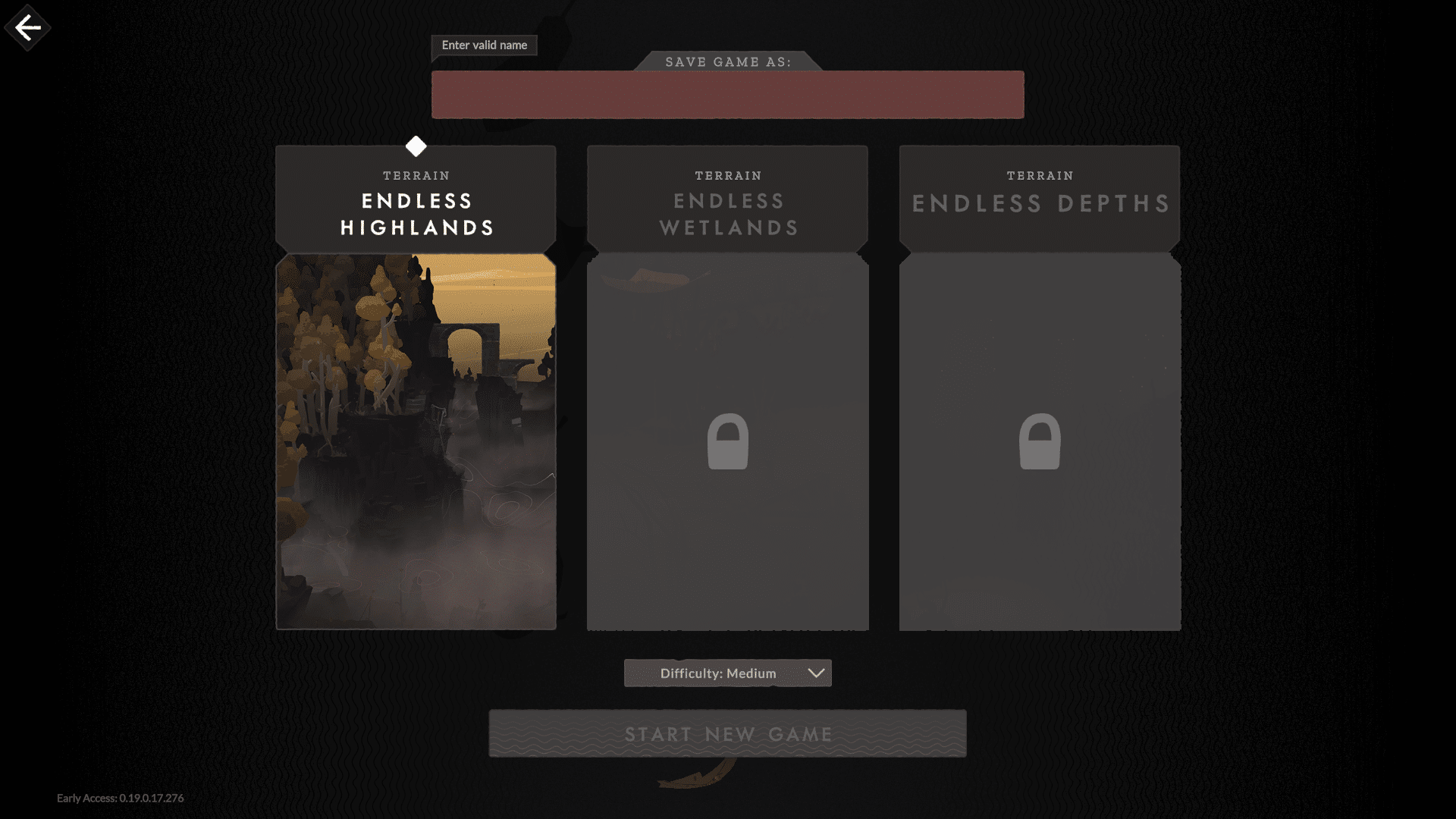
Anyway, you start out with a single world, two scouts and one colony ship. And ships number is soft-capped by command points and if you’re over the limits, you have to pay BCs for it. Clearly a MOO2 clone, after all, that’s all that MOO2 had to offer.
And the early game is where the bulk of complaints comes from. “The game is too slow”, “glacial pace”, “ages before something gets done”, “I started a game, but never finished it”, etc.
These are all perfectly valid complaints because it does not explain the proper way to do things to the player. That’d could’ve been called “no hand holding” if there were other ways to achieve that tempo, but seemingly there is only one.

The actual flow of the game is quite unique.
We’re all used to stuff the new colony with the build order and forget about it, but in IS:G you:
- don’t have enough slots for each and every building
- don’t have enough money for maintenance in the early game
- don’t have that much to build even in the late game
- don’t get enough oomph out of the building when it finally gets constructed
The thing is that the production is the stacking multipliers game. Sure, you have some production per pop, but it’s not that important. What’s very important is the two counters a planet has, population and infrastructure (it’s like another population type).
They multiply, so getting an additional population is most likely more important than getting a +2 production per unit which could be huge in some other game.
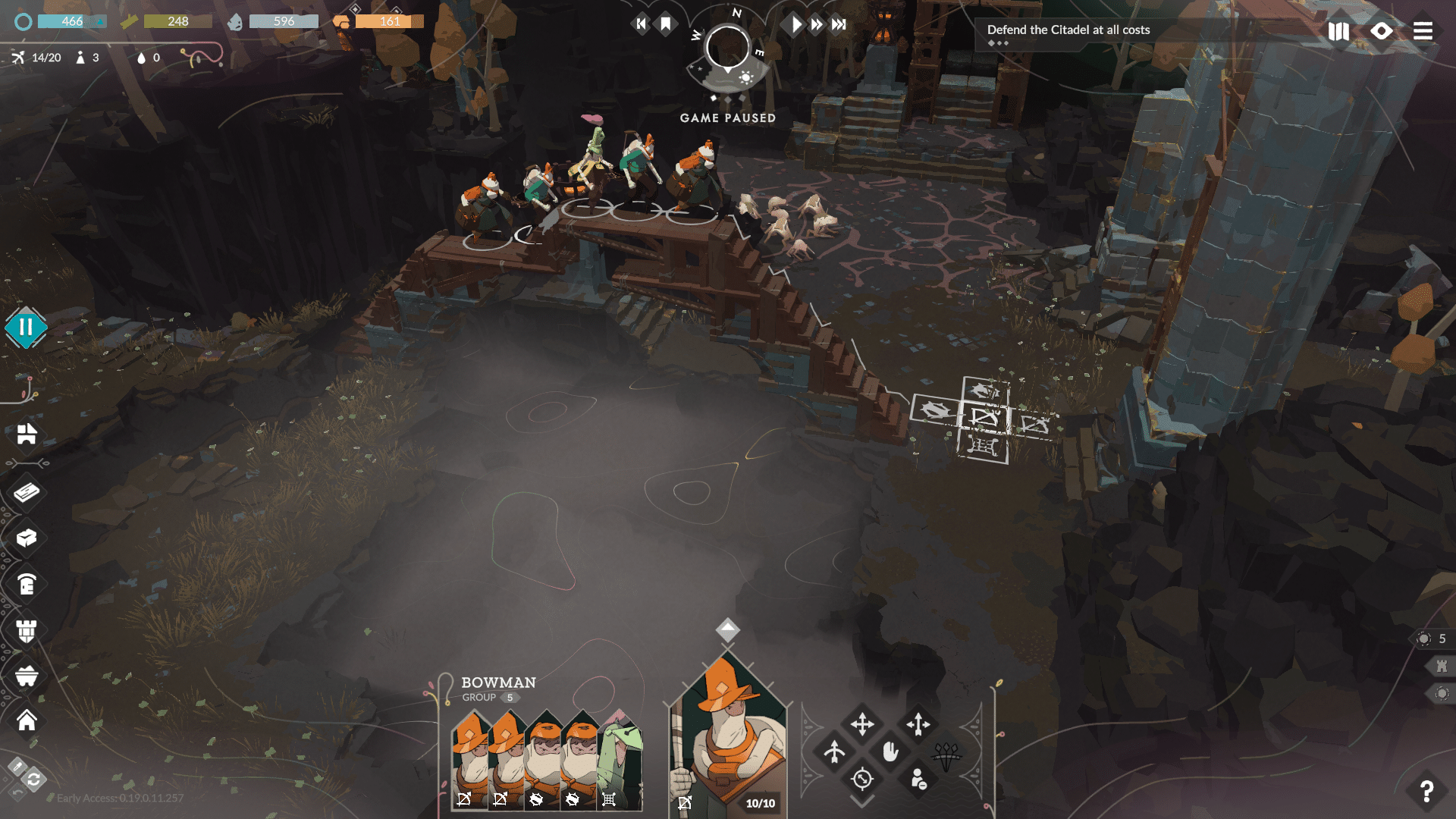
To put it into perspective, this colony…
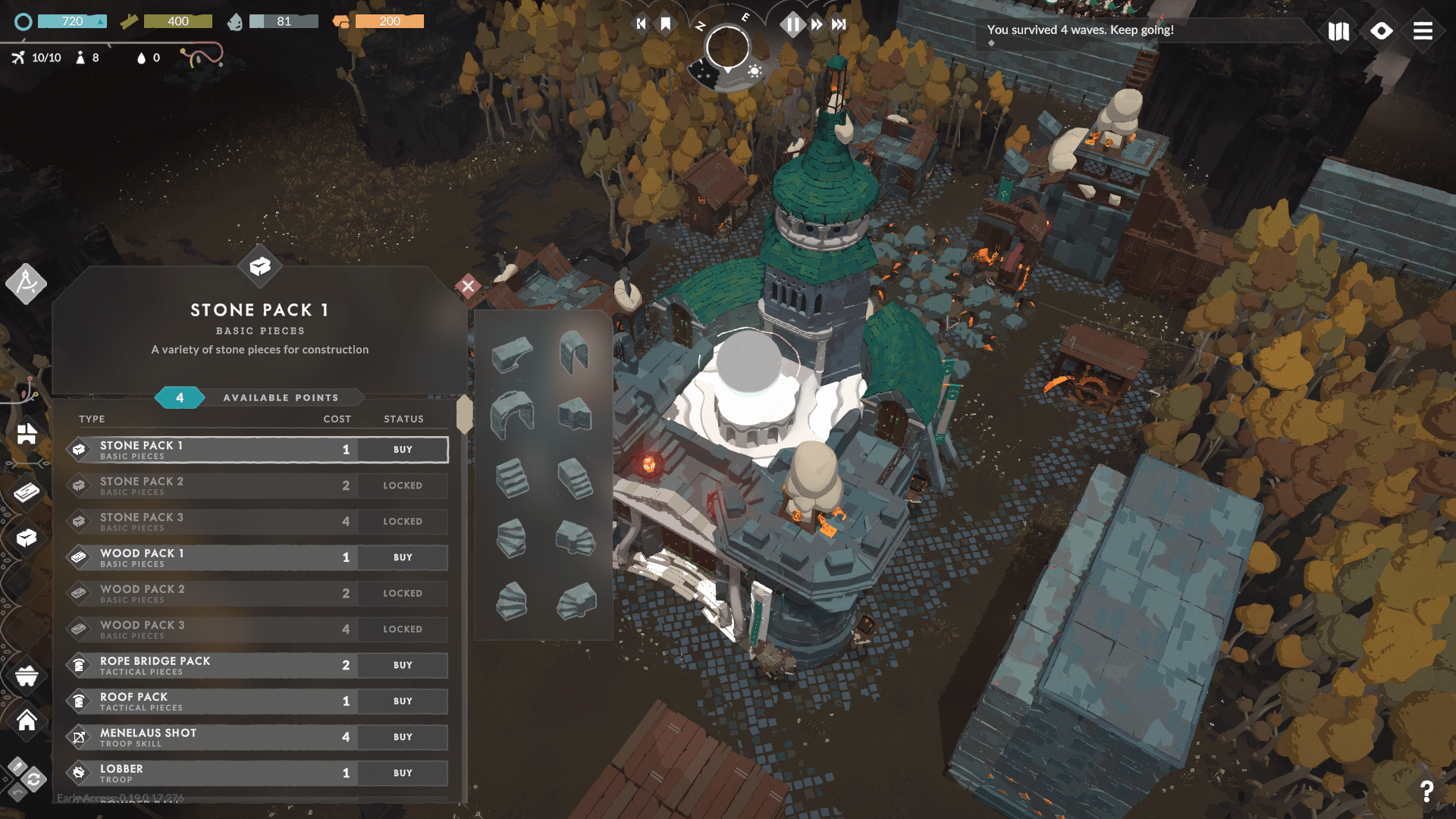
…will become (5+1)*(4+1)/(5*4) = 1.5 times more productive in eight turns. Well, about 1.3 because of flat bonuses, but that sounds not as impressive.
It’s a bit like the “housing” strategy in MOO2. Prioritize population and infrastructure and you’re golden… But how? You have little to no production on a fresh colony. Even 1.2 ups the fresh colony’s output from 40 just to 60. Still ages to get anything done. Should you just rush-buy stuff?
No, there’s not enough money for that. You’ll be on a tight BC budget the whole early game even in 1.2. And that’s, again, tripping people who expect MOO2-like mechanics.
By the way, as we’re talking about money. Look at the upper left corner:
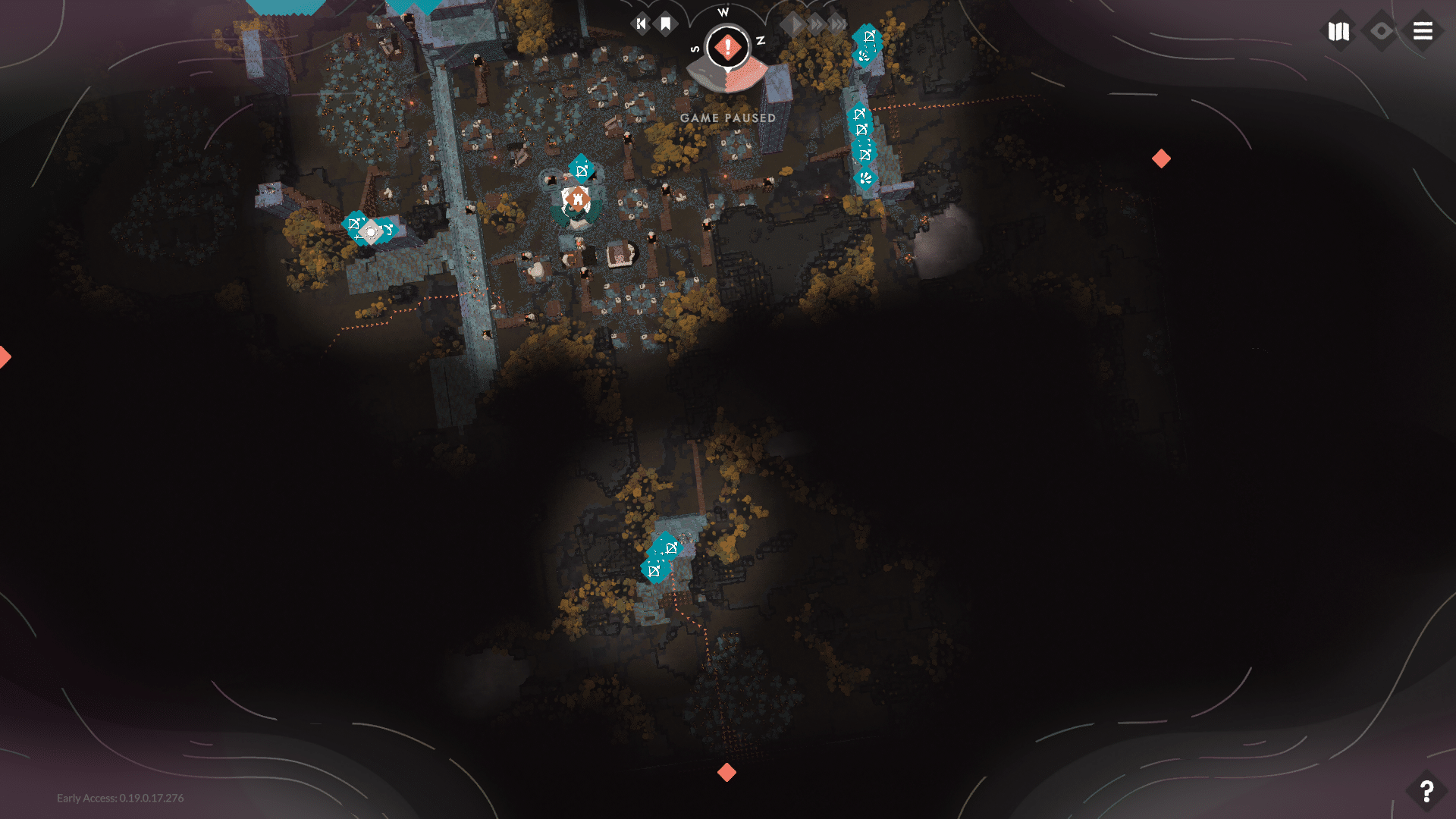
And press that minus button until your research and culture are no longer boosted. That boost is meaningless in the early game and disabling it will provide some cash-flow for early game buildings.
What you should do, is set the correct-for-you ratio between population growth and infrastructure growth and leave the planet be, for now, Master of Orion 1-style.
Overall, don’t concentrate on colonizing planets. Unlike MOO1, you can easily win the game with just a couple of colonies. In IS:G, it’s very convenient to grow tall.
So, instead of building stuff, there are two principal ways of moving production around: support ships and asteroid mining. Better yet, most things that you need to get yourself bootstrapped you can get for free if you follow the game’s mechanics.
Here’s how a powerhouse of an empire looks like:

Disregard the gaudy thing in the center, look at these beautiful and profitable asteroid belts!
They come in three varieties: large, medium and small and offer x3, x2 and x1 bonuses for money, science or production, depending on how you want to exploit them.
Here’s how you should do it:
- large is for production (60 PP * tech_bonuses * leader_bonuses)
- medium is for trade (10 BC) or for production if you just can’t find enough large belts
- small is for science (5 RP base + 10 RP flat bonus from a culture perk)
Leaders require a small footnote here. They have upgradeable stats and skills. Skills give flat bonuses (one leader can easily overshadow your entire empire’s output in the early game) and stats describe their multipliers on a colony. Push “Corporate” as it multiplies asteroid production output.
Also, production exploitation produce these nice dotted lines on the main map:
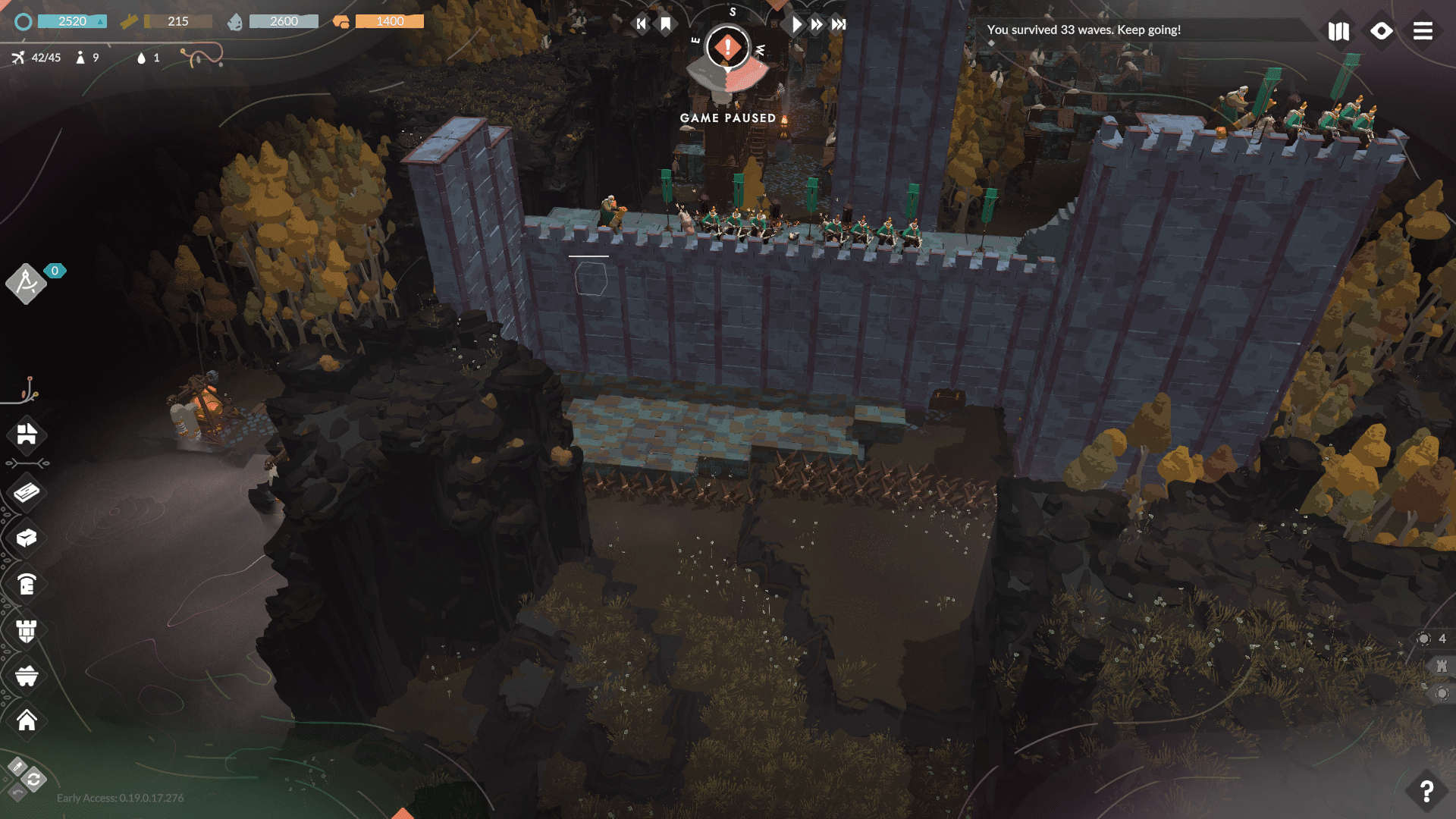
That’s nice, but to start the exploitation you need an outpost, i.e. you need to build an outpost ship (35+ turns at the start for each). Also, for production, you need freighters (10+ turns at the start for each).
So, there are just two minor issues… where to find such places and how to get ships to make it run?
Well, they are hidden in plain sight. Literally. There aren’t any on the map when you start the game. However, at the very first turn, you have to set up your exploration target.
The exploration mechanics were already written about on eXplorminate, so I’ll cut to the chase. Here’s what you want to discover:
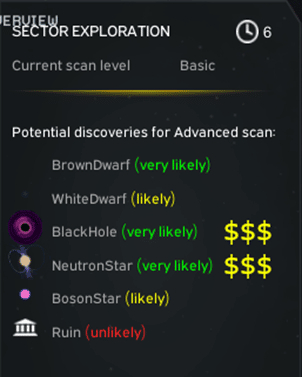
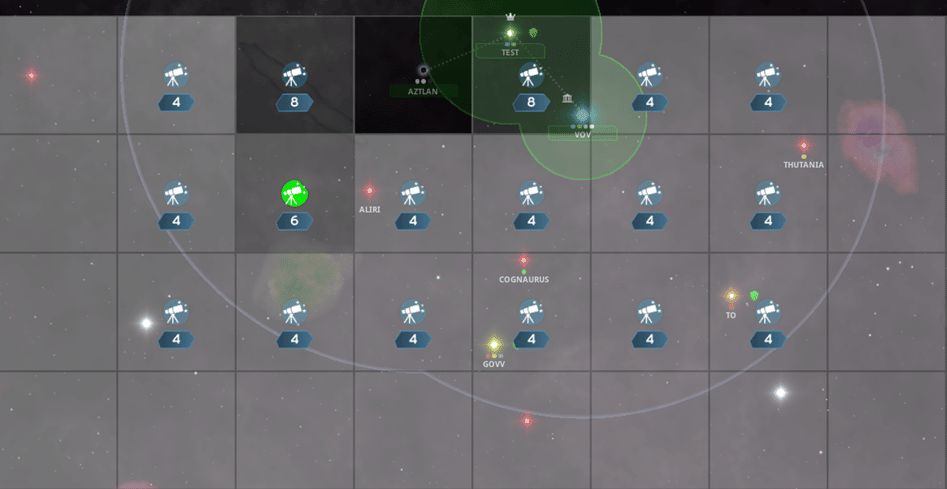
But where? Remember how nebulas and chasms between the stars were your bane in both MOO1 and MOO2? Here they are your best and second best options to search for black holes and neutron stars.
Like in this screenshot, you may have a decent black hole right next to your homeworld. Who would have thought? Well, at least it’s not a hidden quasar nobody knows about.
Now, to ships. We’re going to get ships with SCIENCE and CULTURE.
No, really. Quite a lot of early-game techs and perks come with the ships.
Here are my recommendations for the tech queue in the early game:
- Asteroid mining will give you an ability to exploit asteroid belt and will give one free freighter fleet
- Improved logistics will give you more range (quite a bit more in 1.2) and a free outpost ship
- Robotic factory will give you a serious early game boost from asteroid production
- Starbase will pave the way for offworld support, also freighter port and other later techs that’ll multiply your empire’s output depending on the star base’s presence
- Cloning facility will bump up your population growth rate by 50%
- Synthetic food will up it by an additional 25%
- Offworld support will give you a free support ship that’ll give you about 1-1.5 large asteroid belt’s worth of production just for 4 command points (don’t build them yourself)
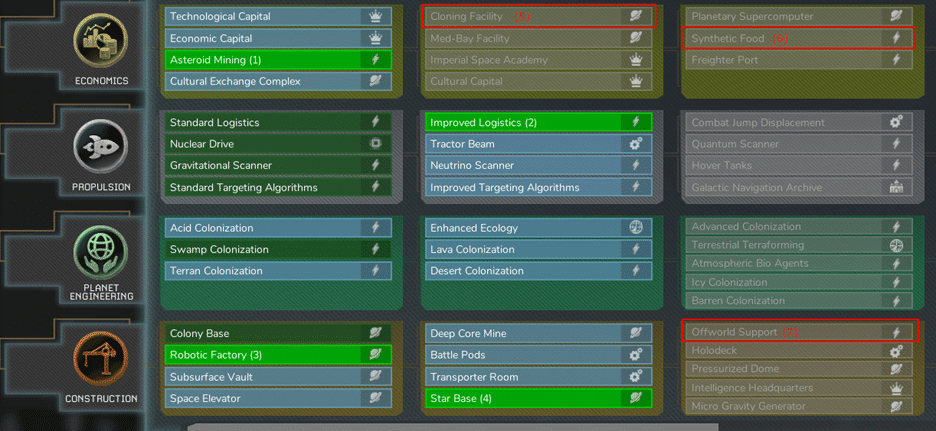
Overall, the research style would be familiar to those who played Distant Worlds: you click over the table with techs and they get researched in order you’ve clicked.
One of the very nice features of 1.2 is the ability to hover over the tech in queue and move it up or down:

However, when you want to research the tech from the same tier/group pair, you have some techs researched, it will cost more and more:

That’s an interesting tradeoff, but it leads to 90% (or more) of the research points spent on civilian tech. It’s way too easy to catch up on military tech, as the newer weapons, armor and shields obsolete the old, but +5% of population growth from each Helium-3 source is going to be viable at every stage of the game.
To make sure you’ll have that time, give your race at creation the “Serenity” ability, it’ll ease all contacts with alien empires.
As a side note, don’t be concerned about building those science buildings.
The lion’s share of the early game research will come from the research asteroid outposts and leaders, the lion’s share of the mid and late game research will come from… wealth.

And your wealth will be out of control, as the colony that built every infrastructure and every population and maxed out on buildings can only produce trade goods or ships.
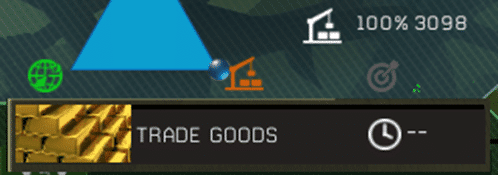
Forever.
Ok, that’s all fine and dandy and we’ve got one freighter and one outpost ship, but is it enough? No, it isn’t.
IS:G has a culture mechanic, it’s just like science, only with perks instead of techs. Like in Civilization V, for example. But, unlike Civ V, and like in X-Com, you can select only one perk out of two on a tier.
This should’ve been a hard choice… but you do it the correct way:
- Space Rush — gives 2 free outpost ships and lowers their price by half — and you get them roughly by the time your asteroid mining tech is researched, go boost production!
- Astronomy Culture — gives the ability to explore two sectors at once
- Stellar Navigators — gives +2 speed on the main map and +1 speed in nebulae — and now you can use “Enlightenment” ability to cut the time to next culture perk roughly in half
- Astro-Mining Guild — gives +50% bonus to asteroid production
- Asteroid Archaeology — gives +10 flat bonus to asteroid research
- Theory of Everything — gives 2 random free techs and is a trash perk, but allows to build Galactic Knowledge Exchange, a wonder you really want to rush
- Megacorporations — +2 BC per population, allows to build wealth wonders
- Space Explorers — gives free survey ship, quite convenient
- Space Socialites — +1 culture per population, x2 tourism income and allows to build adventure wonders

Starting from the 10th perk, the culture points requirements really grow up. If you go tall in one of the segments, you’ll never catch up in time with the others. As IS:G requires the third-tier perk to build wonders of that particular category, you’ll be missing out big time. Don’t do it.
Wait-wait-wait, you’ll say. Why so pushy? Abilities, wonders, where did they come from? We were just getting ships for free!
Yes, but we were getting them to make our homeworld (or any world) build things fast. And “Serenity” ability allows concentrating on things that give stuff a bit more than on things that destroy stuff. And “Enlightenment” allows getting to the perks that allow the best stuff faster. And the best stuff is the wonders.
It’s a strategy. We need to plan ahead, you know?
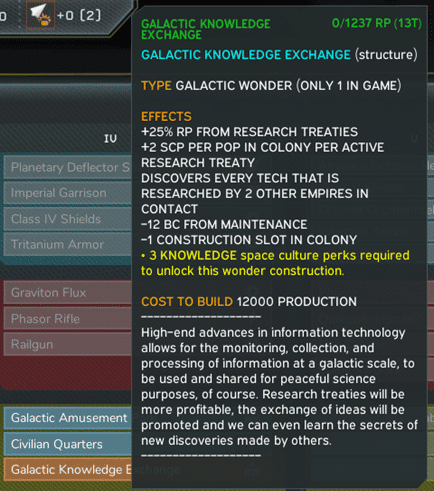
So, there are seven wonders in the game and they are mostly located on the 3rd and 4th tech tiers, an apple’s throw from the start. It’s nice to have them all, though Galactic Surveillance Network is both far away (7th tier) and useless.
The wonder to have is Galactic Knowledge Exchange. It allows you to have a tech that’s been researched by at least two other empires completely for free. It just appears and also does not multiply the costs of other techs in its group. It doesn’t bring free stuff if there was any attached to the tech, but even without it it’s insanely powerful.
The second best wonder is Galactic Navigation Archive. It is cheap to build, speeds up your ships and allows them to ignore nebulae. Unfortunately, the logic of the game makes it ill-advised to rush this wonder. Wealth perks give just too much in production capabilities.
But if you follow my guidelines, with a bit of luck you’ll be rushing wonders at about 100 turns mark.
And then the world’s your oyster.
Oh, and about these abilities. We must go back to the beginning.
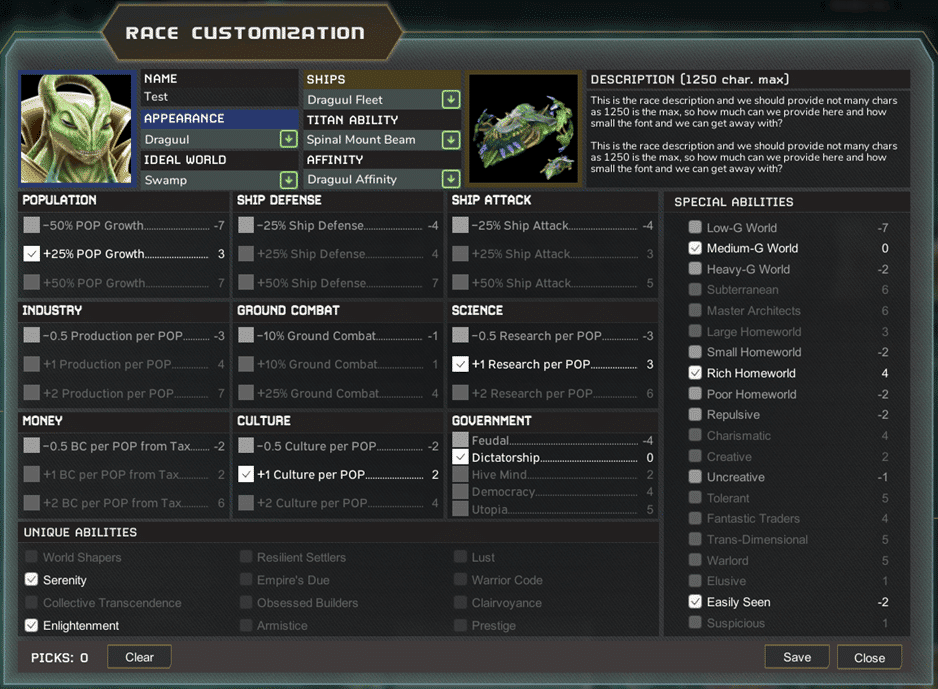
Now, granted, it’s clearly MOO2’s influence that playing a stock race is hard mode. Do yourself a favor, customize your race:
- rich homeworld is important for the tempo
- +25% population growth is cheap enough and very useful
- +1 culture and science are also cheap enough
To offset that the best negative perk to take is probably “easily seen”. Spying is not this game’s forte. You can send out some of your leaders for spying or sabotage, but when you can leave your opponents in the dust economically and scientifically, it’s more for the flavor.
For the unique abilities I’d recommend, as I said, “Serenity” and “Enlightenment”. All other abilities are kinda situational or even useless.
And that’s kinda all that you need to enjoy the game.
Wait, you’ll say. What game? Didn’t I just explain the single bestest way to play it? What’s the point?
The fastest. I explained the fastest way to get in tune with the game’s unique mechanics and approaches, the fastest way to play it as Interstellar Space: Genesis, not like a “Master of Orion 2 successor”. It’s its own game.
If you liked to play in this way and got the hang of the main mechanics, just randomize the tech tree. Or the culture tree. Or both. Or play the stock race. Or try to make use of different abilities. Or try to actually play the tactical combat (still the weakest point of the game) from the tactical standpoint, not from the strategic “six battleships go BRRRT”.
Here’s the truth. IS:G can’t be a successor to MOO2 because many of the design solutions just lead you into an unfortunate dead-end. It’s not nearly as intricately designed. There are a lot of things to combine, but not many of them will reward you in-game, they just don’t click together.
Doesn’t mean it’s not fun to try, though.