Editor Note:
This is an eXploration, because the game is still in early access. Introducing HoMM: Olden Era – sellout? Fluke? Lucky? Good effort? Worth playing? Join our resident expert Boho as he jumps into the Early Access version of Olden Era.
Related coverage:
- Talking about the demo
- Discussing it on the podcast
- And, new, someone playing it blind.
There’s a cinematic intro when you launch Olden Era. In grand Heroes tradition, it’s a pitched battle and its aftermath that serves as a vignette for some of the factions you’ll be encountering – and commanding – in the game. But the style is what stands out: though it’s clearly pre-rendered 3D, it’s also an Impressionist painting: visible brushstrokes adorn the little figures as they fight and die, their edges hazy and vanishing at even a slight distance. Things are familiar, but different.
It’s the visual language of memory. Specifically, nostalgia.
It’s a statement, loud and clear: Unfrozen knows why you’re here, what you’ve come to see. It’s not going to shirk away from the venerable series’ history. It’s not going to reinvent the wheel. If you didn’t like the previous games, you won’t like this one, and everyone involved is A-OK with that.
But as the intro’s roster differences pile up – culminating with the big reveal that the narrator taunting you is something like a drider, complete with a swarm of insects in a magma filled background, a blatant reference to the demonic Inferno town from earlier entries – it’s clear there’s another statement: This isn’t a just a Heroes 3 or 5 remake the most rabid fans clamored for – and at times, clearly felt entitled to.
Olden Era makes it clear it’s going to respect the history, lore, story line, and traditions of the series, but it won’t be the shot-for-shot remake of anybody’s favorite game. And while that’s led to some hilarious and nonsensical feedback that ultimately boils down to “I want to play Heroes 3 for the first time again,” Unfrozen and Hooded Horse have shown remarkable product management by largely ignoring what series fans say they want while accurately determining what they actually want.
In this bizarre era where Early Access has become a performance art as much as it is a preorder with beta access, that takes real discipline and vision, especially with a (comparatively) high profile release like Olden Era.
An Impossible Dream
It’s hard to understate the absurdity of the task Olden Era has before it: revive a series most onetime fans of the franchise associate with their childhood with an accessible modern entry while simultaneously satisfying the hardcore degenerates like myself that still play at least one of the Heroes titles yearly.
The store page and recently released roadmap for the game mentions roughly year in Early Access – subject to change, of course. Having played close to sixty hours now, my own estimate would have been a year as well. To me that’s a good sign Unfrozen, Hooded Horse, and Ubisoft have a solid understanding of where the game is, where it’s going, and what it’ll take to get there.
To that end, I wanted to share my impressions on how development is going, what’s likely to change, and where I could see Olden Era winding up. This article is not intended to be a review, but a “check in” of sorts.
Walk Along the Razor’s Edge
Despite Heroes 3’s enduring popularity, it was well known to have some large blind spots regarding balance. All the best spells were dumped into a single school, some towns were substantially better than others, and warriors could easily thwart wizards’ powerful buffs and crippling debuffs with a single cast of Dispel.
Olden Era attempts to address these problems without actually just removing the offending spells or units from the game, which is commendable. I adore many of these efforts, though a couple are clunky, introducing one-off currencies and systems that exist for the sole purpose of gating these systems.
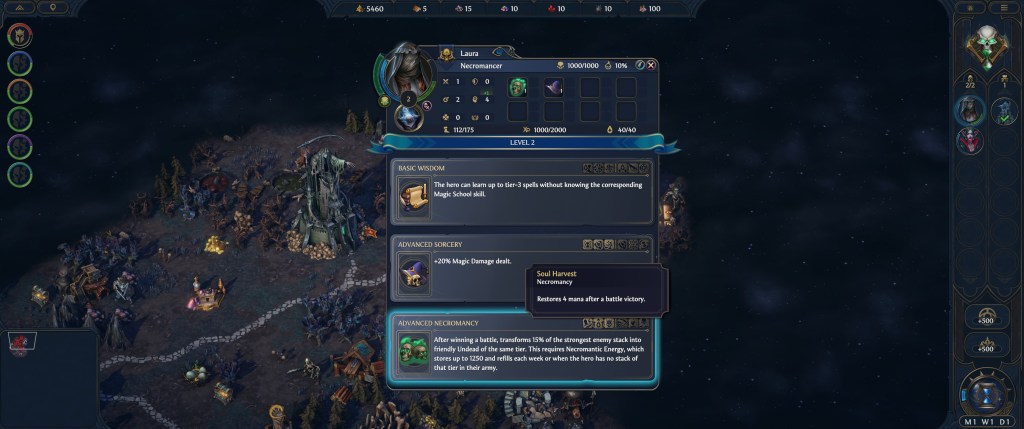
The best of these changes are around hero customization and the balance between the titular Might and Magic. First are the skill perks – not only will you be choosing six skills to master as your hero levels up, but as you master these skills, you’ll have the opportunity to choose two “perks” per skill which let you further customize what these skills offer and how they interact with
each other.
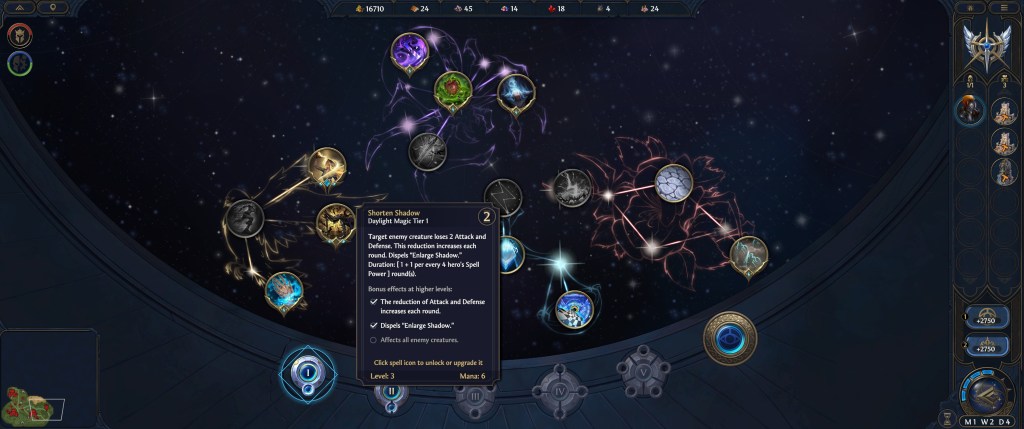
The spell progression refresh is also a win, breaking from the old method of skills determining spell tier and Mages Guilds merely unlocking the spell, making any duplicate discoveries worthless. Now when multiple Mage Guilds discover the same spell, the spell’s tier increases regardless of what skills your hero has.
Additionally you’re given a degree of control over spell research. Want a specific spell that just isn’t appearing? You now have the option to unlock it for a resource cost. Wish a spell was just one tier higher? You can spend precious Alchemical Dust to bump it up to reach an important break point.
And, of course, the old method still works: you can spend a skill slot to become a specialist in the spell school and cast all the spells you’ve learned from that school at a higher level.
The last balance change worth mentioning is how dispelling buffs and debuffs now works. Before, you simply cast Dispel. Your level 1 Fighter could easily erase a level 40 Sorcerer’s buff or debuff in a single turn, which meant there was very little reason to ever play Magic heroes.
Now the dispels are contested checks – they don’t just erase effects, instead they reduce remaining spell duration based on a hero’s spell power. Meanwhile, all buffs and debuffs scale up in duration with spell power. The end result is that the superior caster now has control over the buffs and debuffs on the battlefield. It’s an elegant solution to shrinking the power gap between Might and Magic heroes, finally granting Magic heroes a means of scaling their army that Might heroes can’t do anything about, much like Magic heroes have never been able to do anything about Might’s superior combat stats and skills.
However, I’m not sold on all the updates. High Neutral Magic cordons all the movement spells off into their own corner, divorcing them from any of the magic skills. Thirty years later it’s universally understood that movement points are the most precious resource in the game, meaning these spells are some of the most powerful in the game. Tying them to a skill makes that skill mandatory.
That on its own is a good move, but the way it’s been implemented is clumsy: there are now “Astrology Points” which are mostly generated by towns and have their own individual meter that fills up. These accumulate to “Inspirations” which are then spent to unlock or upgrade the movement spells of your choice similar to the spell system.

Astrology points are not used for anything else, and exist solely to fuel a bar that exists solely to be filled up. It’s not an elegant solution, and I’m not convinced Astrology Points are necessarily the best way to go about gating these powerful abilities. Given how outrageously powerful they are, should they even be in the game at all?
Laws are another addition I’m not really sold on. The idea is similar to Songs of Conquest’s research: empire-wide upgrades to economy, units, heroes, and so on. Each faction has its own unique laws and you can purchase them in any order save for the fact that more powerful laws are gated by first spending a certain number of Law Points.
Yes, just like Astrology Points, this is another fiat currency that fills up a bar which gives you laws, but has no other use. You’ll get a steady income of Law Points from cities, but you also get a chunk whenever you kill a neutral unit or capture a map resource, so they add up fast. You can also specialize cities for Law Points, but they’re too plentiful to need extra income and too weak to warrant picking them over Astrology Points (movement) or raw gold.

Currently I don’t understand the need for laws or Law Points. They’re not so strong as to turn full-clearing zones into a path to victory, nor are they so weak as to be totally forgettable. You don’t really make strategic decisions with them either – you’ll just wind up picking up the same “good stuff” from game to game. They’re just kind of there for some reason. I have the distinct impression that this entire system could be removed from Olden Era and the game wouldn’t change at all.
Past the Point of No Return
As-is, Olden Era comes equipped with three game modes: competitive multiplayer with an ELO-based ladder to climb which uses semi-random maps, single player on premade maps, and single player on semi-randomly generated maps.
Currently, competitive multiplayer is the most complete and robust of the modes – which makes sense, quite honestly. And though I can hear your grumbling from my desk, it makes sense: multiplayer as a game mode simply requires less to get going. Single player requires a separate production cycle for hand-crafted maps as well as all the work that goes into AI, difficulty tweaking, writing, art, potential voice work, and so on.
Olden Era takes great pains to innovate Heroes multiplayer, though like all great innovators, much of it is simply officially codifying pre-existing but less popular methods. Good artists borrow, great artists… officially codify.
Though a simple multiplayer version of the base game (dubbed Classic) is available for purists, it’s easily the least popular method of playing owing to how long a single match takes. Single Hero mode is the current darling, which is pretty much what it sounds like: you pick your starter hero (for balance’s sake, both players are given the opportunity to ban their selection of heroes from the other guy’s available choices) and will not ever be able to recruit more.
Though single hero isn’t a new idea, how the matches then play can be radically new and different. Though it’s possible to play on a simple 1v1 on a small map with regular rules, you’re also able to vote for alternate victory conditions: and this is where the innovations really shine.
These modes are called Tournament and Final Battle. In both modes, the twist is you are totally isolated from your opponent. They can’t rush you or interfere with you, it’s just you and an adventure map.

In Tournament, duels are scheduled on a regular basis (usually something like every week or two). On a “duel day,” both Heroes are teleported to a mandatory battle and you fight to the death. The winner gets a point. Then everything is rewound as if you never fought at all, and you’re returned to your adventure pen and have another time interval to buff yourself up as best you can. Similar to tennis, you only win if you get two points in a row.
In Final Battle, the name speaks for itself. You’re once again isolated from your opponent, and once again have a timer – a longer one this time. When it runs out, your heroes and their armies will duel in one final battle – and the winner takes all.
These modes have been added for a simple reason: accessibility. Many players don’t want to fiddle with the complex and somewhat exploitative art of “Hero Chaining” that top-end players used in Heroes 3 – and many more don’t want a single game to take more than an hour or two.
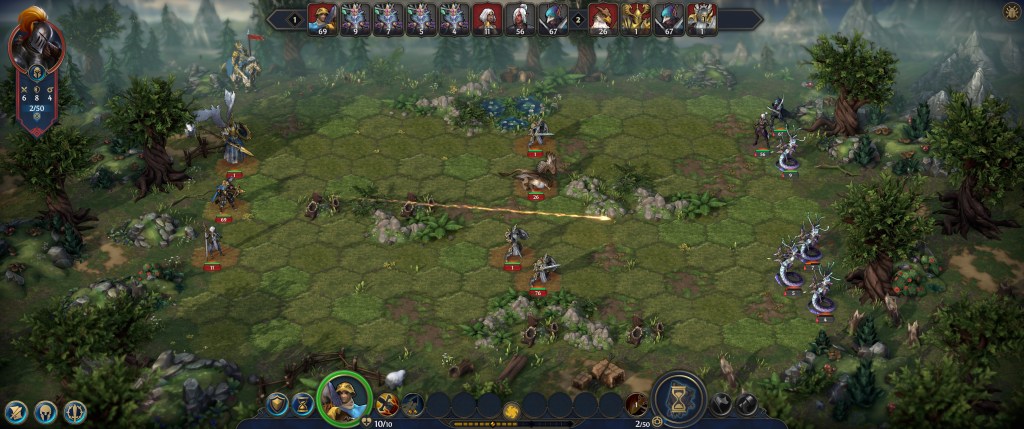
And if you really don’t have time, there’s a very new mode called Arena. You draft your starting Hero, draft their equipment, draft their army, and then fight somebody who did the same. That’s it. No creatures to fight, no cities to build, no land to explore. Just a single, relatively fair fight in thirty minutes to an hour. I’ve heard it compared to Mechabellum, it’s not an autobattler – you’ll be commanding the units just like a regular Heroes combat.
Thus far these modes seem to have been rather successful in getting new players to actually try multiplayer, so I’d certainly say mission accomplished in that regard. Only time will tell what the retention rates of these players will be, or if these modes will be expanded upon.
Dancing With Myself
Single player is of course the less developed mode for all the reasons stated above, though there’s at least a sampling: 8 Scenario maps (most small), a handful of campaign maps, and then all the same random map templates multiplayer uses, except with AI opponents.
The Scenarios are a grab bag of scripted maps with pop up dialog, special objectives, quests, and so forth. They’re basic but certainly worth a playthrough, and often involve unique ways of approaching the game. Just don’t expect a multi-day epic. They’re the kind of map that would make for good tutorials for map makers when it comes to scripting and such.
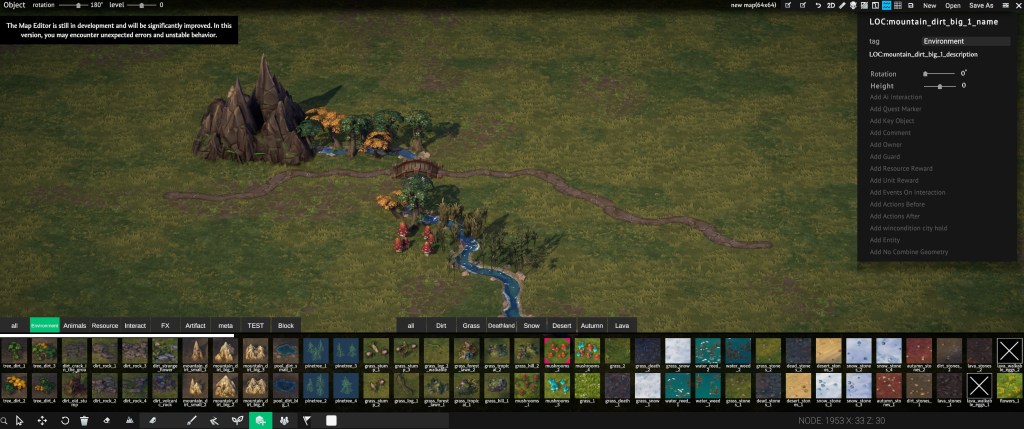
To that point, there is a map editor included, though it’s clearly in “internal tool” shape and lacks any polish or documentation – outside of a warning that it’s totally unpolished and not particularly stable. Some people have nevertheless figured it out and have begun making maps – even I was able to get a few simple things going.
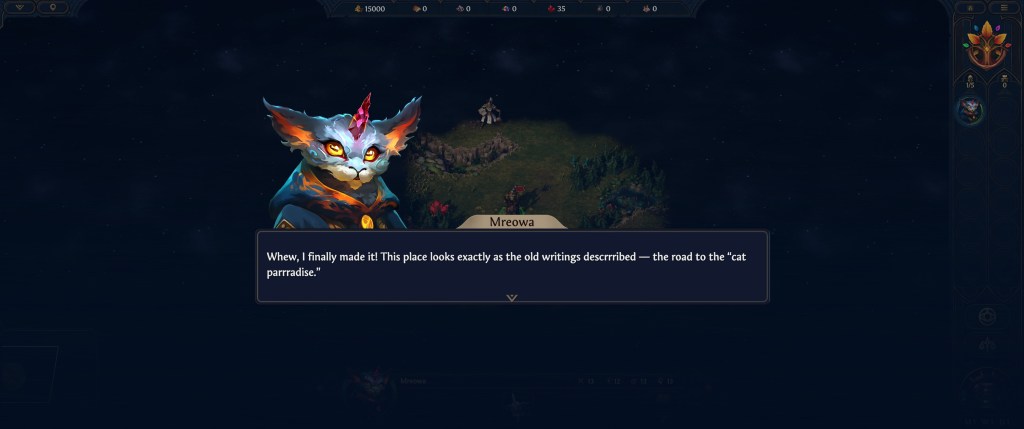
The campaign isn’t going to win any awards for writing, but then, the ill-fated Heroes 4 was the only one with writing worth mentioning. However, of special interest is a “Relations with Factions” tab at the top, which Unfrozen has explained will be used in the future to alter how the campaign (or maybe just parts of the maps in it) works. Truthfully, something like a robust branching campaign seems overly ambitious for just a year of Early Access, so I’d suggest tempering expectations accordingly.
That said, while there aren’t many campaign maps for now, I had no complaints for what was there.
That leaves the random map generator and templates. Templates are guidelines for what kind of map the random map generator should make. Their settings are never actually enumerated in game – for now, all you’re shown is a description and a picture (which is not generated from the template, but instead is just an image file) that’s supposed to be representative of the logic the template will use to generate the map. They also come with a custom-written description which usually tries to explain the kind of experience you’re in for.
The whole experience of trying to choose a template is currently not very good. Two maps that look identical may be radically different – those nodes in the picture are all relative values to the rest of the template. So a “Gold” (rich) zone in one template may have the same amount of treasure as a “Poor” (empty circle) zone in a different one, and there’s no way to tell the difference. Additionally, the picture is a totally arbitrary file and need not have any relation to the template at all – there’s one template with a picture showing eight different players, but the configuration only has slots for 2.

A template editor is also notably absent – if you want to make even simple tweaks like victory conditions, you’ll need to pop open the template JSON buried in the games’ files and make your best guesses as to what to edit. And if you want to make your own template, for now you’ll need to reverse engineer an existing one. As of this writing, no documentation or schema is available.
Supertoys Last All Summer Long
Then, of course, there is the AI.
In the short time since the Early Access release, the AI and difficulty levels have gotten all kinds of changes (and new bugs, and fixes for those bugs, and then maybe bugs from those fixes). Needless to say, it’s been an inconsistent experience as a result. By the time you read this, it will have likely changed again.
For now the combat AI is relatively solid – though keep in mind it’s still ultimately a rules engine, so while it will punish mistakes, it’s also pretty open to manipulation through tactics like baiting to manipulate initiative order.
Besides that, its major limitation is its current inability to ever retreat or surrender in combat. Like all the Heroes before it, a player’s main combat hero is their lifeblood in Olden Era. Until the AI is able to recover its main hero via retreat (and additionally protect its artifacts from capture), the AI is at even more of a disadvantage than usual, and is easily defeated once their best hero is gone.
On the strategic level, the AI has a long way to go. Currently it has a pretty convincing first week or two, but has no plan on how to proceed after breaking out of its starter zone. While it’s decent on Tournament and Final Battle maps where it’s isolated, on Classic maps its behavior is simply to attack the first player (Human or AI) it sees with everything it’s got, as long as it has even a remote chance of winning.
If it doesn’t detect a player, the AI will explore whatever neutral territory it broke into, growing its strength and potentially capturing Neutral towns it comes across. But once a player pops up in its vision, it will immediately follow them like a heat-seeking missile until one of the two are dead. If the AI loses this rush it has no means of recovery, and sort of walks around aimlessly for the rest of the game until hunted down and picked off.
It also seems to have no understanding of how Classic mode works. In Classic mode, if there’s ever a point you control no cities, a countdown begins that ends in your loss. The countdown resets and pauses once you pick at least one up. However, the AI typically chooses to totally ignore defending its own cities, and won’t prioritize capturing at least one city to stay in the game. Instead it mindlessly follow its first acquired target, often resulting in defeat by city loss.
This leads to short, predictable games that will disappoint players looking for a more traditional Heroes experience of slowly exploring and expanding across a map, building epic heroes and a giant army with a climactic clash of titans to decide the game.
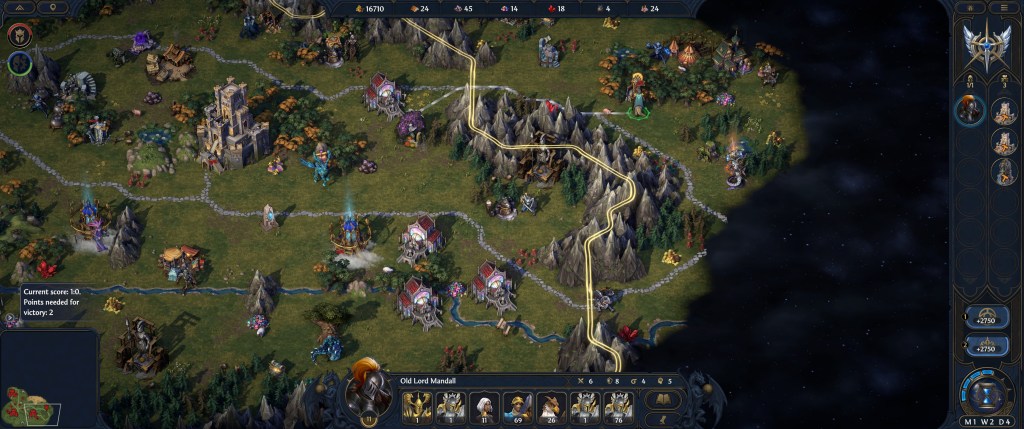
Finally, AI enemy heroes currently don’t know how to use any of those High Neutral Magic spells that have an entire currency and progression system dedicated to them. That’s a major disadvantage, and a human who does use them will inevitably crush the AI.
If there’s anything I’m worried about in Olden Era, it’s the single player AI. At an absolute minimum it needs to reach parity with Heroes 2 and 3, and it’s not particularly close.
Your Blood Panel Results
Unfrozen has done a remarkable thing: take the best aspects from the first five Heroes games and through some dread synthesis produced a product that actually seems to have landed with the series’ hoary, oft-betrayed fanbase. Further, they have already confirmed reworks are en route to systems that have consistently received negative feedback or proven too confusing to users: those specifically being Necromancy, Necromantic Energy, and Subclasses. It didn’t make sense to dig into these systems given we know changes are coming soon.

For now, the major point of concern is single player. Unfortunately the recently released road map indicates multiplayer remains the focus in the short term, with the only changes exclusive to single player being in vague categories like the “Regular Updates” catch-all bucket. Even the AI on templates, which currently behaves more like a rudimentary placeholder bot than anything else, is only mentioned as getting “tweaks.” It’s hard to say what the goal with the AI is, but the breadcrumbing around the subject isn’t a reassuring sign for the future of the single player game.
Originally I ended this early assessment of Olden Era on a positive note. The recent roadmap reveal combined with the development team not yet even acknowledging the AI’s documented limitations has left me much more subdued.
There’s a great game here. Now it just needs an AI that can play it properly.