Ashurbanipal had been ruling the Assyrian Empire through discipline and an iron fist. His son and only heir was a deviant and a miscreant, cast away from family and throne. For 20 years, Ashurbanipal had no heir, despite having outlived four wives. A long war with the Greeks was exhausting him and while he enjoyed initial victories, the Assyrian king hit a quagmire as his men were falling by the day trying to capture the Greek capital of Pella. Eventually, the opportunity presented itself to add a member to the family, an orphan who he saw himself in. And not a moment too soon, as Ashurbanipal passed from this world. Unfortunately, the cowardly Carthaginians took advantage and declared war on an embattled Assyria. Soon the Assyrian Empire would not be more than a memory…
And that is how my first game of Old World went, a game created by the excellent team at Mohawk Games. Led by renowned game designer Soren Johnson and talented CEO and writer Leyla Johnson, Old World is [spoiler alert] one of the finest and most innovative 4X games to be produced in this era. Admittedly, I was a bit skeptical despite Soren’s previous work on Civilization IV, another great title and one of my favorite genre-defining 4X games. My concern was the limited scope of the Old World setting being solely in the Pre-Classical (aka the Classical Antiquity) era, whereas Civ IV covered pre-history to the near future. Old World, however, succeeds in digging deep into the era and making a remarkably interesting game in the process. As an aside, I highly recommend that you read a bit about the Classical Antiquity era, as it is a fascinating period of human history.
A new empire is set to rise with Cyrus of Persia. His rule begins with dreams of conquest, and he knows that on his great shoulders the future kings and queens of Persia will stand proudly atop all Mesopotamia.
An Era of Innovation
What immediately sets Old World apart from its contemporary brethren is the number and quality of innovative ideas the game introduces into the genre. Immediately I noticed the first such innovation, the dynasty system, whereby the leaders you select are not immortal omnipotent beings (à la the Civ series) but are characters with limited lifespans who react to, and are affected by, events in the world around them. The influence from Crusader Kings is clear, however, do not mistake this for a lifted system. Old World does not have the same detailed focus on characters as Crusader Kings, which allows it to play greatly as a sub-system rather than a distraction from the grander strategy game.
In fact, the game can be played without the dynasty system if you want a traditional 4X experience, however, I found the fun and the challenge it brings to the game much more interesting. For one, it is important to ensure your dynasty’s future by producing an heir. Marriages are used to not only boost your empire’s stats, but to increase diplomatic relations and, of course, produce an heir. If your character dies without one, the game ends. Characters are also structured more like RPG characters, in that as they gain experience (XP), they gain levels that allow them to develop their personality and stats.

With regards to stats, characters have four different traits: Wisdom, Charisma, Courage, and Discipline. Each governs a different stat and can affect the outputs of a nation. For example, a character with high Wisdom will output more research, but low Discipline and you may find your coffers of gold lacking. Courtiers, consorts, and successors all affect the income of resources outside of what cities produce, so having a good court can really boost a nation. Different traits also act as modifiers to the values of those stats. A Greedy character is going to have lower Discipline, a Compassionate character will have more Charisma and Discipline, but if they are Insane? Well, they will have more Courage, but will be lacking in Wisdom and Discipline!
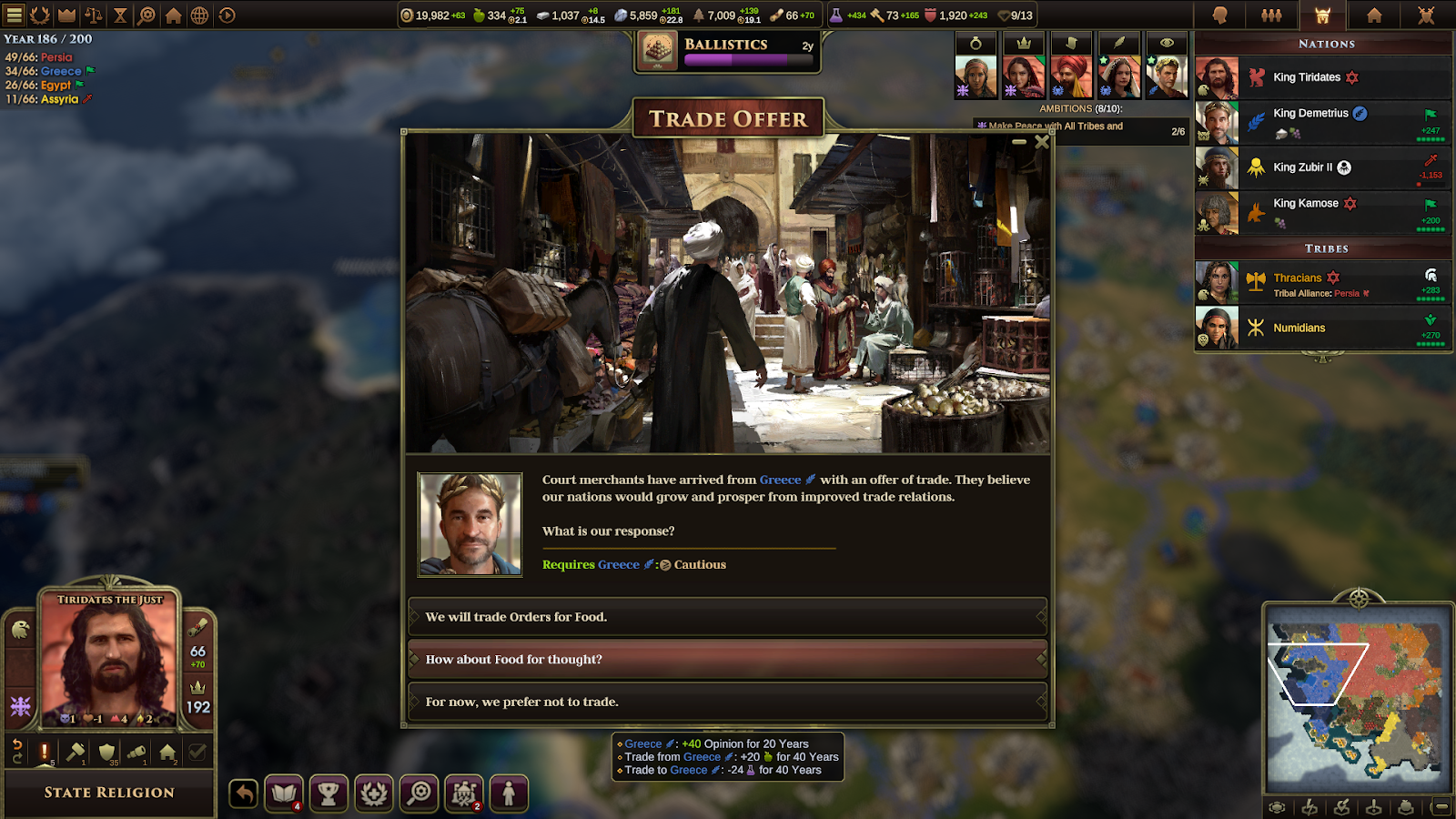
The character system also ties directly into diplomacy. While I may interact with Hatshepsut of Egypt at the beginning of the game and have an excellent relationship with her, by the time her grandson Khutmose comes into power we will be mortal enemies at each other’s throats, because of events that may happen along the way, like a leader insulting me. This keeps diplomacy fluid and dynamic, and as the player you must stay on your toes and be ready for that quick change in diplomatic stance that occurs with the rise of a new leader. This makes Old World’s diplomacy much more interesting than the bog-standard trading screen diplomacy of other 4X games. If you want to initiate trade, you will have to send your ambassador on a trade mission to another nation, but depending on your relations with their ruler, you may have some good trade deals or others that may have harsher terms, depending on how starved for resources you are. Oh, so Dido wants 20 wood in exchange for 15 Civics? I need the civics, but I’m not producing enough wood! What to do now…

The character system in Old World works so well because of how it ties into other systems. Raising your heirs is also an important task, as there are four different paths heirs can take to develop their skills in various directions. If you need a strong military or more training production, then train an heir in Tactics, or Rhetoric if you need to develop your nation with more Civics. I hope this is an addition that inspires other games in the genre.
The Sword and the Spear
In years past, the Persian Empire had endured much hardship. King Cyrus the Strong, the first king of Persia, had grown the empire from the single city of Parsa to four developing cities in the center of the known world. On all sides, Cyrus was surrounded by other empires: the Greeks, the Egyptians, and the Assyrians. In the year 23, Assyria declared war on Persia. The cowards decided to attack without warning and after no provocation! It was time for King Cyrus to order the men of Persia to stand firm in the face of the oncoming onslaught.
Orders are the other innovative system that is the basis of player agency in Old World. In most turn-based 4X games, the player can move all their available units as far as their movement range will allow them to. Old World instead limits the player’s actions through Orders. Now, on its face, this may sound restrictive, but it makes the decision to move units and execute other actions much more important. The number of Orders you have is related to your leader’s Legitimacy. Through events and completing Ambitions, long-term goals your character has (an early Ambition for example is controlling four cities), your characters and dynasty’s Legitimacy will grow. Earning cognomens for your leader, such as the Explorer or the Conqueror, will also increase Legitimacy. Other factors may increase the number of orders, such as the production of certain resources, however growing Legitimacy is a top priority in the early game to manage a burgeoning empire.

What is most intriguing about the Order system is that technically units do not have a maximum distance they can move. There is still a range where a unit can move most efficiently and moving past that range will cause them to be Fatigued, doubling the cost of orders for the move, and requiring some additional Training resources. This can be leveraged during times of war, when you need to move all your units to the frontline. Orders are better fully used up, as extra Orders are sold for money at the end of the turn for a low rate of return.
Orders are not only used to move units, however. Diplomatic actions also require Orders, so if I want to influence Ashurbanipal as Dido (i.e. improve relations) it would cost me two orders and some money. The Order economy is integral to managing your empire, and I found that it made the game much more interesting. I also found that it solved the issue of managing the “carpet of doom” that has been a problem with Civ since the fifth iteration, as I had to be more mindful of which units I moved, especially during war time.
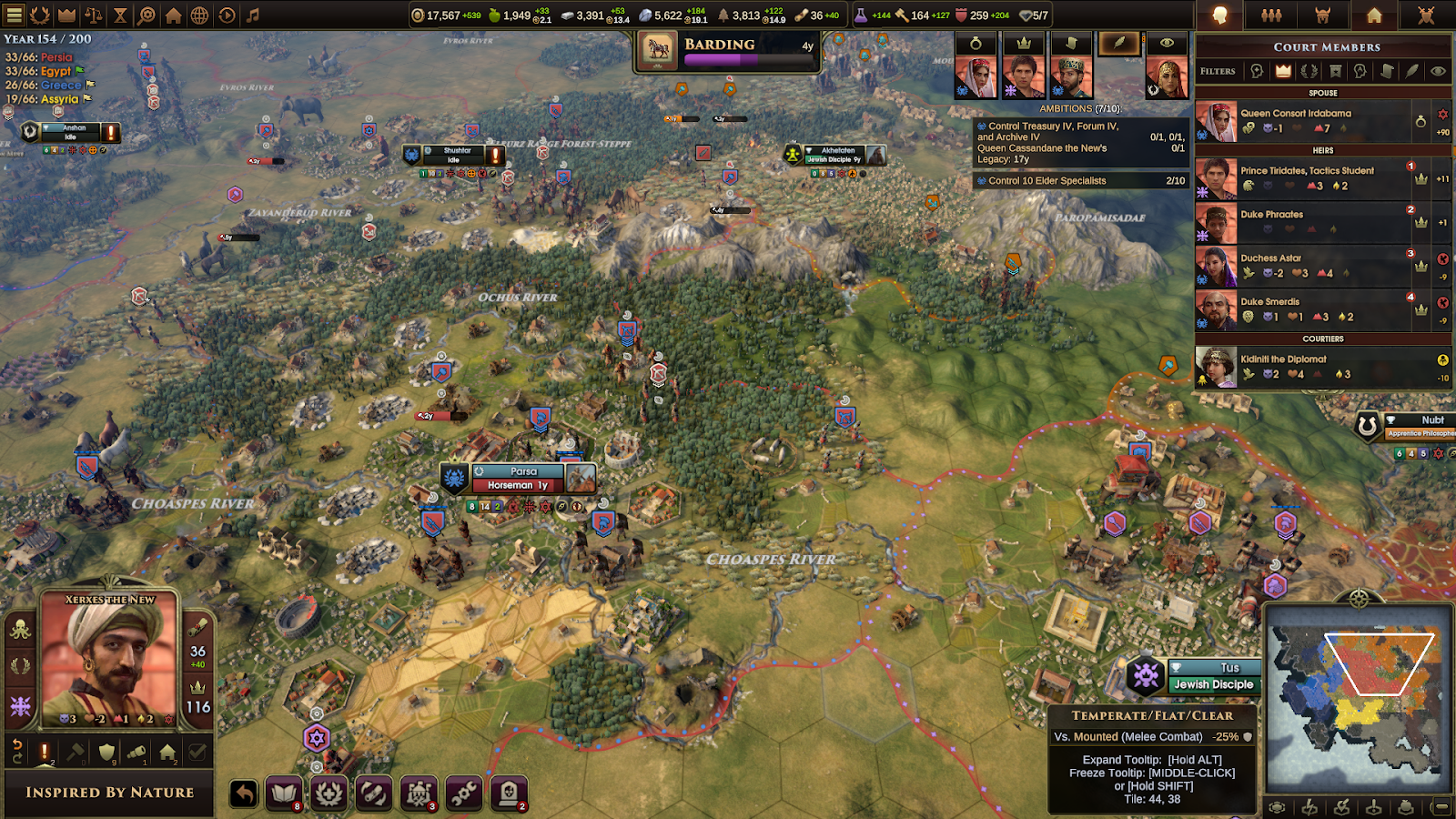
Warfare in Old World will probably be familiar to veterans of the 4X genre, especially Civ. The game is played on a hex-based grid, and military units follow the one unit per tile rule. However, each unit type acts differently and has unique abilities, which keeps warfare tense and engaging. Units have different attacks on the map, instead of just bumping units into each other. While some units, like the early Warrior and other similar melee units, function that way, others like Slingers or Bowman can attack from range. Cavalry units have a unique ability called Rout where if they defeat a unit, they get a free attack on any neighboring enemy units. This leads to interesting tactical decisions, as a well-coordinated attack means that a single cavalry unit can eliminate multiple units on the front line at once.
Units can also level up and gain experience, and this is largely done through combat and special buildings. Barracks can be built on a tile, and any melee unit standing on them gets XP towards the next level. Now, it is possible to level up a unit before they have enough XP by expending the Training resource, which is sometimes perfectly acceptable if you are nearing the limit of Training or need to upgrade units fast, but waiting for units to gain enough XP means a free upgrade. The amount of Training needed changes based on how much XP is remaining before a promotion. Cities can also affect units and their abilities to a certain degree, as certain families will give bonus traits to units due to the family’s traits. The Magonid family of Artisans for Carthage gives produced Siege and Ship units the Ingenuity trait, modifying their attack and defense strength by 20%.
A Glorious Lineage
King Xerxes the New understood what his lineage had been through. The status of King Cyrus was legendary, despite having passed over a century ago. While Cyrus never saw the end of the war with Assyria, his descendants King Oxathres the New and Queen Apama, who would be known as the Glorious, fought to preserve Persia’s borders. Despite that truce, Assyria would strike again, and once more Queen Apama would hold the borders of Persia firm against the onslaught. The Greeks remained steadfast allies even in times when their kings and queens were less friendly. Queen Apama’s descendant, King Yazdegerd the Fountainhead, had the greater challenge of defending Persia against both the Egyptians and the Assyrians – in that task he was successful, despite the challenge of fighting a war on two fronts.
Were it not for the careful maneuvering of his ancestors, King Xerxes would not have had a kingdom to rule. However, now that Persia proved to the world that it could stand strong in the face of adversity, and it had grown its military might to match its rivals, Xerxes knew the demesne of Persia was meant to expand. Persia’s destiny of being the greatest empire was soon to come to fruition.
One interesting aspect of Old World is that your empire will have three main families, each being led by their own characters and have their own family members that can be courtiers. When a city is settled, which can only be done on a valid City Site, there is an option to select from four families. City Sites act as a way to reduce city spam and are designated areas where cities can be built as they cannot be built on any tile. They can be found uninhabited in the game world, but in many cases, you will have to oust barbarians or minor tribes such as the Danes or the Vandals that are residing there. The tribes can also be befriended, and nations like Carthage can even recruit tribal units as mercenaries, but I found that they largely function as minor factions that can be exploited for extra City Sites if needed. Once you pick three unique families, the fourth is no longer available as an option. The families each offer different bonuses and traits, which means the families that are picked are very situational. The Barcid family of Carthage, a family of Riders, gives an extra two Training per city each turn. The Family Seat (i.e., the first city granted to them) can produce Horse, Camel, and Elephant units without the corresponding resource.

Of course, it is always important to keep the families happy. One of my early games with Ashurbanipal ended early due to such a revolt from a family, who were extremely dissatisfied that I imprisoned their traitorous leader. Despite being fully warranted, they spawned rebel units outside my city while in the middle of a war, forcing me to divert troops to quell the rebellion. Obtaining certain luxury resources that the families desire will help, such as Furs and Salt for a family of Riders, but it can be a balancing act when each family follows a different Religion.
Religion is another mechanic in Old World that is straightforward to understand without demanding too much focus from the player. Over the course of the game, it is possible to found various religions that were present during the era Old World takes place in. However, in the beginning, you will likely follow your nation’s pagan faith, assuming you have the Divination technology unlocked and you build your first shrine. Religion can be spread in much the same way as other games, by using a missionary or disciple unit to spread the faith. It is not a mechanic I dug into too much, though in my first full game with Persia I founded the Judaism and persisted with it as my nation’s and character’s main faith throughout the game, despite founding other religions like Zoroastrianism. Some of my neighbors converted over too which slightly helped with relations, but considering there is no “Religious Victory” the incentive (and annoyance) of having missionaries running across the map was not present, which I found to be much better than the alternative. For the most part, you’ll be managing your relationships with the various faiths, as they are each led by a Head of Faith, an actual character in each game that uses religion to keep your people happy and, surprisingly, boost your research capabilities.
Victory in Old World is very straightforward, which I greatly appreciated compared to the multiple divergent victory conditions of other games. There are still multiple ways to achieve victory but they all tie in nicely, and pursuing one does not lock you out of other victory conditions. The game has a time limit of 200 turns – plenty of time to enjoy a playthrough. If you are able to attain a certain number of Victory Points (VPs) before the game ends, however, you win. VPs are earned from your cities, whose culture level will grow over time as you build cultural buildings, and the city itself becomes bigger. More VPs are awarded for more developed cities and building wonders will also add to your VPs. Worker units are responsible for building such buildings on the map itself, and cities do not actually build structures within the tile. This leads to sprawling cities on the map that look great as the game progresses. Ambitions are another way to achieve victory, and by completing ten Ambitions, which progressively become more difficult to accomplish, you can win the game before attaining the number of VPs or hitting the time limit. Ambitions vary widly, from the initial Ambitions of controlling four cities, to researching certain techs, warfare (i.e., capturing cities or defeating enemy units), improving your nation internally by developing the culture of your cities, and so on. Of course, it is also possible to wipe your neighbors off the map, but I enjoyed the fact that having a score-based victory system did not mean that I got locked into a single victory type, and instead I could adapt as the game went on – and take a few cities off my opponents if they got a bit to close in score!
To Stand the Test of Time
By the end of his reign, King Xerxes would be known as the Conqueror. It was his dream to expand the Persian Empire beyond its borders. For too long Persia was on the backfoot, and while Xerxes and his forebearers had constructed great monuments to cement Persia’s legacy, from the Ishtar Gate to the Necropolis and the Hanging Gardens, no longer would Persia be kicked around by its neighbors. The Assyrians and the Egyptians, jealous as they were, constantly tried to steal Persia’s riches.
The war with Egypt was bloody, but more so for the Egyptians than the Persians. Xerxes had done well to raise a strong and trained core of men to fight the Egyptian troops and vast number of chariots, employing Spearmen and Archers to blunt their attacks. Eventually, Xerxes was able to direct his troops to take four Egyptian cities – Nubt, Akhetaten, Khito, and Djedu – all but one of which were subsumed into the Persian Empire before his death. In fact, the Egyptian Empire was falling apart fighting a rebellion just as the Persians swept across the lands of Egypt. Soon the Egyptian people were glad to be a part of the Persian Empire!

Old World is truly a triumph of the 4X genre. The gameplay is tight with interesting mechanics, and plays smoothly all while generating fun and exciting stories. I do not think I have enjoyed a 4X game this much since I started playing them with Civilization III and it is truly a testament to the incredible team Mohawk Studios has put together. As I mentioned, I was wary at first because of the limited time period of the game but considering the depth the team has worked in to make Old World as unique as it is, I appreciate the tighter focus rather than the mess of mechanics that happens when trying to represent all human history. There are only a few drawbacks I can point to the in gameplay or the mechanics; everything in Old World is well done, and I believe it is because the team at Mohawk stuck to their vision during Early Access and used that time to refine all the game elements into one cohesive whole.
Performance is my biggest issue, as the game seems to have trouble with higher framerates, despite running on my mid-to-higher-end PC (with a Ryzen 5 2600 and an RTX 2060), even at the lowest settings. However, as I understand that is currently being addressed by the team, but it is worth mentioning since I would expect a game like this to run much more smoothly on modern machines. While I did not touch on Research too much, it mixes the card-based system of random techs like Stellaris with the fixed tech tree of Civ. Some may find the lack of control annoying, despite the ability to redraw mechanics at a cost and with the proper council. I found that it avoided the problem suffered by most 4X games with linear tech trees that forced me to beeline to certain techs each game. There were times however where I certainly was annoyed or frustrated that the one tech I needed to complete an Ambition just would not roll. The one thing I will mention is that one of my most memorable moments was researching the Drama tech for the first time. Once you unlock that tech, the music for the game begins, which I greatly enjoyed, as I love the Arabic and Middle-Eastern tracks they have. City Sites can also be a bit frustrating, and if you are not fast or lucky enough to find and hold sites, the AI will park units on City Sites denying you access unless you declare war. The player will also need to park a unit on a City Site, otherwise, the AI will swoop in and hold it until they can settle it. I would like a way to claim a site and have implications of taking a claimed site, but I imagine this was the easiest way to manage this mechanic of reducing city spam, and it is something to be aware of before going into your first game if you want to avoid one of the major pitfalls I came across.
Old World can be overwhelming at first, and despite the tutorial messages popping up when new units or actions are unlocked, it may take a restart or two to start gelling with the mechanics. However, it is certainly much easier to get into than many other games of the genre, and I found that I picked it up with much less persistence than other 4X games – especially if you are a veteran of the genre. It certainly does not have the complicated depth of mechanics of say, Shadow Empire, another genre-defining game that came out last year, so if you want to dig into systems and subsystems the same way Old World may not be the game for you. It is also decidedly a Civ-like game, given the history Soren Johnson has with the Civ series. While I think Old World is unique by comparison, if you are not a fan of Civ-like games you will notice the similarities pretty quickly and may not enjoy the Old World. However, I highly recommend Old World to any fan of the 4X genre and will say that if you skip it because of the time period or the fact that it is historical or land-based, you are really doing a disservice to yourself. Old World is truly a magnificent game that deserves all of the praise it will get. Now let me get back to conquering the known world with Dido and her progeny…
The last thing I want to disclose is that our fearless leader and site founder, Rob “The 4Xplorer”, has worked with Mohawk Games to support their community and has been compensated for running Mohawk’s podcast. He had no input on this review and did not influence my score.
I have not played Old World throughout its early access, nor have been involved with or compensated by Mohawk, and have approached this game review as objectively as I can – admittedly, it was not one of my most anticipated games, so it was a personal surprise to me when it jumped to potentially my game of the year for 2021 (I would say Shadow Empire was my 2020 game of the year). Old World is also still an Epic exclusive, however, plans to bring it to Steam are in the works. Understandably, there are still many skeptics of the Epic store, but if that is the only drawback, then hopefully once the game is on Steam or your platform of choice you can check it out. That being said, I am always happy to discuss Old World (or any other games) with folks, so drop a comment below, join us over at Discord and the Steam forums, and chat with us about it and other 4X, Strategy, and Tactics games!
After Xerxes passed, his son Tiridates took the throne. While consolidating his father’s conquests, the Assyrians once again declared war as Tiridates did not want to join in on their frivolous conflict against the Greeks, who are friends of Persia. A brief truce was made so Tiridates could raise his forces while consolidating the Egyptian lands. Once the time was ready, Tiridates marched on the Assyrians. Once again, the Assyrians were no match for them. City after city fell, with Tiridates’ superior Persian forces even taking the Assyrian capital of Assur. Eventually, the Persian forces were stopped at a pass held by the Assyrians and were able to cause mass casualties to the Persian forces. While Tiridates had the troops to crush the Assyrians completely, in his magnanimity he decided to spare the Assyrians the puny cities they had left. From then on, Tiridates would be known as the Magnificient, cementing Persia as the greatest empire of the Old World.

Old World isn’t perfect, but it’s really damn good.