A few weeks back, Rob asked me to do a reXamination of Pax Nova since the game has been out nearly two and half years, has seen three DLC releases and several patches since launch. Full disclosure: I’ve had a front row seat with the development of Pax Nova since launch and chatted regularly with Mike over the last couple of years. I’m also an admin on the Steam forums for the game.
My goal is to examine how the game has evolved since launch and dive more deeply into the game mechanics. I’ll be reviewing the game as it plays with all DLC enabled.
Picking up where Rob left off, the takeaways from that review were communication, content, and bugs. If you haven’t read it fully yet, take a look at his original review to get some context around the state of Pax Nova at launch and a baseline for this reXamination.
Communication
Communication has never been a strong suite with Grey Wolf and that hasn’t really changed in the intervening time since launch. However, despite limited communication, there has been a steady (albeit slow) stream of patches and content released for Pax Nova. It’s not a replacement for regularly engaging with folks directly on the forums or Discord, but it does indicate awareness of bugs or issues found by the community, and dedication to support the product. Seeing as we’re coming up on two and a half years since launch, whether or not there’s good communication is probably something of a moot point, so let’s take a look at what’s been added content wise.
Content
At launch, Pax Nova was pretty sparse on content. I’m going to pause here for a minute because I think minimal design in a game can be a good thing. Cutting off the fat and leaving a streamlined and polished experience can make for a great game, like in the case of Gladius or RotP, but that only works if what’s left is exceptional. Most of the time, minimal just feels incomplete, which is how Pax Nova felt at launch. Today, it’s in a much better place, but only if you include the two paid DLC — although the free DLC was a good step forward. Since launch there’s been an addition of two additional planet types, one new alien race with three factions, additional monsters, techs, districts, game mechanics, artifacts, and random events. Just about every area of the game has seen content added and you would be hard pressed to say that the game doesn’t have enough at this point. However, none of that matters if bugs prevent you from enjoying that content.
Bugs
Let me start by saying that Pax had a lot of bugs at launch and I’ve spent a lot of time cataloging bugs the community has found, and publishing the list on the Steam forums. While there are still bugs and grammatical errors that some folks might see as critical, there has been great improvement since launch. With over 300 hours of playtime on Pax Nova and over 20 hours with the 1.4 patch, I haven’t found the bugs still present to significantly impact gameplay, although they are likely to annoy folks who are less forgiving if an event fails to apply a status modifier, or the planetary pollution level isn’t calculated correctly.
Getting Started
Factions
Pax Nova launched with quite a few factions split between three different species, as well as the ability to create a custom faction if none of them struck your fancy. Beyond the Rift expanded that with an additional three factions that are part of the Tyr species. While there’s quite a few quirks and nuances between them, they do all play somewhat the same because these perks and flaws tend to make minor shifts to the game mechanics. Given enough time, you’ll start to see how the different factions can play differently, but the game would benefit from several factions with a more obvious break from the standard formula.
You can make the argument that there are several factions that already do break from the standard mechanics, such as Inbac being able to ignore food production or Hyrokkin being unable to build new cities with settlers, but the impact on city management and how you expand or fight changes very little. In the case of Inbac, you are just not building farm districts and with Hyrokkin, you’ll unlock colony ships to get around the “no settlers” restriction.
Once you dig into the factions though, the nuances of play become more apparent and, while you can ignore those nuances and play each faction like any other, there is benefit in leaning into the differences. Ashanti’s pollution curtails the city growth, keeping their settlements smaller and the extra city they can control provides early flexibility. Arbin needs Aether to generate settlers, and so seeks out stable Aether sources or uses war to gain what’s needed. Aion can expand quickly with their low pollution and high harmony, creating sparsely populated cities that control much larger areas than other factions. These nuances can create a lot of interesting dynamics for experienced players, but requires a deep knowledge of the game systems to exploit. That depth is something many players won’t bother to develop since a more general approach will work with almost every faction.

Game Setup
Although the game setup options are pretty standard, I think it’s worth taking a moment to look at what’s here as they’ve had some slight changes since launch. At launch, Pax Nova was very much a sandbox game. While the AI would act like it could win, only the player was able to complete any of the six standard victory types, though the AI could still eliminate the player and “win” a conquest victory. That changed with the addition of the competitive option: why this option is not enabled by default I don’t know, but it should be. If enabled, the AI can, and will complete the victory conditions if the player sits around too long.
The second addition to note here is the ability to disable auto generated unit templates. One of my annoyances with Pax Nova when it launched was that there wasn’t much need to design units because the game would automatically create most of the combinations. It was also frustrating because unlocking new tech would auto-update those templates, erasing any changes I’d made to the unit design. This option allows you to disable the default templates for the player so that only designs you create will be used (other than a couple of starting ones).
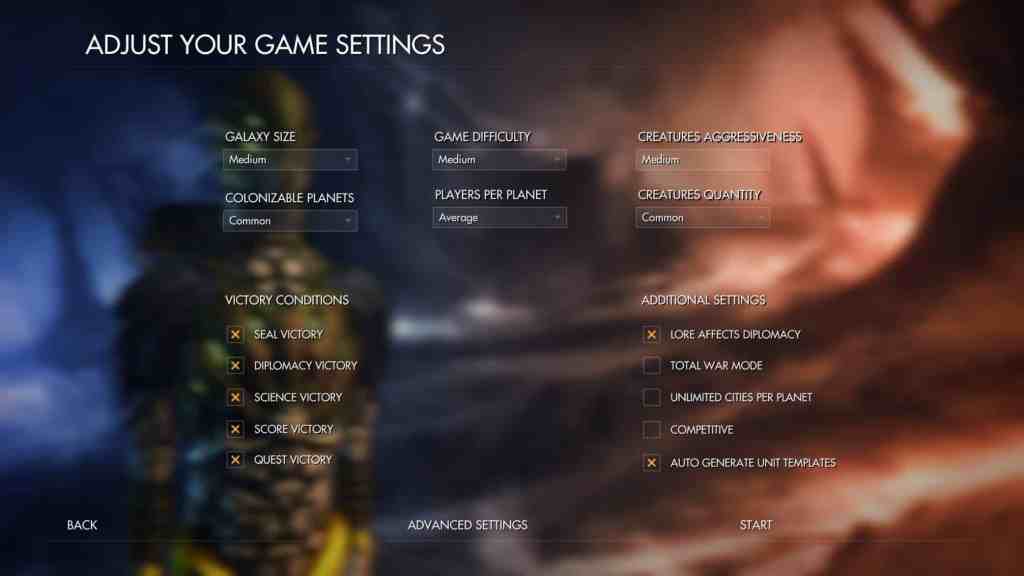
I also want to touch on the advanced settings. This is where you can get granular control over the galaxy setup. You’ll only ever be able to have a total of ten colonizable worlds, which seems like a tiny number compared to most 4X games, but each planet can support up to 7 cities per faction. It’s better to look at cities more like planets, and planets as the rough equivalent to systems in Moo2. This is also where you can add or remove factions and determine which planets they will start on. If you want to make sure you start by yourself, or set every faction to its own world, this is the place to do it.
Mechanics
The mechanics of Pax Nova will be familiar to anyone who’s played 4X games before. It’s got the standard fare of combat, diplomacy, and science. Where Pax differs from other offerings is with the inclusion of a planetary layer along with the space layer, not unlike Emperor of the Fading Suns.
Cities
At the start of the game, your chosen faction lands on a random planet with a single colony ship to found your first city. Each city starts with a city center, and the city borders one tile on all sides of that center. These borders define the only territory you own in Pax Nova, so your goal will be to grow your cities and expand those borders, helpfully prodded by the first few quests of the main story.

To do that you will need to maintain positive prosperity and harmony in your city, while building new districts and assigning your citizens to run them. It’s worth noting here that your city will expand to two random tiles each time it gains a level. Without fail it will be the two worst tiles unless you build a Residential District with the Influential Citizen improvement. For me, it adds a layer of management to city building that I enjoy, but I’ve seen quite a few players frustrated by a city expanding to unusable tiles when the game is left to its own devices.
Prosperity controls the rate you acquire new citizens and harmony controls the rate at which your city borders expand. A third element, pollution, which is generated by districts and improvements, limits growth both in cities and at the planetary level. These metrics are influenced by resources, districts, edicts, and leadership types.
Each city will produce three basic resources: Food, Research, and Labor. The output is calculated from the tile yields of all tiles within your city borders that have citizens assigned to them, and you will receive all resource types those tiles produce. These yields can be modified by special buildings like farms, mines, or research stations. Further bonuses are available for ideal placements of districts such as building a farm next to a river or a mine next to a mountain. These ideal placements are highlighted in the UI when building the district and eventually you will unlock the ability to harvest strategic resources like Pyrite and Titanium, which can be used for city projects and units.
Districts, Improvements, and Projects
As your cities grow you will use credits and other resources to build new districts, boost the city through projects and district improvements, or build units. Once built, you won’t need to open the city itself to build units or improvements in districts. This might seem weird at first, but once you have multiple cities spread across different planets, it really speeds up managing them. While the districts themselves are the same across all factions, there are faction-specific improvements that will make certain districts more valuable to your cities, as well as different art assets for each species.
As you progress through the game, you’ll unlock new upgrades and districts that will help you manage pollution, increase income, or let you build on water tiles. I’ve genuinely found all of the projects and improvements, other than the academies that boost your unit’s starting experience, to be useful at some point. Some districts are boosted by a specific leadership type, which I’ll dig into later. Other improvements require you to place your districts on specific tiles or have other districts adjacent to them. For example, Industrial Fertilizer requires you to have an Industrial District next to your Farm to gain a food boost improvement while Hospital Districts gain access to more improvements if placed next to a Residential District.
There aren’t synergies for every district, but there are enough that you think a bit more about where you put your districts and what tiles your city will have access to as it expands. Sometimes you can let it grow organically and other times you really need that Residential District to ensure you get a specific tile. The only district I’ve found to be truly worthless is the Defense District: the value provided is better served by mobile units, and the tile is used for a more valuable district.
While not overly deep, there are enough synergies and potential ways to grow your cities, utilizing districts and improvements, that it leads to thoughtful expansion and placement of cities, especially in the early stages of a game. This simplified city building and expansion is just complex enough to be a puzzle without becoming onerous. It’s a balance I find quite enjoyable.
Planets and Space
Planets in Pax are where you will build your cities, engage in combat, explore goodie huts, and interact with minor faction settlements. The largest planets are able to support a full complement of metropolises while the smallest will struggle with supporting more than a couple of cities. It’s been my experience that the generation of these planets is weighted toward the small end, which is unfortunate. Your current tech level will limit the number of cities you can have on a planet, encouraging you to expand to new worlds. To reach a new planet you will need to research technologies, both for launching into the void and colonizing any worlds you find. If you’re lucky, you’ll start on a planet with land portals which will allow you to drive your units directly to a planet that’s linked to yours.
Each planet has three of the available terrestrial strategic resources and a subset of special characteristics like perfect weather or mountainous which have minor effects on city growth, the number of monsters present, the tile yields, and usable tiles.

With the addition of Beyond the Rift, planets got a lot more interesting. In addition to new creatures inhabiting the planets, randomized weather phenomena were added which can dramatically shift how cities and units perform. These weather patterns can be manipulated by spending Essence Shards to purchase a particular weather intervention from the Emissary. There’s nothing quite like having your armored spearhead shattered when a freak acid rain storm starts up, preventing you from healing your armor and causing them to take 30% more damage, or suddenly having strong winds blow in, halving pollution in all your cities and resulting in a prosperity boom. On the flip side, if you have the shards, you can easily turn the tide of battle by activating an advantageous weather pattern.
All in all, I really enjoy the addition of weather effects to the planets but because they can be so powerful, I think they could be a bit more expensive to trigger so they aren’t easily abused.
The space layer, in contrast to the planetary layer, is far less interesting. Unlike most 4X games, you won’t have territory you can claim as part of your empire and you can’t block access to planets (creative folk can find a way around this) even if you control all of the cities, so there’s much less that happens in space and I think Pax is poorer for that. It’s probably best to think of space as a transport layer to reach planets and a place to mine Usselium and Yridium which are needed for late-game modules.
That’s not to say there’s nothing to do in space, with Tech Supremacy, a late-game “pirate” faction called the Phantoms was added. These are super powerful ships that will periodically ask you for Aether. You can choose to give them a little which makes them neutral to your ships, or you can pay them more and have them specifically target another faction, giving you a proxy force if you aren’t keen to start up a war. Beyond this, there are resources to mine, anomalies to explore, and minor faction outposts to purchase resources from which still makes space a useful part of the game.
Resources
I’ve alluded to resources a few times in the preceding sections, but let me spend some time going into more depth with them. Beyond the basic resources of food, labor, and research, there are two economic resources. Credits, which are generated by cities and trade, and Aether which is generated by Aether Sources on planets, exploring anomalies, and killing enemy units. Both of these resources can be used to buy production costs, but Aether has the additional benefit of being used to activate certain special modules on your units.

The Beyond the Rift DLC adds in a special resource type called Essence Shards. This is by far the rarest resource and can only be gathered from quests offered by the Emissary, purchased from minor factions, and found in Anomalies. It is powerful in that it can be used exclusively to purchase cards from the Emissary that shift weather, give you cash, or can even be used to destroy a planet outright.
The last type of resources is strategic resources. Most of these can be found on planets, or on uninhabitable planets, that can be mined from the space layer. These strategic resources are Osium, Ermicotta, Ethernium, Pyrite, Titanium, Usselium, and Yridium.
You start with the ability to extract Osium and Ermiocotta. The remainder has to be researched before you can use them and Usselium and Yridium are only found on the space layer. Each of these resources has uses relating to building certain districts, weapons, armor, or special modules. Some are useful, even critical to the end game, while others are situationally useful.
For example, Ermiocotta is primarily used to build robot farmers in Farm Districts and upgrades to Aquatic Districts, something Inbac Collective has little use for with their 25% reduction in food consumption. Overall, the resources are well thought out and provide a lot of value. However, I find that they are a bit too plentiful, especially with the availability of mining dead planets once you reach space. This undermines the scarcity that could make them a catalyst for diplomacy or wars, to acquire sufficient quantities or increase the value of units that mount weapons and defenses powered by them.
Government
Leadership in Pax allows you to periodically modify your empire and gain bonuses to help you grow cities, or defend them. New leadership types are unlocked through research and each one requires a different amount of the ideological “resources” of liberty, authority, and pragmatism before you can activate it. These resources are gained from the choices you make with random events and from activating edicts, which can make some leadership types difficult to activate, or left entirely out of reach entirely, without forward planning. Unless you play a faction like Terrans, there’s a pretty sizable cooldown between leadership switches, so you’ll want to choose carefully what you switch to and when you do it. However, there is a nice Prosperity bonus called Optimism Wave that kicks in when you choose a leadership type you haven’t used before.
Not all leadership types are equal in Pax and despite the potential to add some flavor to your empire, I think that there are some significant balance issues that end up making many of the leadership types subpar choices. For example, Transactional, which is unlocked early game, will boost your income so significantly that it’s essential to late game just so you can buy production on outposts and successfully invade enemy planets. This scalable income boost outweighs the production bonus from another early-game leadership type, Heavy Handed making that choice fairly useless by comparison. Similar issues can be found with most of the authoritarian leadership types. Still, there are enough options that leadership does present a useful, albeit limited choice for your fledgling empire.

Edicts are the second part of government and the main drivers of what leadership types you can switch to. They can be powerful one-time boosts to your empire or smaller passive boosts to it. Each edict has a different cost to activate using different resources, some of which are calculated on the number of cities you control. Because vassal cities are counted as controlled cities, this can quickly price you out of using certain edicts. The use of edicts tends to be very situational or goal based. Needing to swap around edicts to gain enough ideological resources for a leadership switch may require selling strategic resources or bartering with other factions for influence to activate what you need. The player may find they need to reduce pollution quickly or keep their city Prosperity artificially positive. These are all things the right edict can help with… for a price. Where the leadership choices can be somewhat lackluster, edicts I find quite useful, adding fun choices to the game.
Diplomacy
Pax Nova’s diplomacy is one of the more interesting systems in the game. Standing with other factions is based on three values: Affinity, Trust, and Respect. Higher values represent better relations with the faction and are influenced by a wide variety of things. Affinity can be improved by things like path bonuses, helping AI players when requested, certain diplomatic actions, and Embassy Districts. Trust and Respect I find harder to move. These values tend to be impacted more negatively by doing things like placing units too close to a faction’s city border or being behind on tech or military power, but can improve if you choose to start first contact and study a faction.
Treaties will also improve your relations with factions and are important to building alliances. With the 1.4 patch, Pax Nova has improved the usefulness of these alliances considerably. Now, you are presented with a choice to declare war on the aggressor and, if you choose not to do so, you will be given the “Weak Ally” trait and an affinity malus with the requesting faction. The same goes for AI allies who decide not to come to your aid. You are highly encouraged to declare war as the trait gives you a sizable trust penalty with all other factions, making it far more likely they will declare war on you, or be less inclined to accept your treaties.
Unfortunately, it’s not entirely clear the threshold that will trigger the alliance event since it doesn’t always happen when war is declared, or whether your allies will come to your aid if it does. Still, it’s a welcome addition to the game as it can make it more challenging to obtain a diplomatic victory as allies force you to choose sides. Overall, this three-point diplomacy system adds depth and gives you a pretty clear picture of what each faction thinks of you without being overwhelming. One nice note here is that you can turn off non-essential communications, such as requests to share maps or buy resources.

While Pax Nova has your typical quid pro quo bartering, the core of diplomacy revolves around accumulation of influence and spending that political capital on actions and edicts. If you’ve played Grey Wolf’s previous release, Dawn of Andromeda, or played Endless Space 2, the concept should be familiar. Many of these actions are available at the start, but there are several that are unlocked through research and several others that are conditional to actions taken by other factions. These actions are how you will influence other factions, both to increase your standing by starting first contact protocols and praising them to improve trust or denouncing them to reduce other factions’ opinion of them. Even declaring war will require significant influence without the right research.
Early game influence is extremely scarce and you have to carefully balance your actions so you have enough influence available making the system very satisfying. However, the max influence and influence generation increase as the game progresses creates some odd situations where the player has too little capacity to store the influence they need for edicts where the cost grows for each city. Because they can’t go over the cap until they end the turn, it is possible to barter for the needed influence, but it isn’t practical.
A final issue with the balance of the system is that the rate of acquiring influence becomes much too high with embassy bonuses and tech bonuses, resulting in a situation by mid-game where influence is generated faster than it can be used. Add to that the propensity of AI factions to naturally move toward good relations and offer embassies, nonaggression, and other treaties, and the result is that a satisfying system loses some of its impacts as your choices are no longer constrained and the threat of war evaporates as other factions leave you alone.

Warfare
Combat is probably one of the most disappointing mechanics in Pax Nova. All of the systems that should make combat good are there, but the sum isn’t greater than its parts because most of the depth that seems to be there just doesn’t matter. Before we dig into that, here’s a quick primer for warfare in the game.
In Pax, you have three classes of units. Infantry, Vehicles, and Spacecraft. Vehicles and Spacecraft have a bit more division with different hull types. You equip those base units with a variety of weapons, armor, and special modules, before building them and sending them off to fight monsters, or invade other cities. Ground units can’t move off-world unless you have a land gate or unlock Dim Jump modules late game. Thankfully, the 1.4 patch adds a transport module that allows the player to move between three and five ground units off-world once they research planetary invasions.
This is a welcome addition and lets you get your experienced units where you need them more easily. I found it quite fun to build invasion ships around transport modules to give outposts a bit of defense while I started building units. Be warned, there’s no safety check, and using a colonizer or outpost module will destroy any units you haven’t unloaded. The same goes for upgrading a transport design with units aboard.
As you start fighting enemy units, you’ll find there are some rules to combat. Your units can’t stack or pass through one another. Unless you have artillery or snipers, units can only shoot into the next tile and an artillery or sniper unit generally can’t shoot two tiles if it has moved. Last of all, a unit that is attacked will return fire if the attacker is in the tile next to it. Space combat follows a similar pattern.
This tends to mean that maneuvering and placement matter because you need to retreat damaged units to heal without blocking their exit and reduce incoming fire by hiding in forests or taking the high ground on hills. One nice feature is unit experience and veteran bonuses, which can become quite significant as units level up. While it does drive players to be careful with high-level units and the loss can be felt, leveling a replacement doesn’t take an excessive amount of time. Combat sounds good right until the shooting actually starts and then the system begins to crack. Mechanically, everything works fine and combat can be challenging. Unfortunately, there’s just not a lot of synergy between units and you mostly start fielding as many high HP, high movement units as possible while using modules to maintain their health in combat.
The bones of what is needed for satisfying combat is there, but the stats and costs, I think, keep combat from reaching its full potential. Much of the problem is that various unit classes just don’t have well-defined roles to guide their function For example, infantry starts as quick and cheap but quickly inflates in cost to the point that it’s just as expensive, if not more, so than similarly equipped armor. Further, despite modifiers, for much of the game infantry is interchangeable with tanks.
To drill down further, a common mid-late game weapon for infantry is the Ionic Gatling Gun. It does 100 damage with a -25% modifier versus armor. Unless you’ve purchased Octa Shells at a minor faction, your tanks will be using Shark Shells which do 65.7 damage (Shark Shells have a base damage of 75 and gain 15% damage versus armor for a total of 86.25 damage, reduced by 25% if you have armor plating for a total of 65.69 damage) until you get into Era IV and unlock upgraded shells. Granted, Shark Shells are an Era I weapon, but having what is ostensibly an anti-personnel weapon doing more damage than an anti-armor weapon when firing at a vehicle dilutes the differences between the unit types when those technologies are forced to overlap.
Because of how the various weapon types and modules interact, combat will be too simplistic and disappointing for the tactical purist. Despite the missed opportunity to add some real depth, it can present a fun challenge, especially when invading planets with an established enemy presence.
Moving past unit-to-unit combat, I think it’s important to touch on fighting enemy cities, both because the game has some interesting quirks and because you’ll need to take enemy cities if you want to win wars. Cities themselves can build defense districts that gain in strength as you unlock techs, but they are generally a much poorer choice than just building units. More importantly, there are city projects that will boost units within a city’s borders should you need it. Those borders are extremely important because an enemy unit within the border will place a city under siege. When under siege, the city won’t be able to build any units. Further, an enemy unit on a tile with a district can raze that district although that option takes multiple turns and, if you’re in a position to do that, you’ve probably already conquered the city.

Once you’ve defeated a city, you’re given the option to capture it or raze it. Razing destroys the city while capturing it turns it into a vassal city that provides a portion of its cash to you. These vassal cities don’t count toward the total cities you can control on a planet so it can be quite useful to just leave them as vassals. However, if you have enough influence, you can assimilate a vassal, turning it into a full-fledged city in your empire. These vassal cities can also be returned to their owner for a diplomatic boost or an influx of resources. On paper, this sounds nice, but in practice, it’s rarely a good idea to return cities.
To defeat a faction you will need to conquer all of their cities across all planets they occupy. It’s worth noting that just because you take the last city and defeat the faction, it doesn’t mean you automatically get their faction seal. The seal or seals the faction controls get divided up based on the total war score of each group at war with the defunct faction so make sure before you attack that final city!
AI
With any single-player 4X game, one of the most important considerations is how well can the AI play the game. Pax is something of a mixed bag. AI-controlled factions are quite competent in general, effectively scouting, using the space layer, expanding, researching, using diplomacy, and managing unit specials and combat. They also play by the same rules you have and don’t get economic bonuses, which makes the competency of the AI surprising. It also leads me to some of the more significant issues surrounding the AI that a player can exploit.
I’ve found that on equal footing, the AI will perform well in combat, though it sometimes makes suspect choices of targets and favors attacking multiple units rather than finishing off a wounded unit. The AI does an excellent job of picking advantageous terrain from which to attack or defend, but it is not as competent with managing artillery and snipers as a human player. It treats these units more as area denial or moves them next to targets they wish to attack, rather than positioning them to avoid return fire. It will also never do things like land spacecraft to help with a battle, but then I don’t do it often either. With the 1.4 patch, I’ve noticed the AI attacking more reliably and in greater numbers, as well as modifying the units it’s building to attack with. The AI still takes a while to get an assault group together and doesn’t have units in position the moment it declares war as a human would, but it still feels like a significant improvement from the state of the AI at launch.
Previous to 1.4, it was very easy to outpace the AI but the adjustments to how they manage cities have made it much more challenging. I’ve had to retreat from orbit multiple times as enemy destroyer groups or titans ground down my attacking ships. That’s not to say you can’t still gain an advantage over the AI! With good cash reserves and careful planning of your cities to maximize income, you can buy out production and wear AI forces down by the weight of numbers.
AI is a hard topic to definitively say how to improve in a 4X game. It’s easy to say the AI should be more aggressive, but I’m not entirely certain that the failing can be traced to there in Pax Nova because a more technologically advanced and militarily powerful faction will declare war and aggressively attack. I’d be more willing to shift the blame to how the economy functions and how human players can better exploit that economy to buy out production and thereby ramp up military strength very quickly. This isn’t an unknown problem in 4X games and it’s not an easy one to solve short of removing buyout options entirely.
I think a more concrete issue with Pax Nova’s AI is that, despite better use of groups of combat ships to defend planets and establish orbital control in 1.4, the AI still doesn’t provide an escort for their invasion and colony ships, nor shift production to combat ships to achieve orbital control if enemy ships are blockading a planet. This creates situations where an AI faction will attempt to leave their planet and fail repeatedly, or be unable to get a beachhead on a hostile planet. A second reason for passive AI’s is with colonization. I’m not certain what the trigger is, but each game several factions don’t seem to care about colonizing other planets and, even those who are colonizing, tend to be less proactive than the player at establishing new cities.
For example, it’s not uncommon to see an AI with four to five cities on three planets and several others with three cities, or even one city on a single planet. I still see colony ships moving through the space layer, but it seems they stop founding cities at some point. As the game progresses, the player continues to establish and conquer cities which leads to the AI lagging militarily and economically. Still, the AI in the game does a solid job of playing and interacting with the player, despite being somewhat toothless in war and slow to continue expansion against an experienced player.
Sprinkles
It might seem a bit odd to name this section “sprinkles” but I think it is appropriate after having discussed the mechanics of Pax Nova at some length since those mechanics are what make up the core gameplay. They make Pax a decent game but it’s the extra bits like minor factions, pirates, events, and quests that make a game pop and feel polished: sprinkles if you will.
Pax Nova has quite a few sprinkles once you include all of the DLC. Some, like random events and quests, have benefited from the extra content and now have the quantity to provide much-needed variety in each game and don’t need further discussion. Others, like the path system, Emissary, and minor factions I’ll look at more closely.
The path system gives you four affinities and multiple steps along the way. To progress down each path, you’ll acquire points from the choices you make with events and the techs you research. Some points are given from diplomacy choices as well. After acquiring enough points, you’ll be able to make a selection that provides your empire with a slight boost in line with that affinity. The choices at each step are somewhat random and Pax’s DLCs have added more options that can appear. Since you can’t see what your options will be past the next step, it does add some interest to unlocking more of the path each game.

Research military techs and you’ll move down the path of Ember, unlocking boosts to units. Select eco-friendly choices with random events and you’ll move farther down the Gaia path and unlock bonuses that reduce pollution in your cities and help your cities grow. The same applies for the path of Bliss and the path of Enlightenment. These choices could be considered similar in value to a free to activate, and sometimes permanent, edict boost. There is sometimes overlap with edicts as in the case of the Flawless Home choice and the Cleanse Capital edict, both of which reduce pollution in the capital to zero. The last step on each path adds a sizable boost in line with that path, but prevents you from finishing any other path. The system adds some fun flavor to the game, but I feel that there is a missed opportunity to give this more impact by tying your path choice into the requirements for leadership types, or shifting research speeds as you choose your path.
Beyond the Rift added a new mechanic called the Emissary to Pax. This character represents an unknown third party and is only interested in collecting Essence Shards the player acquires. The Emissary offers boons and quests as cards for the player to purchase. Every set number of turns a new card is added to the list, and there is a fairly wide range of things available from selling shards for cash to gaining shards by trading resources, or even destroying planets. The system also allows you to have some control over the weather patterns on planets, which can provide a nice tactical advantage. Overall, I think that the Emissary makes for a great addition.

Finally, minor factions appear randomly on planets and in the space layer as single tiles and provide a range of options depending on the type. These can be Citadels, Trading Companies, Institutes, and Space Trading Posts. Citadels provide artifacts and boosts to your cities, Trading Companies offer access to strategic resources, Institutes offer special techs not available through the tech tree, and Space Trading Posts are a combination of resources and artifacts but are only found in the space layer.
Each faction has a relations bar that grows over time giving you access to better resources as you gain levels. Relations can be boosted every 15 turns to move more quickly up the tiers using cash or influence. Once you max out relations with a minor civilization, you’ll be given the option for buyout which will give you some income each turn and reduces cost for purchases. Generally speaking there isn’t much point in buying out a minor as you’ll probably never recoup the cost, and most things will have been purchased already.

While minor factions aren’t really deep or complex, they do provide players with some additional options, which is nice, especially in the case of acquiring techs from Institutes. I found myself scouring planets in hopes of finding an Institute and being disappointed if a specific tech hadn’t spawned with them. Unfortunately, Trading Companies weren’t as effective as they could be because I was always able to acquire the strategic resources they offered on my own, and they only provided resources present on the planet they reside on. Increasing the rarity of resources, especially removing them from the space layer, and adding one resource not found on their planet could make Trading Companies much more useful.
Modding
One final topic to touch on with Pax Nova is game modding. The game launched with fairly extensive modding capabilities and Steam Workshop support, which was a nice bonus. However, the documentation for modding at release was pretty poor with limited information about mod setup and examples for use. That’s not changed, but the game does surface a large amount of the content for modding purposes. It’s possible to add additional quests, events, artifacts, seal effects, techs, and paths if you don’t mind a bit of a challenge figuring out how the system works.
Mods are controlled with XML files, which are not the easiest to parse and will fail silently if there is an error. It’s also worth noting that these XML files seem to overwrite the base game when active rather than appending extra content to it. This means you’ll need to ensure that you have all the default content from the example XML files included with your mod or they might not show up. The lack of appending to the base content means that mod compatibility can be an issue. Last of all, unit types and modules aren’t moddable. Still, quite a lot of Pax Nova can be modified and it’s unfortunate that there aren’t more mods for the game.
Conclusion
So where does all this leave Pax Nova? With over two years past since its release, I’d say that it’s a solid game with plenty of content available. Since launch, there’s been steady support and optimization. The added content from the DLCs is fun and adds sorely needed diversity to the game, but that’s not to say it’s in a perfect state. There are still bugs present and there’s been little significant change to unit balance or the UI since launch, leaving combat lackluster and annoying quirks, like the confusing button to cancel district production where a close button is expected, still present. It’s not a game for everyone and it’s not going to satisfy those who want complex or deep games like Distant Worlds or Stellaris.
Still, I find myself returning to Pax Nova; there’s depth in the places that make the game interesting, and the puzzle of how to win just challenging enough that I find it relaxing and fun to play. Should Grey Wolf have the opportunity, a balance pass on governments and combat would add some welcome depth that could make the game really shine.
If you’re interested in a game that’s outside the mainstream 4X and don’t mind the occasional bug or sometimes clunky interface, think about picking up Pax Nova. If you do, definitely grab it with the DLC as I think the game is much better with it.