Thankfully Per Aspera is finally out because there has been a dearth of colonization[1] city[2] builders[3] these past few years, especially Mars[4] ones. However, after playing spending ~15 hours through much of the campaign, I can say it finds ways to differentiate itself from other entries in the genre in interesting ways. Per Aspera is the first outing for Tlön Industries, and is published by Raw Fury, who have published Bad North and the Kingdom games as well. It is a colonization city builder (or a colony builder, if you will) that offers a branching story that is presented through conversations in an RPG-like manner with timed decisions (à la The Witcher 3 or Mass Effect), all brought together by the superb voice acting and music.
If you are familiar with Frostpunk, you may recognize the similarities in the way it presents the story throughout the game. In addition, since I largely played through the campaign, there will be a story section with minor spoilers. If you want a pure experience, it may be wise to avoid it.
Anyway, let’s jump right in and blast off to Mars as it’s time to start colonizing with Per Aspera!
Elegant Simplicity

Right out of the gate, it is hard not to notice the aesthetic the developers have decided to use in Per Aspera. The UI is reminiscent of developer Amplitude’s simple design styles with clean straight lines and dark blue/grey backgrounds, or of Destiny’s radar-like UI. The first thing you will see in-game is a topographical map of Mars, with shades ranging from red/brown to almost white showing an altitude of the planet which is something that will be important to note as you colonize Mars and considering terraforming it.

The topographical map presentation helped bring me into the game, considering that it is not a colorful game to start with – everything is in different shades of the same color. The view and level of detail fit the perspective you play as, which will be covered in the story section. I enjoyed the look of the buildings as well, and artists behind this game put the effort into the buildings and colony citizens (i.e., worker robots as humans are not visible in this game outside of vehicles that transport them), giving life to your colony as you expand and begin terraforming. As you play the game, different overlays are unlocked to view your city in different lenses, from electrical coverage, to maintenance, traffic, and weather conditions. These overlays are well done and help convey information to the player, as necessary.
Audio in Per Aspera is also well done, with the developers bringing on excellent talent to voice the player and the characters in the story, including Troy Baker who voiced Joel in The Last of Us games (a pair of little-known indie titles) and Phillip LaMarr, whose acting credits speak to his own talents. There was great emotion behind the words spoken, which really served to immerse me in the game and get into my character. The music is not groundbreaking but made for good background while playing, but even after a few hours of play I really started to notice the same songs playing over and over. Music can be a challenge for a small indie studio, so while I understand the lack of unique tracks and appreciate the ones present, I do wish there were more in Per Aspera to keep it fresh and less repetitive.

But if the developers behind Per Aspera wanted it to be in the same league of a AAA-produced game, they certainly do, and I applaud them for that. It has points where it slows down, which is unfortunately endemic in the city builder genre. Often, I would have planned out where I wanted to place the next 4-5 buildings, but I needed my production and workers to catch up or was waiting on a particular resource to finish producing. In terms of polish and general look, Per Aspera keeps a consistent style and is an aesthetically pleasing game. I would not say it is Cities Skylines or classic SimCity in its ability to have “show-stopping” moments where you want to watch your city/colony run for a few moments and bask in the glory of your creation; no beautiful cities or parks are being built, just the necessary structures required to terraform the planet and complete your directive – and the only bustle is that of your worker bots, with no human in sight.
Thriving on Mars
The gameplay for Per Aspera revolves placing and connecting buildings and grids, which are split into a few categories, with the main ones being buildings for mining resources, factories for creating refined resources, and core buildings, which I would consider being akin to logistics buildings. First, you must mine raw resources, then build factories that take in one or more resources to create a refined resource. Core buildings expand your worker network and reach alongside power, another category. Raw resources include aluminum, iron, carbon, water, silicon, and chemicals, which are then used by factories to generate resources such as polymers, parts, electronics, food for your colonists, and even new workers. If you are familiar with the economic system of the Anno series of games, this may come naturally to you as you try to balance your resource production with a demand to ensure you are not overproducing. I would caution that you should not expect the depth and logistical puzzles of the Anno games – Per Aspera does not place its focus on the city-building aspect as much as Anno, and as a result, lacks the same depth or satisfaction from the system.

Per Aspera does give the player insight into the production of individual resources, and it is possible to view charts and graphs that show a particular resource’s demand, production, and stock-like Banished. However, I never really found myself looking at the graphs unless it was just for the visuals; I mainly focused on ensuring a particular resource never ran too low. There is not as much thought in optimal setups, outside of keeping buildings near each other to facilitate the transportation of resources. You can also find yourself in scenarios where you do not have enough raw resources, as I struggled with in my campaign when I ran out of aluminum, a resource that is required for nearly every building’s construction. But you will probably recover resources from decommissioned buildings, so it is a good idea to recycle buildings as you expand.
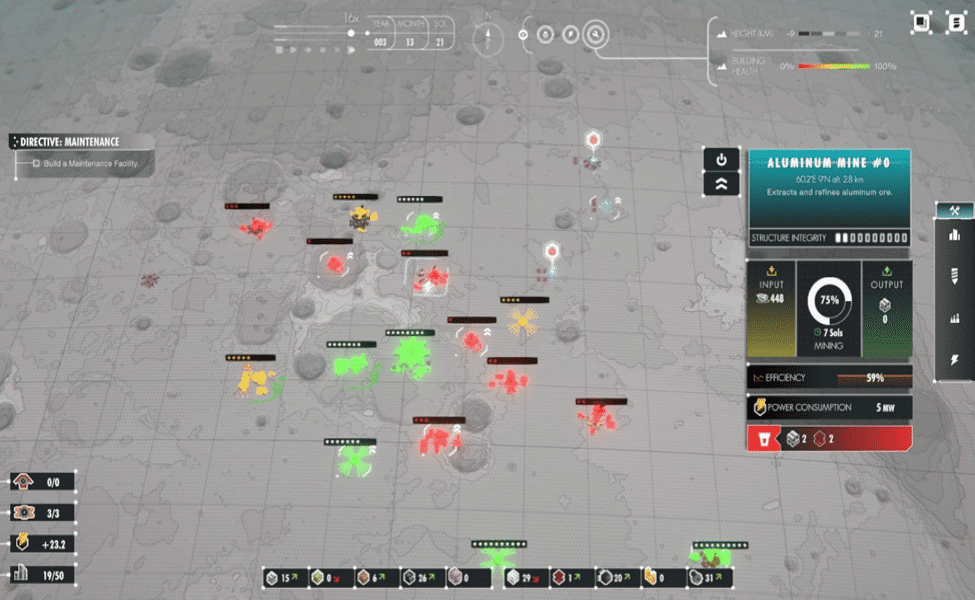
Power and electricity are also extremely important, as not only do you have to produce enough of it, but you also must ensure your buildings are covered by a power plant. Granted, this did not feel like a huge decision in this game, as power plants do not require service outside of general maintenance and can be placed anywhere. Irregular terrain could affect your ability to place a building in an optimal spot, but I never found it to be a huge problem. This concept applies to maintenance as well, and it is important to ensure your buildings are covered by maintenance as you expand.
Speaking of expansion, buildings are required to be “connected” to the rest of your colony to work. When placing a building you will see a little circle surrounding it, and it must touch another building to connect to your network that expands out from the landing site.

There are some quirks to the gameplay that hinder gameplay. For example, when I set up my second landing site, I had no idea how to get the resources I needed to construct buildings there. I did not know if resources are global or not; the counter at the bottom does not appear to differentiate based on the different landing sites, but I’m also not getting the aluminum I need to build a mine by the new landing site? I don’t know how that makes sense! Either way, the mechanic went unexplained, and I ended up building a giant Silk Road of worker hubs and support structures to connect my colonies, which seemed to defeat the purpose.
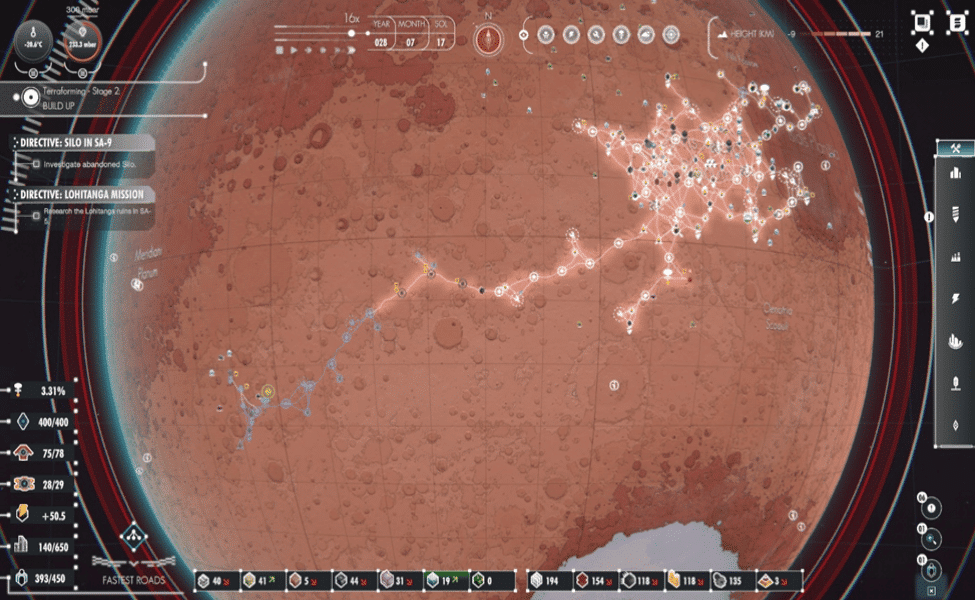
The game does give you the ability to allocate resources (e.g., in the case of my favorite resource aluminum, I can prioritize construction vs. electronics manufacturing) at a granular level by clicking on a resource. It is done all by sliders (which gets me going like nothing else in my strategy games, love me some sliders and percentages) however I could not actually type the exact percent that I wanted for each category, and clicking on the number maxed the slider out – something I found mildly infuriating.
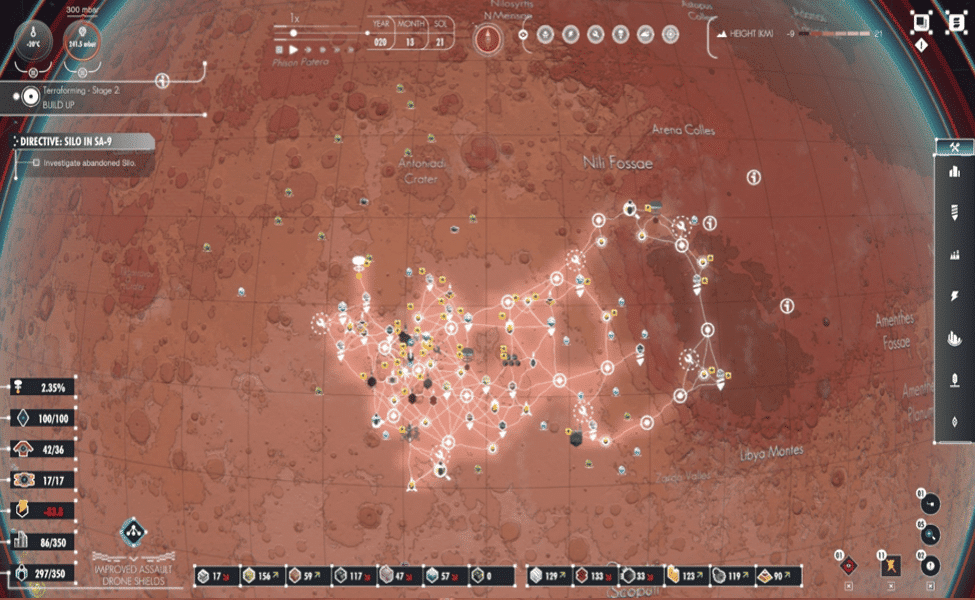
That, combined with the inability to pinpoint or lock the fields as I adjusted them, made it a feature I rarely used; however, considering how buried it is in a UI that is not all that deep it did not seem like a useful tool to have in the player’s arsenal. The last genuine issue I had with resources was finding them. Of course, there is a building that scans tiles and finds resources within them. At a certain point though the map gets cluttered with icons and it becomes difficult to discern which resources are what, or to have a view of resources by deposit size. Considering my struggles with aluminum, this would have been a helpful feature to have as I would be able to expand to capture a deposit as soon as I knew it was available.
There are a few other things I can nitpick about, but overall, these issues did not impede the “fun factor” for Per Aspera. I still enjoyed the gameplay, however simplistic, as it served as a vehicle to tell the story the developers wanted to tell. I find that limiting, however, as even though a Sandbox mode is offered, I had no desire to play the game without the campaign; it feels tacked on to add “playtime” to the game, but I did not feel like the mechanics alone were fun to play with and optimize, like you would in Rimworld, Factorio, or even Cities Skylines. This was a concern I had since I tried the demo for the game during one of Steam’s events, and it has certainly held, not that I see it as a negative aspect. Per Aspera was made to tell a story, and the game is simply fine with the campaign. Whether you may or may not see the value is in the eye of the beholder.
Elon Musk’s Worst Nightmare (WARNING: Spoilers Ahead)

Well, that subheading probably gave it away, but AI is a central theme of the story in Per Aspera – as in the player is represented as the AI, called AMI, that is running the colony and terraforming Mars. I will not go into too much depth about what the story entails, but it starts off with the player being asked a series of questions by Dr. Foster, who created you to colonize the planet, to see if you are functioning correctly. Over time, you have inner monologues where you have “conversations” with yourself, mostly observations on Mars and colonization as you grow the colony. Eventually, when you start getting human colonists, Elya Valentine, the commander for the colonists, becomes another character you interact with and have conversations with. Some strange happenings occur not too long after…
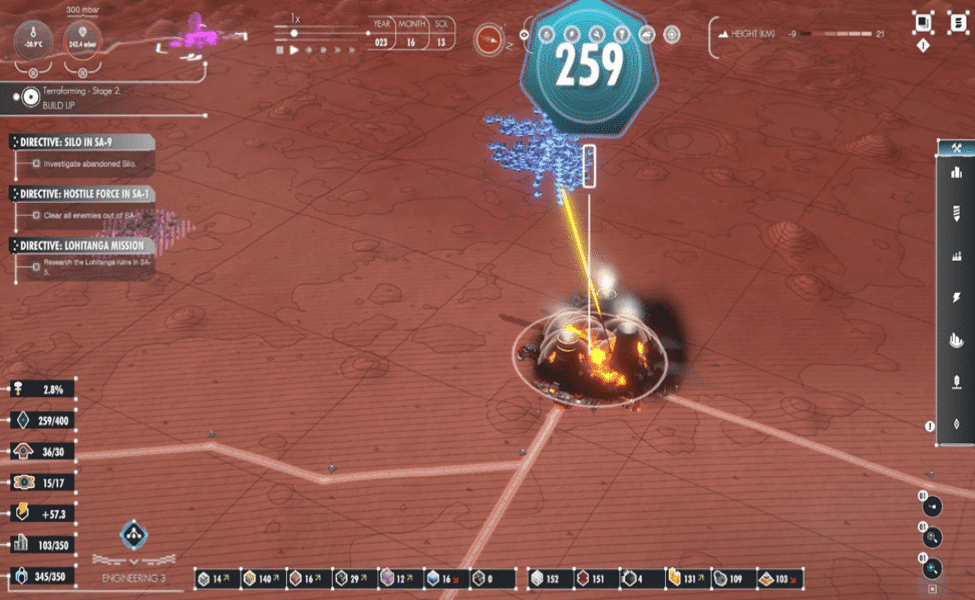
As you can see, there is combat in the game. I want to discuss it a bit but in the spoiler section, as it caught me off guard personally, and not in a good way. Units are difficult to control and move around, as it does not follow traditional RTS control schemes. And that is there besides the fact that you have no control of how units are grouped (the big number in the screenshot above). There is no option to split “fleets”, attack move, etc. It feels tacked on and as though the developers are not familiar with the RTS genre. In any case, this acts as part of the story, as you the AI are modeled from the human brain – which introduces flaws into the system.
The story was engaging enough to keep me in the game, but I did not find it to be anything amazing or groundbreaking. It was well written and had thought provoking moments, but it also served its purpose of giving meaning to the more simplistic gameplay.
Conclusion
Per Aspera is a game that strives to bring an engaging story that is played out through engaging gameplay. For the first outing of a studio, I am impressed; however, the game certainly has room for improvement, hopefully in the form of free content updates and patches. The gameplay just isn’t deep enough to stand on its own and the story is merely ok and perhaps shot for too much.
Once I finished the campaign, I did not feel the need to come back and play more (unless new content and/or DLC are released). I struggled with the same issue for Surviving Mars, the last colony builder I played. The gameplay was not deep enough to keep me engaged for over 20 hours, like Per Aspera. While this may not be something you pick up right away, I do recommend giving Per Aspera a try if you enjoy city builders.