Elemental: Reforged | PC | Stardock | March 2026
Introduction
In the 2000’s, a certain sweary chef shot to prominence, and I, like many others, watched him, and bought his recipe books. Some good stuff there. As much as I like cooking, I am yet to get my beef wellington right. Turns out you can have the ingredients, the recipe, the time, the inclination, the training (I used to work as a line cook) and the talent, and still fail in the execution.
And so, from food to gaming, let’s talk about a game with all the right ingredients, an obvious understanding of the genre, some bright ideas, lots of experience behind it and, plenty of development time, still somehow doesn’t quite gel.
Depending on how you choose to measure it, Elemental: Reforged is a game we have been waiting for 6 months (since we mentioned it on the podcast – look ahead to 2026) or 16 odd years.
Back in the before times (Before Steam), Brad Wardell, of Stardock, kindly let me keep playing my pirated copy of Gal Civ 2. I repaid Stardock in abundance, eventually purchasing multiple copies of Gal Civ 2 & 3.
And shortly afterwards, when I heard Elemental: War of Magic was coming, I bought it, sight unseen.
Actually I think I pre-ordered it.
It was…disappointing
So bad in fact that Stardock gave away their attempt to fix it, Fallen Enchantress to anyone who had bought Elemental, much better received. That said, I never got my free copy!
Then Stardock made a third game, (Sorcerer King), with an interesting premise – you are in the later stages of a 4X and someone else has already won, and you are trying to survive and expand without pissing off the dominus too much. Expand too fast and gain the attention of the big bad.
A similar idea ends up in AI: War, and much better done.
The premise and promise of Elemental: Reforged is that it takes all the good ideas of the original, which were knee capped by hardware limitations, and recreates that ambitious game. It is a strategy role playing game. You have cities, you have heroes, you have rpg stats and trappings, you have quests etc etc.
So, 6 months or 16 years? Was it worth the wait? Is it a remake or a reimagining?


Is it better than Sorceror King?
So, first impressions? Well, we did do a blind eXploration.
Well, before anyone asks, this is most definitely a 4X!
Upon loading the game, it looked…dated.
Upon starting the game, I felt in very well worn territory. I have my start army, and my first choice is where to found my city. I always started near a habitable site, so truth be told, I never saw the need to go exploring for a different site.
Endless Legend 2 makes this initial choice a bit more interesting, as you get a bonus for each turn you delay your initial city.
I have bene reliably informed this is by design, and I think on balance I quite like it, as it lets me get down to business. That said, maybe I should just start with a settlement?
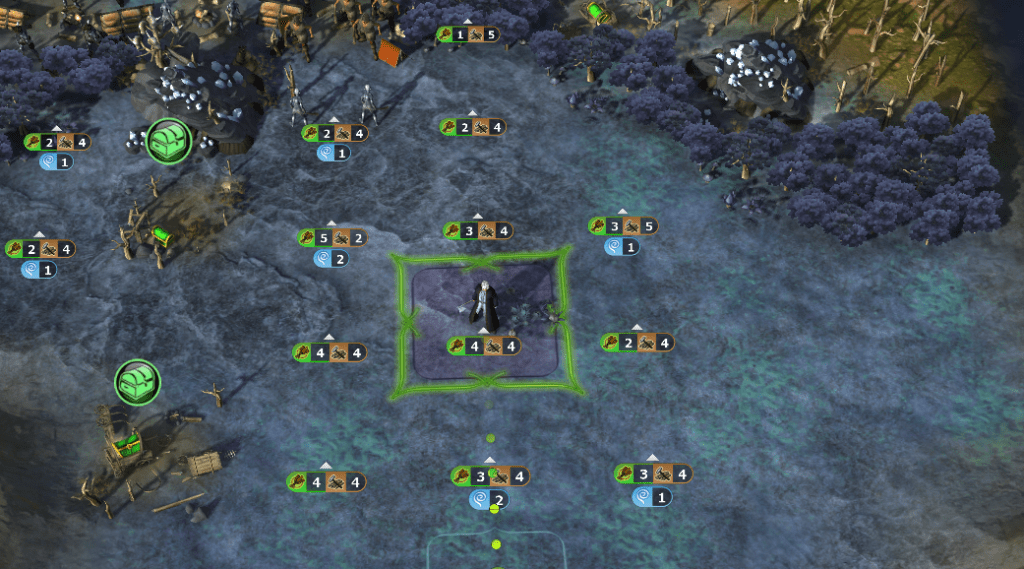
See the screenshot below.
Observe the blue, green and brown icons.
It is not immediately obvious what these do, and I needed much experimenting and not a little guidance (in the form of Discord regular Vaaish) to figure it out – a common theme in this game.
The blue stuff is radiance, which governs how many spells you can cast on your city. Some spells give a food bonus per radiance. Radiance also governs how much mana the city can produce. There is also a building you can unlock that uses radiance.
The green is grain – meaning how much food you can produce.
Thee brown is materials – your building capacity.
So, first city down, let’s go eXploring.
eXploration – the first X
As we discussed in our eXploration podcast, get this part right, and the game is off to a good start. Get this wrong, and you may not recover.

The fog of war is…well it is the fog of war. Nothing special to see here…except..zoom out a bit, now a bit more. What is this? A cloth map. Now, you might think this is nothing special, after all, so many games have this
But Elemental: War of Magic was, I believe, the first, and in many ways, this is a superior cloth map.


Units move out, and reveal the fog of war.
Map generation options are quite generous:
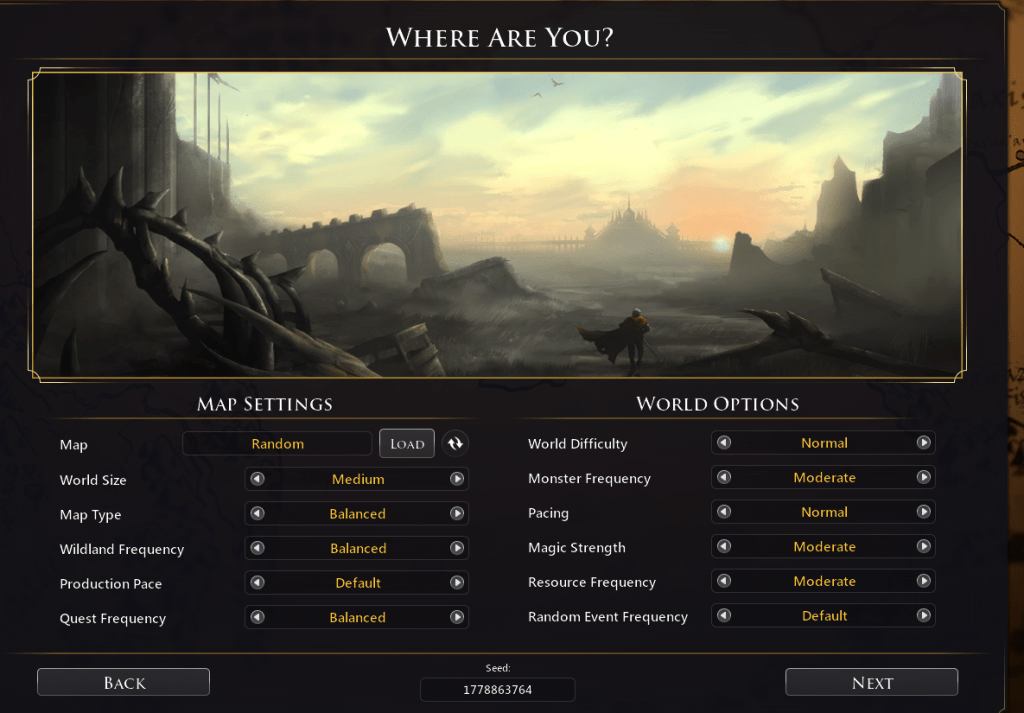
I apperciate the existence of a map seed, meaning I can share this with other people, or try my luck again. More games should do this.
Speaking of maps, map sizes are generally good, nothing great or bad here.
Elemental has this great idea of special regions on the map and this feeds into one of the victory conditions which is a great idea. That said, other games have similar ideas for regions, and better, to be expected 15 years on although these are not yet victory conditions. Maybe Triumph could “borrow” this idea?
It must be noted that the maps are not “pretty.” They are barely serviceable. You will find yourself relying on the cloth map more and more to distinguish what is happening. The map itself often looks quite muddy, muddled.

There are dedicated explorer units, and because your unit count remains quite low throughout the game (around turn 200, I had 2 or 3 armies of 9 units each) these remain useful. That said, they are most useful at the start of the map, and each game I played, I found it *more* useful to get some extra muscle, add those to my leader, and explore that way. It is entirely possible to get to turn 200 + and still not have uncovered the whole map.


The game gets you off to a decent start though, because there are loads of things to attack, lots of shinies to grab, most of the nearby stuff well within your capabilities.
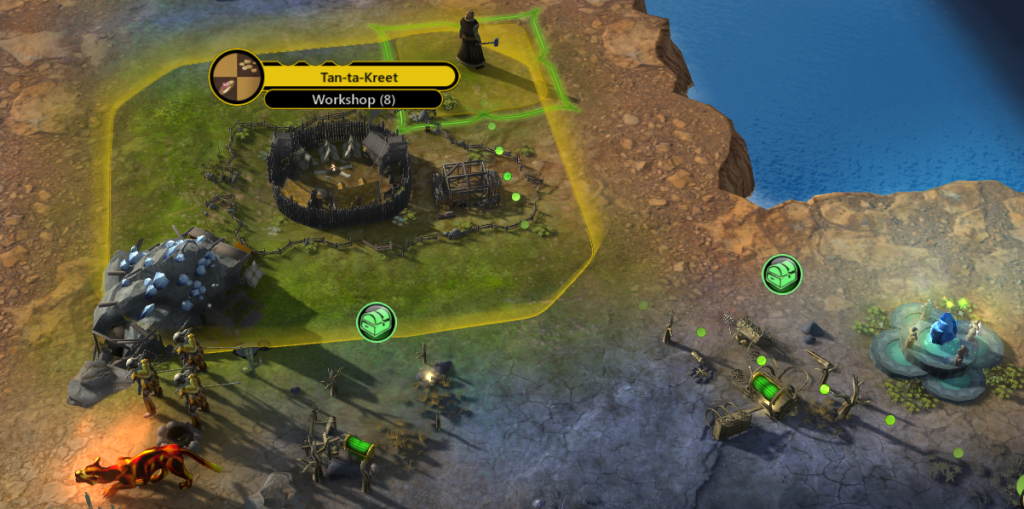
This encourages you to get out and get exploring, which is good, needed. I say that, because your city growth and research are very slow.

It is worth noting that there are several multi step quests in the game. Easy to overlook, but they are there.
Apart from the experience and loot (which funded my economy for a while) the incentive to explore comes from acquiring a resource called fame. Fame has 2 main functions – you need a certain amount to recruit heroes, and you need some to get married.
Married? Yes – and I will talk about that in the next section.
Summary:
This is definitely a game more like Civ than Age of Wonders. You are in for the long haul, so it is good you at least have some good fights at this stage of the game.
That won’t be to everyone’s taste, but I tend to play AoW4 with the slowest and hardest map settings, so I quite liked this about Elemental.
Don’t rush, there is plenty to fight, and plenty to research, plenty to do, and lots of space to plant your cities.
Speaking of cities, let’s get eXpanding.
eXpansion – the second X
There are 3 area to consider with eXpansion in Elemental: Reforged:
- Cities & Forts
- The Dynasty system
- The Research system
Cities & Forts
The first thing you need to know about cities in Elemental is that, other than your first city, they all require settler units. In our upcoming eXpansion & eXploration podcast, we do talk about the merits of settlers being required. Suffice to say it is quite an old system, and one I think survives purely because Civ did it.
The second thing you notice when you create a city in Elemental, is that there are no provinces. I do not recall which game popularised provinces (Endless Legend perhaps?), while I like that system, it does feel like every game is doing it now, so this, older, system feels somehow fresh.

The best way to describe it, is imagine if you “unpacked” the buildings in a typical 4X strategy game city, and placed those buildings on the map. You will put your barracks, directly on the map. Your grocer’s (yes, grocer’s) directly on the map. And so on.

As your city takes shape, so too do your borders. This is useful, because it is within your borders that you can access your shop, and change unit types, and it is that shop that floated my economy for the first hundred turns or so of each of my games. And only resources in your borders can be extracted.
Because you place your cities on the map, you can direct where they grow. So, when you come to place your city, you don’t need to worry too much about getting it just right, as you can snake your city towards a mine for example.
Ontop of this, cities have that radiance rating (mentioned at the start of the article), which affects the total number of spells that can be cast on the city. So, spamming city spells simply won’t happen. Most games just use upkeep cost, so this is different. I am undecided if it is better, but it adds a welcome wrinkle to city founding.
You have a fairly generous upper city limit, in the form of your “essence”, which represents some sort of power of your sovereign. The idea is an interesting one, but in practice, I never felt essence was particularly tight, and there was not much pressure here regarding founding cities. There was more pressure however in the upkeep of cities. You are more or less obliged to have a continuous border with your cities, as the penalties are quite harsh.
Those penalties will make everything in your cities slow down to a crawl. Beware!
Which is why you want to use forts to extend your borders.
Forts are one of the better things here, as they function as extensions of a city They have more upgrade options than in peer games, and are quite fun. Yes, they do cost a Settler unit, but past a certain point, the cost feels quite small.
The list of cities you own is shown on screen all the time, on the left, and at times feels quite cluttered and clunky.
In the 2 videos below, compare a certain other game to Elemental: Reforged.
You don’t get ‘pops’ to manage, imho a good thing, and when your city grows, it gains levels, allowing it to specialise, into things such as fortresses (military choices), conclaves (research bonuses) and merchant towns, { themselves with further specialisations. It is a very light rpg system for cities.
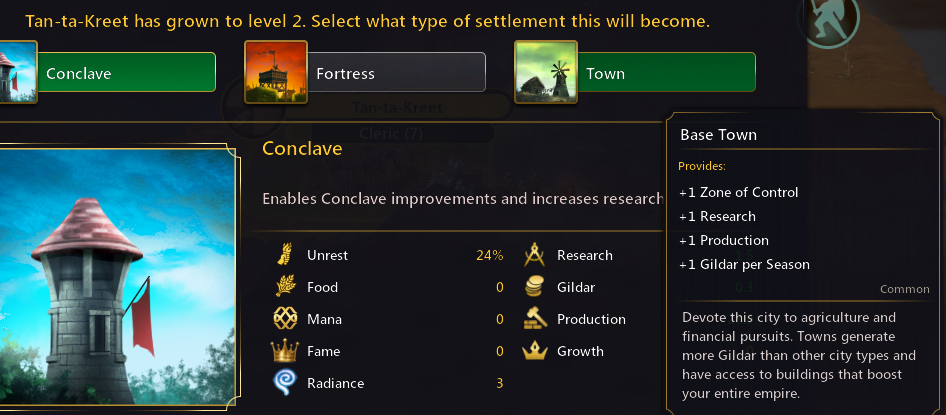

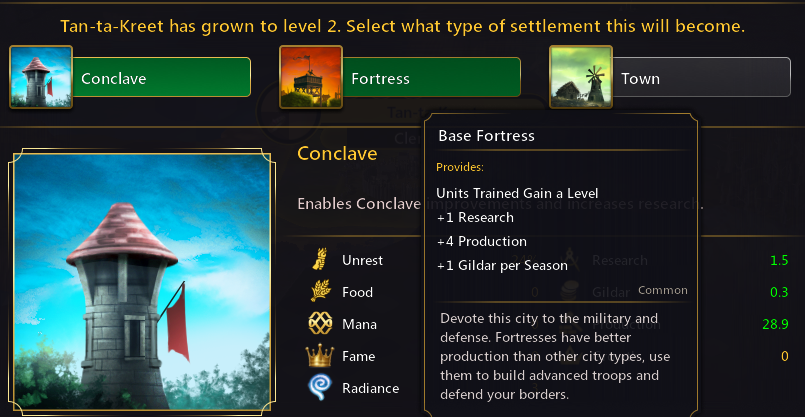
The city system is let down however, because enemy armies are rarely (read never once in my games) going to occupy your lovely fantasy Walmart, and instead just occupy the town. These buildings on the map seem to be there for snaking your city, and for aesthetic purposes, except it is visually quite difficult to tell at a glance what city is what.
On the plus side, there are many buildings to unlock via research and then construct. As mentioned earlier, this is a long game, and it will take time to build your cities. Relax, and enjoy.


Further, there is never any real pressure on your borders per se, you won’t get into a cultural back and forth like you might in Civilisation, or culturally flip an opposing city. Instead, the greatest threat throughout most of your game is likely to be roaming bands of independent units. And these can be quite random. Sometimes they will come charging in and destroy everything, other times they will just…sit there.
The map is hard to read, and by the time you realise an enemy is in your borders, your city will shortly be captured and then, *poof* like magic, your 200 turn city will disappear in a single turn.
I must say it was probably at this point that I went from very interested in this game to lukewarm and ambivalent.
It would be an understatement to say that this is not enjoyable. There is no real counterplay, other than to very slowly expand and keep armies close by, or rather, directly on the city hex, because armies close by will do nothing as the city burns.
The game design seems confused – encouraging, nay obliging, players to spend hundreds of turns crafting a city in this world, and then wrenching it away – with no counter play. I think this is a big MISS and MISTEP – a strategy game with no counterplay?
And before you say, “get good” or “old school,” many other games are older than Elemental (original) and require some time to completely destroy a city.
I quite enjoyed the city building and management of Elemental, especially the fort system and how you can snake a city and wish this is adopted in other games.
There could be more done here, such as improvements to individual buildings.
However, it is a slap in the player’s face to lose a city after 1 turn of enemy occupation.

The potential here for the player to make their own mark, and have every city be unique, is definitely there.
Worth noting is that while there are infestations, and roaming bands of bandits etc, there are no NPC cities, or dwellings. That does feel like a missed opportunity to make the world more alive.
The idea of a post apocalyptic world that the player is rebuilding in is not a new one, and honestly, non player factions seem to me such an obvious fit that I wonder why they are not here.
To be fair, this is a 15 + year old design, so maybe Endless Legend and Age of Wonders 3 onwards have spoiled us here?
The Dynasty System:

The idea here is quite ambitious – create a family line to last throughout the ages.
Pick a suitable spouse for your sovereign, but you have a minimum fame requirement (one more reason to get into fights as early as possible) , create children, turn those children into heroes. In theory you can nurture some very powerful heroes this way, but it never happened in my games.
The idea is a good one.
The reality though, is that this feels fairly tacked on and a bit boring.
First, there is no drawback or cost to marrying your sovereign. You want fame for heroes anyway, and fame is a threshold, not a deductible value. Meaning you don’t lose fame for marrying someone.
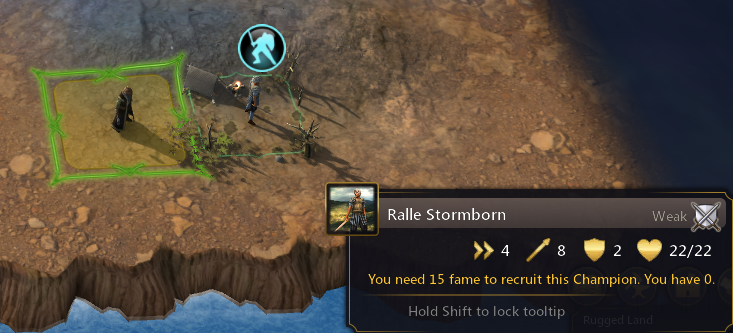
There is no big benefit here either, other than perhaps opening up a school of magic that you might not otherwise get. For example, Pariden cannot use death magic, so a spouse with death magic opens up that avenue. But as you can’t build on death shards, you won’t ever multiple the power of those spells, so at best it will remain a nice bit of spice.
It feels like the intent here was to have a system a bit like Massive Chalice or more recently, Mewgenics where the resulting offspring provide interesting options. It works in Massive Chalice because your children are your only soldiers, and the trade-off comes from choosing which hero to be the founder of a house. You want your best hero there as early as possible, to produce more children, but once in, they never get to fight. So, do you sacrifice a good hero now in the hope of multiple good heroes later, or do you keep them fighting?
In Elemental: Reforged, you will end up with many heroes almost without trying, so the impact of your dynasty offspring is very limited. Plus, you need to invest some of your precious essence to turn them into heroes, essence which you need for founding cities. In effect, not worth the bother, and a system I was able to largely ignore. I would marry because that got me an extra hero, and that was that.
Also, your sovereign never dies until you lose the game, and there is no mechanic like “legitimacy” from Old World . In Old World, legitimacy is closely tied to your leader and has an impact on the orders and other resources that you generate. And because your leader will die, your family really matters.
Not so in Elemental: reforged.
Research:
On a more positive note – This is a solid win.
There are 3 main branches, Civilization, Warfare and Magic, in your research tree:


As might be guessed from the names, Civilization is all about cities, Warfare gets you better equipment and military organisation (and horse or warg riding!) and Magic is all about spells.
The research tree is extensive, and to the game’s credit, I frequently found myself wanting to research all 3 trees. It was not immediately obvious what the best path was, and there is plenty to tempt you.
Also, you can queue up research. This allows you do something like the following (which happened in several of my games):
- scout an area, maybe your start area
- see you have a tile with horses on it
- Found a city to encompass (immediately, or snaking towards it) that tile
- Beeline research to Mounted Warfare
- Build a Stables
- Mount your favourite units on Horses. Hee hal!


Unlocking new units, for example, really opens up the tactical space, feeding into the games greatest strength, the combat (more on that later) but there is a real tension between more and better units, or more city options, or magic.
It sounds so obvious but there is genuine enjoyment here.
The only downside, and it is minor, really is that there does not appear to be a search function so you might scroll a while to find something.
So, overall, eXpansion is handled quite well in Elemental: Reforged, with the negatives of how quickly you can lose a city and the empty dynasty system.
eXploitation – the third X
Apiaries, clay pits, berries, shards, crystals – what do they have in common? All are sites of interest that you can build stuff on.
The game very kindly lets you know when one of these sites of interest in in your city radius, and thus available for exploitation.
Their utility varies.
Some, like the various mounts, are very useful, so much so you may wish to direct your city growth and research path to getting Mounts. They are sufficiently rare and powerful.

Also useful, the shards. How they work is that, unlike most fantasy games, holding a fire shard won’t get you more fire mana. Nor will they unlock fire magic. Instead, they will amplify fire spells. The difference between a fireball with no fire shards and 4 (the max) is huge.

Apiaries though? Apparently it is -2% to unrest globally (thanks Vaaish). To be honest, I never noticed the difference.
Clay pit? A +1 to material
The worst bit is, they are largely indefensible. Enemy armies can swoop in, burn them down instantly, and unless you have an army standing right there, there is nothing you can do. Army next to it? Seems they are just chilling, watching the fireworks.
This is an adjacent, and similar complain to the earlier one about cities being instantly lost.
Thankfully, the crafting system is, at least, a bit more useful.
From very early in the game, you can quickly and easily craft a variety of items. in my games, I never crafted anything earth shattering (unlike items in Dominions, for example ) but the system has some things going for it:
- It is easy to see. A few clicks, et voila, an item
- Items can be used by heroes AND units. This last goes a long long way to making units feel special and interesting, and increasing your attachment
- Even “rubbish” or “filler” items can be sold
- you are going to get plenty of crafting materials


Did I mention that almost my entire economy was floated by selling loot and crafted items?

So, sovereign kitted out, bodyguard recruited and loads of loot from all those dungeons. Time to beat someone up right?
eXtermination – the fourth X
Some Prussian dude said
War is nothing but a continuation of politics with the admixture of other means
Although some of his military reforms led to things we would recognise today, such as a general staff, he probably wasn’t talking about 4X games! But, the point still stands – battles need to be part of something.
So, this is not a war game, or a realistic war simulator, but the basic idea is there – what are the battles for?
Warfare, meaning engaging in hostilities with other entities in the game, of which battles form a part, well it is not very satisfying.
Why not?
Well, the greatest threat is from the independent armies, and half of that is down to a muddy map so you cannot see them coming unless you are very vigilant.

Also, check out this mega army of Golems, that strolled into my territory and then just…stood around for the rest of my game.

Enemy players rarely bring balanced or effective armies, rarely attack, rarely do anything of note. Actually, now that I think about it, maybe instant razing makes sense, as that seems to be the only way the AI can inflict pain on you.
Now, in the exploration stage, fighting a bunch of marauding Darklings might be fun, but towards the middle and end of the game, you are wanting epic showdowns to close out a hard won war.
That just never happened in my games. In theory it should happen, and initially I thought maybe that wonderfully large tech tree just meant players stay low tech for a long time, but across multiple games I got to turn 250 + and was typically fielding the odd mounted unit, some bowmen and a solid front line. With decent armour. More importantly, I was fighting the same sort of stuff from start to end of my games.
This general inactivity, or sense of something lacking, extends to the diplomatic system. One one turn I was threatened by an AI, which I ignored, and the next turn they sent me tribute. On neither turn was I actually anywhere near them, or any sort of threat.

Simply put, diplomacy, and the enemy, are lacking. Lacking in threat, believability, cohesion, fun etc. It very much feels like a P.v.E game, so much so I wonder if Stardock should have modified Sorcerer King instead.
I did eventually get to war with my opponents, largely in a push to close out my games and because things were feeling stale. And I quickly realised that managing a larger (mostly captured) empire was not a good idea, due to the high penalties (ss of expansion penalties) but also because the fastest, easiest thing to do was simply raze enemy cities, as it only took a turn.
And it was here that I got hit by what is clearly a bug, and which threw cold water on my game.
My occupying army captured and razed a city, and then just…disappeared. No way to select them, didn’t appear on the army list on the left of the screen, just gone.
Like magic!
But, all is not lost.
I am happy to report that the tactical battles of Elemental are actually fun. Lots of fun. And I say that as someone who has accumulated some 5,000 or so hours in the Age of Wonders series.
But, “fun,” is such an amorphous word. What do I mean by it, or rather, what do I find fun?
Well, for a start, battlefields don’t feel too small or too big, for the number of units involved.
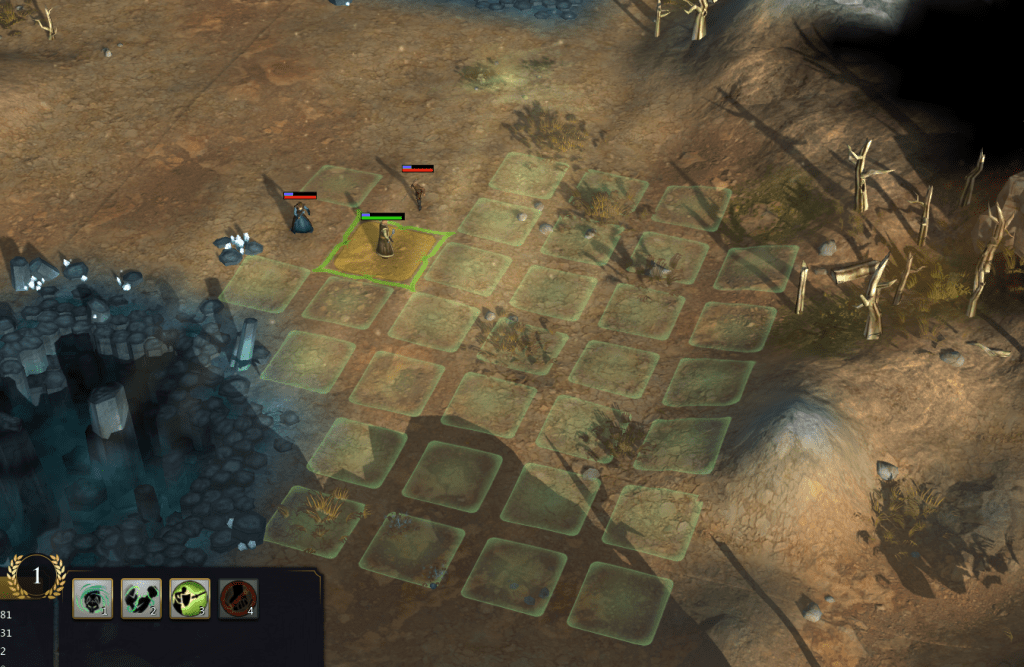
The small scale of combat (you can bring in a maximum of 9 units in your army, after several upgrades – I wish more games did this by the way) means your attention does not get dissipated too quickly, and each loss is something you notice, and, more importantly, can understand. As in, the chain between your decisions and the outcome is usually quite clear. Move here, activate – or forget to – a unit ability, see what happens.
Various units having different figure counts also works very well, so a single unit with multiple figures can be a decent match for more numerous but individual units. A good example of this is picking a fight with Darklings or Bandits in the early game.
Combine that with the equipment system, and often battles feel more like the battle in the mines of Moria than the battle of Cannae. There are of course upsides and downsides, but given how much else is going on in this game (multiple cities, multiple independents, multiple mines etc) a focussed and quick combat system is, I think, a plus here.
Ontop of that, it is always fun to see your research pay off so visually and effectively. I am talking specifically of how you can upgrade the size of your units. I wish more game did that, allowing the player to scale up the size of their battles according to their developmental choices.
Battlefields have choke points, a personal favourite of mine, meaning you can do stuff such as clog the pathway with Spearmen while your hero casts spells.

Did I mention that spells in combat feel rather good? A well placed and timed fireball, yeah you feel it.
Stardock went for balancing magic by making it costly and time consuming. That fireball I mentioned? You need to sacrifice a turn to charge it up. Best position your caster well. I like this, and wish other games would implement it, multiple combat turns to do something, thus increasing vulnerability. Trade offs – name of the game.
You can see below that there are not very many actual spells, but they do all have an impact. I actually prefer this system.
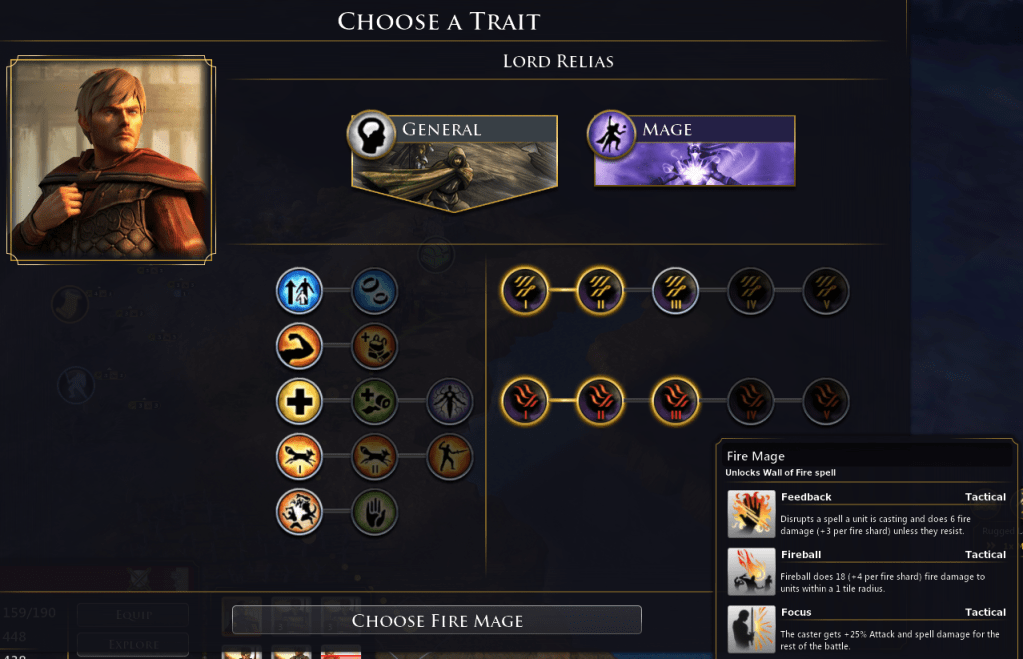

I feel it is relevant to point out that there are more spells available, through research. And some of those are…juicy.

In the screenshots below, observe the HP of my sovereign and supporting hero. The spell above could win the battle. This is on turn 50, for what it is worth.


The various abilities are also impactful. Observe in the screenshot below that this is not a glitch, my sovereign was actually shrunk, with a strength reduction.
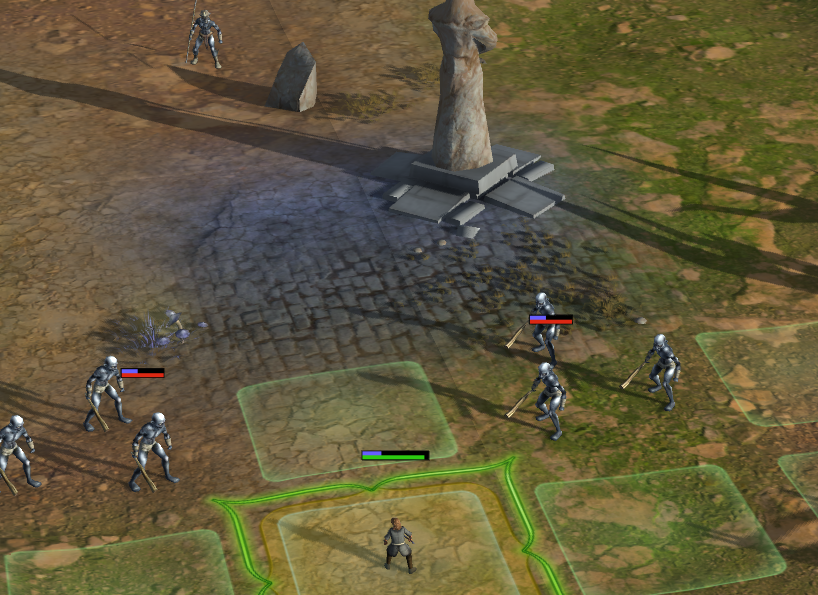
There are 2 things that are not immediately obvious in the combat system, and the game does a terrible job of explaining them.
First, unit positioning affects how many strikes a unit gets. If you look at the screenshot above (shrunken sovereign) the Darklings will attack one by one
Compare to the below screenshot – if the red bandit attacks, the blue one will get a free attack.
NOTE – I have been reliably informed that this is wrong. I quote:
you don’t get extra strikes for grouping units around a target. It looks like it because everyone attacks, but it’s actually a modifier to the attacking unit. It’s a boost to accuracy and damage applied to the attacking unit based on the number of units around the target
That’s not confusing, at all. As clear as crystal, hidden in a bag and thrown into quicksand!
The practical effect of this is you will want to position your troops next to each other, and try and envelop the enemy. This is, think, very very good. It feels organic to make a battleline.

The second thing that you kinda figure out by trial and error is stamina.
Let me draw your attention to the blue bar in the screenshots above. This is your unit stamina. Run out of that, and your unit will do nothing, effectively useless. It is a cool idea, but I must be honest here and tell you that I ran out of stamina I think twice in 50 hours. Annoyingly, it was 2 heroes in the same fight!
But, several abilities require a certain amount of stamina, so if you are lacking, you cannot use those abiltiies.
Anyway, I did manage to get a screenshot of an enemy with no stamina left:

My 3 heroes just whaled on him for a while, easy picking.
I found I could just ignore stamina, but I imagine against a prepared enemy (i.e. multiplayer) more nuance will emerge.
But you definitely won’t be ignoring unit positioning.
Nor will you be ignoring the effects of different weapons
Using a two handed hammer is a different proposition than a two handed spear. See below for a comparison of just 3 of the different item types. The impale of the spear immediately makes me want to bait the enemies into a line (so they are trying for the free attacks) and then hit them from the flanks. Or look to take advantage of a choke point where I can hit 2 enemies but they can hit just one. Throw in some cheap healing and so one and so forth.
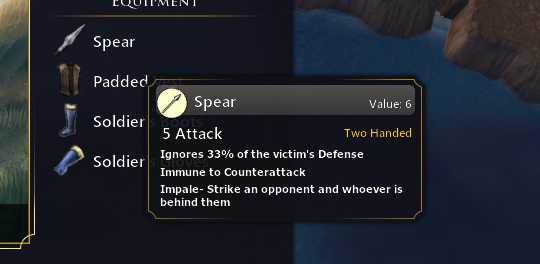


It’s not all good though (there is always a ‘but’, right?).
A calling card of Elemental is the initiative system, and it comes close to being good.
Things like heavy armour lower your initiative, so there is a (that magic word!) trade off. High initiative means you got earlier. High enough initiative and you might be able to go twice in a row, so Drizzt Do’Urden can emerge more organically than just giving a unit double strike, like the Bladedancer here.
Things like haste increase initiative, slow decreseas it (a nic change from just altering speed). I imagine at higher levels of play this might make a difference, allowing you to rescue a precious unit, or doom a priority enemy.
But most of the time, I just ignored it. I just looked for which unit I could use next, and used that. A mechanic you can almost entirely ignore, well that is not a good thing is it? Again, perhaps in multiplayer initiative will shine?
And given that the game is set in English, where you read left to right and top to bottom, why are the earlier rounds at the bottom?
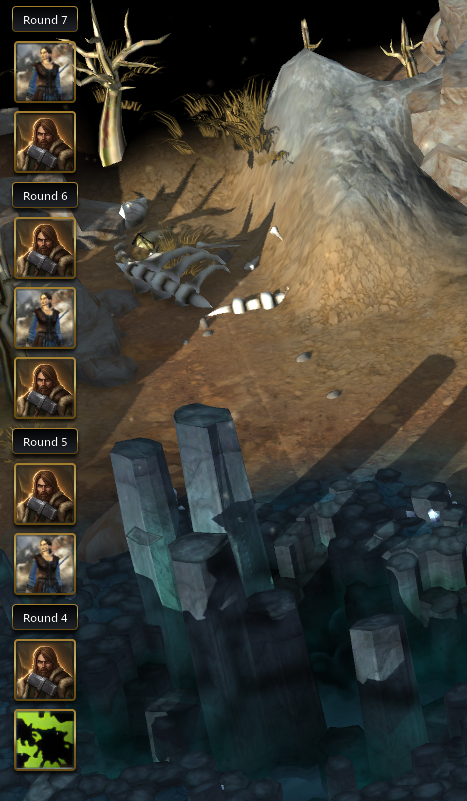
I have also not mentioned details like attack, defence, accuracy, dodge etc. Mostly because these are, like initiative, indicative of the start of something really deep, that never really materialises. I just gave all my units a splintered staff and that let them dodge more often than the enemy. Speaking of that splintered staff…
Battlefields are often not visually very interesting, and the old graphics are especially obvious here, due to the zoomed in nature of the tactical layer.

Last few niggles – I first wrote this article I stated there was no zone of control system. Apparently there is actually one (thanks Vaaish) but for the life of me I honestly did not notice it at all.
So, tactical combat – mostly good. Honestly, this and that research tree are worth coming back to.
eXperience – Bonus X

eXperience is a wildly subjective thing, but overall, this was a decent experience for me.
I got hit by 2 bugs.
The UI is functional, but not amazing. You will notice a few modern things missing, like proper tooltips, or how easy it is to accidentally give a stack orders.
In the video below, observe how I send my sovereign to a lair, the game auto selects my scout afterwards (and focuses my attention there) and the turn auto ends and continues my sovereign’s path – the video ends with my Sovereign getting to the lair.
The fluidity of the end turn system is confusing, at least at first. It feels almost like a real time system.
In this video, observe how to select an army in a city, I need to hold shift click to get my guys. Fiddly. And it gets worse with the more units you have.
Graphics are functional – nothing amazing, but it gets the job done.
The sound track and sound effects are…again, functional, and I am struggling to think of any of the music. When you play, drink a healing potion and tell me what the sound effect is.
Performance is okay. Many people have reported bugs, but I only got hit by 3 real bugs:
One was when I defended a city twice in one turn, and because I had free militia, who were the last units left after my heroes died, it decided I had lost the fight and promptly teleported the heroes to the next town. That was weird and annoying, but not a deal breaker.
Two -having my army disappear during a raze. This was a deal breaker.
There is a visual glitch where the location of your army on the strategic map is NOT where it looks to be. But I kinda got used to that.


There is replayability, mostly through experimenting with arms and armour and magic, maybe seeing what difference it makes going for magic first.
Avoid the campaign. I played the first map, and it was tedious.
Game ran well enough. The screenshot below shows the resources used, if you are curious.

Summary
So, after 15 years of preparation, 50 hours of play time, several hours writing this and a few minutes for you to read this, what do we have?
In a strange way, I want to recommend this game. It is poorly executed, has numerous bugs, lacks polish, probably should not have been released yet, lacks imagination (Darklings? Seriously…) and lacks a certain cohesiveness (as in, the different parts feel disparate) – and yet is still often fun to engage with.

It is a testament, I think, to the enduring appeal of a 4X game.
All 4xs are there, identifiable and usable. None of them is genre leading, and only the tactical combat comes close.
This is a competent remake of a mediocre game, and there is really only so much you can do with that.
I think Stardock would have been better served by ditching “Elemental” altogether and creating something new.
What sort of game would that be? Well, pop on over to the Discord and let me bore you with my mishmash ideal 4X/strategy/empire-building game.
Alternatively, or additionally, look at each 4X and decide how could this be improved. What games have the best exploration? Why?
Fundamentally, this feels like a 15-year-old game, made to work on modern systems. Not just graphically but permeating throughout the whole thing.
Old school design, old school execution. For some people, this will be perfect.
For me, it all feels distinctly average, and I have a Steam backlog to get through.
However, I still had fun, and I think if you like 4X games, you will too. So, I declare it

You might like this game if:
- You want something old school
- You don’t mind the jank
- You like Stardock
- You want a more sedate, long turn 4X, as a palate cleanser from the bombasticness of AoW4 for example.
- You want “Civilisation, but fantasy.”
You might not like this game if:
- you want something polished
- you want something ground breaking (although, to be fair, how many games are groundbreaking?)
- You want something bug free
- Graphics are important to you

Addendum:
There is DLC imminent, which does make one wonder if it is cut content or not, and Frogboy (Brad Wardell – the boss of Stardock, in case you did not know) has been very vocal about the game.