Soulash by Artur Smiarowski is a turn-based traditional roguelike where you play a dark creator god, imprisoned by your children eons ago. You have now mysteriously escaped with the goal of devouring the souls of mortals (and gods), to regain your power, discover how you escaped and reclaim your ultimate power of the universe.
Overview
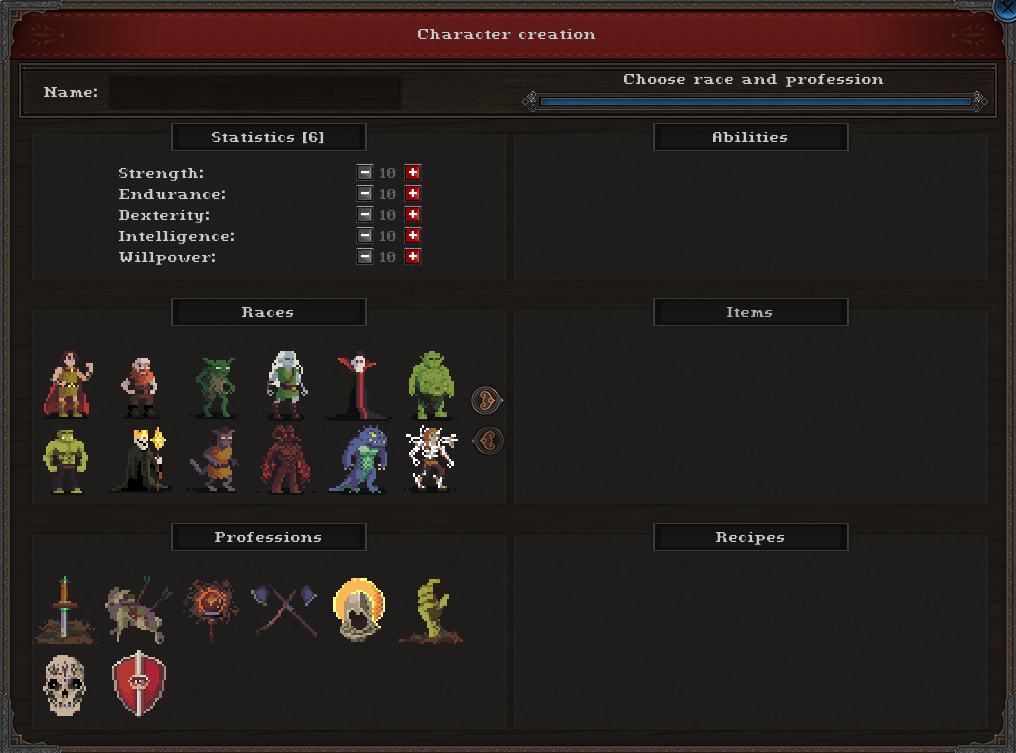
Your character enters the game by taking over the body of an existing entity in the world. As such you pick between sixteen different races and eight different classes, all with a somewhat sinister bent. There is no knight, but a fallen knight, no dwarf, but a dark dwarf. There are five different ability scores, Strength, Endurance, Dexterity, Intelligence, and Willpower, and each have an impact on various game mechanics, including how you deal and take damage. While each race have ability score modifiers, they generally add up to no more than four or five points, and these points are quickly overshadowed by the meagre six you can spend on each level up. How you distribute them will depend a lot on your specific build and what you want to accomplish, but generally, it makes the most sense to load your primary ability score in damage with some limited investment in other ability scores to fulfil your character’s secondary goals.
The game follows the normal traditional rogue-like structure. You get a turn, and then all enemies in the entire world get a turn. This is mostly of relevance when you are in the line of sight and they are aware of what you are doing, but it also can result in enemies wandering out of their normal starting areas into more dangerous ones. Players are thus kept on their toes trying to avoid getting killed by a creature they may not be expecting.

The game innovates over most traditional rogue-likes in its facing system. At any given time you are only able to see things that are directly to the front or side of you. You can only perform basic attacks on enemies that are right in front of you, but special abilities can target anyone you can see. This gives you an opportunity to sneak around and avoid being noticed by enemies. Generally, if you have low dexterity enemies are more likely to notice you, even if they are facing in the opposite direction. With high dexterity however, you will be a virtual ninja, able to sneak past enemies just a few squares away who are not looking at you directly. Changing your facing comes in steps, but these steps only take a fraction of a turn adding some fun little positioning decisions to the game.
Most characters have to keep track of hunger, thirst, and stamina. Hunger and thirst accumulate as time passes. Hunger is refreshed by eating food items gained from loot or butchering animals. Thirst is refreshed by drinking water, though this can be done from a river or lake, a well, or a storage container. Resting has two phases. Stamina powers almost everything you do and is partially recovered by taking short rests, but every time you do so your maximum stamina level goes down. Sleeping is the sole way to restore this maximum gauge.
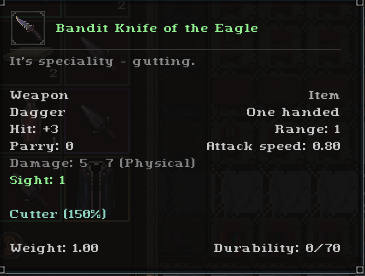
Soulash’s weapons each have their own set of statistics that define how they will perform in combat. Hit and Parry are only relevant if you are making a or being targeted by a basic attack They are used in a random roll to compare against each other, with your combined weapon and appropriate attribute hit value used to roll against the defender’s parry value. The damage range is combined with a half of the character’s Strength or Dexterity (based on weapon type). Some weapons can actually be keyed off a half of your Intelligence or even quarter of Intelligence and a quarter of Strength or Dexterity, if you get the right weapon or the weapon with the right modifier. Attack speed indicates the fraction of a turn the attack takes (and generally ranges from 0.8 to 1.5). Enchantments on weapons largely provide bonuses to ability scores, but some can change the damage type, make the weapon faster, or give it a larger range of damage.
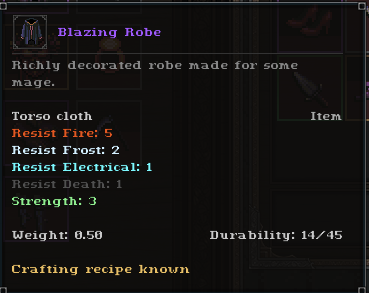
Armor features a mixture of Physical and Elemental resistances that are combined with half of your Endurance added to Physical and half your Willpower added to Elemental. Much like weapons, your armor can have a variety of different enchantments that provide modifiers and bonuses. Many of these are focused on adding attributes or resistances, but some can add more unusual things like faster movement.
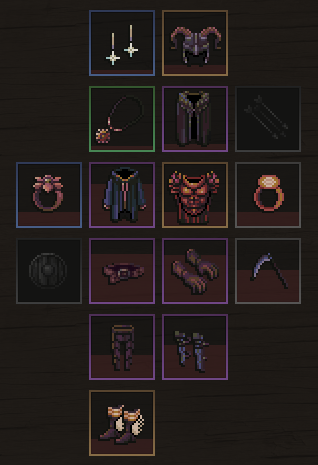
Any given weapon or armor has a chance to be generated as a fixed artefact. Each of these provides an extra ability with limited charges of use, as well as some sort of big ability score boost (usually up to a +6). The specific base item can vary, but the attributes and special ability are always the same. All in all you end up with a total of fifteen equipment slots. This gives the player plenty of options to customize gear in order to fight particular element types or to boost specific ability scores.
Items lose durability over time, though there are ways to refresh this durability at the cost of maximum durability. Everything will eventually have to be replaced, even the artefacts, so managing a steady supply of new and replacement gear is important for success. Thankfully the developer has included a color-coded indicator for your gear so you can easily look at it and see how close it is to needing to be repaired.
Items can also be salvaged, with a chance based on intelligence to give you some of the materials used to craft that item and/or the item’s recipe. Crafting is also Intelligence-based, with crafting attempts always succeeding, but higher intelligence means a higher chance of success with a better enchantment. It is possible to craft a fixed artefact if you are smart and/or lucky enough. This skill in crafting is particularly helpful for Intelligence-based characters due to the low frequency of elemental weapons, but even beyond that Intelligence-based characters will have the best stuff: the most recipes, with more likelihood of enchanted gear.
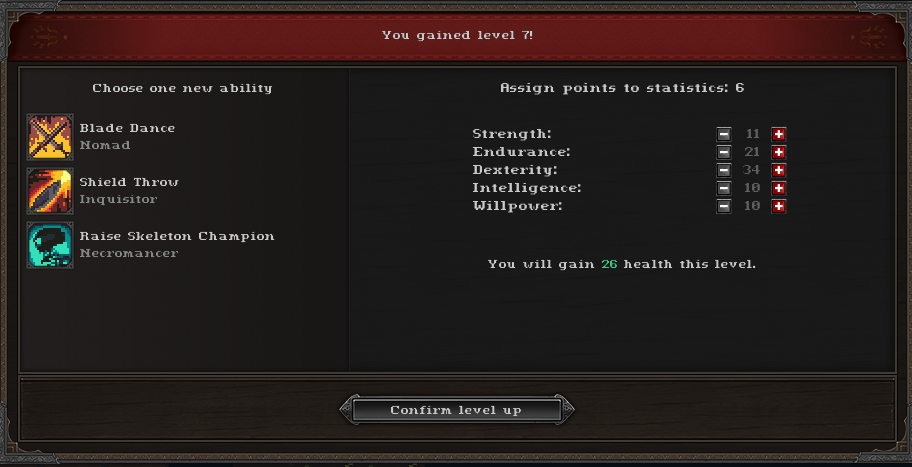
Character level-ups are class-guided but still offer a great deal of flexibility. Your initial skill is set by your base class, but after that, every level gives you the option to pick between three skills, with one of them always being the default skill of the class. You are also given six points to split between your attributes. This theoretically gives you a lot of flexibility in how you build your characters, with the potential to build an Intelligence-based berserker or Strength-based warlock, but with the pool of skills that are pulled from this will largely not be effective. You would have to get consistently lucky in how you roll in order to pull off a character who deviates a lot from the base class’s theme and at that point you are probably just better off playing another class that is well suited for your primary ability scores. However, there is a lot of possibilities to grab specific skills that you want from another class to help you achieve your particular goals or try out different combinations.
Unlike some roguelikes, Soulash doesn’t rely too much on procedurally generated environments. Instead, there is a selection of different encounter variations associated with each location on the map: the first village you are likely to come across has a variant where it is burnt down and inhabited by bandits and orc raiders, but there is also a chance you will just see a normal farming village. The set of enemies in each location is based on this, with the gear types also being somewhat fixed. Gear can have all sorts of enchantments, however, and running into an enemy with a fixed artefact results in a frequently entertaining, and sometimes deadly, surprise.
Enemies largely draw from the same group of abilities that the player gets access to, but a lot of enemies don’t have abilities at all, instead just engaging in melee or ranged attacks. Enemy bosses are a bit more interesting here, and as you get later in the game more typical enemies can have a wide range of abilities, though the bulk will always be a bit more straightforward in how they interact with you. This is largely fine, as the environment, the facing system, enemy wandering, and the threat of fighting multiple enemies at once will keep you on your toes.
Achievements and Triumphs
Soulash’s environment and overall structure represent another step in the diversification of themes seen in traditional roguelikes in recent years. While playing the villain is hardly novel in a video game, having the protagonist being a soul-sucking elder deity fighting farmers, travellers, bards, and eventually sun priests and kings, is fun and different. You are mostly not wandering through deep dungeons but instead traveling between villages, fortresses, and dwarven holds. This creates a certain level of flexible progression that is akin to something like Caves of Qud or Cataclysm: Dark Days Ahead. You can go anywhere you want, even if it gets you killed. There is probably an optimal route for any given character, but there are usually enough sites of a given power level to provide some degree of flexibility in how exactly you want to progress through the game.
This reaches its epitome with the presence of the world’s gods. Each one has an altar somewhere in the world which you can use to summon them if you have the right ingredients. On top of that, at various points in the game, you will draw deadly attention from one of the gods. Fighting them is optional. You can run away from them and will likely not see them again unless you want to, but killing each one has a big impact on the game world. For example, if you kill the river god, the world’s river dries up. If you kill the god of farming, the world’s pastures disappear. This can negatively or positively impact you, but none of these changes will destroy your ability to progress. Additionally, defeating the gods you face at the 11th level and beyond can give you unique special abilities. Killing the god of the forge will give you a throwable anvil (which you can use to craft items on until it disappears). This is honestly one of my favorite things about the game, and the combination of the effect of their defeat, and difficulty of fighting the gods themselves, means that learning who can fight which individual god and how those characters go about beating them will provide a consistent challenge players who really enjoy figuring out optional content.
I really like the crafting system and how the variance inherent to it creates new experiences on any given playthrough. Finding a weapon or armor recipe early can change how you approach the game and finding a rare one can completely upend your capabilities and your goals. Additionally, the random nature of crafting enchantments, means that even a bit later in the game you will find it useful to salvage items, both to replace ones that are worn down as well as for the opportunity to craft another weapon or armor and get just the right bonus.

The look and the feel of the game are excellent. I love the lighting effects and how it plays with your facing, adding a certain element of tension in obscuring what is around you. The music is good and noticeable enough that even my wife commented on it, and the dev has done a great job in making sound aesthetic decisions. The fact that those environments are, at best, semi-procedural means that they have details and a sense of reality that you do not get in the bland corridors of more procedurally-focused roguelike environments. There are statues, fires, and even remnants of your battles. Almost every environmental item can take damage, and as you make your way through villages and cities, walls will come down, floors will take damage, and bookcases will be turned to kindling. It really feels like you are a force of destruction in the world, tearing things down to reclaim your throne.
The “pick three abilities” leveling system is also a plus, even if I wish the choices were slightly more constrained. The ability to mix up your build with a new utility or attack ability is great, and the fact that you don’t have complete freedom to pick has the potential to create inter-play variety to your playthrough as you end up making meaningful character progression choices. With that being said, I wish that the attack abilities were a little more weighted towards ones that are related to your primary attack score, so you would be less likely to end up with elemental abilities on a physical-focused character and vice versa.
Limitations and Failures
Most of my problems with Soulash are in the area of balance and user interface. While my problems with balance are pretty easy to hand-wave away with the understanding that the game is a single-player experience, they still are irritating enough to be worth mentioning. The user interface issues are a bit more bothersome, and will likely be frustrating to most players.
Before I discuss balance concerns, I should caveat that Soulash is quite deep and that some of these concerns may be incorrect. Even with 90 hours of play, I wasn’t able to get a thorough understanding of the final parts of the game, and I am almost certain there are subtleties I missed.
Some of my balance concerns are related to the different racial choices. A lot of them are a combination of “eat in a more efficient manner”, seeing in the dark, and even more specific abilities. Eating largely just frees up some encumbrance and time, and Infravision mostly means less fiddling with light sources or slightly better equipment quality. While all the different ways you can switch up food are interesting, and Infravision is useful, the frequency of it is repetitive. All-in-all ten or sixteen races have either Infravision or an alternative diet as an ability. Additionally, a number of races have abilities of extremely limited use. For example, liches have an alternative way to eat as well as doing a single point of passive damage every turn. This is never a significant amount and is so ineffectual that the fact it takes up one of the lich’s two powers leaves the lich in a pretty bad place. Another example is that the races that have a mixture of “eat easier” and Infravision, such as the vampire and gnoll, are rendered underpowered and really only suitable for a challenge run.
There are also some problems with weapon progression. Equipment progression is one of the two methods of character progression Soulash. Strength-based characters have great progression, with plenty of different early to mid-game Strength weapons appearing as you move through the game. Intelligence has fewer gear progression opportunities, but with how Intelligence intersects with crafting, and with all the enchanted Intelligence-based items you find, it hardly matters. Where it falls down is for physical-based Dexterity characters. They can use daggers and spears, but spears are too slow to be effective in most situations, and daggers have a huge gap in progression, where you get an initial choice in the early game and then don’t see another usable Dexterity-based dagger until you are deep into the late middle-game. While you *can* get to that point with a Dexterity-based character, the lack of progression makes it so Dexterity based melee characters are less interesting than other characters. The number of different dagger types in the end-game is quite expansive, to the point where a fair number of them are quickly overshadowed, making the fact that some of these aren’t available in the mid-game particularly confusing.
This also extends to the general balance between the three ability score types. The equipment power is very reliant on weight, as the best armor is frequently the heaviest. You will sometimes see some more medium-weighted gear that has good resistances, but these end up being very specialized. The vast majority of enemies in the game use physical attacks, and those that use elemental damage tend to just use one or two elements, making gear that gives a variety of elemental resistances less useful in most situations. This puts strength-based characters at a natural advantage: they don’t need to invest in Dexterity so they can ignore one ability score while Dexterity-based characters should be investing in most everything. Intelligence-based characters can also ignore Dexterity, leaving them in a slightly worse position than Strength-based characters because they need to invest heavily into the attribute that is not related to their gear, but Intelligence-based characters have a trump card in the form of the Djinn race. Djinn characters use intelligence for encumbrance and are able to completely ignore two ability scores, and are thus much more specialized (and making them probably the strongest race overall).
Intelligence-based characters are also left in a strong position in the endgame where many of the most powerful enemies have resistances to physical attacks. Elemental attacks are all Intelligence-based, meaning that these characters end up in a better position to manage them than any other character type. While this may not mean Intelligence-based characters are the best in the game it still feels like a weakness and something that ultimately detracts from even a single player that normally would be less affected by balance issues.
User interface irritations are discrete and isolated. A lot of the UI is good, but there are a few elements that are not optimal and get irritating over the course of a run. The biggest of these is the mouse-keyboard hybrid interface. It is impossible to interact with the game entirely with the mouse or with the keyboard, meaning that if you want to increase your overall speed of playing, you can’t discard mouse usage. You always need to use the mouse to confirm ability usage. Other interface issues are less ever-present and thus less important. For example, if performing an action (such as cooking) on a stack of items, you are forced to re-select the stack each time you take an action. Crafting recipes are added in a random manner and it is impossible to sort, making it annoying to find a specific one. With the exception of the mouse/keyboard hybrid interface, nothing is more than a small irritation at the moment.
Conclusion
Soulash is a very well-constructed and fun traditional roguelike. The facing system creates some interesting dynamics, crafting is something I actually enjoy, and the challenge of fighting and figuring out how to defeat each of the gods provides a lot of tension. While I wish the game was a touch better balanced, and have concerns about how much build freedom you really have in the endgame, this title has more than enough fun and interesting content to keep players engaged for a long time.