Star Trek: Infinite is an odd game. After spending dozens of hours going through multiple campaigns, I’m still unsure how I feel about it. I plan to point out the game’s flaws, which are many and glaring, but games are never simply the sum of things that work or don’t work. The enjoyable elements of Infinite can be more challenging to identify, but they’re definitely there. Even as I write this, I’m thinking about how I am going to approach my next game. So, while I fire away my criticisms, keep in mind that this game is undeniably fun, and with a lot of hours under my belt, I don’t feel entirely done.
Before I dive into the review, there are three significant issues that I need to address: Star Trek, Stellaris, and my relationship with both.
I am a huge, lifelong Star Trek fan. I also happen to think that Star Trek has a ton of untapped game potential, strategy game potential in particular. The late ‘90s and early 2000s produced a staggering variety of Star Trek games: Birth of the Federation, Starfleet Command, Bridge Commander, and the Armada series, to name a few. There was a time when store shelves were full of Star Trek games. Store shelves aren’t filled with games at all anymore, but we are living in a new era of Star Trek, and the gaming landscape is yet to catch up. It’s a shame because it’s a fictional universe that feels made for 4X, with its vast field of name-brand species, an established space geography, and a wide variety of cultures and technologies that actively suggest game mechanics.
Needless to say, I was very much looking forward to Star Trek’s return to strategy, but that return comes in a peculiar package. Star Trek: Infinite is built from an earlier version of Stellaris. It makes no effort to hide its roots, and Stellaris with a Star Trek twist feels a bit like a superfluous choice. There are, after all, two massive Star Trek mods that already exist for Stellaris. At least from a distance, it wasn’t entirely clear what this game would offer that the mods don’t.
Perhaps the developer believed there was an untapped audience out there. While some people may like Star Trek and strategy games but haven’t played Stellaris, I suspect Infinite’s target audience will be familiar with the core game and gameplay. I almost wrote “base game” because you have been playing a version of Stellaris since you first fired it up. The map, the interface, and the overwhelming bulk of the mechanics are not similar; They’re identical. Conducting research, building ships, managing worlds, and tinkering with your economy all work the way they do in Stellaris. Now and again, a menu option may not be exactly where a Stellaris player would expect it, but it’s there, and the Stellaris player knows to look for it.
I have a mixed relationship with Stellaris, which I’ve played repeatedly for five years. Once a year I’ll install it and start a game. Since Stellaris has a vigorous post-release development cycle, this inevitably entails learning a few things. Pretty early on, I’ll decide that Stellaris is a blast and wonder why I don’t always play it. I’ll finish a game and start a new one.
That’s the point where I remember my biggest issue with Stellaris: the repetitive gameplay. Despite the staggering number of factions I can create, I tend to feel that most of them play too similarly. They might have unique mechanics or different economies, but the core gameplay loop of expansion and economic exploitation feel almost identical. Here I am again, expanding my borders while managing my planets to maximize my resources so I can crank out ships endlessly. Stellaris feels like a factory game to me, where the only thing that matters is keeping my supply chains running smoothly since ship production is all that matters.
Does Infinite work the same way? At specific points in the campaign, the similar gameplay feels more engaging than Stellaris; at other times, less so. For example, the early game in Infinite is paced very differently than the early game in Stellaris. In Infinite, you can see your principal rivals and, therefore, a large chunk of the map from the beginning. This diminished the exploration element, which is one thing I enjoy most about Stellaris. By contrast, the beginning of Infinite feels slower but more tense. Your rivals are on your border from the start, so building up your fleets can’t wait a few decades the way it often can in Stellaris. Right from the jump, you must assess your most significant threats and prepare for danger.

The map itself is a significant change. Unlike Stellaris, which generates a new random galaxy for each game, the starting situation in Star Trek: Infinite is always the same. The game is set in the universe of late 1990s Star Trek and focuses on the four big factions of the Alpha Quadrant: The Federation, the Klingons, the Romulans, and the Cardassians. The player starts with an existing empire, the size and consistency of which will not vary from start to start. Hidden within the fog of war are many minor (and unplayable) factions, and the locations of these can shift, as do nebulae, storms, and other forms of space geography. That means you still have to explore and look for expansion opportunities, and you also have to be mindful that your rivals will be doing the same. In other words, Star Trek: Infinite sets you up to play to expand your empire and prevent the three other principal factions from doing the same.
Like Stellaris and other Paradox games, Infinite plays out in pausable real-time, with victory determined by who has the highest score after three centuries. The assumption is that you will not destroy your rivals, but rather you mean to outpace them in terms of empire size, influence, and power.
The map is also smaller than what you will find in a standard game of Stellaris. This is also both good and bad. The map gets filled out relatively quickly, and the limited room to grow means there is pressure to expand quickly. You may not be quite ready for that next conquest, but if you bide your time, a rival can snatch up that prime bit of real estate. This pressure to expand aggressively and strategically is quite effective. From the moment the game begins, you have to start doing and thinking Star Trek deeds and thoughts. You’ve got established factions to negotiate with from the get-go, and if you’ve chosen to play a Star Trek game, you likely know something about how those factions will play. The Klingons are going to be warlike and honorable. The Federation is going to pursue peaceful outcomes. The Romulans will be up to something sneaky. The Cardassians will be on the hunt for opportunities to exercise their cruel and imperialistic nature.
For Star Trek fans, there is something unquestionably satisfying about stepping into this position and making choices. Your faction’s mechanics push you into playing how your faction should act canonically. Theoretically, you could try to move your Federation campaign in a belligerent direction or make your Cadassians benevolent peacemakers, but it will be challenging.
This challenge can be made more difficult, or possibly offset, by the game’s mission tree, much like the one found in Hearts of Iron IV (or so I’m told). These provide goals to help guide you to make choices consistent with your faction’s playstyle. The Federation missions give you boosts for pursuing research and diplomacy. The Romulan tree pushes you toward espionage and subterfuge. The player can, in some instances, also use the mission tree to remake your faction’s essential nature, such as going down an evil Mirror Universe path as the Federation or choosing to make your Cardassians less militaristic dictators and more diplomatic do-gooders. These options clearly add some replay value.
The factions feel designed with Star Trek roleplay in mind more than game balance, meaning there is a genuine lack of symmetry. Asymmetry is excellent, but I’m not sure it works as well as it could here. I suspect I’m like most players in that my first game was playing as the Federation, which receives massive bonuses to research. This trait is so advantageous that, even on higher settings, it’s easy to establish an unstoppable steamroll long before the one-century mark. That means you’ve got a couple of hundred years in-game time and several long hours in real-time, in which you are clicking buttons to keep your empire up and running but facing no real threats to your hegemony.
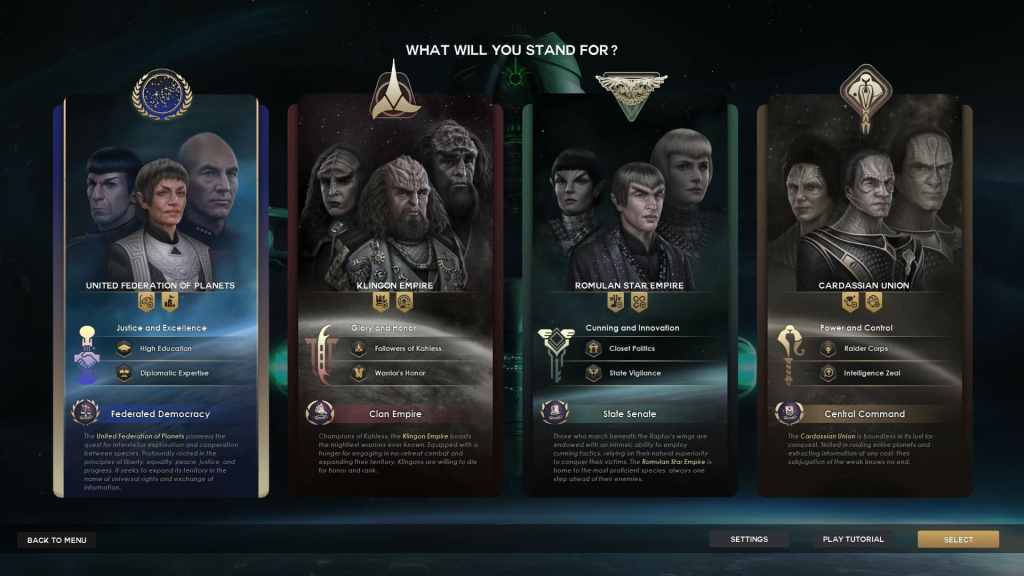
The other factions three have their advantages, but nothing on par with the Federation’s propulsive research skills. It’s hard not to feel hindered by the other factions’ slower research progression, and other mechanics like better espionage or forced labor aren’t anywhere near as applicable. I wished there were more active mechanics to make the different factions feel more distinct and enjoyable.
The inevitable steamroll creates the impression that the game’s goal is less a satisfying strategy experience than a satisfying Star Trek experience, so it’s worth looking at how well the game does in that arena. The answer is, again, mixed. Infinite tries to create a meaningful franchise feel with music that suggests Star Trek music and sound effects that suggest Star Trek sound effects. Every once in a while, there will be a motif that implies The Next Generation theme music before going in another direction. Maybe the licensing costs of using recognizable music and sounds were prohibitive, but this is undoubtedly an immersion opportunity missed.
The game has a character system, and we get more franchise flavor by introducing scientists, governors, generals, admirals, and spies whose names may be recognizable to fans of ‘90s Star Trek. This can be a lot of fun. When playing as the Klingons, did I enjoy sending Lursa and B’Etor on missions into enemy territory? Heck yeah, I did, and these named characters are more than just window dressing. Spies can go into enemy territory and steal research and energy or sabotage star systems. Governors can improve worker output or quell unrest on your worlds. On the other hand, these characters can be somewhat passive. If I parked Data or Spock on one of my science ships, it was easy to forget that he was there.
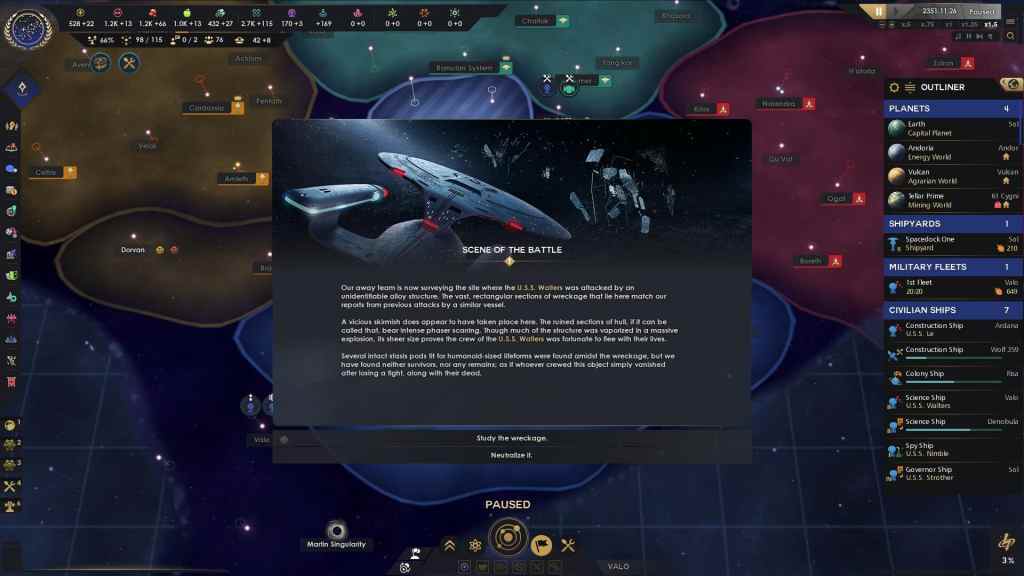
In-game events are clearly meant to be the primary drivers of Star Trek vibes, but these felt more tacked on than essential to the game. I know that not everyone may feel this way, but I hate reading lengthy in-game events. I’m not against reading in general. I read and write for a living (including creating game events that players like me might be tempted to skip), and I read 100+ books a year, but when it comes to playing strategy games, I prefer it when stories emerge naturally from gameplay. If I’m in the middle of gathering my forces and plotting out a major invasion, I don’t want to pause to read through multiple paragraphs in order to get to a dilemma that ultimately boils down to choosing whether or not I want a boost to research or influence.
Some of these events are based around canonical events unfolding, and some are mere flavor, often calling back to events from various Star Trek episodes. These sometimes play things straight, but they are sometimes cheeky winks at hardcore fans. Neither approach felt particularly effective, immersing me in this world. They seem more like occasional reminders that you are playing in a Star Trek sandbox. The developers were quite right to be concerned about the player forgetting.
I’ve spent a lot of time thinking about why this game fails to capture a Star Trek feeling for me. Some of it comes down to missed opportunities in art and UI design, but there’s more to it than that. Star Trek of the 1990s was so often about the grand strategy of the Alpha Quadrant. The Federation might have certain goals, but achieving them meant navigating the needs of the prickly Klingons or the schemes of the duplicitous Romulans or the gambits of the plotting Cardassians. Choices might have consequences that lessened or heightened tensions with other factions, the results of which could play out in exciting ways. For most of the time, I played Infinite; on the other hand, I completely ignored the other three factions. Nothing pushed me into engaging with them, and their empires functioned less as rivals and more as expansion blockers.
In the early game, I was likely to get attacked by a core rival (I found the Federation particularly eager for war when I played as the Cardassians). Still, these surprise wars could be prevented by rushing a couple of decent-sized fleets and parking them near my borders.
And that’s pretty much it. Once I got my economy ramped up and I started to crank out my fleets, the other major factions left me alone. I focused my attention on which minor factions I wanted to conquer, absorb, or welcome and gave very little thought to what the other powers had in mind. I could go decades without bothering to contact them through the diplomacy screen, and when I did, it was to take their temperature to see if they were planning to make a move against me. They weren’t.
In playing as the Cardassians, for example, I never once even tried to improve my relations with the other factions. I absorbed Bajor without any difficulty in the first five years of the game, and the notoriously fanatical rebels of that world never gave me an ounce of trouble. From then on, I expanded as I thought fit, fought wars with minor factions, fended off the Borg and Nausican mercenaries, but gave hardly a thought to Romulans or Klingons or the Federation unless they happened to expand first into a territory of interest to me. If that happened, I found it easiest to expand elsewhere. War with a major power, like diplomacy, was utterly avoidable.

In Stellaris, of course, the player keeps building and growing in part to prepare for the end-game crisis. Infinite is supposed to work much the same way, but in several playthroughs, the end-game crisis turned out to be bugged and never manifested. In one case, the mission to advance the Borg plotline lacked a menu I needed in order to advance. In another case, when I wanted to work on a mission that would lead to the end-game crisis, the character it required had already died. This meant no crisis at all, and my end game was spent swatting away the occasional mercenary fleet, choosing research options that didn’t accomplish anything because I’d maxed out my research, and waiting for the clock to tell me I’d won.
These were not the only bugs in Infinite. Other missions failed to complete, and the audio cues are an absolute mess. Nearly every specific audio alert, research completed, enemy incursion, building completed, etc., could signal that one of my leaders had died. I received this prompt about every two minutes, and that meant it was easy to miss when something important that I would want to know about right away was actually happening.
There could also be an annoying lack of in-game information. When picking research options, I often found insufficient information about what the various choices would get me. Sometimes I might send a governor to improve conditions on a world only to find the previously menu no longer available. I have some guesses as to why, but I really can’t be sure. More information about what to do and why would certainly have produced a more satisfying experience.
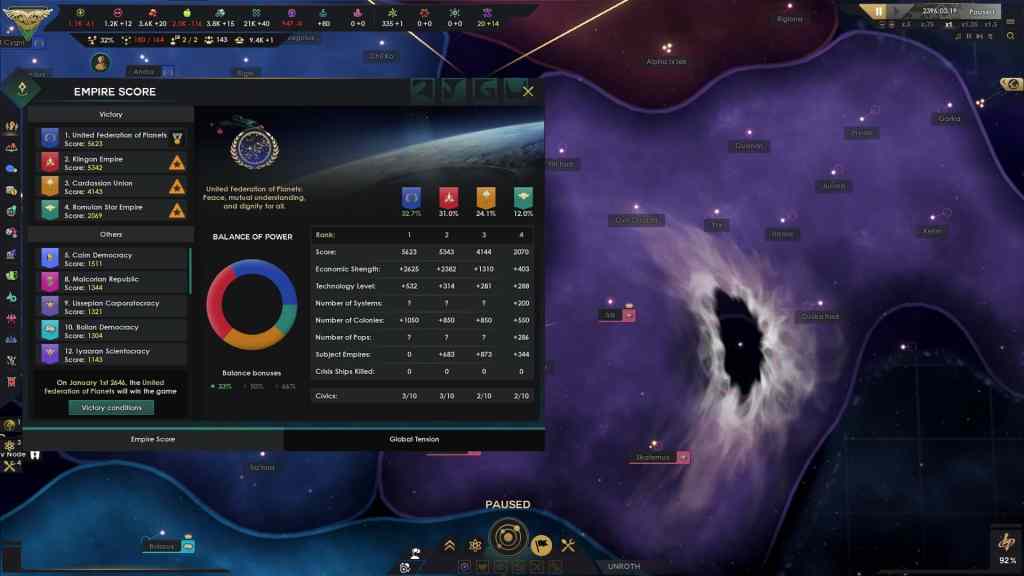
I’ve spent much of this review finding fault with Infinite, but the truth is I mostly enjoyed my time with this game. It wasn’t the Star Trek experience I was hoping for, but it did provide some enjoyable game sessions, and I can very much see myself returning to it at some point, maybe to experiment with paths not taken on the mission tree or maybe to have another crack at dominating the Alpha Quadrant. Certain game elements felt a bit lackluster, but zooming in to watch my Galaxy class ships taking on the Borg was always a thrill.
The developers have said that they are looking into the possibility of (eventually) making the minor factions playable in the game, and that would certainly add some much-needed variety. I also think offering players different start dates and a chance to build one of these factions from the ground up would be a good idea. This would require a new batch of events or, better yet, an approach that brings the Star Trek universe to life without relying so heavily on events.
More than anything else, this game needs to find a way to push the player into having frequent and meaningful contact with the other three Star Trek factions. As it stands, Star Trek: Infinite presents itself as being a four-way (three-dimensional) chess match against the other factions in the Alpha Quadrant, but too often, it feels like a game of Star Trek-themed solitaire.