By Any Other Name
Federations is the fourth expansion released for Stellaris. As the name suggests, Federations is very much focused on federations – intergovernmental bodies that unite two or more empires towards a common cause. The game launched with (and had for 4 years) a single federation option, which included massive upkeep, little functionality, and a lot of headache. Aside from slowing your progress in detracting from the game, your AI “partners” would often take charge of the group and ruin everything you spent several in-game years creating through disastrous unilateral decision-making.
That occurs no longer; from now on, Federations are full of laws, experience bars, and tooltips. It starts with the Federation–Galactic Union for the peace lovers, Trade federation for the capitalists, and Hegemony for those that, like Putin (cough cough), pretend democracy is a choice while they crush freedom under a boot. Alongside research and military unions, these options give you a broad range of backgrounds to base your new alliance upon.

Federations Rework

In the words of the developer:
“Form new types of Federations, each with unique passive effects, and level them up to unlock perks. Customize them further through the new Federation Laws.”
The different types of federations that you can create depend a lot on your empire and are actually mostly decided right from the creation screen. I could not choose my type of federation as my only choice was the Galactic Union. The Trade League would have been the one I wanted, but since I was a mega-corp, I could not create that federation.
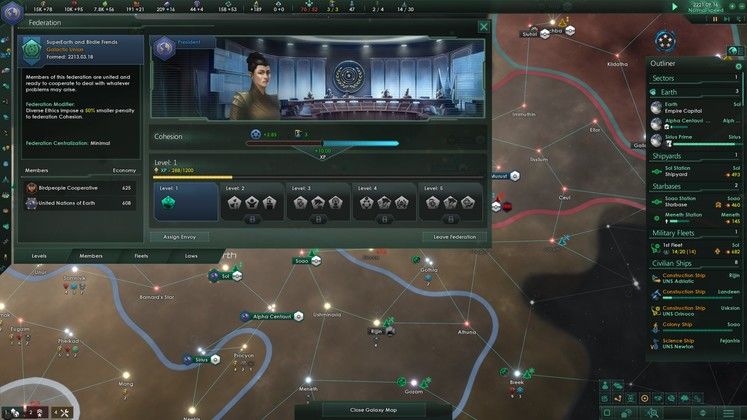
The passive effects of your current federation are very subtle and don’t become noticeable until you can level up a few levels. Leveling up your federation requires cohesion with the other members of the federation. There are lots of modifiers that go into this “cohesion number”, but I found it was easiest to send enough of my envoys to keep the cohesion at a positive number, which will slowly increase the amount of experience you have until you get to the next level.
Lastly, the laws you can enact are all locked behind the current level of your federation, so don’t expect a lot of customizability from level 1. The biggest change throughout the levels is the amount of centralization and how much your current fleet power is moved over to the federation limit.
Galactic Community
“Join the Galactic Community and pass resolutions by voting with the rest of the Community to make the galaxy a better place for everyone. Or slowly build up your diplomatic weight and become the senate!”
When an empire has established communications with half of the empires in the galaxy, an event will trigger to suggest the formation of a Galactic Community. This means that forming the Galactic Community will be similar to how it used to work to form the Galactic Market.
If you were not one of the founding fathers, it is possible to join the Galactic Community (and to see it!) as soon as you have established communications with any member of it.
It is also possible to reform the Galactic Community to include a Galactic Council. The council will be composed of a number of empires with the highest Diplomatic Weight. By default, the council will have three members, but the number can be changed through Resolutions.
It is also possible for the Galactic Community to set a Galactic Focus. This will mean the Galactic Community together have decided to achieve something or to deal with a crisis.
There will be Resolutions to declare the galactic invaders a threat to the galaxy which means it will be against galactic law to have closed borders to any other Galactic Community member while the crisis is ongoing.
Leaving the galaxy community is something an empire might choose to do if they become the target of too many sanctions or if there are too many Resolutions that negatively impact them. However for the most part this is not advised and will not benefit you, but it is always an option.

Origins

“A new way to customize your Empires, by choosing their Origin story. Is your Empire a race of people who survived the destruction of their homeworld who now live on Habitats? Or did your Empire discover nearby allies that it formed a Federation with? Or…?”
Not too much to say about Origins, as they technically were already in the game. They’ve now been moved to their own spot in the empire customization. Life Seeded and Post Apocalyptic are two examples of previous Civics that you could have chosen, but are now moved to the Origins tab. Currently, there are eighteen Origins to choose from, with one option being called the “base“ option, for a relatively “normal” start.
Juggernaut

“Bigger is better! The Juggernaut is a new ship class as large as a starbase that can build and repair ships in the field, turning your offensive fleet into an unstoppable force!”
The Juggernaut is unlocked by a technology which requires Citadels and Battleships to be already researched. A Starbase will also need to have a Colossal Assembly Yard in order to be able to construct one. The Colossal Assembly Yard is required for (and unlocked by) both the Colossus and the Juggernaut. There is an empire limit of one maximum and although the Juggernaut doesn’t claim territory, it is a forward base that can produce ships and defend itself making it a powerful late-game ship/shipbuilder.

Mega Shipyard
A new megastructure with a name so fitting you’d wonder how they even thought of it. The Mega Shipyard will allow you to build ships more quickly and in higher numbers than ever before, boosting up to thirty shipyards and passively increasing your empires ship-build speed, while also starting ships off with some XP.
The Mega Shipyard has 3 stages and can build the aforementioned Juggernaut ships.
Mega Shipyard Framework – 10 Shipyards, +33% Ship Build Speed, +100 Starting Ship XP
Mega Shipyard Core – 20 Shipyards, +66% Ship Build Speed, +100 Starting Ship XP
Mega Shipyard – 30 Shipyards, +100% Ship Build Speed, +100 Starting Ship XP
My eXperience

Unruly is a new Trait that increases the amount of Empire Sprawl from Pops. With the Federation’s expansion, they have reworked admin capacity into a new term called Empire Sprawl. It is essentially the same mechanic but deeper in the way they calculate it now, as each pop has weight on top of the number of ships, starbases, planets, etc…

In my play-through, I also chose this new civic called Public Relations Specialists that increased my Envoys by two and increased my diplomatic weight by 10%. For my Origin, I selected Life-Seeded: this will hurt my expansion but with the Trait I picked this will help reduce any increase in my empire sprawl and along with my Civics should assist me be a diplomatic power in-game.

Thanks to my Civic, I started with five Envoys, which could help to create my first friend or enemy much faster. Once I create my federation, I can send more envoys to increase cohesion to level up the federation faster allowing me to reach the new levels and get those sweet passive bonuses.

This is the breakdown of the empire sprawl. You can see what is the biggest contributor and the negative effects it has on my empire for going over the limit.

There is a new policy you can choose at the beginning of the game, and it is how you stand diplomatically as an empire. BecauseI was going for a merchant focused game, the mercantile stance made the most sense to me to get the biggest benefits.

To create a federation, you will need to choose Traditions inside of the Diplomatic tree. The leftmost Civic will allow you to create federations so you can do this as quickly as two traditions in. Naturally for this run, I decided to go down the diplomacy tree to see all the new mechanics in the game as quickly as possible.

Diplomatic Weight is kind of like a currency and by that I mean you “spend” diplomatic weight to pass certain resolutions. You never actually lose diplomatic weight by voting in the galactic community. As you can see in the picture there are a lot of different factors that go into the number and losing a big war can cause you to lose your sway and might flip a vote in the galactic community.

When conversing with another empire you can now see their general attitude towards you. Sending envoys will make them friendlier with you or hate your guts depending on if you chose to Improve or harm relations. Certain actions like declaring war or being allied require a certain level of opinion of another empire. Sooo… you cannot back-stab your best friend, just because!

When sending an envoy somewhere you will be met with this screen showing what they are currently doing and where they are doing it.

Diplomatic grants now give you more diplomatic weight and increase the effectiveness of your envoys.

Each federation is different but with mine, the main changes I can make are to the federation centralization, fleet contribution, and succession term.
Ending Thoughts
Federations is a nice addition to an already great game. Paradox has finally put some attention into the diplomacy and although it’s not fixed, it does help the player better understand why another empire likes or dislikes them, and gives them Envoys to help with improving or harming relations.
Envoys are a great idea and were supposed to feel very similar to the diplomats in EU4. However, I found that for most of the game I had mine stationed in the galactic community and my federation and never really moved them unless I needed to declare war to make my soon-to-be enemy hate me. I am not saying that Envoys didn’t accomplish what they were made for but you will not be thinking about them too much in this game compared to EU4 diplomats. Also, just as an additional note: when an envoy dies you get a notification about the death, even though it gets replaced and there is no action needed by you. This is just annoying as I dismiss the notification before fully reading what it is and then I am confused when I can’t find which person actually died.
Federations are very passive and this has not really changed from the base game. Yes, it is nice to get cool passive bonuses, which are helpful, but from a player point of view I did not have to do much work to get my cohesion in a positive number to make sure I was gaining exp to get to the next level. This may have been because I had two extra Envoys from my empire customization. In conclusion, I do not feel like it is worth putting resources and picking civics/traits to help you with diplomatic power or increasing your federation cohesion with envoys as it is not worth the effort. They are nice things you can do in your downtime during peace but once you get into a war you will not be worrying about your federation or the galactic community.
The galactic community is another nice mechanic in concept but just doesn’t sit right with me. The biggest problems for me are that the resolutions are not important enough for me to really care whether it gets passed or not. I just vote which side I would prefer and then find out months later if it passed or not. I was playing a more peaceful merchant game so perhaps if you are a warlike empire then it will matter a lot more to you if the war resolutions get passed. The other issue I have with the galactic community is the amount of resolutions that are trying to be passed or repealed constantly. I never in my play-through tried to pass a resolution myself as if I waited a month another empire would have already tried to pass it, which saves me the 150 influence.
The two new units, Juggernaut and Mega Shipyard are amazing and very cool looking units that you can build which will help you turn the tides of war and give you a nice forward base. The problem, however, is that if you have enough resources to build both of these then you probably don’t need them and already have enough power to destroy all who oppose you. Very powerful but not needed…
Empire Sprawl was introduced from the remains of Administrative Capacity and it is similar enough (with minor improvements) to keep empires in check from getting too big early on and snowballing. I feel like this was implemented well and may just need some minor tweaks once they get more player feedback.
Lastly, Origins are a nice addition. They used pre-existing Civics and turned them into their own part of the empire’s creation. As of this review, there are eighteen unique Origins to choose from which will give the game even more replayability as you may want to play all of them. Finally, there is a simpler and non-game-changing Origin for empires that don’t want any drastic changes.
TL;DR: Stellaris continues to be one of the best Space 4X games available and, for the most part, the new content only enhances it. The free Verne update significantly changes several aspects of the AI while also giving the game a huge performance boost for the late game. Although the new Federations might not seem like they live up to all the hype, the supporting features help bring this feel like a good starting point for all the changes they’ve made and just needs some fine-tuning. The game remains a fantastic space-storytelling machine and a solid strategy experience.

You Might Like This Game If:
- You want a (mostly) polished space 4X experience
- You want an immersive, narrative experience that will surprise you on every playthrough
- You enjoy having lots of little systems to fidget with, adjusting everything to your little heart’s delight
- There’s nothing that excites you more than a wide-open galaxy just waiting to be explored
You Might NOT Like This Game If:
- You expect the new federations to be a center point of every playthrough
- You want deep, tactical combat options
- You can’t handle cruelty to others in any (even fictional) form
- You want the relationship depth and the diplomacy of other Paradox games such as Crusader Kings II
Justin played Federations for many, many hours on a custom-built PC including; Ryzen 5 3600x, GTX 1080 TI, 16GB RAM, 2560x1440P monitor @ 144Hz
Disclosure: Justin was given a game key for Federations by Paradox’ PR for the purpose of this review.