Sword of the Stars was an-under-the-radar 4X for many, which is a true shame. There are quite a few ways in which Kerberos tried to break the 4X-genre mold and I wish more developers were trying something similar. However, it’s the game’s technology tree that stood out to me as a gameplay mechanic I’d like to see others emulate.

I’d do my best to explain the uniqueness to this mechanic, but the Sword of the Stars Wiki does a fantastic job already:
“Players will have their own uniquely generated technology tree regardless of race. This prevents the development of an optimal technology progression and adds strategic challenge to your game – what do you do if you rush to get, say, Bursters, only to find that they do not appear in your technology tree?
All players of the same race will share the same statistical weights on each branch of the technology tree, but whether the “dice” give that branch or not is determined independently for each player.
Not all branches have random weights though. There will always be a central core of vital technologies all players will have in every game. These “core technologies” comprise about 30% of the technology tree. While it is possible to only have core technologies or to have all techs that are available for your race, it is very, very unlikely. “It’s possible like winning the lottery is possible…random chance does allow it…BUT that is MUCH different than saying you are likely ever to see it.“
You only learn what a tech leads to once it’s finished and any mandatory prerequisites for the subsequent tech are met. For example, you won’t know if VRF Technology leads to Point Defense Tracking until you’ve finished VRF, and you won’t know if Mass Drivers leads to Bursters until you’ve got a ship that can hold large turrets. Randomized technologies that you do not have access to in the game do NOT appear in the Tech Tree at all. And there will be NO indication in the tree which techs are random and which are not. Each game is an island unto itself.
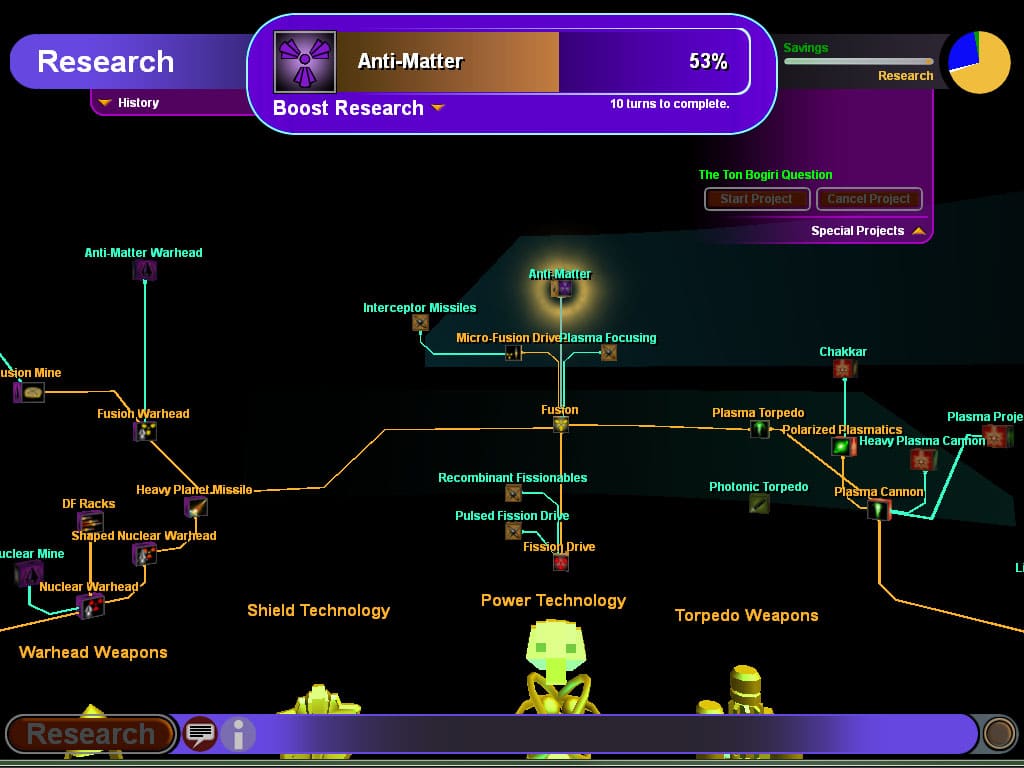
The technology tree is set at the start of the game initialization.
The game “rolls” for each link on the tech tree until it comes to a dead-end (a “failed” roll) and it stops rolling for that branch. This effectively sets the remaining techs on that branch to null chance. The game then moves on to next branch where, if that branch has a link back into a previous branch, it may result in a previously null tech being introduced to your tree with subsequent techs on that branch now rolled randomly until that fails and nulls any remaining techs on that branch again. This is repeated for every branch in all the Technology Categories listed below.
One of the more curious side effects of this is that techs with multiple tech requirements can be rolled for even if you don’t roll up all the requirements. Missing requirements that don’t give links to a tech don’t stop rolls for the links to that tech from happening. For example, Arcology Construction requires both Polysilicate Alloys and Environmental Tailoring but is only linked to by Polysilicate Alloys. So if the roll for the link from Polysilicate Alloys to Arcology Construction succeeds but the roll for Environmental Tailoring from Atmospheric Adaptation fails, Arcology Construction won’t show up in the Tech Tree. But if you acquire Environmental Tailoring later in the game (say through Salvaging, see below), Arcology Construction will then show up and be available to research as normal.
After game initialization, the only way to get technologies not in your tech tree is through (a gameplay mechanic called) Salvaging.”
– Sword of the Stars Wiki
The reason that this system works so well is accurately described above, but I’ll reiterate the point: it allows for unique gameplay every time you play the game, even when playing as races you’ve played as before. Not only that, but the excitement of discovery is elevated by the fact that topics only reveal themselves as you discover the preceding technologies.

It’s a system that I wish more developers would adopt. Admittedly, I grow a bit tired of eventually finding the “optimal path” in most 4X-game technology trees and I think that this system was a brilliant way to overcome that perceived staleness.
What did you guys think of the Technology Tree from Sword of the Stars?