Go back to 2015 for a moment. It was a year marked by the disappointing launches of Worlds of Magic and Sorcerer King, as well as the solid but ultimately unimpactful Galactic Civilizations III. It was also the year we got the most original take on 4X gaming since the ’90s: Thea: The Awakening (Thea1).
Thea1 blended elements of a Rogue-like, an RPG, and 4X games complemented by deep Slavic lore and fantastic storytelling. The title was a smash-hit for newcomer developer Muha Games. Praise was almost universal (it was our Game of the Year), and as of this writing, Thea1 still has a 90% positive rating on Steam. Very few games are able to maintain such a high rating after four years on the market. Especially one as unique and creative as Thea1.
Naturally, any time a developer has such success, they want to capitalize on it with a sequel. Earlier this year Muha released Thea 2: The Shattering (Thea2). Unlike its predecessor, Thea2 had a successful Kickstarter campaign and a high level of interest from 4X and strategy fans. Also unlike its predecessor, Thea2 was saddled with extremely high expectations. Sometimes high expectations can be helpful and other times they can be hurtful. In Thea2’s case, they’re both.
eXplore

Thea2 has all the exploration components you’d expect from a 4X game: the fog of war, haunted ruins/goodie huts, diverse biomes, etc. Nothing too different there. However, one of the biggest changes from Thea1 to Thea2 is the map. Thea1 took place on a pangaea; Thea2 is an archipelago. Each island in the chain has its own unique biomes, native species, and resources. Players start on the “human” island with the Slavyans, Lightbringers, and possibly the Scavengers all the while having access to basic Tier I and Tier II resources such as coal, iron, bones, rubies, and dryad wood.
As you gear up your group, you’ll want to branch out to other islands. This is done via ships! In Thea2, you’ll get to build ships out of wood, bone, and gems or by summoning it via ritual thanks to the new DLC. The higher tier of material you use to make the ship, the further it will go and the more weight it can carry. Arriving on a new island is a momentous occasion. Traveling the ocean can be harrowing (there are random events that can cost the lives of your characters), but success is celebrated with a popup that announces what type of island you’ve journeyed to and a certain amount of the special resource that can be found on the island. For instance, if you travel to the Goblin island, you’ll get 10 Dragon Bones, which is a Tier III resource and very valuable. It’s like you’re a real explorer reaching uncharted lands for the first time.
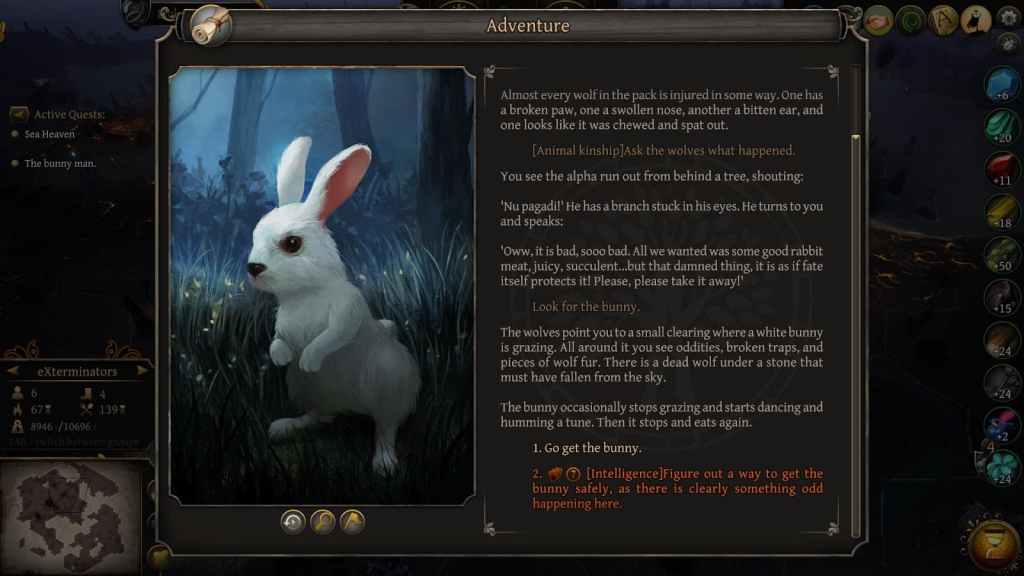
At first, I didn’t like the islands. They made traveling difficult and having to traverse so far to get a particular resource seemed unnecessarily frustrating. The more I played it, though, the more I realized I was totally wrong. Islands are great! Thea2 is the first game I’ve ever played where going to a new land felt like an actual accomplishment. It’s hard, and making it there in one piece deserves to be celebrated. And it is! The announcement you’ve reached the “Dwarf Island” for the first time is rewarding – not for the extra Mithril you get, but because you know how much work it took to get there.
Not only that, each new island is a complete enigma the first time you show up. That makes it threatening and mysterious. How often do you get that in a 4X game? For me, it’s rare. I never felt that way when discovering a new system in Endless Space 2 or sailing to a new land in Civilization V. For me, Thea2 nails the exhilaration of exploration better than any other 4X game I’ve ever played.
eXpand

In Thea1, players were limited to a single village. Think of it as a single-city challenge 4X. Thea2 now allows players to build multiple villages. This is a major change, and quite honestly, a welcome one. Islands can be very far apart. Villages provide bonuses to gathering and crafting way beyond what roaming camps can give. They are now important game pieces that change all your strategic choices and give you a rush after fully kitting them out with buildings. So, if you want to work up a bunch of mithril into a secret alloy (more on how to do this in a bit) while at the same time working dragon bones into forgotten essence, you’re going to want multiple villages to do that efficiently.
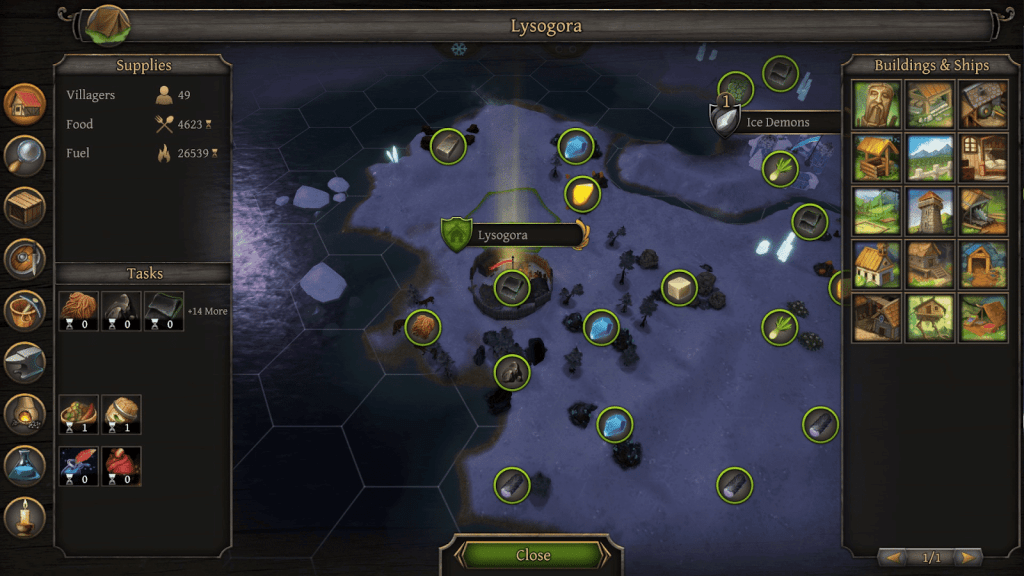
That said, you don’t have to establish any villages. You can roam the map with a massive nomadic horde. In fact, there are advantages to staying nomadic. Large groups always have the right personnel for any given challenge. You don’t have to keep track of multiple locations. If you lose a character to an event or challenge, nomadic groups always have plenty of extra characters ready to step into the dead character’s place.
Another great aspect of expansion in Thea2 is the gods and goddesses. Unlocking new deities by performing well in a game is a mechanic that’s carried over from Thea1 and it’s just as enjoyable. Unlike Thea1, though, deities don’t have pre-determined abilities. Instead, each has a set of cards that you can also unlock. These cards will give you different starting bonuses, characters, resources, equipment, and other advantages. The advantage to this card system is far more customization and player agency, but at the same time, they can be frustrating. Many of the cards cost five or more points to unlock (some are as high as 25 points!). Accumulating that many god points aren’t easy. As a result, the new card-trait system hasn’t been received with much enthusiasm. In fact, some players have cited it as one of the biggest reasons they’ve gotten discouraged by this game.

eXploit

Exploit is Thea2’s bread and butter. Many of the resources from Thea1 such as shadow bone, diamonds, dark wood, and scaled leather are carried over into Thea2. In addition, Thea2 brings whole new resources to the game such as void sparklers, grand gems, igneous spikes, and alchemy skin. These more esoteric resources cannot be gathered, they must be refined. As with Thea1, you must camp or build a village near resources in order to assign characters to gather them, but that’s only for Tier I through Tier III resources. For Tier IV and V materials, you must utilize your characters’ cooking skills to convert low tier resources into high tier resources using coal.

This new mechanic is something that fans asked for in Thea1. I don’t know if this is what fans had in mind, but at least the devs tried to give us what we wanted. The Tier V resources are extremely powerful, but also extremely difficult to get. Refining a resource usually converts 10 of something into 2of something. So if you want to get 10 void sparklers, you will need 25 grand gems and 25 enchanted bones. To make 25 grand gems, you will need 130 diamonds. To get at least 25 enchanted bones, you’ll need 65 diamonds and 65 dragon bones. So that’s 260 units of Tier III materials needed to make 10 of a Tier V material. And 10 units of a material might not even be enough to make a single item. It could take hundreds if not thousands of turns to outfit a large group with full Tier V gear. As a result, this has frustrated a number of players. The truth is, though, the devs expect players to get Tier IV and V resources mainly through adventuring, not gathering and refining. That’s fine, but gathering and crafting were part of what made Thea1unique, and I’m somewhat disappointed to see that deemphasized a bit in the sequel.

In addition to the new materials, there are new items that can be crafted and rituals that can be cast. Wands and spellbooks are great additions to the game. Making high tier spellbooks can turn an ordinary character into a powerhouse. Wands are lightweight, and usable even by children. The latest DLC (as of this writing) called “Return of the Volh” which is free, like all Thea DLC, introduced a raft of new rituals that can summon temporary helpers such as a new pet (permanently) or a Rocker (temporarily) or give your group members a short-term physical, mental, or spiritual buff. These new additions give players plenty of options for outfitting a group and jobs for characters who can’t craft, cook, or gather for whatever reason.
eXterminate

Thea2 breaks down intricately designed challenges into three types: physical, mental, and spiritual. Physical challenges can include combat or perhaps feats of strength such as digging out of a collapsed tunnel or weathering a particularly nasty blizzard. Mental challenges are often social in nature such as seduction or diplomacy, but can also be psychological – for instance when a monster attacks your characters’ minds. Spiritual challenges are characterized mainly by magic, making witches, Volhs, Zercas, healers, and other magic users incredibly useful.

Without a doubt, extermination in Thea2 is the most frustrating part of the game and its greatest weakness. Part of the frustration comes from how often and how intense challenges can be. Recall the starting island that has the Slavyans and Light Bringers? Light Bringers often attack your villagers using mental and spiritual assaults. Low-level characters are not equipped to repel them. Thus, it is common for you to have a total party wipe in the first 50 turns of the game. Twice, the Light Bringers have been nerfed in patches, but complaints about them still roll in. It might be time for them to be removed from the starting island altogether. They seem to ruin the experience for many players. But needless to say, challenges are very (some would say overly) difficult in the early game and trivial in the late game.
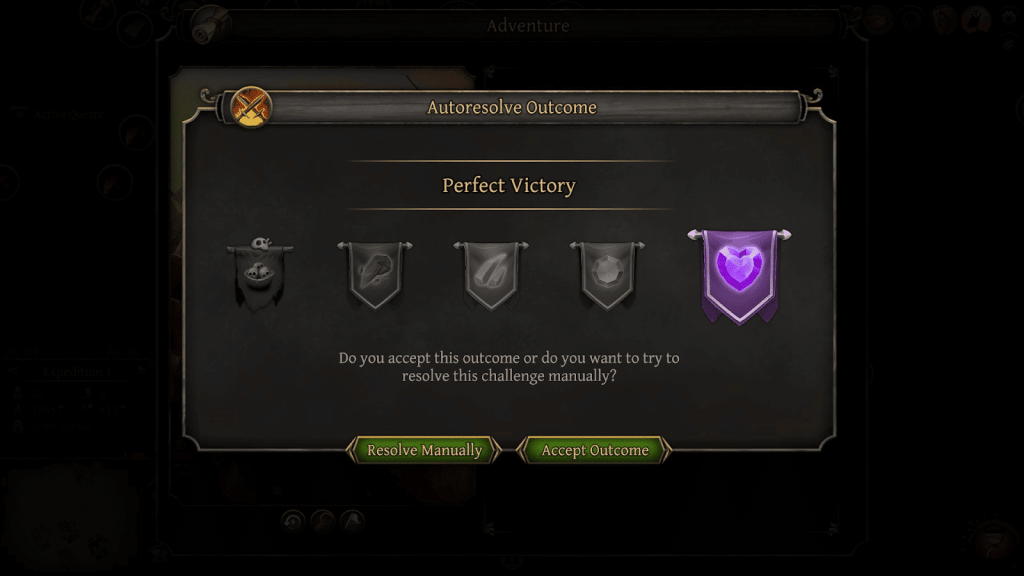
The second source of frustration in extermination comes from the card combat system. The #1 aspect of Thea1 that kept members in the eXplorminate forum from trying it was the card-based combat. When Muha announced Thea2 would have card combat again, I was anxious. It appears my anxiety about it was well-founded. Browsing the Steam reviews as well as the thread on our forum, card combat once again is cited most often as the greatest frustration for players and greatest barrier for customers. I’ve got over 100 hours in Thea2, and I still don’t understand the nuances of combat. In Thea1, you had a single field to track – the one where cards were played. In Thea2, there are two fields to track: the card field and the initiative field. This doubles the complexity of combat and it’s hard to know how to manipulate both at the same time for maximum effect. And even when I did figure out how to target enemies with something like an area effect weapon, the AI was smart enough to spread its cards out enough to nullify my tactics. This results in even greater consternation to the point where I (and anecdotal evidence suggests “many”) players just auto-resolve everything. Thus, combat is either a source of rage or a source of boredom. And that’s a shame.
eXperience

So what’s the overall experience like? Well, it’s good and bad. Let’s continue talking about combat for a bit. When you play a game where all you have to do to resolve combat is click a single button, the game gets reduced mainly to a clickfest. I click to end turns, I click to move characters, and I click to resolve conflicts. That’s not exciting.
If there is ever a third installment in this franchise, I implore Muha games to PLEASE strongly consider 3D tactical combat. I recommend looking at Fallen Enchantress: Legendary Heroes and Sorcerer King: Rivals as good examples of fast, lethal, and tactical combat with lots of fun and unique abilities. I feel that Age of Wonder 3-style combat would be too laborious for a game like Thea while Planar Conquest-style combat would be too simplistic. My experience tells me that, while the card-based combat system shows brilliant design, players just don’t enjoy it.

Also, challenges come so often sometimes, that I felt like I couldn’t make any progress in the game. A single turn might give me two or three events to resolve if I have a couple of villages and a roaming group going. That’s time-consuming and very tiring to deal with.

These challenges also make the early game brutal, as I previously mentioned. I’ve read numerous reports of people starting five, ten games in a row only to die in the first 100 turns. Now, you do get god points to improve your deities and starting parties when you wipe out, but that does little to mitigate the frustration of restarting games over and over. If you can get to a point where you can craft gear using Tier III materials, though, there’s a very good chance you’ll be able to play a game to completion.

The storylines surrounding the events, though, are awesome! The lore in Thea2 is deeper and more robust than Thea1. The situations are more mature and much more compelling. I’d love to tell you what I’ve read and experienced, but I don’t want to spoil the game. The writing is so good, you have to enjoy it for yourself. Even in MuHa’s own forums, players have taken great pains to mark posts and pics as potential spoilers. If you’re looking for a 4X game or any strategy game for that matter with great narrative aspects, you can’t do much better than Thea2.
The artwork is also fantastic. Thea2 is a dark fantasy game, and the illustrations, maps, and icons reflect this very well. It’s easy to be immersed in the world and let your imagination linger on the sights of forlorn elves, cynical dwarves, and enigmatic spirits. The latest DLC added even more character art to the game, so new games are kept fresh – you’re not seeing the same people over and over.
I’ve played over 120 hours so far. The first 15 were tough, but then I got the hang of it. Shadow Bones, Dark Wood, and Rubies are your friends on the first island. Try to find those, gather as much as you can, then craft good gathering baskets and weapons, and you’ll be fine. Since I learned that, I thoroughly enjoyed the game even if I do have to auto-resolve every conflict. The humor, missions, and adventure are terrific. Thea2 has a lot of content to offer at a very reasonable cost.
Finally, I want to touch on performance. I don’t have the greatest gaming computer anymore. It’s several years old, but it does beat the requirements for Thea2 by quite a bit. Yet, my rig runs really hot when playing. I feel Thea2 could use some more optimization. Opening and closing menus is not as quick and crisp as many other games. Loading takes longer than I would expect. Little things like that add up. If you have a non-elite gaming computer as I do, I suggest turning off V-sync and reducing the frames per second so you don’t melt your electronics.

Conclusion
In the end, I don’t think Thea2 is as successful a game as Thea1. Expectations were higher, and honestly, they haven’t been met yet. That doesn’t mean Thea2 is a bad game. Far from it! It’s a fun and unique experience. However, that experience does come with some problems that have to be managed by the player.
When we last reeXamined Thea1, we had a long internal debate on whether or not it deserved an eXemplary rating. It was a very close call. Two of my biggest regrets when it comes to eXplorminate are not giving Age of Wonders 3 and Thea: The Awakening eXemplary ratings when we probably should have. However, with Thea2, there was no such internal debate.

Much like our review with Interstellar Space: Genesis, I’m going to give Thea 2: The Shattering a soft recommend. There is a lot to love about this game, and serious fans of Thea1 should be able to settle right in and enjoy it. At the same time, I recognize the aggravating nature of some of the mechanics and understand that someone new to the franchise or only marginally attached to Thea1 will likely struggle.
Nate’s Perspective:
In short, Thea 2: The Shattering is my favorite game of 2019. I put more hours into it on and offline than the next two games I own, including the games that NDA NDA NDA. I backed its Kickstarter campaign and I feel that I got my money’s worth 10 times over. Unlike some other games that I backed of late. Anyways, let me get to the point.
I agree with much of what Troy has written above, except for one major point: the combat. I LOVE IT!

That’s right, I love it. Yes, when it is a foregone conclusion that I am going to win, I auto-resolve. But if I get any other outcome than perfection, I will go in and play the cards. One thing that Troy didn’t talk about in the card mechanics is how MuHa took feedback throughout Early Access and kept tweaking the card game. They are still doing it. Would this game have been better as a full-fledged 4X with proper combat mechanics? Probably. But the card mechanics are in to give us the full experience without having to spend a crazy amount of money on art and coding. The AI is certainly hardcore, and thankfully, the difficulty settings are constantly being adjusted to give the player more options.
I love how Thea2 has grown from the first game. All the changes to the crafting mini-game are changes I’ve wanted. I can’t even begin to tell you how much time I spend on cookouts with my Warband: a feature that I was hoping would make an appearance. I write little background stories for each person within the game. Stories that I adjust as the game progresses. Just like Troy, I can’t help but think about the emergent gameplay that we are presented with. I want more and more.
I will make one admission though: Thea2 is not a typical game and it is not an easy game, even on the easiest of settings. However, rebalances are coming. And as long as the adjustments that MuHa games make don’t result in my experience being overly simplified, I’m all for it.

I. Love. Thea 2!
TL;DR: Thea 2: The Shattering is an engrossing dark fantasy game based on Slavic lore. It nails exploration and exploitation better than most other 4X-style games out there. However, combat can be confusing, and given the lethality of the frequent encounters in the game, ultimately frustrating. Hardcore fans of the Thea franchise will most likely enjoy the game and its brutal nuances. However, newcomers will certainly struggle.
You might like this game if:
- You enjoy high-difficulty games
- You enjoy figuring out puzzles
- You really want a 4X game that focuses on narrative choices
- You are looking for a fantasy 4X with a unique twist
You might NOT like this game if:
- You consider yourself a more casual 4X fan
- You consider having to start over a lot as something negative
- You have no interest in learning card-based combat
- You don’t like a lot of randomness in your games

OUR (UPDATED) REVIEW POLICY
Troy played 121+ hours of Thea 2: The Shattering on his Windows 10 Dell Inspiron 7000 Series 7537 BTX 17” laptop with Intel(R) Core(TM) i7-4500U CPU @ 1.80 GHz, 16GB Ram, 64-bit Operating system, x64 processor, and 2GB NVIDIA GeForce GT 750M graphics card.
Disclosure: Troy received a copy of Thea 2: The Shattering as a reward for backing it on Kickstarter.