Trials of Fire by Whatboy Games is a turn-based tactical RPG/deck builder hybrid where you lead a party of three characters in a quest to save your dying village. To achieve this, you lead them across a post-apocalyptic fantasy world, dealing with bandits and settlements, exploring ruins, and facing ancient horrors of all sorts that want nothing more than to eat you.
Overview
Trials of Fire’s core loop feels like a variation of the standard deck builder, though it is implemented effectively keeping the game’s theme and distinctness intact. Each of the available missions features the party wandering across the map with only a general directional indicator to show where they need to go in order to reach the next boss, whose defeat will unlock the next mission. Along the way there are numerous question marks on the map, most associated with a terrain feature, all of which feature a decision leading to resources or a battle.
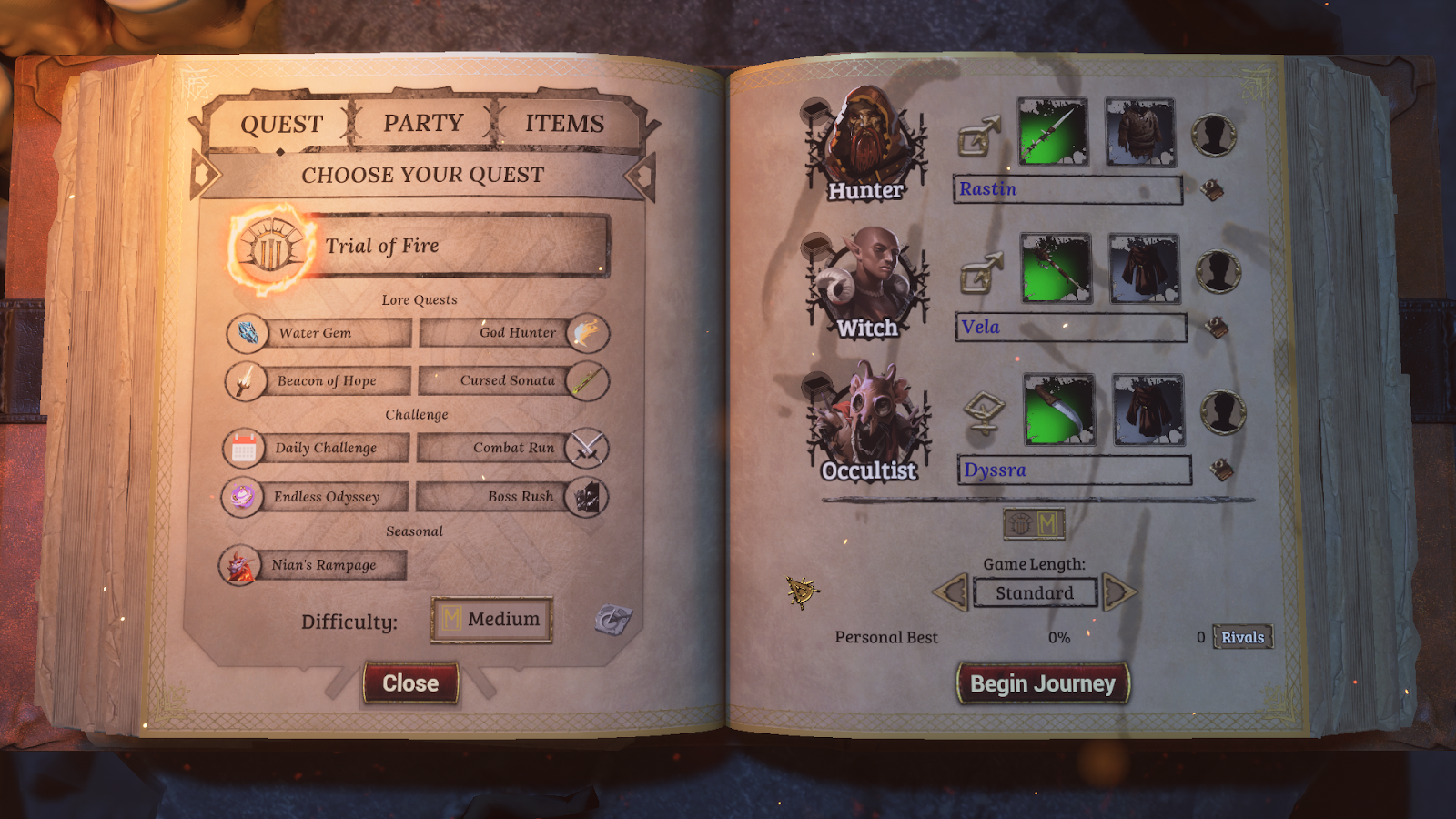
A game of Trials of Fire starts with campaign selection, character selection, and item selection. The available campaigns vary in length and difficulty, however none last more than four hours. There are also daily challenges that pick one of the default quests and “remixes” it, a procedurally generated Trial of Fire, and a seasonal challenge. The player always leads a party of three characters from a selection of nine options, each of which are unlocked through play. Only three are available at first, but further characters are generally easily unlocked, with access to more options after the first completed campaign. Items also let you customize your starting weapon, which can change one card in a character’s starting deck.
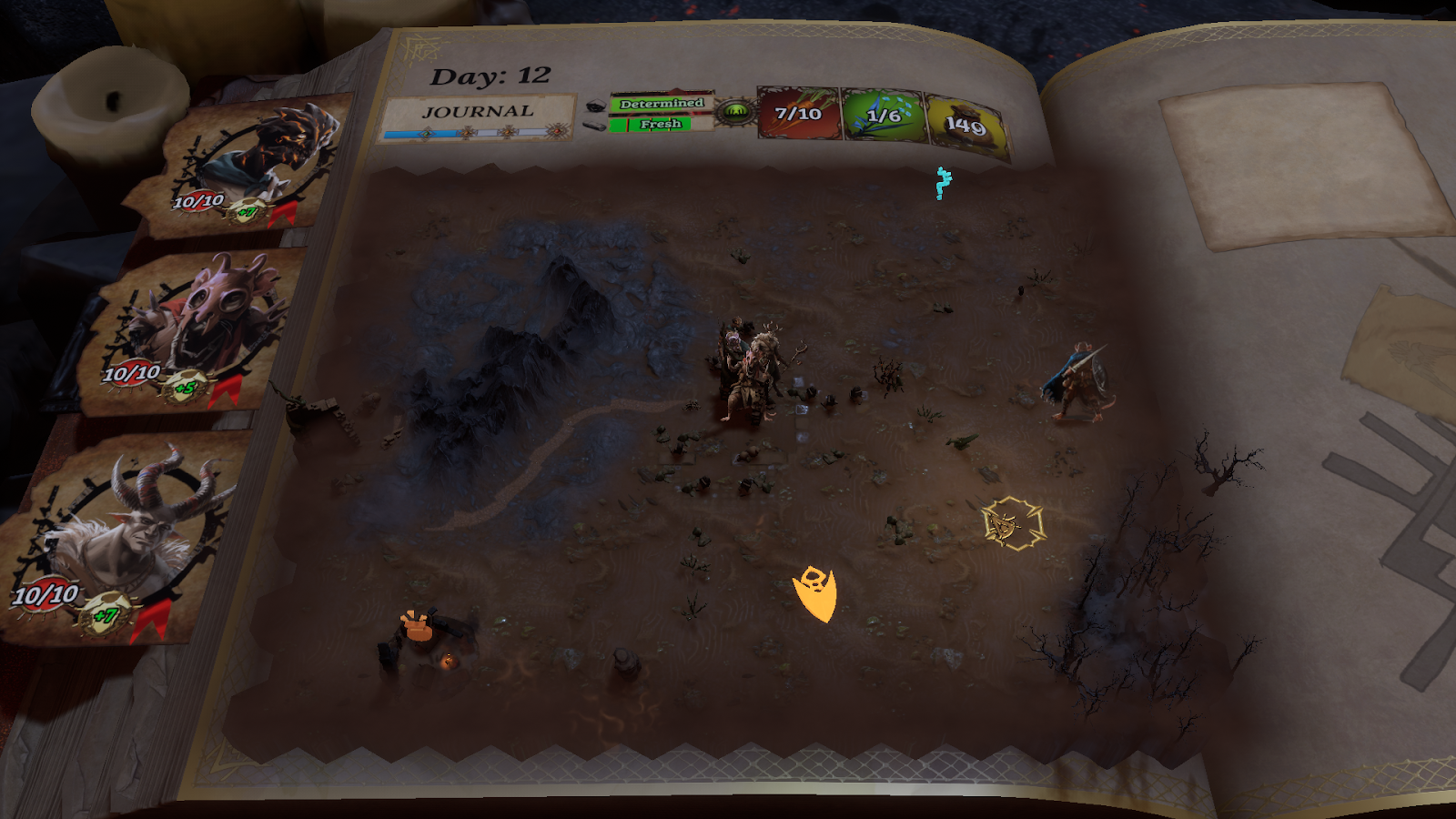
With a campaign and characters picked you can start to explore the map. Travel is pretty straightforward, consisting of picking a spot on the map and the party heading in that direction. Question marks indicate events, and the type of event that can occur is determined by the terrain underneath the location. Ruins tend to have the most dangerous events, but with a higher chance of an interesting reward. Settlements and towns likely give access to shops, and there are also random locations with events while traveling that run the gamut of outcomes. Additionally, there are some triple question mark locations that feature extra boss fights and wandering monsters that you can either engage or avoid.
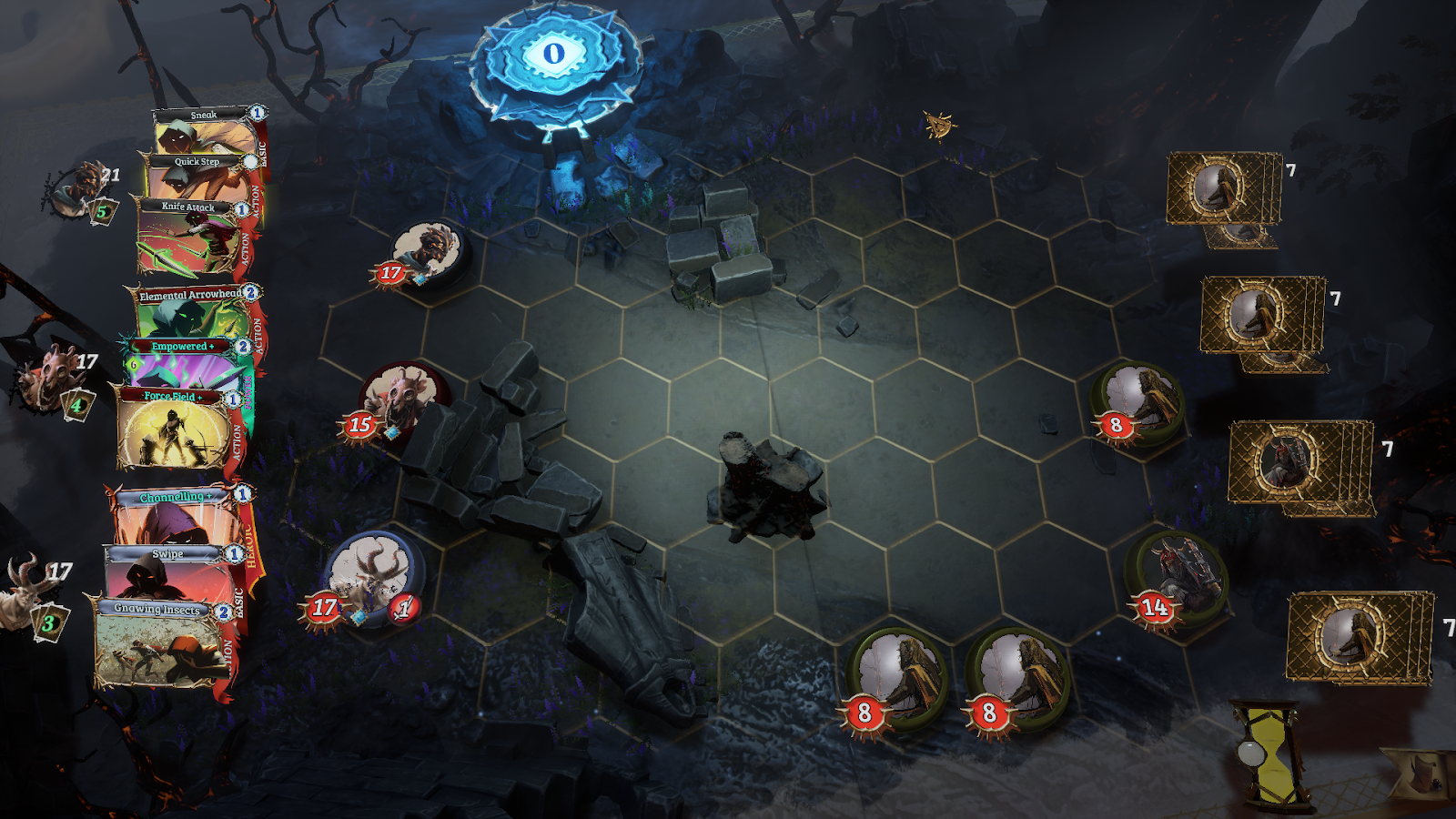
Fights follow a “we go/you go” format, with the ability to interweave actions between each character, following with the enemy’s turn. During a turn, each character has a hand of cards which cost willpower to use. These cards can be played for their stated effect, turned into a willpower point, or used to provide the character with the card 2 movement or +2 to defense. All fights last until one side or the other is eliminated. If all characters in a party die, then the run is over, otherwise they get their rewards. Characters getting eliminated without a loss results in the addition of an injury card to the character’s deck. These are detrimental without usually being overwhelming, and are removed whenever the team wins the next story boss fight.
Battles involve managing a flow of willpower, defense, and damage by continually reducing the enemy’s capability to deal damage, while eliminating them faster than they are able to damage the party. Maps feel like they are the right size, and are big enough that it is possible to retreat and hide from enemies, without it being so large that it takes a long time to engage. Cover is varied and relevant, and occasional battle events mix things up even further; however, with only two available, some more variety in this area would be nice. Another interesting aspect of combat, particularly for those who are familiar with other deck building games, is that emptying a deck gives you a dead card, “Exhausted”, that has no action but can be used for willpower, defense, or movement. This actually discourages the use of an ultra thin deck, and instead characters typically end up with bigger decks that have other ways to ensure the cards needed. The tactical elements and multi-function nature of cards play much better than in a pure card game, as having an occasional “down” turn is not the end of the world; assuming you are able to make good progress towards overall goals with other characters on subsequent turns.

After winning a battle, the characters get between one to three level-ups, which depends on if the battle fought was against a story boss or not. Level-ups let you replace one of the cards in a character deck from a list of four, or upgrade one of the same cards. The available set of cards is pretty wide and provides some ability to customize characters. Most characters have a few different themes that can be mixed and matched, with a character likely to be quite varied from one playthrough to the next thanks to only seeing a subset of cards at any given level up.

Gear in Trials of Fire serves to add additional cards to a deck. Each item has a particular theme or role and provides cards related to them. Additionally, higher tier weapons provide “Quality” and armor of various types provide “Armour”. Quality defines how many total times per battle cards can be rerolled, while Armour serves as temporary hit points which are used up before a character’s innate hit points can be damaged. This means front liners, or characters who are going to regularly be in the line of sight of an enemy, want more Armour, while characters who can avoid enemies do not find it as crucial.
Gear comes in five different tiers. The first two tiers offer a single card, the third tier two cards, and the fourth and fifth tiers offer three. Additionally, the fifth tier, Legendary, provides a special passive bonus that is present no matter what cards the character has in their hand. Most of these are interesting, and the game helps ensure that you are never forced to take a legendary item that do not fit with your goals, by giving you a choice of three whenever you acquire one.

There are a couple of other mechanics that do not fit neatly into the sections above that are still worth mentioning. The first of these is followers, which you can potentially get as rewards for various map events. These vary in overall usefulness, with most of them affecting camping actions. The others are special cards that can be added to your deck, called Traits and Weaknesses. Traits are great and overall a big help, but Weaknesses tend to not be quite worth the rewards that you can get by risking acquiring one. Beware.
Failures and Limitations
To be quite frank, I do not feel as though there is whole lot that Trials of Fire fails to do for someone who is seeking a deck building tactical RPG that offers quick individual runs. That being said, while the available content of Trials of Fire is relatively high, I do feel that there could be a higher variety of bosses, specifically very late game bosses. Most of the story modes have fixed bosses you fight throughout a run, but for the longer procedural Trials of Fire mode – which I suspect will be a key part of long term replayability – end with a disappointing fight with the same end boss as their long pre-built God War scenario. This is not a huge issue in of itself, but having even a few more bosses would add more to the game’s novelty and ability to surprise and force you to be ready for the widest array of potential end games possible.
Beyond that, its limitations are almost entirely attributable to the genre it is in, and particular choices the designer’s made. For example, I see little point in trimming your deck to a smaller size due to the drag that exhaustion cards provide to a deck’s overall efficiency each time the deck is reshuffled. Many games support having thinned out decks, and some players may find the fact that Trial of Fire pushes for bigger decks to be less interesting or unfun. Similarly, for more traditional tactical RPG fans, the randomness of available build upgrade options may be a detriment. Neither of these things are choices I find to be poor ones, but they are definitely ones that one could find problematic depending on their overall preferences.
Achievements
Trials of Fire’s entire loop works well at being engaging and fun, and encouraging you to dive in for just one more encounter or one more run. Fights, even on the medium difficulty I played, were tense and risky, and at the moment they became too easy I could push up the difficulty or start pursuing challenge runs, where I could try to topple one of the high scores for a particular mode.
Characters are diverse, with each of the nine having a very unique and specific feel to them, thanks to their available cards and the sort of gear they are able to equip. This also results in some interesting decisions and potential overlap. Most of these are simply due to the interaction between having abilities focused on a particular style of play and gear that has a similar focus. If you are lucky and thoughtful you can end up with a character specialized in a specific element or attack type; however, this is not something that will always happen, and is not always a good idea. Characters can be built that are synergistic or complimentary, but there is also some fun challenge to be found just using a random set of heroes to see what can be pulled off, and how the characters end up fitting together in ways that are unexpected.
Enemies are also well designed. The variety of cards that can be included in a deck means that no two unit feels the same, and the game does a good job of using the enemy mix to create interesting encounters. Bosses feel unique and tough, and particularly in the Trials of Fire mode where the uncertainty around the next opponent adds a degree of anticipation that I find enjoyable.
I could go on about each and every element that I enjoyed, but really I found it to be all well designed. The designers clearly have thought deeply about what they wanted to do with the game and how to combine two different subgenres, and have been able to iterate into a point where the game is not only content complete and ready for release, but is also effective and fun.
Conclusion
There are not a lot of games in the deck builder/turn based tactical RPG space, but Trials of Fire is the one that I think is the best. It is so good, in fact, that I have difficulty imagining that another game in this particular niche will exceed it. Every element of the game is well thought out, well designed, and just plain fun. If the idea behind this game appeals to you at all I can highly recommend it and definitely suggest you check it out.