Urtuk: The Desolation (Urtuk) by David Kaleta (also known as Mad Sheep Studios) is a turn-based tactical strategy game where you play a character named Urtuk, who has just escaped from a lab after being subjected to horrific experiments that will eventually kill him. Now he is searching for a cure, and will steadily recruit allies from the world at large to use in tactical turn-based battles in pursuit of his survival.
Overview
Urtuk begins with character selection, letting you pick three characters from one of the available factions. In the beginning, only the human faction is unlocked, but every faction in the game is available in one form or another once the conditions required to unlock them are met. Additionally, you pick three mutations to start with. The bulk of them are available from the start but winning with a faction unlocks three more, and some can be obtained through faction unlocks are found nowhere else in the game.
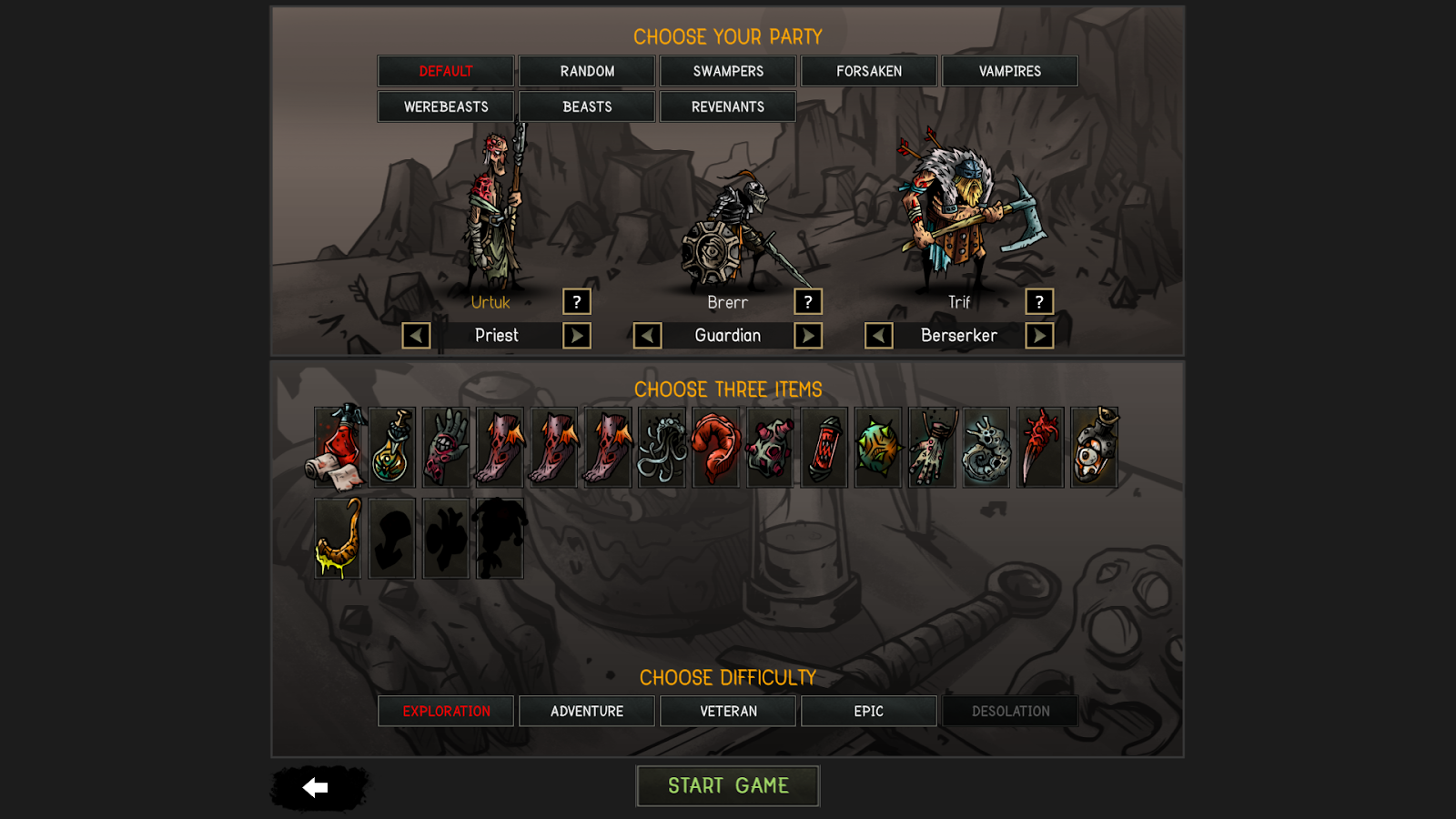
Characters are defined by their class, stats, equipment, mutations, and their bonus capabilities vs. a randomized, specific unit class. Class determines a lot about a character, including what they can equip, starting and developed abilities, and what actions they can take. The mix of these is always unique, and no two character classes start from the same point, though some of them can end up at similar endpoints. For example, there are multiple classes that feature the billhook weapon and many of them have the ability to close a greater distance than is indicated by their movement rating, then locking down an opponent with the Engaging Strikes ability. Armor and weapons also determine what kind of damage the character will do, how effective they will be vs. armor, and finally how many bonus mutations their gear provides.
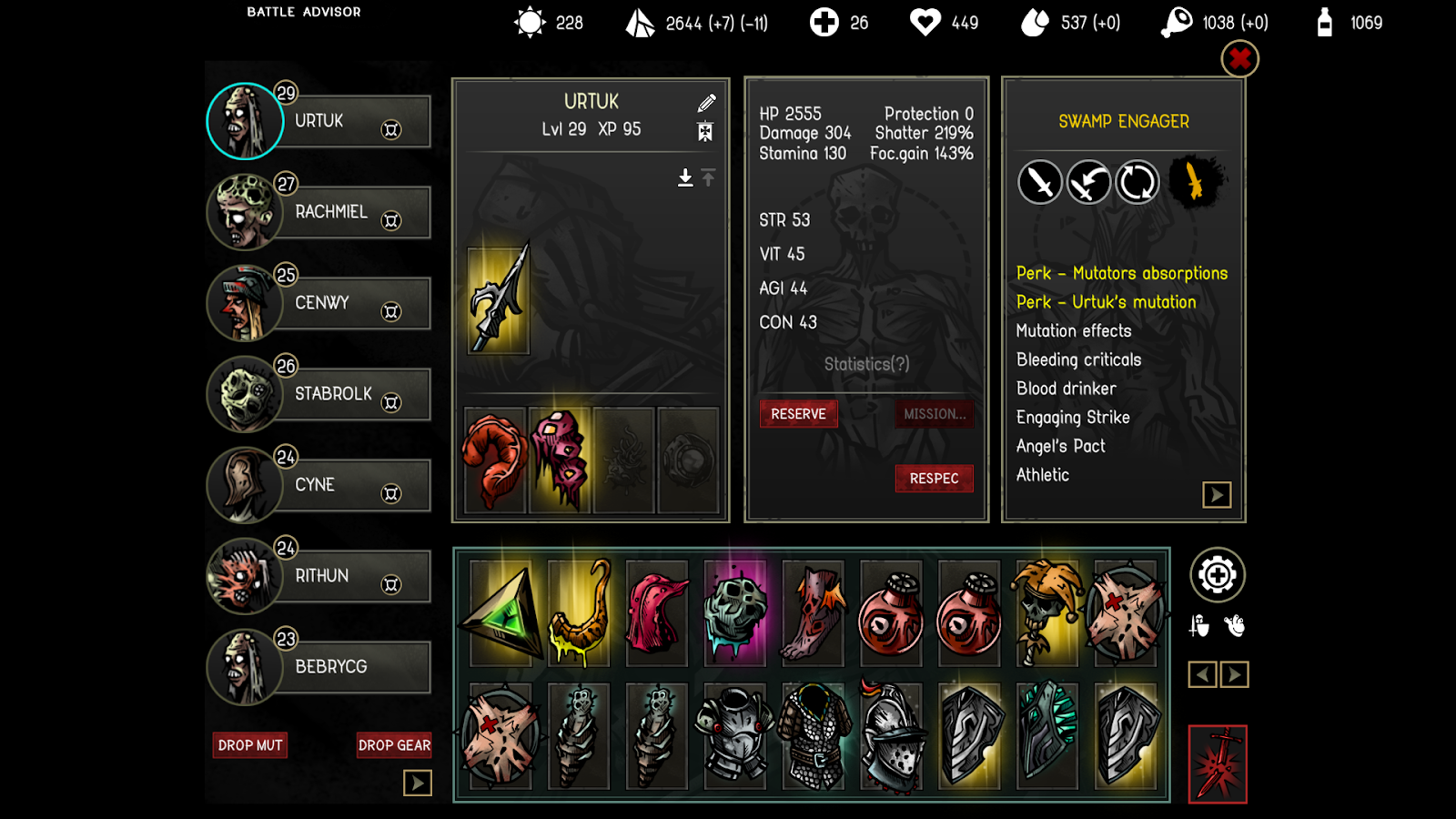
There are four stats each impacting one (or sometimes two) aspects of battle. Strength increases weapon damage, vitality improves hit points, agility impacts quantity of stamina and how frequently a character takes turns, and concentration impacts focus generation. The abilities have various degrees of usefulness and figuring out how to tune them and optimize the three points you get at each level for specific builds contributes a lot to becoming good at the game.
Equipment has four different tiers of quality, with intermediate steps between the tiers, and available equipment blends together across different stages. For example, steel is found on the first area, silver is available in the first and second area, and so on. Gear has a pretty unique impact on a character and their role, but luckily it does not strictly define how good a character is. There are some characters with relatively weak weapons that still perform well, yet there are some with a higher damage output that aren’t so good.
Mutations are an extremely important part of the game and are an underpinning to how a lot of the rest of the system works and are what drives the game forward. At the most basic level, each mutation represents a distinct ability. These abilities are layered on to every other combat-related system in the game creating a wide variety of different ways you can do specific things (such as healing) while also providing plenty of abilities that are fairly unique. Each character can equip three mutations at a time, while different classes vary in the number of mutations they can absorb. Mutations have the option to be absorbed after a number of battles that varies based on their cost, with more expensive mutations taking longer. Absorbed mutations act like just any other character’s innate ability while ones that are not absorbed can be swapped between characters at will.

Mutations feature a level, ranging from 1 to 10. Lower level mutations of all sorts provide a penalty to character hit points, but as they go up in level this turns into a bonus. Additionally some mutations, particularly healing ones, provide a bonus that scales with level, making it especially valuable to combine them or boost them with objects made specifically for that purpose. Mixing and maxing mutations allows you to customize characters in very diverse ways allowing you to create completely different roles for them, within the constraints provided a particular character’s class. It is possible to make characters with limited armor and a big weapon tank for you, to make tankier characters with weaker weapons focus on dps, and do either one with support characters. This doesn’t mean it is a good idea to do those things, but the option to mix and match and experiment is there if you dare to innovate.
The Strong vs. characteristic stands apart from other aspects of a character, in that it provides context and nuance in how you use a character and, to some extent, if you even want to feature them on your team. What Strong vs. does is gives a character a specific situation under which you will get an automatic critical hit, which gives extra damage, provides a trigger condition for a lot of mutations, and gives a 50% chance to get an additional hit. This is huge and can rapidly amp up the power level of a particular character vs specific enemy types. This can help you with hollowing out a section of the enemy squad, in the event that you have lots of duplicates in a Strong vs. ability, or it can help you with prioritization. A particular character could be a specialist in fighting swordsmen or big brutish wielders of maces and axes, or fighting armored enemies. You can also specifically hunt for characters with strength vs. status effects and build a team around Strong vs. bleed or poison. In most cases, you will mostly end up playing with what you find, but if you find an easily replaceable character who does not have a strong vs. that synergizes with your team, then you may end up using that as a basis for replacing them.
The unit you select as Urtuk is both very similar and very different from other units of the same type. While he has the same general kit and build strategies, each Urtuk develops four additional free mutations over the course of time. Many of these are very rare or unique, and allow you to supercharge his capabilities, making him very effective in his role. Granted, most of the Urtuk mutations are geared towards a more damage based role, so offensive Urtuks are popular but there is nothing forcing you to make your Urtuk a damage dealer. It is just likely that if you make, say, a tanky character into an Urtuk you will likely end up with a hybrid character rather than one who is strong in their original role.

Combat is turn-based and played on a hex grid. Individual characters move in sequence based on agility. Battlefields are replete with terrain to funnel movement, pits to knock enemies into, and differences in elevation. The layout and enemies are a mix of procedurally generated and templated, which leads to a pretty wide variety of possible battle environments. The effect of this variety is blunted by the sheer quantity of battles fought. Even with the number of possible battle situations available, it is inevitable you will face the same ones several times each run. Still, the topography provides a lot of skill testing. Keeping track of differences in height and a potential avenue of attack can be difficult, but it is rewarding if you are able to pull off something special.
Each unit has a specific set of abilities defined by class that are selected every turn. Most units do not have more than two or three options, but with modifiers and the special effects of mutations there are a dynamic and rich set of choices. Luck is minimal too; attacks, aside from ranged attacks through cover, do not have a percentage to hit, and damage variability is determined by terrain and enemy unit weaknesses. Interestingly, the AI’s decision making process is ambiguous. While sometimes it may be possible to manipulate or predict what they can do, the combat situation can change so much between one turn to the next it will frequently be difficult to impossible to predict what will happen at the end of a turn.
One interesting twist to battle is focus abilities, which are as customizable as the mutations. Each character starts with one, but additional ones can be obtained through stage rewards and customized to your heart’s desire. Every time a character attacks, uses an ability, or is targeted by one an amount of focus will be generated, with the base amount inversely related to the characters level (i.e.h a higher character level means less focus) and their concentration stat (which provides a greater boost). Once the focus fills up, a unit can use the ability on any ally on the stage. These run the gamut, with healing, damage, defensive, and other types of abilities, all available with varying power levels and degrees of usefulness. Additionally, there are a fair number of mutations that are dependent on filling up focus, with some giving a free critical hit on the following turn, providing instant healing, or an immediate trigger of the unit’s focus ability on the unit itself.
The potential repetitiveness is also mediated by the sheer variety of battle combinations. In addition to the variation provided by the map, there are 10 factions to fight, with a variety of different scenarios ranging from besieging a fortress or village, defending or rescuing some configuration of friendly characters, attacking enemy champions, or fighting with allies in massive pitched battles. These battle’s goals are typically focused on just killing all the enemies or enemy leaders but there are some others that offer additional ways to win, or different ones entirely.
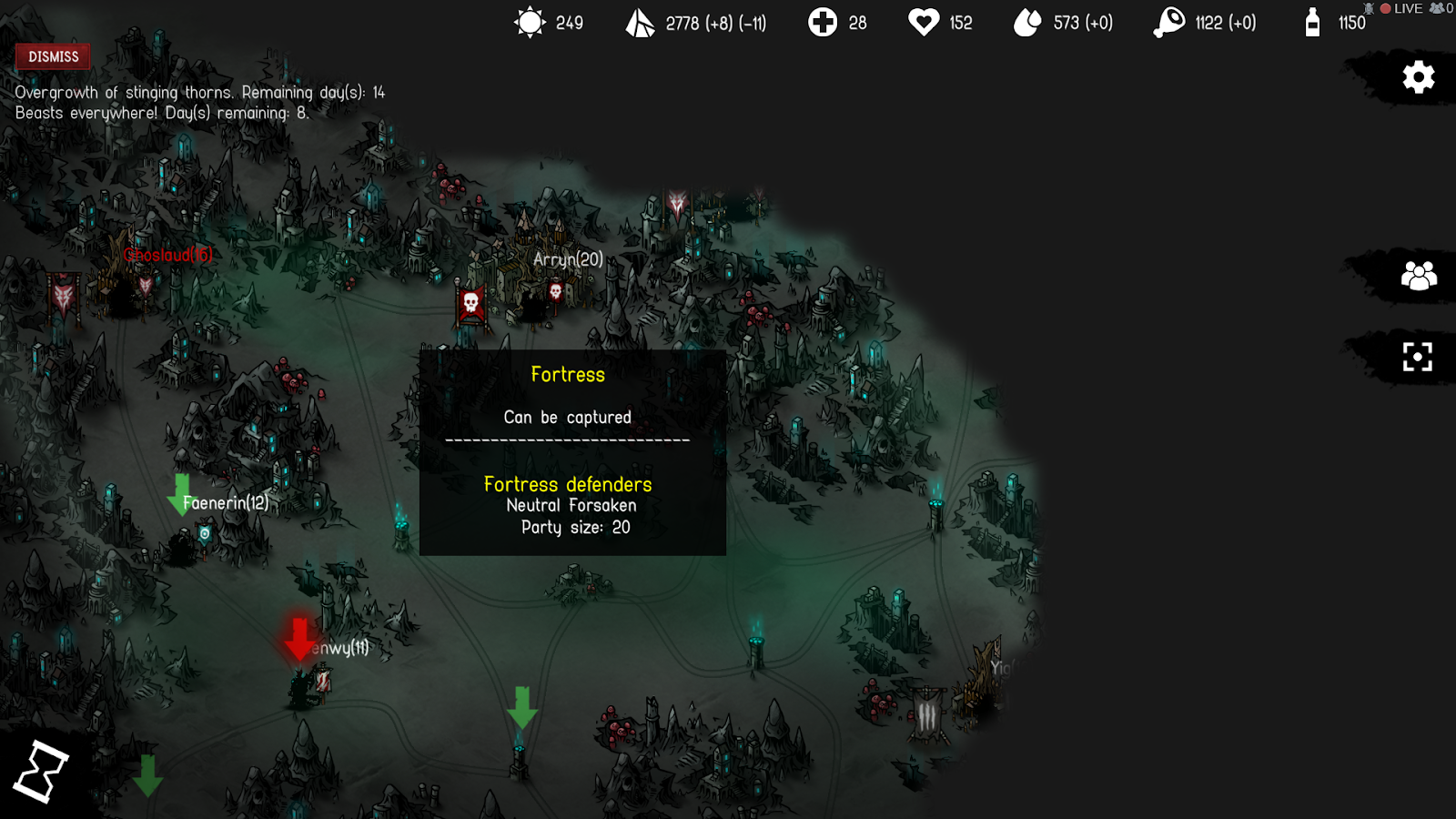
The campaign map is node-based with individual nodes either empty or featuring a potential battle. You can see the map and the most likely enemy by rolling over the location, with each map having a different primary faction, which features in most of the missions. Specific missions can show off the vampire, werebeast, and beast factions that are not map dependent, and there is often some overlap. For example, the 2nd campaign map, the Swamp, will feature mostly Swamper faction characters but there will be a few villages with Forsaken, and at least one fortress with Valdor or Necroreavers. There are four maps total, each of which contains a hidden boss stage beneath a village that you must defeat in order to progress to the next map. These always feature a mini-boss that must be defeated. There are also a number of special, “secret” bosses that have special loot or recruitable characters that you have to find or trigger the right conditions to face.
However, the game’s story is minimal. Most stages have descriptions and explanations, but it is ignorable and frankly does not add much to the game. What Urtuk: The Desolation has in spades is the theme. The game successfully presents its dark weird fantasy world through the art, races, and the types of actions you can take with your characters. In how many games are you able to sacrifice members of your party for valuable blood and flesh? Urtuk’s ugly, misshapen artwork adds to the sense of brutishness and darkness. The tiny, spindly legs each unit possesses also reveals that even the largest unit in the game skips leg day at the gym!
Failures and Limitations
The biggest problem I have with Urtuk is the sense of tedium that can develop by the third map. At this point, your team is mostly in place, you have faced numerous different encounter combinations and are most aware of what your team is capable of and can achieve. So on the third map, I feel like it begins to drag. Of course, there are ways around it, in that you can skip encounters, rush through villages to find the path to the next stage, and face the final boss, but it still feels like there is something that could be done to reduce this tedium. I can’t offer a solution, as I don’t know what it is. The game already has more than enough content, but I can’t help but wish the game had another faction or was slightly shorter in order to meet a greater length-to-content ratio.
The other real limitation of the game lies in the procedural generation of maps. While in many cases the combination of terrain and starting area can result in tight, tense gameplay, it can also feel unfair or impossible to get through without massive casualties. Now it is possible, even on Ironman, to just reload from the start of the map resulting in a completely different map layout and enemy placement but that feels a bit like cheating. This is another item where I am not sure what the solution is. Dynamic procedural map generation with a variety of heights that are also fair and balanced every encounter is difficult, and I suspect that having tougher map situations sometimes may be preferable. But even with that, it can result in maps that are too tough and challenging, and I wish things were a bit different there.
Achievements
Urtuk’s systems work very well together and, beyond the game length vs. content issues noted above, most of Urtuk‘s systems are tight, effective, and fun. Every choice you make feels real and significant, and this becomes increasingly true as the game increases in difficulty. At some point, you may get too powerful for most encounters and are ready to end the game, but in those situations your goal is clear. You push down as deep as you need to go (though this will rarely happen before the third or fourth map), and then head straight for the final boss. The game gives you the ability to grind as long as you want, but you only really need to do so up until the point where you are ready to end the game.

A big part of these real choices is the wide variety of builds. There are over fifty mutations you can assign to characters, some of which are extremely rare or only found on gear, and their many combinations result in rich and interesting decision-making. It is also fun to grapple with the character recruitment system. Some units are rare or unavailable until much later in the game, and every time you end up recruiting another one you have to decide. Does this character fit? Can I use my available mutations to make him productive and an asset to the team? Is the time it takes to make this character a positive contributor worth his potential power increase? The answer to these questions are usually not obvious until you have gone deep into the game. Considering how much experienced players disagree about the answers to these questions, there is an argument to be made that it will remain up in the air just enough to last for most player’s entire time with the game.
Battles serve as an excellent testing grounds for the theories built in character generation and recruitment, and are generally brutal and fun. Positioning matters. Engagement strategies matter. Individual tactical choices matter. All of this leads to deeply satisfying gameplay that can easily keep someone coming back, remaining engaged for as long as they wish to play the game.
Replay value is through the roof, and even though I only beat the game for the first time recently, I still have over 200 hours of play. It is so easy to dive into a new starting party composition, to see how your party is going to develop and get excited about the specific loot you are going to find. This keeps me coming back and fits well with the other things that make Urtuk such a joy to play and experience.
Conclusion
Urtuk: The Desolation is very good. While it is not perfect, and that is perhaps philosophically impossible to achieve anyway, it does a lot of things right and is a very enjoyable experience. I have enjoyed my time with the game and fully expect to get dozens, if not hundreds, of more hours of the game in years to come. It is something I can easily suggest to most any turn-based tactical RPG aficionado, and will (hopefully) make many of them very, very happy.
If you’re interested in some video gameplay of Urtuk: The Desolation, be sure to watch Rob’s new series featuring the latest build of the game here:
We’ll be keeping a close eye on Urtuk as its development continues and will be sure to check back in with it later and report!