Vagrus: The Riven Realms is a turn-based open-world RPG set across post-apocalypse wastelands following a divine moment of destruction called The Calamity. The player takes up the part of a Vagrus, a leader of a convoy of beasts, fighters and slaves called a Comitatus. What you wish to do with the convoy is up to you. You can become a merchant, buying low and selling high. Or you can become a mercenary, robbing other comitati or killing monsters to earn your coin. It is a game that is heavily inspired by classic text-based adventure games where when things started to go wrong, they went very wrong very quickly.

Learning the Tricks of the Trade
Starting out, you are given the basic world description. The premise is simple: the gods disliked human hubris, wreaked a little havoc, the world ended up as a wasteland with few survivors and mythical monsters emerging from the darkness. You lead a group of travelers with the main goal of surviving the wasteland. That is your mission, first and foremost. Once you are stable, you can start building up some capital, expand your comitatus and recruit special heroes with diverse abilities in combat and upgradeable perks.
It is highly recommended that a first-time player starts with the tutorial. It is a self-contained story with a set series of tasks to complete. This helps get acquainted with the various game mechanics one by one and there are plenty to go around. In fact, there are so many different scores and attributes to keep track of and so few tooltips to go around that even the tutorial is not enough. It is also not shameful to do the tutorial more than once, especially since the tutorial does not pull any punches and you can lose the game very suddenly. To be a successful Vagrus, the player has to learn the tricks of the trade the hard way – through complete failure and starting over.
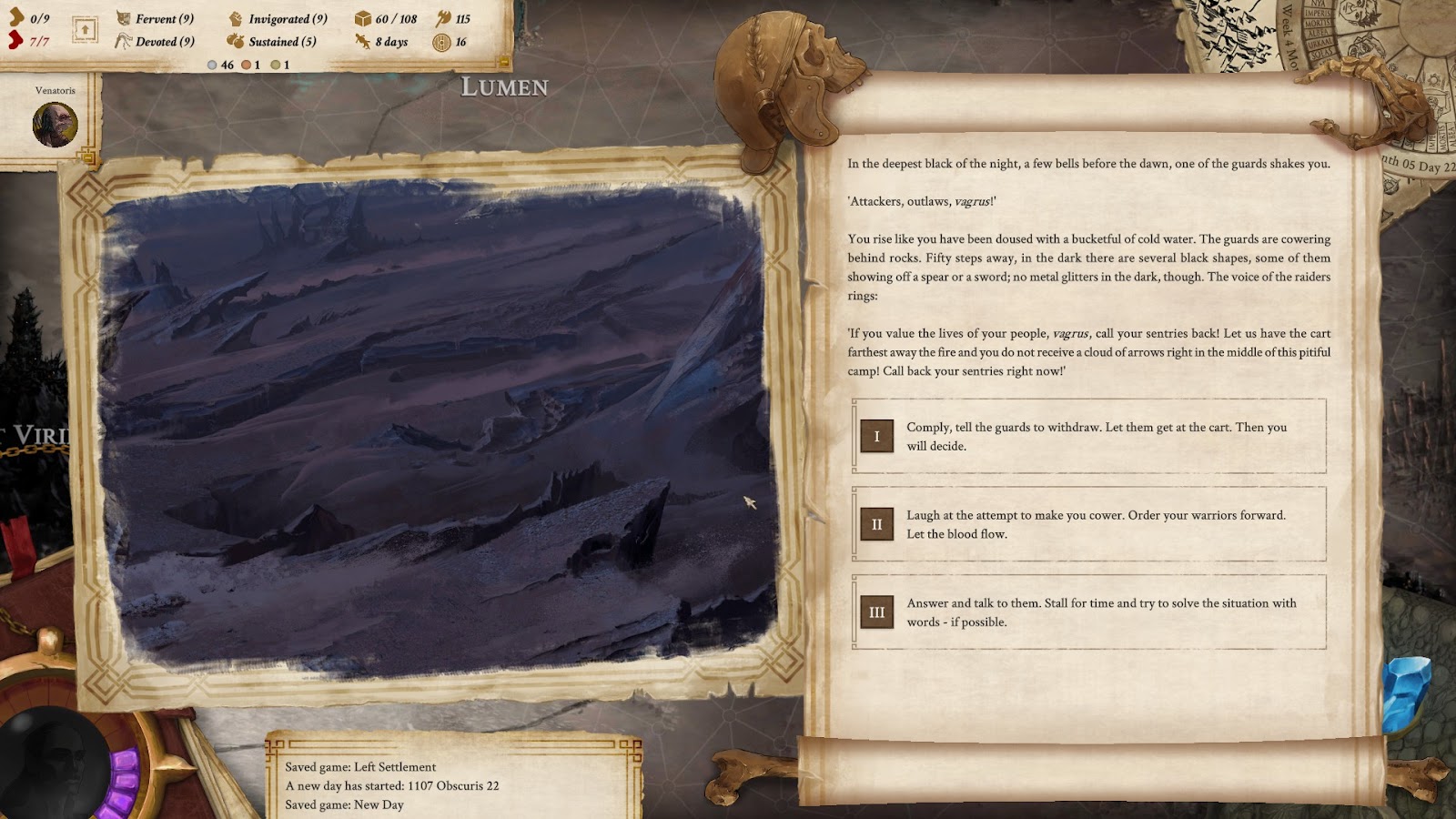
A large portion of the game takes place in dialogue screens where the player decides the best course of action. Personal or comitatus attributes and scores can affect the success probabilities of those decisions and almost every choice is a gamble. Even seemingly simple actions like foraging for extra food can risk the lives of your workers for little benefit unless you have a specific set of skills to keep your crew alive. In a barren wasteland, luck does not favour a mere Vagrus. Misfortune is expected and reacting to it keeps you alive. This lends the game a real sense of suspense.
Trading for Life
Trading is of paramount importance in Vagrus: The Riven Realms and the act of buying and selling goods is something the player will be doing a lot of. As you have to pay wages for your workers, warriors, and companions, as well as keep them fed, the money needs to come from somewhere. Travel between towns, outposts, mines, and other locations that may offer you a quest is slow, but these offer the opportunity to trade or just a safe place to sleep where you do not need to post guards throughout the night. Most nights are spent camping in the wilderness, so preparation for any long travels and unexpected surprises is critical.
In the wasteland, lucrative opportunities are few and far between so there is an element of satisfaction to finding routes that actually pay off their own costs. The wages are significant and food can be hard to come by. It is very easy to over-expand your comitatus early and run out of coin or supplies. If your comitatus is not happy with you, perhaps due to overexertion, low morale, or starvation, the game throws you a lifeline in the form of a dice roll. If you cannot remedy the situation, you lose the game. As a rule, when things start to go wrong, they snowball. Low morale means adverse penalties to almost everything you do, including any attempts to raise morale. Overexertion in the wastelands causes the comitatus to travel slower and so it takes longer to reach a safe resting place. Making good trades and preparations at the oases in the bleak wastelands is a matter of life and death.
The prices, as in most trading games, are dynamic and will shift according to the trades you make. Use the same route too much and you saturate the market. The player is therefore motivated to constantly keep looking for alternative routes. After a while, the original market situation is restored and those original routes start being profitable once again.
To help you on your journeys, you can also take on delivery quests for various factions that inhabit the wasteland. Guilds and Churches will gladly offer you payment in exchange for some luggage space in your caravan along with a delivery deadline. This makes exploring new places profitable and allows you to get price information without risking any own investment. Undertaking and completing these quests also improves your relationship with the faction who gave it, slowly unlocking more interesting missions. Deliveries are one of the most lucrative activities in the game, but if something happens on the journey, the cost of the undelivered goods has to be covered. That something can be anything from a random encounter to a fight with some ghouls or robbers.

Fighting in Multiple Forms
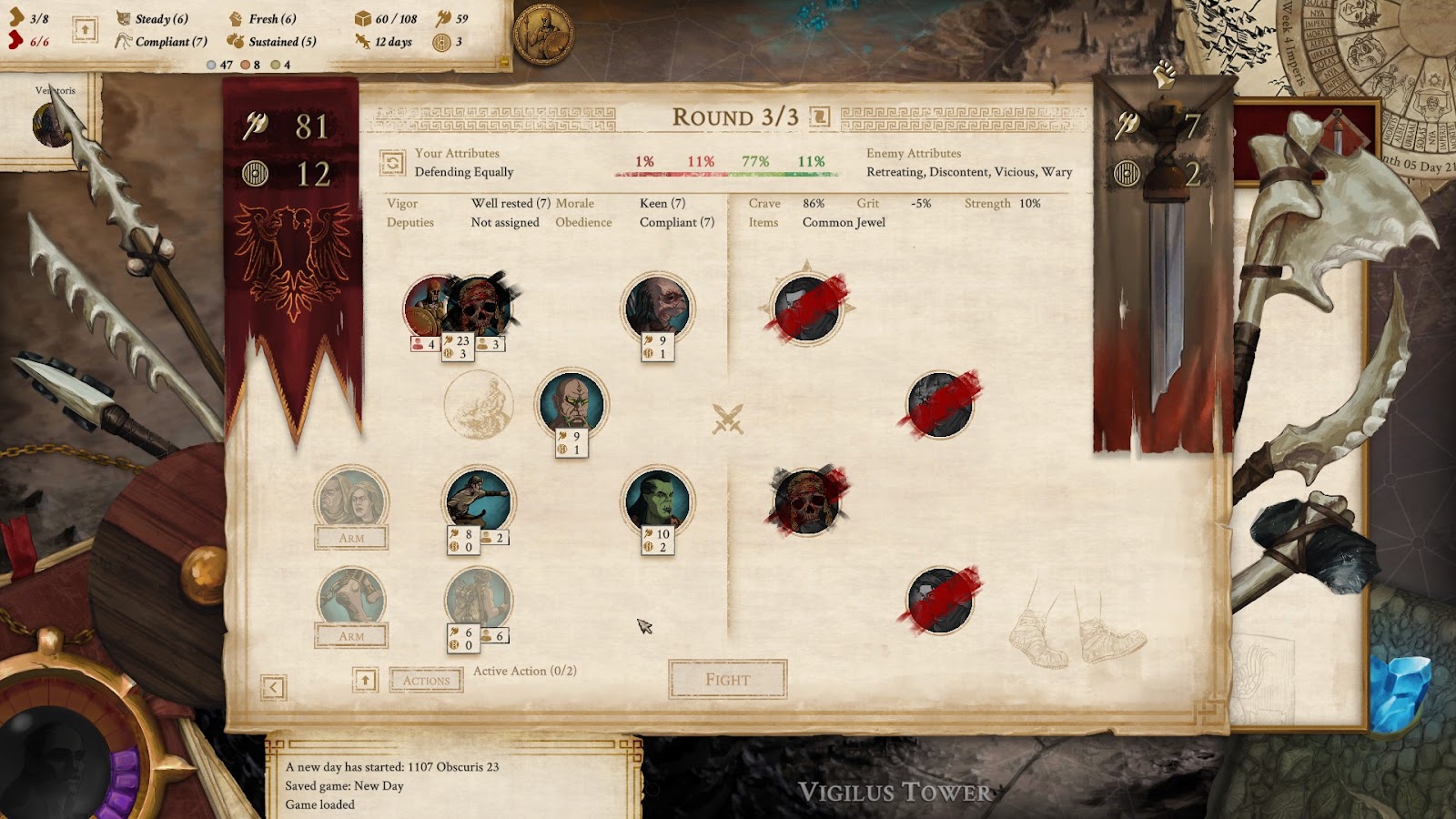
While traveling the wastelands, you can end up in two kinds of confrontations. In a companion battle, up to six companions that you have recruited on the way can fight up to six attackers. The battlefield is divided into two sides with two rows each. The back row is designed for ranged or support units while the front row is ideal for melee units and if a unit on the back row has a unit in front of it, it cannot be targeted by melee attacks.
The companion battle takes place over several rounds with each character’s turn order being defined by an initiative roll at the start of each one. In their turn, a character can use one of their abilities to attack enemies or to support friends. Over time, these abilities can be upgraded and special battle actions, such as aiding a companion who is near death, can be unlocked. The enemies’ potential actions are hidden, so, using special tactics for fights is not really possible until you have repeatedly fought the same opponents again and again, learning everything they can throw at you. Until then, though it could be a lot worse, the combat feels repetitive and dry.
Happening upon a battle encounter puts your entire comitatus at stake. Having more warriors and companions plays a big role in this phase of the game. In desperate times, slaves and workers may be used as additional military strength, albeit at a heightened risk to their wellbeing. Additionally, special actions can be used to boost the offensive or defensive scores or to engage the opposing force in companion battle. The choices are not simple by any measure as a lot of pertinent information is not explicitly stated: oftentimes it is best to reuse a single tactic repeatedly and hope for a stroke of good luck.
Oh the Calamity!
While the game takes place in a fixed world with plenty of backstories, the game does not really have a central story arc for the player to follow. At the start of the game, you can decide on a large overall goal for the game if you wish, but that is about it. There are, however, a plethora of mini-stories that come up during play, through random encounters on the road, visiting taverns, talking to your companions, etc. Playing in a certain consistent style can lock you out of some encounters so multiple playthroughs are required to experience the entire game.
Despite the apparent randomness of many encounters, a lot of the smaller stories are heavily scripted, meaning you can rely on some of the same things happening every time you play. In a way it is like Fallout – you never know when you might happen to find a crashed alien spaceship on your travels, but you always know where to find the characters you want to recruit.
Following quests or storylines is not always straightforward, as occasionally actions have to be made in rather obscure places or involve details that are never clarified by the dialogues. On other occasions, you have to deliver a specific amount of something and you can only deliver the full shipment in one visit as opposed to making multiple deliveries. This slows the tempo of the game down and can cause notable confusion.
The game starts with a warning that it is designed to be difficult, and in this respect, it does not disappoint. Every stroll you take through the quaint old streets of a small town can start you on a downward spiral, every journey you undertake could be your last. In fact, my shortest game barely lasted five minutes – I started without supplies, the closest outpost refused to sell any and so my comitatus starved to death. Most games last for hours, rare games for dozens. There is a story option available when you start a new game for the people who want to focus on the narrative experience rather than tense battles and the woes of exploration. The game is regularly updated and patches usually include some user interface improvements along with the usual bug fixes.
Verdict
Vagrus: The Riven Reals is set apart from its RPG brethren with its focus on its text-based adventure mechanics while adding useful screens and systems for party management, personal development, public relations, cartography, and combat. A lot of games have borrowed basic elements of text-based adventures, but Vagrus puts it upfront and centre. That is a brave choice because the quality of the game is then mainly dependent on the quality of writing. Lost Pilgrims Studio made it a good wager.
Beyond the writing, the game has a steep learning curve, the UI needs a little work to become more practical to use and the battle mechanics are on the lower end of being considered passable. Yet, there is promise here: the core is solid, the surface needs polish.