What happens on Baal stays on Baal – unless it’s Tyranids.
Warhammer 40,000: Battlesector is the latest game from developer Black Lab Games, best known for their previous title Battlestar Galactica Deadlock. This turn-based tactics game focuses on the Space Marines Blood Angels Legion they attempt to purge the monstrous Tyranids from the moon of their home planet.
Campaign
To explain what is going on in Battlesector’s campaign, as with anything in the Warhammer universe, will require a bit of backstory. The campaign is set after an event in WH40K lore called the Devastation of Baal. Hive Fleet Leviathan, a colossal Tyranid fleet the likes of which had never been encountered by humans before, attacked the planet Baal, home of the Blood Angel Legion. Two external forces intervened to assist the Blood Angels and their allies in destroying the Tyranids assaulting their world. The great Khornate Demon Ka’Bandha, a mortal enemy of the Blood Angels, led a massive assault against the Tyranids and Blood Angels. Primarch Roboute Guilliman then reinforced the Blood Angel defenders with Primaris Space Marine forces dispatched from his Indomitus Crusade fleet, scouring Baal of all xenos life and forcing the demons to retreat. Once their home planet was secure, the Blood Angels and their newly inducted Primaris soldiers turned to its moon, Baal Secundus.

This brings us up to speed with the events of Battlesector. Throughout its twenty mission campaign the Blood Angels, led by Lieutenant Carleon, cleanse the moon of the remnants of Hive Fleet Leviathan. Throughout the story, Carleon recruits several other heroes to assist in this task. The plot thickens as the Blood Angels track down the Tyranids commanding the xenos forces remaining on Baal Secundus, allies join the player’s troops and deadly enemies are uncovered. From a gameplay perspective, I think the campaign has fairly low replay value due to its linear nature but it has a serviceable story that moves at a steady pace and doesn’t overstay its welcome with added bloat. The characters narrating pre-and-post mission dialogue ramble on a bit, however as the story progresses some interesting bits of lore are brought to light by the heroes as they struggle not only with the Tyranid menace but their own inner turmoil.
There is also a decent amount of variety to the missions. Some require only that every enemy be slain, while others may involve solving simple mechanical puzzles or, in a few cases, rescuing or working with allies like the Sororitas (Sisters of Battle) faction. In places the missions seem to be designed to make the secondary objectives very difficult to achieve: if they are, bonus upgrade points are awarded; if failed the player can still finish the mission. In a few of the missions, objectives could do with better signposting, such as the Breach in the Heavenwall mission where the player is charged with activating a mechanism to free Croginax and Quindar. It is not really clear where the two early objectives are, and as they are on a timer the player can fail the mission trying to find the buttons. A couple of missions also seemed to have a required unit type to complete primary objectives. One calls for units with jet packs that can jump on a wall to open a gate. Without those units, the mission is still achievable but made for a frustrating experience due to a less than optimal player-controlled force being bombarded from the ramparts by enemy fire support units, with only limited ways of responding. Thankfully, these are rare occurrences and due to the linear nature of the missions, once the objectives are learned they are much easier to find and complete.
The heroes show a lot of character and their interactions feel meaningful to the player. Carleon seems emotional about fighting for his home, Croginax and Quindar sound like a sarcastic old couple of grizzled veterans and Sister Verity of the Sisters of Battle seems like she’s often caught between her own convictions and her distrust of the Blood Angels.
Strategic Layer
As far as the strategic portion of the game goes there are no side missions, points of interest, or any random events. The strategy layer in Battlesector amounts to a pre-mission tech tree called HQ Upgrades and army customization.
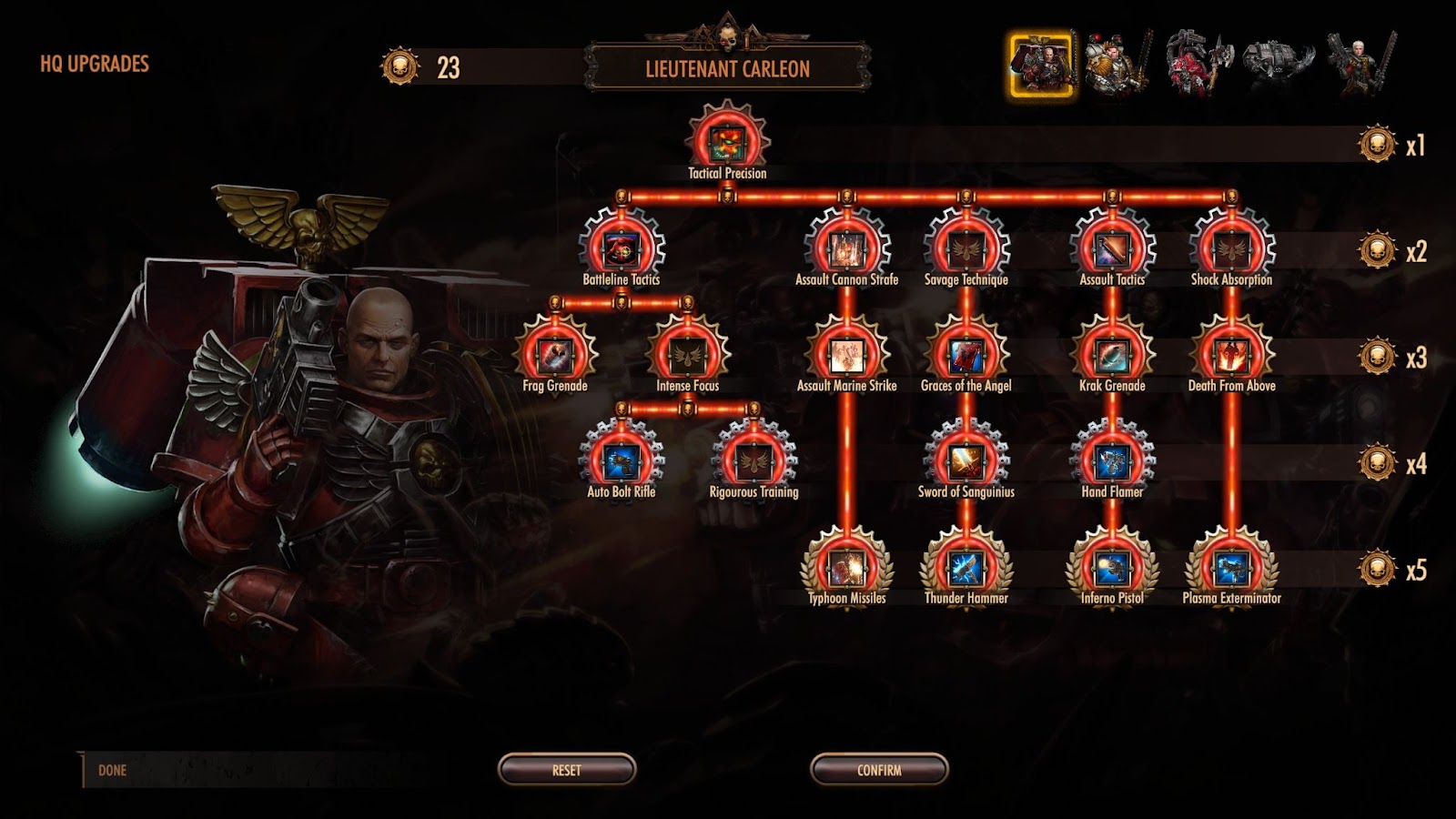
The HQ upgrade trees are available prior to each mission, using points gained from prior missions to unlock upgrades such as new weapons, abilities, stat increases, or command abilities. As new heroes are recruited throughout the Battlesector campaign, they are added to the HQ upgrades section providing alternative upgrade paths. Each hero tends to specialize in upgrades for certain unit types- for example, Lieutenant Carleon focuses on command abilities and Primaris units while upgrades unlocked under Tech Marine Croginax tend to be more aimed at mechanical units like Land Speeders or Predator tanks. This gives the player some agency in deciding how to kit out their forces for upcoming missions. Initially, upgrades are gained slowly but further in the story they unlock much faster as missions and secondary objectives start offering more points.
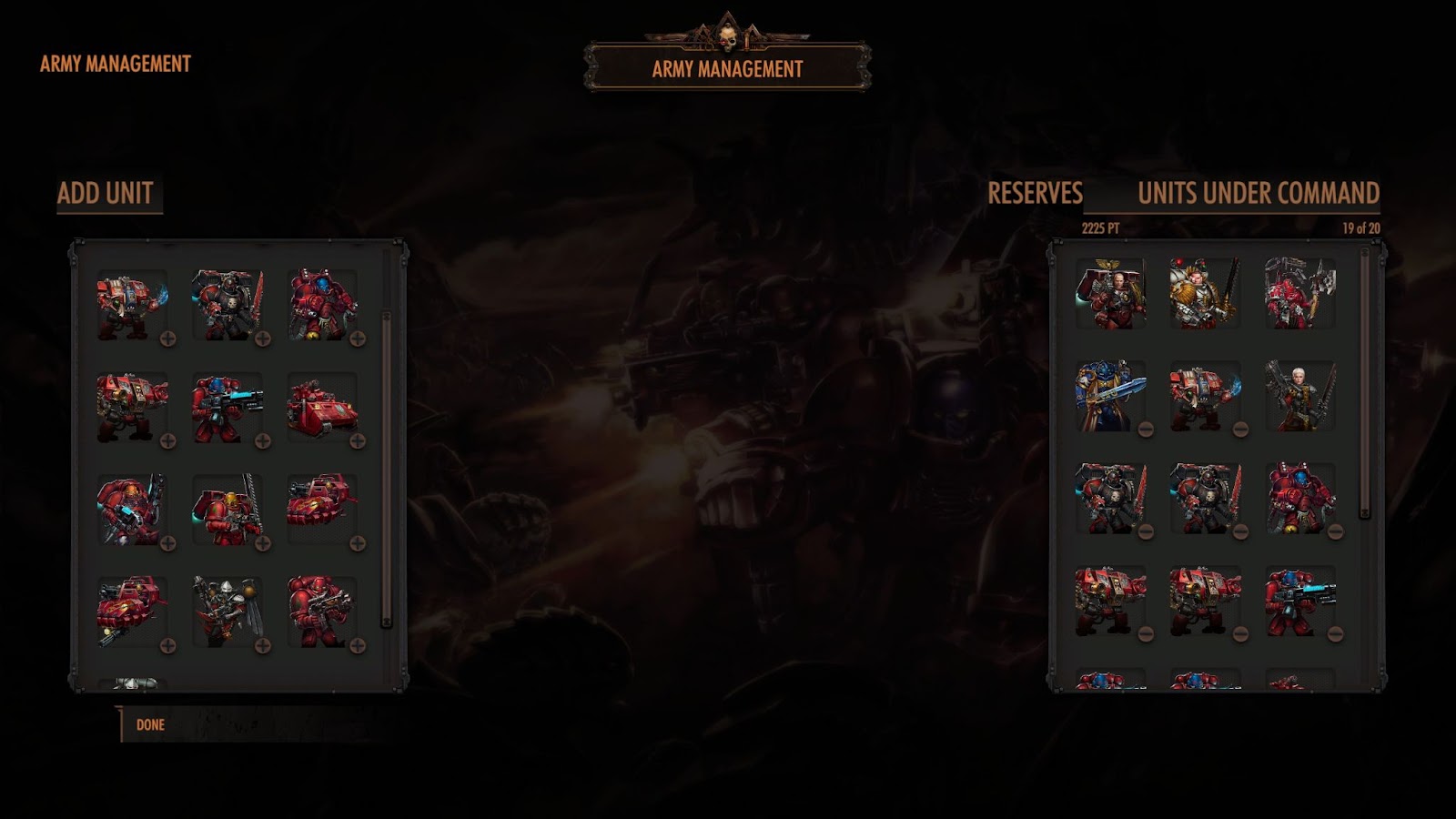
The army management screen is where players can change their army composition, assign units to reserves or change individual unit loadouts. Missions have a predetermined army point limit imposed at the start, limiting the number of units which can be fielded. Opting for upgraded weapons increases the point cost of the units wielding them.

Tactical Layer
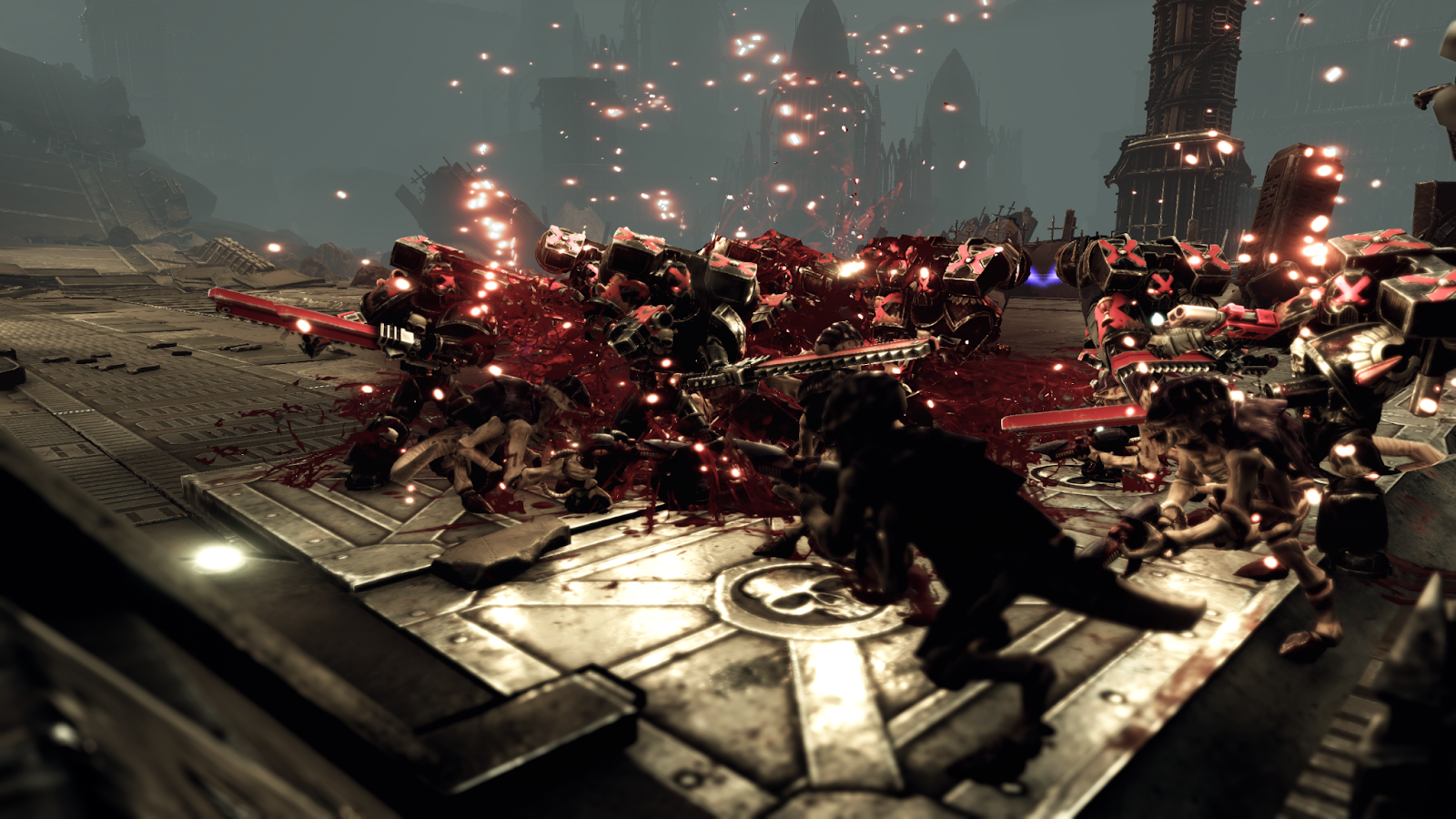
Each mission begins with the army deployment, where units can be moved around within a deployment zone and excess units can be taken out, then the fun can begin. The combat is where Battlesector really shines. Moving and attacking feels very slick for a turn-based title. There is no waiting for a unit to finish its moves before moving another – units can be moved as fast as the player can interact with them. If there is a heavier unit, say a Tyrannofex on the field and I know I need two Hellblaster squads to take it down I can have both units fire at the enemy nearly simultaneously, be quite sure it will be killed, and move to other units. Attacks feel really meaty and impactful: bolter rounds and explosives shred enemies, chainswords leave blood trails behind after Assault Marine strikes and melee attacks from heavy units like Dreadnoughts can knock targets to the ground.
Each weapon type has an optimal range and hit chance adjusts depending on how close to the optimal weapon range the unit is, as well as other factors like terrain and the enemy’s defensive stats. Attacking works in a similar way to the tabletop without the administrative overheads – hit chance is calculated at the squad level then each individual attack rolls to hit. For example, a Hellblaster squad with Heavy Plasma Exterminators might have an 80% chance to hit at an optimal range. Their weapons only fire once per turn so each unit also has to roll to hit with their one shot. A relatively minor gripe I have with the UI is that it would be nice to have more information available prior to attacking. The UI might show a 35% hit chance at the optimal range, but does not display information explaining why. Is the unit being protected by terrain, or does stacking units grant a cover bonus? How much is the unit’s dodge stat affecting the incoming attack? Unless the player goes into skirmish mode and plays around with the Tyranids (or does the overhead work in some cases) it is hard to know what is affecting the success of attacks, and the same applies to on-attack effects like suppression or overwhelmed. Maybe an expanded tactical view as in Gears Tactics, or an expanded tutorial, would remedy this.
Battlesector employs an interesting mechanic called the Momentum system. Every unit killed grants momentum points to a maximum of 100 as well as boosting the squad’s crit chance. When the squad reaches 100 momentum it surges, offering the player the choice of an extra action point or a boosted version of a standard attack. I found that a lot of units struggled to hit the 100 points as they lose momentum each turn; late-game forces like Predator tanks with heavy flamers or Death Company Marines can hit the cap really quickly. The Momentum system pushes the player to play aggressively while managing the risk to their own units.
Some of the HQ unlocks provide special abilities to heroes that can buff other units, or themselves. Lieutenant Carleon, for example, can unlock Battleline Tactics which boosts the damage and accuracy of Primaris Intercessors or Sword of Sanguinius to boost his own melee damage. Carleon’s HQ tree can also unlock Command Point abilities, which build a meter as units are killed. As points accumulate and points are unlocked he can deploy powerful assets such as an Assault Marine squad or Typhoon missile barrage.
Multiplayer and Skirmish
The skirmish mode is quite robust, offering a good variety of maps and options to play with. Players can customize their own forces, and that of their AI opponents and then set other options such as win conditions, army points, and turn limits. It also allows campaign missions to be replayed. Finally, Battlesector has regular, hot seat, and PBEM (Play by Email) multiplayer modes.
Verdict
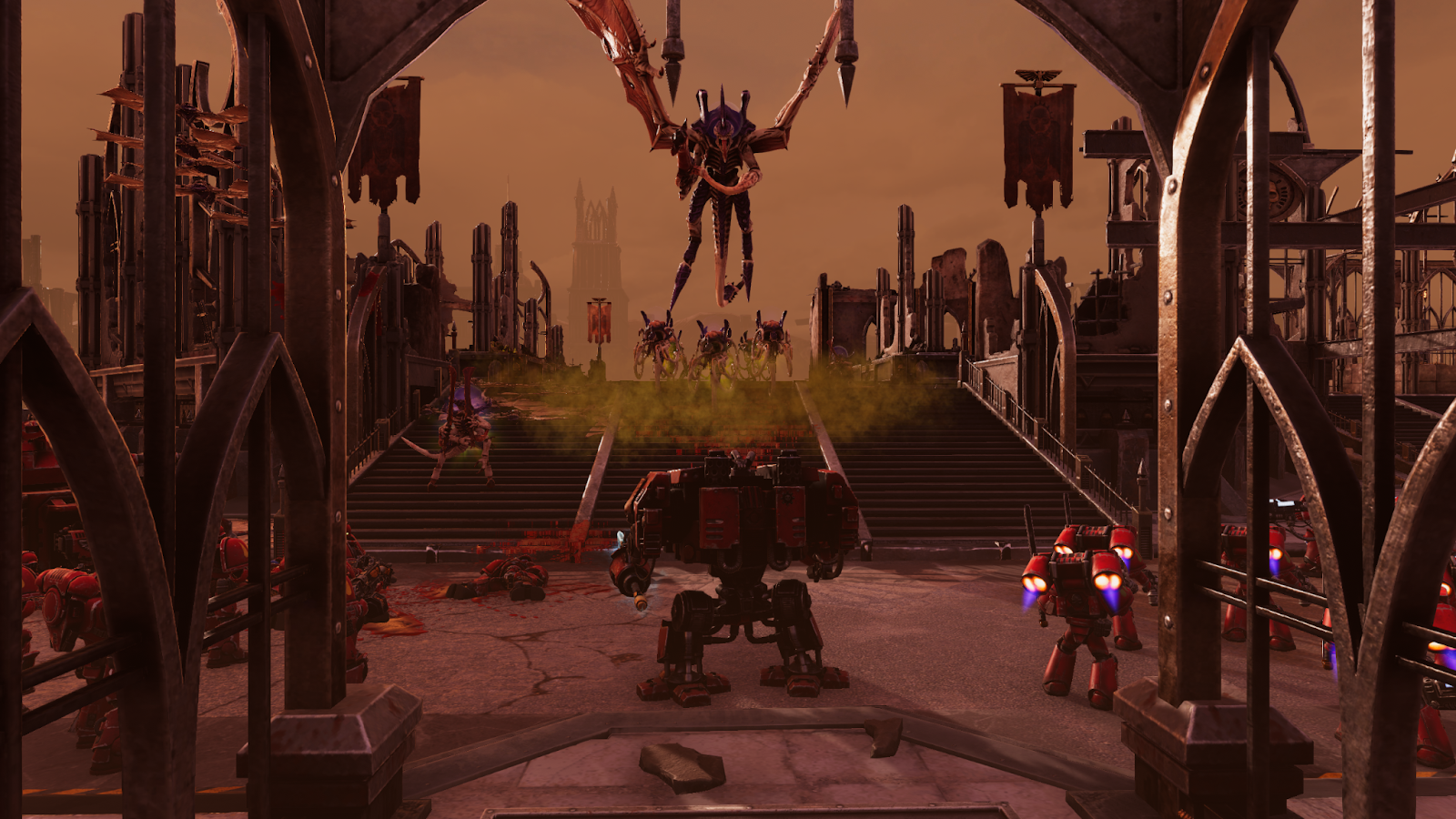
Apart from some minor gripes, Battlesector is fairly successful. It has a decent, if rigidly, linear campaign and engaging multiplayer or skirmish modes to add longevity. The combat feels fantastic and it’s interesting enough mechanically to set it apart from other tactics games, staying close to the tabletop rules without bogging the player down with the extra administrative overhead required of the player when playing the tabletop game. The game is also technically impressive: it runs smoothly, is virtually bug-free (likely thanks to a very extensive beta testing phase) and Black Lab has once again delivered a quality product. The game is launching boasting a quality rarely seen in either the Warhammer 40k franchise or outside of it. In this state, Battlesector is a solid addition to the tactics genre and should provide a solid platform for future content.