It is a truth universally acknowledged that a single man in the grim, dark future of the year 40,000 must be in want of war.
Warhammer 40,000: Gladius: Relics of War – we’re just going to call it Gladius – is one such war, featuring the regular misfit cast of fantasy tropes shot into space with enough DLC to sit at Paradox’s lunch table. Gladius includes four factions with DLC adding seven more, with additional smaller “unit pack” DLCs adding new units to each faction available at the time of the pack’s release.
Gladius, despite turning 5 in 2023, honestly hasn’t aged much. While there are many reasons for that, the biggest is also the simplest: Gladius doesn’t try to reinvent the wheel. It’s a turn-based tactics/strategy game with quality graphics, sound, and a clean, intuitive UI. It uses the venerable 40k license and cribs heavily from Civilization – the most obvious of course being 5 with its hexes and one unit per tile (1UPT), but when it comes to Civ mechanics the lion’s share of its borrowing was first present in 3, a game 15 years Gladius’s senior. If you were to strip away the Civ 3 mechanics, what was left could easily be pictured next to Fantasy General on a Circuit City shelf in 1996.
Fantasy General turns out to be a more prescient possible neighbor than it first may seem: though Gladius is billed as a 4x, in its moment to moment gameplay it most resembles tactics games like Advance Wars, Battle for Wesnoth, or even a traditional wargame like the aforementioned Fantasy General. Truthfully, it feels like playing Relic’s acclaimed 40k RTS, Dawn of War, made turn- and hex-based. For turn-based strategy fans, this is a very good thing. For 4x fans? It’s debatable.
This ReeXploration will give you a general idea about the state of Gladius as of the start of 2024 – the strengths and weaknesses of the game regardless of any DLC – and then take a rapid-fire look at all 14 content DLCs, what they add, and my take on each in terms of value.
Note this is the second ReeXploration of the game, the first being from Battlemode and written just before the T’au faction released. It’s excellent and you should check it out, especially since Ben knows way more about the lore than I do. And if you’re completely unfamiliar with Gladius I encourage you to first check out the original review on eXplorimate here to get an idea regarding its basic gameplay, as I won’t be covering that in any great detail.
I’ll also note I’m not a 40k scholar. This article will contain heresy. You have been warned.
Graphics and Sound
There’s a slight tinge of disappointment when after five years and fourteen DLCs I find myself pointing out the same issues day one reviewers noted. For instance, the music, while of good quality, is repetitive. Initially I assumed this was due to a lack of tracks, but that’s not the case: each faction DLC actually added two additional songs. The soundtrack lists a total of 27, for two and a half hours of music.
Another lingering issue is the visuals. Gladius is quite pretty but still suffers from readability issues if advanced graphical bells and whistles are left on. Mostly, this is due to an inappropriate use of shaders. As an example, Depth of Field doesn’t make much sense to me outside of first person and only really serves to smear the screen in Vaseline in a bird’s eye view strategy game.
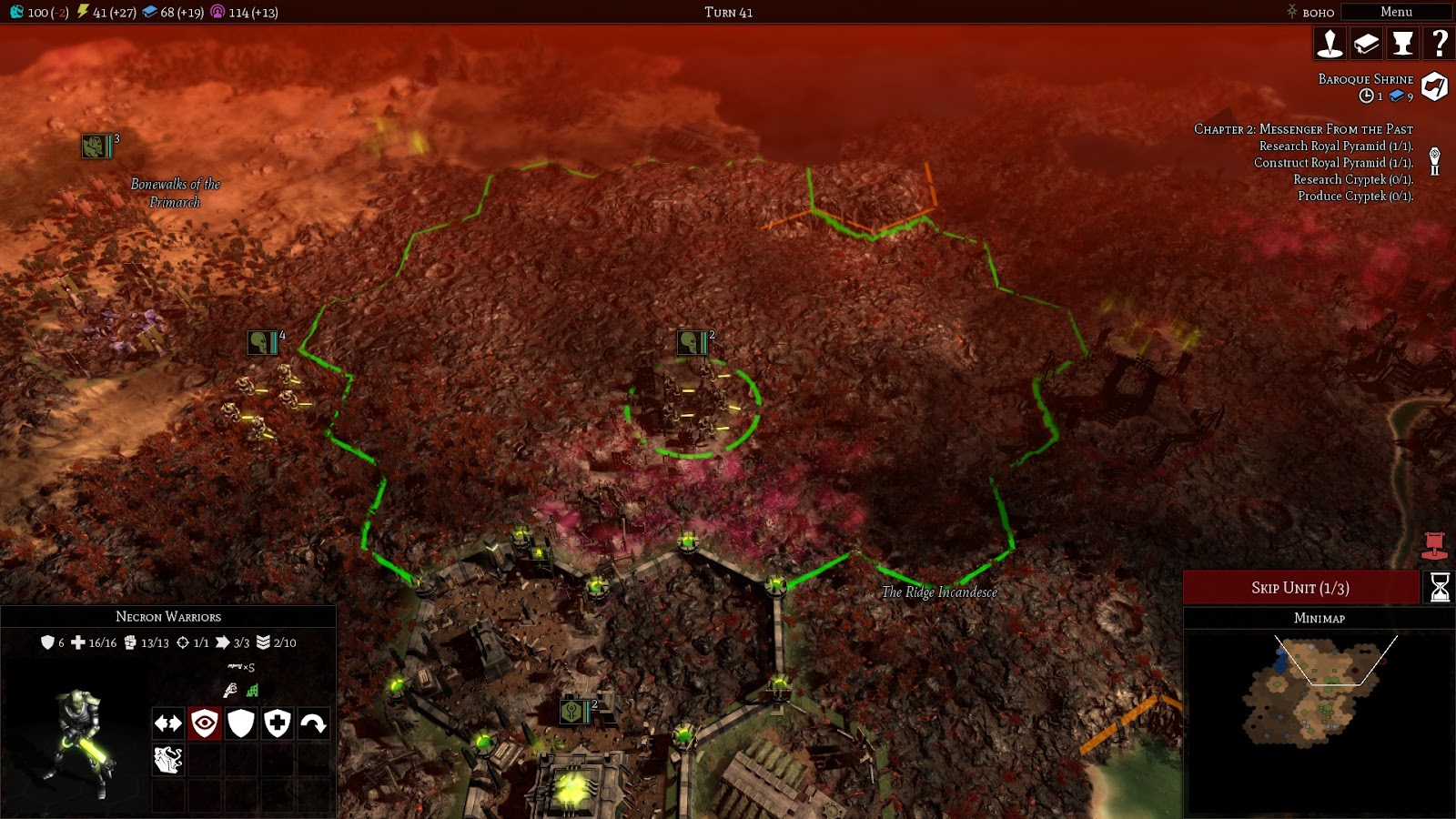
If you find Gladius starting to look less like wartorn terrain and more like grimdark soup, I’d strongly recommend turning off Cloud Shadows, Depth Fog, Depth of Field, and Anti-Aliasing (implemented as FXAA, which further blurs the image) under Advanced in Graphics settings. If you like you can choose more appropriate shaders via good old Reshade and force a better AA method via your graphic card’s control panel instead.
It’s a shame that Gladius is stuck under a couple of layers of blur by default: there’s a surprising amount of detail in play here.
AI
Even at the end of 2023, it’s refreshing to see a 4X AI with Gladius’s tactical prowess. At no time did I feel like the AI was cheating – it played by the same vision rules I did, falling into or avoiding traps in entirely believable ways. It had to bring scouts to flush out potential ambushes or risk a unit to check for greater danger. If I picked off its scouts, it’d send one of its durable flying units in as a makeshift scout. Impressively, the AI could make the mistake of picking an already occupied tile for his flier-scout and lose its turn due to an invalid move – just like I could (and did).
The tactical AI is convincing in a few more important ways. Most notably, it does its best to preserve its units, rarely putting a unit into a situation where it’d die based on the units it can see. It will fall back to regroup if it’s suffered too many overall casualties or if its units get scattered. The AI will push an advantage, and if it backs off, it’s only because there’s a reason for it.
Gladius’s AI takes a default posture of a generally infantry-heavy approach, eventually adding some vehicle and air support. That’s certainly a reasonable strategy, but it would have been nice to see a bit more randomization in default approaches, as a human might try (vehicle-heavy, for instance). However, it will also dynamically respond to the units you choose to field, so to a large extent its variety reflects your own.

There are, of course, flaws and quirks. The AI doesn’t generally consider the overall order of its attacks or ability uses to maximize damage, which can mean it leaves a good deal of potential on the table. It’s entirely possible to watch it unload 5 attacks on a target, then debuff the target’s armor or buff its own units’ damage. But even with those quirks, this is one of the best tactical AIs in the genre.
There’s a reason I’ve been careful to specify the tactical AI up until this point: the strategic AI doesn’t quite live up to its tactical companion. While competent, all its attention goes to the meat grinder of the battle lines – basic infantry heading to the front often won’t even spend a turn to stop and recapture a stolen resource right outside their base.
While you could feasibly argue that’s a tactical choice, it’s less debatable when the AI ignores the massively powerful, game changing relics. These can grant army-wide buffs like 10% extra HP or 10% extra damage – and they stack. Unlike resource locations, a unit will always attempt to grab any relic in its move range, but it’s not hard to use a single throwaway unit to steal relics a few hexes away from enemy bases as long the relics aren’t in the direct path to the battlefront. It almost seems that once a relic or resource has fallen back into the fog of war, the AI forgets it ever existed in the first place.
The strategic AI, like the tactical, doesn’t cheat (unless you tell it to via difficulty levels). While the lack of cheating is impressive on a tactical level, on a strategic one it can lead to the AI coming across as dumber than it actually is. Ben alluded to this effect in the first ReeXploration, mentioning the disappointment in building up and crossing a map just to find two AI in a slug match, both out of resources and hurling cheap units at each other, meaning you steamroll right over both.
The knee-jerk reaction to seeing this is to say “the AI sucks.” It actually doesn’t – playing 1v1 and 1v1v1 matches showed me that – it’s just that it plays by the rules. Two players who have been fighting to stalemate all game getting steamrolled by the guy that went totally unharassed is what’s supposed to happen.
That said, the fact that this odd asymmetry seems to occur as frequently as it does in the supposed default settings (that is, 4 player FFA with all settings on the default “medium” or “average”) actually is a problem. Which brings us to…
Map Generation
In ReeXamination from 2020, Ben mentioned the map generator essentially struggles to create memorable maps. Three years later I’m not sure that’s still the case – I’ve gotten some great maps – but I’ve noticed a stranger problem instead.
Gladius really struggles to distribute players fairly on the default map setting of 4 players. Too often, I’ve seen three players on one edge with one player on the opposite edge. In a single-player, being in the middle of the crowded edge is a desperate (and fun!) fight for survival. If you wind up on the lonely side, you’re basically guaranteed the win. And if you get one of the two corners, rush the lonely side and claim as much as you can. Different strategies really only make the match take longer.
If all the players are human, this could play out in a more interesting way (well, the middle guy is probably still screwed), but against the AI, it plays out the same way over and over. What’s weird is this odd configuration happens more often than it doesn’t.
Writing and Quests
With the onetime institution of the static story campaign in its twilight, it’s no great surprise Gladius went with the increasingly familiar Endless Legend approach: a static unique-by-faction storyline appearing in every randomly generated map that, when stitched together across the factions, establishes the narrative of Gladius Prime and why things are so screwed up there. Steps of the quests can give you fantastic rewards. And, like Endless Legend, finishing your faction’s entire quest line wins you the game.
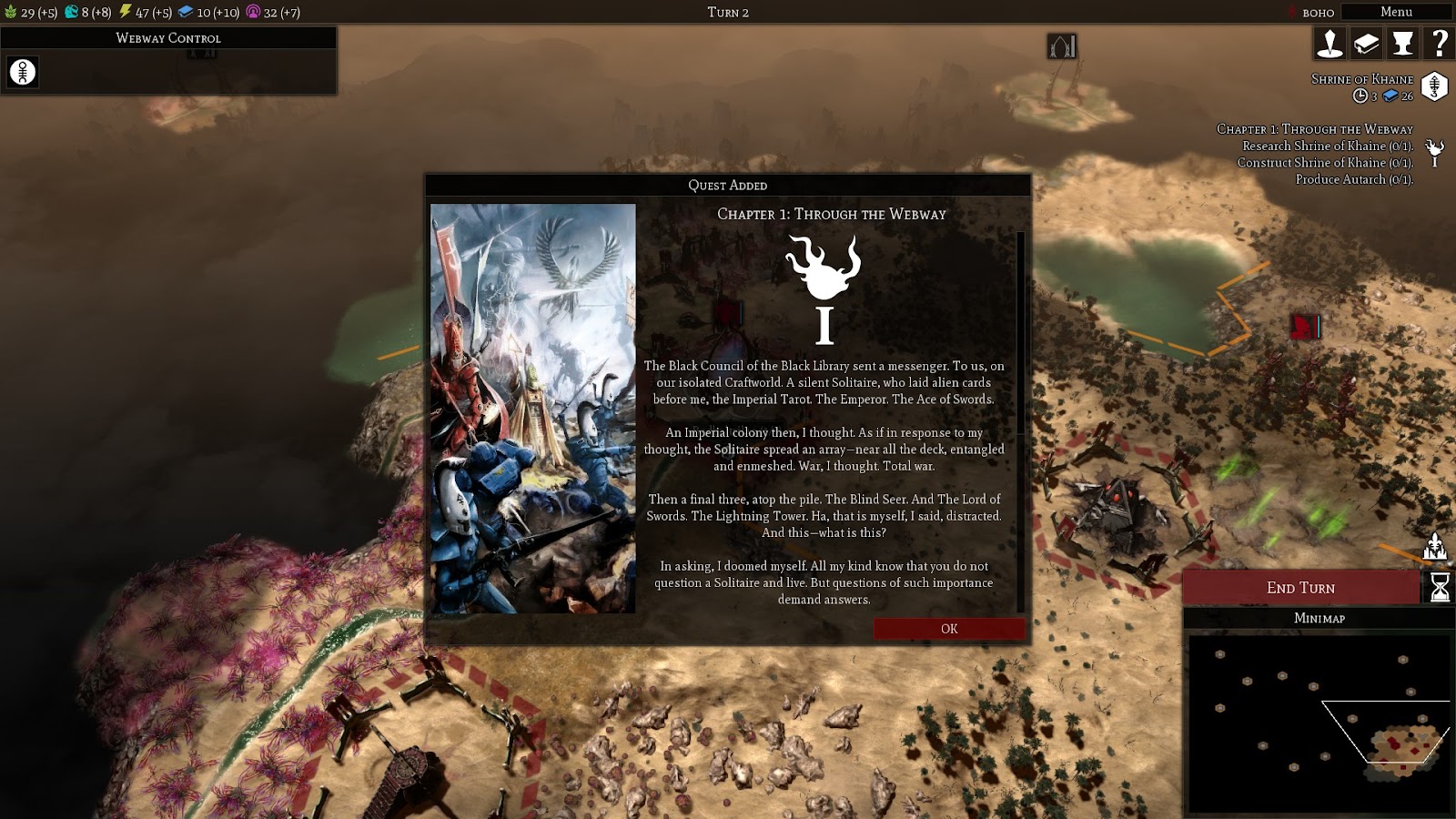
And the writing is actually pretty good. Gladius is sufficiently 40k-ish and wonderfully captures the spirit of each faction: The odd hints of lingering empathy in the genetic monstrosities of the Space Marines. The honor, victimhood, ironic humanity, and undermining hubris of the Necron. The primal violence and joy of the Orks concealing the fact they’re merely elaborate fungal spores. The dystopian horror of an unchecked military-industrial complex in the Imperial Guard, replete with the tacit question of whether such a life is even worth protecting. Within each is another statement on the human condition – successfully capturing the element of 40k that keeps people returning again and again to this lore.
And then there are the Quests themselves.
Gladius quests absolutely love spawning hostile neutrals on the map. Or on top of your army. Or right in the reinforcement route to the battle lines. Or, on your only city, when your army is mired in a battle line on the other side of the map, turn away.
Some of these are worse than others. They can range from a few low-tier Imperial Guard units to waves of relics which fire, as their default weapon, warpfire chain lightning, an ability powerful enough to be hero-only and require a multi-turn cooldown. And bizarrely, that chain-lightning-spawning quest comes immediately after the basic “build your base and research the basics” ones.
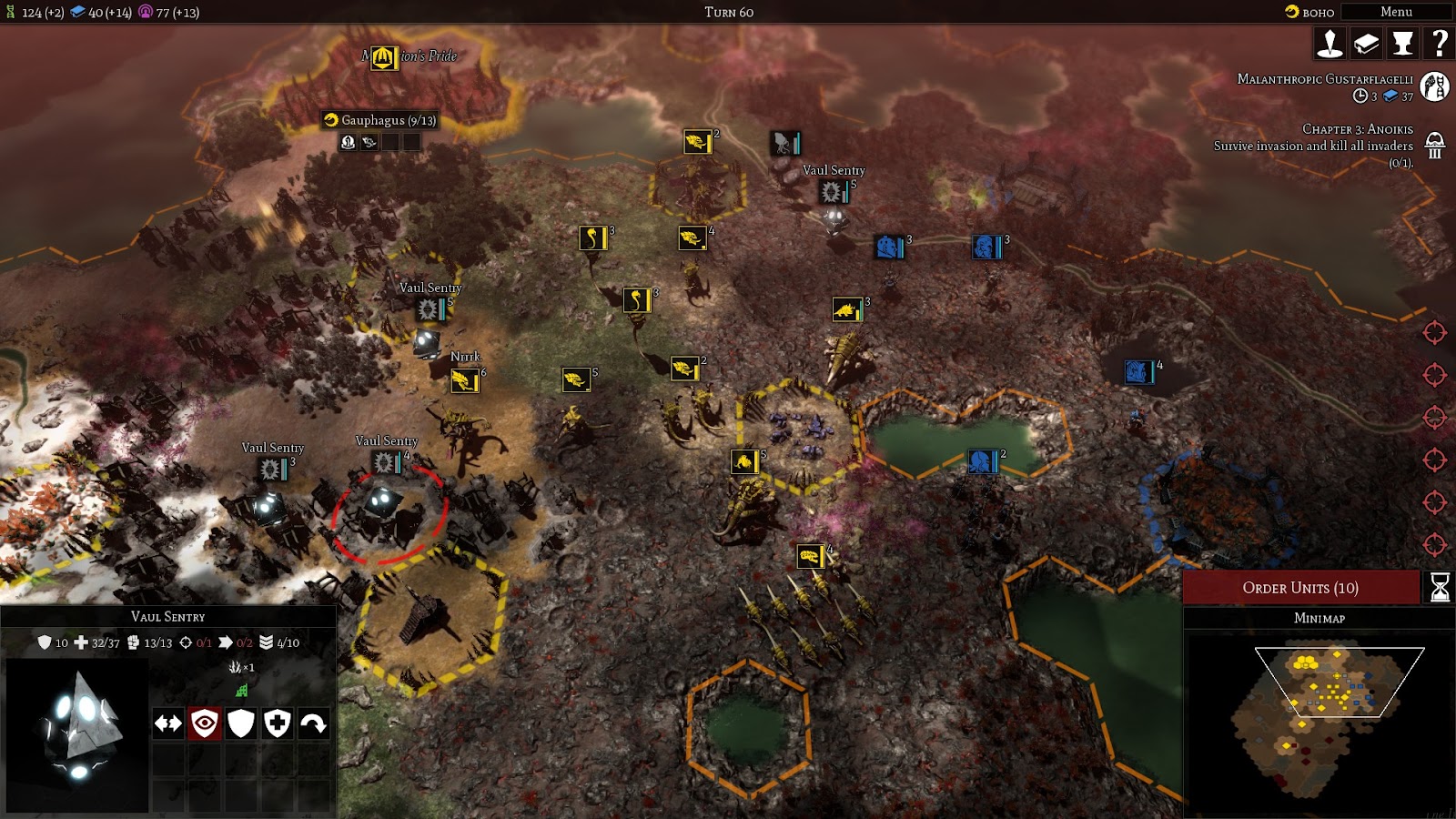
Regardless of the difficulty, these ambush events aren’t fun. Gotcha scripted events specifically designed to “surprise” the player were why people hated campaigns. They were never challenging, exciting, or dramatic. If they couldn’t rapidly be squished or cheesed, all they ever did was make the player restart the map – except this time equipped with psychic foresight to know on step 5 the game was going to conjure an army-deleting force from thin air next to your HQ.
Not all of the quests are this bad. Some spawn a new neutral faction base nearby with a modest starting army that behaves like any other AI, giving you a fair shot to reposition or build up and respond. Some are desperate last stands as you rush to deliver a unit across the map – crucially, with appropriate foreshadowing. When the prize is actually winning the match, this feels dramatic and fair. The stakes are appropriately high. One way or another, it’s the end of your game.
Multiplayer
Proxy Studios has shown great interest in balance – a surprising amount, really, for a turn-based game. This attention seems to have attracted an audience, as there’s still a small but active multiplayer community. I expect public game lists to be empty in most turn-based games, but randomly strolling in on a Saturday afternoon EST (to be fair, that’s around primetime for a good chunk of the EU) showed something like 20 public games open and available. So there’s good news for those of you who are interested in multiplayer: at the start of 2024, Gladius is
still active.
Conclusion
Here at the beginning of 2024, the state of Gladius is strong. The new factions have added an immense amount of much needed variety to the default Gladius roster, though they of course come with the caveat of extra price tags. Though it hasn’t outgrown some of its fundamental issues, it’s still absolutely worth playing.
But is it a 4x? Yes, but only by the skin of its teeth. That said, unless you very specifically want your turn-based strategy to come with diplomacy and multiple nonconfrontational victory conditions, it’s close enough. Don’t miss out on this great game – after all, more often than not, you end up doing a military victory anyway.
The Catalog
Relics of War
The base game. Of course, it’s required and only mentioned here because it goes on sale for 90% off quite frequently. It has four factions: Space Marines, Orks, Imperial Guard, and Necron. Without additional factions, it can feel a bit sparse, so I’d hesitate to recommend it at full price when you could grab it and a couple of DLCs on sale for the same cost.
Lord of Skulls
This adds the titular Lord of Skulls, a super unit that starts to spawn randomly after turn 100 or so. Killing it gives you a factionwide 10% damage reduction, which is quite strong but probably won’t represent a momentum shift.
It seems to spawn outside of starting positions but will gleefully knock over cities if they’re unfortunate enough to be in range of its wandering. Finally, where it appears is random, and it disappears after 10 turns only to return roughly 10 more turns later.
This was the first DLC for Gladius, and I’ll admit it gave me pause at the time —an extremely small DLC essentially asking three bucks for a new unit model? We can’t stop here; this is Paradox country!
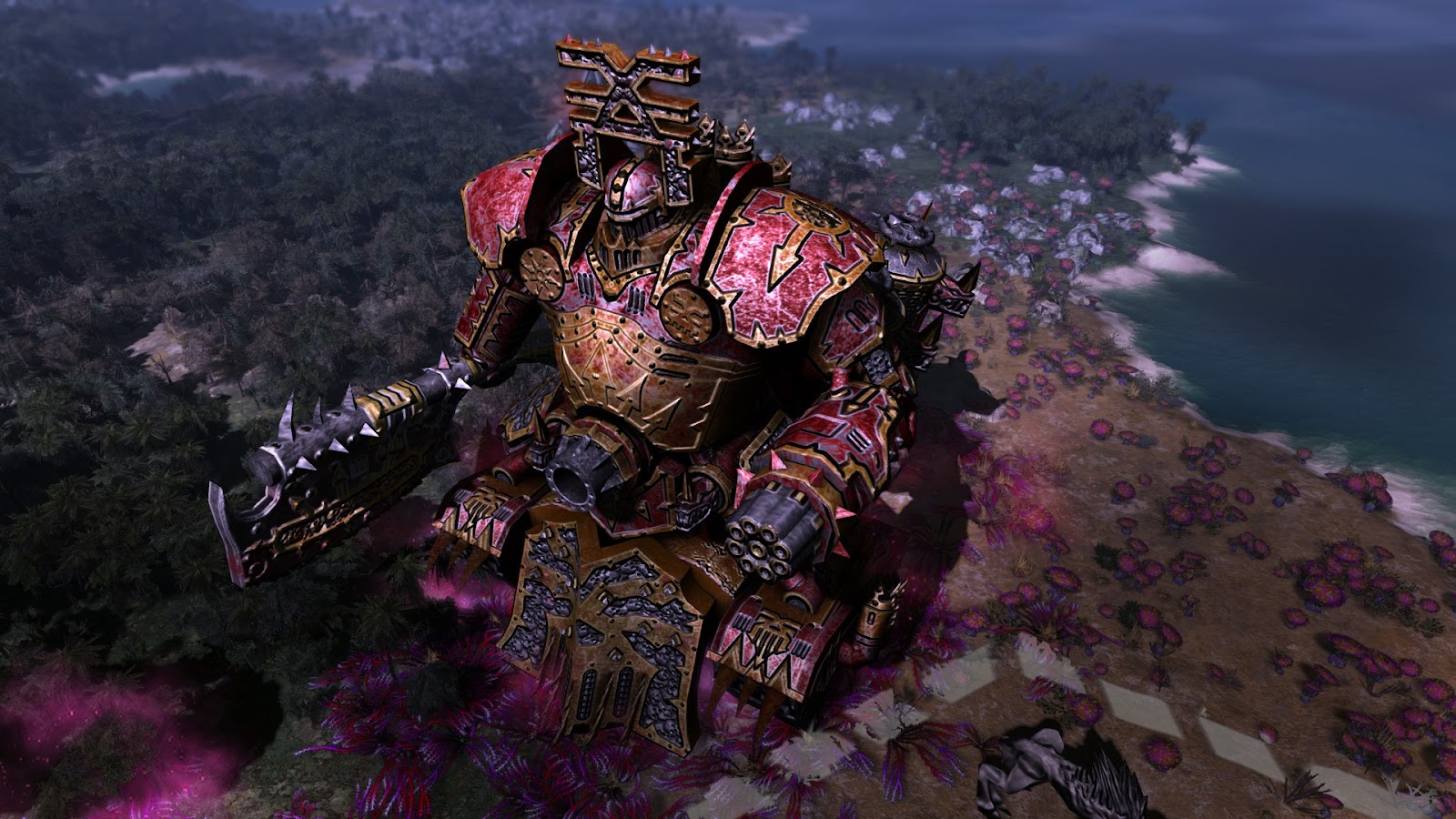
This guy takes a mid-game army to kill – enough, at the time, to wipe out another player, or at least knock down a couple expansions. Is it worth potentially decimating your own army to kill it when you could instead wipe out another player? That really comes down to the circumstances of the map.
While it’s an interesting option to have available, I wouldn’t necessarily recommend it. As far as I can tell the AI seems to pay it no heed whatsoever, so this really is just a player option. If anything, grab it on sale.
Reinforcement Pack
The first in the set of “unit packs” added one unit to each of the original four factions. And then an extra neutral, too, because why not? All future packs would follow this model of one unt to each released faction, though new Neutrals appear only rarely.
The units are debatable. While they cover gaps in faction rosters, in doing so they make the factions more homogenous.
Imperial Guard and Necron both get “medium” infantry units (Tempestus Scions at Tier 4 and Immortals at Tier 2, respectively), which are more heavily armored and sport weapons with more armor penetration than the basic infantry. These don’t really cover gaps so much as serve as direct upgrades to their basic infantry. While this was probably very helpful at the time, in my opinion, the factions don’t need these units with the other packs available in today’s Gladius and would be richer for going without these options.
Orks also get a medium infantry in the same vein, the Flash Gitz at Tier 4. They’re also ranged – a rarity for the Orks. Unlike the Necron and Imperial Guard, this makes them a new option for the Orks – and not necessarily a strict upgrade to anything. While it helps, it doesn’t overwhelm or replace – and for that it’s one of the stronger additions.
Space Marines get the famous Land Raider, a super-APC, all the way at Tier 9. Due to Space Marine durability, Apothecaries, and vehicle penalties in forests and ruins, I never found APCs to be particularly important to the Space Marines. I much preferred orbital dropping slow infantry into tactical positions instead of slogging through the battle lines. Plus orbital drops are available substantially earlier, in Tier 7.
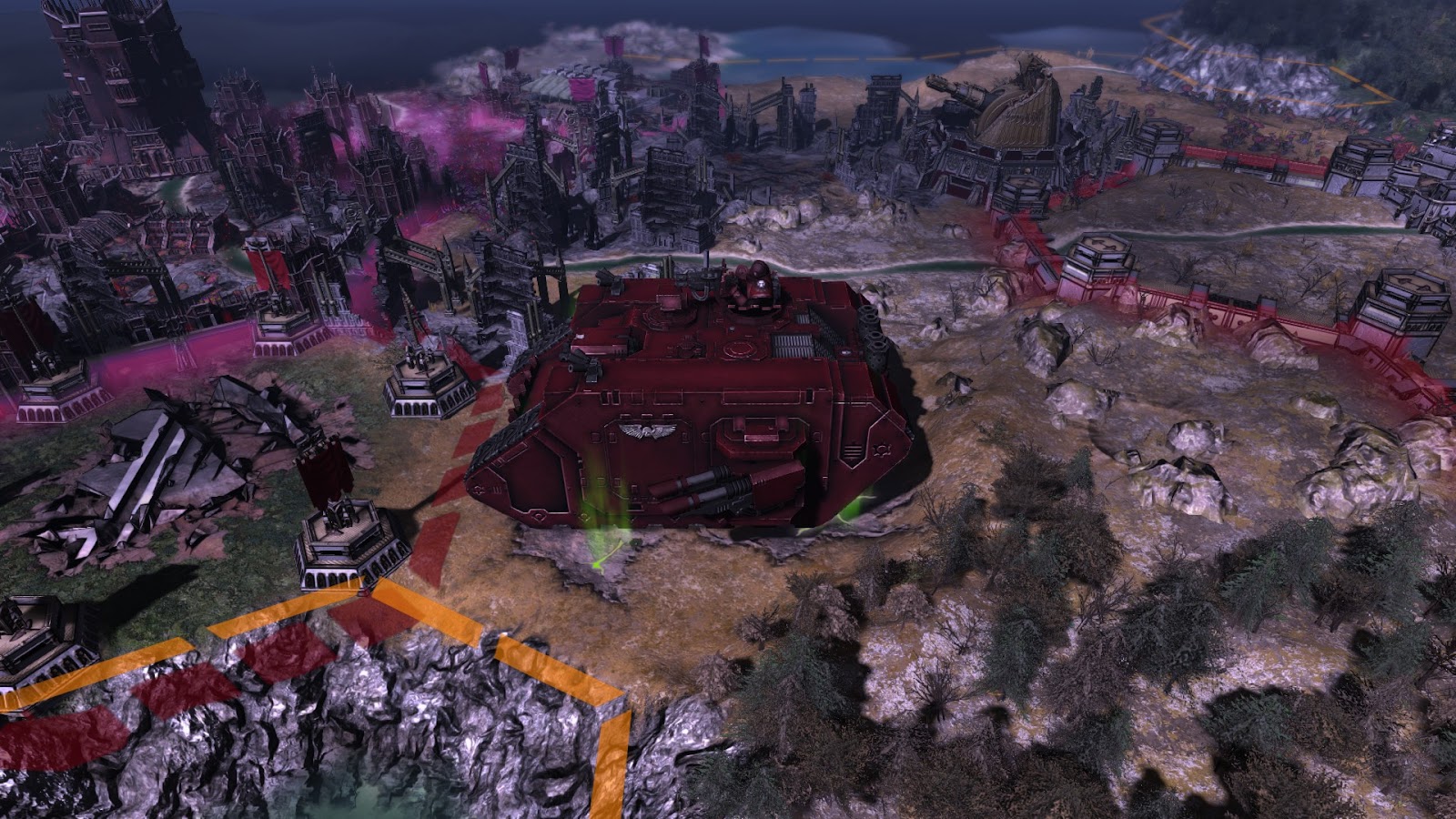
The Neutrals get Neophyte Hybrids, which are apparently rich in lore. While they’re talked up as having special features, I’ll be honest: I didn’t even know these guys were in the game until I played Aeldari. Before that, I’d always mistake them for regular Chaos Cultists. Either way they’re just a low-end barbarian, which means they’re at worst a speed bump for most factions. But if your starting units are exceptionally fragile, they can be a very nasty surprise with their damage boost to overwatch attacks.
New toys are always fun to play with, but considering the limited scope and the fact that a couple arguably cheapens the experience of the factions, I’d only get it on sale. On the plus side, the AI has no trouble utilizing these units.
Tyranids
The first faction pack is the notorious Tyranids, 40k’s very own Vermintide, except instead of a plague of rats this time it’s a plague of locusts. This hive mind eats planets – not just the crunchy, delicious other factions, but all biological matter on the planet. Of course, the Tyranids are biological, so this actually includes themselves. When the job is done, the planetside Tyranid are willingly converted back to liquid biomatter and extracted along with everything else.
In 40k games, Tyranids are usually represented as being just like any other faction, except green and slimy with some flavor text about the whole eating the planet – and themselves – bit. Not Gladius! Both are actually critical to your success with this race, and you’ll struggle mightily if you don’t play the faction like a semi-conscious lymphatic system.
Tyranid have three big gimmicks. First, they only have two resources: Influence, which represents your hivemind’s mental bandwidth and ability to exert its will, and Biomass, which replaces all other resources.
Second, you’re actively encouraged to eat both the planet and your own units. Your engineer unit, the Malanthrope, can devour any adjacent tile at the cost of Influence, instantly converting it to barren rock and immediately giving you a supply of Biomass equivalent to the amount of organic matter on the tile (basically, Forest on Grassland with a River is high, bare Desert is low, everything else in between).
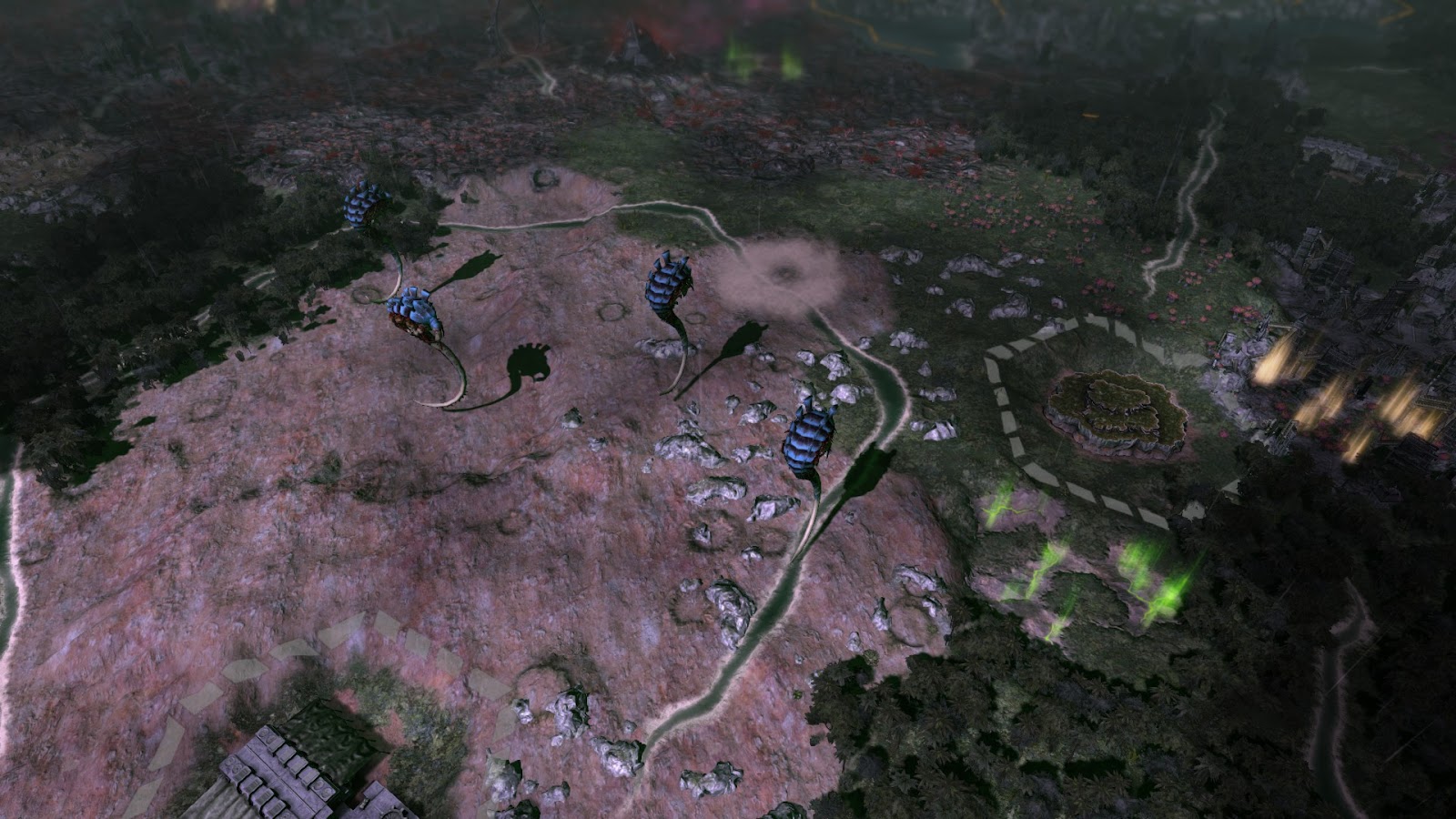
The self-cannibalization comes in with the option to devour your own units, which refunds half of the unit’s Biomass cost and half its Production cost. This refund allows you to accelerate any type of construction, plus you get the full refund regardless of how damaged the unit is. This isn’t just flavorful: using and abusing this feature is the key to Tyranid success.
Third, there’s the concept of Synapse and Instinctive units. This distinction is unique to the Tyranid, and impacts how morale is handled for most faction units.
Instinctive units are most of the Tyranid forces. These units are essentially mindless, only capable of basic instinctual responses like insects. Instead of their morale constantly recovering, it constantly decays, and many of them have very small max morale values, quickly leading to shaken or broken status.
You’re still able to command them – the morale collapse represents the fact you can still direct them in the broadest sense – but they’re disconnected from the hive mind, meaning they rapidly decay into a vulnerable, disorganized force. However, nothing prevents them from gaining or losing morale normally, meaning a series of winning encounters might keep an instinctive pack going by virtue of primal violence.
Synapse units are naturally connected directly to the hive mind, granting them two unique effects: complete immunity to morale (they’re always at max and nothing changes that) and the ability to transmit the hive mind’s will to adjacent units. This immediately grants adjacent units maximum morale and immunity to morale effects exactly like the Synapse unit. In short, they’ve connected to the hive mind. Moving away removes this effect, but at least their morale is topped off, meaning they’ll remain effective for a turn or two.
Finally there are Normal units. The Tyranid actually do have a couple units which simply obey the regular rules of morale and tend to have typical morale scores. Spore Mines and Zoanthropes would be two examples. That said, the Synapse effect works for Normal units just as well as Instinctual ones, meaning they can take advantage of the connection if needed.
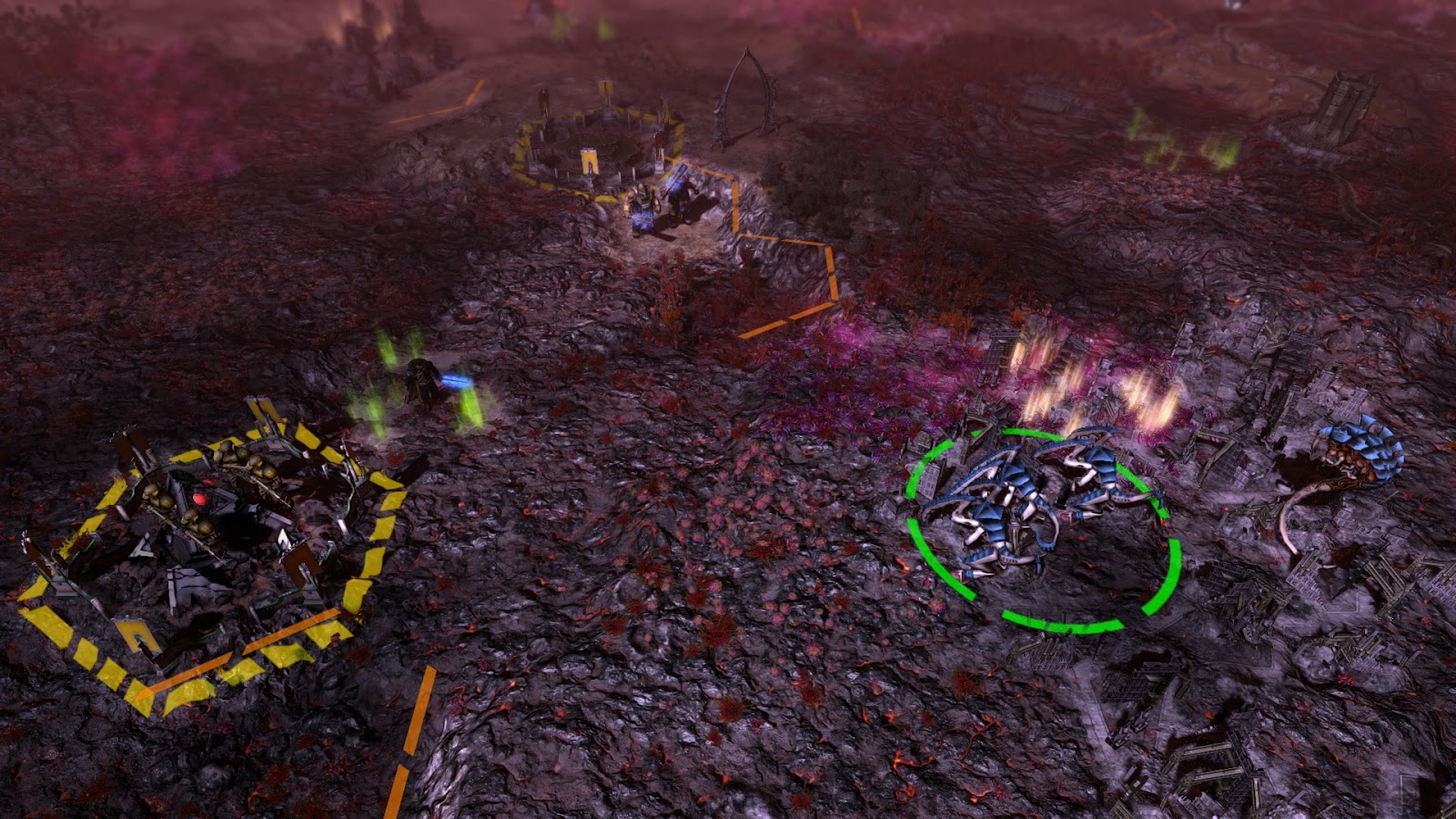
If you’re in a pinch, there’s a method of temporarily taking over an Instinctive unit by directly exerting your psychic energy – that is, spending Influence. This is the quite accurately named “Override Instinctive Behavior” command. It does exactly what it says on the label, though stronger units do require a larger Influence cost to override.
The actual Tyranid roster is predominantly composed of quick, fragile, hard-hitting melee units with Move Through Cover, meaning they’re able to upend the cover mechanic, turning a strength of regular infantry into a weakness. Though they are capable of wiping out even the toughest units in a flash, failure to do so often results in major losses, and charging a waiting overwatch line is often suicidal. They feel like a true locust swarm, appearing in huge numbers out of nowhere, descending onto a target, eating it in a turn, and vanishing into cover or out of range.
With a roster primarily of landbound melee infantry and monstrous createss, their main weaknesses are air power, skimmers, and long-range anti-infantry, like snipers or artillery. With few ranged units, most of which are slow and fragile, their anti-air capabilities are especially not very good.
Because of this, the Tyranids should look to decide the game by Tier 7, as any longer will begin to magnify these weaknesses. Tier 7 is also when the Trygon comes into play – the unit that can create Broodhives, giant tunnels that serve as point-to-point teleports for almost any Tyranid unit – meaning if they’ve managed to keep pace technologically, they’re capable of rapidly ending the game before it runs away from them.
Overall this feels like the first proper expansion to Gladius, and I certainly do recommend it unless you have absolutely no interest in the Tyranids whatsoever. However, the AI doesn’t seem to play them particularly well, generally making for an uninteresting and unchallenging opponent. For those who stick exclusively to single player, it doesn’t make sense to buy these guys solely for a new challenge.
Chaos Space Marines
I mentioned earlier I’m not a 40k scholar. What I do know about Warhammer mostly comes out of Warhammer Fantasy – and though many of the races essentially translate to futuristic versions of themselves in 40k, the Chaos Gods are a constant in both settings.
Personally, I’m all in on Tzeentch, the Changer of Ways, but they’re all wonderfully horrific in the same way the Greek Gods at their worst are alien, inscrutable, but also undeniably human. They aren’t remotely good but they’re not necessarily completely bad either – mostly they’re just selfish, imprisoned by the concepts they represent as much as they are masters of them.
The Chaos Gods may not be intrinsically evil, but evil sentients sure do love abusing the easy power accessible through service to the Gods’ single-mindedness. Enter the Chaos Space Marines (which I’ll shorten to “Chaos” for Gladius). These are 40k’s Blackguards, Shadow Knights, Anti-Paladins, Fallen Paladins, Paragons of Evil, you get the picture. Their origin story is arguably the framing structure for Warhammer 40k itself, so I’m not going to try to summarize it. You just need to know they’re evil, corrupted Space Marines.
Chaos strikes an excellent balance between the familiar and the novel, giving you a toolset you recognize: the Space Marines, but through a glass darkly. They’re weaker initially, but you’ll soon learn you’re able to both manually customize these units by using one of the marks of the four Chaos Gods (your pick), or indirectly, by researching Boons of Chaos and having the unit kill stuff. You may even witness your unit be overcome by warp energy and transform into something new.
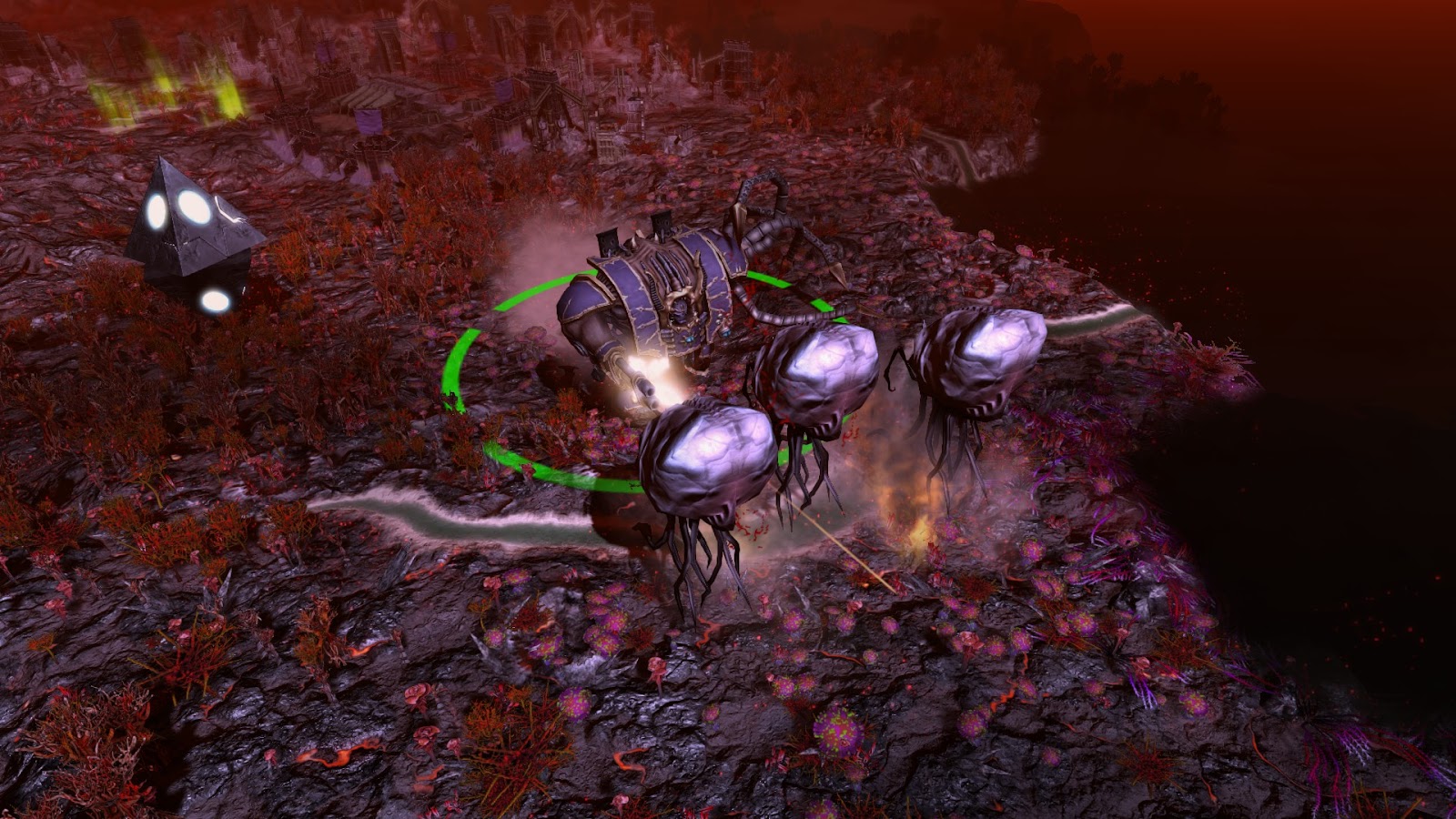
Chaos Boons are a suite of abilities that have a chance to be added to a unit with the “Champion of Chaos” ability when it gets a killing blow. Only human units on Chaos have Champion, so no other units can acquire Boons.
When a Champion gets a kill, there’s roughly a 1 in 4 chance for something special to happen. If that check is made, the most likely outcome is that a random Chaos Boon from the pool of those you’ve researched will be chosen and granted to the unit. However, if they already have that Boon, nothing happens. There are also substantially smaller chances that the unit will be overtaken by Warp energy and either ascend to a Chaos Prince, a Hero unit, or become a Chaos Spawn, which may or may not be a downgrade.
With the Mark and Boon mechanics, you can take a relatively basic army of rusty ex-Space Marines and turn them into unpredictable and varied killing machines. Boons can grant anything from the chance to heal half your total hit points on kill, an extra move point, or even extra attacks. Marks grant similar bonuses: more max hitpoints, damage reduction, additional attacks, and so on, but you have full control over these and simply spend a little Influence to apply them.
The system is a lot of fun to use, though I’ll put an asterisk next to it: Chaos Infantry depend on Marks and Boons. As a whole, they’re just not very good without them, and Boons are unpredictable. At best, you can stack your deck of Boons with selective research to increase the chances of specific Boons if you so desire. While Tier 9 has a tech that instantly grants any newly built low-end infantry a free unlocked Boon, it comes way too late to impact anything in a regular game and a single boon isn’t going to suddenly make Tier 0-3 infantry viable at Tier 9.

Boons really begin to flourish when used with Chaos’s heroes though, which are some of the best in the game. You have a total of four, and at least three are must-haves:
The Chaos Lord is a melee unit that radiates an aura which makes it more likely adjacent Champions will experience a Boon event (or transformation) on kill. The Lord also gets a flat damage reduction for himself, an “execute” type ability that vastly increases in damage if a target is below 50% hitpoints, and an amplified melee damage reflect. To give you some idea of what this all adds up to, I’ve watched the Lord of Skulls DLC boss destroy itself by swinging his stories-high cleaver against the Chaos Lord, leaving him on the brink of death but dealing over 90 damage to itself. Sadly the game didn’t give me the achievement for killing the Lord of Skulls since it decided it had killed itself and that it didn’t count. Or perhaps Gladius was as stunned as I was and forgot to.
The Master of Possession is a Psyker that can heal at the cost of his own HP and buff adjacent friendly units, but also summons permanent Chaos Spawns on kill and eventually can summon a temporary random Daemon every five turns, giving you one of your best category of units instantly. Being able to alter the numbers in a skirmish suddenly can turn a flirty scuffle into a full-blown rout that takes you all the way to the gates of the enemy base.
Finally, there’s the Daemon Prince, which can be researched and recruited as normal, or, rarely, spontaneously generated when a Champion suddenly morphs into one. Every four turns, the Prince can instantly grant a Champion one Boon selected randomly from your research pool that the Champion currently doesn’t have. Stack those other heroes high! He’s also fantastic at debuffing units, being able to use an ability with a range of 3 which causes Blighted (even more damage per turn), or blasting a unit in melee with a suite of debuffs (Blinding, Concussive, and Pinning, plus dealing damage), or deal a huge amount of damage against multi-figure infantry or open-topped units with his Poisoned/Flame/Template/Ignore Cover/No Escape breath attack ultimate.
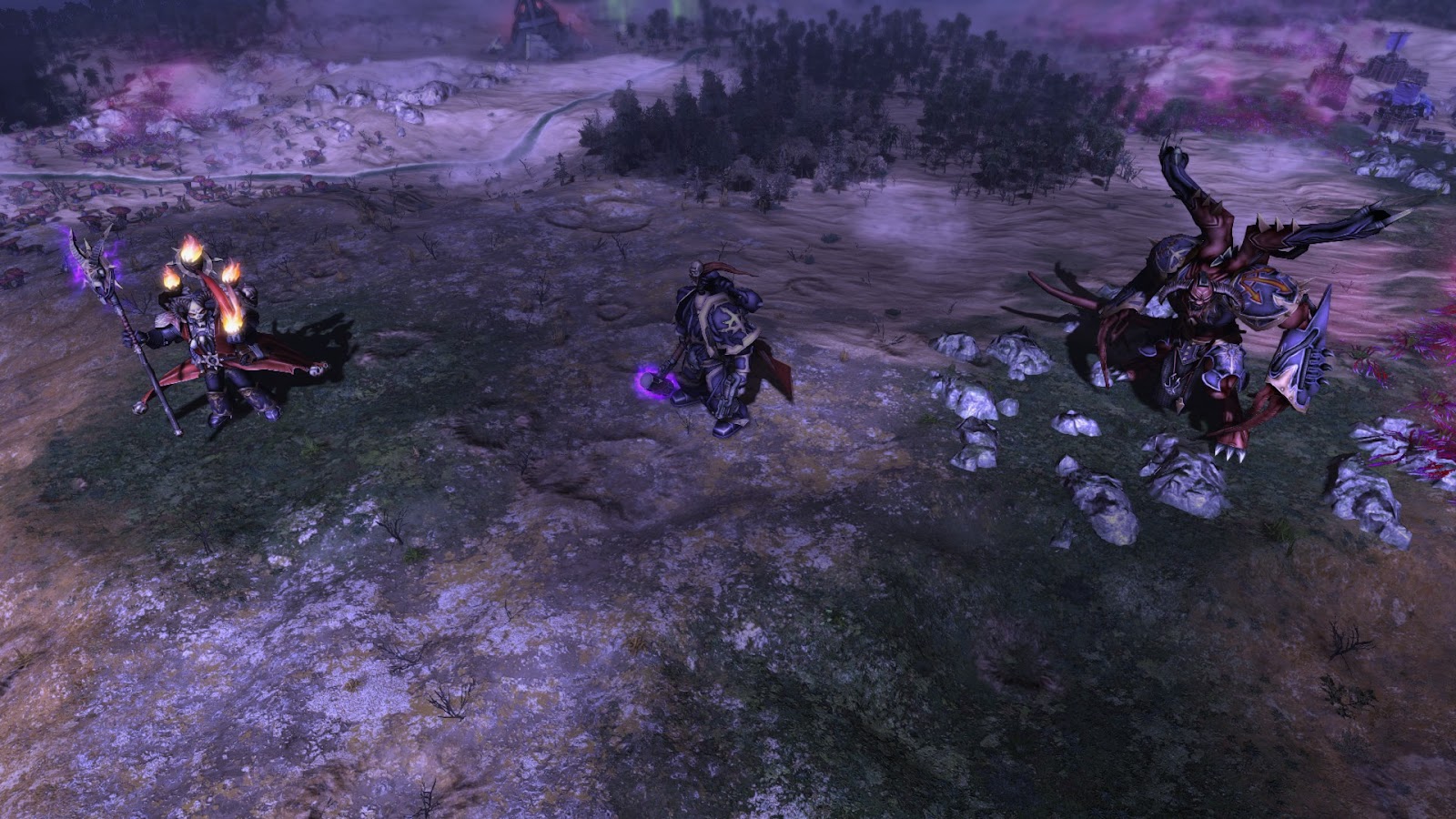
Chaos’s suite of Daemons and Vehicles – their heavier units – are nice but become much more impressive with unit pack addons. That said, the default set is acceptable, but there are holes in it. Ranged options are somewhat lacking; there’s not an anti-air option, and there’s no artillery. They only get one air unit, the Heldrake, which is a fighter-type Daemon that applies Soul Blaze (additional damage over several turns) and has extra defense against small-arms fire unless the weapon also has the anti-air Skyfire trait. For an infantry-leaning faction, Chaos also lacks any method of getting infantry across the water. This hasn’t changed with unit packs. It’s just a faction limitation.
While I feel like it goes without saying, I’d be remiss if I didn’t point out that Chaos cities can sacrifice their own populations in rituals to one of the Chaos Gods, granting that city some nice buffs. And sacrificing packs of cultists can help a city grow faster. But come on, it’s Chaos. Human sacrifice goes hand-in-hand.
Chaos Space Marines are a highly customizable (at least for Gladius) Hero-focused faction that’s a lot of fun to play and surprisingly unique even after all this time. It’s my personal favorite, and I highly recommend it. Plus, the AI plays them well!