Fortification Pack
Another unit pack, again with one unit per faction, but hey, now there are two extra factions. More value!
All the units are themed around – wait for it – fortification. Of the six, four are actually immobile structures deployed by engineer-type units with the Fortification trait, so they will capture and hold adjacent outposts automatically, like the original Space Marine Fortress of Redemption. The remaining two are a little special.
The Aquila Macro-Cannon goes to the Space Marines – an absolutely giant fortification that fires two shells with 5(!) range, which can hit up to 10(!) figures in a unit. You can even attach a suite of shorter-ranged Bolters to it with some research, giving it some self-defense (beyond the doomsday cannon, of course). It can even garrison units! The downside is it’s all the way at Tier 10.
Necrons enjoy the Gauss Pylon. This fortification is the final word in Anti-Air defense, with a range of 4, Skyfire, and a massive 24 base damage with 3 attacks and 6 armor penetration. Being Skyfire, it can also be used against hovering units with average accuracy, or ground units with even lower accuracy – but its high damage and number of attacks will still be felt by single-figure units. It’s also a late bloomer at Tier 10.

On the Imperial Guard side is the Void Shield Generator, a fortification that radiates a 33% invulnerable damage reduction vs. ranged at up to 2 hexes away. It’s also dirt cheap to place. It is extremely useful, both defensively and offensively (though enemies get the aura, too, so don’t place it too close). It has no weapons, though. This comes out at Tier 5, which means you may actually get to use it in a default game.
Chaos Space Marines get the Noctilith Crown fortification, which is complicated: first, it’s a light turret. Nothing that’ll kill real units, but any damage helps, and it could put a dent in weaker units. Second, it radiates 33% invulnerable damage reduction vs. everything, but only in radius-1. Third, it radiates a second aura, which damages non-Chaos psykers in a radius of 3 for 10% of their HP per turn. It’s also quite cheap to place, meaning it can be utilized in offensive sieges, and is available as early as Tier 4.
Orks don’t get a fortification. Instead, they get a new unit, the Big Mek, a more combat-oriented version of Meks that can’t clear tiles or found cities but comes with a radius-1 aura of 33% invulnerable damage reduction vs ranged and can still heal. Armor is also upgraded, but the Big Mek is a single-figure unit, meaning it has less health than Meks. It’s quite cheap to train too. I always sprinkle a few through Ork armies, assuming my research is up to snuff. The Big Mek is available at Tier 5.
Finally there’s the Tyranids. They’re granted another unit: Biovores. This is an Instinctual unit that doubles as shorter range artillery (Range 3) that’s best used against poorly armored but numerous infantry, and, of all things, a mine layer, also good against similar units. Though this sounds somewhat underwhelming, the Biovore’s big feature is Barrage: it doesn’t need line of sight to fire on a target, playing into the Tyranids’ strength of turning cover into a weapon. Biovores also appear at Tier 5.
Overall I’d recommend getting this one on sale. Tier 10 is appropriate for the big guns, but is rarely reached without customizing the rules. I’ve only once had reason to use the fortifications against the AI (the Imperial Guard’s Void Shield), and I’ve never seen the AI use any of the fortifications. It uses the units just fine though.
T’au
The T’au are an East Asian-inspired faction that’s a mashup of all sorts of things from the region such as mecha anime, a caste system named after the four elements, and appropriately cryptic, Sun Tzu-esque metaphors on the nature of combat strategy. And if all that was too subtle, in-universe, they’re actually from the “Eastern Fringes” of the galaxy.
Once upon a time, the T’au were the good guys of 40k: a multi-species diplomacy-first empire interested in walking softly and driving a really big mech. Of course, fans complained – 40k was supposed to be grim, dark, and grimdark – so Games Workshop began to weave a sinister undertone into the T’au.
Gladius does the sinister undertone of the new T’au very well. At the start of a match, the T’au appear to be what they say they are: diplomats interested in spreading their egalitarian philosophy called the “Greater Good.” But in things as subtle as tech flavor text, some cracks begin to show. Following the T’au story reveals even deeper ones, culminating with a short peek behind the mask.
However, it might be too on the nose: the newfound evil is Communism, and the parallels with the past 100 years of Chinese history become blatant. It feels a little icky given the gross injustices that have happened in that time.
Mechanically the T’au lean into their diplomatic nature and their philosophy of the “Greater Good.” Their Influence abilities can immediately generate any resource except Production, immediately add one population to a city, convert a Kroot Hound or Vespid Stingwing to your side, reduce a single target’s Morale, or reduce an enemy city’s Loyalty.
Their cities have the trait “Utopia,” which grants a bonus +1 Loyalty for each unique type of building in the city, but a -1 Loyalty for each redundant building in a city. To me, this suggested the T’au might be the first faction to be able to really go wide, but it didn’t turn out to be the case: Loyalty penalties from multiple cities are just too strong. Utopia actually turned out to make T’au better at going tall. You’ll still want some redundancy – extra unit production is unavoidable – but it’s a nice taste of builder-style play in the usually blood-soaked Gladius.

Turning toward combat, T’au units will reflect some damage while garrisoned in a city, again supporting a little more turtleish builder play. The “Greater Good” comes in with the fact that units often have ways of sacrificing individual glory for overall success. As an example, many units can give up their attack to shine a targeting laser on a target, increasing multiple units’ accuracy and adding range to missiles.
The defining mechanic of the T’au are drones. Nearly every T’au unit can deploy a drone as a free action on a long cooldown. The most basic are simple gun drones that shoot for extra damage. You can research advanced types which instead use targeting lasers, provide defensive buffs, scout ahead, or even do esoteric things like make a single hex completely impassable for a turn.
Though temporary and not super-strong, these drones can double the size of your army in a turn. That means double the targets, double the zones of control, double the number of overwatch-catchers, double the harassers, and flankers, and so on. Tactically it’s extremely powerful.
It’s also extremely tedious at scale. Going from 3 to 6 units? No problem. 20 to 40? Uh, wait. These drones last three turns, which is quite great, but also means a double-sized army for three turns. You can always disband drones like any other unit and clean things up, but won’t get a refund on cooldown or anything. Just a refund on sanity.

T’au unit power versus drone power feels fair, which is good because there really isn’t a counter to mass drone use. Gladius has no multi-tile damage effects. Fortunately they’re pretty fragile and their destruction can damage other T’au morale like normal, so just picking them off is sometimes enough.
As for recruitable forces, T’au put the “mecha” in mechanized armor. Their infantry is almost exclusively mechanized – specifically via battle suits, which have wonderfully anime names like the XV8 Crisis Battlesuit. These armored infantry are likely their biggest strength and make for great all-around units throughout the game.
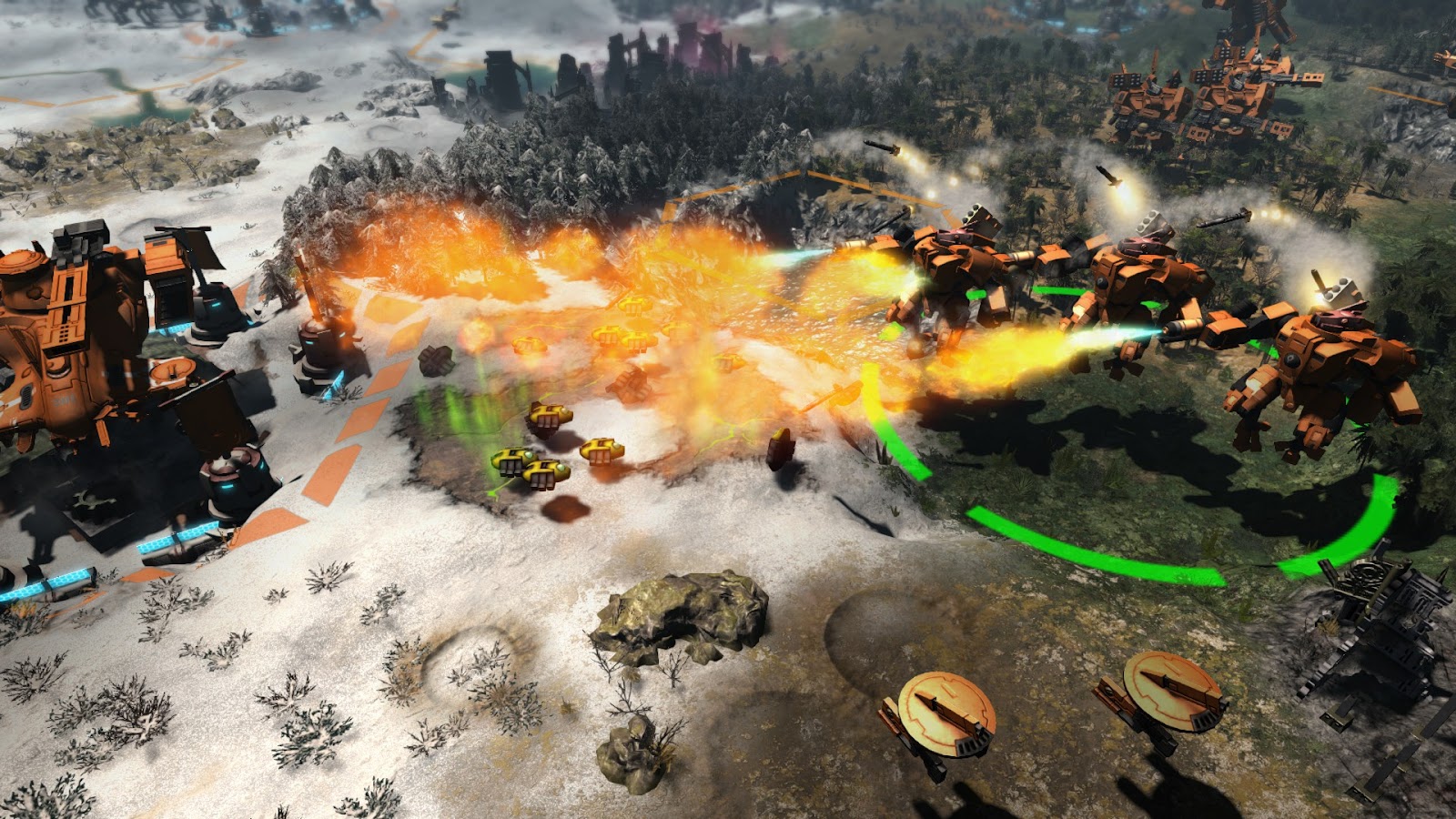
They’ve also got a suite of monstrous units – these being even bigger, stompier robots, piloted by teams of T’au and networked AIs. I found these to be substantially less impressive, but they can be produced in parallel with the mechanized infantry, so no great loss.
All types of battlesuits come with a certain number of System Slots, which define how many “Support Systems” can be plugged into the unit. This is quite similar to the Chaos Space Marines’ Marks system, though it offers more opportunities for mixing and matching.
I ended up having much less fun with Support Systems though – the earliest shows up at Tier 5, but the first generally useful one appears at Tier 7, and none of them ever have the punch of +HP or +Attacks like the Marks do. For how underwhelming some effects are, they simply appear too late in the tree.
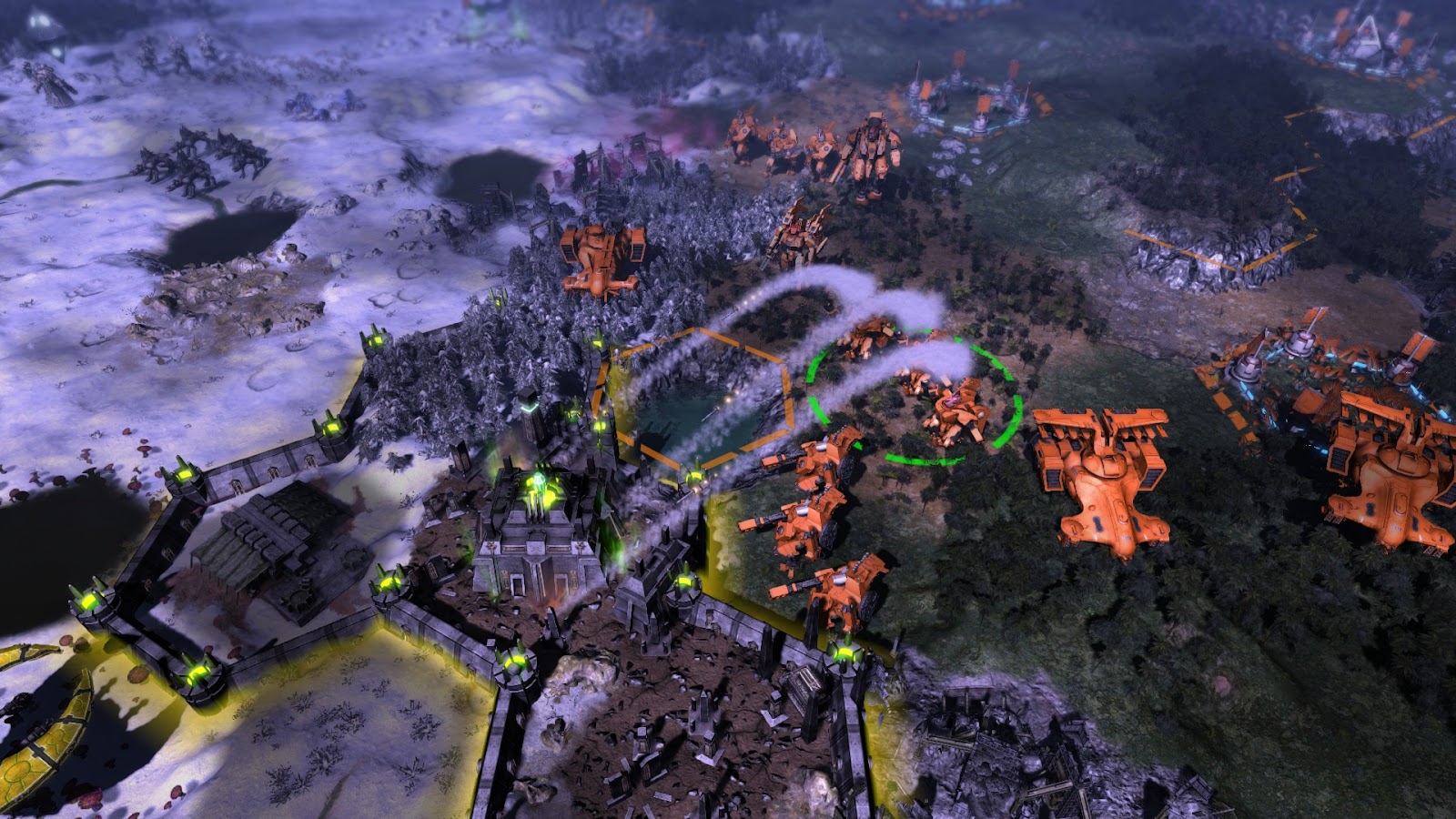
Their vehicle arsenal is, interestingly enough, all skimmers, meaning they have unparalleled mobility, especially over water, and unparalleled vulnerability to certain traits. In terms of air units, the T’au have two: a fighter at Tier 7 and a bomber at Tier 9, both above average in their roles.
While I’ll admit the T’au aren’t my favorite faction, I also have to admit they’re a very capable one, and I’ll still take them out for a spin now and again. The DLC is certainly worth it, especially since the AI is relatively good at playing them too.
Assault Pack
These units are all across the board in application, though there is a theme of early aggression. Anyway, roll up your sleeves, here’s the breakdown:
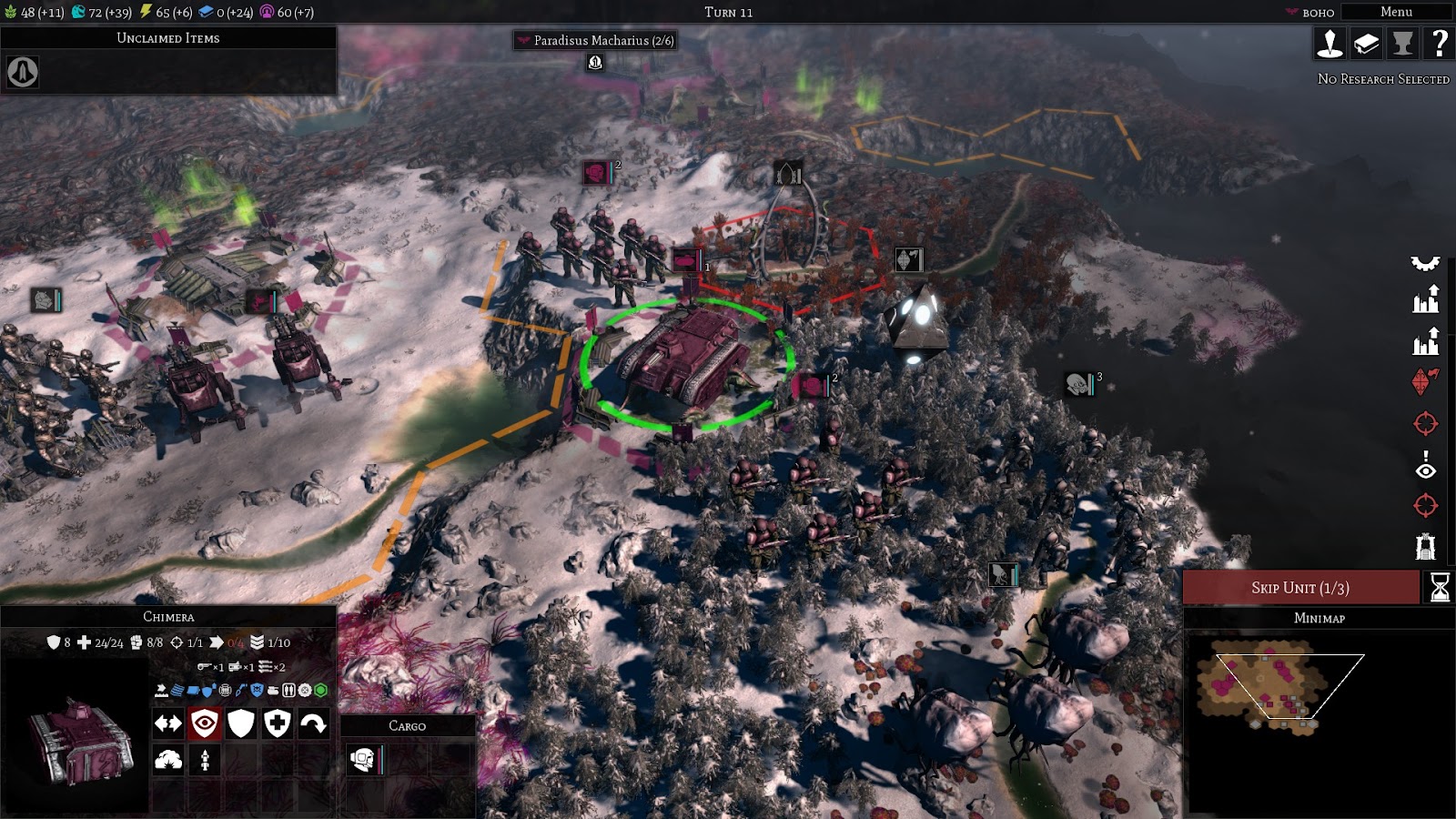
The Imperial Guard get the Chimera at Tier 1, an APC with two unique features. First, it starts to punch almost as hard as a light tank when its main weapon is “manned,” defined as at least one passenger in the APC. Second, any auras radiated by units will continue to be radiated if they’re inside the Chimera. I personally love this thing, and I almost wonder if it’s a little overpowered, given how early and rapidly it can be fielded. A complete game changer for the IG.
Tyranids get the Scythed Hierodule all the way at Tier 10. This is an endgame unit that, to be totally transparent, you will probably never use or see on the battlefield, given the average cadence of the game. Like other endgame units, it’s designed to be a generalist “closer” – the deciding factor in a long, drawn-out stalemate. It performs exactly as advertised – a devastating force of nature.
The T’au get the Tidewall Gunrig, a Tier 5 railgun turret. This one’s essentially a tank buster siege weapon: basically helpless on its own, it’s billed as being capable of devastating armor and monstrous units at range 3 when properly covered, but feels underpowered for being a slow, fragile Tier 5 with only range 3. You’ll probably need several to really pick off armor.
Up next is the Orks, who get the Warbiker right at Tier 1. The Warbiker is a move 5 skirmisher that does both melee and ranged damage at melee range. Like most Ork units, they’re fragile and cheap. Though there are allusions to what sounds like smoke screens in the description, what the unit actually has is the ability to consume its action for +2 move and 17% ranged damage reduction for a turn. Since it consumes their action, it’s really only for repositioning or hastening to the front. To be honest, I never used these guys and was using Warbuggies and Deffkoptas by the time I started skirmishing. It’d be useful for early aggression or low-tech games, though.
The Flayed Ones join the Necron roster at Tier 1. These are fast, devastating melee units with Infiltrate (which doesn’t trigger overwatch) that lack the durability of your typical Necron. Most of their power comes from their sheer number of attacks – 10 at full health, to be exact – combined with the fact that melee attacks deal full damage to targets in cover. These guys are one of my favorite Necron units to use – having a few lurking in cover on a flank can be utterly devastating, meaning they stay relevant much longer than their low tier would indicate.
Finally, in an odd turn of events, the Space Marines and Chaos Space Marines swap technology. Chaos comes out ahead in this trade, getting the Chaos Land Raider at Tier 9, which is… a Land Raider, except chaotic. Space Marines get a Tier 1 APC, the Razorback, which is a more orderly version of the Chaos Rhino. While these are different units – the Land Raider has a Multi-Melta, the Chaos Land Raider has a Havoc Launcher and a bunch of knives glued to the hood, to be totally honest you’d need a side-by-side breakdown of each to see how they differ.
Assault is a very strong pack in my opinion, especially considering the AI actually fields all of these units. Definitely worth it.
Craftworld Aeldari
You probably know them better than the Eldar, but that name stopped being used in 2017 because it’s literally straight out of J.R.R. Tolkien. In what I’m sure is an absolutely, positively, unequivocally, complete, and utter coincidence, 2017 is also the year Amazon got the rights to Lord of the Rings.
They’re space elves. Specifically High Elves, for the WFRP or Total War: Warhammer fans.
“Craftworld” Aeldari are named such because they live on giant interstellar trade ships, which turned out to be convenient for them because they were away on a business trip when the nascent Chaos God Slaanesh ate their entire civilization.
In Gladius, the Aeldari are designed to be counter-punchers. Their strategy is as classically elven as it gets: always be in the trees, and always get the first shot since you hit extremely hard. Lure enemies into ambushes because if they get the first shot, you’re screwed: the Aeldari, again in classically elven fashion, are made of wet tissue paper.
There’s more that plays into this role of agile skirmishers. Many units have +1 Movement, meaning they can travel long distances quickly, and many also have the ability “Battle Focus,” which is described as “Actions do not consume movement.” That’s somewhat misleading, though, since you only get one move action per turn. If, like me, you had dreams of moving two hexes, attacking, and then moving two hexes back into cover, that’s not how it works.
What Battle Focus really means is you can counter-punch twice in a row: once with your overwatch during the enemy turn, then in the following turn, immediately attack again while still being able to reposition. It’s extremely powerful, just be careful not to start taking it for granted – you can wind up with some units badly out of position because you assumed they had Battle Focus.
Though the Aeldari are listed as a “Medium” difficulty faction, I’d argue they’re actually the most difficult faction in the game all the way up through Drukhari, requiring quite a bit of experience to survive their early game. Your starting uses are fragile, so you need to take good care of them, but that doesn’t mean you can afford to spend several turns healing because you ate overwatches or over-extended. And, of course, you can’t play passively, either.
They also have a range of only 1 – melee range. Thus, you’ll need to know the nature of each different neutral, how they fight, how many to expect, and how to hold your attacks for overwatch more often than going for alpha strikes.
Unloading some rounds at range to weaken Vespid Stingwings ahead of time and pull all their other friends out of hiding isn’t an option here. Mowing down Kroot Hounds may stop your outposts from being decapped, but angering a species with Infiltrate too early is unwise when your main defense is Overwatch.
Survive the initial bumpy road, and you’ll eventually be able to field some impressive units. The Wave Serpent is one of the most impressive APCs in the game, and the Aeldari’s Battle Focus makes popping in and out of the APC to dodge a turn of retaliation a very strong tactic.
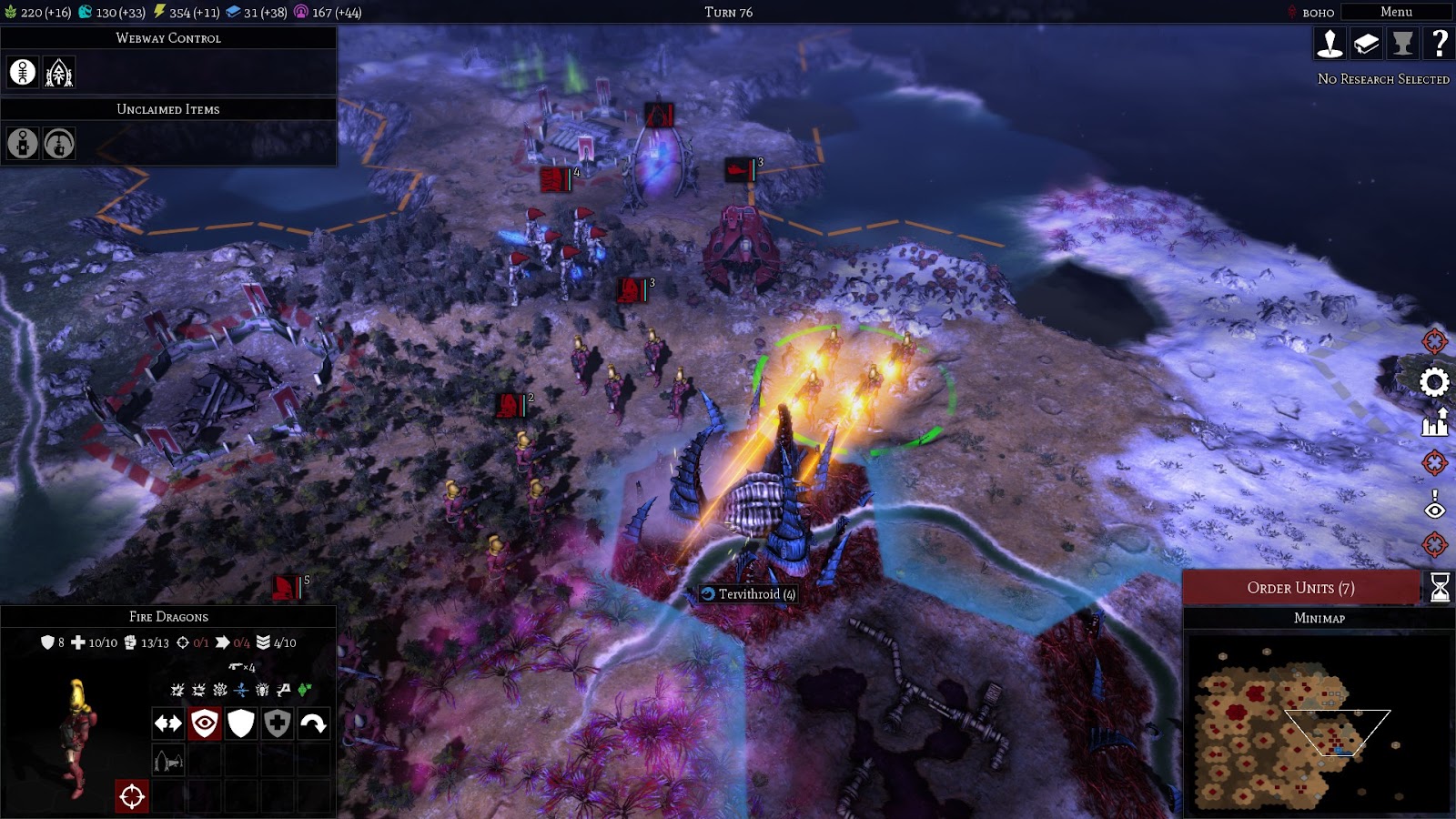
Fire Prisms use the Prism Cannon, which functions as a Lance, meaning they stay relevant throughout the entire game. Wraithblades are extremely durable melee infantry and War Walkers are strong, flexible walker units that are useful in nearly any situation. And unlike most factions, the Aeldari’s first air unit is not a fighter, but actually an anti-armor unit – another lancer like the Fire Prism, it’s not a bomber exactly, but it’s just as lethal against armored ground targets as armored air units.
However, the Aeldari do have a major limitation besides their early game challenge: Webway Gates. Scattered across the map semi-randomly, gates can be activated for a small amount of influence, which enables Aeldari units to teleport between open gates for an additional influence cost per unit. Teleporting requires and consumes the unit’s action.
You actually begin the game knowing the location of all Webway Gates on the map, letting you pop any of them open on demand. Most importantly they double as the foundation of all Aeldari cities – and most problematically, they can be destroyed.
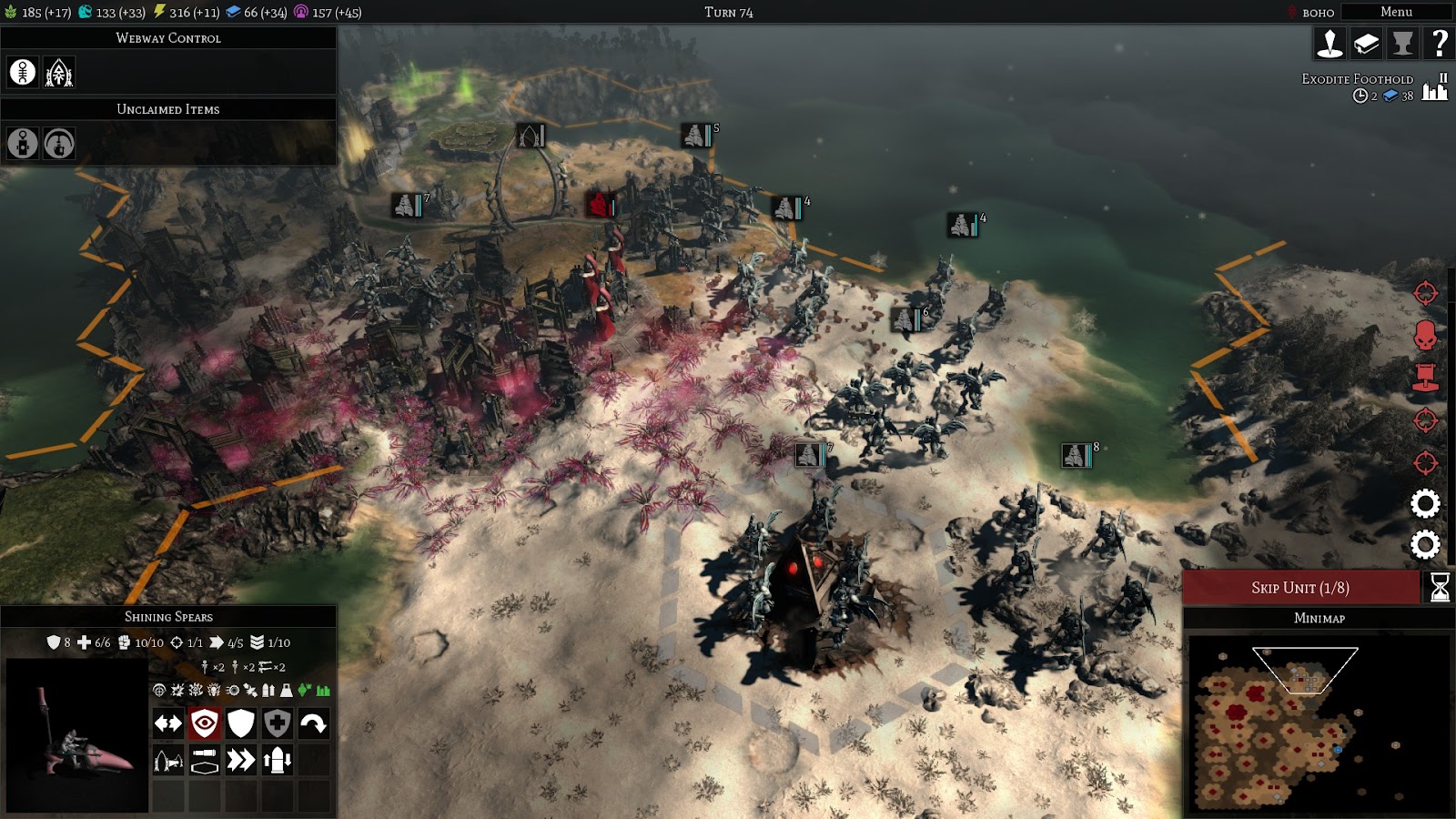
This in itself isn’t unusual. What is unusual is that once a Webway Gate has been destroyed, there is no way to bring it back. You will never have a city there. Why not just open the gate and send units through to defend a spot you want? Because honestly, you won’t get the chance. The gates are absurdly fragile, collapsing permanently in just 2-4 hits from starter infantry.
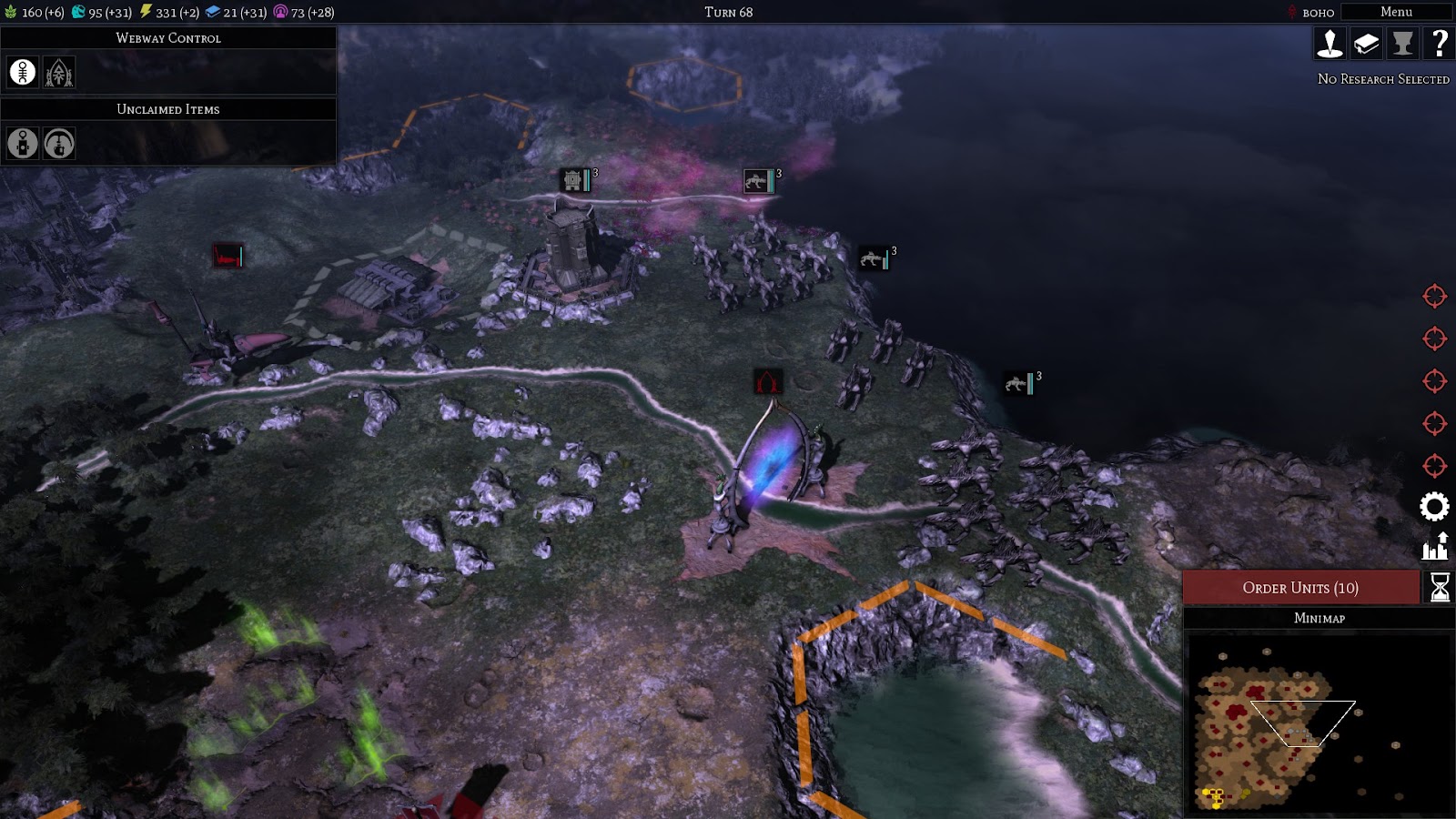
AI opponents are also coded to destroy gates on sight, targeting them to the exclusion of anything else. If you activate a gate to gain line of sight around it and grant yourself an early warning to gate in preemptively, the gate becomes a valid target for Neutral units, ending in its rapid destruction.
The problem here is a lack of realistic counterplay. Remember, using a gate requires and consumes a unit’s action, meaning you can’t immediately defend the gate. Since the AI ignores everything but the gate, defenders aren’t much use if they can’t shoot til the turn after.
Essentially, you’re going to have to live with half of the gates on the map being gone by the time you’re ready to make a second city. On the plus side, the destruction of a neutral gate does give away an enemy position.
So, do I recommend it? My answer would have to be “Yes, but…”
If you’re buying factions one at a time, I think it’d be wise to leave Aeldari for last. If anything, the Drukhari is more accessible despite being rated “Hard,” and prepares you to enjoy the Aeldari better than any other faction. They can be frustrating – and at times downright unfair due to an unlucky random map – but they’re hardly weak at all once they have their feet under them.
Specialist Pack
Feeling special? The gimmick with this pack is gimmicks: each of these units has a unique ability or twist that are unique to the faction, often not filling a missing role, but creating a new one.
Of course, the first on the list has to be the exception to what I said just to spite me: the Imperial Guard gets Ratlings, granting them a sniper right at Tier 1. The Ratlings’ twist is they can move after firing just like the Aeldari – that is, they can move after firing only if they haven’t already moved that turn. A nice ability to have on a sniper!
The psychopaths from the distant past called the Chaos Space Marines get Dark Disciples at Tier 2, whose gimmick is standing next to things. This means that they emit a radius-1 damage reduction aura. They also get cool-looking whips. Sadly that’s all those whips do, as these guys aren’t much stronger or tougher than regular Chaos Cultists – minus getting their own aura, of course.
The Aeldari recruit the Warlock, who are a Tier 5 Psyker melee infantry that can warp to any currently revealed tile on the map. They hit hard, can self-buff to hit harder, have a flat 50% damage reduction in lieu of any armor, and, with research, can use “Cleansing Flame,” basically the equivalent of a psychic Flamer attack that applies Soul Blaze for extra damage over time as well. They’re nasty little fellows but may come online a little too late to help an especially rough early game.
Necrons get the extremely obnoxious Canoptek Wraiths at Tier 5. Though they’re infantry, they behave more like a helicopter, ignoring terrain and zone of control to hit whatever they want within range – with the sole exception of cliffs, which they still have to go around. With some serious built-in damage reduction (in-lore they’re dimensionally hopping around, letting them ignore some shots) they’ll easily shrug off quite a few Overwatches as well. If they have a weakness, it’s that they’re melee attackers: despite looking like they’re flying, they’re actually completely vulnerable to fliers as they simply can’t hit them back.
To the Orks goes the Kill Bursta, a superheavy tank that doubles as an APC. The gimmick is it has Ignore Cover, meaning it’s extremely maneuverable considering its size and making infantry drops into cover a cinch. Though it’s all the way up at Tier 9, meaning you probably won’t see it in an average game, it’s extremely cheap and quick to build for a Tier 9 unit, so it’s easily massed. And if you make it all the way to Tier 10, the Grot Riggers technology will cause Kill Burstas to start regenerating health as well.
Devastator Centurions come out of storage for the Space Marines, and they’re a doozy. Though they’re only three to a squad, they’re walking fortresses – and despite the Twin-Linked Lascannon and Krak Missile Launcher each carries, they never take penalties for moving and firing a Heavy weapon. They’re also available at Tier 8, meaning they might actually see the light of day in some average-length games. These are scary enough against vehicles and cities, but their gimmick comes in a second tech, the Omniscope, which allows them to ignore ranged damage reduction for one volley once every five turns. With the Omniscope, they’ll rapidly live up to their name.
Back on the lower-tech end is the Krootox Rider for the T’au, available at Tier 3. These guys had the brilliant idea to turn the Krootox – not to be confused with Kroot Hounds – into rideable weapon platforms by attaching guns to them. Their gimmicks are ignoring overwatch, a unique bonus to ranged damage reduction in forests and looking as dumb as they sound. Lucky for them, they’re cheap, and the T’au needed an Infiltrate unit.
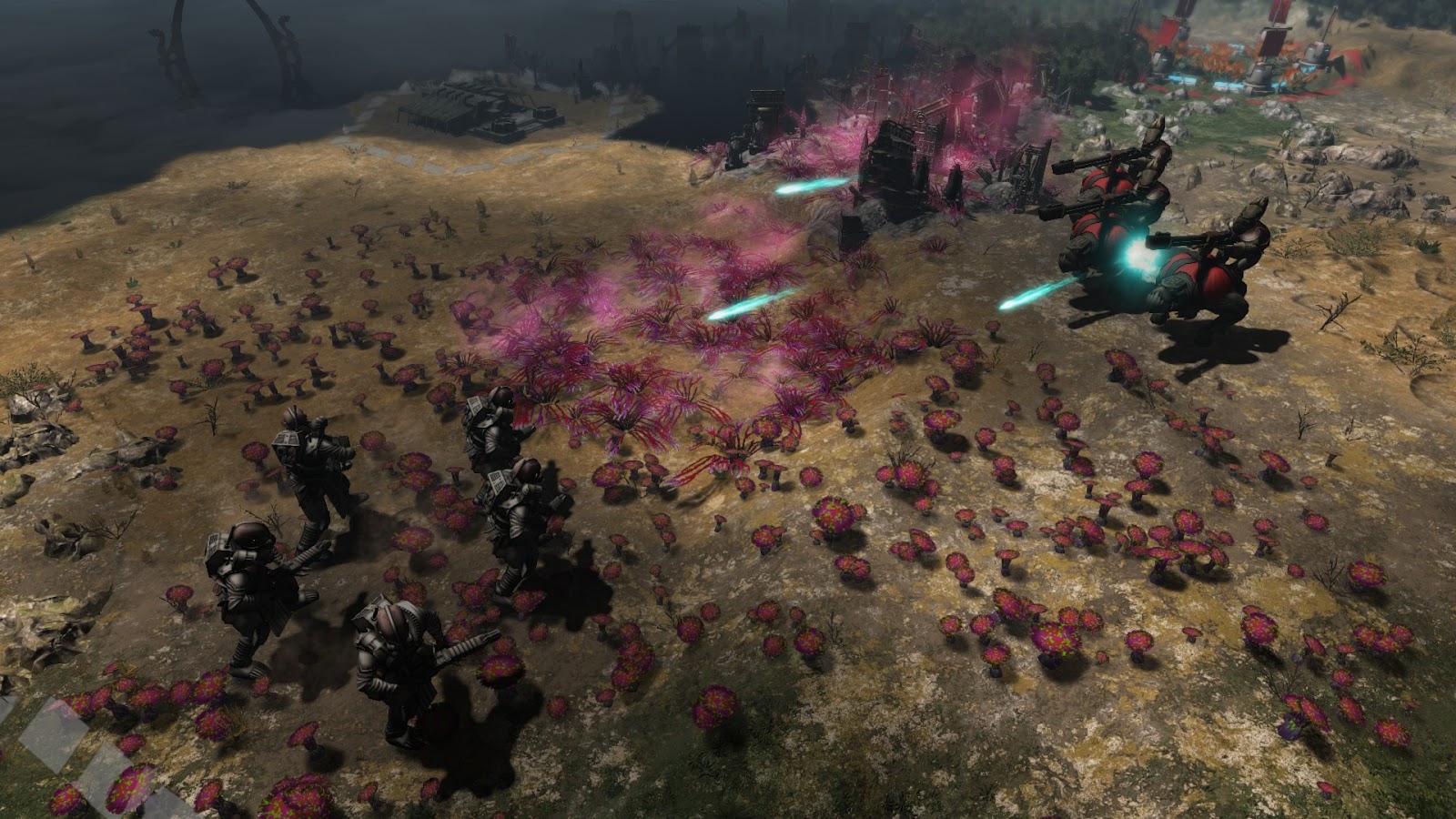
Doomed to the bottom of the suddenly alphabetical by faction DLC description is the Tyranids, who get the Tier 3 Venomthrope. Sort of like Chaos’s Dark Disciples, these guys specialize in standing next to things, giving Tyranid units in radius 1 some ranged damage reduction. They also get the Tyranid equivalent of a Flamer: Toxic Miasma is a Template weapon with Ignore Cover, but it’s low damage. This damage does increase noticeably against infantry thanks to the Poisoned trait, but don’t go expecting Flamer results on a beer budget.
Is the Specialist Pack worth it? Honestly, it’s a rather weak pack overall. Warlocks, Devastator Centurions, and Canoptek Wraiths are all great, and Ratlings are OK. The rest are quite frankly duds. That makes this a pack of extremes – 3 great units, 4 duds, and Ratlings. My recommendation would be to wait for a sale and only then buy it if you really enjoy one of the factions who got a decent unit.
Adeptus Mechanicus
Though they serve the Imperium and the Emperor himself, the Adeptus Mechanicus are really an empire of their own, based on Mars, whose interests happen to align with the Imperium at large. At least, most of the time. Though they willingly recognize the Emperor as the one true ruler of mankind, they actually don’t worship the Emperor as a god as most of the Imperium does, instead sticking with their ancestral Martian religion of worship of the Omnissiah, or “Machine God.”
The Imperium, generally fanatical about eradicating heresy, turns a blind eye to the entire Mechanicus at large, while the Mechanicus, for their part, pay lip service to the notion that the Emperor is the Omnissiah. So that way it’s not technically heresy. Why is Mars given this rather massive exception? Simple: they make all the Imperium’s war machines.
There’s a lot more to the Mechanicus, and the DLC does a good job illustrating their strengths and weaknesses as a culture. As literal machine worshipers, the Mechanicus eagerly replace their human flesh with mechanized parts, but also see technology as holy and necessarily infallible and beyond reproach. Thus their “research” has nothing to do with innovating, and everything to do with attempting to recover sacred data from a past technological golden age.
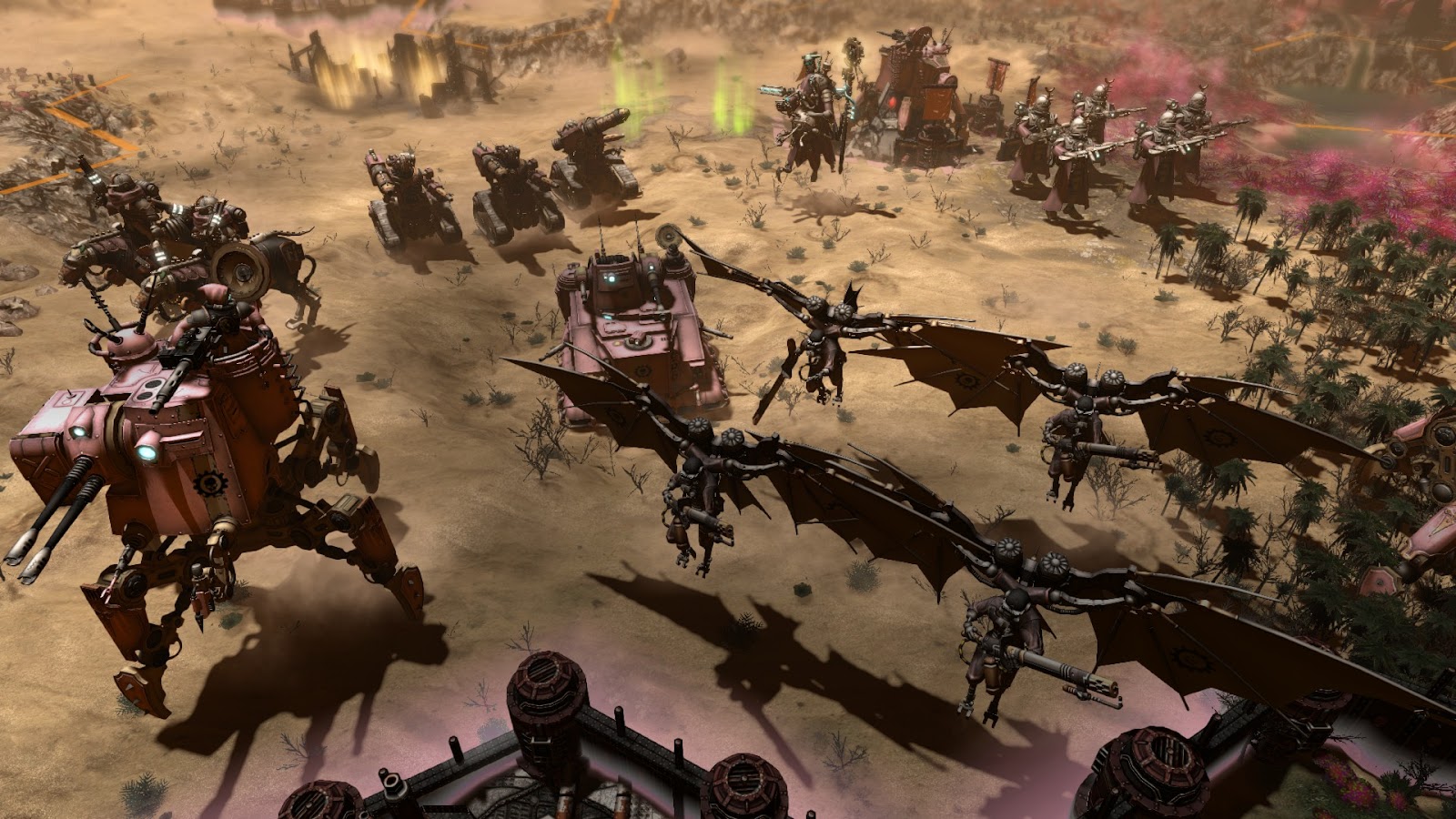
In Gladius, Mechanicus infantry are granted flat damage reduction to represent the fact they’re no longer entirely squishy flesh, but rather more machine than man. Since they’re no longer capable of innovation or creative thought, their research takes substantially longer than other factions.
Representative of their entirely linear thinking, Mechanicus cities grant resource and production bonuses to buildings when placed in hexes with other buildings of the same type (for instance, multiple Farms in the same hex), while actively penalizing buildings of different types being in the same hex. Further, efficient use of space is rewarded – with research, buildings can gain bonuses based on the total number of buildings in all adjacent hexes.
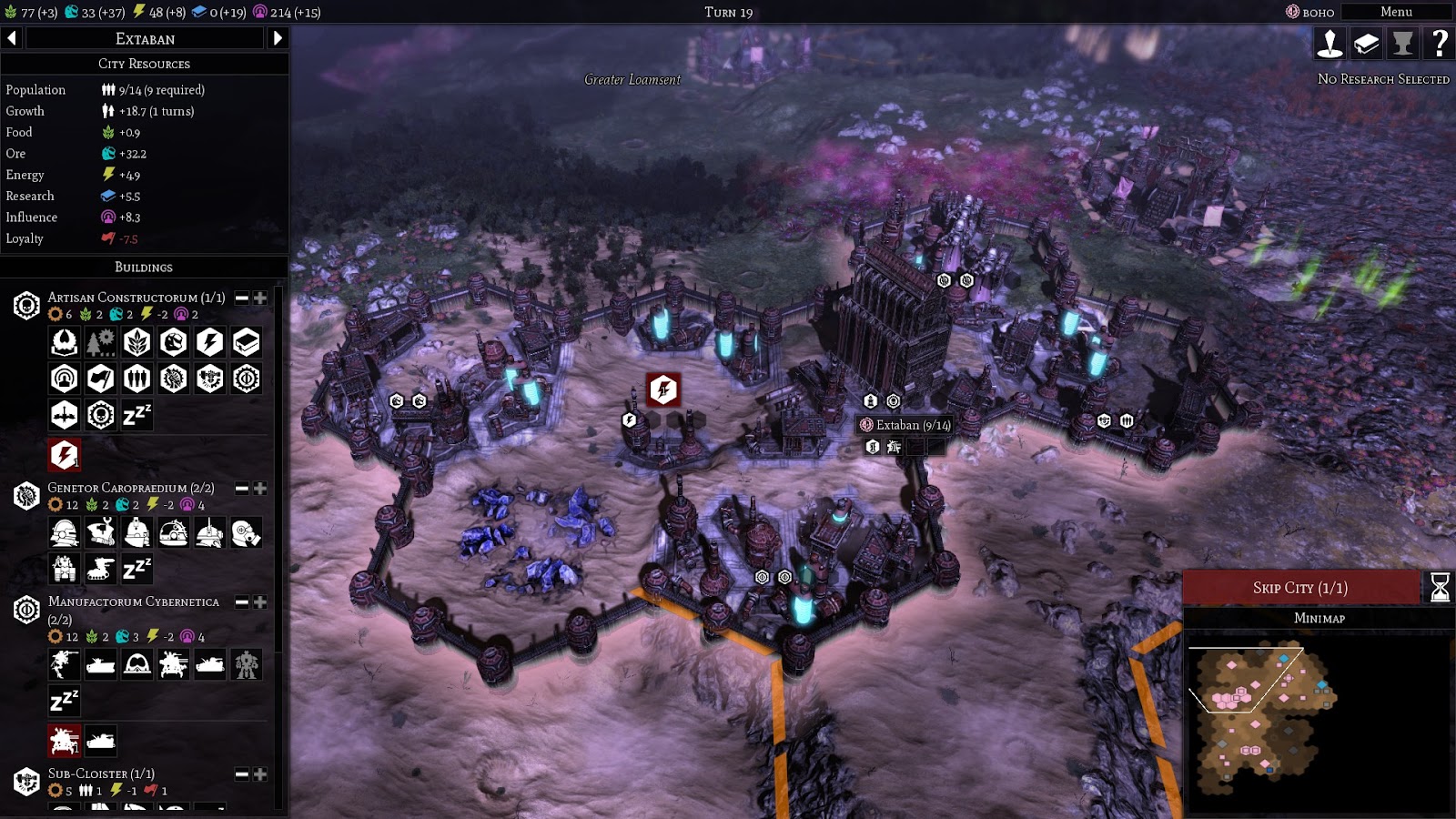
The Mechanicus get a suite of global abilities listed under “Glory of the Machine God,” which are essentially litanies, prayers, chants, and so on for units flagged as “Canticles of the Omnissiah.” When one of these Canticles is invoked, all Canticle units are given a buff, which actually grows in power with the total number of Canticle units.
Other units are classified as “Doctrina Imperatives.” These Doctrinas are exactly like Canticles – global buffs scaling in power with the number of Doctrina units – they just apply to a different set of units. What differentiates these units? Aside from their text description, I have no idea.
Confused? Wait til you see the UI – there’s basically no at-a-glance indication of whether a unit is a Canticle or a Doctrina, nor are the icons for the actual Glories (that is, the buffs) immediately distinguishable from each other until you’ve got enough researched to spot the difference. This was a rather obvious miss in terms of UX.

Aside from that oversight, the Mechanicus units themselves are well-designed and feel fair, both when fighting with and against them. They lean into some of the more exotic mechanics, like Flamers, Phosphor, and negative auras – either debuffing or damaging. The Heroes are unimpressive in combat but unique in utility. There’s a remote Scrying ability, the ability to greatly buff Armor Penetration, Damage, and/or Attacks for a single unit, or even a strong heal with only a 1-turn cooldown.
Given the number of auras, both positive and negative, single-target buffs, global buffs, copious debuffs, and consistent strong healing, the Mechancius has a toolkit that, for some reason, made me think of a Dungeons and Dragons-style Cleric. It really makes the Mechanicus feel much more like a unique religious order instead of just the Space Marines’ IT department.
Do I recommend the DLC? Yes, absolutely, though I’ll qualify that a bit by pointing out they aren’t quite as straightforward as other factions and do require at least a little foresight when planning out your cities, which is pretty unique in Gladius. That may not appeal so much to those who love the tactical layer but find the strategic layer tedious.