Escalation Pack
I suppose the name “Escalation” could be stretched to hint that this one was going to be about air power or at least skimmers, but, nope, Escalation is another variety pack. Will that be a bad thing? Let’s find out with the usual breakdown!
We open with the Chaos Space Marines since the faction order in the DLC description is random again. Luckily it’s with a good unit: the Forgefiend. This is a Tier 6 walker/demon unit with a Hades Autocannon, a Heavy and Pinning weapon. Its impressive range fills a much-needed gap in the Chaos arsenal, and while it’s fantastic against infantry, it can also serve surprisingly well in an anti-air role. The only downside is it’s not as durable as it might appear.
The Tyranids get Hive Guards, an Instinctual unit equipped with Impaler Cannons, one of the Tyranids’ few weapons with a range greater than 1. The cannons come with some great perks: Homing, meaning Line of Sight isn’t required, and Ignore Cover, a rare trait that fits in with the Tyranid perfectly. Practically speaking, the Hive Guards are the Tyranids’ only serious land-based anti-air weapon, again filling a once-empty role. And at only Tier 4 they come out surprisingly early. Once again, their only major downside is being squishy. Great unit!
Next up is the Mechanicus. They get the Skitarii Rangers, a Tier 1 sniper with Move Through Cover. Their rifles have more armor penetration than is typical for a sniper rifle, giving them a little wiggle room in terms of targets. Their rifles are Heavy, like most snipers, but the Rangers have Relentless, negating the usual Heavy penalty. Due to the situational use of snipers, I tend to judge snipers based on whether they have any utility beyond sniping. Rangers don’t. Nevertheless, it fills a gap in the Mechanicus roster.
Time for the boys in blue (at least in official art) – the Space Marines. The Space Marines get the Scout, another Tier 1 sniper, which is extremely convenient because I can immediately compare them to Skitarii Rangers. Scouts also have Move Through Cover, but their best feature is they can actually use Scout, a radius-3 reveal on a 3-turn cooldown. Plus they have access to all three types of Space Marine grenades. While Scouts are worse at dealing damage than the Rangers, their utility more than makes up for it. An inferior assassin, but an excellent unit.
The Imperial Guard get a new light tank at Tier 4: the Devil Dog, a relatively durable option for its tier that, crucially, comes with a Melta Cannon, a Melta weapon with Blast. It’s also got a Heavy Bolter so it can at least flail in the general direction of infantry, but we’re all here for the Melta. Its ideal target is multi-figure armored units like Space Marine infantry (both Chaos and Vanilla flavored), or T’au Battlesuits. However, with only one figure in the unit and only one Melta Cannon, it’s generally terrible at killing anything else. Certainly a useful situational weapon, though.
Necron get a very unusual unit for their faction: the Ghost Ark, a transport unit that can also heal. Available at Tier 4, I honestly have never had reason to use this unit. It’s a good transport unit, though: a skimmer with three cargo spaces with the Assault Vehicle trait, meaning disembarking units can use all of their move points. And… that’s about it. Not a bad unit, and the Necrons’ only transport, but… why, when there’s Dimensional Corridor? Why, when everything regenerates and most of it can heal itself? Given this unit costs half the price of a Monolith, and the fact that a Monolith is an infinitely more useful unit, I’ve never seen a reason to even research this.
To the Aeldari goes the Hornet, a Tier 3 skimmer with Scout and the most durable unit before Wave Serpents. Unfortunately that’s not enough to make it a good unit. Sadly it’s inferior to the Shining Spears – a Tier 0 unit – in all other places, and the Shining Spears’ Expert Jink and Battle Focus often makes up for the durability difference. This one’s a dud.
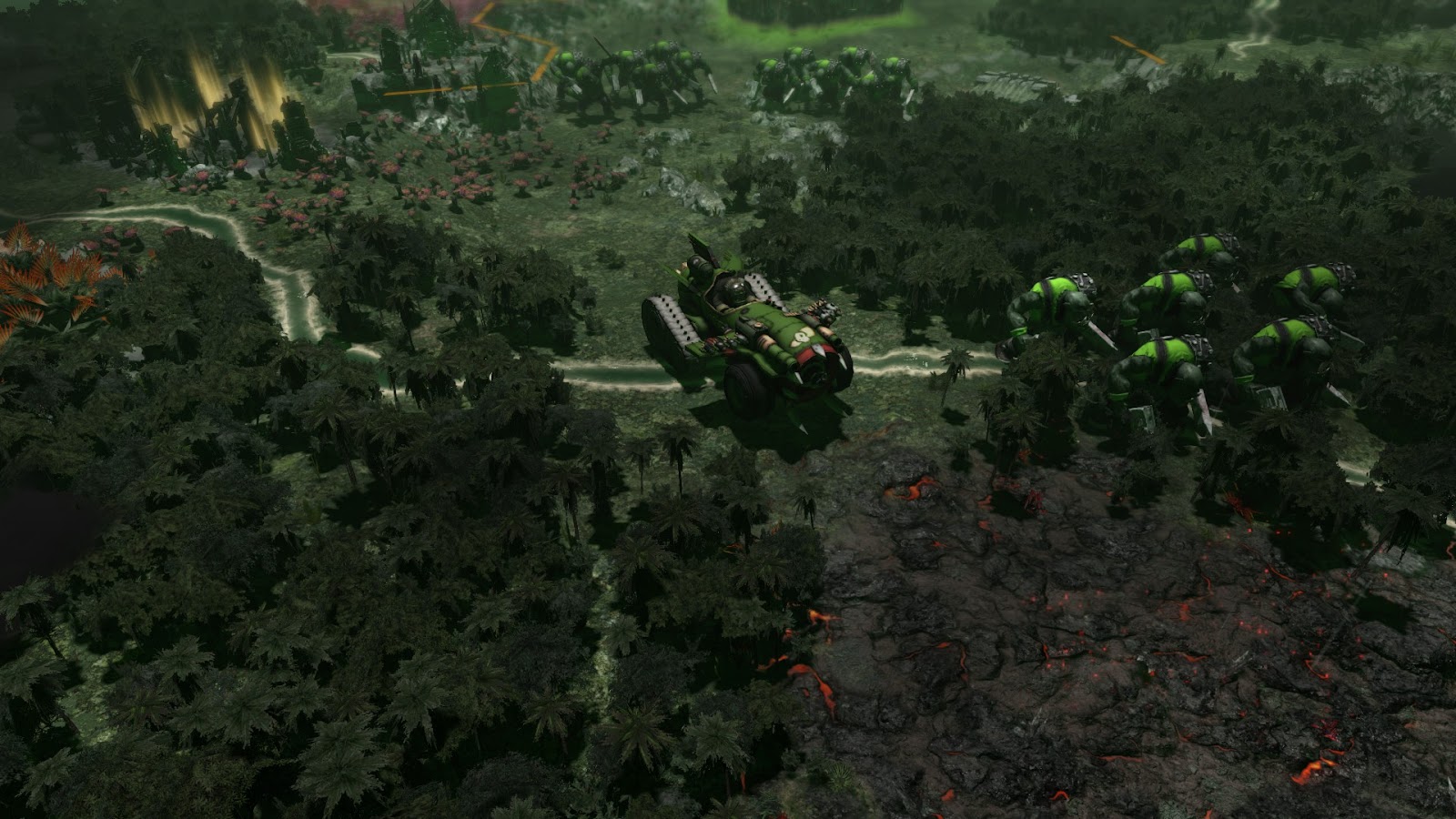
The green lads wot hit stuff, the Orks get the Megatrakk Scrapjet, a wonderfully Orky Tier 2 “vehicle.” Described as “a metal tube covered in things that make enemies die,” it’s basically a hollowed out fuselage covered in guns and give, of all things, a Nose Drill, which is a melee weapon. Don’t count on this guy to make it back home. The good news is they’re cheap, quick to build, and come out of the Kult of Speed, leaving your Pile o’ Dakka open. Lots of fun to use and quite effective as flankers, though it slows to a crawl in rough terrain.
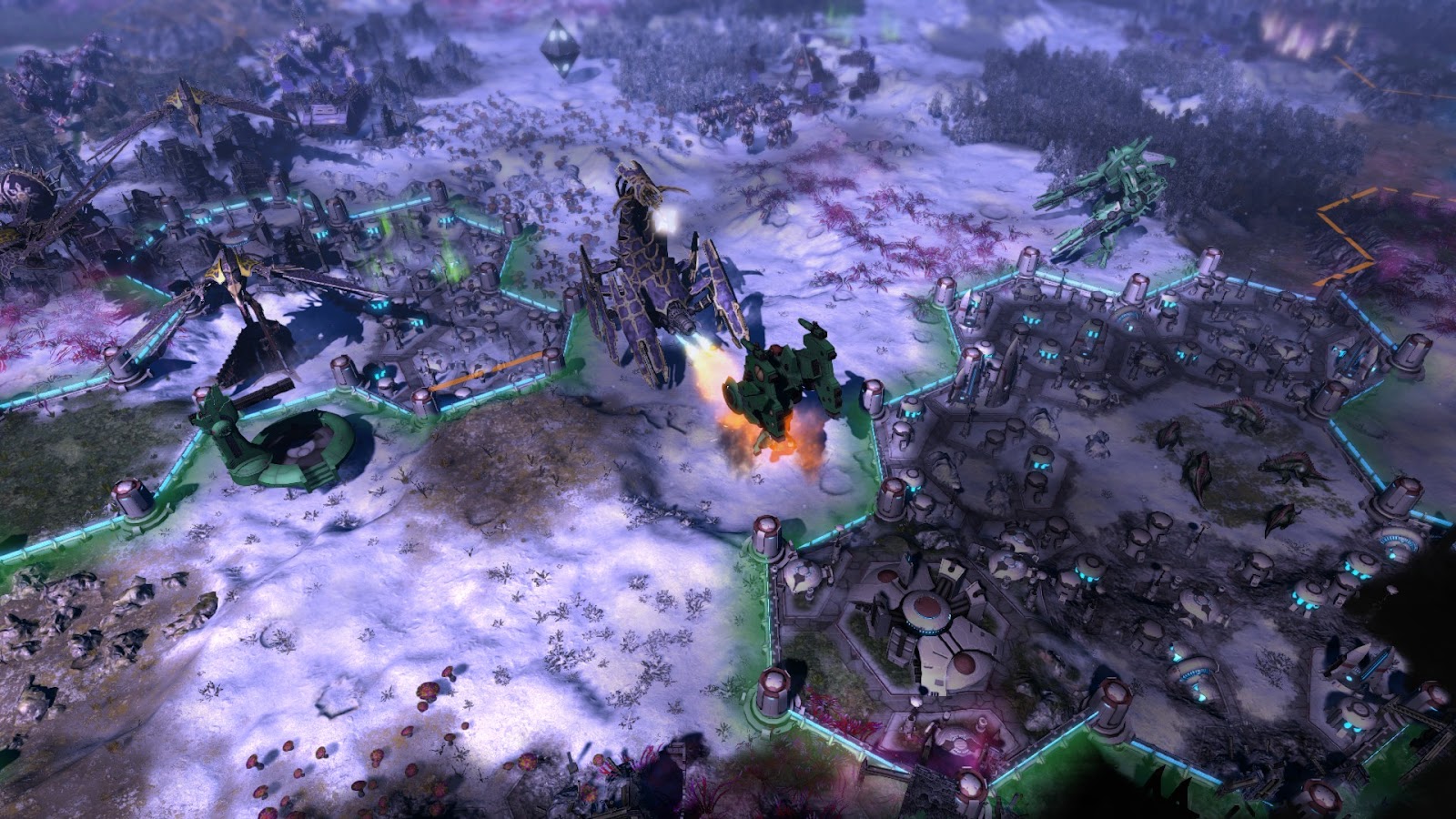
At the bottom of the DLC description this time around is the T’au. Their prize? The Tier 10 Tiger Shark, their only other flying unit past their Tier 7 fighter. The Tiger Shark is a super heavy bomber with a suite of traits that make it excel at killing ground targets. It’s a cool unit, but at Tier 10, don’t expect it to become a staple of your strategy on the default settings.
Phew. And now, the question: Worth it? Absolutely. Sure, there are a couple duds, but the good ones are really good, and the AI can competently use them all (well, it doesn’t use the Ghost Ark, but in my opinion competent use of the Ghost Ark is to never use it at all).
Adepta Sororitas
The Sisters of Battle. The ladies that got thineselves to a nunnery. The Daughters, then Brides, then Daughters (again) of the Emperor. Don’t give me that look, it was just a name change. The Sisters of Battle (the armed division of the Adepta Sororitas) are the military arm of the Ecclesiarchy, whose religious and political core is the Imperial Cult. Is your head starting to hurt? Don’t worry, that’s the lore settling in.
While the Sisters of Battle aren’t exactly the most exciting faction in terms of lore – they’re honestly what I’d consider the first of 40k’s “minor” factions to appear in Gladius – it’s good to see them appear at all in a video game. The last time I personally saw them was in the first Dawn of War, but evidently they’re making a bit of a comeback these days, making an appearance in Battlesector and a couple other 40k games as well.
At first glance the Sisters might seem like diet Space Marines. Like the Space Marines, they use Requisitions, compressing Ore and Food into one resource. Sacred Rites sound a lot like Doctrines. You’ll recognize Tactical Marines in the basic Battle Sisters infantry and Assault Marines in the Zephyrim. Your light tank feels suspiciously like the Predator, the Space Marine’s light tank. And, to paraphrase Freud, sometimes an APC is just an APC.
Early on, there are two key differences: your units are generally weaker than the Space Marine equivalent, but you’re allowed to found new cities. Though these expansions are restricted to a radius of 1, this results in substantially more resources than the Space Marines if done properly, and allows for parallelization of unit production. Given your weaker units, you’ll need this – or supreme terrain advantage – to have an early advantage against them.
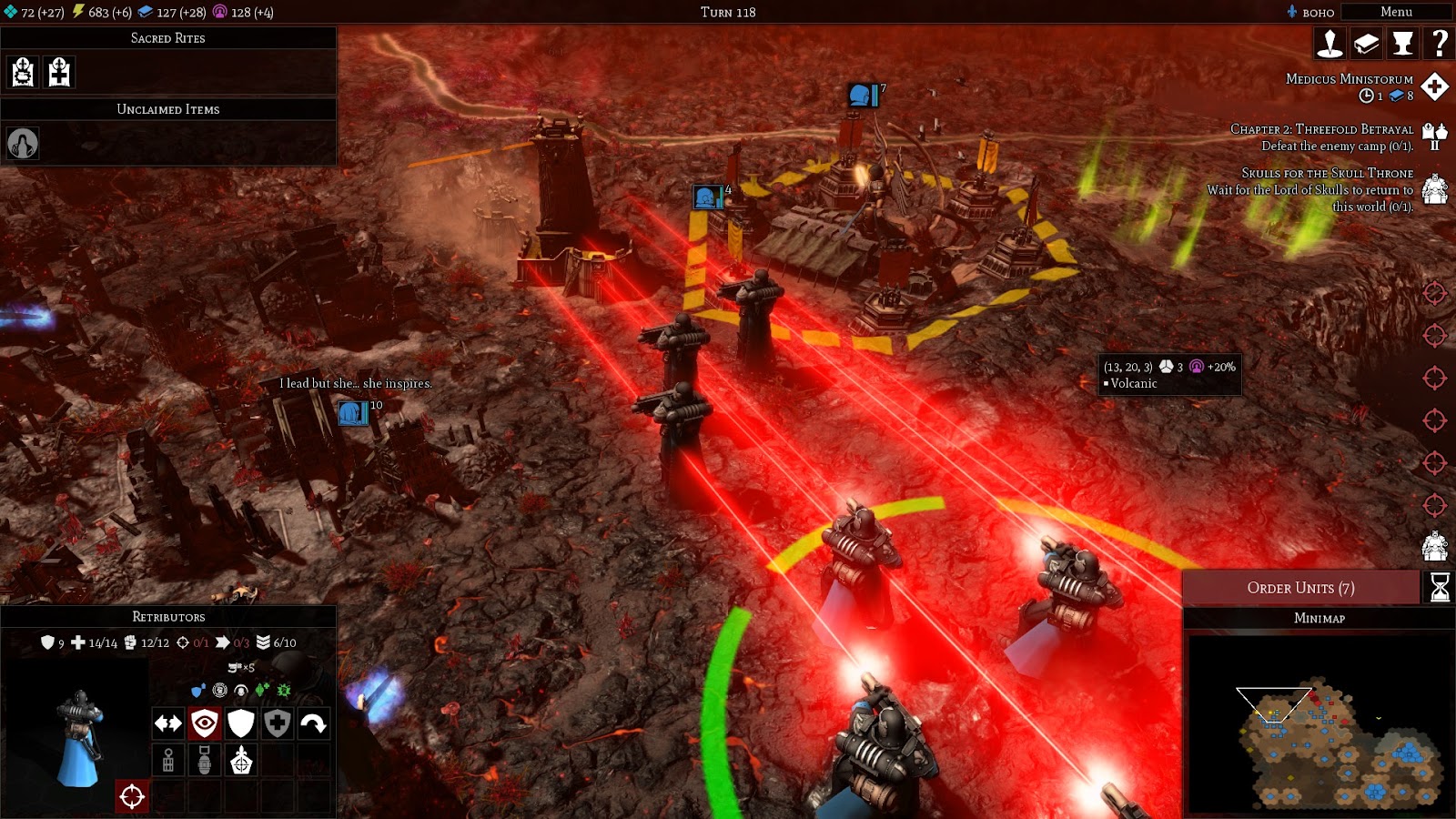
As you move to mid- and end-game, the real differences begin to emerge. While the Space Marines pivot toward armor, the Sisters remain Infantry and Hero-oriented. Aside from not having many vehicular options to begin with, and no source of field repair for vehicles, many of the Sisters’ abilities are Infantry-only. On the other hand, you’ll already be fielding plenty of Hospitallers, which can explore Holy Sites for research points, clear terrain, make cities, heal infantry every turn, and, with research, even radiate damage reduction – but only to infantry.
Like the Tau, the Sisters are inundated with buttons. Specifically, each infantry (and Hero, which are exclusively Infantry for the Sisters) are given a Free Action called an “Act of Faith,” which can only be used when Morale is in the blue (that is, not Shaken or Broken). These start on a 10-turn cooldown, but can be reduced to 5 with research. Unlike the Tau, all these abilities are far less tedious since you’re not instantly doubling your army size via drones. Just don’t forget to use them while caught up in a battle haze of holy fury.
Between their Acts of Faith, Sacred Rites (cheaper army-wide Doctrines that only last a turn), multiple Hero abilities, and various auras, the Sisters are able to perform withering alpha strikes, making them incredibly dangerous against cities and monolithic units. Similarly, they can also pivot to become far tougher than they appear or suddenly become highly mobile, increasing their movement and letting them ignore rough terrain. The catch is they can’t do all of these things at once – and that these Rites almost exclusively apply solely to infantry.
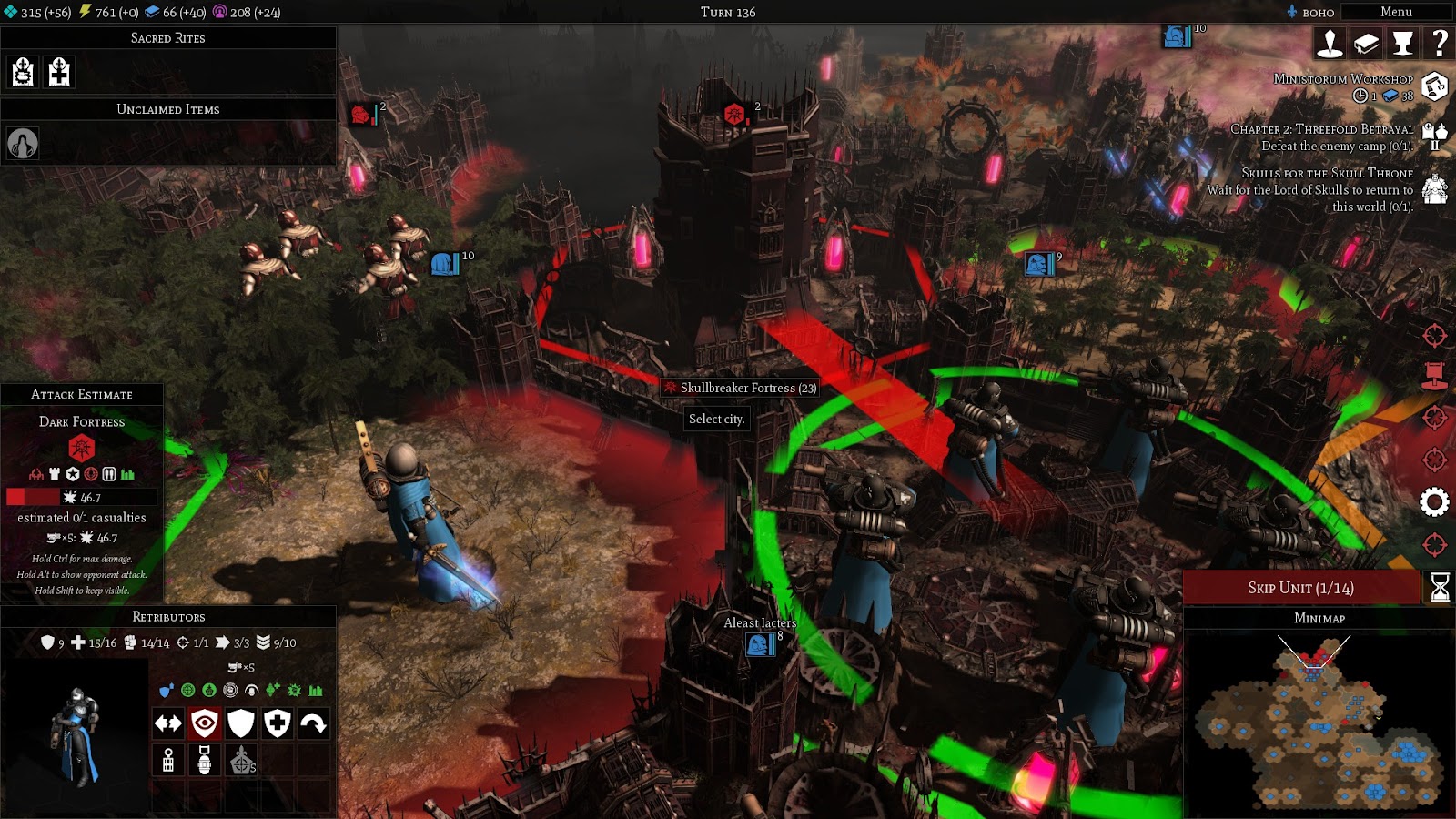
The Sisters of Battle also get a fascinating Hero unit – Saint Celestine. Celestine is special amongst all the Heroes: If she dies, she immediately springs back to life. At full health. This self-resurrection is her Act of Faith, and benefits from the cooldown reduction. She can also restore 30% of her max health as a Free Action, hit hard, and comes with a Jump Pack – which is to say, she’s incredibly hard to kill. And in a nice touch, all the Sisters’ unit barks change to reference Celestine when she’s nearby.

Since the Sisters don’t exactly use Influence hand over fist unless you opt to use Sacred Rites each turn, completely decking Celestine out in top-end gear is quite possible, turning her into a one-woman army. Torin the Chosen would be proud.
While Adepta Sororitas doesn’t start out with its best foot forward, the faction comes into its own in the midgame and by the end can incinerate priority targets like ants under a magnifying glass on a sunny day. Meanwhile, a dubiously sane and more than likely warp-touched “Saint” rampages across the battlefield, calling holy orbital strikes from the sky and slicing heretics up with Space Excalibur.

Do I recommend this one? You bet. This is the kind of weird 40k stuff I love to see. That said, if you vastly prefer playing “what you see is what you get” factions like the Space Marines or Necron, you might find the Sisters’ dynamism requires a bit of an adjustment to enjoy.
Firepower Pack
It should come as no surprise: this one’s about overwhelming firepower, though there’s a bit of an asterisk at the end with the note that the pack will “increase the strategic options available to all commanders.” How’d they do? Time to break it down.
The release order defines the list ordering this time, so the original four are up first, starting with the Imperial Guard. And no, I’m not sure why the constantly changing order fascinates me so much either. Anyway, the Commissar target dummies get the Rogal Dorn Battle Tank, basically an even heavier version of the Leman Russ. The Rogal comes in at Tier 8 – a bit late, but not an unrealistic “end game” research target – and it’s pretty much exactly what you’re looking for if your game has gone on this long: a Leman Russ that got super-sized.
Space Marines get the Whirlwind, a Tier 3 anti-infantry artillery weapon. It’s actually not that great at actually killing infantry – just softening them up – but it comes with a very cool feature: when adjacent to another Whirlwind, both begin to deal more damage, and, best of all, apply Pinning. The early ability to Pin at a respectable range made it one of my personal favorite Space Marine units overall, not just from this pack.
The Necrons are the next in line. They get Deathmarks – a Tier 2 sniper and also one of my overall Necron favorites. Why, when I normally don’t like snipers? Because they can teleport to any currently visible hex, neatly working around so many of the sniper positioning annoyances. The teleport requires 20 Influence and is on a 10 turn cooldown, but crucially, it only consumes movement – not the action. That means Deathmarks can fire or go into overwatch immediately after teleporting! It’s a very fun unit to use, and often quite useful early on.
The last of the original cast are the Orks who unveil the Deff Dread. Not to be confused with the Judge, this guy’s a Tier 5 relatively well-armored walker with a Power Klaw and a Rokkit Launcha. In my opinion, they’re not a particularly good unit: they’re awkwardly positioned at Tier 5, just a single Tier before the Meganobz, which in my opinion are a strictly stronger unit. Since both Deff Dreads and Meganobz are built at the Pile o’ Dakka, I just don’t see the point in even researching this unit, short of a game capped at Tier 5. This makes the Dread Firepower’s first dud.
Tyranids are next. Sort of. Proxy released the Tyrannocyte at the same time as the Firepower Pack, except the Tyrannocyte is free for any Tyranid DLC owner. It’s up to you whether this glass is half full or half empty This thing is a Tier 2 APC with a whopping 6 cargo slots and a rather useful weapon: the Barbed Strangler, a lower damage weapon, but one that comes with Blast and Pin, making it quite useful to have around. In terms of morale the Tyrannocyte is a normal unit, neither Synapse nor Instinctual. And while it’s very clearly floating, it’s not a Skimmer or Aircraft, so it can’t actually cross any water. Judging it seems superfluous given you get it for free, but: I see it mostly as an edge case unit. With six slots it can technically transport any Monstrous Unit, except all the Tyranid’s Monstrous Units already have Move Through Cover so I’m not sure what the point of doing that would be.
Moving on. The Chaos Space Marines get one of the more hilarious units: the Greater Brass Scorpion. Curious what this is? Well, it’s a giant scorpion that appears to be made out of brass. Of course it’s not brass, it’s some space metal armor, and it’s technically an animate altar to Khorne, not an actual scorpion. But it does look like a scorpion. Except for the guns. Since it’s a Tier 10 unit, 99.9% of the time it’s a “win harder” option. But despite its dubious use in practice, I still love this goofy unit.
Who was next? Oh yeah, T’au. The communists get another battlesuit that’s a jumble of letters and numbers that only the most dedicated fan would memorize: the Tier 9 XV107 R’Varna Battlesuit. Basically, it’s a heavier and slower Tier 7 Riptide (XV104). Like every other T’au monstrous unit, its description writes checks that its combat performance can’t cash. It’s by no means a bad unit, but if you’re like me you might be a bit disappointed by the big stompy robot feeling so… milquetoast.
Still four units left. Ok, Aeldari. Dark Reapers join their roster at Tier 3, and are an anti-armor unit that’s not as simple as it seems. With their big range (for Tier 3 Aeldari) my initial impression was of something like an anti-materiel sniper, but that’s not quite the case. Dark Reapers are really good at killing moving targets: they get an accuracy bonus when targeting a bike, jetbike, flyer, or regular old vehicle that moved this turn. An extra interesting twist is that they actually ignore the ranged damage reduction granted by Jink or Skilled Jink. They can also swap missile types, either choosing between a high-damage single shot or a lower damage double shot, but they’re extremely similar given they have the same traits. They’re a good unit if you have a pretty open map, but like any Aeldari, they’re fragile. If there are few opportunities to take advantage of their range, I’d skip them – they just die too easily otherwise.
Mechanicus gets Kataphon Breachers. These are Tier 5 Canticle units that excel in a close-range anti-armor role. The description describes them as living battering rams, and that’s not far from the truth – though they do come with a great ranged attack, you’re missing out on their melee Arc Claw attacks by keeping them at a distance. Of course, maybe that’s for the best – despite having treads they’re not the tankiest units, with only 8 Armor, 16 HP, and just 2 units. Don’t forget the Mechanicus built-in damage reduction certainly helps there though: they aren’t tough enough to go completely nuts with them, they’re tougher than their stats might indicate, especially in cover. They make for great city busters.
Finally, the newest faction at Firepower’s release: the Sisters. Here, we pivot to support: the Tier 2 Imagifiers have three different “Tales” they can tell which buff all adjacent infantry. The options are bonus melee damage, damage reduction, or movement. They play well into the Sisters’ theme of weaving short buffs to customize infantry. So is the Imagifier good? It can be very useful to have two or three of them, but keep in mind ranged units don’t benefit from the damage bonus. There were several times I was thankful to have an Imagifier nearby, and just as many times where I wished the hex was occupied by a normal combat unit instead.
Those are all the player factions, but there’s one unit left: The Neutrals’ Pox Walker. These guys are something like zombies or ghouls: they’re slow, relatively low damage, and melee-only, but come in a huge pack (10 figures), are quite durable, and can be made even more durable thanks to built-in Lifesteal. Essentially, they’re the first “tanky” neutral, seeking to win via attrition, not ambush. A nice change of pace.
Firepower continues the trend of each unit pack being higher quality and better thought out than the last. I stopped short of simply saying “better” than the last because unit packs are a matter of preference – teleporting snipers or extremely large metallic scorpions might simply be of no interest to you. What I can say is it’s an excellent pack, so if you like the sound of at least a chunk of the units, pick it up.
As a final note: while the AI does use all these units, it currently seems to be incapable of using teleportation effects or loading any units into transports, and the AI is really bad at both organizing units for area buffs and actually applying them in a sane fashion, so some units are less effective than they should be.
Drukhari
If you read the Aeldari opening, you might remember that bit about the newborn Chaos God Slaanesh eating the Aeldari civilization, with the Craftworld Aeldari surviving only by virtue of being out for smokes at the time. And while all that’s true in the broadest of strokes, it’s not the whole story. I left out the part where the Aeldari were actually responsible for Slaanesh’s birth.
After thousands of years of universal domination, the Aeldari civilization began to become more and more decadent. This being Warhammer 40k, the decadence was taken to an extreme of extreme, like entire races being slaughtered just to be rendered down into aphrodisiacs for decade-long orgies. From the psychic energy of a corrupted, decadent universal empire, Slaanesh was born in the Warp and immediately devoured the Aeldari.
The richest and most powerful Aeldari – and the most decadent – were spared from this fate. They’d long ago retreated to remote endpoints on the Webway to be away from the common Aeldari rabble and were thus out of Slaanesh’s initial reach, though they were fully aware “She Who Thirsts” was hunting them, as She still hunts all Aeldari.
But these remnants – what would become the Drukhari – discovered something: Slaanesh wanted suffering and wasn’t particularly picky about where that suffering came from. So, to keep She Who Thirsts from finishing the job and eating their souls, they fed her what she wanted: suffering. Ideally, others’ suffering, but their own suffering worked too. And in doing so, the Drukhari themselves began to be sustained on suffering too.
At least, that’s the lore reason behind why the Forgotten Realms’ Drow got shot into space.
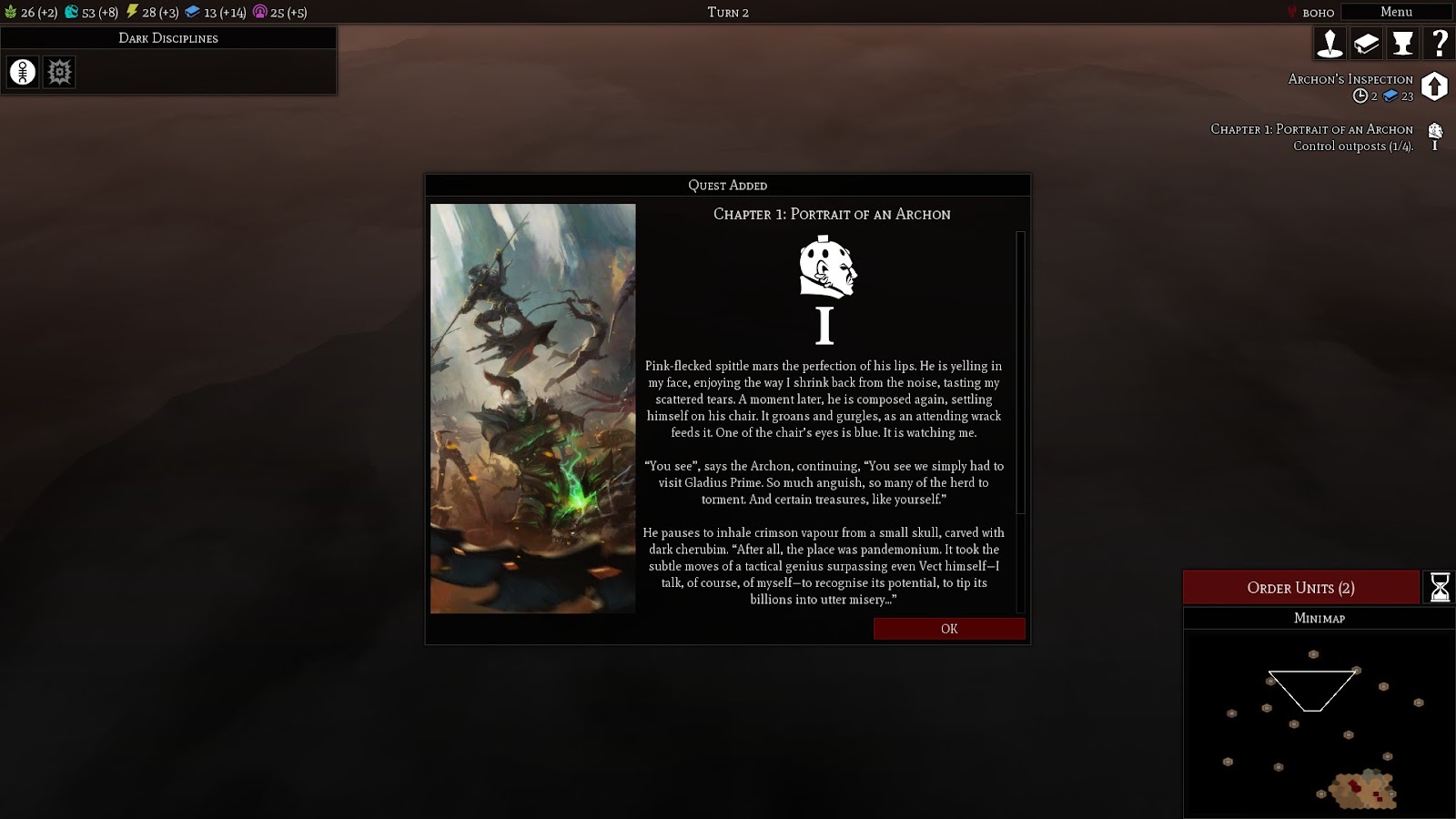
And Drow they are. Not just Dark Elves, but Drow – from spider iconography to a raider culture of backstabbing, betrayal, scantily clad androgyny, major S&M overtones, and being hilariously arch. Seriously, the Drukhari writing is absolutely spot on. The graphical work is great – though I find the Drukhari style to be a little samey in both Warhammers, there’s no arguing it’s spot-on accurate in Gladius. My only look & feel complaint would be the Drukhari’s complete lack of unit barks. It’s still a relatively recent release as of this writing, so perhaps this was a bug.
How they play is very interesting. Being infantry, raiding, and suffering-focused, the Drukhari don’t really care to actually destroy objects so much as they care to torture and kill. In Gladius this means the vast majority of their ranged infantry do very low base damage, but come with high values of the “Poison” trait, which adds quite a bit of damage to organic targets. If you want to take out buildings or armor, you’ll need to bring one of the few anti-armor tools, or get up close and personal with the much more abundant melee. The Drukhari prefer a front-row seat for any collateral murders, after all.
Much like the Aeldari, there isn’t too much room for mistakes in early exploration or research. Unlike the Aeldari, you’ll likely have an easier time thanks to starting infantry (the Kabalite Warrior) with a range of 2. While the Warriors have much less danger potential than Aeldari Guardians and are still elfy and fragile, that one extra range dramatically increases survivability in the open against the mostly range 1 Neutrals.
Kabalite Warriors also come with rapid fire, doubling attacks at range 1 – so there’s still a big advantage to ambushing or outmaneuvering. The downside is, unlike Guardians, you can’t get anti-infantry grenades with the Warriors, limiting their effective options while fighting targets in cover. And unlike the Aeldari, there is no Battle Focus – no moving after attack.
While they inherit some the Aeldari’s problems – Drukhari use Webway Gates as city foundations too – they do have an answer to the gates being easily destroyed: temporary gates! You can’t turn these into cities, but you can put them anywhere you currently have vision on. They last three turns with a four-turn cooldown and are as durable as a normal gate (so, not at all). Making a gate requires influence and teleporting still requires influence, but the Drukari have plenty of transport options, allowing you to pay only once to deliver multiple units somewhere.

Thanks to temporary gates, the potential for surprise attacks or quick escapes isn’t negated just because your opponent explored thoroughly. This means gate destruction in terms of founding cities isn’t as big of a deal – the most obvious way to play Drukhari is probably to function as a pirate cove, ships full of infantry designed to carry out devastating hit-and-run attacks just sitting in your base until you have enough influence to cover all the portals and teleportation costs needed. Alternately, let those transports sail across the map normally, raid, and open a gate only if you need to escape.
Yes, Influence income is extremely important for the Drukhari, much like the Aeldari. Fortunately, whenever you kill a unit, you get some influence based on their experience value, and if you use the Archon hero, you can magnify this reward further. While the Influence is a nice perk, it’s probably not enough for most players to preclude building any Influence structures. I did just fine with only one, but a lot depends on your outpost control, of course. Your mileage may vary.
However, it’s extremely important to earn this murder Influence for a different reason: all your cities have a Loyalty penalty until you’ve done enough killing to earn 200 Influence from this mechanic. You don’t have to keep 200 banked, you just have to have earned enough across the entire game. In fact, if you get more than 200, you actually start to get a bonus to Loyalty, expressed by all sources of Loyalty suddenly becoming more efficient.
To drive home the “Influence is really important” bit, I’ll mention another unique Drukhari mechanic: Combat Drugs. This is a 10-turn buff you can activate on certain units that give them bonuses. Via research, these bonuses can become extremely good, multiplying number of attacks, total melee damage dealt, invulnerable damage reduction, granting move through cover, and more – making even Tier 1 units something to take seriously.
The downside? It costs 20 Influence to use. Per unit. Every ten turns. Rushing to improve the drugs and get the invulnerable damage reduction for more durable exploration seems like a good idea, but can easily bankrupt your Influence. While only a few units can use the Combat Drugs by default, there is a Tier 10 research that lets any infantry use them. Not something to plan for, but certainly something that could end a stalemate.
What’s great about the Combat Drugs mechanic is it actually expresses the narrative element of the Drukhari being sadists addicted to suffering into a gameplay loop: Combat Drugs make a unit Hulk out, but you have only 10 turns to cause enough death to earn that Influence back. You, as a player, end up addicted to the Combat Drugs – at first, the rush of power, then normalizing them and taking them for granted, then planning around them, then desperately trying to meet your sadism quota to get your next fix since you’re out of Influence and everybody’s suddenly wimpy and dying.

There are also army-wide “Dark Disciplines” you can use for an Influence cost, but I feel inclined to mention them only for completion’s sake: like pretty much every other faction, these are Space Marine doctrines by another name and slightly different rules. They’re good, and you should use them, but it’s nothing new.
The Drukhari are strong, but they do have two major weaknesses. First, they’re a midgame faction. The longer the game goes on, the weaker they get – their higher-end units just aren’t very good. In the Tier 10 research, I mentioned that giving grants to everybody can solve that problem, but getting there will be tough.
Their best anti-armor weapon is preventing your opponent from getting to high-end armor, either via an outright rush to kill or via frequent raiding that keeps opponents’ cities damaged. Remember, a damaged city loses efficiency in everything it does proportional to the amount of damage it’s taken. Damage that you’re able to sustain for a while can easily create a deficit and cause a domino effect in other cities. The only downside is there’s no obvious sign when you’ve successfully managed to push a player into bankruptcy.
The problem with being a faction that peaks in the midgame is that human players know what to anticipate. Drukhari are the raider faction. They’re going to raid. You have to do what your opponent knows you’re going to do in a way that can overcome the fact they know it’s coming.
The second point, somewhat owing to the first, is that in terms of research, the Drukhari need to pick a lane and stick with it for a while. Want to do Combat Drugs? Great – build some early Influence, research Wyches, the Succubus, Hellions, and the drug research itself, of course. Want to portal drop? You’ll want Haywire grenades, Raiders (the vehicle), and all the temporary buffs granted when disembarking. A traditional battleline? Wracks, Scourges, the Haemonculus, Cronos, and Trueborn.

The point here is that, unlike other factions, diversifying on the same tier doesn’t give you options so much as it gives you multiple starting points. While some factions have good units basically right out of the box, Drukari units need research to thrive. Wyches are basically a complete waste of resources without adding additional effects to Combat Drugs, or at the very least, giving them Plasma Grenades.
As a final note, it’s worth mentioning the AI basically can’t use any Drukhari-ish strategies. The faction perfectly highlights all the AI’s weakest points: bad buff usage, inability to use transports, teleports, etc. While at first, it’s startling to see a Raider pop out of the fog of war across the bay, when you see it’s totally empty – when you see AI-controlled transports are always totally empty – it does make you shake your head. And there’s no need to anticipate any temporary gates appearing just out of line of sight of your capital.
Overall, the Drukhari are a new way to play Gladius and manage to fix most of what’s wrong with the Aeldari while still managing to have a similar identity. They absolutely have a learning curve, and absolutely are fragile by default, but there’s agency here where there wasn’t before. I certainly recommend them, even with the weak AI.